


INTRODUCTION
Sexual victimization causes physical and psychological trauma, and a person’s fear of crime often leads them to preventively adapt their daily behavior. Both have serious consequences for victims. Knowledge about sexual victimization has increased, numerous studies have been conducted and the prevalence of sexual victimization among students in university settings has also been noted widely. At the same time, the increase in incidents of gender-based violence on campus shows that neither university zero-tolerance policies nor (legal) regulations and procedures designed to combat such violence succeed in preventing or at least minimizing its occurrence in university settings. Therefore, in addition to the general existence of sexual violence against women in personal, professional and social contexts, the question that must be addressed is whether there are factors embedded in the university setting itself as an institution that influence or even promote the persistent occurrence of gender-based violence against students.
CHALLENGES IN RESEARCH ON GENDER-BASED VIOLENCE IN HIGHER EDUCATION
Although university professionals, police and support services see female students as a high-risk group for sexual violence, there is still a lack of research on the situation of students in Europe. In addition to the challenges of this defining period in a young person’s life, in which models of behavior within partnerships (whether strong or not) are tested and casual dating is common, the consumption of alcohol in association with a strong party culture also gives cause for concern when it comes to students’ vulnerability and lack of safety. What we do know is that certain aspects of gender-based violence against students are common: reporting levels are very low, the student’s year of study is relevant (higher victimization rate in the first or second year), perpetrators are most likely to be (fellow male) students, and women often are unsure whether what happened was a crime or was serious enough to report. Alcohol is already widely acknowledged as a major factor: the relationship between alcohol and sexual assault is well established in research.
METHODOLOGICAL ISSUES
National and international surveys on violence against female students have increased the visibility of gender-based violence in higher education and put the spotlight on university settings and policy. Despite this, appropriate comparable data across Europe were not readily available prior to this study. Using a standardized approach in order to align the definitions, legislation and procedures relating to gender-based violence in five countries, the “Gender-Based Violence, Stalking and Fear of Crime” project funded by the European Commission between 2009 and 2012 surveyed the occurrence of gender-based violence against female students in Great Britain, Germany, Italy, Poland and Spain. The anonymous online questionnaire was chosen as a tried-and-tested method in sexual violence research in order to ensure the anonymity of victims of gender-based violence (see Schwartz and Leggett Reference Schwartz and Leggett1999:261) and to uphold their data protection rights. Research on survey tools in this specific field shows that, compared with personal interviews, the online format markedly increases the willingness of victims to disclose experiences of violence (Nicholson, White, and Duncan Reference Nicholson, White and Duncan1998:112 ff.). The two main reasons for non-disclosure – feelings of shame and the fear that friends and acquaintances might find out what has happened – can be significantly mitigated by the use of an online survey tool. A further argument for using an online survey lay in the necessity to obtain a sufficient number of cases in order to be able to draw significant conclusions for all the different forms of sexual violence. Complementary, voluntary interviews with student focus groups and with experts from universities, support services and the police meant that a significant amount of quantitative and qualitative data could be gathered in order to comparatively analyze the responses of more than 21,000 female students, also in regard to cultural specifics. Using research instruments for collecting data on gender-based violence, developed as part of the European Union (EU)-funded project “Coordination Action on Human Rights Violations (CAHRV)”, female students were asked about their fear of crime and experiences of sexual violence in relation to the university context. The term “sexual violence” was defined according to the United Nations Declaration 48/104 from 1993 as “any act of gender-based violence that results in, or is likely to result in, physical, sexual or psychological harm or suffering to women, including threats of such acts, coercion or arbitrary deprivation of liberty, whether occurring in public or in private life” (United Nations Assembly 1993). All forms of gender-based violence – sexual harassment, stalking and sexualized violence in the legal sense – were explained by description, such as “Someone groped me or tried to kiss me against my will” as an example of sexual harassment, or “Someone forced me to engage in sexual intercourse and used their penis or something else to penetrate my body against my will” as an example of forced sexual acts.
The project survey included not only incidents on campus and certain study contexts (for example, a course or tutorial) but all other contexts in the students’ life during their time at university. A carefully designed series of filter questions ensured that the respondent was guided to only those questions relevant to her. Three facets of gender-based violence – sexual harassment, stalking and sexual violence (as defined in law) – were investigated by means of item lists that included carefully worded questions and the option of giving multiple responses. Questions were also asked about the frequency of the women’s experiences and their sense of threat. The sex (male or female) and profile (stranger, various forms of known persons from inside and outside the university) of the person who carried out the assault were ascertained, as were the place and time it occurred and the consequences that ensued. Finally, the student was asked whether she had disclosed her experience to anyone and, if so, to whom; if not, she was asked why she decided against doing so. At the end of the questionnaire the respondent was given an opportunity to give feedback and was given information about points of contact and support in case her participation in the survey had elicited emotionally laden recollections. The questionnaires were translated into the five languages of the participating countries. In all, 34 universities in five countries confirmed their willingness in advance to allow the survey to be drawn to their female students’ attention. The latter were contacted both by post and email to inform them about the survey and to request their participation.
FEAR OF CRIME – EXISTING BUT OFTEN NOT DETECTED
Existing research confirms the finding that women have a higher level of fear of crime than men (“Thesis of vulnerability”; see also Pantazis Reference Pantazis2000:415 ff.; Greve Reference Greve2004:167 ff.). Fear of crime is generally activated either by a person’s own experience of victimization or by other people’s accounts of an assault they experienced (see Schwind et al. Reference Schwind, Fetchenhauer, Ahlborn and Weiß2001:234 ff. and 269 ff.; Boers Reference Boers2002:1408 f.; Dölling and Hermann Reference Dölling and Hermann2003:237 ff.; Hermann and Simsa Reference Hermann and Simsa2003:222 ff.; Holst Reference Holst2003:48 ff.); in most cases, the way a person copes with their experience is the key factor in the level of their fear of crime. This becomes clearer when we consider the example of a series of rapes that took place between 1994 and 2002 in the general environment of the Ruhr-University in Bochum, Germany and affected 12 student victims. Although the incidents happened at least 15 years ago, they have been “injected” into the students’ collective memory, affecting even younger students on campus.
One key problem – confirmed by research – is the reluctance of students to talk to university authorities about the sexual violence they experience in university settings. A fundamental reason for this has to do with the informal and therefore “vague” culture that often exists within university departments. Behavior by lecturers and professors that is perceived as macho, sexist or harassing is difficult to define and to combat. A student’s entire future career seems to depend on a positive recommendation by a formal academic superior. Against this background, students are afraid that, if they are assaulted by a member of staff in a higher position, in cases of doubt this person’s word is more likely to be believed than their own. This fear based on hierarchical dependency is prevalent within the student community. Higher education systems with rigid hierarchical structures (such as the German university system with its rather traditional professorial system) are more prone to generate both such fears and actual violations.
SEXUAL HARASSMENT – COMMON BUT MARGINALIZED
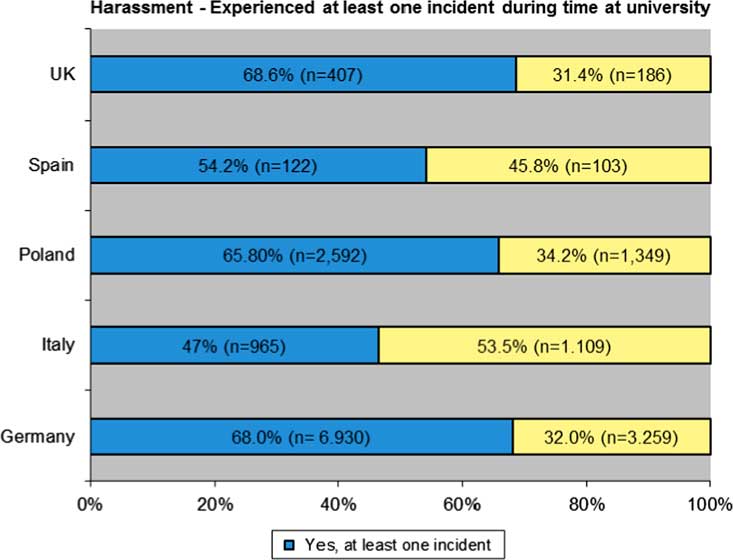
As is to be expected, sexual harassment is the kind of assault experienced most on average by female students in the five European sample countries (Figure 1): 51% of the respondents reported experiencing harassment at some point in their life and 60.7% reported at least one incident during their time at university. In fact, there are differences between the countries regarding the numbers of harassment incidents reported: while students in the United Kingdom (UK), Poland and Germany reported the most incidents of harassment, students in Italy and Spain seem to experience (about 10%) less sexual harassment. The question arises whether there is really less harassment in the latter two countries or whether the students in these countries interpret incidents such as being whistled at, having “dirty” comments or comments about their body shouted at them (the latter being the incidents most frequently reported) differently, i.e. that they perceive such incidents in a less negative way.
Harassment – experienced at least one incident during time at university (from Feltes et al. Reference Feltes, List, Schneider, Höfker, Balloni, Bisi, Sette, Czapska, Klosa, Lesińska, Bodelon, Igareda, Casas, Stenning, Mitra-Kahn and Gunby2012:59). For a color figure, see the online version of the paper

It was not possible to establish with any certainty a correlation between the variations in perception of incidents of harassment perceived as threatening and specific cultural settings. Nonetheless, certain aspects can be understood as a reflection of certain habits or unwritten rules of a society regarding gender relations and contact between the sexes. More in-depth research is needed in psychology and cultural studies for a comparative analysis of (gender-based) perceptions of sexualized violence. It may be, for example, that incidents involving harassment that are perceived as threatening by some women might be seen by other women as a compliment about their physical appearance: whereas in Germany and the UK such harassing behavior is generally viewed at best as a backhanded compliment, it may be viewed quite differently in countries such as Italy or Spain. However, looking at the overall data it is not possible to state unambiguously why the differences between the European countries exist. There were marked variations in the responses from Italy and Spain, two southern European countries, as well as clear similarities between countries such as Italy and Poland, which are very different in many respects. Some responses seem to be very similar with regard to the women’s perception of certain types of sexual violence but then differ considerably concerning one specific aspect. Research has begun to focus more on the correlations between attitudes towards gender-based violence and socio-economically defined groups in society (see Gracia and Lila Reference Gracia and Lila2015:53 ff.). By viewing university students as a homogeneous sample, research thus far has neglected the influence of the diversity and complexity of individual and social backgrounds such as age, sexual orientation, socio-economic status and educational background of the family of origin, ethnic or religious background, minority or immigrant status and also previous experiences of (sexual) violence. Although the intention of the present project was to explore women’s exposure to gender-based violence in relation to, for example, ethnic heterogeneity, the relatively small numbers of participants from minority populations posed an obstacle to conducting a valid analysis. A conclusion of this study is that diverse ethnic groups require different forms of informational access to match their specific understandings and ways of dealing with incidents of sexual violence; researchers therefore must find appropriate ways of providing such access.
SEXUAL VIOLENCE – “TOO DIFFICULT TO TALK ABOUT”
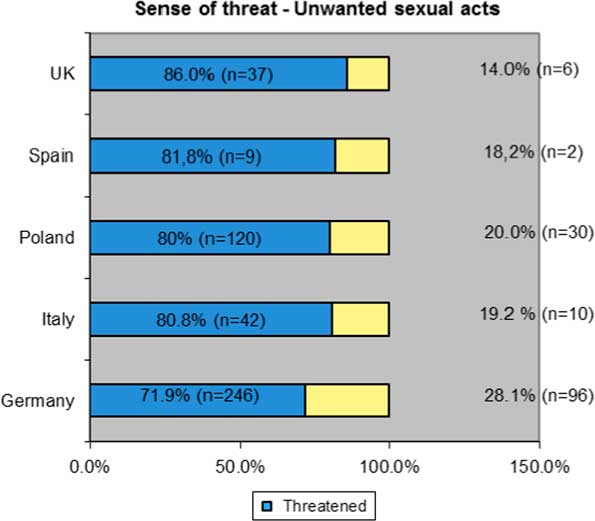
Of those who responded to the question about the number of times they had experienced an incident of sexual violence, 65.4% of the entire sample said they had experienced at least one incident of sexual violence during their lifetime (with nearly one in ten [8.7%] reporting criminal sexual assault), while 35.5% reported the same for their time at university. Figure 2 shows the prevalence of sexual violence linked with a sense of threat that was experienced during the respondents’ time at university.
Sense of threat – unwanted sexual acts (from Feltes et al. Reference Feltes, List, Schneider, Höfker, Balloni, Bisi, Sette, Czapska, Klosa, Lesińska, Bodelon, Igareda, Casas, Stenning, Mitra-Kahn and Gunby2012:74–8). For a color figure, see the online version of the paper

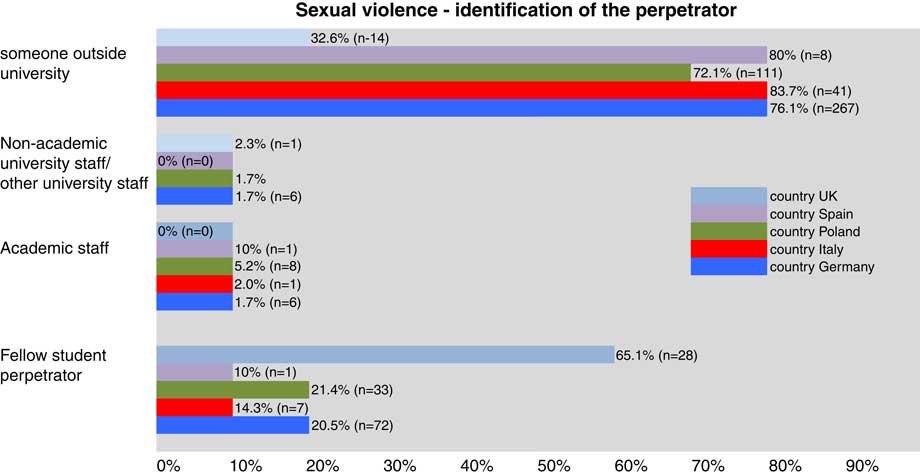
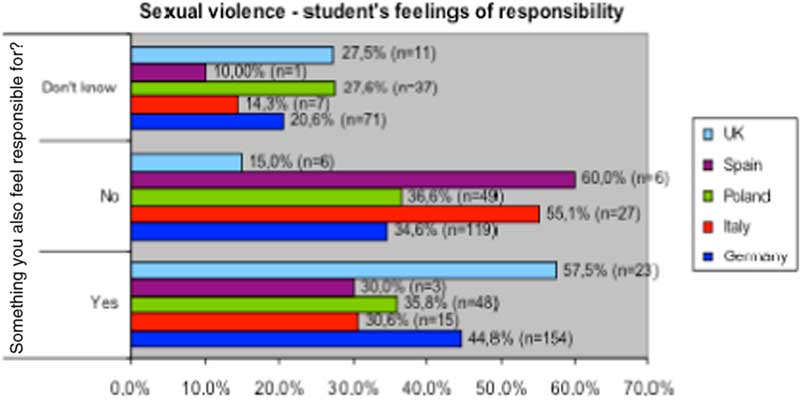
As research verifies that women are often reluctant to report unwanted sexual experiences, even when anonymity is provided, this prevalence data must be handled with caution. Another point to bear in mind is that the majority of perpetrators of sexual violence are close acquaintances or even partners of the victims (Figure 3). This might contribute to the tendency of the victim (and the perpetrator) not to interpret the experience as sexual assault but rather to explain it as being a result of a misunderstanding or being drunk. A further factor is whether the victim feels partly responsible for the violence experienced. This depends in part on the perception of rape in the context of so-called rape myths. Here, a “real rape” is considered to involve an unknown perpetrator forcibly attacking the victim in a public place in the dark. In fact, only a minority of rapes occurs under these circumstances. Despite this, the widely shared myth means that people who are raped in a private setting by a perpetrator who is either casually or intimately known to them (which is predominantly the case) contributes to their uncertainty about the significance of the experience and thus prompts a reluctance to disclose it.
Sexual violence – identification of the perpetrator (from Feltes et al. Reference Feltes, List, Schneider, Höfker, Balloni, Bisi, Sette, Czapska, Klosa, Lesińska, Bodelon, Igareda, Casas, Stenning, Mitra-Kahn and Gunby2012:92). For a color figure, see the online version of the paper

Perpetrators of sexual violence against female students are predominantly male, constituting 96.6% on average for the European countries surveyed. A minority of perpetrators is from the campus itself, the majority of these being fellow students and staff (see Feltes et al. Reference Feltes, List, Schneider, Höfker, Balloni, Bisi, Sette, Czapska, Klosa, Lesińska, Bodelon, Igareda, Casas, Stenning, Mitra-Kahn and Gunby2012:87 ff.). In nearly all the countries surveyed, the perpetrator of sexual violence was mainly from outside the university; whereas this was the case in “only” 32.6% of the British responses, however, it was named by 83.7% of the Italian and 80% of the Spanish respondents (see Feltes et al. Reference Feltes, List, Schneider, Höfker, Balloni, Bisi, Sette, Czapska, Klosa, Lesińska, Bodelon, Igareda, Casas, Stenning, Mitra-Kahn and Gunby2012:92).
Gender-based violence seems to be perpetrated on university premises and in the context of university-related activities with variations across countries as to specific patterns of assault (Feltes et al. Reference Feltes, List, Schneider, Höfker, Balloni, Bisi, Sette, Czapska, Klosa, Lesińska, Bodelon, Igareda, Casas, Stenning, Mitra-Kahn and Gunby2012:238 ff.; List Reference List2014:176 ff.). Nevertheless, these results should be questioned against the background of existing research in the individual countries: whereas in the UK, research on gender-based violence has been linked particularly to “lad culture” (see Phipps and Young Reference Phipps and Young2013:460 ff.), German, Spanish and Polish results have stressed power differences between female students and male professors in particular (see Feltes et al. Reference Feltes, List, Schneider, Höfker, Balloni, Bisi, Sette, Czapska, Klosa, Lesińska, Bodelon, Igareda, Casas, Stenning, Mitra-Kahn and Gunby2012; Klein Reference Klein2016:15). Country-specific settings such as age at entry into university and study requirements seem to be important aspects for explaining differences in the prevalence and (non-)disclosure of gender-based violence. This becomes clearer when looking at the huge difference in the data concerning the perpetrator of sexualized violence: the UK is the only one among countries studied with mainly well-defined campus settings and displays a low quota of perpetrators from “outside the university” in contrast to the other European countries (see above) but a very high quota for perpetrators from inside the university (66.7% of respondents for sexual harassment and 65% for sexual violence). Furthermore, UK respondents who had been victims of sexual violence on campus stated surprisingly that most of their assailants were fellow students – and that none was academic staff. As these results are based on an anonymous online questionnaire, there is no easy explanation for the absence of responses referring to academic staff as perpetrators. One possible explanation may be found in the responses of victims assaulted by people known to them or superior to them in the academic hierarchy. In many cases, they gave excuses (including misunderstandings and their own – “wrong” – behavior) as a way of living with their experience and dealing with ongoing contact with the assailant. The fact that incidents of sexual assault are placed under a taboo by universities and research communities may contribute to victims choosing this strategy to deal with their experiences.
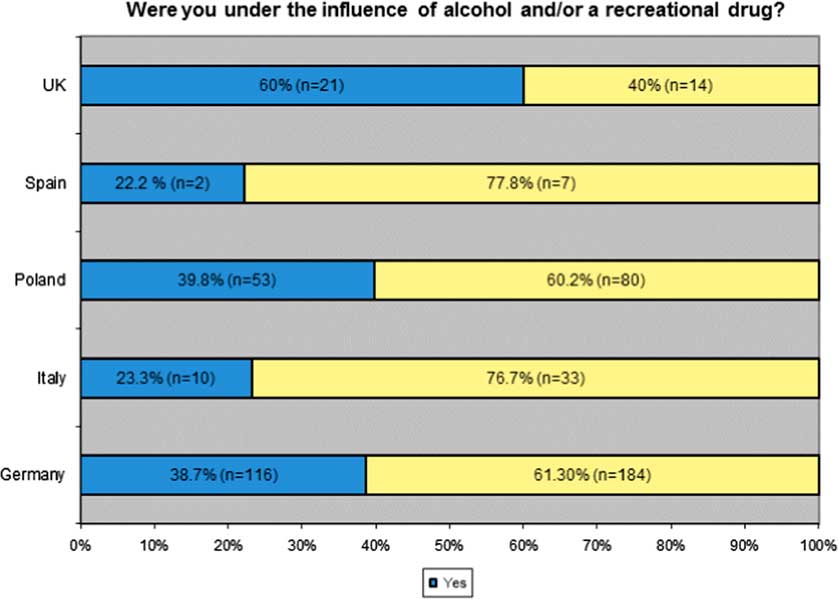
Another factor relates to the poorly defined student “lifestyle”, which seems also to be rooted in national cultural frameworks. For example, the relevance of alcohol consumption in the study context is difficult to ascertain on the basis of the data. Whereas in Britain 24% of respondents indicated a substantial use of alcohol when they went for a drink, the figures for Spain and Germany were 5% and from Italy just 2% of the sample (see Feltes et al. Reference Feltes, List, Schneider, Höfker, Balloni, Bisi, Sette, Czapska, Klosa, Lesińska, Bodelon, Igareda, Casas, Stenning, Mitra-Kahn and Gunby2012:151). Correspondingly, 40.5% of the British, 24.2% of the German and 9.8% of the Italian respondents answered “yes” to the question about whether they were under the influence of alcohol when they experienced sexual violence (Figure 4). The question that arises here is whether certain culturally specific “perspectives” which are felt to be more “communicable” (such as alcohol consumption) were emphasized by both researchers and student respondents whereas “unthinkable” forms of assault (such as harassment by a member of university staff) may have slipped beneath the radar.
Were you under the influence of alcohol and/or a recreational drug? (from Feltes et al. Reference Feltes, List, Schneider, Höfker, Balloni, Bisi, Sette, Czapska, Klosa, Lesińska, Bodelon, Igareda, Casas, Stenning, Mitra-Kahn and Gunby2012:95). For a color figure, see the online version of the paper

STALKING – A CRIME OF “PASSION”
Stalking is also a prevalent experience among students, the data showing a nearly similar prevalence in all the countries surveyed (see Feltes et al. Reference Feltes, List, Schneider, Höfker, Balloni, Bisi, Sette, Czapska, Klosa, Lesińska, Bodelon, Igareda, Casas, Stenning, Mitra-Kahn and Gunby2012:66). Stalking behaviors experienced at university made up between 58.2% of respondents in the British sample and 41.8% in the Italian sample and were linked with an extremely heightened sense of threat. Young female students in particular reported being stalked by ex-partners in connection with the use of new technologies (see Schneider, List, and Höfker Reference Schneider, List and Höfker2012:101 ff.). The impact of new technologies as instruments of stalking among this age group should be investigated in more detail. International studies reveal that so-called “digital natives” are subject to an increased risk of continued harassment and that the alleged virtual assaults should not be underestimated (see Festl and Quandt Reference Festl and Quandt2013:102). The fact that online or digital harassment at times cannot be proven (due to anonymity) without difficulty and that such harassment also affects the victim’s relationships with others in their social networks intensifies the distress of the student concerned while also reducing their willingness to disclose such incidents (see Nixon Reference Nixon2014:145).
With the majority of perpetrators coming from outside the university, it was the respondents’ ex-partner who was mentioned most frequently: 36% of all the female students surveyed in the participating countries identified their ex-partner as a perpetrator, the highest percentage (43.4%) being found in the British sample (see Feltes et al. Reference Feltes, List, Schneider, Höfker, Balloni, Bisi, Sette, Czapska, Klosa, Lesińska, Bodelon, Igareda, Casas, Stenning, Mitra-Kahn and Gunby2012:91). The threat or actual use of physical violence was a major component of stalking by an ex-partner. This indicates that stalking is often a continuation of violence within a relationship. This kind of harassment being viewed as a “private” matter and an emotionally loaded incident again contributes to non-reporting, especially not to university authorities. In general, given that most forms of sexual violence are perceived as being related to “personal” or even intimate experiences with a known perpetrator, occur in a familiar setting and/or involve “ambiguous” behavior on the part of the victims, the perpetrator or both, the students concerned were quite ambivalent regarding the university’s responsibility to respond to such assaults.
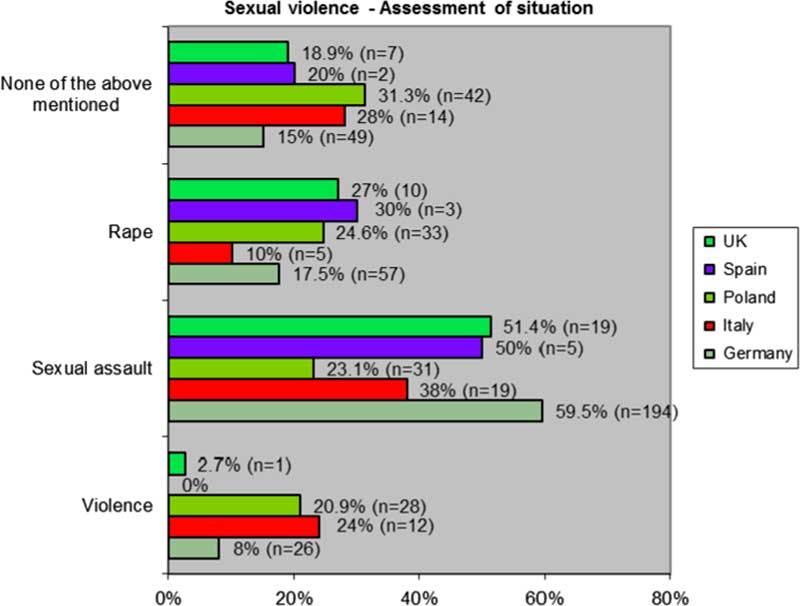
Considering, however, that fellow students can be (intimate) friends, the female student’s own room may be located in a dormitory and the term party often takes place in university accommodation, it seems clear that universities do share responsibility. To be sure, the issue of uncertainty (see Figure 5 for how the victims assessed the situation) and the reluctance of the students themselves to talk about their experiences make it difficult for institutions of higher education to find out more about the occurrence of sexual violence in university settings. This in turn makes it all too easy for universities to define their policy agenda on gender-based violence independently and without reference to actual incidents.
Sexual violence – assessment of the situation (from Feltes et al. Reference Feltes, List, Schneider, Höfker, Balloni, Bisi, Sette, Czapska, Klosa, Lesińska, Bodelon, Igareda, Casas, Stenning, Mitra-Kahn and Gunby2012:100). For a color figure, see the online version of the paper

PERCEPTIONS OF GENDER-BASED VIOLENCE AND CORRESPONDING CHALLENGES
Knowledge about the dynamics of gender-based violence in society in general and university settings in particular remains fragmentary. One dominant reason for this probably lies in the fact that it is widely regarded as a personal issue – one which often elicits shame and fear among those directly affected and disbelief or silence to protect the reputation of the institution among those belonging to the institutional structures in which it occurs. This in turn contributes to the situation when even today the actual extent of rape and sexual assault still cannot be determined for sure, as levels of under-reporting and trivialization are still much higher for rape and sexual assault than for almost any other crime. Social assumptions about how often such incidents occur and about the victims and perpetrators of rape and sexual assault coupled with victim blaming are still alive and well, both in society at large and within the academic community. Recent examples such as the sexual assault of an unconscious young woman by a Stanford University student show that images about who rapists allegedly are (or are not) and how victims should behave continue to be prevalent, as are the ways in which sexual assault is often trivialized. Perpetrators of sexual violence are not “evildoers who lurk in the shadows, in alleys and parking garages” (Washington Post article by Dvorak Reference Dvorak2016) but are actually most often acquaintances, friends or even partners.
Within university settings this relationship between victim and perpetrator – whether the latter is a friend, a known fellow student or a professor – leads to problematic responses both by the individuals involved and the institution. While the university’s handling of such incidents may be essential for the victim’s recovery and her future sense of empowerment and safety, the organizational regulations which have been installed in order to conform to legal requirements and/or institutional standards may contribute to making gender-based violence invisible – with disastrous consequences. One example is the use of non-disclosure agreements at British universities, which have become a part of confidentiality clauses in settlements involving sexual harassment. Given that any kind of disciplinary action against academic staff as a means of sanctioning them for pressurizing students to engage in sexual relations is extremely rare, the reluctance of universities to address and respond to sexual harassment seems to be a “normalized and generalized part of academic culture” (The Guardian article by Weale and Batty Reference Weale and Batty2016). No analogous findings exist to date in other European universities’ procedures. Besides the common belittlement and negation of women through gender-based violence, fear about institutional and people’s reputations and the economic costs entailed by competing in the higher education marketplace lead universities to construct an ambiguous policy position with regard to gender-based violence. On the one hand they proclaim a zero-tolerance policy with apparently tough sanctions on perpetrators, while on the other their management of complaints actually serves to mask the prevalence of harassment and sexual violence at universities.
In addition, the type of university and the way academic education is conducted also have to be taken into account. Although there is no detailed research on this, it is assumed that especially one-to-one tutorials (as is common in music conservatories) render abuse more likely. The ominous connection between hierarchical dependency and fear for one’s own credibility (in contrast to the credibility of the professor or of the institution itself) contribute to women’s reluctance to disclose. This applies to first-year students in particular (Figure 6).
Sexual violence – students’ feelings of responsibility (from Feltes et al. Reference Feltes, List, Schneider, Höfker, Balloni, Bisi, Sette, Czapska, Klosa, Lesińska, Bodelon, Igareda, Casas, Stenning, Mitra-Kahn and Gunby2012:102). For a color figure, see the online version of the paper

Students are aware of this Janus-faced approach, and many fear it. The students’ reluctance to reveal their experience of violence with a person related to them hierarchically at university makes it doubly difficult to report such an assault to a university representative. They assume they will not be believed and will not be supported effectively. The universities concerned need to confront the fact that by “covering for” academic perpetrators, they are potentially contributing to future incidents of abuse at the same or another university. Perpetrators exploit this, and universities tacitly allow it to occur.
POLICY BACKGROUND REGARDING GENDER-BASED VIOLENCE AT UNIVERSITIES IN EUROPE
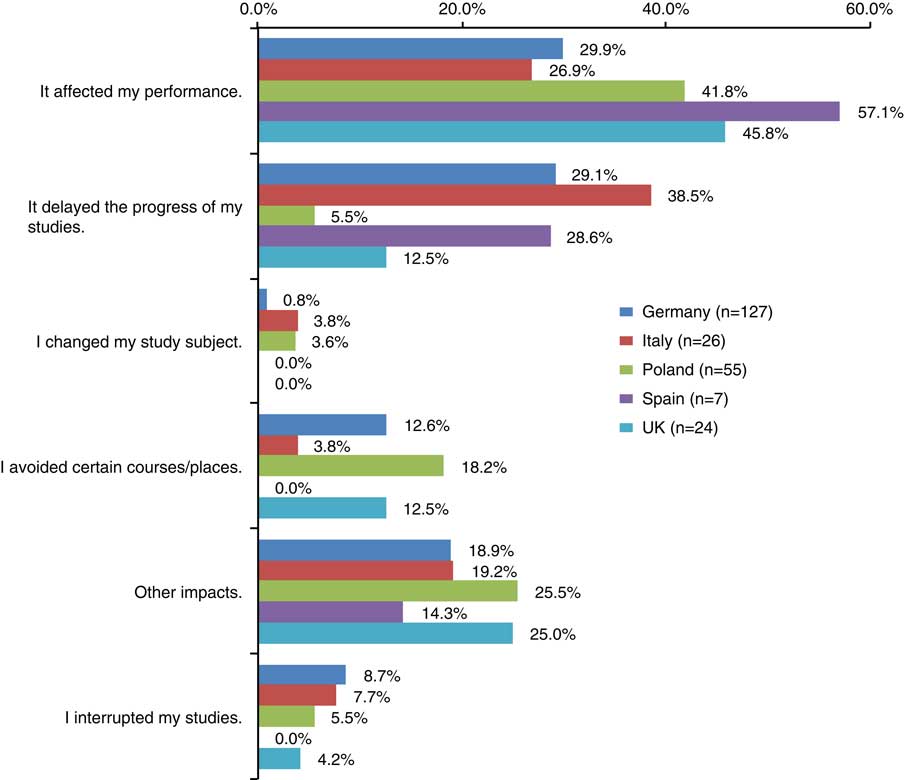
Countries in Europe have diverse, influential women’s movements, criminal and civil law and a variety of legal instruments at their disposal to combat gender-based violence. Most universities offer various kinds of support for students but seldom specialized services for sexualized assaults. In general, institutions refer to specialist services in the community (see Feltes et al. Reference Feltes, List, Schneider, Höfker, Balloni, Bisi, Sette, Czapska, Klosa, Lesińska, Bodelon, Igareda, Casas, Stenning, Mitra-Kahn and Gunby2012:228 ff.; Stenning, Mitra-Kahn, and Gunby Reference Stenning, Mitra-Kahn and Gunby2012:44 ff.; Freeman and Klein Reference Freeman and Klein2013:11 ff.). While international research and national lobbying by, for example, the National Union of Students in the UK (National Union of Students 2010) has moved gender-based violence upwards on the policy agenda, awareness of gender-based violence against students in other European countries appears quite poor. Gender-based violence against students in most European countries is a matter of the individual university’s policy. At present, comprehensive organizational policy frameworks on gender-based violence at European universities are rare (see Freeman and Klein Reference Freeman and Klein2013:22) and university responses seem largely up to the initiative and expertise of individual staff members. Awareness of gender-based violence generally comes to surface when an incident occurs that affects the public (for example, the Cologne assaults on New Year’s Eve 2015). Against the background of a continuing reluctance to tackle sexual violence at universities in Europe, some efforts are nonetheless being made (for the UK, see Universities UK 2016). At the same time, websites – as windows onto an institution’s framing of gender-based violence at large universities and as instruments of communicating corporate responsibility (see Pollach Reference Pollach2003:284 ff.) – often do not mention gender-based violence in mission statements or policies (see Freeman and Klein Reference Freeman and Klein2013:22 ff.). However, even good intentions to raise awareness about the issue in the higher education sector and to push for better policy at universities will not necessarily produce effective practices, as described above. This suggests that ultimately the issue is not sufficiently integrated into institutional “consciousness” and governance. However, the effects of gender-based violence on students as victims should be of interest to universities – partly due to their responsibility but also due, not least, to their overall mission to provide a safe campus environment for all those engaged in studying and research there (Figure 7).
Impacts of sexual violence – on women’s studies (from Feltes et al. Reference Feltes, List, Schneider, Höfker, Balloni, Bisi, Sette, Czapska, Klosa, Lesińska, Bodelon, Igareda, Casas, Stenning, Mitra-Kahn and Gunby2012:120). For a colour figure, see the online version of the paper.

OUTLOOK – THE CHALLENGE OF POPULIST PERCEPTIONS OF GENDER-BASED VIOLENCE
Comparing sexual victimization rates transnationally is difficult because of the differences in definitions and understandings about what counts as sexual victimization, the potential for society to conceal the extent of its occurrence, and the extent of penal exposure to sex crimes.
Alongside the long-established, internalized myths about rape that mislead girls and women to behave in self-restricting and preventive behavior, the current debate about sexual violence in the populist context of the “refugee crisis” likewise contributes to a climate in which the issue of gender-based violence in Europe is distorted in unhelpful and misleading ways. The events that occurred on New Year’s Eve 2015 in Cologne were used to derail progress against gender-based violence and distort feminist concerns by spreading racist fantasies about (sexual) violence being perpetrated solely by “Others”. Although crime statistics in diverse European countries tell another story, the narrative about the (sexually) aggressive (African and/or Muslim) migrant is prevalent in European societies (Saunders Reference Saunders2016). Universities too should be called upon to denounce such false messages. Not only should they counter misleading narratives about gender-based violence itself but they are also responsible for protecting their students – irrespective of gender, origin or cultural background – from populist and racial perceptions of gender-based violence in all academic settings. In addition to protecting (potential) victims of gender-based violence and discrimination on campus, institutions of higher education are also called upon to meet their obligation to provide education and information with regard to human rights and mutual respect for all human beings.
CONCLUSION
At least half the female students in the survey had experienced sexual harassment, and nearly one in ten had been a victim of criminal sexual assault. While the results of the EU project show that the extent to which female students in the participant countries are affected is above average due to their age and lifestyle, there are no general indications that young women are more at risk of sexual assault due to their status as students than are women of a similar age in the wider community. However, the negative effects of violence experienced during their time at university are of considerable significance for universities because of their impacts on students’ academic performance. In addition to delaying the progress of students’ studies, a particular concern is the way in which exposure to incidents of gender-based violence involving the hierarchical structures of the institution damage the faith students have in their university. Widespread fears among female students include inadequate institutional responses, the perpetrator receiving no punishment, and their potential disclosure account not being believed. Conversely, universities do not always respond appropriately to cases of assault, either because of the difficultly of establishing firm evidence or because of their anxiety about forfeiting the university’s reputation. Such weak institutional conduct in turn reinforces the students’ fears. This applies to all the participating countries, alongside the other similarities in regard to prevalence rates, circumstances and impacts of sexualized violence. Awareness of the relevance of gender-based violence in university settings in Europe has grown – to a greater or lesser degree – and has started to influence university policies and tools for countering and reducing incidents on campus. However, there is no specific legislation in Europe compelling universities to report sexual violence statistics on campus to the state authorities as it exists in the United States with the Clery Act (1990) (United States Department of Education 2017). Much more generally, the Human Rights Act in the UK (United Kingdom Government 1998) and the General Equal Treatment Law Allgemeine Gleichbehandlungsgesetz (2006) (Bundesministerium der Justiz und für Verbraucherschutz 2006) in Germany impose a duty of care on universities to protect female students and ensure they are treated equally to male students. Finally, the debate about gender-based violence is a challenge generated by the change process that is taking place in society as a whole. Universities have a special responsibility to take care of their students at a particular time in their life, in respect of both their education and personal development. They should take this responsibility seriously.
Katrin List is a sociologist and political scientist currently working as a research associate in the Department of Social Inequality and Gender at the Ruhr-University Bochum, Germany. She was the main coordinator of the European Community-funded project “Gender-Based Violence, Fear of Crime and Stalking” 2009–2011 and of follow-up research on security, crime and gender in the Department of Criminology and Police Science at the Ruhr-University. As part of her PhD research she undertook a comparative analysis of the fear of sexualized violence among women and men.