Implications
Specific nutritional strategies involving dietary lysine restriction can be developed for fattening fatty and lean pigs to increase IMF with expected positive consequences on meat quality. The biochemical mechanisms that contribute to the increase of fat in these conditions seem to differ among tissues such as subcutaneous backfat and muscle. Further studies including time–course measurements can contribute to develop suitable strategies for the modulation of fat content in pork meat.
Introduction
A major factor affecting meat organoleptic characteristics is the amount and composition of intramuscular fat (IMF) (Wood et al., Reference Wood, Enser, Fisher, Nute, Sheard, Richardson, Hughes and Whittington2008), and a positive relationship between the acceptability or the tenderness of pork and IMF content is generally accepted (Font-i-Furnols et al., Reference Font-i-Furnols, Tous, Esteve-Garcia and Gispert2012). Different nutritional strategies have been proposed to increase IMF in pigs, as reducing dietary crude protein levels (Doran et al., Reference Doran, Moule, Teye, Whittington, Hallett and Wood2006) or reducing dietary lysine levels (Katsumata et al., Reference Katsumata, Kobayashi, Matsumoto, Tsuneishi and Kaji2005; Katsumata Reference Katsumata2011). Recently, we have shown that reduced lysine supply – maintaining constant crude protein levels – could be an effective strategy to increase IMF in fatty (Iberian) and conventional pigs (Palma-Granados et al., Reference Palma-Granados, Haro, Lara, Aguilera, Nieto and Seiquer2017a). Changes in other biochemical parameters such as increased oleic acid concentration of IMF and increased proportion of oxidative muscle fibers in pigs fed a lysine-deficient diet were also observed. In contrast, other authors have reported that reduced lysine supply was effective in increasing IMF content in longissimus muscle of lean pigs but not in fatty Alentejano pigs (Madeira et al. Reference Madeira, Pires, Alfaia, Costa, Luxton, Doran, Bessa and Prates2013).
Reduction of dietary lysine could have a negative impact on growth and protein deposition; therefore, further research is needed to design best strategies to modulate IMF content according to different factors, as pig body weight (BW) or genotype, in order to obtain desirable effects on IMF content and composition with minimum penalty on pig growth. Besides the effects on IMF, the knowledge of possible effects of lysine deficiency on growth and development of other fat depots is also of interest. In this sense, Katsumata et al. (Reference Katsumata, Kobayashi, Matsumoto, Tsuneishi and Kaji2005) did not detect any significant influence of lysine deficiency on subcutaneous backfat-adipose tissue (SCAT) depth, carcass weight and longissimus area of (Landrace × Large White) × Duroc finishing gilts. Similarly, Tous et al. (Reference Tous, Lizardo, Vila, Gispert, Font-i-Furnols and Esteve-Garcia2014) found no effect of dietary lysine deficiency on SCAT proportion or thickness of Landrace × Duroc finishing barrows. In contrast, we have found increased SCAT depth at the first rib, and lower carcass length in young Iberian and conventional pigs fed a DL diet (Palma-Granados et al., Reference Palma-Granados, Haro, Lara, Aguilera, Nieto and Seiquer2017a).
The mechanisms involved in the promotion of IMF by a lysine deficient supply are not fully understood, although increased m(messenger)RNA abundance of PPARG (nuclear hormone receptor involved in adipocyte gene expression and differentiation) in longissimus muscle has been reported (Katsumata et al., Reference Katsumata, Kobayashi, Matsumoto, Tsuneishi and Kaji2005). Doran et al. (Reference Doran, Moule, Teye, Whittington, Hallett and Wood2006) described increased activity and protein expression of stearoyl-CoA desaturase (SCD, involved in monounsaturated fatty acids (MUFA) biosynthesis) in muscle but not in SCAT of pigs fed a low-protein diet. Additionally, Madeira et al. (Reference Madeira, Pires, Alfaia, Costa, Luxton, Doran, Bessa and Prates2013) have reported that lysine deficiency increased mRNA levels for SCD in muscle but not in SCAT of lean pigs, although the muscle effect was not observed in fatty (Alentejano) pigs.
Comparing breeds of different growth potential implies some difficulties as developmental age of animals may differ. Also, nutritional requirements may differ among breeds and differences may amplify as pigs get older. In the present work, the use of young pigs, with the same weight at the start of the experiment and very close in age, enables a comparison in similar conditions, as nutrient requirements of breeds are closer at this physiological state (Conde-Aguilera et al. Reference Conde-Aguilera, Barea, Le Floc’h, Lefaucheur and Milgen2011)
With this background, the aim of the present study was to further investigate the effects of a deficient lysine supply on carcass composition, lipogenic enzyme activity and expression of genes involved in lipid metabolism in longissimus and biceps femoris (b. femoris) muscles and SCAT of fatty (Iberian) and conventional pigs (Landrace × Large White (LDW)). We hypothesized differential effects of lysine deficiency on lipogenic enzyme activity and expression of lipid metabolism genes among tissues and similar general effects between breeds.
Materials and methods
Animals, diets and experimental design
Animals, diets and experimental design have been described previously (Palma-Granados et al., Reference Palma-Granados, Haro, Lara, Aguilera, Nieto and Seiquer2017a). Briefly, 14 purebred Iberian and 14 LDW barrows of 58 and 50 days, respectively, were housed in individual pens of 2 m2 at 10 kg BW and they were randomly assigned to each of two experimental diets (n = 7 pigs per diet and breed). Diets were isonitrogenous and isoenergetic containing (per kg DM) 200 g CP and 14 MJ metabolizable energy (see Palma-Granados et al., Reference Palma-Granados, Haro, Lara, Aguilera, Nieto and Seiquer2017a; Table 1). One of the diets was adequate in amino acids and rest of dietary nutrients (adequate lysine (AL), 10.9 g lysine/kg DM); the other one had identical composition except for the lysine content (lysine deficient (DL), 5.20 g lysine/kg DM). Daily feed allowance was adjusted on a weekly basis according to a BW function (Conde-Aguilera et al., Reference Conde-Aguilera, Barea, Le Floc’h, Lefaucheur and Milgen2011) and pigs were fed at 0.85 × ad libitum intake of the Iberian genotype, of greater intake capacity (Morales et al., Reference Morales, Pérez, Baucells, Mourot and Gasa2002). Feed intake was daily monitored. Pigs were slaughtered by exsanguination after electrical stunning at 25 kg BW. The empty gut, carcass and organs were weighed separately. The carcass without head, feet and tail was weighed and divided longitudinally. Samples of SCAT, longissimus and b. femoris were immediately collected from the left half of carcass, snap frozen in liquid nitrogen and stored at –80°C until analysis. The right half of carcass was rapidly processed as described in Nieto et al. (Reference Nieto, Lara, Barea, García-Valverde, Conde-Aguilera and Aguilera2015) to obtain carcass components. All the components were homogenized together and subsamples were taken for freeze-drying and analysis.
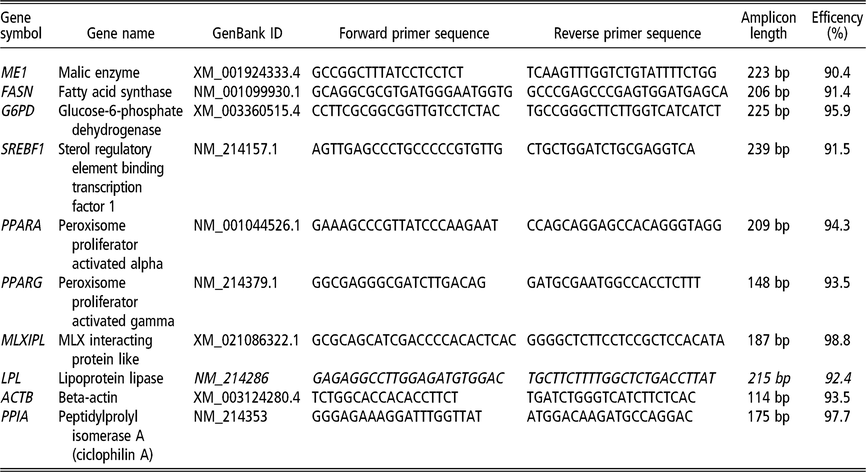
Primer design for qPCR, gene details and PCR efficiency to investigate gene expression in pig tissues

qPCR = quantitative real-time PCR.
Carcass and feed chemical composition
Analytical procedures have been described previously (Palma-Granados et al., Reference Palma-Granados, Haro, Lara, Aguilera, Nieto and Seiquer2017a). DM content and total ash were carried out according to the Association of Official Analytical Chemists (AOAC, 2002; methods 934.01 and 942.05, respectively). Total nitrogen in feeds and in freeze-dried samples of carcass was determined by combustion, according to the Dumas’ method, in a TruSpec CN equipment (Leco Corporation, St. Joseph, MI, USA). Crude protein content was calculated using the factor of 6.25. Dry matter was determined in aliquot samples of freeze-dried material to establish the residual water content after freeze-drying. Gross energy of feeds and freeze-dried carcass samples was determined in an isoperibolic bomb calorimeter (Parr Instrument Co., Moline, IL, USA). Fat content in feeds was determined by ether extraction according to standard procedures (AOAC, 2000). Fat content in carcass and IMF were determined by extraction of 2 g of freeze-dried material with chloroform/methanol (2 : 1, v/v) according to Folch et al. (Reference Folch, Lees and Sloane Stanley1957). Fatty acids in freeze-dried carcass samples were extracted as described by Folch et al. (Reference Folch, Lees and Sloane Stanley1957), and methylation of fatty acids was performed following the procedure of Kramer and Zhou (Reference Kramer and Zhou2001), slightly modified: two methylation procedures were used in each sample, NaOH/methanol at 50°C for 15 min, followed by HCl/methanol at 50°C for 1 h. Tricosanoic acid (C23 : 0; Larodan Fine Chemicals, Malmö, Sweden) was used as internal standard. Fatty acids methyl esters were identified by gas chromatography using a gas chromatograph equipped with a flame ionization detector (Focus GC, Thermo Scientific, Milan, Italy) and a capillary column (Teknokroma, Barcelona, Spain, phase: TR-CN100, 100 m x 0.25 mm i.d. and 0.20 µm film thickness). The temperature program used was: 70°C, 4 min, ramp of 8°C/min to 110°C, ramp of 5°C/min to 170°C, 10 min at 170°C and ramp of 4°C/min to 240°C, final time 14.5 min (total time 63 min). The injector and detector were maintained at 255°C. The carrier gas (helium) flow rate was 1.2 ml/min with a split ratio of 50, and 1 µl was injected. Areas of peaks were quantified based on the reference standard mixture, with correction for recovery of the internal standard. The fatty acid profile was expressed as a percentage of identified fatty acids.
Lipogenic enzyme activity assays
The activities of malic enzyme (ME), glucose-6-phosphate dehydrogenase (G6PDH) and fatty acid synthase (FAS) were assessed in aliquots of SCAT and longissimus and b. femoris muscles. The samples were homogenized in an ice-cold 0.3 M sucrose solution containing 1 mM ethylenediaminetetraacetic acid and 25 mM dithiothreitol using an Ultra-Turrax® homogenizer (IKA-Werke GmbH & Co. KG, Staufen, Germany). Mixtures were centrifuged for 20 min at 20 000 × g at 4°C. The supernatant was collected and stored at –80°C. The ME, G6PDH and FAS activities were assayed in the soluble fraction according to Bazin and Ferre (Reference Bazin, Ferre and Ailhaud2001) by absorbance at 340 nm to assess the appearance (for ME and G6PDH) or the decrease (for FAS) of NADPH2. Substrate quantities were optimized to ensure linearity of the reaction. The soluble protein concentration in supernatant was determined using a commercial kit (PierceTM BCA Protein Assay Kit, Ref., 23225–23227, Thermo Scientific, Madrid, Spain). Enzyme activities were expressed as nmol of NADPH per minute per milligram of supernatant protein.
Gene expression quantification
Total RNA was extracted from 50 to 100 mg of SCAT and longissimus and b. femoris muscles. Samples were homogenized with 1 ml of TRIzol Reagent (Invitrogen, Carlsbad, CA, USA), using an Ultra-Turrax® homogenizer. The homogenate was mixed with 200 μl of chloroform and incubated for 8 min at room temperature, and then centrifuged at 12 000 × g for 15 min at 4°C. The aqueous phase was collected, precipitated with 500 μl of ethanol and then applied to an RNeasy Mini-column (Qiagen, Madrid, Spain) before spinning for 30 s at 10 000 × g. The flow through was discarded and RNA bound to the column was DNase treated using RNase-free DNase Set (Qiagen, Madrid, Spain) and collected in a 50 μl volume. The RNA quantity was measured using a ND 1000 spectrophotometer (NanoDrop Technologies, Wilmington, DE, USA). RNA integrity number was measured using Experion™ Automated Electrophoresis System (Bio-Rad, Hercules, CA, USA) and ranged from 6.8 to 8.6 for SCAT and from 7.0 to 9.6 for muscles. The extracted total RNA was reverse transcribed using QuantiTect Reverse Transcription Kit (Qiagen, Madrid, Spain) following the protocol of the manufacturer.
The expression of candidate genes was quantified by qPCR (quantitative real-time PCR) as described in Ovilo et al. (Reference Óvilo, Benítez, Fernández, Núñez, Fernández, Rodríguez, Isabel, Rey, López-Bote and Silió2014). Primer pairs used for quantification were designed using Primer Select software (DNASTAR, Madison, WI, USA) from the available GENBANK and/or ENSEMBL sequences, covering different exons in order to assure the amplification of the cDNA (complementary DNA). Sequence of primers and amplicon lengths are indicated in Table 1.
Standard PCR on cDNA was carried out to verify amplicon sizes. Transcript quantification was performed using SYBR Green mix (Roche, Basel, Switzerland) in a LightCycler480 (Roche, Basel, Switzerland). The qPCR reactions were prepared in a total volume of 20 μl containing 2.5 μl of cDNA (1/20 dilution), 10 μl of SYBR Green mix and 0.15 μM of both forward and reverse primers. Mixes without cDNA were used as negative controls. Cycling conditions were 95°C for 10 min, followed by 45 cycles of 95°C (15 s) and 60°C (1 min) where the fluorescence was acquired. Finally, a dissociation curve to test PCR specificity was generated by one cycle at 95°C (15 s) followed by 60°C (20 s) and ramp up to 95°C with acquired fluorescence during the ramp to 0.01°C/s. Data were analyzed with LyghtCycler480 SW1.5 software (Roche, Basel, Switzerland). All points and samples were run in triplets as technical replicates and dissociation curves were carried out for each individual replicate. Single peaks in the dissociation curves confirmed the specific amplification of the genes. For each gene, PCR efficiency was estimated by standard curve calculation using four points of cDNA serial dilutions. Cycles to threshold values were employed for the statistical analyses of differential expression. Data normalization was carried out using the most stable endogenous genes out of GAPDH, ACTB, PPIA and B2M. Stability of endogenous genes was tested with Genorm software (Ghent, Belgium) (Vandesompele et al. Reference Vandesompele, De Preter, Pattyn, Poppe, Van Roy, De Paepe and Speleman2002). ACTB and PPIA genes were employed for normalization.
Expression levels for FASN, G6PD and ME1 genes encoding the lipogenic enzymes studied, as well as for genes with key roles in regulation of lipogenesis (SREBF1, sterol regulatory element binding transcription factor 1; MLXIPL, MLX interacting protein like), adipogenesis (PPARG, Peroxisome proliferator activated gamma) and lipolysis (PPARA, Peroxisome proliferator activated alpha; LPL, lipoprotein lipase) were assessed in SCAT and longissimus and b. femoris muscles. Results are presented for genes whose level of expression allowed a reliable quantification in each tissue (FASN, G6PD, ME1, SREBF1, MLXIPL, PPARG, LPL for subcutaneous adipose tissue; FASN, G6PD, ME1, PPARG, PPARA and LPL for both muscles).
Statistical analysis
Statistical analyses of body and carcass composition, and lipogenic enzyme activity were assessed by the Proc MIXED procedure of SAS as heterogeneity of variances was detected for most breed comparison (Barlett’s test; P < 0.05). The effects of genotype (Iberian, LDW), lysine content (AL, DL) and their interactions were included in the statistical model. Pig was considered the statistical unit. Means of the four treatment combinations were compared by DIFF option of MIXED procedure adjusted to Tukeýs t test. The level of significance was set to 5%. Pearson correlations coefficients were calculated between lipogenic enzyme activities and IMF content in muscle tissues.
Statistical analysis of gene expression data was carried out as described in Ovilo et al. (Reference Óvilo, Benítez, Fernández, Núñez, Fernández, Rodríguez, Isabel, Rey, López-Bote and Silió2014) following the method proposed by Steibel et al. (Reference Steibel, Poletto, Coussens and Rosa2009), which consists in the analysis of cycles to threshold values for the target and endogenous genes simultaneously using a linear mixed model. The following model was used for this purpose in a joint analysis of all the recorded gene expression measures:
 $$ {y_{gijkr}} = T{G_{gi}} + {P_{gj}} + {B_{gk}} + {D_{ijk}} + {e_{gijkr}} $$
where  $ {y_{gijkr}} = - {\rm{lo}}{{\rm{g}}_2} \left( E_g^{ - C{t_{gijkr}}} \right) $; Eg brings the efficiency of the PCR of each gene, Ctgijkr is the value obtained from the thermocycler software for the gth gene from the rth well in the jth qPCR plate corresponding to the kth animal subjected to the ith treatment, TGgi is the specific effect of the ith treatment on the expression of gene g, Pgj and Bgk are specific random effects on the expression in the jth qPCR plate of gene g and the kth pig, Dijk is a random sample-specific effect common to all genes and egijkr is a residual effect.
Four different groups were fitted to the model: dietary effects (two levels: AL and DL) in two breeds: Iberian and LDW pigs; and the four combinations of the two diets and two breeds. To test differences or interaction between classes in the expression rate of genes of interest (diffTG) normalized by the endogenous genes, different contrasts were performed between the appropriate estimates of TG levels. Significance of diffTG estimates was determined with the t statistic.
To obtain fold change values (FC) from the estimated diffTG values, the following equation was applied: FC = 2-diffTG. Standard errors of fold change values (SE (FC)) were calculated from the standard error of the estimated differences (SE), using a similar transformation: SE (FC) = 2-SE
Results
No deaths or diseases were denoted during the feeding trial. Results on animal performance and muscle characteristics have been published elsewhere (see Palma-Granados et al., Reference Palma-Granados, Haro, Lara, Aguilera, Nieto and Seiquer2017a).
Body and carcass composition
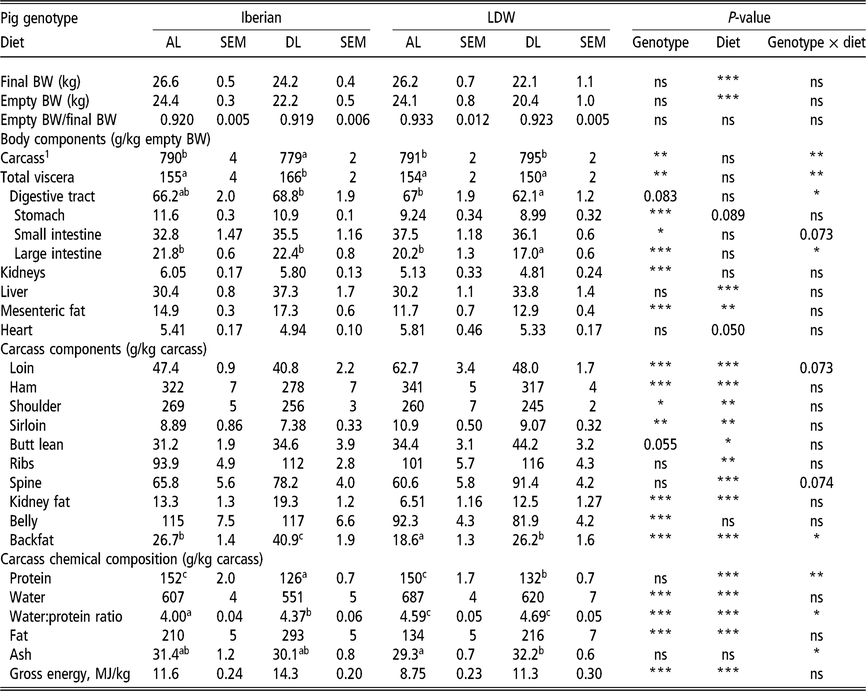
The effects of genotype and dietary lysine content on body and carcass components and composition are displayed in Table 2. Lysine deficiency decreased final BW and empty BW of both pig types (P < 0.001), although empty BW/BW ratio remained unchanged. The proportions of whole carcass and viscera (g/kg empty BW) were similar for both breeds of pigs when fed AL diet, although Iberian pigs fed DL diet showed increased viscera and decreased carcass proportions (genotype × diet interaction, P < 0.01). Relative weights of stomach, kidney and mesenteric fat were higher (P < 0.001), and that of small intestine was lower (P < 0.05) in Iberian compared to LDW pigs. The whole digestive tract decreased in LDW pigs fed DL diet respect to LDW pigs fed AL diet (genotype × diet interaction, P < 0.05) and large intestine proportions decreased in LDW pigs fed DL diet respect to the rest of groups (genotype × diet interaction, P < 0.05). Liver and mesenteric fat proportions increased (P < 0.01), and heart relative weight tended to decrease (P = 0.051) in pigs consuming the DL diet.
Effect of genotype and dietary lysine content on whole-body and carcass composition of piglets growing from 10 to 25 kg BW

LDW = Landrace × Large White pigs; AL = Lysine-adequate diet (1.09% Lys); DL = Lysine-deficient diet (0.52% Lys); ns = not significant.
n = 7 individually housed piglets per each genotype × diet combination.
1 Including head, feet and tail.
a,b,c Means within a row with different superscripts differ significantly at P < 0.05.
*P < 0.05; ** P < 0.01; *** P < 0.001.
Most relative weights of lean components (g/kg carcass) were heavier in LDW pigs (loin, ham, sirloin, P < 0.01), except for shoulder which was heavier in Iberian pigs (P < 0.05). Lean component proportions decreased in pigs fed the DL diet (P < 0.01). Butt lean tended to be higher in LDW pigs (P = 0.055) and increased in DL-fed pigs (P < 0.05). Ribs and spine proportions increased (P < 0.01) in DL-fed pigs of both genotypes. Belly, kidney fat and SCAT proportions were higher in Iberian than LDW pigs (P < 0.001). Kidney fat increased in pigs fed DL diets (P < 0.001) as well as SCAT proportion (particularly in Iberian pigs; genotype × diet interaction, P < 0.05).
Carcass chemical composition (Table 2) is in line with the physical dissection of carcass components presented above. Iberian pigs showed less water and more lipid (g/kg carcass) and energy content (MJ/kg carcass) than LDW pigs (P < 0.01). When pigs were fed LD diet, carcass protein concentration decreased (particularly in Iberian pigs, genotype × diet interaction; P < 0.01) and lipid and energy contents increased (P < 0.01). Ash content was lower in LDW pigs fed AL diet compared to LDW pigs fed DL diet (genotype × diet interaction; P < 0.01).
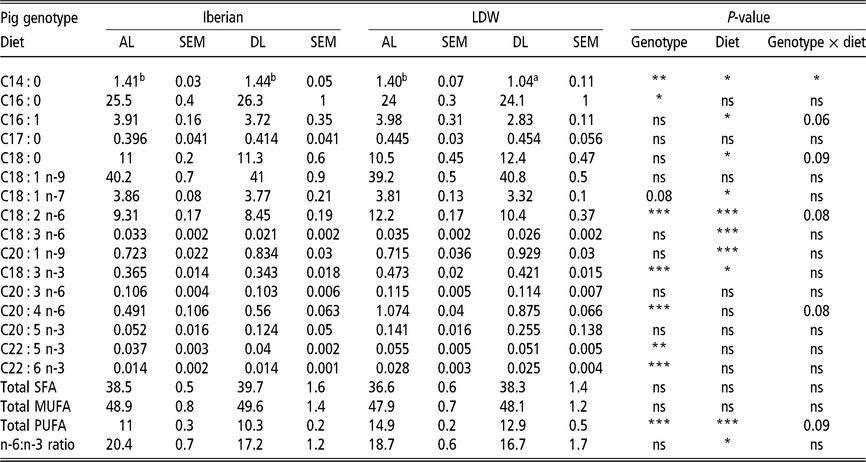
The fatty acid composition of carcass is shown in Table 3. Iberian pigs showed greater proportion of C16 : 0 (P < 0.05) than LDW pigs. No significant differences were found for C17 : 0, C18 : 0, C18 : 1 n-9, total saturated fatty acids (SFA) and MUFA between genotypes. Proportions of C18 : 2 n-6, C18 : 3 n-3, and some linoleic and linolenic acid derivatives (C20 : 4 n-6; C22 : 5 n-3 and C22 : 6 n-3), and total polyunsaturated fatty acids (PUFA) were higher in LDW pigs (P < 0.01). Pigs receiving the DL diet had higher content of C18 : 0 (P < 0.05) and lower of C18 : 2 n-6 (P < 0.001), C18 : 3 n-3 (P < 0.05) and total PUFA (P < 0.001), with a consequent decrease of the n-6/n-3 ratio (P < 0.05).
Effects of genotype and dietary lysine content on the FA composition (g FA/100g of identified FA methyl esters) of carcass of piglets growing from 10 to 25 kg BW

A = fatty acids; LDW = Landrace × Large White pigs; AL = Lysine-adequate diet (1.09% Lys); DL = Lysine-deficient diet (0.52% Lys); SFA: Saturated fatty acids; MUFA = Monounsaturated fatty acids; PUFA = Polyunsaturated fatty acids ; ns = not significant.
n = 7 individually housed piglets per each genotype × diet combination.
a,b Means within a row with different superscripts differ significantly at P < 0.05.
*P < 0.05; ** P < 0.01; *** P < 0.001.
Lipogenic enzyme activity
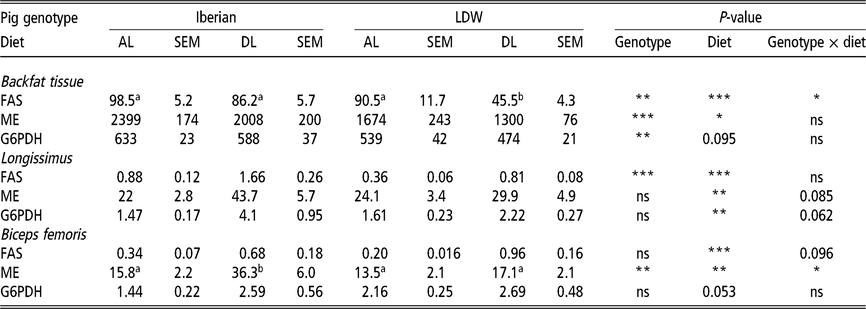
In backfat tissue, Iberian pigs had similar FAS activity than LDW pigs when both were fed AL diet, whereas lysine deficiency decreased FAS activity in LDW pigs only (genotype × diet interaction, P < 0.05, Table 4). Iberian pigs had higher ME and G6PDH activities (P < 0.01) than LDW pigs. In both breeds, lysine deficiency decreased ME activity (P < 0.05) and did not affect G6PDH activity.
Effect of genotype and dietary lysine content on lipogenic enzyme activities of subcutaneous backfat adipose tissue and muscles of piglets growing from 10 to 25 kg BW

LDW = Landrace × Large White pigs; AL = Lysine-adequate diet (1.09% Lys); DL = Lysine-deficient diet (0.52% Lys); FAS = fatty acid synthase; ME = malic enzyme; G6PDH = glucose-6-phosphate dehydrogenase.
n = 7 individually housed piglets per each genotype × diet combination; Activities were expressed in nmoles of NADPH2 produced (ME, G6PDH) or consumed (FAS) per min and per mg cytosolic proteins.
a,b Means within a row with different superscripts differ significantly at P < 0.05.
*P < 0.05; ** P < 0.01; *** P < 0.001; ns = not significant.
In longissimus muscle, the activity of FAS was higher in Iberian pigs (P < 0.001) and increased in both pig types when fed DL diet (P < 0.001). The ME and G6PDH activities did not significantly differ between genotypes, and both enzymes increased their activity in DL pigs (P < 0.01).
For b. femoris muscle no significant differences between genotypes were detected in FAS and G6PDH enzymatic activities. The FAS activity was raised (P < 0.001) and G6PDH activity tend to increase (P = 0.053) in DL pigs. The ME activity did not differ between both pig breeds when fed AL diet, and it increased in Iberian but not in LDW pigs when fed DL diet (genotype × diet interaction, P < 0.05).
Gene expression levels in tissues
For backfat tissue and regarding the genotype effect (Figure 1a), the genes SREBF1, MLXIPL, PPARG, LPL and ME1 were upregulated in Iberian compared with LDW pigs (P < 0.001; except for PPARG and ME1 with P < 0.05, Figure 1a). FASN and G6PD genes did not show differences in expression between Iberian and LDW pigs. Regarding the diet effect, for FASN and G6PD genes we observed similar responses (Figure 1b), in both cases with interaction effects (P = 0.06 and P < 0.01 for genotype × diet interaction, respectively); in Iberian pigs these genes were upregulated in AL group, while in LDW the same genes were upregulated in DL pigs (P-values from 0.06 to 0.001). For MLXIPL gene a significant upregulation was observed in AL- v. DL-fed pigs in both breeds (P < 0.01; Figure 1b).
(a) Relative gene expression (FC, Fold change) in subcutaneous backfat adipose tissue of Iberian respect to Landrace × Large White (LDW) pigs both fed adequate (AL) or lysine-deficient (DL) diets. FC values higher than 1 indicate higher gene expression in Iberian, while FC values lower than 1 indicate higher gene expression in LDW. Results of genotype effect are presented within diet group, in order to appreciate the genotype × diet interaction. (b) Relative gene expression (FC) in backfat adipose tissue of Iberian and LDW pigs fed AL diets respect to pigs of the same breeds fed DL diets. FC values higher than 1 indicate higher gene expression in AL, while FC values lower than 1 indicate higher gene expression in DL. Results of diet effect are presented within genotype group, in order to appreciate the genotype × diet interaction. MLXIPL: MLX interacting protein like; SREBF1: sterol regulatory element binding transcription factor 1; PPARG: Peroxisome proliferator activated gamma; PPARA: Peroxisome proliferator activated alpha; LPL: lipoprotein lipase; FASN: fatty acid synthase; G6PD: glucose-6-phosphate dehydrogenase; ME1: malic enzyme.

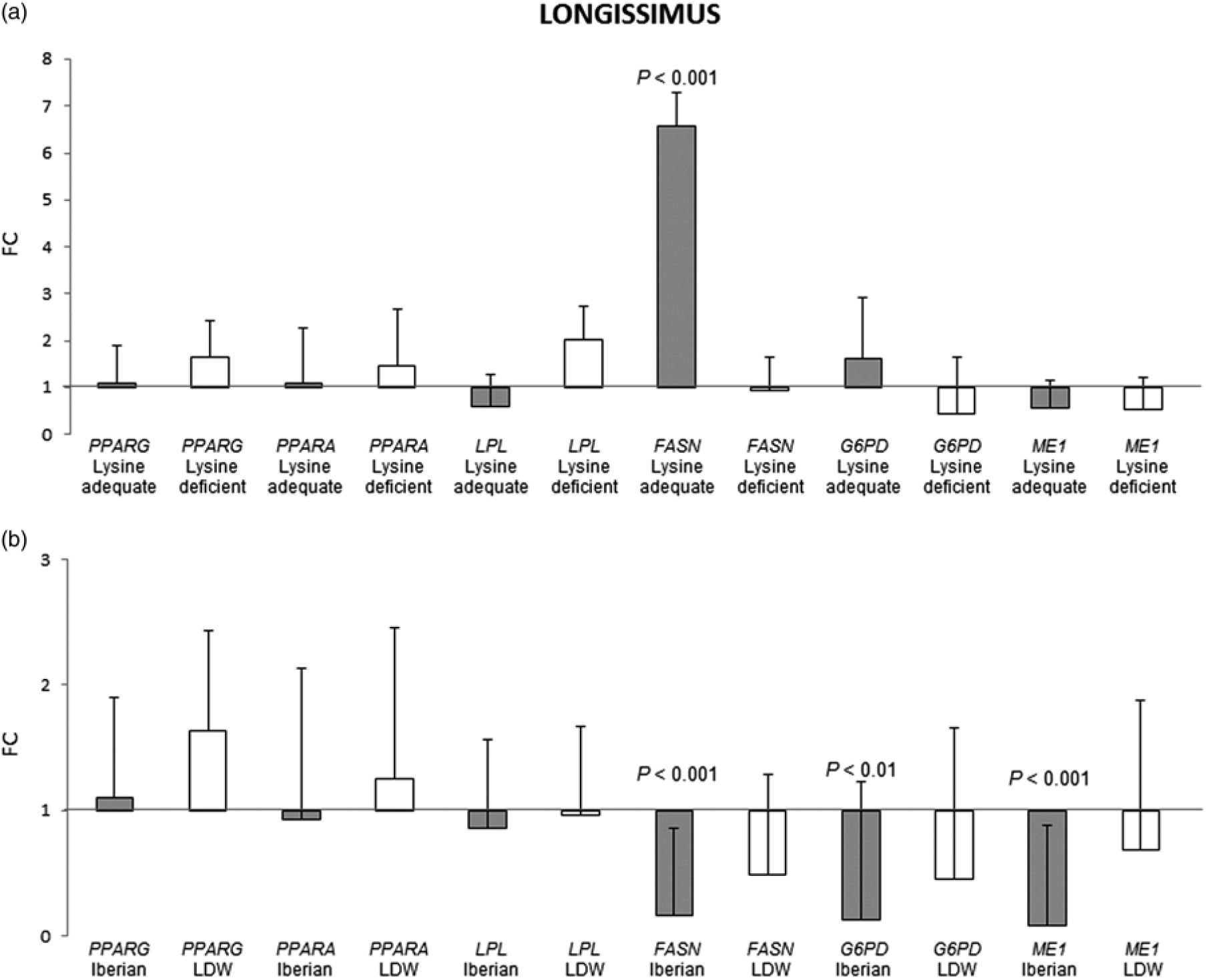
In longissimus muscle, expression of FASN gene was higher in Iberian compared to LDW pigs, only for pigs fed AL diet (genotype × diet interaction, P < 0.001, Figure 2a). No significant genotype effect was observed for any other genes. The same response to diet was observed for FASN, G6PD and ME1 genes, for which the gene expression was upregulated in pigs fed DL diet respect to pigs fed AL diet, only in Iberian pigs (P < 0.001, P < 0.01 and P < 0.001, respectively; genotype × diet interaction P < 0.001, P < 0.05 and P < 0.01, for FASN, G6PD and ME1, respectively, Figure 2b). No significant effects of breed, diet or interactions were detected for PPARA, PPARG and LPL genes (Figure 2a and b). SREBF1 and MLXIPL genes were not quantifiable in muscle due to low gene expression levels.
(a) Relative gene expression (FC, Fold change) in longissimus muscle of Iberian respect to Landrace × Large White (LDW) pigs both fed adequate (AL) or lysine-deficient (DL) diets. FC values higher than 1 indicate higher gene expression in Iberian, while FC values lower than 1 indicate higher gene expression in LDW. Results of genotype effect are presented within diet group, in order to appreciate the genotype × diet interaction. (b) Relative gene expression (FC) in longissimus muscle of Iberian and LDW pigs fed AL diets respect to pigs of the same breeds fed DL diets. FC values higher than 1 indicate higher gene expression in AL, while FC values lower than 1 indicate higher gene expression in DL. Results of diet effect are presented within genotype group, in order to appreciate the genotype × diet interaction.PPARG: Peroxisome proliferator activated gamma; PPARA: Peroxisome proliferator activated alpha; LPL: lipoprotein lipase; FASN: fatty acid synthase; G6PD: glucose-6-phosphate dehydrogenase; ME1: malic enzyme.

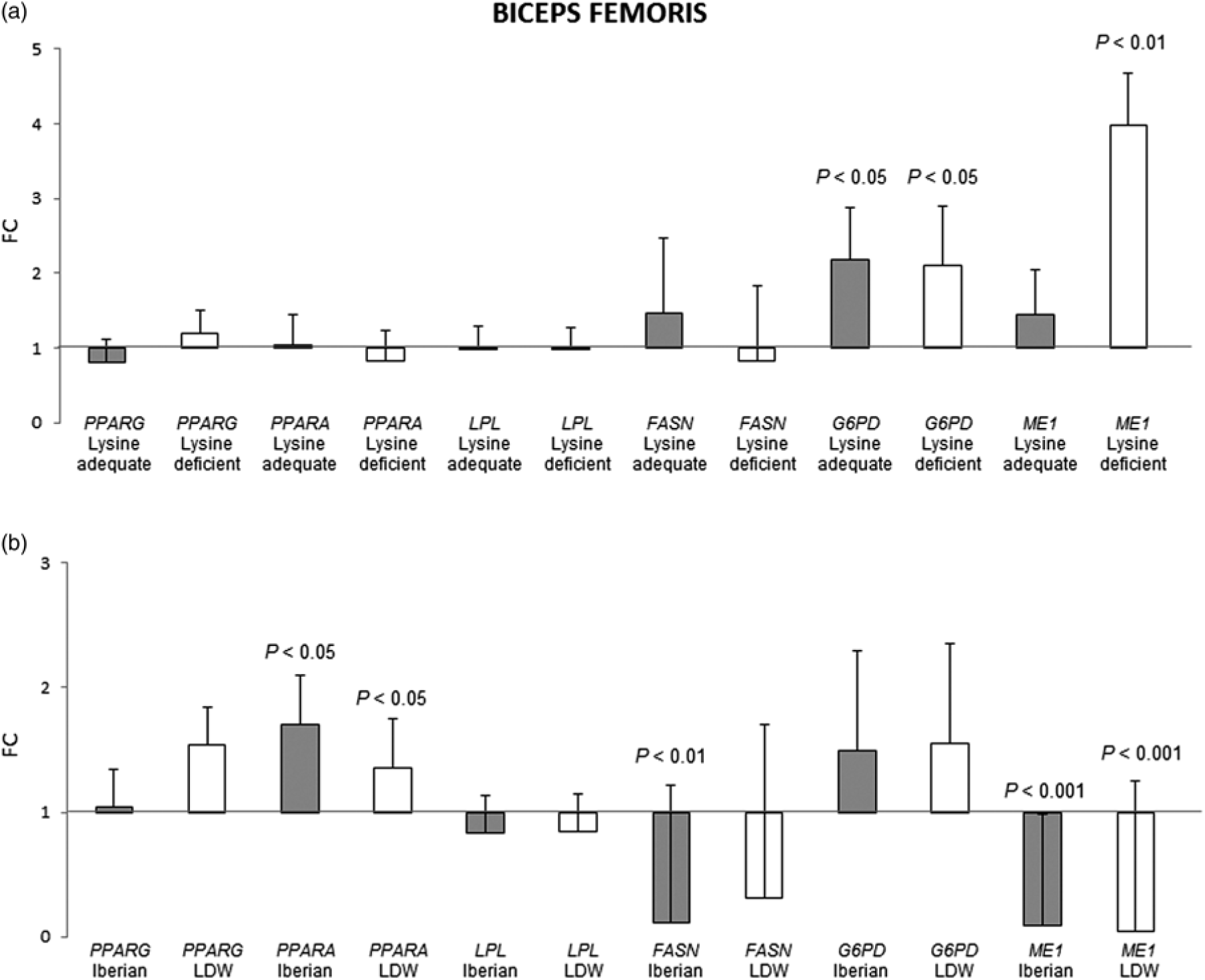
For the b. femoris muscle, the G6PD gene was upregulated in Iberian compared to LDW pigs (P < 0.05; Figure 3a), and the same was observed for ME1, but in this case only in pigs fed DL diet (P < 0.01, genotype × diet interaction P < 0.001, Figure 3a). No other significant breed effect was observed. Significant effects of diet were observed for PPARA, FASN and ME1 genes (Figure 3b). PPARA and ME1 genes showed opposite patterns, with PPARA being upregulated in pigs fed AL diet while ME1 was upregulated in DL fed pigs (P < 0.05 and P < 0.001, respectively). Diet effect on FASN gene expression was conditional on breed, being upregulated in pigs fed DL diet only in Iberian pigs (P < 0.01; genotype × diet interaction; P < 0.05, Figure 3b). As for the longissimus muscle SREBF1 and MLXIPL genes showed very low expression levels preventing their quantification. No significant effects of genotype, diet or genotype × diet interactions were detected for PPARG and LPL genes (Figure 3a and b).
(a) Relative gene expression (FC, Fold change) in b. femoris muscle of Iberian respect to Landrace × Large White (LDW) pigs both fed adequate (AL) or lysine-deficient (DL) diets. FC values higher than 1 indicate higher gene expression in Iberian, while FC values lower than 1 indicate higher gene expression in LDW. Results of genotype effect are presented within diet group, in order to appreciate the genotype × diet interaction. (b) Relative gene expression (FC) of lipogenic enzymes in b. femoris muscle of Iberian and LDW fed AL diets respect to pigs of the same breeds fed DL diets. FC values higher than 1 indicate higher gene expression in AL, while FC values lower than 1 indicate higher gene expression in DL. Results of diet effect are presented within genotype group, in order to appreciate the genotype × diet interaction. PPARG: Peroxisome proliferator activated gamma; PPARA: Peroxisome proliferator activated alpha; LPL: lipoprotein lipase; FASN: fatty acid synthase; G6PD: glucose-6-phosphate dehydrogenase; ME1: malic enzyme.

Discussion
The Iberian pig is an autochthonous, slow-growing, fatty-type pig reared in the southwest of Spain, known for the quality of its products. Nowadays they represent approximately 10% of total pigs produced in Spain, including purebred and crossbred animals (50% Iberian: purebred Iberian dam × purebred Duroc sire; and 75% Iberian: purebred Iberian dam × (purebred Iberian dam × purebred Duroc sire) (Ministerio de Agricultura, Alimentacióny Medio Ambiente, 2018). The purpose of this study was to explore further the mechanisms involved in IMF deposition and to investigate the effects of dietary lysine deficiency on SCAT and growth of body components (as potential negative effects) of pigs under DL conditions, to gather more information and complement previous results on two different pig genotypes. In order to avoid some of the difficulties encountered when comparing breeds of different growth potential, young pigs of the same weight at the start of the experiment and very close in age (and in nutritional requirements; Conde-Aguilera et al., Reference Conde-Aguilera, Barea, Le Floc’h, Lefaucheur and Milgen2011) were used. Growth rate and feed efficiency – reported previously in Palma-Granados et al. (Reference Palma-Granados, Haro, Lara, Aguilera, Nieto and Seiquer2017a) – were higher in the lean breed, in line with earlier studies (Rivera-Ferre et al., Reference Rivera-Ferre, Aguilera and Nieto2006). Palma-Granados et al. (Reference Palma-Granados, Haro, Lara, Aguilera, Nieto and Seiquer2017a) also observed that effects of Lys deficiency on growth and performance were comparatively greater in LDW pigs, in agreement with previous observations in Iberian and Landrace gilts fed AL and DL diets (Rivera-Ferre et al., Reference Rivera-Ferre, Aguilera and Nieto2006). These findings are in agreement with van Lunen and Cole (Reference van Lunen, Cole, Garnsworthy, Wiseman and Haresign1996) who suggested that highly selected pigs were more sensitive to nutritional deficiencies than animals of lower protein deposition potential.
Breed and diet effects on body components and carcass composition
Visceral organ-relative weights remained unchanged when pigs were fed the DL diet, except for large intestine and the whole digestive tract that were reduced in LDW pigs, and liver and mesenteric fat that increased in both genotypes of pigs fed DL diet. Conde-Aguilera et al. (Reference Conde-Aguilera, Aguinaga, Aguilera and Nieto2010) reported an increase in intestine, liver and blood proportions of young Piétrain × (Large-White × Landrace) pigs fed a diet deficient in sulfur amino acids for approximately 20 days. However, no significant effects on liver and small intestine relative weights were detected when pigs consumed a sulfur-deficient diet for 17 weeks (Conde-Aguilera et al., Reference Conde-Aguilera, Cobo-Ortega, Mercier, Tesseraud and van Milgen2014), which could indicate that under nutrient deficiency conditions the animals probably tend to preserve visceral organs – with essential body functions – in detriment of muscle.
The relative proportions of carcass components showed, as anticipated, higher lean components in LDW pigs (loin, ham, sirloin, except for shoulder), and greater relative weights of fatty components in Iberian pigs (belly, SCAT, internal fat), corroborating the predisposition to fat deposition in the carcass of Iberian pigs (Nieto et al., Reference Nieto, Barea, Lara, Palma-Granados and Aguilera2013). When pigs were fed DL diet, similar effects were found for both types of pigs on relative weights of carcass components, i.e., a reduction of leaner parts and an increment of the fatty components, in close agreement with the changes in carcass chemical composition detected (decline of protein and water contents and increase of lipid and energy contents). These effects are in line with others described in the literature, as reduction of nitrogen retention (Roy et al., Reference Roy, Lapierre and Bernier2000; Rivera-Ferre et al., Reference Rivera-Ferre, Aguilera and Nieto2006) and in muscle fractional protein synthesis rates (Rivera-Ferre et al., Reference Rivera-Ferre, Aguilera and Nieto2005) when pigs are fed diets with insufficient lysine supply. In young conventional piglets fed sulfur-deficient diets, Conde-Aguilera et al. (Reference Conde-Aguilera, Aguinaga, Aguilera and Nieto2010) also found lower carcass protein and water concentration and greater lipid deposition than in control pigs. However, other authors that found an increment of IMF following a DL diet (Katsumata et al., Reference Katsumata, Kobayashi, Matsumoto, Tsuneishi and Kaji2005) or protein-deficient diet (Doran et al., Reference Doran, Moule, Teye, Whittington, Hallett and Wood2006) did not found increased SCAT depth, which can be considered as an indicator of total lipid deposition in carcass. Probably, the reasons for these discrepancies stem from differences in the age of pigs, much younger in the present case and in the study of Conde-Aguilera et al. (Reference Conde-Aguilera, Aguinaga, Aguilera and Nieto2010), and probably more susceptible to deficiencies in amino acid supply.
In the present case, the genotype differences found regarding carcass fatty acid profile are related mainly to the proportion of PUFA, which are higher in the LDW pigs, with no genotype differences for oleic acid or total MUFA proportions. Native pig breeds present high rates of MUFA and oleic acid deposition (probably related to higher de novo lipid synthesis), meanwhile, in conventional-type pigs a more SFA profile, along with higher relative levels of PUFA, mainly linoleic acid, are found (Pugliese and Sirtori, Reference Pugliese and Sirtori2012). We have previously observed such genotype differences in SCAT fatty acid composition of Iberian and conventional pigs (Barea et al., Reference Barea, Isabel, Nieto, López-Bote and Aguilera2013) and also in IMF fatty acid composition of muscles (Palma-Granados et al., Reference Palma-Granados, Haro, Seiquer, Lara, Aguilera and Nieto2017b). Carcass fatty acid profile represents the composition of whole lipid content of the pig (except for head, feet and tail), driven mainly by SCAT composition. In the present work, when pigs of both genotypes were fed DL diet, there was a slight increase of C18 : 0 content and a general decrease of PUFA in carcass fatty acid profile, although no significant effect was detected for the relative proportions of SFA and MUFA in DL-fed pigs. In contrast, the IMF fatty acid profile showed a clear increase in oleic acid in DL-fed pigs (in Palma-Granados et al., Reference Palma-Granados, Haro, Lara, Aguilera, Nieto and Seiquer2017a) indicative of de novo fatty acid synthesis.
Breed and diet effects on gene expression and enzyme activity
To further investigate the potential mechanisms involved in fat deposition promoted by dietary lysine deficiency, and the potential differential responses between tissues, such as muscle and SCAT of the two pig types, the activity and gene expression of three main lipogenic enzymes were determined (FAS – which catalyzes palmitate synthesis pathway from malonil-CoA-, and ME and G6PDH – involved in providing NADPH2 for the reductive biosynthesis of fatty acids) as well as the expression of key genes involved in regulation of adipogenesis and lipid metabolism. Kloareg et al. (Reference Kloareg, Noblet and van Milgen2007) suggested that de novo synthesis in tissues represents more than 80% of total fatty acid deposition in pigs; therefore, lipogenic pathways would have a major role determining the quantity of lipid deposited in tissues. Although there are some discrepancies, in general, the catalytic activity determined in each tissue is corroborated by the analysis of expression of genes codifying these enzymes. In general, we observed a greater capacity for tissue lipid synthesis in Iberian pigs which agrees with previous reports comparing lipogenic enzyme activities in lean and Alentejano piglets (fatty pig similar to the Iberian; Freire et al., Reference Freire, Mourot, Cunha, Almeida and Aumaitre1998), and in fattening Iberian and conventional pigs (Morales et al., Reference Morales, Pérez, Baucells, Mourot and Gasa2002, Benitez et al., Reference Benítez, Fernández, Isabel, Núñez, De Mercado, Gómez Izquierdo, García-Casco, López-Bote and Óvilo2018). However, in 15-day-old suckling piglets of the same genotypes used in the present study, we were not able to detect genotype differences in lipogenic activity for SCAT and longissimus muscle (Palma-Granados et al., Reference Palma-Granados, Seiquer and Nieto2017c), although these differences may have develop further as pigs get older.
The effects of lysine deficiency on enzymatic lipogenic activity and gene expression were different in SCAT and in the muscles studied. In spite that SCAT proportions increased in Iberian and LDW pigs when consuming the DL diet, the activity and gene expression of the lipogenic enzymes studied in general decreased or were unchanged, except in LDW pigs where FASN and G6PD gene expression increased. Madeira et al. (Reference Madeira, Pires, Alfaia, Costa, Luxton, Doran, Bessa and Prates2013) did not find changes in FASN expression in SCAT of DL pigs. In contrast, in young Pietrain × LDW piglets fed a methionine-deficient diet, the activity of FAS, ME and G6PDH was raised and upregulation of FASN and ME1 genes was observed in SCAT as lipid content increased (Castellano et al., Reference Castellano, Perruchot, Conde-Aguilera, van Milgen, Collin, Tesseraud, Mercier and Gondret2015), which point out potential different effects of methionine and lysine deficiency on adipose tissue lipogenesis.
The analysis of expression of SREBF1, MLXIPL, PPARG and LPL in SCAT show higher expression of these regulators of transcription and lipid metabolic pathways in Iberian compared with LDW pigs, indicating higher lipogenic, adipogenic and lipolytic activity, and therefore, a more intense lipid metabolism in the autochthonous breed in agreement with their higher capacity for fat deposition (Nieto et al., Reference Nieto, Barea, Lara, Palma-Granados and Aguilera2013, Ovilo et al., Reference Óvilo, Benítez, Fernández, Núñez, Fernández, Rodríguez, Isabel, Rey, López-Bote and Silió2014). However, we do not found evidences of increased lipogenesis or adipogenesis linked to the lysine deficiency in this tissue. In turn, MLXIPL (regulator of glucose associated pathways) was upregulated in SCAT of pigs consuming the AL diet. In this sense, plasma glucose concentration was more than 30% higher in AL v. DL pigs of both breeds (Palma-Granados et al. Reference Palma-Granados, Haro, Lara, Aguilera, Nieto and Seiquer2017a) which could be related to the upregulation of MLXIPL in SCAT of these animals. Thus, the present gene expression results based on a limited panel of candidate genes cannot unveil the molecular mechanisms responsible for the increased SCAT in DL-fed pigs.
Other mechanisms, besides de novo fatty acid and triglycerides synthesis, could have been involved in the increase in SCAT on DL-fed pigs, as increased deposition of dietary fatty acids, or reduced lipolysis rates. On the other hand, it is possible that changes in these regulators promoted by dietary lysine deficiency were produced at an earlier stage (before sampling at the end of the experiment). In any case, these changes, if produced, did not affect the enzymatic activity of lipogenic enzymes in backfat at the time of sampling, which would suggest different regulatory mechanism among SCAT and muscle regarding lipid metabolism. More powerful transcriptome-wide approaches or sequential samplings could be suggested for future studies focused on understanding the biological basis of the effects observed in SCAT.
In contrast, in pigs fed DL diet, the IMF content of longissimus showed a strong correlation with the activity of FAS (r = 0.8), G6PDH (r = 0.6) and ME (r = 0.7) that were also in line with upregulation of expression of genes that codify these enzymes in muscle of DL animals, particularly in Iberian pigs. In the case of b. femoris, increased IMF content in DL-fed pigs was linked to increased activity of FAS and ME enzymes, and ME1 upregulation (and FASN in the case of Iberian pigs). We also found a decrease in PPARA gene expression in b. femoris from DL pigs, which may have contributed to the higher IMF observed as this regulator is known to have a lowering fat effect due to increased fatty acid oxidation (Minnich et al., Reference Minnich, Tian, Byan and Bilder2001). In conventional pigs fed reduced protein diets (Doran et al., Reference Doran, Moule, Teye, Whittington, Hallett and Wood2006) or reduced lysine diets (Madeira et al., Reference Madeira, Pires, Alfaia, Costa, Luxton, Doran, Bessa and Prates2013), the IMF increase in longissimus muscle was related to increased protein and gene expression of SCD enzyme, respectively, but no effect was detected in SCAT.
Our results suggest, in agreement with others (Mourot and Kouba, Reference Mourot and Kouba1999; Gondret and Lebret, Reference Gondret and Lebret2002) a close relationship between ME activity and IMF deposition, as this is, by far, the lipogenic enzyme with higher activity rates in muscle.
The present results show that lipogenic enzyme activities and gene expression are regulated differentially in SCAT and skeletal muscle in piglets, in agreement with previous studies (Doran et al., Reference Doran, Moule, Teye, Whittington, Hallett and Wood2006; Madeira et al., Reference Madeira, Pires, Alfaia, Costa, Luxton, Doran, Bessa and Prates2013). As pointed out by Gondret and Lebret (Reference Gondret and Lebret2002), the differences found in the effect of lysine deficiency among SCAT and muscle regarding enzymatic activity and gene expression may be related to the fact that IMF is the last fat deposit to develop and may respond to nutritional changes in a different way or with a different timing with respect to other fat depots.
Lysine-deficient diets can be a suitable strategy to increase IMF content in fatty and lean pigs, although appropriate nutritional strategies should be designed to avoid decrease of growth of lean carcass components. For each pig type, tailored diets – including specific lysine restriction – need to be further developed to schedule duration and specific starting time of the treatment during the fattening period. In both fatty and lean piglets, the lipogenic effect of lysine deficiency seems to be tissue specific, promoting an activation of the lipogenic enzyme systems of both longissimus and b. femoris muscle with no apparent stimulation of lipogenesis in SCAT.
Acknowledgements
Supported by Spanish Ministry of Economy and Competitiveness (MINECO grant No. AGL2011-25360). P. Palma-Granados had fellowship from the Spanish FPI Program (BES-2012-053078). The assays described are part of the doctoral thesis of P. Palma-Granados, under the Doctoral Program of Granada University, Spain. We thank Miguel A. Liñán and Isabel M. Romero for skillful technical assistance and to Dr L. Lara for advice in statistical treatment of data. We are also very grateful to Sánchez Romero Carvajal Jabugo S.A. (El Puerto de Santa María, Cádiz, Spain) for providing Iberian purebred experimental animals Corn gluten meal and corn starch used in this experiment were kindly provided by Tereos Syral (Zaragoza, Spain).
Rosa Nieto 0000-0002-8330-2471
Declaration of interest
The authors declare no conflict of interest.
Ethics statement
Experimental procedures and animal care were in agreement with Spanish Ministry of Agriculture guidelines (RD53/2013). Procedures used in this experiment were approved by the Bioethical Committee of Spanish National Research Council (CSIC, Spain) and the competent local authority (Junta de Andalucía, Spain).
Software and data repository resources
The data sets that support the findings of this study are available from the corresponding author upon reasonable request.