Aortic valve stenosis is the most frequent valvular heart disease and represents 2–5% of all congenital heart anomalies.Reference Stark, de Leval and Tsang 1 – Reference Kouchoukos, Doty and Hanley 2 The natural history of congenital aortic valve stenosis is well documented and described as a progressive lesion with high risk of sudden cardiac death. The overall 25-year survival in aortic valve stenosis is 85% with 59% of patients ultimately requiring intervention.Reference Keane, Driscoll and Gersony 3 Surgical aortic valvotomy, introduced by Lillehei in 1956, was the only therapeutic option until 1983, when Lababidi introduced the aortic balloon valvotomy.Reference Lillehei, Dewall, Gott and Varco 4 – Reference Lababidi 5 Nowadays, both techniques show comparable early results,Reference Gatzoulis, Rigby, Shinebourne and Redington 6 – Reference McCrindle, Blackstone and Williams 9 and the choice of treatment seems to vary more according to local expertise and/or preference as well as the age of the patient. Owing to restenosis or residual regurgitation, the first intervention is often palliative and reintervention is necessary sooner or later. In the literature, 85–95% of children and young adults are free of reintervention for at least 10 years. At 20 and 40 years after initial intervention, only 60 and 10% of patients will be free of reintervention, respectively.Reference Kouchoukos, Doty and Hanley 2
Predicting long-term outcomes of patients with congenital aortic stenosis has proven to be a clinical challenge, largely because mechanism of restenosis and residual regurgitation is not well known. The purpose of this retrospective study is to describe the long-term outcomes of aortic valve stenosis during a 25-year follow-up, and to investigate early and late determinant factors of reintervention.
Materials and methods
Patient selection
All patients <16 years of age with a congenital narrowing of the aortic valve were identified as patients with a congenital aortic stenosis. The follow-up took place from January 1985 to December 2009 in our institution. At least, pre- and post-intervention medical data and echocardiographic examinations were required to be included. Exclusion criteria were any other associated cardiac malformations influencing the decision to operate on the heart. During the 25-year follow-up, a total of 167 patients were identified; of them, 57 were excluded because of documented associated malformations or incomplete medical data and of the 110 patients left, 77 underwent an intervention and were eligible for the study.
For the statistical analysis and the determination of predictors of reintervention, the 77 patients were divided into two groups: a group of patients with intervention and no reintervention (group A); and a group of patients with intervention and reintervention (group B).
Ethical approval and data collection was obtained according to the guidelines of the ethical committee for clinical research of our University Hospital.
Clinical data
Patients were identified using the medical and echocardiographic database. Variables included demographic information, clinical status, echocardiographic, and haemodynamic data reviewed by the same investigator. We defined the clinical status as “normal” in asymptomatic patients, and as “reduced” in patients with symptoms of dyspnoea, syncope, angina pectoris, fatigue on exertion, cardiogenic shock, left ventricular strain on the ECG, low cardiac output, and severe left ventricular dysfunction. End-points were defined as aortic valve intervention, reintervention, and death during follow-up.
Echocardiographic data
All standard echocardiographic examinations were conducted without sedation by a paediatric cardiologist. Left ventricular morphologic criteria were derived from M-mode analysis. As cardiac dimensions and body surface change non-linearly during normal growth and development, the Haycock formula of body surface area was used to index these recorded parameters: left ventricular end-systolic and end-diastolic diameter, interventricular septum thickness, left ventricular posterior wall thickness, and aortic annulus diameter.Reference Haycock, Schwartz and Wisotsky 10 Moreover, these variables were standardised according to the Z-score, to enhance comparison between individuals.Reference Kampmann, Wiethoff and Wenzel 11 The aortic jet velocity was recorded with continuous-wave Doppler and used to calculate the peak aortic gradient.Reference Otto 12 In our institution and according to the guidelines,Reference Bonow, Carabello and Chatterjee 13 a peak aortic gradient >50 mmHg in symptomatic patients and a peak aortic gradient >60 mmHg in asymptomatic patients were indicators for intervention. On the basis of colour flow imaging, aortic regurgitation severity was graded from none to severe (grade 0–3).
The bicuspid valve is defined as an aortic valve formed of two leaflets or functioning like a two-leaflet valve. The denomination dysplasia is defined by using a standardised system developed in this study including thickening, fibrosis, or hypoplasia of the valve leaflets.
Statistical analysis
All statistical analyses were performed using Statistical Analysis Software JPM version 8.02 (SAS Institute, Cary, New Jersey, United States of America). Univariate analysis with the parametric tests (paired t-test, χ2-test, or Pearson regression) was performed to identify differences between categories of possible predictors compared with the end-points: intervention, reintervention, and death. The mean and standard deviations were derived for the continuous variables. Categorical variables were expressed as counts and percentages. Multivariate analysis was performed using stepwise multiple linear regressions to determine independent predictors of reintervention. Variables with a p-value 0.10 in the univariate analysis were included in the stepwise multivariable fit model. Kaplan-Meier survival analysis was used to estimate probabilities of reintervention-free survival rates for the levels of various prognostic factors, and to estimate the overall survival rates from the time of admission to death. For patients who did not reach end-point death, the data were censored at the time of hospital discharge, last echocardiographic examination recorded, or at the time of end of the study. Risk ratio and 95% confidence intervals were calculated using a Cox proportional hazards model. A p-value <0.05 was considered as statistically significant.
Results
Characteristics of patients
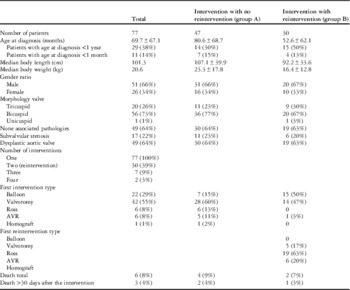
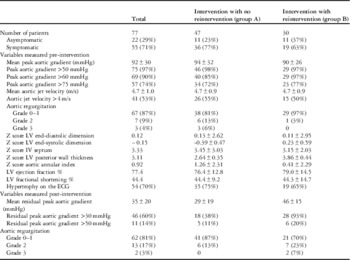
From January, 1985 to December, 2009, 77 patients who underwent intervention with congenital aortic valve stenosis were identified with a majority of male patients (n=51, 66%) (Table 1). The mean age of the cohort was 5.8±5.6 years. At diagnosis, 29 patients were <1 year old (38%), and 11 patients were <1 month old (14%). A bicuspid aortic valve was found in 56 patients (73%), a tricuspid valve in 20 (26%), and a unicuspid valve in one patient (1%). A muscular or fibromuscular subvalvular stenosis was associated in 17 cases (22%). A total of 49 patients (64%) had an aortic valve dysplasia with fibrotic, thickened, or hypoplastic leaflets. The majority of the patients (n=55, 71%) were symptomatic at diagnosis (Table 2), with 14 patients <1 year of age (18%) showing symptoms of congestive heart failure, such as dyspnoea or fatigue on exertion.
Baseline patient characteristics.

AVR=aortic valve replacement
Patients data before and after intervention.

IV=interventricular; LV=left ventricular
The mean peak aortic gradient before intervention was evaluated at 92±30 mmHg; more precisely, 75 patients (97%) had a peak aortic gradient >50 mmHg, 69 (90%) had a gradient >60 mmHg, and 57 (74%) had a gradient >75 mmHg. At the time of intervention, 67 patients (87%) had no or mild aortic regurgitation (grade 0–1). Signs of left ventricular hypertrophy with strain on ECG were found in three patients (3%).
Immediate results
The initial intervention was a surgical aortic valvotomy in 42 patients (55%), a percutaneous balloon aortic valvuloplasty in 22 patients (29%), a Ross procedure in six patients (8%), an aortic valve replacement in six patients (8%), and an aortic homograft replacement in one patient (1%).
The mean residual peak systolic valve gradient was 35 mmHg after intervention. Of the patients, 11 had residual gradients >50 mmHg (14%). The mean immediate peak systolic gradient was reduced by an average of 63% after the procedure. A gradient reduction of more than 40% occurred in 66 patients (86%).
The first intervention resulted in an increase of the proportion of patients with grade >1 regurgitation by 7% (from 13 to 20%). However, only 3% of the patients had a post-intervention regurgitation grade >3.
A total of four deaths (9%) were associated with the first intervention. Of these, three deaths happened in patients <1 month of age, two after surgical aortic valvotomy, and one after percutaneous balloon aortic valvuloplasty. Of these three deaths, two occurred in an interval <30 days after intervention because of cardiac insufficiency, and one happened 45 days after surgical valvotomy by a cardiac arrest after obstruction of the endotracheal tube. All of them had a severe preoperative aortic stenosis. The fourth death occurred in a 5.5-year-old patient who had severe congestive heart failure at diagnosis and died in an interval >30 days after surgical valvotomy.
Long-term results
Clinical follow-up information, including survival and need for repeat intervention, was available at a mean follow-up of 13.8±9.1 years (range 1-431 months, cumulative follow-up of 611 years).
Of the patients who underwent a first intervention, 30 (39%) required a reintervention in a mean interval of 7.6±5.3 years (range 0.5–251 months). A third intervention on the aortic valve was necessary in seven cases (6%), and a fourth intervention in two cases (2%). Owing to the sample size in what follows only the first reintervention is considered.
The indication for reintervention included restenosis in 17 cases (57%), aortic regurgitation in two (7%), and a combination of aortic stenosis and regurgitation in eight patients (27%). All of the 30 patients underwent surgery; none required a repeat balloon dilatation. A Ross procedure was necessary in 19 patients (17%), an aortic valve replacement in six patients (15%), and a surgical aortic valvotomy in five patients (5%).
When we evaluate the peak systolic valve gradient after the first procedure, we observe a progression or a recurrence of the stenosis in 39% of the cases. For example, 11 of the 30 patients (37%), who had to undergo a reintervention, presented a peak aortic gradient >75 mmHg before reintervention compared with two patients (7%) after first intervention, and 15 (50%) patients had a peak aortic gradient >50 mmHg before reintervention compared with six (20%) after first procedure. The mean peak aortic gradient before reintervention was 73±20 mmHg.
A similar effect was documented for the regurgitation after intervention. We observe a significant progression of regurgitation at follow-up, with 40% of these patients having a regurgitation grade >1 before reintervention as compared with 20% immediately after first procedure. Patients with regurgitation grade 3 increased from 3% after intervention to 18% at late follow-up.
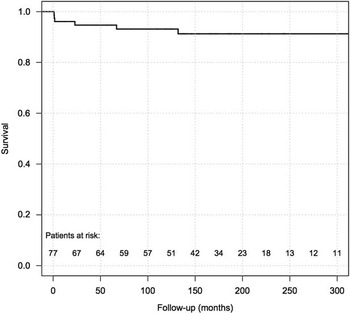
Long-term survival of patients with aortic stenosis after first procedure was excellent, with 96% survival at 1 year, 93% survival at 10 years, and 91% at 25 years, respectively (Fig 1). The only two late deaths were related to reintervention. One patient with a moderate aortic stenosis died after cardiac arrest at introduction of anesthesia, and the second one died of cardiac insufficiency by myocardial infarction 60 days after surgical valvotomy reintervention.
Kaplan-Meier estimates of survival after first intervention.

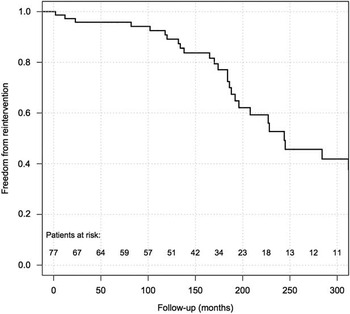
The estimated freedom from reintervention was 97, 89, 75, 53, and 42%, at 1, 10, 15, 20, and 25 years, respectively (Fig 2).
Kaplan-Meier estimates of freedom from reintervention.

Factors influencing long-term results
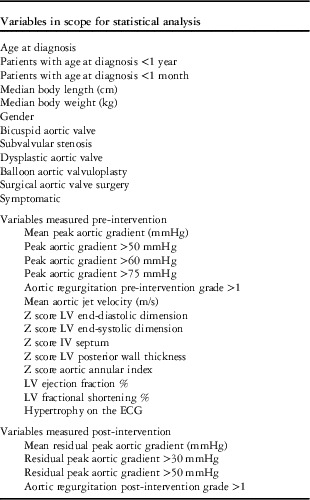
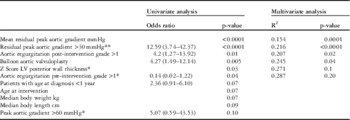
To evaluate possible predictors of repeat intervention after the first procedure, the 77 patients were divided into two groups consisting of 47 patients who did not have a repeat intervention on their aortic valve during the 25 years of follow-up (group A), and 30 patients who did (group B). Comparison of pre- and post-intervention characteristics for group A and group B are summarised in Table 2, significant factors are described below. Both univariate and multivariate analyses gave some similar results, suggesting that only increased left ventricular posterior wall thickness before intervention, balloon valvuloplasty, residual peak aortic gradient, and regurgitation grade >1 after the first procedure influenced significantly time to repeat intervention (Table 3).
Variables tested by statistical analysis.

IV=interventricular; LV=left ventricular
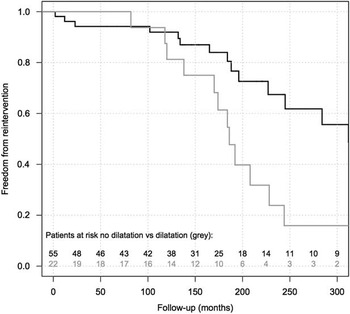
Patients who had undergone balloon valvuloplasty as the first procedure significantly underwent more repeat intervention than patients who had undergone surgical intervention. Estimated reintervention-free survival after balloon aortic valvuloplasty was 100, 81, 55, 16, and 8% at 1, 10, 15, 20, and 25 years, respectively, compared with 96, 92, 81, 67, and 56% for patients with no prior balloon valvuloplasty (Fig 3). Aortic regurgitation grade >1 after the first procedure independently predicted the chance of repeat intervention. The proportion of patients having a reintervention was twice as high when the aortic regurgitation grade was superior to 1. The greater the residual peak aortic gradient after procedure, the higher was the risk of repeat intervention. Moreover, a gradient cutoff point of 30 mmHg immediately after intervention was shown to be predictive of reintervention with a sensitivity of 87% and a specificity of 66%. Interestingly, the rate of reintervention was also influenced by increased left ventricular posterior wall thickness before intervention.
Kaplan-Meier estimates of freedom from reintervention from patients with prior balloon valvuloplasty compared with patients without prior balloon valvuloplasty.

The remaining variables, including gender, age, body surface, bicuspid aortic valve, subvalvular stenosis, dysplastic aortic valve, and surgical aortic valvotomy had no influence on time to repeat intervention, as well as the following pre-intervention values: symptoms, peak aortic gradient, aortic jet velocity, ejection fraction, fractional shortening, aortic regurgitation >1, left ventricular end-systolic and end-diastolic diameter, interventricular septum thickness, aortic annulus diameter, and hypertrophy signs on the ECG, which were not found to be significant predictors of outcome (Table 4).
Predictors of reintervention.

LV=left ventricular
* Measured before the intervention
** Multivariate analysis also performed independently with the 30 mmHg cut-off
Discussion
We present our experience with 77 consecutive paediatric patients with congenital aortic valve stenosis followed up in our institution, referral centre for ~1 million inhabitants, during a period of 25 years. Long-term survival after intervention is excellent; however, reintervention is frequently required.
Our immediate results after intervention confirm the findings of previous studies,Reference Gatzoulis, Rigby, Shinebourne and Redington 6 , Reference Pedra, Sidhu and McCrindle 14 – Reference Moore, Egito, Mowrey, Perry, Lock and Keane 20 namely, the first intervention was successful with a significant reduction in peak aortic and an immaterial increase in aortic regurgitation of the patients. Mortality rate in our study stood at 8% compared with other studies.Reference Vogel, Benson, Burrows, Smallhorn and Freedom 15 , Reference Hawkins, Minich and Tani 21 – Reference DeBoer, Robbins, Maron, McIntosh and Clark 25
The long-term survival results are good with a stable survival rate of 91% up to 25 years and are similar to other studies reporting a 10-year survival of 92–96%.Reference Reich, Tax and Marek 7 , Reference Hawkins, Minich and Tani 21 , Reference Brown, Dipilato, Chong, Lock and McElhinney 26 – Reference Fratz, Gildein and Balling 31 Yet, the low incidence of sudden death seems to support our selection criteria for early and repeat intervention.
The incidence of repeat intervention in the long term is important. There are several contemporary surgical reports describing excellent results with low reintervention rates (up to 90% free from reoperation at 10 years post-surgery).Reference Moore, Egito, Mowrey, Perry, Lock and Keane 20 , Reference Hawkins, Minich and Tani 21 , Reference Jindal, Saxena, Juneja, Kothari and Shrivastava 27 – Reference Detter, Fischlein, Feldmeier, Nollert and Reichart 30 , Reference Kugelmeier, Egloff, Real, Rothlin, Turina and Senning 32 , Reference Ettedgui, Tallman-Eddy and Neches 33 Our study shows comparable results in the first 10 years after intervention, but thereafter the freedom from reintervention decreases significantly. Over the past 20 years, much improvement has been made in interventional catheterisation and surgery, which should improve long-term results in these patients.
However, these comparisons are of limited value because of the inconsistent criteria used to determine the need for repeat intervention. Further investigation is warranted to optimise patient selection and appropriate criteria for the timing of reintervention.
Balloon valvuloplasty versus surgical valvotomy
In our study, there was a trend towards more reintervention in the patients who had a prior intervention with balloon valvuloplasty. Interestingly, the need for aortic valve reintervention after balloon dilatation was unrelated to age at the first procedure or to severity at presenting aortic stenosis.
Throughout the literature, we found various studies comparing results of balloon dilatation with surgical valvotomy.Reference Keane, Driscoll and Gersony 3 , Reference Gatzoulis, Rigby, Shinebourne and Redington 6 – Reference McCrindle, Blackstone and Williams 9 , Reference Moore, Egito, Mowrey, Perry, Lock and Keane 20 , Reference McCrindle 22 , Reference Alexiou, Chen and Langley 29 , Reference Detter, Fischlein, Feldmeier, Nollert and Reichart 30 , Reference Kugelmeier, Egloff, Real, Rothlin, Turina and Senning 32 , Reference Balmer, Beghetti, Fasnacht, Friedli and Arbenz 34 – Reference Galal, Rao, Al-Fadley and Wilson 36 However, these studies have a number of limitations including retrospective analysis, non-randomised patient group, comparisons between different time periods, different lengths of follow-up, and a lack of set criteria for intervention and reintervention. Despite these limitations, and with a lack of prospective randomised trials, these studies concede that the outcomes of balloon dilatation and surgical valvotomy are equivalent and that the type of intervention is not predictive of outcome.Reference Gatzoulis, Rigby, Shinebourne and Redington 6 , Reference Justo, McCrindle, Benson, Williams, Freedom and Smallhorn 8 , Reference McCrindle, Blackstone and Williams 9 This is in contrast with our findings that a shorter freedom from reintervention for patients undergoing balloon valvuloplasty is certainly because of a change in practice in our institution, with a more aggressive approach to aortic valve repair for paediatric patients over the last decade. Moreover, the technology of balloon valvuloplasty evolved during the last 25 years, with regard to size of the balloon and the risk of increasing aortic regurgitation, and may also explain this contrasting finding.
However, if a treatment strategy is adopted that uses balloon valvuloplasty as initial palliation instead of initial aortic valve surgery, patients may benefit from at least one less open-heart surgery in their life, thus lowering the risk of reoperation resulting from scar tissue and decreasing the risk of the neurodevelopmental consequences of cardiopulmonary bypass.Reference Bellinger, Jonas and Rappaport 37 Balloon valvuloplasty is also associated with shorter hospital stays and recovery periods as well as lower costs.Reference Gatzoulis, Rigby, Shinebourne and Redington 6 , Reference Pedra, Sidhu and McCrindle 14 , Reference Fratz, Gildein and Balling 31
Aortic regurgitation
As already described in some studies, we identified the presence of more than mild aortic regurgitation immediately after intervention as risk factors for reintervention.Reference Moore, Egito, Mowrey, Perry, Lock and Keane 20 , Reference Brown, Dipilato, Chong, Lock and McElhinney 26 , Reference Demkow, Ruzyllo and Ksiezycka 38 In addition, the 20% incidence rate of significant aortic regurgitation immediately after intervention, and the 40% incidence rate at follow-up, are of concern. The increase in aortic regurgitation over the period of follow-up reflects the progressive nature of this disorder. The observation that the degree of aortic regurgitation increases over time is universal, and is common to all case series, whether related to catheter or surgical intervention.Reference Pedra, Sidhu and McCrindle 14 , Reference Moore, Egito, Mowrey, Perry, Lock and Keane 20 – Reference Bauer, Schmidli, Vogt, von Segesser and Turina 23 , Reference Ettedgui, Tallman-Eddy and Neches 33 , Reference Weidman 39 – Reference Chartrand, Saro-Servando and Vobecky 41 In the literature, we observed a 7-19% increase in the degree of aortic regurgitation directly after intervention,Reference O’Connor, Beekman, Rocchini and Rosenthal 16 , Reference Moore, Egito, Mowrey, Perry, Lock and Keane 20 , Reference Fratz, Gildein and Balling 31 , Reference Demkow, Ruzyllo and Ksiezycka 38 and a 10-45% incidence of significant aortic regurgitation at late follow-up.Reference Justo, McCrindle, Benson, Williams, Freedom and Smallhorn 8 , Reference Pedra, Sidhu and McCrindle 14 , Reference Bauer, Schmidli, Vogt, von Segesser and Turina 23 – Reference DeBoer, Robbins, Maron, McIntosh and Clark 25 , Reference Fratz, Gildein and Balling 31 , Reference Balmer, Beghetti, Fasnacht, Friedli and Arbenz 34 , Reference Demkow, Ruzyllo and Ksiezycka 38 , Reference Weidman 39
Although risk factors for increasing aortic regurgitation have not been fully defined, it has been speculated that this is an inevitable occurrence because of the intrinsically abnormal morphology of the aortic valve, reflecting the modified natural history of this disorder. This is not surprising, considering that either the balloon of the interventionist, or the scalpel of the surgeon, cause variable splitting of the fused zones of apposition of the leaflets, this being the primary mechanism for valve dysfunction.Reference Waller, McKay, VanTassel, Taliercio, Howard and Green 42 Indeed, inspection at surgery shows commissural avulsion, tearing, perforation, extensive scarring, and calcification.Reference Phillips, Gerlis, Wilson and Walker 43 , Reference Bacha, Satou and Moran 44 Tear, perforation, or partial detachment could be easily explained by procedure.Reference Waller, McKay, VanTassel, Taliercio, Howard and Green 42 Furthermore, blow flow through the aortic valve leads to constant haemodynamic trauma.
Although it has been suggested that aortic regurgitation may be more frequent after balloon dilatation than surgical valvotomy,Reference McCrindle, Blackstone and Williams 9 data from our institution were also tested for these parameters but do not support this view, as described in other studies.Reference Justo, McCrindle, Benson, Williams, Freedom and Smallhorn 8 , Reference Fratz, Gildein and Balling 31 At late follow-up, aortic regurgitation increased significantly in both surgically and balloon dilated cohorts.
Residual peak aortic gradient
Congenital aortic valve stenosis is a progressive lesion and risk of reintervention after initial procedure on aortic valve stenosis is high.Reference Moore, Egito, Mowrey, Perry, Lock and Keane 20 , Reference Hawkins, Minich and Tani 21 , Reference Bauer, Schmidli, Vogt, von Segesser and Turina 23 , Reference Ettedgui, Tallman-Eddy and Neches 33 , Reference Galal, Rao, Al-Fadley and Wilson 36 , Reference Chartrand, Saro-Servando and Vobecky 41 Most series identify the higher residual gradients or a progressive and recurrent systolic pressure gradient after the first procedure as predictors for reintervention.Reference Reich, Tax and Marek 7 , Reference Brown, Dipilato, Chong, Lock and McElhinney 26 , Reference Fratz, Gildein and Balling 31 , Reference Balmer, Beghetti, Fasnacht, Friedli and Arbenz 34 , Reference Demkow, Ruzyllo and Ksiezycka 38 , Reference McElhinney, Lock, Keane, Moran and Colan 40 , Reference Jindal, Saxena, Juneja, Kothari and Shrivastava 45
In our study, the outcome of the first intervention on aortic valve stenosis in terms of immediate gradient reduction is comparable to that reported by others.Reference Gatzoulis, Rigby, Shinebourne and Redington 6 , Reference Reich, Tax and Marek 7 , Reference Vogel, Benson, Burrows, Smallhorn and Freedom 15 – Reference Shaddy, Boucek, Sturtevant, Ruttenberg and Orsmond 18 , Reference Moore, Egito, Mowrey, Perry, Lock and Keane 20 , Reference DeBoer, Robbins, Maron, McIntosh and Clark 25 , Reference Balmer, Beghetti, Fasnacht, Friedli and Arbenz 34 , Reference Lababidi, Wu and Walls 46 This attests the efficacy of aortic first intervention in relieving left ventricular outflow tract obstruction and confirms previous reports. However, 14% of the patients had acute residual gradient of 50 mmHg or greater, and 39% of the patients showed a progressive or recurrent systolic pressure gradient at late follow-up. Indeed, although in group A the peak aortic gradient after intervention remains low for many years, confirming a favourable and long-lasting success of first intervention in reducing the left ventricular pressure load in this group, in group B a significant increase in residual gradients was documented. Therefore, not surprisingly in our population, and in accordance with the results reported in the literature,Reference Satou, Perry, Lock, Piercey and Keane 47 , Reference Shim, Lloyd and Beekman 48 most of the reinterventions performed on the aortic valve were because of restenosis or persistent residual gradient.
More precisely, we identified a residual gradient immediately subsequent to the procedure >30 mmHg as a risk factor for reintervention. It confirms the findings of two previous studies. Pedra et alReference Pedra, Sidhu and McCrindle 14 found the risk of reintervention as increasing logarithmically for values of >30 mmHg. Galal et alReference Galal, Rao, Al-Fadley and Wilson 36 identified with multivariable stepwise logistic regression analysis an immediate residual gradient of >30 mmHg as predictor of restenosis. In a third study, Demkow et alReference Demkow, Ruzyllo and Ksiezycka 38 described some similar findings with a residual gradient of >40 mmHg after the procedure carrying a sixfold increase in relative risk for reintervention for restenosis. Although these studies have demonstrated similar outcomes and associated risk function, systematic comparison of different series are of limited value because of heterogeneous population, non-contemporary timeframes, lack of uniformity in defining restenosis, and variables criteria to determine the need of reintervention.
Left ventricular posterior wall thickness
Interestingly, we also found an initial echocardiographic factor as predictor of reintervention. The increased left ventricular posterior wall thickness before first intervention was independently associated with shorter freedom from reintervention. In the literature, we did not find a study highlighting these relationships. To find further implication of this parameter, it would be necessary to conduct a prospective randomised study.
Study limitations
There are several limitations to this study. The primary limitation is its retrospective design and the extended enrolment period, a process that may limit the applicability of our findings. For example, there has been substantial evolution in balloon technology, which may have influenced both technical variables and outcomes. Similarly, the patients have not been randomised in one group or the other, and thus the responsibility of intervention with balloon valvuloplasty or surgical valvotomy was incumbent on the surgeon or cardiologist and was not necessarily consistent over the course of the study period. In addition, this analysis is from a single institution, and the number of patients is relatively small and heterogeneous, and thus the results may not necessarily be generalisable to all patients with congenital aortic valve stenosis.
Conclusion
This study confirms that first intervention is a safe and effective procedure to provide a significant acute relief of congenital aortic stenosis. Owing to the progressive nature of this pathology and the palliative incidence of first intervention, sooner or later a reintervention would be necessary. Factors increasing the risk of reintervention include increased left ventricular posterior wall thickness pre-intervention, prior balloon valvuloplasty, higher residual peak systolic valve gradient, and more than mild regurgitation post-intervention. The study highlights that long-term or even life follow-up is recommended for these patients. Our findings should inform and help the specialist in his decision making for the long-term follow-up of congenital aortic valve stenosis.
Acknowledgement
The authors gratefully acknowledge the kind collaboration of the Cardiovascular Surgery and Pediatric Cardiology staff of the University Hospital of Lausanne.
Financial Support
This research received no specific grant from any funding agency, commercial, or not-for-profit sectors.
Conflicts of Interest
None.
Ethical Standards
The authors assert that all procedures contributing to this work comply with the ethical standards of the relevant national guidelines on human experimentation and with the Helsinki Declaration of 1975, as revised in 2008, and has been approved by the institutional committees (Prof. M. Burnier, President of the ethical commission on human experimentation (VD), 1011 Lausanne).