Historical aspects
By signing the Convention of Biological Diversity in Rio de Janeiro (Ministry of Environment of the Republic of Lithuania, Reference MINISTRY OF ENVIRONMENT OF THE REPUBLIC OF LITHUANIA1999), Lithuania committed itself to the preservation of its genetic resources including the unique Vishtines Goose population. In Lithuania goose production is related to the old tradition of roasting a goose for Christmas. This fact is confirmed by the Vallachian law issued in 1557 by Grand Duke of Lithuania Sigismundus Augustus, where it was indicated that, beside other various taxes, peasants where obliged to give their feudal lord one goose or 1.5 mite equivalent per every Vallach land (Jablonskis et al., Reference JABLONSKIS, JURGINIS and ZIUGZDA1955).
According to their biological properties, geese are pasture raised, grass eating birds. An important attribute of geese is their ability to consume green forages and other cheap crops (Romanov, Reference ROMANOV1999). Goose production does not require high amounts of concentrated feeds provided there are good pastures available. In autumn and winter concentrated feeds in goose diets can be replaced by succulent and roughage feeds. In Lithuania, geese have been the main meat poultry species for a long time. They were traditionally extensively grown on natural pastures for four to five months. Not only their meat, but their fat was valued, therefore, geese were fattened intensively before slaughter. For the most part geese were used to meet personal needs, whereas a smaller part was exported especially from the areas closer to Germany. As there were no slaughterhouses in Lithuania, large flocks of geese were driven across borders.
Lithuania was occupied by Russia until World War I and consisted of two provinces, Kaunas and Vilnius. According to the statistical data of 1897, 546,685 live geese were exported to Germany and Austria-Hungary (Kovno provincial statistical committee, Reference KOVNO PROVINCIAL STATISTICAL COMMITTEE1898). In 1918, Lithuania became independent and after a certain period, the Central Statistical Bureau indicated that, between 1932 and 1934, over 3 million geese were raised in Lithuania every summer. In winter the numbers of geese often decreased to only 250,000. In the above mentioned period from 379,706 to 476,077 geese were exported mostly to Sweden, England and Germany every year. Live and slaughtered geese accounted for, respectively, 80% and 20% of these numbers. Statistical data indicates that larger flocks of geese were kept in the areas with more favourable economic and market conditions. Geese accounted for 70% of all birds raised in Lithuania, and, on average, there were six geese kept per 100 ha of farmland (Central Statistical Bureau, Reference CENTRAL STATISTICAL BUREAU1930; Reference CENTRAL STATISTICAL BUREAU1933; Reference CENTRAL STATISTICAL BUREAU1934; Reference CENTRAL STATISTICAL BUREAU1935; Reference CENTRAL STATISTICAL BUREAU1939).
The number of geese increased after World War II during Lithuania's occupation by the Soviet Union because at that time there were lots of fields neglected by farmers. Peasant farms were greatly affected by people being deported to Siberia and collectivisation into communist farms when the land and property of people became state owned. Only 0.5-0.6 ha of land were left available to individuals (Vaikutis, Reference VAIKUTIS2005). Around the 1950's, goose farming was establishing on collective and state farms. According to the data of the Ministry of Agriculture of Lithuania, in 1955 122,515 goslings were incubated and in 1956 there were 132,300 geese on Lithuanian farms with 50 to 200 geese per farm. The geese of Lithuanian Vishtines and Pulkines breeds were most predominant on farms (Jackunas, Reference JACKUNAS1957). From the end of World War II to 1965 there were no distinct criteria for the development of poultry production. The year 1965 was the start of the development of intensive industrial poultry breeding, with the focus on breeding egg-type and meat-type chickens. As goose breeding was less profitable, it was increasingly neglected and, thus, the breed of Pulkines geese became completely extinct, whereas conservation flocks of Vishtines geese were established on farms near Moscow and the Ukraine.
After Lithuania regained its independence in 1990, 100 eggs of Vishtines geese were purchased from Russia in 1994 and, thus, the breed was restored with currently two conservation flocks of 150 geese each. It is thought that that there are also about 3000-5000 birds kept by individual breeders and farmers.
Origin of Vishtines geese
The breed was developed at the turn of the 19th and 20th centuries on peasant farms via non-selective breeding. Later, local geese were crossbred with East Prussian, Pomeranian and Emden geese, and in 1954, the Vishtines was recognized as an individual breed (Jackunas, Reference JACKUNAS1957; Maciulaitis et al., Reference MACIULAITIS, KRIUKIENE and KAULYTE1998). Vishtines geese belong to Emden phenotype (Romanov, Reference ROMANOV1999).
Breed development was influenced by goose pasturing conditions because, already in the first few days after hatching, goslings were driven to pastures and fed crushed wet peas once or twice a day. In autumn, winter and spring periods, geese were typically fed twice a day. Morning and afternoon allowances consisted of wet pea feed and in the evening oats were offered.
The houses for goslings were heated until four weeks of age, depending on the temperature outdoors. Geese of this breed were good layers but bad hatchers. Their eggs were brooded under hens or turkey hens for hatching, and it is most probable that for to this reason geese were named Vishtines (Lith. Višta means hen). Vishtines geese were mostly spread in the south, south-east and west of Lithuania (Cikotas, Reference CIKOTAS1930; Strazdas, Reference STRAZDAS1941).
Geese genetics
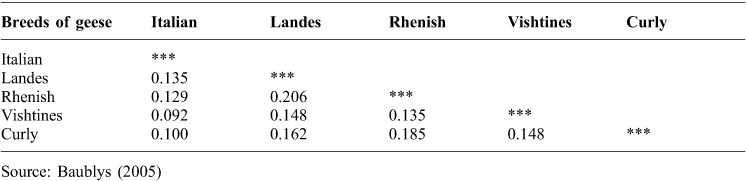
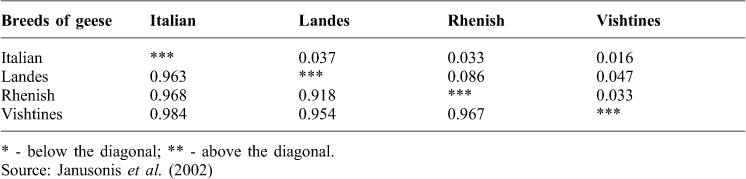
Janusonis et al. (Reference JANUSONIS, RAZMAITE and SRUOGA2002) analysed the genetic differentiation of Vishtines, Italian and Landes geese using polymorphic blood sera protein system electrophoresis. The analysis indicated that Vishtines geese differed from Landes geese belonging to the Toulouse phenotype by the allelic frequency in five loci: albumin (Al), post-albumin (PostAl), pretransferin (PreTf), macroglobulin (Mc) and transferin (Tf). Meanwhile, the difference between Vishtines and Italian geese was detected only in the allele frequency in two loci, post-transferin (PostTf) and transferin (Tf). It should be noted that both breeds belong to the same Emden phenotype. The study indicated that the observed heterozygote frequency in Vishtines geese corresponded to the theoretical one according to the Hardy-Weinberg equilibrium (Baublys, Reference BAUBLYS2005). Biochemical genetic similarity analysis indicated (Table 1) that the smallest genetic distance (according to Wright, Reference WRIGHT1978) is between Italian and Vishtines breeds (0.092). The genetic distance between Vishtines and Landes goose breeds is 0.148, Vishtines and Rhenish 0.135 and Vishtines and Curly 0.148 (Baublys, Reference BAUBLYS2005). Other authors indicated that the highest genetic identity and the lowest genetic distance (according to Nei, Reference NEI1972) were calculated for Vishtines geese and Italian geese (0.984 and 0.016, respectively) (Table 2). At the same time the lowest genetic identity and the highest genetic distance were calculated for Vishtines and Landes geese (0.954 and 0.047, respectively) (Janusonis et al., Reference JANUSONIS, RAZMAITE and SRUOGA2002; Sruoga et al., Reference SRUOGA, JANUSONIS, BUTKAUSKAS, MOZALIENE and RAZMAITE2002). Lithuanian Vishtines and Italian goose breeds have common origins and similar phenotypes (Sruoga et al., Reference SRUOGA, BUTKAUSKAS, BAUBLYS, PAULAUSKAS, MOZALIENE, JANUSONIS and RAZMAITE2004).
Genetic distance between goose breeds (Coefficients according to Wright, Reference WRIGHT1978).
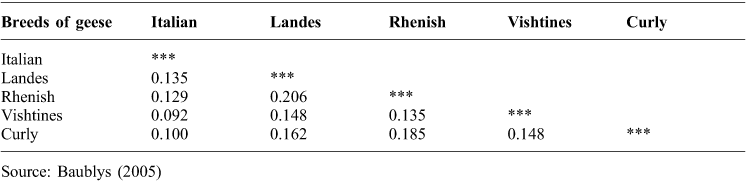
Source: Baublys (Reference BAUBLYS2005)
Cluster analysis showed that Italian and Vishtines geese make up one cluster in the dendrogram. Genetically most distant from these is the Landes goose breed (Thoulouse phenotype) which makes up a separate branch in the dendrogram (Janusonis et al., Reference JANUSONIS, RAZMAITE and SRUOGA2002; Sruoga et al., Reference SRUOGA, JANUSONIS, BUTKAUSKAS, MOZALIENE and RAZMAITE2002; Baublys, Reference BAUBLYS2005). Microsatellite DNA analysis with three primers (TTUCG-1; TTUCG-2; TTUCG-4) showed that among the goose breeds raised in Lithuania, Vishtines and Curly geese had the lowest mean genetic distance (0.282). Cluster analysis by microsatellite DNA revealed that Vishtines geese made up a separate cluster in the phylogenetic tree of goose breeds.
The results from biochemical protein polymorphism and microsatellite analysis indicate that Vishtines geese are unique and can be distinguished by biochemical genetic individuality (Baublys, Reference BAUBLYS2005).
Genetic identity* and genetic distance** between goose breeds (Coefficients according to Nei, Reference NEI1972).
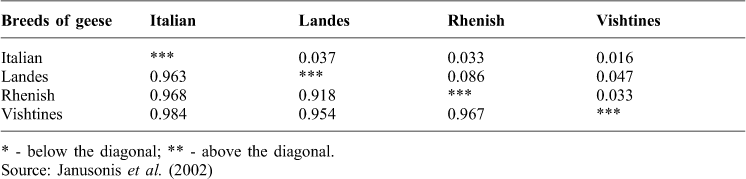
* - below the diagonal; ** - above the diagonal.
Source: Janusonis et al. (Reference JANUSONIS, RAZMAITE and SRUOGA2002)
Body conformation of Vishtines geese
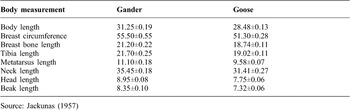
In literature sources, the body conformation of Vishtines geese is described as follows: Vishtines geese are rather large in size with medium-sized head, blue eyes and straight short orange beak. The neck is arched and of medium length. The breast is broad and deep. The back is straight, horizontal, the shanks are long and orange. There are one or two skin folds on the abdomen. The plumage is white but mottled colours may occur as well. Ganders are usually white. The live weight of males is 6-7 kg and that of females 5-6 kg (Jackunas, Reference JACKUNAS1957; Maciulaitis et al., Reference MACIULAITIS, KRIUKIENE and KAULYTE1998). The body measurements of Vishtines geese are presented in Table 3.

Individual body measurements of Vishtines ganders are somewhat higher than those of geese. Sexual dimorphism of these geese is not distinct and poorly expressed by secondary sexual characteristics (Jackunas, Reference JACKUNAS1957). Three most important conformation indices are mass, breastbone and chest indices. The conformation indices for Vishtines geese indicated by Jackunas (Reference JACKUNAS1957) did not differ significantly between the ganders and geese. The index of mass that characterises body compactness and condition score was 5.66 and 5.96, respectively, for ganders and geese. The breastbone index indicating the muscling score of the bird also did not differ significantly and was 0.617 and 0.621, respectively, for ganders and geese. It should be noted that this is characteristic of many goose breeds. The chest index, which indicates the breast muscle development, was 1.67 and 1.69 for ganders and geese respectively.
Poult growth and development
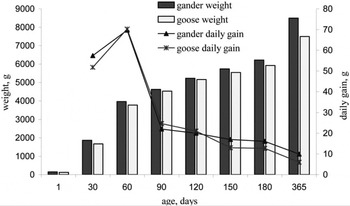
The most intensive development of the young of Vishtines geese takes place in the first two months after birth. Daily weight gain in the first month is from 55 to 65 g. In the second month, daily weight gain increases to approximately 70 g, and at two months of age, goslings reach 50% of adult goose weight. The growth rate is much slower in the third month when daily weight gain amounts to only 20-30 g. Poult weight changes are presented in Figure 1.
Goslings weight dynamics
Maciulaitis et al. (Reference MACIULAITIS, KRIUKIENE and KAULYTE1998) indicated that the weight of goslings differed significantly in different groups (CV from 11 to 14%). Goslings also differed in size. According to Jackunas (Reference JACKUNAS1957) the weight of goslings at the age of 30 days varied by 60% for males and 52.2% for females, whereas at the age of 120 days it varied by 42.2% for males and 28.3% for females.

Reproduction of Vishtines geese
Egg laying for geese begins at the age of 250-280 days. First year geese lay from 10 to 20 eggs in the spring period, second and third year geese lay up to 30 and 35 eggs respectively. In year four, egg-laying rate decreases significantly and amounts to only 20-25 eggs (Jackunas, Reference JACKUNAS1957). According to Zarkova (Reference ZARKOVA2007) Vishtines geese are more stress susceptible (when not allowed to pasture) than the geese of other breeds. The average egg weight of first, second and third year geese was 140-160g and 170 and up to 190 g, respectively. The weight of egg-laying geese decreases in line with the weight of their eggs. The weight of the final eggs produced is approximately 10 to 13% lower than that of the first eggs.
Vishtines geese are poor hatchers. Egg fertilization reaches 75-80 and 80-90% for, respectively, yearlings and the oldest geese. The average rate of gosling production is approximately 60-75% (Jackunas, Reference JACKUNAS1957; Maciulaitis et al., Reference MACIULAITIS, KRIUKIENE and KAULYTE1998). The main selection of the breeding flock should be carried out at the age of two months because, if the birds are selected at the age of five to six months, the already existing pairs are disjointed and subsequent egg fertilization of the first year geese is lower. In small flocks, the sex of 80% of geese can be determined by appearance at the age of four to five months.
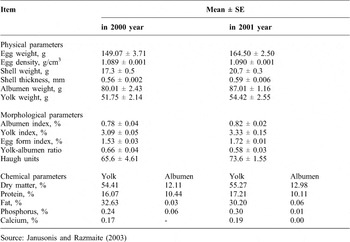
Goose eggs in Lithuania are mostly used for incubation. In 2000 and 2001, physical and morphological characteristics of eggs and their chemical parameters (Table 4) were investigated to determine their effects on incubation data (Janusonis and Razmaite, Reference JANUSONIS and RAZMAITE2003). Egg weight determined by Janusonis and Razmaite (Reference JANUSONIS and RAZMAITE2003) ranged from 149.1 to 164.5 g and this range did not vary greatly in comparison with the data (145.5-183.6g) presented by Jackunas (Reference JACKUNAS1957). Egg weight comparisons indicated that Vishtines goose eggs are larger than those of Native Turkish Geese (147.9-150.9 g) but similar to those of Landes geese (avg.173.1 g) and INRA geese (144.2-172.3 g) (Molnar, Reference MOLNAR1990; Tilki and Inal, Reference TILKI and INAL2004; Saatchi et al., 2005).
Egg quality of Vishtines geese in the years 2000 and 2001.

Source: Janusonis and Razmaite (Reference JANUSONIS and RAZMAITE2003)
A close positive correlation between the density of goose eggs and their hatchability was found by Bogenfürst (Reference BOGENFÜRST1995). It was determined that goose egg densities for incubation should not be lower than 1.083 g/cm3 (Parkinson et al., Reference PARKINSON, SAUTER, PETERSEN and STEELE1982). Janusonis and Razmaite (Reference JANUSONIS and RAZMAITE2003) indicated that the egg density of Vishtines geese was optimum and amounted to 1.089-1.090 g/cm3. Moreover, the studies showed that the higher is the density of eggs, the higher is the quality of the shell (Parkinson et al., Reference PARKINSON, SAUTER, PETERSEN and STEELE1982). According to Janusonis and Razmaite (Reference JANUSONIS and RAZMAITE2003), the shell thickness of Vishtines goose eggs was 0.56-0.59 mm or 0.04-0.08 mm higher than that of INRA geese (0.51-0.55 mm according to Tilki and Inal, Reference TILKI and INAL2004) and 0.03-0.06 mm lower than that of Landes geese (0.62 mm) as indicated by Molnar (Reference MOLNAR1990).
Haugh units for Vishtines goose eggs ranged from 65.6 to 73.6 in accordance with the findings of Janusonis and Razmaite (Reference JANUSONIS and RAZMAITE2003), and were similar to those of INRA geese (71.5) according to the findings of Tilki and Inal (Reference TILKI and INAL2004). Molnar (Reference MOLNAR1990) indicated that the optimal index of goose egg for incubation is 1.36-1.65. The egg index of Vishtines geese was found to be 1.53-1.72% and might be considered as optimum. In comparison it can be mentioned that the egg index of Landes geese is 1.69% (Molnar, Reference MOLNAR1990; Janusonis and Razmaite, Reference JANUSONIS and RAZMAITE2003). The dry matter, protein and fat in the egg yolk of Vishtines geese were, respectively, from 11.3-12.2%, 0.57-1.7% and 4.7-7.1% higher in comparison with the egg yolk of some other breeds. Egg albumen had greater dry matter and protein, respectively, by 2.5-3.4% and 2.2-2.5% but had 0.04 to 0.07% less fat in comparison with the egg albumen of some other breeds (Yuwanta, Reference YUWANTA2002; Janusonis and Razmaite, Reference JANUSONIS and RAZMAITE2003).
Performance of Vishtines Geese
fattening
The main product from Vishtines geese is their dark specifically-flavoured meat. Jackunas and Kazlauskas (Reference JACKUNAS and KAZLAUSKAS1963) and Juodka et al. (Reference JUODKA, JANUSONIS and BENEDIKTAVICIUTE2008) indicated that these geese are suitable for the production of feathers and liver. Vishtines geese are noted as one of the breeds most suitable for down production (Bogdanov, Reference BOGDANOV1996). The main purpose of goose fattening is to increase live weight, improve meat quality and accumulate more fat of high nutritional value. According to Jackunas (Reference JACKUNAS1957), the fattening results from Vishtines geese with an average body weight of 6.14 kg at 6 months of age were as follows: daily weight gain in the first fattening week was 101.2 g. in the second and third weeks it was 22.9 g and 40.7 g lower, respectively, and in the last fattening week the daily weight gain amounted to only 21.6 g. During the allocated 27 fattening days geese gained 1.83 kg (Table 5). Fattening of Vishtines geese could be improved by 20%. From economic viewpoint it is most expedient to fatten geese of this breed from 15 to 20 days (Jackunas, Reference JACKUNAS1957).

carcass traits
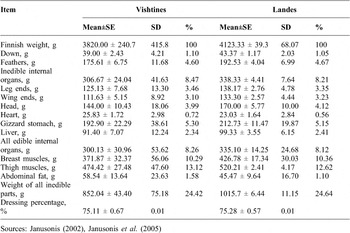
Vishtines goslings were grown together with Landes goslings in trials to compare their slaughter results at nine weeks of age (Janusonis, Reference JANUSONIS2002; Janusonis et al., Reference JANUSONIS, JUODKA, BENEDIKTAVICIUTE-KISKIENE and RAZMAITE2005). Controlled slaughtering indicated that important carcass indicators such as weight of feathers, down and liver were very similar for both breeds (Table 6). The percentage (% live weight) of feathers, down and liver was, respectively, 4.6, 1.1 and 2.3% for Vishtines geese and correspondingly 4.7, 1.05 and 2.4% for Landes geese. Abdominal fat accounted for, respectively, 1.6 and 1.1% of the carcass. All the edible parts in the abdominal cavity made up 8.3% in Vishtines goslings and 8.1% in Landes carcasses. The percentage of breast muscle was almost the same for both breeds (10.29-10.36%) but the weight of thigh muscle was 0.5% higher for Vishtines goslings, yet the difference was not statistically significant. The dressing percentage for Vishtines and Landes breeds was, respectively, 75.1 and 75.3%. It was concluded from this research that there were no significant differences for such economically important carcass characteristics as feathers, down, liver, breast and thigh muscles and dressing percentage in both Vishtines and Landes goslings. Juodka et al. (Reference JUODKA, JANUSONIS and BENEDIKTAVICIUTE2008) found that control slaughtering of Vishtines and Italian geese showed almost similar amounts of breast muscles and abdominal fat, respectively, 10.2 and 10.1% and 1.3 and 1.2%.
Slaughter data from nine-week old goslings.

Sources: Janusonis (Reference JANUSONIS2002), Janusonis et al. (Reference JANUSONIS, JUODKA, BENEDIKTAVICIUTE-KISKIENE and RAZMAITE2005)
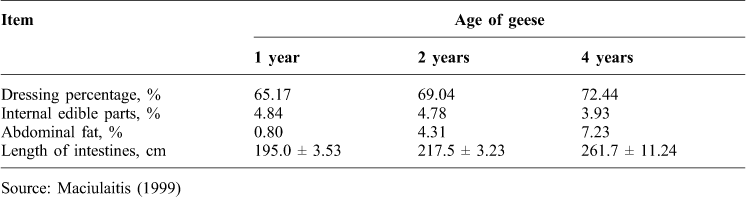
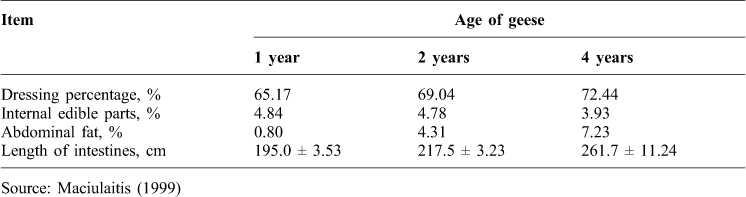
Anatomical carcass dissection of Vishtines geese of various ages (Table 7) indicated that the amount of abdominal fat for second year geese increased five-fold and for four year geese 9 fold. The dressing percentage also increased with age, being 3.87% for the second year and 7.27% for the four year old geese (Maciulaitis, Reference MACIULAITIS1999).
The comparison of the dressing percentage from two-year-old Vishtines geese with that of Turkish local geese at the age of 104 weeks indicated that it was lower, i.e. 69.0% vs. 69.3-71.6% (Isguar and Pingel, Reference ISGUAR and PINGEL2003). The higher the age of the Vishtines goose, the lower the proportion of edible parts from the abdominal cavity. The decrease was significant for only 0.06% of second year geese and as high as 0.91% for four year geese (Maciulaitis, Reference MACIULAITIS1999).
meat quality
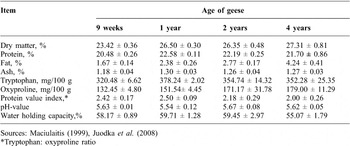
The highest protein content (22.5%) in breast muscles of Vishtines geese (Table 8) was found at the age of 12 months. From one to four years of age the protein content in breast muscle decreased by 0.88%. The protein content in the breast muscles of nine-week old geese was 1.22 to 2.10% less in comparison with one-to-four year old geese. The fat content was lowest (1.67%) in the breast muscles of nine-week-old geese. Later the fat content increased and was higher by 0.7, 1.1 and 2.6% for, respectively, one year, two-year and four-year-old geese (Maciulaitis, Reference MACIULAITIS1999; Juodka et al., Reference JUODKA, JANUSONIS and BENEDIKTAVICIUTE2008).
Chemical composition and physical parameters of breast muscles of Vishtines geese.

Sources: Maciulaitis (Reference MACIULAITIS1999), Juodka et al. (Reference JUODKA, JANUSONIS and BENEDIKTAVICIUTE2008)
*Tryptophan: oxyproline ratio
The comparison of the chemical composition of breast muscles in Vishtines goslings at nine weeks of age and in Polish White Koluda goslings at ten weeks of age indicated that the protein and ash contents were similar, i.e. 20.5 vs. 20.0% and 1.2 vs. 0.9%, whereas the contents of dry matter and fat were one per cent higher (24.8 vs. 23.4% and 2.7 vs. 1.7%). There were differences for the pH-value and water holding capacity between Vishtines and White Koluda geese, respectively 5.6 vs. 6.2% and 58.2 vs. 44.6% (Maciulaitis, Reference MACIULAITIS1999; Biesiada-Drzazga, Reference BIESIADA-DRZAZGA2006; Juodka et al., Reference JUODKA, JANUSONIS and BENEDIKTAVICIUTE2008).
The comparison of the protein and fat contents in the breast muscles of two-year-old Vishtines and similar age Turkish local geese showed that Vishtines geese had higher protein and fat, respectively, 22.2 vs. 18.0-22.0% and 2.8 vs. 0.2-0.5% (Maciulaitis, Reference MACIULAITIS1999; Isguar and Pingel, Reference ISGUAR and PINGEL2003). The lowest amount of the essential amino acid tryptophan was found in nine-week old goslings (320 mg/100g). Correspondingly, the highest amount (378 mg/100 g) was determined for 12 month old geese and after which it decreased from 24 mg/100 g in two-year-old to 26 mg/ 100 g in four-year-old geese.
The content of oxyproline was increasing with the age of geese. The oxyproline content was the lowest in the muscles of nine-week-old goslings (132.45 mg/100 g), it increased by 19 mg/100 g in the muscles of 12-month-old geese and by 39 and 47 mg/100 g in, respectively, two-year and four-year-old geese. Higher protein value index (tryptophan/oxyproline ratio) was found in 12-month-old geese (2.50). The protein value index was 2.18 and 2.00 in the muscles of two-year and four-year-old geese, respectively. The tryptophan content in the breast muscles of Vishtines geese was lower than that in the breast muscles of Italian geese, i.e. 320 mg/100 g vs. 336 mg/100 g, but the difference was not significant (P>0,05). However, the content of oxyproline was higher and was 132 mg/100 g vs. 118 mg/100 g (Maciulaitis, Reference MACIULAITIS1999; Juodka et al., Reference JUODKA, JANUSONIS and BENEDIKTAVICIUTE2008).
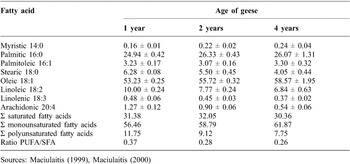
Breast muscles of one-year-old Vishtines geese (Table 9) contained 0.16% saturated myristic (C 14:0) fatty acid and with older age this content increased to 0.22-0.24%. However, the highest content of saturated stearic (C 18:0) fatty acid was found in one-year old geese (6.3%), it was 0.8 and by 2.2% lower in two-and four-year-old geese, respectively. The levels of monounsaturated oleic (C 18:1) acid was 53.2% in one year old geese and, respectively, by 2.5 and 5.3% higher in two and four-year-old geese. Meanwhile, the lowest total content of monounsaturated fatty acids was determined for one-year-old geese (56.5%) and the highest (61.9%) for four-year-old geese.
Omega-6 linoleic (C 18:2) and arachidonic (C 20:4) acids were highest, in the breast muscles of one-year-old geese and accounted for 10.0 and 1.3% of total fat, respectively. With the increasing age, the levels of these acids decreased by 3.2 and 0.7%, respectively. The same tendency was observed with omega-3 linoleic fatty acid: 0.5% in one-year-old geese and, respectively, by 0.03 and 0.1% lower in two-year- and four-year-old geese. It should be noted that the total content of polyunsaturated fatty acids decreases with age of Vishtines geese, i.e. from 11.8% in one-year-old geese to 7.8% in four-year–old geese. At the same time the PUFA/SFA ratio decreases from 0.37 to 0.26, respectively, in one-year and four-year old geese. Hence, as well as the total content of PUFA declining, the quality of fatty acid composition in Vishtines geese becomes lower with age (Maciulaitis, Reference MACIULAITIS2000).
Fatty acid content in breast muscles of Vishtines goose breed, %.

Sources: Maciulaitis (Reference MACIULAITIS1999), Maciulaitis (Reference MACIULAITIS2000)
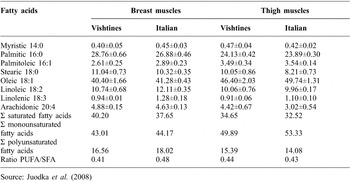
The contents of saturated palmitic and stearic acids (Table 10) in the breast meat of Vishtines geese were respectively 1.9 and 0.7% higher than Italian geese. Meanwhile, the contents of monounsaturated palmitoleic and oleic fatty acids were lower by 0.3 and 0.9% respectively. The contents of polyunsaturated linoleic and linolenic acids in the breast muscles of Vishtines geese were lower (by 1.4 and 0.3%) and that of arachidonic acid which was 0.3% higher in comparison with the Italian goose breed. The PUFA/SFA ratio in the breast muscles of both breeds was similar.
The content of saturated stearic fatty acid in the thigh muscles of Vishtines geese was 1.8% higher than that of Italian geese. The content of monounsaturated oleic fatty acid was significantly higher (3.4%) in the thigh muscles of Italian geese. The contents of polyunsaturated linoleic and linolenic acids were similar in the thigh muscles of both breeds (a difference of 0.1-0.2%) and the content of arachidonic fatty acid was higher (1.4%) in Vishtines geese. The PUFA/SFA ratio in the thigh muscles of both breeds was almost identical. The PUFA/SFA ratio (0.4) in breast and thigh meat of both breeds meet the requirements for healthy food (Noble and Penny, Reference NOBLE and PENNY2002; Juodka et al., Reference JUODKA, JANUSONIS and BENEDIKTAVICIUTE2008).
Fatty acid composition (%) in the muscles of Vishtines and Italian geese.

Source: Juodka et al. (Reference JUODKA, JANUSONIS and BENEDIKTAVICIUTE2008)
Conclusions
Genetic studies indicated that the Lithuanian goose breed referred to as ‘Vishtines’ (belonging to the Emden phenotype) makes up a separate branch in the dendrogram and, therefore, is unique and important in the world goose gene pool. The geese of this breed are suitable for meat, down and liver production and could be included into the diets of the people in Lithuania, especially because the PUFA/SFA ratio in the meat of these geese meets the human requirements for healthy food. These geese are also considered to be an attraction in the farmsteads of rural tourism and can be used as a historic relic for educational purposes.