The markers and outputs of variables relating to positive psychology have been researched in many different samples. The reflection of life satisfaction, especially, has been investigated in adolescents (Cikrikci & Odaci, Reference Cikrikci and Odaci2016), university students (Kong, Ding, & Zhao, Reference Kong, Ding and Zhao2015), adults (Kong & Zhao, Reference Kong and Zhao2013), and the elderly (Gutiérrez, Tomás, Galiana, Sancho, & Cebrià, Reference Gutiérrez, Tomás, Galiana, Sancho and Cebrià2013). As emotional fluctuations are experienced intensely in the adolescent period (Steinberg, Lowe Vandell, & Bornstein, Reference Steinberg, Lowe Vandell and Bornstein2011), there is more variability in their mental state compared to adults (Csikszentmihalyi & Larson, Reference Csikszentmihalyi and Larson1984). As a result we planned to complete this study with adolescents. The aim of the study was to research the variables mediating the correlation between test anxiety, a universal phenomenon in adolescence (Beidel, Turner, & Taylor-Ferreira, Reference Beidel, Turner and Taylor-Ferreira1999; Erzen & Odacı, Reference Erzen and Odacı2016; Segool, Carlson, Goforth, Von Der Embse, & Barterian, Reference Segool, Carlson, Goforth, Von Der Embse and Barterian2013) and life satisfaction. In this way, the mediating role of self-esteem and optimism was researched. To achieve the aim of the research, four hypotheses were developed and the reality of each hypothesis was determined.
Life Satisfaction
Life satisfaction has been founded on the theoretical basis of subjective wellbeing, which is associated with the hedonic dimension of wellbeing. Accordingly, subjective wellbeing is the assessment of life by individuals in light of pleasurable desires (hedonic-pleasure principle; Ryan & Deci, Reference Ryan and Deci2001). Subjective wellbeing is a high-order conceptual construct formed by the combination of three low-order constructs: positive affect, negative affect, and life satisfaction. Positive affect indicates the intensity (i.e., frequency) of positive emotions, while negative affect describes the intensity of negative emotions such as sadness, worry and anxiety (Diener, Reference Diener2000). The third construct ensuring satisfaction with life as a whole encompasses life satisfaction (Diener & Diener, Reference Diener and Diener1996). The emotions and thoughts of an individual directly or indirectly affect their experiences. As a result of cognitive assessments by the individual about their experiences, a perception of satisfaction is created toward a specific area of life or life as a whole. In this way, cognitive assessments of life as a whole conceptualise life satisfaction (Diener, Oishi, & Lucas, Reference Diener, Oishi and Lucas2003). Life satisfaction is an evaluation of quality of life made by the individual in light of their own criteria (Shin & Johnson, Reference Shin and Johnson1978). Çikrıkci (Reference Çikrıkci2016) defined life satisfaction as cognitive evaluation of the individual's achieved and desired hedonic gains and stated that if the distance between these gains is close, it may be a marker of high levels of life satisfaction.
Test Anxiety
Anxiety is a future-oriented emotion that may develop toward an event, object or person (Craig & Chamberlain, Reference Craig, Chamberlain, Stein, Hollander and Rothbaum2009). The subjective form of test anxiety is a cognitive, emotional and behavioural reaction to the chance of failure encountered during evaluation situations (Zeidner & Safir, Reference Zeidner and Safir1989). Stated differently, the anxiety created in an individual by tests or similar evaluation situations is defined as test anxiety (Putwain, Woods, & Symes, Reference Putwain, Woods and Symes2010). Test anxiety generally is assessed in two dimensions: cognitive and affective. The cognitive dimension is characterised by worry. Worry is a cognitive statement of anxiety relating to performance and possible failure of an individual. The affective dimension comprises the autonomic reactions caused by test anxiety in an individual (Wigfield & Meece, Reference Wigfield and Meece1988).
The View of Counsellors on Test Anxiety
In contemporary education, it is clear that there is a need for multifaceted and qualified individuals to lead society forward. As student personality services are considered to be essential in current educational understanding, there are preliminary tasks for school counsellors. Test anxiety appears not to be just an educational performance-focused phenomenon. Psychological help services should meet the personal social needs (i.e., provide personal guidance) of the students and make it easier to learn (i.e., educational guidance). In the relevant literature, there are studies that can advise school counsellors in combating test anxiety (Larson, Ramahi, Conn, Estes, & Gihbellini, Reference Larson, Ramahi, Conn, Estes and Ghibellini2010; Ramirez & Beilock, Reference Ramirez and Beilock2011; Shobe, Brewin, & Carmack, Reference Shobe, Brewin and Carmack2005). In these studies, it seems that the interventions for test anxiety are based on the cognitive behavioural approach. Writing out the thoughts that cause test anxiety, relaxation and breathing exercises, imagination, and imagining the moment of testing in a safe environment are among the applied approaches. It may be that school counsellors’ use of the cognitive behavioural approach is effective for working with test anxiety. Ergene (Reference Ergene2003) reported in a meta-analysis study that group guidance for test anxiety was more effective than individual guidance. It is recommended that school counsellors use group guidance to reduce test anxiety during adolescence, when peer interaction is very common and effective. Von Der Embse, Barterian, and Segool (Reference Von Der Embse, Barterian and Segool2013) recommend school counsellors use cognitive behavioural techniques to reduce test anxiety. Finally, Von Der Embse and Hasson (Reference Von Der Embse and Hasson2012) speak of the benefits of positive internal speech for the cognitive dimension of test anxiety, whereas relaxation exercises are beneficial for the affective dimension of test anxiety.
Test Anxiety and Life Satisfaction
In the literature, the effects of test anxiety on the academic success of students have been discussed. There is a consensus that high levels of test anxiety negatively affect student performance (Sung, Chao, & Tseng, Reference Sung, Chao and Tseng2016). Adolescence has critical importance in terms of physical and psychological development (Steinberg et al., Reference Steinberg, Lowe Vandell and Bornstein2011). Friedman and Bendas-Jacob (Reference Friedman and Bendas-Jacob1997) noted that test anxiety is observed more in adolescents while they are engaged in their education. Additionally, the effect of test anxiety on adolescents, apart from academic performance, is still a topic of curiosity. Lufi, Okasha, and Cohen (Reference Lufi, Okasha and Cohen2004) reported that test anxiety may affect many areas of life in adolescence. The performance of adolescents should not be evaluated solely with an academic focus (e.g., academic achievement) when the role of test anxiety on the lives of adolescents is investigated. Adolescents can experience the devastating effect of test anxiety in other important dimensions of life, such as family experiences (Peleg-Popko, Reference Peleg-Popko2002), social support resources (Bharathi, Sasikala, Nandhitha, & Karunanidhi, Reference Bharathi, Sasikala, Nandhitha and Karunanidhi2015; Sarason, Reference Sarason1981), motivation resources (Carden, Bryant, & Moss, Reference Carden, Bryant and Moss2004; Yeşilyurt, Reference Yesilyurt2014), and even physiological structures (Glazeski, Hollandsworth, & Jones, Reference Glazeski, Hollandsworth and Jones1986; Morris & Liebert, Reference Morris and Liebert1970).
The life satisfaction of adolescents may also be assessed as one of these areas of effect. In the literature, no study was found on the correlation between test anxiety and life satisfaction. However, studies have evaluated the correlations between test anxiety and some psychological constructs (Akinsola & Nwajei, Reference Akinsola and Nwajei2013; Liu & Lu, Reference Liu and Lu2012). The common point in these studies is that test anxiety is correlated with negative mental processes. When the aetiology of test anxiety and its effects on the individual are assessed, it is probable that life satisfaction is negatively affected by test anxiety. Among adolescents making efforts to obtain success academically, high levels of test anxiety can cause them to obtain less success (Fincham, Hokoda, & Sanders Jr., Reference Fincham, Hokoda and Sanders1989). In this situation, the distance between the target success and obtained success increases.
In terms of academic performance, adolescents experiencing test anxiety in different psychological, social, and emotional dimensions are unlikely to reach their goals. When test anxiety becomes an important obstacle to the psychological, social and emotional gains an adolescent strives toward, the hedonic gains in the academic field and other areas of life may not coincide. It is assumed that life satisfaction of adolescents will be adversely affected by this process as a reflection of the increase in distance between gains, and so the experience of life satisfaction in adolescents will be negatively affected by this process. The first hypothesis of our study was created from this viewpoint.
Hypothesis 1: Test anxiety is a significant negative predictor of life satisfaction.
Test Anxiety, Self-Esteem, and Optimism
Self-esteem is a psychological construct with vital importance for the continuation of life (Branden, Reference Branden1969). For this reason it is a concept that has attracted the attention of researchers for many years (Coopersmith, Reference Coopersmith1967; Rogers, Reference Rogers1961; Rosenberg, Reference Rosenberg1965). Self-esteem is an assessment of a comprehensive presentation, including cognitive and behavioural aspects of the self (Mruk, Reference Mruk2006). Through this assessment, the individual makes positive and negative judgments about themselves, and these judgments can affect the self-esteem of the individual (Lubow, Reference Lubow2009). Rosenberg (Reference Rosenberg1965) defined self-esteem as positive and negative attitudes of the individual toward themselves.
Self-esteem is assessed as a developmental phenomenon and varies in different periods of life and in light of different events (Lubow, Reference Lubow2009). Test anxiety has been shown to be one of these experiences (Ahangary & Sharifi, Reference Ahangary and Sharifi2015; Dan, Bar Ilan, & Kurman, Reference Dan, Bar Ilan and Kurman2014; Dan & Raz, Reference Dan and Raz2015). In the literature, positive experiences increase the individual's self-esteem, while it is clear that when faced with negative experiences or failures, self-esteem reduces (Mruk, Reference Mruk2006). The negative correlation between test anxiety and self-esteem is supported by research results (Croyle, Weimer, & Eisenman, Reference Croyle, Weimer and Eisenman2012; Dan et al., Reference Dan, Bar Ilan and Kurman2014; Hembree, Reference Hembree1988; Peleg, Reference Peleg2010). Wachelka and Katz (Reference Wachelka and Katz1999), in a study of high school students with learning disabilities, stated that with cognitive-behavioural treatment the test anxiety of students was reduced. At the same time, it was observed that as test anxiety was reduced in high school students, self-esteem increased. Similarly, Peleg (Reference Peleg2009) identified that students with high test anxiety had low self-esteem. Considering the relevant literature and previous studies, it may be said that test anxiety is a significant predictor of self-esteem.
In this study, another variable assessed in relation to test anxiety is optimism. The expectation of an individual toward positive and fulfilling gains that will be obtained is a marker of optimism. Optimistic individuals desire experiences that will make them even happier in the future (Carver & Scheier, Reference Carver, Scheier and Chang2001). In the relevant literature, it appears there are a range of classifications relating to optimism. One such classification is that optimism is a personality trait, while another is that optimism may be learned. A continuous tendency of individuals facing important experiences in life to expect positive results is stated as optimism and it is described as a personality trait (Scheier & Carver, Reference Scheier and Carver1992). As a personality trait, it can be generalised that the optimistic individual will have positive expectations of nearly all experiences, displaying fixed and consistent behaviour and directing cognitive processes in this way. Optimism can also be defined as the strong belief that many experiences will end positively in the face of all obstacles (Carver & Scheier, Reference Carver, Scheier and Chang2001).
Test-anxious individuals have expectations that test or evaluation results will not be positive for them, and this has resulted in them being described as pessimistic individuals (Carver, Scheier, & Weintraub, Reference Carver, Scheier and Weintraub1989). Previous experience of evaluation settings resulting in failure may strengthen the negative expectations of anxious individuals toward evaluation (Carver & Scheier, Reference Carver and Scheier1981). Thus, it appears possible that test anxiety may have negative results for optimism (Zeidner, Reference Zeidner1998). In the relevant literature there are limited studies investigating the correlation between test anxiety and optimism. In these studies, there appears to be a negative correlation between test anxiety and optimism (Bagana, Raciu, & Lupu, Reference Bagana, Raciu and Lupu2011; Kleijn, Van der Ploeg, & Topman, Reference Kleijn, Van der Ploeg and Topman1994).
There are studies investigating the correlation between test anxiety and self-esteem and optimism. As this study investigates the mediating role of self-esteem and optimism on the correlation between test anxiety and life satisfaction in a multiple mediator model, it is necessary to assess the predictive role of test anxiety on self-esteem and optimism. In this way, the second hypothesis developed may be assessed as a repeat of previous studies.
Hypothesis 2: Test anxiety is a significant negative predictor of self-esteem and optimism.
Self-Esteem and Optimism
Optimism has the potential power to increase beliefs relating to the possibility of successful experiences (Heinonen, Raikkönen, & Keltikangas-Jarvinen, Reference Heinonen, Raikkonen and Keltikangas-Jarvinen2005). The individual seeing themselves as valuable strengthens the expectation that they will achieve their desired future (Hutz, Midgett, Pacico, Bastianello, & Zanon, Reference Hutz, Midgett, Pacico, Bastianello and Zanon2014). Self-esteem is the individual's evaluation of their own worth. This evaluation is completed in light of positive and negative emotions, thoughts and attitudes (Blascovich & Tomaka, Reference Blascovich, Tomaka, Robinson, Shaver and Wrightsman1991). These evaluations forming self-esteem are associated with many psychological constructs (Robins, Tracy, Trzesniewski, Potter, & Gosling, Reference Robins, Tracy, Trzesniewski, Potter and Gosling2001), and optimism is one of these constructs (Fontaine & Jones, Reference Fontaine and Jones1997). The optimistic view that good things will occur instead of bad experiences is associated with self-esteem (Wenglert & Rosén, Reference Wenglert and Rosén1995). Scheier, Carver, and Bridges (Reference Scheier, Carver and Bridges1994) stated that the feeling of self-worth linked to positive expectations occurring in optimism is a basic element of self-esteem. Research results support this inference in the studies revealing the correlation between self-esteem and optimism (Fontaine & Jones, Reference Fontaine and Jones1997; Hutz et al., Reference Hutz, Midgett, Pacico, Bastianello and Zanon2014; Tan & Tan, Reference Tan and Tan2014). In this study, as it was necessary to determine the correlation between the mediating variables of self-esteem and optimism, the third hypothesis was developed.
Hypothesis 3: Self-esteem is a significant positive predictor of optimism.
Self-Esteem and Optimism as Mediators
The determinants of life satisfaction, conceptualised as the hedonic view of wellbeing theories, have been developed over time. In addition to the psychological (e.g., depression; Fergusson et al., Reference Fergusson, McLeod, Horwood, Swain, Chapple and Poulton2015) and personal (e.g., Big Five; Joshanloo & Afshari, Reference Joshanloo and Afshari2011) determinants of life satisfaction, the effect of academic processes on this construct has been researched. For example, the correlations of variables such as academic procrastination (Balkis, Reference Balkis2013), school-related social support (Danielsen, Samdal, Hetland, & Wold, Reference Danielsen, Samdal, Hetland and Wold2009), and academic success (Suldo, Riley, & Shaffer, Reference Suldo, Riley and Shaffer2006) with life satisfaction have been determined. There are few studies on the correlation of test anxiety associated with academic experiences and wellbeing of students. Steinmayr, Crede, McElvany, and Wirthwein (Reference Steinmayr, Crede, McElvany and Wirthwein2016) determined a negative correlation between test anxiety and subjective wellbeing in high school students. Another study observed that as test anxiety levels fell in high school students, psychological wellbeing levels increased (Saeed, Ahmad, Farah, & Mehdi, Reference Saeed, Ahmad, Farah and Mehdi2016). Additionally, no study could be found that investigates the correlation between test anxiety and life satisfaction.
In the first hypothesis of the research, it is assumed that test anxiety is a significant predictor of life satisfaction. In this section, the mediating role of self-esteem and optimism that may mediate these two variables is evaluated. The mediator variable is one that allows determination of which predictor affects the dependent variable (Baron & Kenny, Reference Baron and Kenny1986). In this way, it is predicted that the effects of test anxiety on life satisfaction will vary depending on how they are mediated by self-esteem and optimism. Self-esteem is considered to be an important mediator because students experiencing high levels of test anxiety may have diminished meaning attached to their lives and perceptions of life satisfaction may be reduced. In this process, students who are unsuccessful due to high anxiety are considered to reduce their positive self-assessment and hedonic satisfaction.
The other variable with a possible mediating role in the correlation between test anxiety and life satisfaction is optimism. As is known, optimism is a concept related to life satisfaction, and individuals with high levels of optimism have high life satisfaction (Bailey, Eng, Frisch, & Snyder, Reference Bailey, Eng, Frisch and Snyder2007; Leung, Moneta, & McBride-Chang, Reference Leung, Moneta and McBride-Chang2005). The reductions that may be observed in the success of individuals experiencing test anxiety may cause a reduction in their perception of optimism. This negative development is assumed to affect cognitive assessments of life. As observed, in the correlation between test anxiety and life satisfaction, the multiple mediators of self-esteem and optimism are questioned. The correlation between test anxiety and life satisfaction and the multiple mediators of self-esteem and optimism are questioned, and therefore a fourth hypothesis was developed.
Hypothesis 4: Self-esteem and optimism have mediator roles in the correlation between test anxiety and life satisfaction.
Method
Research Design
In this study, which aimed to determine the mediator role of self-esteem and optimism in the correlation between test anxiety and life satisfaction of high school students, the correlational structure was identified by testing mediation models. Correlational research studies current phenomena ensuring comprehension and explanation of the complexity of human behaviour. In this way, the correlations between patterns of behaviour and variables defining behaviour may be determined (Cohen, Manion, & Morrison, Reference Cohen, Manion and Morrison2007; McMillan & Schumacher, Reference McMillan and Schumacher2006). Fraenkel, Wallen, and Hyun (Reference Fraenkel, Wallen and Hyun2012) stated that correlational research served two important aims: (1) to explain human behaviour accepted as important, and (2) to predict the probable results of human behaviour. In light of the aim of the research, a mediation model based on the mediating roles of self-esteem and optimism on the correlation between test anxiety and life satisfaction was developed.
Participants
The study group for the research included a total of 397 high school students: 201 females (50.6%) and 185 males (46.6%). Some of the students in the study group did not state their gender (n = 11, 2.8%). The ages of adolescents in the study group varied from 14 to 19 years with a mean age of 16.09 years (SD = 1.09). Of students in the study group, 119 (30%) were in first class of high school, 127 (32%) were in second class, 108 (27.2%) were in third class, and 43 (10.8%) were in their final year of high school. The students’ success at the high school they attended was assessed based on full points of 100. The mean academic success of students participating in the study varied from 43.48 to 94.65. Additionally, the majority of students (n = 389, 97.98%) had mean academic points of 50 and above.
Measures
During the data collection process, the Test Anxiety Inventory, Self-Esteem Scale, Life Orientation Test (Optimism), and Satisfaction with Life Scale were used, along with a personal information form.
Test Anxiety Inventory (TAI)
The TAI was developed by Spielberger (Reference Spielberger1980) to determine anxiety among students relating to exams. The self-report format inventory may be applied after fourth class in primary school. The inventory comprises two factors of worry and emotionality and contains 20 items. The inventory is prepared with a 4-point Likert structure. Answers are chosen from (1) almost never, (2) sometimes, (3) frequently and (4) nearly all the time. An example item is ‘I wish tests did not make me this uncomfortable’. The Turkish adaptation studies of the inventory were completed by Öner (Reference Öner2008). The results of factor analysis determined that the two-factor, 20-item structure was valid. The test–retest reliability of the Test Anxiety Inventory varies from .70 to .90. The highest points obtained from the inventory are interpreted as indicating the presence of test anxiety. Within this research, the data collected from the study group had an internal consistency coefficient (α) of .92.
Self-Esteem Scale (SES)
With the aim of determining perceptions of the individual toward themselves, the SES was developed by Rosenberg (Reference Rosenberg1965). The scale, with a 4-point Likert type assessment, comprises five positive and five negative items for a total of 10. An example item is ‘I take a positive attitude toward myself’. The SES is a scale accepted as having high internal consistency (α = .80). The test–retest reliability was determined as .85 (Rosenberg, Reference Rosenberg1965). The Turkish adaptation studies for the SES were completed by Çuhadaroğlu (Reference Çuhadaroğlu1986), who determined the test–retest reliability of the scale was .75. After completing inversion of reverse items, high points obtained from the scale indicate high self-esteem. Within this research, the data collected from the study group had internal consistency coefficient (α) of .85.
Life Orientation Test (LOT)
Developed by Scheier and Carver (Reference Scheier and Carver1985), the LOT determines the optimism levels of individuals. It has a 5-point scale and comprises 12 items. Four items on the scale (items 2, 6, 7 and 10) are used as fillers. In other words, these items are ignored during evaluation. Of the remaining eight items, four are positive (1, 4, 5, 11) and four are negative (3, 8, 9, 12). An example item is ‘If something can go wrong for me, it will’. The Turkish validity and reliability studies of the LOT were completed by Aydın and Tezer (Reference Aydın and Tezer1991). High points obtained on the scale indicate high levels of optimism. In this study, the internal consistency coefficient (α) was .71.
Satisfaction with Life Scale (SLS)
The SLS was developed by Diener, Emmons, Larsen, and Griffin (Reference Diener, Emmons, Larsen and Griffin1985) to determine perceptions of satisfaction of individuals toward their lives and has a 7-point evaluation. Comprising five items, the internal consistency of the SLS is .87. An example item is ‘In most ways my life is close to my ideal’. The adaptation of the scale to Turkish culture was completed by Yetim (Reference Yetim1991). In this study, the reliability internal coefficient of the SLS was investigated and it was concluded the scale was reliable (α = .86). Yetim (Reference Yetim2003) determined the test–retest reliability of the SLS in Turkish format was .73. With no negative items, the total points on the Satisfaction with Life Scale show high levels of satisfaction with life. The internal consistency coefficient (α) in this study was .79.
Personal information form
Developed by the researchers, the personal information form aimed to collect personal information about the high school students participating in the research. In this way, items about demographic information such as age, gender, class level, and mean academic points were included in the data.
CFA for Measures
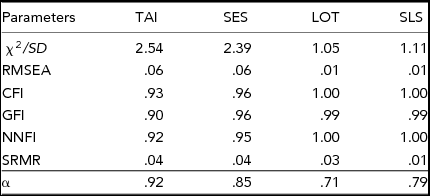
Within this study, the validity and reliability of the scale tools used were reinvestigated. Confirmatory factor analysis was used for validity of scale tools, while reliability was assessed with internal consistency coefficients. The results of the analyses concluded that all the scale tools in the study were valid and reliable. The fit indices of confirmatory factor analysis and internal consistency coefficients are presented in Table 1.
Findings Related to Validity and Reliability of Scale Tools

Note: TAI = Test Anxiety Inventory, SES = Self-Esteem Scale, LOT = Life Orientation Test (called optimism), SLS = Satisfaction with Life Scale.
Statistical Approach
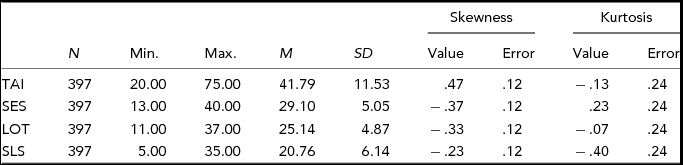
Before analysing the data obtained in the research, a range of statistical organisation was required. Lost values analysis, end value analysis, normal distribution, and linearity analysis were among necessary assumptions (Field, Reference Field2013). In this study, first lost value analysis was completed and it was determined there were no lost values in the data set. While completing end value analysis, the points obtained from the measurements of the variables were transformed to standard z points and measurements with z points outside of -3 to +3 (n = 6) were removed from the data-set (Tabachnick & Fidell, Reference Tabachnick and Fidell2007). In the third stage, the skewness and kurtosis values of the variables were investigated to assess the assumption of normality. As shown in Table 2, the skewness and kurtosis values (-1.5 to +1.5) are within the skewness values accepted as criteria in the relevant literature and were determined not to vary from normal (Tabachnick & Fidell, Reference Tabachnick and Fidell2007).
Skewness and Kurtosis Coefficients of Scale Tools

Note: TAI = Test Anxiety Inventory, SES = Self-Esteem Scale, LOT = Life Orientation Test (called optimism), SLS = Satisfaction with Life Scale.
Correlation Among Variables

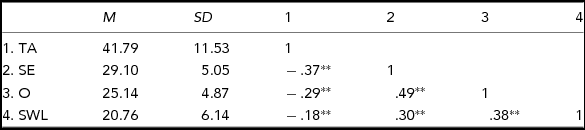
Note: N = 397. TA = test anxiety, SE = self-esteem, O = optimism, SWL = satisfaction with life.
** p < .01
Analysis of Data
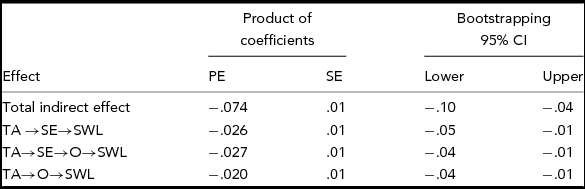
Mediation theory is used to investigate cause-effect correlations. Additionally, mediation studies are assessed as a causative model investigating the processes affecting the creation of the cause-effect correlation (Rose, Holmbeck, Coakley, & Franks, Reference Rose, Holmbeck, Coakley and Franks2004). Pioneering explanations of how the mediation test is performed are presented by Baron and Kenny (Reference Baron and Kenny1986). However, in this model, the effect of the mediator variable expressed as c- cı or ab is not evaluated. As a result, Baron and Kenny (Reference Baron and Kenny1986) stated that the Sobel test may be useful. For the Sobel test to be applicable, it is necessary to meet the normal distribution assumption. Additionally, to calculate the indirect effect of the mediator variable (ab), it is necessary to study large samples. At this stage it is recommended that the reliable interval be investigated with the bootstrap method (Serial-Multiple Mediation Model 6; Preacher & Hayes, Reference Preacher and Hayes2008). In this study, in addition to the reliability interval based on the bootstrap method (N = 10000), the PM values recommended by Preacher and Kelley (Reference Preacher and Kelley2011) were investigated (Table 4).
Total Indirect Effects

Note: N = 397, k = 10000. TA = test anxiety, SE = self-esteem, O = optimism, SWL = satisfaction with life.
To analyse the data, the Lisrel 8.51 and SPSS 22.0 programs were used. With the aim of completing mediation tests based on the bootstrap method, the PROCESS macro application was uploaded to complete the analyses (Preacher & Hayes, Reference Preacher and Hayes2004).
Results
Preliminary Analysis
According to the results of correlation analysis, there were significant correlations between test anxiety and self-esteem (r = −.37, p < .01; 95% CI [−.45, −.38]; Cohen's d = −.79), optimism (r = −.29, p < .01; 95% CI [−.27, −.19]; Cohen's d = −.60) and life satisfaction (r = −.18, p < .01; 95% CI [−.28, −.08]; Cohen's d = −.36). Additionally, there were significant correlations found between life satisfaction and self-esteem (r = .30, p < .01; 95% CI [.20, .39]; Cohen's d = .63) and optimism (r = .38, p < .01; 95% CI [.30, .48]; Cohen's d = .82). Finally, correlation analysis determined a significant correlation between self-esteem and optimism (r = .49, p < .01; 95% CI [.40, .57]; Cohen's d = 1.12).
Mediation Test
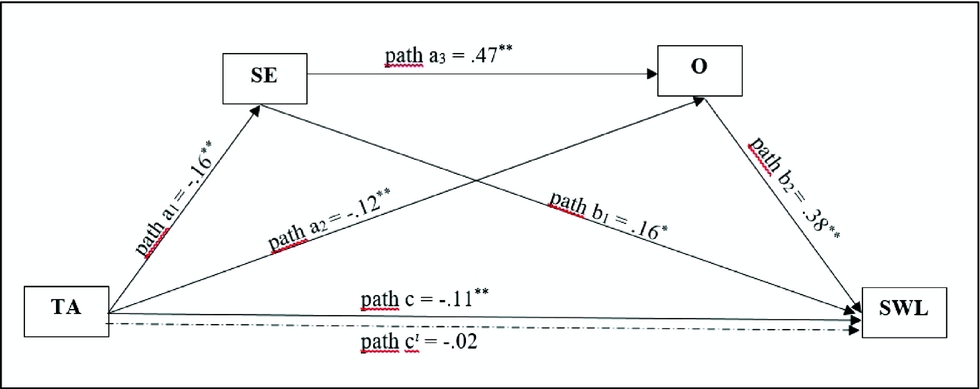
When non-standardised regression coefficients were investigated, the total effect of test anxiety on life satisfaction was significant (ß = −.11, SE = .02, t (395) = 3.83, p < .001, 95% CI [−.15, −.04], path c, Step 1). Additionally, test anxiety had a ignificant effect on self-esteem (ß = −.16, SE = .02, t 395) = 7.94, p < .001, 95% CI [−.20, −.12], path a1) and optimism (ß = −.12, SE = .02, t (395) = 6.05, p < .001, 95% CI [−.16, −.08], path a2). Self-esteem assessed as the first mediator variable in mediation analysis had a significant effect on the second mediator variable of optimism (ß = .47, SE = .04, t (395) = 11.32, p < .001, 95% CI [.37, .56], path a3, Step 2). After the effects of the independent variable (test anxiety) together with the mediation variables (self-esteem, optimism) were investigated on the dependent variable (life satisfaction), the effects of the mediation variables on the dependent variable were investigated. Accordingly, self-esteem (ß = .16, SE = .06, t (393) = 2.39, p < .05, 95% CI [.02, .29], path b1) and optimism (ß = .38, SE = .06, t (393) = 5.78, p < .001, 95% CI [.25, .52], path b2) had significant effects on life satisfaction (Step 3). Then, the final stage of the mediation analysis was completed when test anxiety was included in the model with the mediator variables. According to the obtained results, when the mediator variables are included in the model, test anxiety was not significantly related with life satisfaction (ß = −.02, SE = .06, t (393) = 1.01, p > .05, 95% CI [−.07, .02], path cı, Step 4). In other words, in the correlation between test anxiety and life satisfaction, self-esteem and optimism have full mediator roles (PM = .27, SE = .14, 95% CI [.13, .60]). When the model is evaluated in general, the model was significant (F (3, 393) = 26.75, p < .001) and explained 17% of the variation in life satisfaction.
Discussion
In this study, the mediator roles of self-esteem and optimism in the correlation between test anxiety and life satisfaction were investigated. The mediation test was completed with the aid of a multiple mediation model. To achieve the aims of the research, four hypotheses were tested.
The results obtained in the research confirm the the first hypothesis, that is, test anxiety is a significant negative predictor of life satisfaction. When the theoretical construct of both variables (test anxiety and life satisfaction) are assessed, this negative correlation is an expected finding. It is thought that adolescents experiencing intense test anxiety do not achieve their desired results in different performance fields. In the context of academic performance, Sung et al. (Reference Sung, Chao and Tseng2016) reported that high levels of test anxiety negatively affected academic success. In other words, test anxiety may lower the academic success of adolescents and prevent them from achieving their desired success. This process increases the distance between the academic expectations and academic gains achieved by adolescents. This distance between the hedonic gains of adolescents may indicate that they have not achieved their desired gains. Thus, this situation is assumed to negatively affect the life satisfaction of adolescents.
The assumption in hypothesis 1 is that test anxiety negatively affects different performance fields and then negatively affects life satisfaction; that is, there are insufficient academic, psychological, social, and physiological gains. As test anxiety negatively affects these fields, we focused on the increased distance between the hedonic gains of the adolescent because many performance experiences related to both academic life and other areas of life (e.g., academic procrastination, educational stress) are considered to negatively affect life satisfaction through test anxiety.
The second hypothesis assessed the correlation between test anxiety, self-esteem, and optimism. The results obtained support hypothesis 2, that is, test anxiety is a significant negative predictor of self-esteem and optimism. Considering that adolescents experience high levels of test anxiety that negatively affect their academic process, it is thought that their self-conception may show negative development. Mruk (Reference Mruk2006) determined that individuals experiencing failure have reduced self-esteem. Thus, adolescents experiencing failure as a result of test anxiety may be said to develop negative and pessimistic attitudes to themselves. In the relevant literature, there are studies supporting these findings and inferences (Croyle et al., Reference Croyle, Weimer and Eisenman2012; Dan et al., Reference Dan, Bar Ilan and Kurman2014). Therefore, test anxiety may be said to have a negative explanatory role for optimism. Adolescents who are unsuccessful due to test anxiety may see the future pessimistically. Though an adolescent may have sufficient academic ability, if this is not transformed into performance due to experiencing test anxiety, they may develop irrational beliefs that they will not achieve academic gains sufficient to make them happy in the future. Additionally, it may be said that individuals experiencing test anxiety think pessimistically (Carver et al., Reference Carver, Scheier and Weintraub1989), and previous experience resulting in failure may reinforce this negative tableau (Carver & Scheier, Reference Carver and Scheier1981).
The third hypothesis of the research tested the assumption that self-esteem is a significant positive predictor of optimism, and the results support this hypothesis. An individual's positive judgments of themselves strengthen self-esteem (Lubow, Reference Lubow2009). The quality of the individual's experiences may be a determinant for these positive assessments or judgments. In other words, if the individual achieves noteworthy gains, it may increase their probability of self-esteem development. It is thought there is a two-way interaction between self-esteem and optimism, or that experiences or processes that allow the possibility of developing an optimistic perception are predicted to simultaneously develop a positive perception of the self. The individual may avoid experiences that negatively contribute to their sense of self to protect their self-esteem, or may direct their energy toward areas where they have previously achieved success or gains (with the effect of optimism), and thus achieve their desired experiences. In short, to protect or develop their self-esteem, the individual may organise future experiences based on similar experiences that develop an optimistic perception. Thus, the individual avoids negative judgments of the self, and is assumed to develop optimism levels.
The final result of the research showed that in the correlation between test anxiety and life satisfaction, self-esteem and optimism were full mediators. This result confirms the fourth hypothesis. In hypothesis 1 it was stated that high test anxiety in adolescents may reduce life satisfaction. When self-esteem and optimism are included in the correlation between test anxiety and life satisfaction, it appears the correlation between test anxiety and life satisfaction disappears (see Figure 1). Self-esteem and optimism have an indirect mediating role between test anxiety and life satisfaction and may significantly contribute to the development of reduced life satisfaction in adolescents due to test anxiety. Positive assessments of the self and hope for the future in adolescents may ensure they feel less anxiety related to exams, and therefore the effect of test anxiety on life satisfaction is assumed to be reduced by the effect of self-esteem and optimism. Çivitçi and Çivitçi (Reference Çivitci and Çivitci2009) determined that in adolescents, positive self-conception plays a role in increasing life satisfaction and reduced effects of loneliness. Similarly, Kapıkıran (Reference Kapıkıran2013) revealed the positive contribution of self-esteem to life satisfaction in adolescents. The results of this study concur with other studies showing a positive correlation between self-esteem (Chen et al., Reference Chen, Zhang, Pan, Hu, Liu and Luo2017; Du, Bernardo, & Yeung, Reference Du, Bernardo and Yeung2015; Frederick, Sandhu, Morse, & Swami, Reference Frederick, Sandhu, Morse and Swami2016; Kong & You, Reference Kong and You2013; Martínez-Martí & Ruch, Reference Martínez-Martí and Ruch2017) and optimism (Bailey et al., Reference Bailey, Eng, Frisch and Snyder2007; Jiang et al., Reference Jiang, Li, Jiang, Yu, Liu, Li and Zuo2014; Tomlinson, Keyfitz, Rawana, & Lumley, Reference Tomlinson, Keyfitz, Rawana and Lumley2016) with life satisfaction.
Serial-multiple mediation of self-esteem and optimism in the relationship between test anxiety and life satisfaction with non-standardised beta values.

Limitations and Recommendations
There were some limitations to this study. The most important was that methodologically the generalisability was not at desired levels. To generalise the results obtained from this study to the population, it is recommended that the study be repeated with similar study groups. This study was completed in accordance with quantitative research approaches. To research the reflections of test anxiety, self-esteem, and optimism on life satisfaction in more detail, future studies may be completed with qualitative research approaches. In this way, the interactions between variables may be researched with observations of different study groups and using qualitative data collection techniques, such as interviews. Additionally, longitudinal or experimental studies may be effective to determine the factors affecting life satisfaction. It is recommended that psychoeducational programs be applied to increase the self-esteem and optimism of adolescents experiencing test anxiety. With the aid of these psycho-educational programs, an increase may be observed in the life satisfaction of adolescents experiencing test anxiety. At the same time, to positively contribute to the self-esteem and optimism of adolescents with intense academic responsibilities, teachers and parents should use supportive language. Considering that test anxiety may develop more in the academic environment, it is important that educators be informed on this topic and appropriate changes made to the learning environment for adolescents to experience less test anxiety.
Author Note
This study was presented as an oral presentation at the Sixth International Congress on Research in Education, 13–15 October 2016, Rize, Turkey.
Conflict of Interest
The author(s) declared no potential conflicts of interest with respect to the research, authorship, and/or publication of this article.
Funding
The author(s) received no financial support for the research, authorship, and/or publication of this article.
Ethical Approval
All procedures performed in studies involving human participants were in accordance with the ethical standards of the institutional research committee and with the 1964 Helsinki declaration and its later amendments or comparable ethical standards.