Introduction
Extracts from plants have been reported to elicit varying biological consequences in vivo depending on their constituents. In pregnant women, compounds that bind to estrogen receptors – that is, phytoestrogens – have been subject of much discussion in terms of their potential beneficial or possibly harmful effects.Reference Gustafsson 1 Phytoestrogens are weaker in activity than steroidal estrogens. Plant oils have shown great significance due to the presence in them of phytosterols that are precursors for the synthesis of some steroids in vivo. These sterols can mimic the actions of steroids.Reference Onwuliri and Anekwe 2 Soya (Glycine max) contains β-sitosterol, daidzen and genistein, which are isoflavones with estrogenic properties. Avocado oil (Persea gratissima) contains phytosterols such as β-sitosterol, campsterols, stigmasterols, brasicasterols, tocopherols and other unidentified sterols. These naturally occurring sterols bear tremendous similarity to synthetic steroids such as corticosterone and hydrocorticosterone.Reference Tsiapara, Kassi, Angela, Aligiannis and Moutsatsou 3 RCO is derived from the seed of the Ricinus communis plant. Ricinoleic acid accounts for 87–90% of the fatty acyl groups in RCO with oleic acid (2–7%), linoleic acid (3–5%), palmitic acid (1–2%), stearic acid (1%), dihydrostearic acid (1%) and trace amounts of other fatty acyls. 4 Other sources reported 2.4% lauric acid,Reference Larsen, Rinvar and Svendsen 5 2–5% linoleic acid,Reference Maier, Staupendahl, Duerr and Refior 6 as well as globulin, cholesterol, lipase, vitamin E and β-sitosterol.Reference Scarpa and Guerci 7 The oil is widely used in cosmetics (over 700 different brands of cosmetic products). 8 The Food and Drug Administration 9 has classified R. communis as a stimulant laxative; the oil is therefore available as ‘on the counter drug’ (OTC). Contraceptive jellies have also been found to contain ricinoliec acid, which is the main component of RCO. Clinically, the use of RCO as a labor inducer has been extensively reported.Reference Davis 10 – Reference Boel, Lee and Rijken 14 The oil was also reported to have abortifacient activity when taken orally by pregnant women.Reference Sani and Sule 15 Extracts of the seed have been tested in women and found to produce long-term contraception.Reference Okwuasaba, Osunkwo and Ekwenchi 16 On the estrogenic potential of R. communis var. minor seeds,Reference Okwuasaba, Osunkwo and Ekwenchi 16 studies have reported increase in uterine weight ratio, degree of vaginal cornification and quantal vaginal opening even in ovariectomised rats. Raji et al.,Reference Raji, Oloyo and Morakinyo 17 investigated the impact of the R. communis seed extract on adult male reproductive functions, and found that R. communis seed extract negatively impacted the male reproductive functions in a dose-dependent manner. Raji et al.,Reference Raji, Oloyo and Morakinyo 17 concluded by suggesting that the observed adverse impact on the male reproductive functions appears to be mediated via gonadal disruption in testosterone secretion. Zambrano et al.,Reference Zambrano, Bautista and Deas 18 reported that maternal protein restriction resulted in delayed sexual maturation and premature aging of reproductive function in offspring. Altered postnatal physiological function has also been observed after maternal fat feeding and dietary manipulation of specific micronutrients such as minerals (calcium, iron), co-factors (folic acid, taurine) and vitamins (A and D).Reference Armitage, Khan, Taylor, Nathaniels and Poston 19 In some instances, the programming effects of macronutrient restriction were ameliorated by supplementation of the altered diet with single cofactors and amino acids.Reference Armitage, Khan, Taylor, Nathaniels and Poston 19 Intrauterine programming can occur at any level within the affected physiological system and may involve structural and functional changes in genes, cells, tissues and even whole organs. These changes may be isolated or widespread events with either discrete or cumulative effects on development depending on the nature and timing of the programming stimulus.Reference McMillen and Robinson 20 Although it is clear that fetal programming is not simply the effect of genes passed on through generations, it is clear that the phenotype of offspring subjected to a variety of intrauterine challenges is determined by lifelong gene expression patterns set into motion during critical windows of development and that in some instances these phenotypes may pass on their effects to future generations.Reference Langley-Evans, Gardner and Jackson 21 – Reference Doyle, Ford, Davis and Callanan 24
Despite the reported extensive human use and the potential estrogenic properties of RCO, its generational reproductive effects sequel to maternal exposure at different gestational periods on reproductive functions in the litter delivered have not been explored. This study investigates the generational reproductive effects of maternal RCO consumption at different gestational periods in Wistar rats.
Materials and methods
Animals
Adult male and female rats (7 weeks; Wistar strain) that were not from the same litter obtained from the Central Animal House, Lagos State University College of Medicine Ikeja, Nigeria, were used. Females were nulliparous, and males used for mating were certified fertile by isolated mating technique. Animals were allowed to acclimatize for 3 weeks to the laboratory conditions, housed singly in cages and were fed rats’ cubes (Ladokun feeds limited Ibadan, Nigeria) and water for the entire duration of the study. A 12-h dark–light period was maintained throughout the study. The weights of the rats were 180–200 and 200–250 g for the females and males, respectively, when matting commenced at week 10. Ethical approval for the use of animals in this study was certified by the College of Medicine University of Ibadan Animal House Committee.
Extraction, gas chromatography and mass spectrometry (GCMS) of RCO
Seeds of R. communis were air dried to a constant weight and then pulverized. Pulverized seeds (1.5 kg) were extracted using 5 l of methanol by cold extraction. RCO obtained by filtration was evaporated of the solvent in a rotatory evaporator at 37°C and stored at 4°C. GCMS analyses of RCO were carried out using an Agilent Technologies 6890GC interfaced to an Agilent 5973 N mass selective detector. Individual constituents of the oil were identified on the basis of their retention indexes determined by referring to a homologous series of n-alkanes and by comparison of their mass spectral fragmentation patterns.Reference Salami and Raji 25
Experimental protocol
A total of 25 mature nulliparous female albino rats (10 weeks) with normal estrous cycle were used. Male animals for mating were certified fertile by the isolated mating technique. Pairing for matting was 1:1 for female/male. Mating was confirmed by the presence of a sperm-positive vaginal smear or copulatory plug. The day after which either was found was taken as gestational day 1. Pregnant rats were randomly assigned to treatment groups in a manner that provided for comparable body weight, means and distribution across groups. There were five animals per group, and the dosage for all groups except the control group was 950 mg/kg body weight via oral dosing syringe.
Group 1
Control rats received distilled water for each treatment period; group 2 rats were administered RCO between gestation days (GD) 1 and 7; group 3 rats were administered RCO between GD 7 and 14; group 4 rats were administered RCO between GD 14 and 21; and group 5 rats were administered RCO between GD 1 and 21. The animals were allowed to deliver, after which the following parameters were determined: gestational length, weight, litter size and weight until weaning at postnatal day (PND) 21; morphometric data (body length, abdominal diameter and head diameter) at PND 1 and at sacrifice (PND 90); anogenital distance (AGD) and index on PND 1 and at PND 90, weight and day of attainment of puberty; sperm parameters in F1 males at sacrifice (PND 90), absolute and relative reproductive organ weights and histopathology of the testis and epididymis. Finally, mating index, fertility index, gestation index, live birth index, day survival index (viability index), lactation index/weaning index were determined according to the United States Environmental Protection Agency (EPA) guidelines on generational reproductive toxicity risks assessment. 26
Mating experiment, AGD and index measurement and puberty determination
Randomly selected F1 males (10 weeks) were paired with randomly selected F1 females (10 weeks) from each treatment groups at a ratio of 1:1 for 14 days. The presence of sperm-positive vaginal smear was taken as the evidence for positive mating. Treated male F1 rats were also paired with untreated female rats at a ratio of 1:1 for 14 days. A digital caliper was used to measure the distance between the posterior base of the phallus and the anterior rim of the anus. The anogenital index was measured by adjusting the AGD with body weight (i.e. AGD divided by cube root of body weight).Reference Reynolds, Gallavan, Holson, Stump and Knapp 27 The vagina was considered to be patent when no membranous connections were observed on physical examination in the female litter of individual groups starting from PND 25.Reference Ostby and Gray 28 Preputial separations in male rats (complete manual retraction of the prepuce) were checked daily beginning at the 35th day. Preputial separation was completed when the entire perimeter of the prepuce could be retracted evenly around the base of the glans penis.Reference Guzman, Cabrera and Cardenas 29
Sperm analysis, organ collection and histopathology of reproductive organs
Semen samples were collected from the cauda epididymis. Two drops of semen were placed on the microscopic slide with two drops of warm 2.9% sodium citrate. It was then covered with a coverslip and examined under the microscope using 40× objective with reduced light. Sperm motility was determined as a percentage.Reference Zemjanis 30 Epididymal sperm count was determined by mincing pairs of caudal epididymis in distilled water and filtering through a nylon mesh. The spermatozoa were counted with a hemocytometer using the improved Neubauer (Deep 1/10 m; LABART, Munich, Germany) chamber as described.Reference Pant and Srivastava 31 For percentage viability (live/dead ratio) assay, the live–dead staining principle was used. Eosin penetrates and stains the dead sperm cells, whereas viable cells resist this stain. The staining was performed on the sperm smear using 1% eosin and 5% nigrosine in 3% sodium citrate dehydrate solution according to the method describedReference Wells and Awa 32 for the determination of the live to dead (L–D) ratio. It was performed immediately to avoid negative results. Morphological abnormalities were determined using a portion of the sperm suspension placed on a glass slide and smeared out with another slide and stained with Wells and Awa’s stain (0.2 g eosin and 0.6 g fast green dissolved in distilled water and ethanol in a 2:1 ratio) for morphological examination. The animals were killed by cervical dislocation and dissected to collect the testes, epididymis, seminal vesicle, prostate gland, pituitary gland, liver, ovary and uterus. The organs were cleared of adherent tissues, fats and then weighed immediately using an electronic weighing balance, model DT 300, with a capacity of 0.01–300 g. Samples from the organs were fixed initially with Bouin’s solution, transferred to 70% alcohol after 48 h, sectioned and stained routinely with hematoxylin and eosin for microscopy studies. Slides that had been stained were cleared in xylene before they were mounted on the microscope for histological examination. Photomicrographs of the slides were subsequently taken.
Serum collection and assay of testosterone, luteinizing hormone (LH), follicle-stimulating hormone (FSH) and estrogen
Rats were bled from the orbital sinus and blood samples were collected into polythene tubes and allowed to clot for 1 h. Blood samples were then centrifuged at 3500 g for 15 min at 4°C. Serum was then aspirated and stored for hormonal assays. Intelco ELISA Kit for in vitro determination of testosterone was used for this assay. Luteinizing hormone enzyme immunoassay (EIA) Kit [Immunometrics (UK) Ltd, London, UK] and Follicle-stimulating hormone enzyme immunoassay (EIA) Kit [Immunocentric (UK) Ltd, London, UK] were used to determine LH and FSH, respectively. The inter-assay variation for all hormones assayed averaged 5.8%, whereas the intra-assay variation averaged 5.2%
Statistical analysis
Mean values, standard error of mean (mean±s.e.m.), test of significance between two groups and for more than two groups by the analysis of variance were all determined using Graph Pad Prism V 5.01.
Results
Effects of maternal exposure to RCO on litter size, body weight, morphometric measurements, AGD and anogenital index of F1 female and male pups
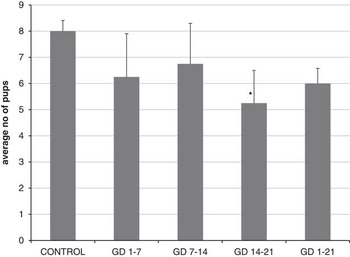
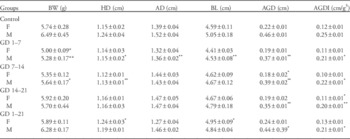
Litter size decreased in all the RCO-treated groups, and the decrease was significant in the GD 14–21 group (Fig. 1). There was a significant decrease in the weight of F1 male pups from pregnant rats treated with Ricinus communis oil (RCO) between gestational days 1–7 and 7–14 (P<0.05) and in F1 female pups treated with RCO between gestational days 1–7. There was a significant change in the head diameter, when compared with the control group, of F1 female pups from pregnant rats treated with RCO between gestational days 1–21. Head diameter in F1 male pups from pregnant rats treated with RCO between gestational days 1–7 and 7–14 showed significant decrease (P<0.05). There were significant decreases compared with the control group in AGD and index in all F1 males from the treated groups (P<0.05; Table 1).
Average litter size per group in pregnant rats treated with Ricinus communis oil at different gestational periods. *P<0.05.

Body weight, morphometric data, anogenital distance and index in F1 female and male pups at birth (PND 1) from pregnant rats treated with Ricinus communis oil at different gestational periods

BW, body weight; HD, head diameter; AD, abdominal diameter; BL, body length; AGD, anogenital distance; AGDI, anogenital distance index; F, female; M, male; GD, gestation days; N, no. of pups.
Control, 32 (5); GD 1–7, 25 (5); GD 7–14, 27 (5); GD 14–21, 21 (5); GD 1–21, 24 (5) for number of pups (litters).
*P<0.05; **P<0.01.
Effects of maternal exposure to RCO on body weight and day of attainment of puberty in F1 male and female pups
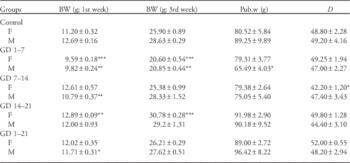
Body weights decreased significantly in F1 male pups from the GD 1–7, 7–14 and 1–21 groups and in F1 female pups from the GD 1–7 group during the 1st week. Body weights in F1 male pups from the GD 1–7 group decreased significantly compared with controls at the 3rd week. F1 female pups from the GD 14–21 group, however, significantly increased in body weight (Table 2) at the 3rd week. Body weight at puberty was significantly decreased (P<0.05) in F1 male pups from the GD 1–7 group (Table 2); however, there were no significant changes in weight on attainment of puberty in all F1 female pups from the treated groups. There was a significant decrease (P<0.05) in the number of days it took to attain puberty in female pups from the GD 7–14 group (Table 2).
BW and day of attainment of puberty in F1 pups from pregnant rats treated with Ricinus communis oil at different gestational periods

F, female; M, male; GD, gestation days; BW, body weight; Pub.w, body weight at puberty; D, day of pubertal attainment.
Control, 32 (5); GD 1–7, 25 (5); GD 7–14, 27 (5); GD 14–21, 21 (5); GD 1–21, 24 (5) for number of pups (litters).
*P<0.05; **P<0.01; ***P<0.001.
Effects of maternal exposure to RCO on body weight, AGD and index and relative organ weight in adult F1 males at sacrifice
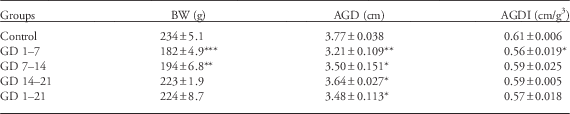
As shown in Table 3, F1 adult males from gestational days 1–7 and 7–14 decreased significantly (P<0.05) in weight at sacrifice on PND 90. AGD decreased significantly (P<0.01) in all F1 males from treated mothers. Weight of testes decreased in all F1 males and was particularly significant in the GD 1–7 group (P<0.05; Table 4). Liver weights decreased significantly in F1 males from the GD 1–7 and 7–14 groups. There were no significant changes compared with controls in the weights of the epididymis, prostate and seminal vesicle (Table 4).
BW and AD of F1 males at sacrifice (PND 90)

GD, gestation days; BW, body weight; AGD, anogenital distance; AGDI, anogenital distance index; PND, postnatal day.
Control, 27 (5); GD 1–7, 20 (5); GD 7–14, 22 (5); GD 14–21, 17 (5); GD 1–21, 19 (5) for number of pups (litters).
*P<0.05; **P<0.01; ***P<0.001.
Organ weights in adult F1 males from rats treated with Ricinus communis oil at different gestational periods (PND 90)

R, relative organ weight; GD, gestation days; PND, postnatal day.
Control, 27 (5); GD 1–7, 20 (5); GD 7–14, 22 (5); GD 14–21, 17 (5); GD 1–21, 19 (5) for number of pups (litters).
Effects of maternal exposure to RCO on epididymal sperm characteristics, serum FSH, LH, estrogen and testosterone and the histology of testis and epididymis in adult F1 males
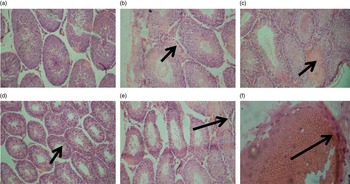
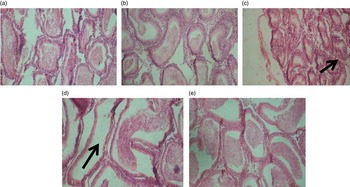
Epididymal sperm count, motility and morphology were significantly impaired (P<0.01) in all the F1 males from the treated groups (Table 5). However, there were no significant changes in sperm viability when compared with the controls. Serum LH and FSH levels were statistically increased (P<0.05) when compared with the controls in all treated F1 males. Serum estrogen levels were significantly increased (Table 6) in F1 males from the GD 7–14 group. Increases in serum estrogen levels in F1 males from the GD 1–7, 7–14 and 1–21 groups were not statistically significant. However, serum testosterone levels significantly decreased (P<0.01) in all F1 males. There were no visible lesions in the photomicrographs of both the testes and the epididymis of F1 males from the control group (Figs 2 and 3). Photomicrographs of testes of F1 males from the GD 1–7, 7–14 and 14–21 groups showed interstitial edema, whereas photomicrographs of the testes from the GD 1–21 group showed severe subcapsular congestion. All epididymides appeared normal except for slightly reduced luminal content in GD 7–14, 14–21 and 1–21 animals.
Photomicrographs of the testes of F1 males from female rats treated with Ricinus communis oil at different gestational periods [a, control; b, Gestation days (GD) 1–7 showing slight interstitial edema; c, GD 7–14 showing mild interstitial edema; d, GD 7–14 showing reduced seminiferous tubular diameter and interstitial edema; e, GD 14–21 showing slight interstitial edema; and f, GD 1–21 showing severe subcapsular congestion mag. 200×].

Photomicrographs of the epididymides of F1 males from female rats treated with Ricinus communis oil at different gestation periods [a, control showing no visible lesion; b, Gestation days (GD) 1–7, no visible lesion; c, GD 7–14, showing sparse luminal content; d, GD 14–21, sparse luminal content; and e, GD 1–21, no visible lesion, 200×].

Epididymal sperm characteristics in adult F1 males from female rats treated with Ricinus communis oil at different gestational periods (PND 90)

GD, gestation days; PND, postnatal day.
*P<0.05; **P<0.01; ***P<0.001.
Serum hormonal profiles in adult F1 males from female rats treated with Ricinus communis oil at different gestational periods (PND 90)

LH, luteinizing hormone; FSH, follicle-stimulating hormone; GD, gestation days; PND, postnatal day.
*P<0.05; **P<0.01.
Effects of maternal exposure to RCO on reproductive indexes in F1 males/females and morphometric data and anogenital index in F2 males and females
Mating index, fertility index, gestation index, live birth index and day survival index were all 100% in control F1 male and female mating experiments, except for lactation index with a percentage of 92.8% (Table 7). F1 males and females from gestational days 1–7, 7–14 and 1–21 treated rats after mating experiments showed a mating index of 100%; fertility, gestation, live birth, day survival and lactation indexes were all, however, 0% (Table 7). F1 males and females from GD 14–21 treated rats after mating experiments showed 100% mating, fertility, gestation and live birth indexes. Day survival and lactation indexes were, however, 89.5%. As shown in Table 8, there were no significant differences in the morphometric data at birth in F2 males and females from GD 14–21 treated rats. There were no significant differences in the AGD and index of F2 males and females from the gestational days 14–21 group as well.
Reproductive indexes from mating experiment in male and female F1 animals from RCO-treated mothers

RCO, Ricinus communis oil; GD, gestation days.
Body weight, morphometric data, AGDand index in F2 female and male pups at birth (PND 1)

BW, body weight; HD, head diameter; AD, abdominal diameter; BL, body length; AGD, anogenital distance; AGDI, anogenital distance index; F, female; M, male; GD, gestation days.
Control, 20 (5); GD 1–7, 15 (5); GD 7–14, 17 (5); GD 14–21, 14 (5); GD 1–21, 14 (5) for number of pups (litters).
Discussion
The route of administration of RCO in this study was in accordance with the route of possible human exposure during pregnancy when used as a laxative or labor inducer. In addition, the metabolic pathway of RCO for this route of administration has been extensively delineated and found to be the same in human and rats by previous studies.Reference Paul and McCay 33 – Reference Ihara-Watanabe, Shiroyama and Konda 36 The dosage used in this study was also according to recommended therapeutic human dosage. 37
The major aim of the present study was to investigate the probable programming effects and outcomes in males and females born of mothers exposed to RCO at critical windows of development – early, mid, late and entire gestational periods. From the study of literature, humans are exposed directly or indirectly to RCO during these critical periods of fetal development. This study is a follow-up of our previous study.Reference Salami and Raji 25 It focused on previously unexplored areas by attempting to investigate not only the immediate but also the generational reproductive effects in offspring maternally exposed to RCO.
Our previous data revealed that the uterus in pregnant rats exposed to RCO at gestational days 1–7 and 7–14 showed ballooning, uterine tissue disruption and resorption with implantation sites, indicating compromise of the uterine support for the developing embryo. These findings may be responsible for the reduced body weight at birth (Table 1) and litter size (Table 8) in the present study. Changes that could impair intra-uterine availability of nutrients, oxygen and hormones have been reported to usually program tissue development leading to abnormalities.Reference Fowden, Dino and Forhead 38 The timing, duration, severity and type of insult during development have also been found to be contributing factors to the type of physiological outcome. From this study, mothers exposed at early gestational periods have been found to be most susceptible and their offspring most compromised. This study also showed that male offspring from gestational days 1–7 and 7–14 were more affected than females. The associations between low birth weight and adult disproportionate phenotype have been linked to poor nutrition and oxygenation during early life due to placental compromise.Reference Harding and Johnson 39 Low birth weight as a result of disproportionate fetal growth has also been reported to be a ‘classical’ risk factor indicating occurrence of fetal programming,Reference Berthold 40 although other studies have shown that programming can occur during pregnancy without influencing birth weight.Reference Berthold 40 , Reference Nathaniesz and Thornburg 41 The roles of hormones as programming signals have also been reported in humans and experimental animals.Reference Fowden and Forhead 42 As RCO has been reported to have estrogenic properties,Reference Okwuasaba, Osunkwo and Ekwenchi 16 the impairment observed in the uterus of exposed mothers, particularly at gestational days 1–7 and 7–14, and the subsequent reduction in litter size, morphometric data and body weight of pups from this group portends that RCO can program in utero.
Male F1 rats exposed to RCO from this study showed reduced AGD at birth and later at sacrifice. AGD in many species (including rats) acts as an excellent noninvasive marker of sexual differentiation at birth.Reference Mylchreest, Sar, Wallace and Foster 43 Androgens (testosterone and dihydrotestosterone) are central at critical periods of fetal development for proper masculinization of both internal and external reproductive structures. Compromise to androgens as a result of exposure to any estrogenic agents during uterine development usually result in abnormalities of the external genitalia,Reference Mylchreest, Sar, Wallace and Foster 43 resulting in reduced AGD. AGD can be used to measure the degree of demasculinization of males as a consequence of developmental exposure to androgen receptor antagonists, 5α reductase inhibitors or compounds that inhibit steroidogenesis. Likewise, AGD is useful in measuring the degree of masculinization of females exposed during sexual differentiation to androgenic compounds or anabolic growth stimulants. AGD has been reported to be a reliable predictor of permanent alterations of the reproductive system that are not often apparent until the animal reaches sexual maturity. Male pups from mothers exposed to RCO in this study showed significant decrease in AGD when compared with controls. StudiesReference Clark, Antonello and Grossman 44 , Reference Clark, Anderson and Prahalada 45 have reported that male rats exposed in utero to finastride – a 5α reductase inhibitor that blocks conversion of testosterone to dihydrotesosterone – displayed decreased AGD at birth; however, there was eventual catch-up growth in the low-dose group animals at adulthood, suggesting that decreases in AGD in early postnatal life were transient. Other studiesReference Gray, Ostby and Furr 46 – Reference Ema, Emiko, Akihiko and Eiichi 48 have also reported reduction in AGD without catch-up growth in adulthood in male rats exposed in utero to anti-androgens or estrogenic agents. In the present study, male rats from exposed mothers at adulthood (PND 90) still maintained the reduced AGD observed at birth without any catch up growth (Table 3). To further support this fact, there were elevated estrogen levels in F1 male rats from RCO-treated mothers compared with controls at sacrifice on PND 90 in the present study.
Vaginal perforations and preputial separation have been considered as good and acceptable markers of puberty onset.Reference Ostby and Gray 28 , Reference Guzman, Cabrera and Cardenas 29 , Reference Stump, Holsen and Murphy 49 In this study, female pups, particularly from the gestational days 7–14 group, displayed early and significant onset of puberty when compared with controls. RCO-treated male F1 rats also displayed early onset of puberty when compared with controls. Early onset of puberty in this study was related to body weight, as both F1 male and female pups showed reduced weight at puberty. This is in line with other authors who have reported on puberty having an association with body weight,Reference Baker 50 whereas others reported weight as being independent of puberty onset.Reference Engelbregt, Houdijk, Popp-Snijders and Delemarre-van deWaal 51 , Reference Engelbregt, vanWeissenbruch, Popp-Snijders and Delemarre-van deWaal 52 There could be early onset of puberty when there is inappropriate gonadal or adrenal steroid secretion (LHRH-independent precocious puberty) or hypothalamic luteinizing hormone release (LHRH) pulse generator when pulsatile release of LH that is seen in puberty is inappropriately initiated (central precocious puberty).Reference Rodney and Bell 53 In this type of precocious puberty, LH increases in response to LHRH (i.e. LHRH dependent). In this study, there was obvious and significant increase in both the serum LH and FSH levels in RCO-treated F1 males when compared with controls, showing an inappropriate increase in either gonadal or adrenal steroid secretion. The potential of RCO serving as an estrogenic endocrine disruptor sequel to maternal exposure was further exacerbated as findings have shown that high concentrations of maternal steroids (from endogenous or exogenous sources) can adversely affect both the pituitary–gonadal and pituitary–adrenal functions in the offspring.Reference Guzman, Cabrera and Cardenas 29 In the present study, F1 male rats exposed to RCO at different gestational periods showed significant impairment in epididymal sperm characteristics. Sperm counts, motility and viability were significantly reduced when compared with the controls. There was also an increase of more than 15% in abnormal sperm cells in the F1 male offspring of treated rats. Similarly, serum testosterone levels were significantly reduced in treated F1 males. Histology of the testis and epididymis of F1 males from RCO-treated rats, particularly from the gestational days 1–7 and 7–14 groups, showed interstitial edema, reduced seminiferous tubular lumen and epididymal hypospermia. The weight of reproductive organs, particularly the testes and epididymides, also decreased when compared with controls. Testosterone is not only key but also required for the normal development of the male reproductive organs; therefore, the decrease in weight in this study of the testis and the epididymis could be due to the significant reduction in the serum levels of testosterone. The reduction of testosterone in this study may be due to edema in the interstistial spaces. The accompanying edema observed in the interstitium could have impaired the normal Leydig cell function. Leydig cells that secrete testosterone are populated in the interstitial spaces.Reference Lording and De Kretser 54 Several other studies have also reported deleterious effects of maternal exposure to any agent on the fertility of male and female offspring. StylianopoulouReference Stylianopoulou 55 reported that maternal adrenocorticotropin injection diminishes reproductive capability in adult life, such as changes in frequency of copulation and ejaculations. Neonatal administration of testosterone was also reported to affect sexual behavior and cyclicity in female offspring.Reference Stylianopoulou, Fameli, Brountzos and Contopoulos 56 In addition, male offspring of rats stressed prenatally showed decreased sexual activityReference Anderson, Fleming, Rhees and Kinghorn 57 and reduced fertility rate.Reference Zambrano, Rodriguez-Gonzalez and Guzman 58 Similarly, male mice exposed prenatally to diethylstilbersterol have been reported to show abnormalities such as epididymal cysts, urogenital impairment and enlargement of the seminal vesicle.Reference McLachlan, Newbold and Bullock 59 , Reference Foster Warren, Lagunova and Anzarb 60
As shown in Table 7, random pairing of F1 males and females according to treatment groups gave a mating index of 100% for all RCO-treated groups and controls. On the contrary, fertility index was 100% for controls and for gestational days 14–21 F1 animals but 0% for other groups. This finding showed that exposure to RCO at early gestation, particularly when reproductive organs are being differentiated, might lead to infertility later in life. During organogenesis, insults may cause discrete structural defects that permanently reduce the functional capacity of the organ. Rhind et al.,Reference Rhind, Rae and Brooks 61 reported that when the insult occurs during gametogenesis, reproductive potential of the next generation may be impaired. However, male and female offspring exposed at late gestational periods (i.e. GD 14–21) were able to conceive and deliver safely similar to controls. It may be that exposure after full differentiation of reproductive organs in utero did not have any effect on adult fertility potential in later life. Studies have shown that the programming effect could be influenced by timing and duration of intra-uterine exposure to assault.Reference Clark, Antonello and Grossman 44 , Reference Nathanielz 62 In addition, there seems to be no adverse effect on libido and copulatory capacity as mating index was 100%, indicating possible non-impairment in the central nervous control of sexual behavior in F1 males and females. However, impairment in F1 male sperm characteristics, reduced testosterone levels and impaired histology of the female F1 adult uterus could synergistically contribute to the 0% in fertility indexes of the GD 1–7, 7–14 and 1–21 groups. Interestingly, when F1 males from treated mothers were mated for a shorter period with untreated females, fertility, gestation and lactation indexes were all reversed to 100% (Appendix 12).
Second generation (F2) study on RCO
The substantial body of both epidemiological and empirical evidences showing that programming effect could be trans-generationally transferred,Reference Nathaniesz and Thornburg 41 , Reference Drake and Walker 63 – Reference Torrens, Brawley and Anthony 65 coupled with the effects observed in F1 from this study, was the impetus for this aspect of the study. NathanielzReference Nathanielz 62 identified in his principle of fetal programming that most often than not compensation for disturbances in the fetal environment usually results in secondary and typically negative effects. He also asserted that postnatal effects at compensation or correction may often have further deleterious effects. In line with these two assertions,Reference Ong and Dunger 64 F2 males and females that hitherto had early onset of puberty in the F1 generation had delayed onset of puberty in the F2 generation, particularly seen in females than in males (Appendix 8). Second generation (F2) males from the GD 1–7 group also showed significant increase in birth weight compared with F1 generation that showed significant reductions (Appendix 7). On the contrary, AGD were not significantly reduced in F2 rats between treated and control F2 offspring (Table 8).
Conclusions
Exposure to RCO at early gestation periods, particularly during the programming period for reproductive organ embryogenesis, impaired some estrogen-sensitive reproductive end points in male than in female F1 rats. This could be attributable to ricinoliec acid and sterol alcohol, which from gas chromatography and molecular spectroscopy analyses as previously reported, constitute 80–90% of the fixed oil of the R. communis seed. Onwuliri and AnekweReference Onwuliri and Anekwe 2 have attributed that the presence of sterols in RCO is important in that sterols as steroid alcohols are intermediates in the synthesis of related steroids. Moreover,Reference Green, Stout and Taylor 66 asserted that some steroids have been found to be convertible into animal steroids hormones in the presence of relevant enzymes in vivo. ThompsonReference Thompson 35 has also delineated the pathway of enzymatic degradation of RCO by reporting that pancreatic lipase acts on RCO to liberate glycerol and ricinoliec acid. The ricinoliec acid is then rapidly metabolized. Therefore, the estrogenic effects of RCO are probably due to sterols and ricinoliec acid present in them. Actions of RCO are consistent with estrogenic agents, and it seems to be an endocrine disruptor. In addition, it negatively impaired the reproductive end points in offspring of exposed rats in this study.
Acknowledgements
Authors acknowledge the support of Mrs Ope and Mrs Ooreoluwa of Reproductive Physiology and Developmental Programming Unit, Department of Physiology, University of Ibadan.
Financial Support
This research received no specific grant from any funding agency, commercial or not-for-profit sectors.
Conflicts of Interest
None.
Ethical Standards
Ethical approval on use of animal in this study was certified by the College of Medicine University of Ibadan Animal House Committee.
Supplementary material
For supplementary materials referred to in this article, please visit http://dx.doi.org/10.1017/S2040174415001245