





Across the globe in 2022, approximately 1·05 billion tonnes of food products went to waste, which is equivalent to over one billion meals every day(1). A substantial amount of the food that is grown and produced is never consumed by people – this is a significant global issue, with extensive environmental, economic and social implications(Reference So2). The food supply chain is complex and nuanced, starting with agricultural production, going through various forms of processing, preparation, transport and retail, ideally ending in consumption(1). Food loss refers to products being discarded after harvest, but prior to reaching retail outlets – this accounts for only 13 % of the world’s discarded food(3). The vast majority of discarded food happens at the retail, food service and individual household level and is referred to as food waste(Reference So2). In the USA, nearly 54 million tonnes of food is wasted every year, which is equivalent to around 40 % of the food supply(4).
Alongside this epidemic of waste, there is a rising rate of food insecurity worldwide, with an estimated 735 million people facing hunger in 2022(3). While the primary drivers of food insecurity include climate change, conflicts and global food access inequalities(Reference Awoke and Bruck5), there is a relationship between food waste and food insecurity as this is a reflection of profound systemic inefficiencies: food waste represents a ‘failed opportunity’ because a significant portion of discarded food remains nutrient-dense and safe for consumption at the point of disposal. When edible surplus makes its way to landfills, the food system fails to capitalise on already-expended resources – water, land and labour – to address the immediate nutritional needs of millions of food insecure people around the globe(Reference Royer6,Reference Cohen7) .
In Switzerland, specifically, 1/3 of food produced for consumption is wasted(Reference Beretta and Hellweg8). This waste is estimated to be around 2·8 million tonnes of food, equivalent to around 330 kilograms of food per person annually in Switzerland(9). The source of waste is from households, restaurants and supermarkets alike, and wasted food products account for roughly 25 % of Switzerland’s total food-related carbon footprint(10). Due to the gravity of this situation, Switzerland has implemented an action plan to reduce food waste by half before 2030(9). This plan includes measures that would oblige food retailers to donate food instead of disposing of it as its best-before date approaches. In 2022, the initial stages of this plan were put into place, encouraging food retailers to participate in these waste reduction initiatives voluntarily. If the goals were deemed to not be on target to be reached by mid-2025, the next step in the plan was to increase enforcement of the plan(11).
These types of food redistribution efforts have the potential to address the two interrelated issues of decreasing food waste and addressing local food insecurity. Food redistribution acts as a critical intervention by linking the oversupply in the commercial sector with the caloric deficits in socially disadvantaged communities. However, redistributing food to accomplish this objective is mediated by a complex ecosystem. In several jurisdictions, policy frameworks have been developed to guide food donation and redistribution efforts, although these vary considerably by region. Global comparative research, such as the Global Food Donation Policy Atlas, highlights that while some regions utilise robust liability protections and tax incentives to encourage donation, others lack the basic regulatory clarity needed to scale operations(12). The Food Waste Policy Hub identifies a spectrum of interventions ranging from voluntary industry agreements to mandatory organic waste bans, illustrating how local governance structures dictate the feasibility of rescue initiatives(13).
Several successful examples of redistribution systems exist: In Israel, ‘Leket Israel’ the largest food bank, obtains high-quality foods from several sources, including farmers, agricultural organisations, bakeries and cafeterias(Reference Philip, Hod-Ovadia and Troen14). The organisation then redistributes these food products through nonprofit organisations to people in need, reaching around 175 000 people per year(Reference Philip, Hod-Ovadia and Troen14).
In Australia, ‘SecondBite’ collects food from partners, then redistributes healthy, fresh foods to charities(Reference Lindberg, Lawrence and Gold15,16) . In 2023, they provided the equivalent of 50 million meals to those in need(16). In spite of these successes, it is notable that very few countries have enacted food waste deterrence policies, like those proposed by the Swiss policy proposals(9).
To date, no academic research has been published about the Swiss system of food distribution or the motivations, challenges and experiences of participants who represent organisations within the food redistribution ecosystem. Understanding these factors is crucial for improving the existing programme, as well as implementing and improving similar initiatives in other parts of the country and around the world. Given this context, the objective of this study was to explore how food redistribution works in the Canton of Vaud, specifically focused on exploring the motivation for participation of various actors within this system.
Methods
Setting
The study took place in the Canton of Vaud, in French-speaking Western Switzerland, which has a population of approximately 800 000. The food redistribution process in the Canton of Vaud involves grocery stores, delivery organisations and social service organisations. The food redistribution process begins at the grocery store, with employees sorting through food items on the verge of expiry, but which are still edible and putting them aside. Next, a delivery organisation (Table Suisse or Fondation Mère Sofia) gathers these items from participating grocery stores and stocks it at their headquarters. The last step is delivering these items to social service associations, which is also done by the delivery organisations. The associations then disperse the food as they see fit, for example through making warm meals for their clients, delivering food packages or giving out snacks/ready-to-eat meals on an as-needed basis. An alternative pathway for food to be diverted is at the industrial/wholesale level – when surplus or damaged shipments are identified they can be donated to the ‘Centrale Alimentaire de la Région Lausannoise’ (CA-RL), which makes deliveries to the same social service organisations.
The social service organisations and grocery stores were primarily located in the cantonal capital city of Lausanne, with a few in the surrounding towns (Vevey, Nyon and Yverdon). The delivery organisations also operate out of Lausanne and drive around the canton to collect from myriad grocery retailers and deliver the food products directly to the social service organisations.
Study design
A qualitative descriptive study was undertaken to explore the experiences of managers from organisations that are involved in the food redistribution process. Qualitative description aims to provide a comprehensive summary of events using everyday terms, capturing direct experiences from those with relevant experiences(Reference Neergaard, Olesen and Andersen17). Ethical approval was sought from the Swissethics board, who considered the protocol and granted it a waiver based on the fact that participants were not providing any information about their individual health or personal data.
Participant selection
The research team contacted the directors of the two delivery organisations directly, and both provided verbal informed consent to participate in the study. The team also contacted all the social service organisations in the region directly, obtaining consent from managers in each organisation to participate in the study. The managers then referred the team to professional chefs working in their organisations, where applicable. The head office of one major grocery store chain provided contact information for managers from three local stores. Purposive sampling was used to include participants occupying different roles across the food redistribution system, as well as individuals with varying lengths of experience in the process, in order to capture a range of operational perspectives. Participants who had recently started participating in the process as well as those with long-standing involvement were sought for inclusion.
Data collection
A semi-structured interview format was utilised, with the aim of yielding consistent yet rich qualitative data(Reference Moser and Korstjens18) (Appendix A). The interview guide was informed by existing literature on food redistribution systems and was designed to explore operational processes, including perceived benefits and challenges. Participants had the ability to elaborate, decline to answer certain questions or end the interview whenever they wished. The interviews were conducted in French by DJTC (a male physician and health services researcher, trained in anthropology and experienced in qualitative data collection), who did not have a pre-existing relationship with any of the participants. Interviews took place at the grocery stores, delivery service organisations and social service associations. Interviews were recorded digitally and transcribed by a human transcriptionist (CP). In addition to the interviews, DJTC also conducted field observations of the various locations, with permission. He would observe the processes of the organisation and record field notes about what was observed. As a non-Swiss visiting researcher, the lens brought to these observations was etic and fundamentally exploratory in nature.
Data analysis
Conventional qualitative content analysis was used to analyse the data, to understand and explore the topics of interest(Reference Moser and Korstjens18,Reference Hsieh and Shannon19) . This approach was primarily inductive in nature – starting with the data rather than with any pre-conceived notion of what codes might arise. Initially, three interviews were analysed independently to help develop a preliminary coding template for further analysis. Coding was done by three researchers (CP, EH and DJTC), using NVivo 14 software (Lumivero).
First, the three researchers read and re-read the transcripts and field notes to familiarise themselves with the data(Reference Braun and Clarke20). The initial interviews were independently coded line-by-line by all three researchers with codes applied to the relevant sections of text. Once an initial coding template was established, further transcripts were reviewed by two of the three reviewers. This process allowed each reviewer to bring their own independent lens to the data as each had different perspectives and prior experiences which informed their interpretations.
The codes were then combined into broader categories based on similarities. Themes were developed by identifying patterns that connected categories to our research question. The research team held iterative consensus meetings to refine theme definitions and ensure they were grounded in the data and reflected in the codes generated. Field notes were used for triangulation, providing context that enriched the interpretation of interview transcripts. Finally, representative quotes were purposively selected to illustrate the final themes.
Sample size
We sought to collect data from all the organisations involved in the food redistribution process in the Canton of Vaud. To do so, we ensured that we conducted observations and interviews with all the three food redistribution agencies as well as all of their beneficiary organisations. While we could not feasibly collect data from all agencies that provided food (grocery stores), we ensured that we purposefully sampled a variety of stores including those that had been long-time participants in the programme, as well as those who were newer to the programme. Sample adequacy was guided by the concept of information power(Reference Malterud, Siersma and Guassora21). The narrow study aim and rich descriptive quality of interviews supplemented by observations supported a small sample size, leading to cessation of interviews after 14.
Results
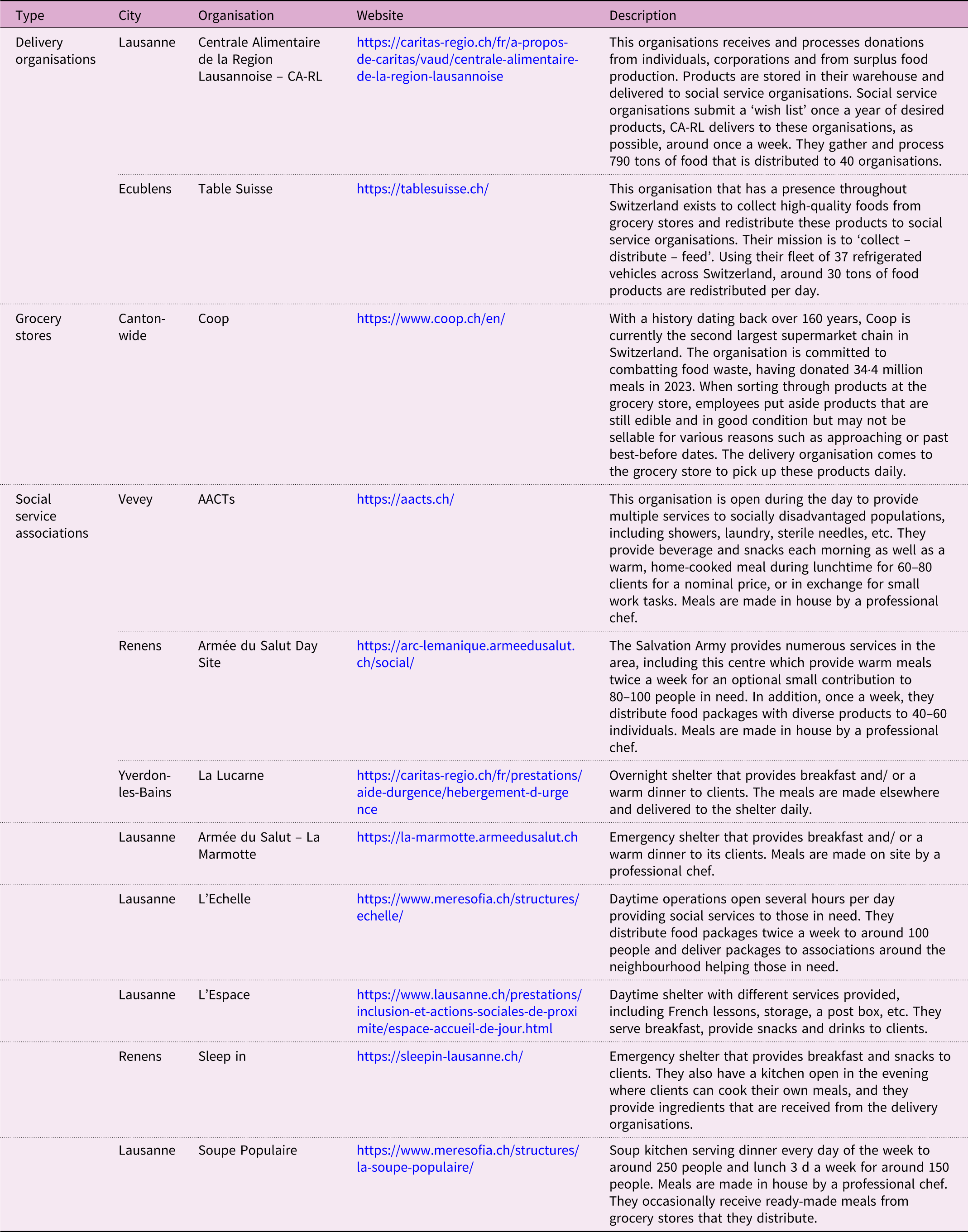
A total of fourteen semi-structured interviews were completed with representatives from delivery organisations, grocery stores and social service organisations, with an average interview length of 54 min. The sample included managers, chefs and owners from a range of organisations, including overnight shelters, support services and soup kitchens (Table 1). In addition to these interviews, eight field observations were conducted including a visit to CA-RL warehouse, a ride-along with Table Suisse, a site visit to participating grocery stores and visits to five social service organisations who received, prepared and distributed the food to clients. Four major themes were identified through this analysis, with some variation in the points of view from all three groups.
Overview of interview participant organisations

Table 1. Long description
The table is organized into three main categories: Delivery organisations, Grocery stores, and Social service associations. Each category lists the city, organization, website, and description. The table has 14 rows and 5 columns. Column headers are Type, City, Organisation, Website, and Description. Row 1: Delivery organisations, Lausanne, Centrale Alimentaire de la Region Lausannoise - CA-RL, https://caritas-regio.ch/fr/a-propos-de-caritas/aud/centrale-alimentaire-de-la-region-lausannoise, This organisation receives and processes donations from individuals, corporations and from surplus food production. Products are stored in their warehouse and delivered to social service organisations. Social service organisations submit a wish list once a year of desired products, CA-RL delivers to these organisations, as possible, around once a week. They gather and process 790 tons of food that is distributed to 40 organisations. Row 2: Delivery organisations, Ecublens, Table Suisse, https://tablesuisse.ch/, This organisation that has a presence throughout Switzerland exists to collect high-quality foods from grocery stores and redistribute these products to social service organisations. Their mission is to collect - distribute - feed. Using their fleet of 37 refrigerated vehicles across Switzerland, around 30 tons of food products are redistributed per day. Row 3: Grocery stores, Canton-wide, Coop, https://www.coop.ch/en/, With a history dating back over 160 years, Coop is currently the second largest supermarket chain in Switzerland. The organisation is committed to combatting food waste, having donated 344 million meals in 2023. When sorting through products at the grocery store, employees put aside products that are still edible and in good condition but may not be sellable for various reasons such as approaching or past best-before dates. The delivery organisation comes to the grocery store to pick up these products daily. Row 4: Social service associations, Vevey, AACTs, https://aacts.ch/, This organisation is open during the day to provide multiple services to socially disadvantaged populations, including showers, laundry, sterile needles, etc. They provide beverage and snacks each morning as well as a warm, home-cooked meal during lunchtime for 60-80 clients for a nominal price, or in exchange for small work tasks. Meals are made in house by a professional chef. Row 5: Social service associations, Renens, Armée du Salut Day Site, https://arc-lemanique.armeedusalut.ch/social/, The Salvation Army provides numerous services in the area, including this centre which provides warm meals twice a week for an optional small contribution to 80-100 people in need. In addition, once a week, they distribute food packages with diverse products to 40-60 individuals. Meals are made in house by a professional chef. Row 6: Social service associations, Yverdon-les-Bains, La Lucarne, https://caritas-regio.ch/fr/prestations/aide-d-urgence/hebergement-d-urgence, Overnight shelter that provides breakfast and/or a warm dinner to clients. The meals are made elsewhere and delivered to the shelter daily. Row 7: Social service associations, Lausanne, Armée du Salut - La Marmotte, https://la-marmotte.armeedusalut.ch, Emergency shelter that provides breakfast and/or a warm dinner to its clients. Meals are made on site by a professional chef. Row 8: Social service associations, Lausanne, L’Echelle, https://www.meresoft.ch/structures/echelle/, Daytime operations open several hours per day providing social services to those in need. They distribute food packages twice a week to around 100 people and deliver packages to associations around the neighbourhood helping those in need. Row 9: Social service associations, Lausanne, L’Espace, https://www.lausanne.ch/prestations/inclusion-et-actions-sociales-de-proximite/lespace-accueil-de-jour.html, Daytime shelter with different services provided, including French lessons, storage, a post box, etc. They serve breakfast, provide snacks and drinks to clients. Row 10: Social service associations, Renens, Sleep in, https://sleepin-lausanne.ch/, Emergency shelter that provides breakfast and snacks to clients. They also have a kitchen open in the evening where clients can cook their own meals, and they provide ingredients that are received from the delivery organisations. Row 11: Social service associations, Lausanne, Soupe Populaire, https://www.meresoft.ch/structures/la-soupe-populaire/, Soup kitchen serving dinner every day of the week to around 250 people and lunch 3 d a week for around 150 people. Meals are made in house by a professional chef. They occasionally receive ready-made meals from grocery stores that they distribute.
Theme 1: Processes are in place to ensure the food that reaches individuals is reasonably fresh and of high nutritional quality
A common theme among all stakeholders in this food redistribution network is the emphasis on the nutrition and quality of food products provided to clients. From the products being sorted at the grocery store to their final use at the social service organisations, all interviewees spoke about the importance of ensuring that high quality and nutrient dense foods make it to the other end of the delivery chain. Individuals at all levels of the network are responsible for ‘triage’: sorting through products and deciding which items are edible and worth passing along to the next person in the chain. This process begins at the grocery stores, where stores have implemented a system for employees to sort through produce, baked goods and other products and put aside eligible and salvageable items. As stated by this grocery store manager, the process is both efficient and straightforward, requiring minimal additional effort:
‘If everyone who is responsible for part of the department, if everyone sorts what is going to go to [Delivery Organization] as they go, and puts aside what is really no longer consumable, in fact when they arrive to the back and unload their pallets, there is a box that goes to [Delivery Organization]. It doesn’t take much more time.’ (Grocery Store #1)
Next, the food products are picked up from the grocery stores by the delivery organisation. Their drivers are trained in also conducting their own triage to sort out the products that were left out for their organisation. When unsuitable products or produce that is wilted, rotten or unconsumable are identified, they are simply left behind and the grocery store must then dispose of them through their usual methods. As one delivery organisation manager explained when describing their role in maintaining food quality in the redistribution chain:
‘… the big problem that we can have with sorting, is that some stores sort well, others sort less well. The final sorting is done on the beneficiaries’ end, but we will also sort a certain percentage, for example if the beneficiaries say, ‘listen yesterday’s delivery was disgusting’, I try to see where the problem is. Is it my drivers who took the wrong boxes? That can happen, or if it is always like that, I call the store and tell them they need to make an effort here.’ (Delivery Organization #2)
The delivery organisation finally delivers the salvaged food products to the social service organisations, where another round of triage is conducted – this time by staff members who keep only what they deem useful for their clients in the next day or two. Most of these associations put an emphasis on choosing fresh and healthy foods, when possible, as well as keeping a variety of products stocked to create balanced meals. For many, this focus on highly nutritious meals is a top priority, as highlighted by one association:
‘We really try to have diversity in the diet here, also for health reasons. We want people to eat well here, we see when you eat well, you are in good health, mentally and physically too. So, fruits, vegetables, fibers, we really try to have a balanced diet.’ (Service Association #1)
Theme 2: Food redistribution contributes to addressing food needs, while simultaneously reducing food waste
This programme was described by participants as having multiple interrelated benefits at different levels, benefiting the specific population, but also society at large. One commonly cited outcome was the reduction of food waste, which has become a stated priority for many grocery stores and even the Swiss federal government. Due to strict food safety regulations, these stores have traditionally been mandated to adhere to guidelines regarding expiry dates and the types of products they can sell. This was perceived as wasteful and unfair by many of the participants, and therefore, the motivation to participate in this programme for some came from their drive to reduce this unnecessary waste. All participants described the programme as reducing food waste, all while supporting socially disadvantaged populations in Switzerland, as stated by this grocery store manager:
‘I think it’s good, it stops us from throwing away the product, it revalues the product. And instead of throwing it in the trash, we fight against food waste, it’s better to give it to associations like them that are in need.’ (Grocery Store #2)
In addition to the goal of reducing food waste, participants described food redistribution to populations in need was a major reason for their involvement. We were told that since the COVID-19 pandemic, the demand for social services, particularly to address food access, has increased dramatically, driving participants to look to make a meaningful impact in their community. Each association has developed its own approach, with some providing home-cooked meals for clients and others providing food packages for clients to take home. These two goals of reducing food waste and addressing food insecurity in disadvantaged populations are deeply intertwined, as one participant explained:
‘Well in fact there is a food surplus, so we can use this food surplus to help people in precarious situations, but the primary goal of the foundation, which has always been, is to help people in precarious situations, and we use food waste as a means [to support this objective].’ (Delivery Organization #2)
Theme 3: A high degree of creativity and flexibility is required to optimally use the redistributed foods
For this process to function smoothly, a high degree of creativity and flexibility is required from all stakeholders involved, especially from the associations which receive the food at the end of the chain. Many associations hire a professional chef to assist in their mission, particularly when their mandate includes offering cooked meals to their clients (as opposed to simply giving food baskets or raw ingredients). Given the uncertainty of the ingredients that will be received from one day to the next, the chef must be able to quickly adapt their menus while managing the food stocks and knowing when to use each ingredient:
‘There is no menu. Because in fact the menu, I have to calculate it in my head every day, I go to [Delivery Organization] and while I am selecting the products, I am already thinking: “What am I going to do with this? What am I going to do with this?”’ (Service Association #4)
This creativity and adaptability often come from extensive experience in the field. One chef expressed:
‘It depends on what we get - we call it managing the unexpected, it’s a bit like that, you know. I’ve been cooking for 40 years, so after that we manage to get by, we always receive more or less the same merchandise, especially vegetables. In summer it’s better, there’s fruit too, it’s better, but after that, I don’t know, sometimes if we don’t receive anything, with a bit of flour, an egg, we make a cake, we do something, you know. The system sorts it out, as they say.’ (Service Association #2)
The unpredictable nature of this process means that meals are never pre-planned very far in advance, and clients never know what meals they will be getting in advance. However, most participants stated that this was not perceived to be an issue. Participants described the meals provided as nutritionally balanced and positively received by clients. Some commented specifically that the clients enjoyed the somewhat unpredictable nature of the meals that would be prepared:
‘I think they like it that way, because it’s always a surprise – “what are we going to eat tonight?” And for now, every morning I hear: “it was good yesterday, it was good yesterday”’ (Service Association #4)
The instability in the delivery of fresh foods from grocery stores was supplemented by the rather stable and reliable delivery of shelf-stable items that come from CA-RL so that organisations at least knew that they had the backbone of meals to rely upon: milk, pasta, flour, etc. The social service organisations submit an order once a year of the products they need, and CA-RL then delivers them around once a week, as explained:
‘We have categories: groceries, cereals, starchy foods, etc. Once a year, they tell us what they want, and we say yes or no, and then it’s the same thing every week… the same categories of food, because our idea here is to feed people who are hungry,’ (Delivery Organization #1)
Theme 4: All parties involved in food redistribution participate with goodwill towards one another
For this process to succeed, all stakeholders must collaborate effectively to reach the common goal. Participants highlighted different degrees of collaboration to optimise the process and maximise the efficient use of the food products. Each stakeholder has a specific role and set of responsibilities in the process, and through communication and collaboration, the process can run as intended. A notable aspect of this collaboration comes from the delivery process, where staff at each association have the opportunity to choose what to take from the delivery truck. Several of the organisations commented that unless they are last on the delivery route for that day, they are mindful that other associations would be depending on the stock on the van as well. Out of respect and collegiality, several stated that they carefully take only what they need, ensuring there is enough for everyone. This demonstrates the collaborative effort required to run this process:
‘-and then we try to be really careful about what we take. That means we take what we have to take and not what we want to take. There are times when passion says “I want to take this, this and this” and then you say “yeah but in fact if I take all that, the others have nothing left.”’ (Service Association #1)
Another example of a broader community effort on this front is a biannual event in the region, where shoppers at grocery stores are encouraged to choose to buy groceries to donate to the cause. These donations are stored at CA-RL’s warehouse and are subsequently delivered among all participating associations throughout the subsequent months as needed. There are many examples of this cooperation, but the common sentiment among all participants is collaboration is essential and that without each other, the redistribution process would be difficult to sustain. One of the chefs from a social service organisation described the process as so:
‘It’s a food drive that happens twice a year in all grocery stores. For two days, we’re there and people come into the store. They buy what they want and give it to us. Everything goes to the CA-RL. And there are tons and tons of food products because it’s in all the grocery stores.’ (Service Association #4)
Discussion
The food redistribution process that currently exists in the Canton of Vaud is perceived as providing nutritious, high-quality foods to disadvantaged populations, while reducing food waste. It serves as a possible solution to the interrelated challenges of food waste and lack of food access. This programme’s perceived success is attributed to positive collaboration among all those involved, a creative and flexible mindset at various stages and a commitment to social and environmental goals.
Our study highlights the role of food redistribution, and the effect it can have on reducing food waste. The Food Recovery Hierarchy developed by the US Environmental Protection Agency lists ‘feeding hungry people’ as the second most preferred method of reducing food waste, with ‘source reduction’ as the only method that is more highly preferred(4). Importantly, the redistribution process has been shown to provide nutritious foods to people in need. In jurisdictions that lack a food redistribution process, social service organisations and food banks tend to serve cheaper, calorie-dense food products due to budgetary and logistical constraints, with fresh produce and nutrient-rich options being particularly difficult to access(Reference Bigand, Dietz and Gubitz22,Reference Campbell, Larsen and DiGiandomenico23) . By contrast, our study found that food redistribution could serve as a means to provide high-quality nutritious foods to populations in need, which would otherwise be discarded. In a case study done in Israel, they found that redistributed foods greatly improved the nutritional value of food aid, with 90 % of the food products distributed being fresh fruits and vegetables(Reference Philip, Hod-Ovadia and Troen14). Similarly, in Australia, a qualitative study was done to explore the impact of SecondBite, a food rescue service, and they identified that an emerging problem was people who were in need of fresh foods(Reference Lindberg, Lawrence and Gold15).
Collaboration among the different stakeholders was a crucial part of making this system work. Reducing food waste while addressing food insecurity is a complex task, and collaborating is required to make it more feasible. In our study, all participants worked together to achieve a common goal, with each participant having their tasks and responsibilities to ensure the process runs smoothly. Similarly, in a study conducted in the USA interviewing members of food policy councils, they found that many tasks these groups wished to complete could not be achieved alone(Reference Nadeau and Koebele24). Different groups built partnerships to help each other and meet their desired goals(Reference Nadeau and Koebele24). In a qualitative study done in Italy, they studied an initiative where organisations volunteered to collect food surplus and redistribute it to those in need(Reference Cattivelli25). The study showed that the strong cooperation among the population, associations and grocery stores was necessary in order for this new initiative to succeed(Reference Cattivelli25).
Our findings demonstrate an example of how food redistribution systems can function when they involve strong collaboration in the community, flexible, skilled staff and have a common goal. The system in the Canton of Vaud shows it is possible to establish redistribution programmes that can both provide nutritionally balanced foods while reducing food waste. These findings may be applicable to other jurisdictions and regions seeking an approach to addressing food access and food waste simultaneously. The identification of core operational and relational features that support effective food redistribution could aid in the transferability of our findings to other systems. Initiatives seeking to reduce food waste may benefit from fostering strong collaboration between all members, prioritising the nutritional quality of the foods and ensuring flexibility in the process.
Our study is not without limitations, as we did not interview any individuals who receive the food products, which would provide insight into how well the programme works to meet their needs. Further research could explore recipients’ perspectives on this initiative, to gather further information on its success and impact. The transferability of this work is potentially limited given the context-specific nature of the findings. It is possible that the policy environment is different in another jurisdiction, which would make the incentives and motivations of those in the Canton of Vaud irrelevant. However, in spite of these contextual factors, we feel that the themes we have elucidated in this work could be broadly applicable across jurisdictions and hope that our findings can inform others seeking to implement food redistribution programmes.
Conclusion
The food redistribution programme in the Canton of Vaud simultaneously addresses food access for disadvantaged populations while reducing food waste through collaborative and creative approaches. Our findings suggest that when diverse stakeholders work together, it is possible to provide nutritious, high-quality meals to vulnerable populations using food products that would otherwise been discarded. These findings offer an example of a system that could be used as part of a solution to the common food-related challenges that exist worldwide.
Supplementary material
For supplementary material accompanying thispaper visit https://doi.org/10.1017/S136898002610322X
Authorship
The study was conceptualised by V.G. and D.J.T.C. D.J.T.C. collected data. Analysis was conducted by C.P. and E.H. Interpretation of the data was done by C.P., E.H. and D.J.T.C. C.P. wrote the first draft of the manuscript, which was critically reviewed and edited by all co-authors.
Financial support
Funding for this study was provided by the Division of Endocrinology, within the Cumming School of Medicine, University of Calgary and in-kind support was provided by Unisanté.
Competing interests
The authors declare no conflicts of interest.
Ethics of human subject participation
This study was conducted according to the guidelines laid down in the Declaration of Helsinki. A waiver of formal ethics review was granted by the Swiss Ethics board. Verbal informed consent was obtained from all participants.


 Open access

