Introduction
This analysis of changes in bilingual repertoires over biographical time was triggered by a question raised at a conference at Yale University, where I had discussed difficulties that Castilian-speaking high school students encountered in using Catalan in metropolitan Barcelona in the late 1980s (Woolard Reference Woolard1997). A young man in the front row spoke up and said, “You have just described my high school.” Blushing, I peered closely to see if I should have recognized him. No, no, he said, he was from a neighboring city, where he had attended a public school very similar to the one in my study. What I found accurately reflected his own experience, he continued, but what I had captured was just the first year of high school. People change, language use changes, the young man asserted, offering himself as an example. What happened later, as these kids moved through and beyond high school?
In recent years interactional research on language and identity in Western (post)industrial societies has focused increasingly on adolescence, and particularly on late middle school and early high school years (Bucholtz & Hall Reference Bucholtz, Hall and Duranti2004). Penelope Eckert has aptly called high school “a hothouse for the construction of identities,” particularly those that highlight oppositions (Eckert Reference Eckert and Coulmas1997:163). High school might be seen as a distinct chronotope in the literary theorist Mikhail Bakhtin's formulation—that is, a time and a space or “space-time” that carries within it a distinctive logic of character development (Bakhtin Reference Bakhtin1981). The interactional sociolinguistic literature on youth language and identity suggests that a drive toward the social semiosis of distinction is a hallmark of Western teenage life. This does not in any way implicate a biological imperative; rather, this semiotic preoccupation of adolescence responds to the emphatic age segregation within these societies, and in particular to the total institutions that modern schools are, as Eckert has described so well (Eckert Reference Eckert1989, Reference Eckert and Coulmas1997:163). Culturally, adolescence in the industrial and postindustrial West is a period of specialization in the dramatized semiotics of social identity, to a degree if not of a kind rarely found at other life stages.
Do the linguistic identities that are formed in the crucible of adolescence remain part of the individual's habitus throughout the life course, or are they of more ephemeral significance to the individual's identity across the lifespan? This is the underlying question raised by the student at Yale, and it is one to which our fields do not yet have a clear answer.
On one hand, in bilingual as well as variation studies, early adolescence is often understood, implicitly or explicitly, as the end of a sociolinguistic critical period, a time that fairly decisively establishes the individual's linguistic habitus (Labov Reference Labov1972; Bourdieu Reference Bourdieu1991; cf. Eckert Reference Eckert and Coulmas1997; Sankoff Reference Sankoff and Fought2004, Reference Sankoff and Brown2006; and Mendoza-Denton Reference Mendoza-Denton2008 for discussions of the question).Footnote 1 On the other hand, studies from the language socialization and communities-of-practice perspectives posit that the acquisition of language practices is an ongoing project across the lifespan (see especially Eckert Reference Eckert and Coulmas1997 on this view). Kulick & Schieffelin (Reference Kulick, Schieffelin and Duranti2004) attribute the idea that cultural competence is largely complete after adolescence to what they see as an outmoded enculturation framework. As they point out, socialization to identities (or what we might call incumbencies, e.g. as coworker, lover, mother) happens throughout our lives, and this will be socialization to and through language, just as in earlier stages.
There is now considerable agreement that linguistic identities are not fixed but rather are multiple and constructed through active, although not unconstrained, choice among stylistic practices. As Bucholtz & Hall (Reference Bucholtz, Hall and Duranti2004:378) put it, social actors move between different communities of practice in their daily lives, and as they do so, different dimensions of identity and linguistic practices come to the fore. Rampton (Reference Rampton1999) refers to this as the “vacating” and “inhabiting” of identities in interactional time. The pendulum of research has now swung very far toward this emphasis on the synchronic, interactional variability of an individual's identity. There has been less attention to diachronic change in identities and linguistic repertoires across biographical time, not just as people move between different communities or personae in their daily lives, but as they vacate and inhabit different postadolescent life stages over the years.
Variationist sociolinguists are currently attempting to find surer ways to distinguish historical change—change in the speech of a community over time—from age grading—change in the speech of the individual as he or she moves through life stages (see especially Eckert Reference Eckert and Coulmas1997; Sankoff Reference Sankoff and Fought2004, Reference Sankoff and Brown2006). Noting that there has been no concerted study of variation from a life-course perspective, Eckert (Reference Eckert and Coulmas1997:152) raises the questions of the extent to which a speaker's language can change over the life course, and how any such changes are embedded in socially constructed, culturally specific life stages and life events (Sankoff Reference Sankoff and Fought2004 and Keim Reference Keim and Auer2007 are examples of research that addresses these issues).
These questions are especially significant for bilingual minority-language societies, although the answers may be different from those found for language-internal phonological variation. In such settings, youth language behavior is generally monitored by laypeople and professionals alike as a harbinger of societal language maintenance or shift. Reading age-related linguistic differences as representing sociolinguistic change over time (just as variationists do in what Labov (Reference Labov1963) dubbed the “apparent time” interpretation of synchronic evidence), minority-language planners and activists often think that teenagers' language use is a diagram of the community's sociolinguistic future. “As our teenagers go, so goes the language” is a common belief. Indeed, in my own research on Catalonia, I have tended to write as if beginning high school students are at a decisive developmental stage, consolidating ethnolinguistic identities and verbal repertoires that will become those of their adult selves. But there has not been much systematic study to test the assumptions on which this interpretation rests. (See Williams & Nussbaum Reference Williams and Nussbaum2001 for a critique of the developmental-stage view of identity formation in general, and Thurlow Reference Thurlow, Williams and Thurlow2005 for an application of this critique to other issues in adolescent communication.)
There have been some exceptions, particularly in earlier studies of bilingual communities, when causal explanations of language maintenance and shift were more frequently debated. For example, in a quantitative study of aggregate longitudinal data from francophone Canada, the sociologist Stanley Lieberson (Reference Lieberson1970) found bilingualism to wax and wane with the life cycle, corresponding particularly to participation in the labor market. In a challenge to Joshua Fishman's model of the relation of diglossia and language maintenance, Pedraza, Attinasi & Hoffman (Reference Pedraza, John, Hoffman and Padilla1980) also found some evidence of a life-cycle factor, suggesting that when some of the adolescents in their study of Puerto Ricans in New York took up young-adult roles, they revived Spanish linguistic skills that they had seemed to be losing. Ana Celia Zentella (Reference Zentella1997) followed this line of inquiry with an explicitly longitudinal restudy of changes in the linguistic lives of five focal children from her ethnographic study of language socialization among Puerto Ricans in New York. Zentella returned some ten to thirteen years after the close of her original fieldwork to find changed and varying individual linguistic patterns corresponding to varying life trajectories postchildhood, with motherhood a salient factor. (The original study had ended before or just at the adolescence of the informants, who were initially aged six through eleven years). In a recent ethnographic study, Ayala Fader (Reference Fader2009) interprets synchronic age-cohort differences in the amount of English used by Hasidic Jewish girls in New York not as apparent-time representation of change in progress, but as age-graded, life-stage changes modeled on adult women's social role as mediators with the “modern” English-speaking world. Fader's interpretation of synchronic evidence is bolstered by observation of some individuals' changing linguistic choices over the real time of several years of fieldwork for her study.
François Grosjean (Reference Grosjean2010) also describes the waxing and waning of personal multilingualism, charting the changes in his own repertoire at different life junctures. But in his case, the changes respond to physical moves from one national linguistic environment to another. How might life changes across social time itself, rather than a move through international space to a new linguistic environment, affect the bilingual repertoire? This article develops this line of inquiry by bringing explicitly longitudinal individual-level data to bear on the question.
Background: Catalan language policy
In the Barcelona area over the last two decades, Catalan-medium schooling has become the main vehicle for catalanization of a society in which—because of demographic change deriving from migration rather than intergenerational familial linguistic shifts—barely half the population, and considerably less than half of the school-age population, are mother-tongue speakers of the autochthonous language (Vila i Moreno Reference Vila i Moreno2004a). It is an indication of the success of Catalan educational linguistic policy that by almost all measures, knowledge of Catalan is extremely high among young people today. But actual use of Catalan by teenagers generally is viewed as lagging considerably behind; Katharina Wieland (Reference Wieland2009:3) reports that “Young people don't speak Catalan!” is a common refrain (cf. Larreula Reference Larreula2002). Catalan advocates are concerned about the lack of informal use of Catalan among schoolchildren, and particularly about a perceived shift away from Catalan in elementary school to Castilian dominance of peer relations and popular culture consumption in secondary school (Vila i Moreno Reference Vila i Moreno2004c; cf. Pujolar i Cos, Gonzàlez i Balletbò, Font i Tanyà, & Martínez i Sanmartí Reference Pujolar i Cos, Balletbò, Tanyà; and Sanmartí2010). Several high school students in my case study in 2007 commented that younger children speak more Catalan and shift to Castilian as they get older; one girl volunteered that she herself now speaks Castilian to people with whom she used Catalan in primary school. Surveys have found lower consumption of Catalan media than Castilian among adolescents, and lower consumption of Catalan media among youth than among adults (FUNDACC 2007; Bretxa i Riera Reference Bretxa i Riera2009). Commenting on this pattern, Vanessa Bretxa offers a mild summary of what is a more acute concern for some observers: “At an age when the formation of identity and the social perception of the world around us is so important, it's necessary to seek mechanisms to increase the presence of Catalan in the everyday lives of adolescents” (Bretxa i Riera Reference Bretxa i Riera2009:199; my translation).
Taking differing patterns of language behavior among generational cohorts to represent change over time, applied linguists and lay defenders of the Catalan language find the current picture of adolescent language practices worrying. But if adolescent practices of language and identity are distinctive age-graded processes specific to a particular life stage, rather than continuous with such processes in other life stages, then this concern may be exaggerated or misplaced.Footnote 2
Twenty years after the fieldwork that I reported on at Yale, I returned to Catalonia to try to answer the question the young man raised and discover the current linguistic practices of the former students with whom I had worked when they were fourteen years old. I was able to locate one-third (twelve) of the thirty-six participants in the 1987 case study, who in 2007 were thirty-four years old, although they had become perpetual adolescents in my mind (frozen in memory as in the sociolinguistic imagery). I would never have predicted what I found for many of them, either in their personal biographies or in their language practices.Footnote 3
The case study
The school where the classroom case study was conducted, which I have given the pseudonym Institut Pep Ventura, was a public high school in a satellite city in the Barcelona metropolitan belt.Footnote 4 Catalan predominated as the medium of classroom instruction there even in 1987, when Catalan-medium instruction was not the juridical much less the de facto norm for public high schools, although a significant presence of Catalan in instruction was mandated by law. In attending Pep Ventura, then, the many students who came from Castilian-medium homes and elementary schools had made an active choice to take on this potential linguistic challenge, or had the choice made for them by their parents.
I chose to study a class in the first year of high school as a critical juncture for ethnolinguistic identity, reasoning that the break with elementary school and entry into a new peer environment offered a potential to remake the ethnolinguistic self. This was quite accurate for some of the students; one pair of Castilian-speakers even discussed how they had deliberately made a pact to transform themselves linguistically and speak only Catalan at their new school.Footnote 5 However, as the snapshot of this class has continued to develop over the following twenty years, it now shows that several post-adolescent social junctures were able to significantly alter the sociolinguistic patterns established in high school. Specifically, entrance into higher education, the labor market, romance, and parenthood all proved to be consequential turning points for increased use of Catalan. This is not necessarily because these contexts demanded new linguistic skills or brought exposure to new linguistic varieties that informants had not encountered before. Rather, these were critical junctures because they altered speakers' social environments in ways that led them to mobilize linguistic resources that had been at least theoretically available to them earlier.
Among the students in the classroom in 1987, I had identified three different types of first-language (L1) Castilian-speaking students with different relationships to the Catalan language: Catalanconverts who took on Catalan-dominant language habits and were often able to pass as native Catalan-speakers; New Catalans, who saw themselves as Catalan and spoke Catalan but who also publicly presented Castilian-based bilingual interactional personae; and Castilians, who retained monolingual identities and relatively monolingual practices. These last Castilian students, as they were known among their peers, were all of blue-collar working-class origins, while the other groups were children of white-collar and middle-class parents. My analysis painted a pessimistic picture of the effects of working-class origins on L1 Castilian-speakers' educational experience and on their relationships to the Catalan language. Kids from working-class backgrounds were largely alienated from school and thus also from Catalan, since they mainly encountered the language there. Seeing working-class Castilian-speakers fooling around in the back of the classroom, failing many of their subjects, I envisioned them on a dead-end road.Footnote 6 Moreover, I implicitly assumed that their reluctance to take up Catalan in this first year of secondary school would prove decisive; if people didn't use the language while young and immersed in a Catalan-dominant environment, when would they? In fact, a group of university-bound Castilian-speakers in another working-class school told me that they didn't speak Catalan regularly because living in such a poor neighborhood they were “socially marginalized,” but they planned to start speaking it when they got to the university. I wrote skeptically that “I found their apparent faith in the ease… of such a situated change in language practices poignant” (Woolard Reference Woolard and Blot2003:99). My skepticism has been proven unjustified.
In 2006–2007, I was able to find and interview some members of each of the linguistic groups from the 1987 study, with greatest representation of the Castilian group.Footnote 7 My fundamental finding was that all of those I reinterviewed had become Catalan users, and the New Catalan who had already been using the language in high school had expanded that use. Most, with one important exception, now also identified themselves as Catalan, whereas at the age of fourteen, the functionally monolingual Castilian-speakers generally had not.
I discuss five of these informants in this article, four from the Castilian group (Elena, Rosario, Adela, and José Luis) and one New Catalan bilingual (Josefina).Footnote 8 Together they establish a general pattern, and at the same time each illustrates the effect of a different specific social juncture on the linguistic repertoire. These five reinterviewees are sketched in the next section.
Five Castilian-Speaking informants
Elena, Rosario, and especially Adela all had been at the strongly Castilian-identified, functionally monolingual end of the continuum in their high school classroom. They all were children of Andalusian-immigrant construction or factory workers (some of the parents were unemployed at the time), and they came from Castilian-dominant working-class neighborhoods and schools. Elena and Rosario could actually carry out conversations and tasks in Catalan, and both of them sometimes chose Catalan to speak to me (Rosario used Catalan in more than one segment of our high-school interview). But in encounters with peers and teachers, these girls used Castilian most of the time; they were even directly addressed in Castilian by most of their Catalan-speaking teachers. Adela rarely spoke in class and never in Catalan. She dropped out of high school before completing her first year. These girls were fans of the Real Madrid soccer team, belonged to Andalusian flamenco dance groups, and felt more Spanish than Catalan. In the interview, Elena, for example, was quick to claim Castilian and Spanish as her nationality, though when questioned whether she also considered herself Catalan, she admitted, “I ought to say I'm Catalan… because I was born in Catalonia.” The girls were perceived by teachers as poor students and by fellow students as “those Castilian girls in the back,” who, as one Catalan classmate put it, incorrectly imagined themselves to be marginalized by the class, a diagnosis that was echoed by Rosario herself twenty years later.
The last Castilian in the group, José Luis, was the son of a taxi driver. He moved in an ethnolinguistically mixed circle of boys, in which he participated in passive bilingual conversations where each used his own language. He reported in the interview that two of those boys encouraged him to try to speak Catalan, and that he had begun to do so with them, but he also asserted that he basically never spoke the language. My classroom observations and recordings revealed almost no use of Catalan on his part, and showed him responding in Castilian to all of the Catalan directed to him on all but one occasion.Footnote 9 José Luis did understand himself to be Catalan by virtue of birthplace, but culturally and linguistically he identified as Castilian. This is the label he used in high school to describe himself when talking about peer groups, adding at one point, “I'd like to be Catalan.”
The final reinterviewee, Josefina, was not one of the Castilians, but rather what I called a New Catalan. She was a relatively fluent though clearly nonnative speaker of Catalan and used that language consistently with Catalan-speaking teachers and peers. Nonetheless, she and her close friends openly kept a bilingual identity, publicly using Castilian with each other at times and often codeswitching within conversations in ways that L1 Catalan-speakers did not.
When I returned, I found that much had changed. Elena is now a lawyer in private practice with a Catalan-speaking law partner. She reports that she uses Catalan daily and as her unmarked choice in workplace and commercial exchanges. She considers herself proud to be Catalan and Spanish. “¡Yo seguro que he cambiado mucho!” ‘I've surely changed a lot!’, Elena exclaimed early in our interview.
“¡Sí, yo también!” ‘Me too!,’ Elena's close friend Adela agreed. After dropping out of school at fifteen, Adela has worked in a dry-cleaning plant for over seventeen years. She had basically no productive competence in Catalan when last interviewed at fourteen. At thirty-four, she has a Catalan-speaking domestic partner and a Catalan-medium relationship with him. She planned to speak Catalan with their baby, due in a few months. Adela now travels weekly with her partner to support his activity as a casteller, a form of human tower-building that is one of the most folkloric and Catalan of cultural activities. She enjoys watching “The Word Hunters,” a popular and informative show about the Catalan language on the Catalan government-sponsored television channel, and she gave her partner a book based on the program to celebrate St. Jordi, the Catalan patron saint's day. From a monolingual Castilian high-school dropout Adela has become, in short, a proud and eager fan of Catalan.
Rosario—always an at-risk high school student and then a dropout—is now a multilingual cosmopolitan, a fluent English speaker married to a Dane. English is her household language, and she now speaks Catalan comfortably. (When she first phoned in response to my bilingual contact letter, she spoke to me in Catalan.) After switching from Pep Ventura to another high school she hoped to find more hospitable, Rosario had finally finished her diploma in night school and a few years later left for London, where she ended up working in high-end fashion sales. Seven years later, she returned to Barcelona with her husband, an accountant for an international firm, for the birth of their child. Rosario identifies herself as Catalan as well as Spanish now and characterized her feelings toward Catalan-speakers as ‘totally different’ from the pained resentment she felt in high school, saying ‘surely I didn't feel Catalan back then.’ Commenting later on Catalonia's relationship with Spain, Rosario acknowledged with a laugh that in fact she now feels bastante catalana ‘quite Catalan.’
José Luis, now a white-collar employee of the Spanish state, spoke Catalan comfortably to me in the second part of our interview. He claims to use it in his daily life and to have exclusively Catalan-medium relations with some friends. He too has come to see himself as Catalan as well as Spanish and asserts that he finds being bilingual enriching and satisfying.
Josefina, the one functional high-school bilingual in this set, is now an office administrator. She speaks to her children only in Catalan, and her L1 Castilian-speaking husband has joined in the practice. The household answering-machine message is in monolingual Catalan. Josefina considers herself wholly Catalan and believes she sometimes now passes for a native speaker of Catalan.Footnote 10
These are rather surprising success stories, both for several of these young people who had not looked to have bright futures, and for the state of the Catalan language. What brought about these changes? In the following sections, I explore this question through excerpts taken principally from the adult interviews, with some complements from the same informants' high school interviews.Footnote 11 The extracts highlight specific junctures in the transformation of the adolescent linguistic pattern, as noted earlier: higher education, work, romance, experience abroad, and parenthood. But together they also reveal a shared folk explanation of late language acquisition and change: a narrative of maturation into adult flexibility in contrast to rigid adolescent preoccupations with the social semiotics of distinction and shame.
Reluctance to speak: Shame
To begin, why had these speakers been so reluctant to use Catalan when they were younger, given that they had opted, or their parents had opted for them, to attend a Catalan-identified school? Elena and Rosario tell similar stories that show how second language acquisition runs afoul of the binary semiotics of early adolescence and the accompanying practices of cruel teasing and insult (cf. Goodwin Reference Goodwin2006).
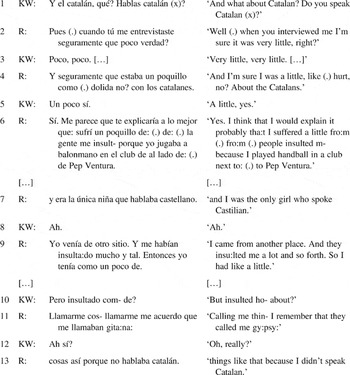
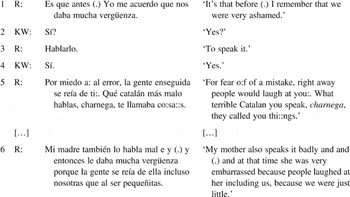
In (1), Rosario recalls herself as speaking little Catalan because she was ‘hurt’ or ‘aggrieved’ (dolida) by Catalan peers who insulted her and called her names because she spoke Castilian.
Rosario: Hurt and insulted (421–40)Footnote 12

Later in the interview Rosario also recalls being called charnega, a strongly insulting epithet for immigrants to Catalonia rarely used by young people now (See (7) below). Rosario was called this because she spoke Castilian, she says.
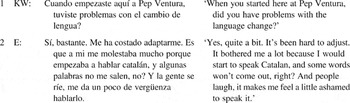
Elena's interviews both as a teenager and twenty years later focused on the shame of being laughed at when speaking Catalan, as in (2), taken from her 1987 interview.
Elena (1987): Laughed at (164–80)

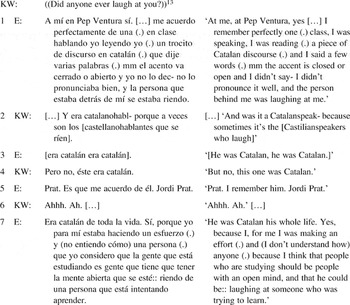
Twenty years later, Elena provides more details (see (3)), remembering with indignation being laughed at by the Catalan speaker behind her in class because she didn't distinguish tense and lax vowels when reading aloud in Catalan. She even remembered the name of the boy who laughed at her. (His clearly Catalan surname and first name are represented in turn 5 below by a pseudonym).
Elena (2007): Laughed at (1050–60)

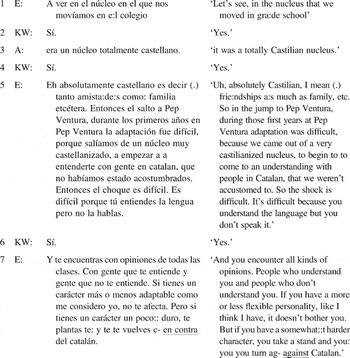
In (4) Elena expands on this memory, explaining that such experiences were a shock to young people like her who came from entirely Castilian-speaking environments. Humiliating encounters with Catalans could easily turn them against Catalan, as Elena said happened with her sister.
Elena and Adela: The shock of Catalan (53–59)

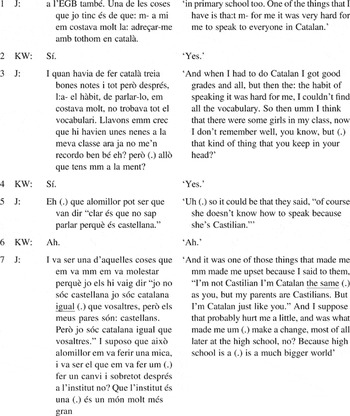
Even Josefina, who had become a New Catalan bilingual by high school, recalls a school incident with Catalans that upset her (see (5) below). But for Josefina—a step ahead in the catalanization process throughout her life—the incident came earlier, in primary school, and she suggests it motivated her to make the transition to Catalan earlier, with the move to high school.
Josefina (speaking Catalan): Upset and a little hurt (574–78)

The insults, ridicule, and explicit or implicit rejection that these women recalled feeling as young girls are linked in their accounts to their own vulnerability and shame (vergüenza) about speaking incorrectly. Vergüenza is a term used by all three formerly monolingual Castilian women (e.g. Rosario in (7)) and is also the term that José Luis had used in his 1987 interview (extract 6, turn 4 below). These informants themselves emphasize the powerfully motivating linkage of shame and linguistic purity that James Wilce (Reference Wilce2009) has recently suggested needs to be explored more explicitly in sociolinguistics.
José Luis (1987): Shame (348–450)

Rosario: Shame (631–37)

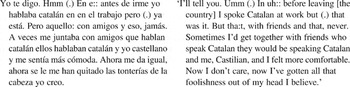
Losing this linguistic shame allowed all of these informants to launch themselves into speaking Catalan, as Rosario explains in (8).
Rosario: Loss of shame (491–93)

Outgrowing shame and intolerance
What allowed all four of the former nonspeakers to overcome their vergüenza and begin to speak Catalan? They offer a common narrative of outgrowing shame and concern about what others think, on one hand, and of greater tolerance of difference among post-adolescents, on the other. Young people are more susceptible to shame than adults: very vulnerable ‘vulnerable’ or muy sensible ‘very sensitive,’ as Elena, Adela, and Rosario variously say.
Elena: Outgrowing shame (1015–21)

With age comes security to accept your own mistakes, Adela explains in (10).
Adela: Accepting mistakes (138–42)

These informants speak of age positively, and repeatedly characterize the adolescent preoccupation with shame as foolishness or stupidity (tonterías), as shown in (11) below (we will see the term tonterías, like vergüenza, recur in other extracts).
Rosario: Foolishness (497)

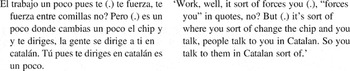
Rosario characterizes her younger self and her high-school group as “closed-minded” (turn 3 in (12)). This explanation is also implicit in Adela's account (turn 3 in (13)) of how her ex-husband opened his mind and “changed the chip” after high school to become proud of speaking and being Catalan. “Changing the chip,” as in changing the microchip card in a cellphone, is a popular phrase and is also used by José Luis (see (16) below) to capture the turnabout in his attitude toward the Catalan language.
Rosario: Closed-minded youth (1049–54)

Adela (speaking Catalan): Changing the chip (1702–8)

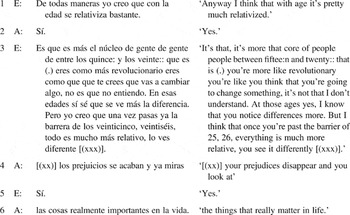
All of these informants also believe that with age people become not only less vulnerable in themselves but also more tolerant toward others, less invested in monitoring and judging others' behavior. With age comes a sense of proportion, says Elena in (14), and Adela adds that prejudices disappear.
Elena and Adela: Age relativizes (750–55)

We see in these various extracts taken together the folk explanation of changing language practices that emerged in all of the Castilians' interviews. That is, the informants share a developmentalist model in which simply aging out of adolescent self-consciousness and foolish adolescent preoccupations with difference and sameness opens the individual's mind to the possibilities of speaking Catalan. In this model, the commonsense world that shapes the consciousness of the adult is less threatening and more tolerant than that of the adolescent. Adults are held to be more open-minded than teenagers, merely as a matter of social-psychological development.
Environments for change in the linguistic repertoire
In addition to the shared view of the effects of maturity on language practices, each of these informants' accounts also pointed to specific changes in environment or experience that led to new stances toward linguistic practice and a new sense of self. In this section I briefly identify these significant changes in social environment and give an extract to illustrate each of them.
School and university
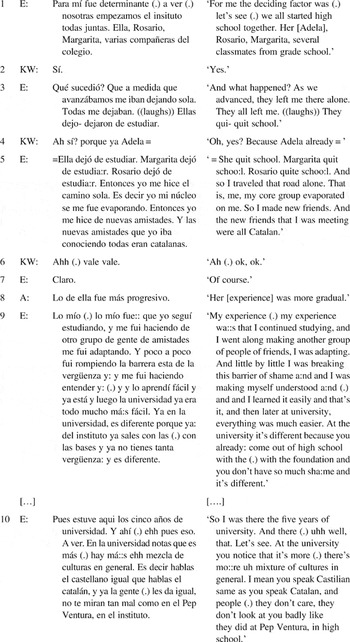
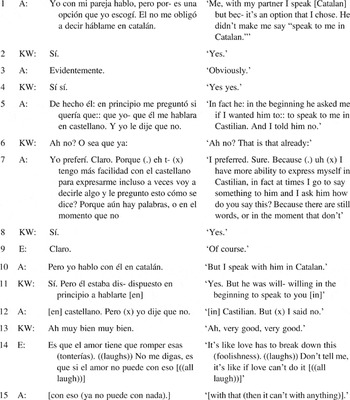
For Elena, simply continuing in high school when her friends dropped out was a prime factor affecting her relationship to Catalan (see (15) below). As Adela, Rosario, and others left school, Elena's Castilian-speaking circle “evaporated,” as she puts it (turn 5). Persevering on her own with high school, Elena came to make friends with people she refers to as “Catalans”—some of them bilingual New Catalans, including Josefina. As she adapted to new friends, “little by little I broke the barrier of shame, and I learned it [Catalan] easily” (turn 9).
Elena and Adela: Continuing education and university (194–219)

Exactly as my earlier informants had predicted for themselves, university life was a linchpin in Elena's linguistic transformation. Linguistically, she found “everything much easier” at the university because, having gained a foundation in Catalan in high school, she no longer felt shame (turn 9 in (15)). Moreover, at the university, people mixed across linguistic lines and were more accepting than in high school (turn 10). For Elena, then, the move from high school to university functioned the way the move from primary school to high school had for Josefina (see (5) above). Those like Josefina who had acquired basic knowledge of Catalan in primary school could make the social leap to speaking Catalan regularly in high school, which they found to be a more ethnolinguistically mixed place that gave them the opportunity to speak it. For Elena, this same experience came one stage later, after acquiring the linguistic base in high school.
Work
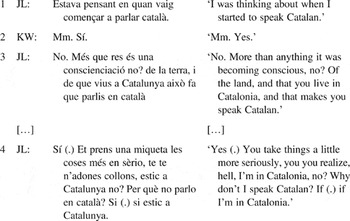
José Luis worked in a hospital after high school in order to pay for his subsequent university studies. It was entry into the workforce that led him gradually to “change the chip” linguistically and to gain what he characterizes as linguistic consciousness (see (17) and (18)). He came to see himself as having foolishly passed up linguistic opportunities (see (18) below).
José Luis: Work (332)

José Luis (speaking Catalan): Becoming conscious (1089–95)Footnote 14

José Luis (speaking Catalan): Giving up foolishness (1103–5)

Like Elena, Rosario, and Adela, José Luis depicts the transformation as mostly a developmental matter, an opening of the mind, as Adela and Rosario each said specifically, against the closed-minded preoccupations of adolescence. But in this case it is the new environment of the workplace that triggered the moment of recognition and the opportunity for change.
Cosmopolitan travel
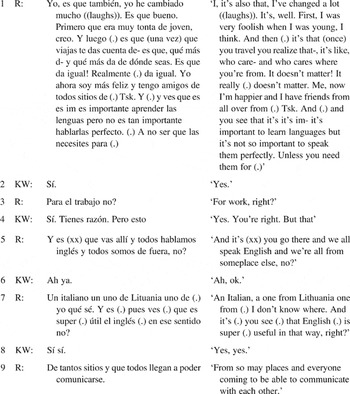
Rosario's newfound comfort in speaking Catalan is in her view partly a matter of the seemingly natural process of maturing, partly a response to what she sees as a more relaxed attitude among contemporary Catalans about linguistic correctness, and largely a result of her cosmopolitan experience.Footnote 15 Travel does not only change the linguistic repertoire by adding new languages encountered abroad, although Rosario did indeed become a fluent English speaker. Movement through new linguistic worlds can also allow a different orientation to the old one, a kind of gestalt shift. This was the case for Rosario, who had been aggrieved and ashamed to speak Catalan if she couldn't speak perfectly, an attitude that she now sees as foolish, as expressed in (19). Travel and the experience of learning English imperfectly put her relationship to Catalan and even to a Catalan identity in a new perspective, allowing her to take up both on her return to Barcelona.
Rosario: Cosmopolitan experience (2162–70)

Social networks and romance
Adela did not speak Catalan until after she divorced at age twenty-eight. Trying to restart her social life, she joined a ski class with a niece and found herself in the midst of Catalan-speakers. And there, having outgrown her teenaged shame, she began to speak Catalan. But it was the relationship with the new romantic partner she met in the ski class that cemented her new relationship with the Catalan language. She and her conarrator Elena conclude with a laugh “Love has to break down the foolishness; if love can't, nothing can.” (turn 14 in (20)).
Adela and Elena: Love overcomes foolishness (258–72)

Parenthood
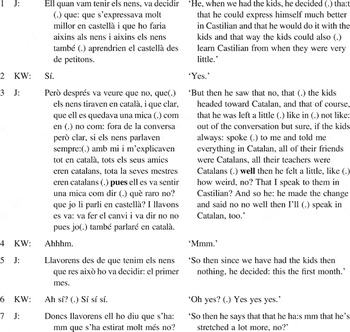
Entry into parenthood can also create or cement changes in the linguistic repertoire. For example, Pujolar and colleagues (2010:22) found that 40% of Castilian-speaking couples use Catalan as much or more than they use Castilian with their children. Josefina had already made the change to bilingual practice and persona in high school, and then to increasing Catalan dominance when she joined the workforce. But her Catalan identity was reformulated and moved to a new stage when she became a mother and decided to speak only Catalan to her children so that they could have native-speaker accents and native-speaker advantages. Her bilingual husband—with whom she speaks directly in Castilian—has been brought along in the arrangement, willy-nilly (see (21)). This rupture of intergenerational transmission of the mother tongue is significant for the expansion of Catalan, and it is also significant for Josefina's own social identity.
Josefina (speaking Catalan): Parenthood (448–54)Footnote 16

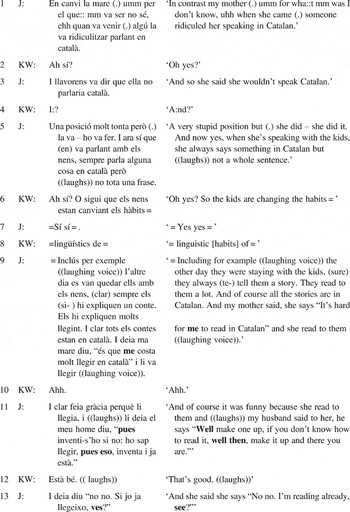
In a hint of the further changes possible later in the lifespan, Josefina points to her own immigrant mother, who never spoke Catalan while Josefina was growing up because someone had ridiculed her early on. Now as a grandmother she has begun to use Catalan with her Catalan-dominant grandchildren, and even attempts to read to them in that language.
Josefina (speaking Catalan): Grandparenting (523–36)

Methodological considerations and some caveats
How representative are these informants of their age cohort of Castilian-speakers? Although I cannot claim that the small ethnographic case study from which they are drawn is representative of the population, there are larger-scale data that demonstrate that their linguistic trajectories are far from unusual. For example, a 2008 survey shows that approximately 41% of parents in Catalonia speak Catalan to their children, yet only 32% speak it to their own parents (Generalitat de Catalunya Reference Generalitat de Catalunya2009). Josefina belongs to this 9% of parents who have shifted intergenerational language. A recently released study of youth by Joan Pujolar and colleagues, shaped partly in response to early results from the present study (Joan Pujolar i Cos, p.c.) also finds reports of postsecondary school shifts to Catalan that are highly resonant with those found in this ethnographic case study (Pujolar et al. Reference Pujolar i Cos, Balletbò, Tanyà; and Sanmartí2010).
These larger-scale survey and interview-based studies suggest that my informants may well represent a typical experience of former students from academic high schools like theirs. However, those who attended the vocational schools (Formació Professional) of their era or Castilian-dominant academic high schools may not show the same kind of turn toward Catalan as was found in this group (although the fact that even the high-school dropout among these informants joined the trend toward Catalan is of interest on this point.) Pujolar et al. (2010) found that a significant minority of the population, concentrated in sectors with lower educational attainment, continues to hold negative and resistant attitudes toward the Catalan language and language policy. In fact, Josep, a classmate of the informants discussed here, complicates the picture I have drawn. Although Josep now uses Catalan fluently in his professional and public life (occasionally appearing in discussions on local television), it is highly marked as nonnative, and he commented that he is always translating from Castilian when he speaks Catalan. That is, Catalan has not been naturalized or internalized for him, even though he had been ahead of his classmates in using Catalan in high school. His resentment was perhaps apparent even then, in his frustrated comments on Catalan classmates who couldn't bring themselves to speak Catalan with him (Woolard Reference Woolard and Auer2007). Josep's current stance toward Catalan language policy and Catalan identity is quite negative and more distinctly political than that of his classmates and friends discussed here. His experience and views, and their relation to those of his classmates, will be pursued in further analyses.
My knowledge of these informants’ practices as teenagers was based in ethnographic observation and interactional documentation as well as interviews, but my knowledge of their current practices, and of the experiences that brought them about, is based in interviews only.Footnote 17 In particular, the accounts of how and when the changes in linguistic practices occurred derive only from the informants' own retrospective narratives. Am I, then, analyzing their linguistic transformations, or their narratives and their own (“folk”) explanations of such transformations? The answer is clearly both, and both are of interest. However, my inventory of explanatory factors for change in the linguistic repertoire is filtered through the informants' narratives, which themselves show a cultural pattern in the emphasis on adolescent shame and mature tolerance. Some larger patterns in these informants' narratives are considered below.
Conclusion
In these informants' own accounts and in the linguistic abilities they displayed in their interviews, there was evidence of considerable development of their bilingual repertoires after adolescence and high school. Their ability in, comfort with, and use of Catalan had all grown notably since they were teenagers, as had their self-identification as Catalan. For each informant, theses changes responded to some specific social juncture that proved as critical for linguistic practice and identity formation as had the start of secondary school. These include entrance into university, a first job, a romantic relationship, international experience, and parenthood. Under these later influences, the alienation from Catalan linguistic practices that most of them had shown in early high school gave way to socially integrative and linguistically additive habits.
Despite the variation in the particular social triggers of their own personal sociolinguistic development, these informants offered a common account of an underlying cause of such linguistic transformations. They posited qualitative differences between the ways that adolescents and adults orient to sociolinguistic distinctiveness and particularly in the way they relate linguistic distinctions to sense of self and social identity. They view shame, self-consciousness, exclusiveness, and intolerance as immature traits that inhibit second language learning and that are shed with age, allowing new linguistic forms to be taken up more freely.
Surely this shame complex can be seen as a form of symbolic violence, in Bourdieu's (1991) term. However, rather than emanating directly from institutions of linguistic authority such as the school, as Bourdieu originally posited, this is interpersonal symbolic violence among peers. In this sense it is similar to the class-based aggression Goodwin (Reference Goodwin2006) has documented on playgrounds in Los Angeles. In recent research on Moroccan children in Spanish elementary schools, García Sánchez (Reference García Sánchez2007) also has found students enforcing immigrant-origin peers' marginality, through tattling and bossing that are unwittingly sanctioned by teachers in the classroom. García Sánchez warns of the effects of such interactions on the development of immigrant children's identities, and on whether they grow up seeing themselves as full members of Spanish society, or feel a sharp sense of alienation and nonbelonging. My longitudinal study confirms that such alienation can indeed result from youthful peer aggression and intimidation, but it also shows that this alienation does not necessarily become a fixed part of the marginalized young person's identity (despite the persistence of its memory). These informants essentially concur that “It gets better,” as the phrase goes in the current US project to support gay teenagers who are bullied in high school.
García Sánchez's work shows the unintended complicity of teachers in peer bullying. We might ask to what degree the shame complex that my informants experienced was actually provoked or exacerbated by the organization of schooling and particular classroom practices. Activities such as reading aloud in Catalan or writing on the board in front of peers, which my informants experienced as painful, have obvious potential to induce shame and embarrassment. Beyond these, the formal prescriptive approach that was taken to language instruction in the 1980s in Catalonia, emphasizing grammatical analysis, orthography, and correctness, may itself have encouraged a stance of linguistic intolerance among students. When these informants were in high school, the focus of Catalan instruction was on grammar and orthography in all of the schools I visited, from elite to working-class vocational schools. In some classes almost all of the students were L1 Castilian-speakers. Nonetheless there was little and in most cases no acknowledgment in any of the classrooms that Catalan was being taught to people who not only were not native speakers, but in many cases were not speakers of the language at all. Strikingly, some teachers who were themselves L2 speakers of Catalan did not reveal this fact to their Catalan-learning students, deeming it “irrelevant.” The focus was on correctness and on literate skills for all, regardless of their existing functional skills in the language. On the surface this may have avoided making social distinctions between the two ethnolinguistic groups, a deliberate principle of Catalan educational policy. But in practice it may have provided disproportionate opportunities for Castilian-speakers to fail by classroom standards and thus be open to apparently institutionally supported censure by their peers.
Rosario herself posited that a Latin-inspired concern for grammar is typical of Romance language instruction and that it inhibited her willingness to speak if she could not do so perfectly. She contrasted this with her husband's Danish schooling, which she believed involved little training in grammatical analysis (“An adjective, what's an adjective?” she reported that he asked in response to her coaching), but rather emphasized language learning through what she characterized as a more natural, oral method. Rosario's observation suggests that the focus on correctness not only did little to encourage acquisition of Catalan, but also actually militated against such acquisition.Footnote 18 The approach to language teaching in Catalan schools has changed considerably in the intervening years, particularly for new immigrants who now attend specially designed “reception” classes that emphasize functional communication.
It is noteworthy that these informants' accounts share a chronotopic frame, in that they are for the most part told in biographical rather than sociohistorical time. As Eckert (Reference Eckert and Coulmas1997:166) points out, social and political events can affect the way people speak, so cohort membership—“coming of age” in a particular historical context (the baby boom, the Great Depression, the end of the Franco era)—can be as important as life stage (simply “coming of age”) in explaining linguistic behavior (see Williams & Nussbaum Reference Williams and Nussbaum2001:144–46 for a brief discussion of such cohort and generational effects on identity more generally). In contrast, these informants rarely refer to their specific historical context in explaining their own linguistic evolution. Instead, they tell their stories more in the form of a bildungsroman, the novelistic genre in which character development is primarily a matter of self-actualization, of individual maturation and self-realization within a social environment that is less susceptible to change. As in the bildungsroman, the social context offers the challenges, but developments and changes occur in the individual, who adapts to those challenging structures. For example, when asked to compare the linguistic situation of Catalonia now to that of twenty years earlier (see (9) above), Elena explicitly attributed improvement to her own personal age, rather than to contextual changes, despite the considerable cultural, political, and economic transformations of Spain and Catalonia over the last two decades. Only Rosario, with the dual insider-outsider view of the returned expatriate, suggested that there may also have been contextual change over the period in the attitudes of native Catalan-speakers. The relation of these two perspectives, the biographical and the sociohistorical, will be explored in further work. Of particular interest is the close fit of this narrative with the neoliberal model of the individual cultivated in late modern social ideology (Mary Bucholtz, p. c.).
This upbeat account of linguistic expansiveness and flexible identification across the lifespan needs to be nuanced. There are limits to the linguistic growth that all of these informants showed and claimed. True to the notion of a critical period for language acquisition, none of them displayed a native Catalan-speaker's habitus, a point that Adela remarked with regret (though not in quite these terms). All of the informants display their linguistic origins to a greater or lesser degree in various kinds of linguistic transfers from Castilian that go beyond those often found among native Catalan-speakers.
Finally, these informants' active use of the Catalan language should not be taken to imply loss of Castilian, and claims to Catalan identity do not in any way signify an embrace of the Catalan nationalist project. Elena, for example, speaks vociferously against Catalan nationalism. She is, however, also vociferous in her condemnation of a new political party that claims to be simply antinationalist but is widely perceived as anti-Catalan; she didn't hesitate to label the Ciutadans de Catalunya ‘Citizens of Catalonia’ party as fascist (facha). Similarly, Elena's friend Adela is enamored of Catalan and things Catalan, just as she is enamored of her Catalan domestic partner, but she echoes Elena in speaking against all nationalist sentiments and politicians who “sell” the language.
Catalan identity is something that these informants struggled with as teenagers, but as adults they have incorporated it into their sense of self. This incorporation is more akin to a civic, residential identity than an ethnic or nationalistic one; “I'm from here, I live here,” says Rosario in claiming her Catalan identity. Yet rather than being a merely “local” or provincial identity as outside critics often assert, speaking Catalan for them is a sign of being adult and modern, open-minded and cosmopolitan, in contrast to those of either stripe who are narrow-mindedly resistant to linguistic variation and multiplicity. The Catalan language and Catalan identity have become relatively de-ethnicized and depoliticized facts and facets of their daily lives. They like to view this as a choice they made to enlarge rather than constrict their personal world. These informants would prefer that the language and identity not be politicized by others, either.Footnote 19 Given the often vehement political rhetoric aimed at Catalan language policy from other parts of Spain, tensions surely underlie this espoused resolution of experience as personal rather than political. Nonetheless, in contrast to their own teenage years as well as to the enduring monolingual ideology that dominates much of Spain, these young adults insist that bilingualism is now neither problematic nor political, but rather simply part of the landscape and of their personal reality.
APPENDIX: TRANSCRIPTION CONVENTIONS
- [words]
overlapping speech
- (.)
perceivable pause
- (word)
uncertain transcription
- (x)
unintelligible
- (( ))
analyst's comments
- […]
material omitted
- :
elongation
- word
emphatic speech
- =
latched speech, no pause
- boldface
codeswitch