“The general tendency of the evidence indicates that unnatural crimes are far more common in the penal colonies than would be supposed from the number of convictions for those offences.”Footnote 1
So declared the 1838 Report from the Select Committee on Transportation, chaired by Sir William Molesworth. The British perception of the Australian colonies as a southern Sodom in which buggery was practiced with alacrity played an important, if sometimes overdetermined, role in the eventual cessation of convict transportation to New South WalesFootnote 2 (NSW) in 1840.Footnote 3 The report was no doubt correct that unnatural crimes or buggery, which in legal terms was a capital offense encompassing both sodomy (anal penetrationFootnote 4 by a man of another man or a woman,Footnote 5 irrespective of consentFootnote 6) and bestiality (sex with animals),Footnote 7 occurred with greater frequency in the colonies than conviction rates would suggest. However, the report does not mention that in the decade prior to 1838 there was, at least in NSW, a discernible increase in the number of men tried in court for committing unnatural offenses. In terms of raw numbers, the trial rate was indeed small when compared with the number of men committed for trial on charges of buggery in England.Footnote 8 However, when measured against population size, a very different picture emerges. The “unspeakable” crime, it seems, was in fact productive of significant amounts of speech in colonial NSW, as the community voiced its collective intolerance of buggery by surveilling and informing on persons suspected of its practice, and providing lurid testimony in court regarding others’ sexual misdeeds.
This article analyses the cases brought against men for buggery (i.e., sodomy and bestialityFootnote 9) and attempted buggery (a common law offence that is discussed further in Part I) in NSW during the period 1788–1838;Footnote 10 that is, from the time of the First Fleet's arrival at Sydney Cove through to the Report from the Select Committee on Transportation.Footnote 11 It shows that in the first 40 years of colonization, up to the passage of the Offences Against the Person Act 1828 (Offences Act), which dispensed with the long-standing need to prove ejaculation to secure a conviction for buggery and rape,Footnote 12 there was an irregular pattern of sodomy cases in NSW.Footnote 13 In the next 10 years, however, the number of men brought before the courts on sodomy charges rose dramatically, but also stabilized on an annual basis at rates significantly in excess of that seen in England when population size is taken into account.Footnote 14 The charge rate for bestiality also stabilized on an annual level post-1828, but no comparable rise in frequency is apparent; nevertheless, when considered against population size, even this fairly static rate is shown to be surprisingly high. The data also reveal a distinct shift in the types of charges that were brought in sodomy cases that reached court: in the first 40 years, men were far more likely to be charged with attempted sodomy than with completed acts. Between 1828 and 1838, however, trials for the capital offense were much more frequent than charges of attempt. No such shift is apparent in bestiality cases because the tendency was always to charge the capital offense. Although it is not in every instance possible to determine the genesis of buggery complaints from the records,Footnote 15 the vast majority of cases do provide detail on this question. Collectively, they show that most charges were the result of community surveillance; that is, most complaints were made by victims, participants,Footnote 16 or members of the public, and were generally not the result of official forms of policing.Footnote 17 The cases also reveal an interesting tension between the putatively unspeakable nature of buggery and the evidentiary requirements for conviction. Recalling Michel Foucault's discussion of the “institutional incitement to speak” in nineteenth-century Western societies,Footnote 18 the cases show that witnesses were far from circumspect in their descriptions of the acts that they claimed to have been subjected to or seen.
This article then sets this empirical analysis in historical context. It suggests that the upswing in buggery charges after 1828 had less to do with the introduction of the Offences Act than with the exacerbation of long-standing tensions in the colony revolving around crime, morality, and the place of convicts in NSW following the publication of John Thomas Bigge's 1822 Report into the State of the Colony of New South Wales;Footnote 19 those tensions, it is suggested, resulted in a heightened degree of community surveillance of convicts in the 1820s and 1830s, resulting in the increased reporting of unnatural sex and indocile bodiesFootnote 20 to an expanding police force.Footnote 21 This social exposure of buggery was, in turn, augmented within the legal system by the evidentiary changes enacted by the Offences Act; in essence, the removal of the ejaculation requirement translated (albeit with a lag time) into a prosecutorial practice of charging the accused capitally, at least in sodomy cases (this was always the practice for bestiality). At the final stage of the trial, the punishments meted out by judges moved away from spectacular, public forms of humiliation after 1828. This makes sense in light of the trend toward charging men with the capital offense because a guilty verdict in such cases resulted in a sentence of secondary transportation or death (which was usually commuted to transportation). More speculatively, this move may also be seen as part of a broader shift in the logic of punishment away from the exemplary and toward the disciplinary; in other words, eschewing the public spectacle of ritual bodily punishment in favor of more hidden forms of individual moral reformation.Footnote 22
The final part of the article connects the morality-driven surveillance of convicts, and the law's discursive impetus to speak of the unspeakable, to the evidence given to the Select Committee on Transportation concerning the prevalence of unnatural crimes in NSW and Norfolk Island, and the eventual cessation of convict transportation to NSW in 1840.
I. The Transplantation of English Buggery Law into NSW
In his Commentaries on the Laws of England, William Blackstone declared: “For it hath been held, that if an uninhabited country be discovered and planted by English subjects, all the English laws then in being, which are the birthright of every subject, are immediately there in force.”Footnote 23 The logic of English political thought and public international law in this era meant that for English purposes, the lands that eventually comprised NSW were treated as “uninhabited country”;Footnote 24 a product of the European preoccupation with individual property rights and cultivation of land as a marker of ownership,Footnote 25 and racist attitudes toward Indigenous customs.Footnote 26 Consequently, English law automatically applied in the new colony; but, in Blackstone's words, “with very many and very great restrictions. Such colonists carry with them only so much of the English law, as is applicable to their own situation and the condition of an infant colony; such, for instance, as the general rules of inheritance, and of protection from personal injuries.”Footnote 27 To this list Blackstone might have added the English law of buggery.
Civil, rather than ecclesiastical, prohibitions on buggery emerged in England in 1533 under the reign of King Henry VIII. The Act for the Punishment of the Vice of Buggery criminalized “the detestable and abominable Vice of Buggery committed with Mankind or Beast” on pain of death.Footnote 28 In 1642, Edward Coke defined buggery as anal penetration of a man or woman by a man, or penetration of an animal by a man (whereas any sexual act between a woman and an animal seems to have been sufficient).Footnote 29 In 1781, in the case of R v. Hill, it was held that in cases involving men ejaculation must have occurred in order for the offense to be proved.Footnote 30 Although this finding raised the bar in buggery cases, the common law also expanded the ambit for prosecution by treating attempts to commit buggery as offenses, albeit of a lesser magnitude than completed acts.Footnote 31
In NSW, it took until 1796 for a buggery case to be heard by the Court of Criminal Jurisdiction, despite the first Governor, Arthur Phillip, having declared his preference for dealing with sodomites by “confin[ing] the criminal until an opportunity offered of delivering him to the natives of New Zealand, and let[ting] them eat him.”Footnote 32 Joseph Pearce, a settler, complained that Francis Wilkinson, laborer, “had carnal connection with him when he had him on the ground.” Charges were brought against Wilkinson alleging that he “did make an Assault on him the said Joseph Pearce … with an intent [to commit] that most horrid detestable and sodomitic crime (among Christians not to be named) called Buggery.”Footnote 33 Wilkinson was found not guilty based on evidence that Pearce had publicly declared “he knew not who it was that had assaulted him.” The case against Wilkinson was the first in NSW concerning sexual contact between men, but it was not the only buggery case heard by the Court on April 23, 1796. On that same day, charges were read against George Hyson alleging that he “diabolically & against the Order of Nature, had a Venereal affair with [a] she dog & then & there carnally knew the said she Dog & … did commit and perpetrate that detestable and abominable Crime of Buggery.”Footnote 34 Evidence was given by a passerby that he “found the prisoner on his knees, with his trowsers down—that his private parts were close to the bitch's.” Hyson was cleared of the capital offense but found guilty of assault with intent to commit it. He was sentenced to stand in the pillory on three separate occasions for 1 hour per time.
These cases made it clear that English buggery law in its entirety applied in NSW. Anal penetration of a man or woman (including a wifeFootnote 35), and vaginal or anal penetration of an animal amounted to buggery under the terms of the 1533 Act if ejaculation occurred.Footnote 36 In the absence of proof of emission, or in cases in which the requisite forms of penetration did not occur (oral sex or mutual masturbation) or could not be proved, a man could still be convicted of the lesser offence of assault with intent to commit buggery. As in England, this position remained the law until 1828 when the Offences Act came into force. The Offences Act applied in NSW by virtue of the Australian Courts Act 1828.Footnote 37 Section 15 of the Offences Act effectively mirrored the earlier law by providing that “every Person convicted of the abominable Crime of Buggery, committed either with Mankind or with any Animal, shall suffer Death as a Felon.” Crucially, however, Section 18 amended the common law approach to proof of carnal knowledge, providing “it shall not be necessary … to prove the actual Emission of Seed in order to constitute a carnal Knowledge, but that the carnal Knowledge shall be deemed completed upon Proof of Penetration only.”
II. The Cases
The primary archive for this investigation is Peter De Waal's extraordinary collection of materials, Unfit For Publication,Footnote 38 which is an online record of “NSW Supreme Court, Quarter Sessions and Police Court, Bestiality, Buggery, Sodomy, and other sex offences Trials, 1727–1930.”Footnote 39 De Waal painstakingly located records from newspapers throughout NSW, along with judges’ notes and police records in rural and metropolitan areas, and catalogued the results by year and the name of the person charged.Footnote 40 I supplemented De Waal's material with further searches of early Australian court cases,Footnote 41 which yielded limited additional results.Footnote 42 In what follows, I present a breakdown of cases concerning buggery and attempted buggery in the period from January 1788 to July 1828, when the Offences Act came into operation, and the decade following the act's introduction, August 1828 to July 1838.Footnote 43
The baseline focus is the number of cases according to type: sodomy, assault with intent to commit sodomy, bestiality, and attempted bestiality. Where charges were brought against more than one individual in a single case, or multiple charges were laid against a single individual, I counted the number of charges.Footnote 44 In order to account for the small (although rapidly growing) population in NSW, and to provide a basis for comparison with English data, I have converted the raw figures into charges per 100,000 persons;Footnote 45 however, to account for the wild fluctuations in the early decades of the colony, I present these data as an overall average for the period 1788–1828. For the period 1828–1838, when annual case numbers stabilized, I give an average annual figure per 100,000 persons.Footnote 46
The sodomy and attempted sodomy cases (only) are also sorted by reference to the sex and age of the accessory/victim. With respect to sex, the cases throughout the entire period disclosed only one instance in which a man was charged with buggery involving a female.Footnote 47 Concerning age, neither the 1533 Act nor the Offences Act distinguished between acts committed with/on adults and minors, but males under the age of 14 were not considered capable of committing the offense during the period in question.Footnote 48 Accordingly, I have treated 14 as the applicable age of majority and sorted the sodomy cases according to whether they were committed on or with adults or minors.Footnote 49 I have not, however, sorted the sodomy cases according to whether consent was or was not given,Footnote 50 partly because consent was legally irrelevant to buggery cases at this point, and also because of the limited nature of the record in many of the cases and the clear incentive to retrospectively withdraw consent in the face of corroborating witnesses (the evidence of an accomplice alone being insufficient to ground a convictionFootnote 51). Nor have I distinguished between cases involving white settlers/convicts and Indigenous persons.Footnote 52
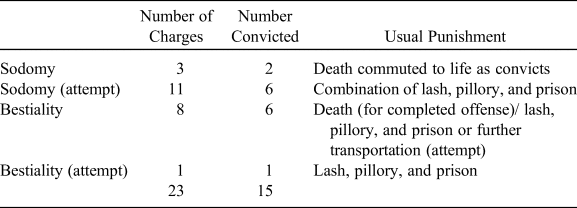
Buggery Charges, 1788–1828.

The next step involved determining whether the charge(s) resulted in acquittal or convictionFootnote 53 and, in the latter scenario, determining the punishment imposed. I also analyzed the ways in which cases came before the courts to ascertain whether charges were the product of official or community policing (i.e., was the offense observed by a prying publican or a zealous constable).Footnote 54
A. 1788–1828
In the 40-year period between the arrival of the First Fleet and the introduction of the Offences Act in July 1828, there were only three sodomy charges laid against men in the colony, and all of these cases appear to have involved acts with or on adult males. The first of these cases was not heard until 1808, and involved charges against two men, Richard Moxworthy and John Hopkins, for actions committed onboard a ship. The case (discussed further subsequently) resulted in the only convictions for sodomy (in the specific sense in which I am using the term here) in the entire period: both men were sentenced to death, but pardoned on condition of serving as convicts for life.
The same period saw a further eleven charges of assault with intent to commit sodomy;Footnote 55 all of those charges related to acts committed with or on males, two of whom were under the age of 14. The results in those two latter cases were evenly split: Francis Hobra (1813),Footnote 56 found guilty of assaulting a boy of 7, was sentenced to 3 years in jail, 100 lashes, and time in the pillory; John Wilson (1809) was found not guilty of the same charge. Of the attempt cases involving males older than 14, the first being the trial of Francis Wilkinson (1796), five out of nine charges resulted in guilty verdicts, with sentences similar to that given to Francis Hobra.
Concerning bestiality, eight charges were brought alleging the capital offense, plus an additional charge of attempt. Seven convictions resulted, but interestingly, six of those were convictions for attempt only; that is, in six out of the eight cases in which capital charges were brought, guilty verdicts were returned only in respect of the lesser offense (the one case in which attempt only was charged also resulted in a guilty verdict). The only case in which a guilty verdict was returned for the completed act of buggery with an animal resulted in the only sentence of death to be carried out for the crime of buggery in the entire period 1788–1827. James Reece (1799), convicted of sexual congress with “a Certain Sow,” was executed on February 8, 1799. The sentences for those found guilty of attempts varied between a combination of prison, lash, and pillory, and further transportation to places such as Norfolk Island.
In all, then, there were twenty-three buggery cases against men in NSW between 1788 and 1828. Of those twenty-three charges, fifteen convictions resulted; somewhat surprisingly, only one man (Reece) was executed. Although figures per 100,000 persons are of limited utility in a situation in which more than a decade sometimes passed between the issuing of buggery or attempt charges, when averaged out over the entire period, they give at least a baseline for further analysis. Thus, the fourteen sodomy-related charges result in an average annual rate of 3.165 charges per 100,000 persons.Footnote 57 The nine bestiality-related charges give an average annual of 1.87 charges per 100,000 persons. The combined average annual rate is 5.035 buggery charges per 100,000 persons. By way of contrast, Harry Cocks’ investigation into committal rates for sodomy and related misdemeanors (not bestiality) in England between 1806–1900 showed a rate varying between just over 0.2 and around 0.9 committals per 100,000 in the period between 1806 and 1828. The two societies and their legal systems cannot, of course, be directly compared at this early juncture, but the figures from NSW serve to indicate that when considered in relation to population size, the number of sodomy and bestiality charges in the early decades was not quite as low as initial appearances might suggest.Footnote 58
Given the structure of early NSW society, it is not especially surprising to find that the majority of cases in this period were brought against convicts.Footnote 59 Nor, in the absence of a modern police force,Footnote 60 is it surprising that most cases came to court as a result of surveillance by fellow convicts, seamen, and military officers operating within their respective milieus. The first man charged with bestiality in NSW, George Hyson (1796), convict laborer, was convicted (of assault with intent to commit buggery) based on the evidence given by another convict, James Ormond, who deposed:
That on the fourth of April [1796], between the hours of twelve and one in the (?), as he was returning from Cockle Bay, whither he went for some (greens? …) on passing by a house which had been used as a stable, hearing a noise he looked in, & in one corner of the room he saw the prisoner upon his knees with a (terrier? …) bitch … with his trowsers down--that his private parts were close to the bitch's—close to her backside … that when he [Hyson] perceived him (the witness) he appeared much (flurried?) & immediately buttoned up his trowsers.
Ormond's evidence was corroborated by a local constable who did not witness the act but simply recounted what Ormond had told him. (The constable, Henry Kable, was a prominent emancipist who, along with his wife Susannah, successfully brought the first civil action in the colony in 1788, against the master of the ship that had brought them to NSW for the loss of goods shipped on board the vessel; the Court of Civil Jurisdiction's acceptance of the Kables’ standing to sue established the legal personhood of convicts within the new Colony.Footnote 61)
Similarly, the first men convicted of sodomy in the colony, Moxworthy and Hopkins (1808), were observed en flagrante by their fellow crew on board the American ship Hero. Moxworthy's subsequent (1817) petition to Governor Macquarie for clemency records that the pair were “charged with Fellony on the Coast of [New] Mexico and … Tryed and convicted there for the said charge by the Illegal Government.” Presumably, then, the men were transported from New Mexico to NSW as prisoners, where they were tried, found guilty, and sentenced to death. Clemency, however, was extended to the men by Lieutenant Governor Joseph Foveaux, possibly in an attempt to avoid public spectacle in the wake of his assumption of temporary control of NSW following Governor Bligh's arrest in January 1808 by the New South Wales Corps.Footnote 62
Only one case in the entire period between 1788 and 1828 appears to have been brought against a man from the upper classes of NSW society: charges of attempted sodomy leveled against Captain David Dundas (1809) by numerous members of the NSW Corps. According to Sergeant Major Thomas Whittle, a number of officers “told me that an attempt was made by the Prisoner on three of the Centries to have an improper connexion with them.” Although his accusers were free men, Dundas—reflecting the transplantation of English concerns with class into colonial NSW—nevertheless urged the court to treat their evidence with the greatest care because of “the looseness of Principles which prevails among the lower Classes of Persons in the Colony.” Whether or not the court agreed with Dundas on this point is unclear. He was acquitted, but the evidence given by the various men (discussed subsequently) was far from overwhelming, amounting to little more than assertions of importunate behavior and groping.
B. 1828–1838
The decade following the introduction of the Offences Act saw a dramatic increase in the number of charges laid against men in NSW for sodomy. Soon after the act's commencement, sodomy charges were brought against the chief officer of the Royal Sovereign, Alexander Brown (1828), and two men with whom it was alleged he had been intimate, Edward Curtiss and Richard Lester. The charges against Brown and Curtiss alleged, “with force and arms upon the high seas within the jurisdiction of the Admiralty of England in and on board of a certain ship or vessel called the Royal Sovereign, [Brown] feloniously wickedly and against the order of nature had a venereal affair with one Edward Curtiss and did then and there … know the said Edward Curtiss and with him the said Edward Curtiss did then and there … perpetrate the detestable and abominable crime of Buggery.” Similar charges were made in the case against Brown and Lester. In both cases evidence was given by other seamen that, on separate occasions, they had witnessed Brown sodomize Curtiss and Lester in Brown's quarters. In the case brought against Brown and Curtiss, the jury returned verdicts of not guilty against both men. In the other case, however, guilty verdicts were returned and both Brown and Lester were sentenced to death. Brown was executed the following week, but Lester, presumably because of his youth (and perhaps because of the receptive role he appears to have taken with Brown) was reprieved on condition of his immediately leaving the Colony.
A similar case in 1828 involved four men belonging to a whaling vessel: Henry Airs, James Stephenson, Thomas Turner, and one unnamed man. According to The Australian newspaper: “Suspecting, from the apparent close intimacy of the parties, and their secluded habits, that all was not correct, the Captain and others took an opportunity of observing their conduct, with more than common circumspection, which finally induced the Captain to bring his vessel into port, and the merits of the case under legal investigation.” The observers would seem to have been either too suspicious or too circumspect in their surveillance. The four accused men were acquitted.
Although these cases are something of an aberration in terms of the number of charges involved and the maritime location in which they were alleged to have occurred, they presage the remarkable increase in the prevalence and consistency of sodomy charges in the 1830s.
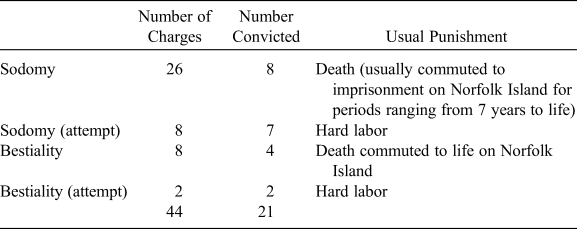
Buggery Charges, 1828–1838.

Between 1828 and 1838 there were thirty-four cases against men for sodomy and attempted sodomy.Footnote 63 This compares with just fourteen such charges in the preceding 40-year period.Footnote 64 Even when increasing population size is taken into account, the average annual rate nearly doubled, from 3.165 charges per 100,000 people in 1788–1828 to 5.87 charges per 100,000 people in 1828–38. Again, a direct comparison between England and NSW at this point is problematic, but to give a measure of comparative context, Cocks’ work on English buggery committals (excluding bestiality) in the same period revealed a rate between 0.4 and 0.9 charges per 100,000 persons. Equally striking is the reversal in the nature of the sodomy charges that were laid. Whereas eleven of fourteen charges in the earlier period were for attempt, only eight of thirty-four charges in the second period alleged attempt; that is, twenty-six of thirty-four charges were for the capital offense (and there was no mistaking that the offense was capital; the Offences Act specifically provided that persons convicted of “the abominable crime of Buggery … shall suffer Death”Footnote 65).
In raw terms, the figures for bestiality and attempted bestiality also suggest a significant increase compared with the earlier period: ten charges in 1828–38 compared with nine in the previous 40-year period. In this instance, however, a different picture does emerge when population size is taken into account. Measured on that basis, the average annual rate for bestiality actually fell from an average of 1.87 charges per 100,000 persons to 1.72 charges per 100,000 persons in 1828–38. When combined with the sodomy figures, the overall average annual number of charges for buggery stands at 7.6 per 100,000 persons, compared with 5.035 per 100,000 persons for the preceding 40-year period.
There is one other distinctive difference between the cases heard pre- and post-1828: a move away from punishment as spectacle. During the first period, six men were sentenced to punishments involving either the lash or time in the pillory or both. Not a single person during the second period was sentenced to punishment of this sort. By no means does this indicate a softening attitude toward buggery or crime in the 1830s—death and transportation for extended periods to Norfolk Island were not uncommon sentences. It does, however, suggest a shift in the logic of punishment. This is explored in greater depth subsequently.
The profile of the men charged with buggery during this period closely resembles that seen in the first four decades; that is, the vast majority of the accused men were convict laborers. Again, this is not especially surprising in light of the number of convicts who were transported to NSW in the 1820s and 1830s.Footnote 66 The notable exception is the series of cases in 1828 against Alexander Brown, Edward Curtiss, Richard Lester, Henry Airs, and three others, all of who were seamen. This stands as something of a contrast to the situation in England, where it appears that a much broader cross-section of society was brought before the courts. Cocks's research revealed that, “the largest single occupational/status groups represented in reported cases were artisans/skilled labourers and gentlemen” (although he noted that the preponderance of newspaper references to gentlemen and other professionals “reflects editorial decisions about what was likely to be of interest to a public fascinated by the transgressions of the respectable”).Footnote 67
Greater congruity between NSW and England is apparent in the routes by which cases came before the courts. According to Cocks, until the early 1840s in England, “prosecutions were still, as far as can be determined, initiated by individual men and women who were parties to the acts, or who claimed to be their inadvertent witness or unwilling ‘victim.’”Footnote 68 The same can be said of NSW.Footnote 69 The cases reveal that the majority of charges arose out of observation by passersby, masters, or other convicts, or by way of complaint made by victims of assault (or, in the case of children, their parents).Footnote 70 In other words, the majority of charges arose from community rather than official surveillance; and many of the lay witnesses in the cases surveyed herein gave evidence of having followed accused persons because of suspected criminal intent. To confirm their suspicions (and to satisfy their own prurient interest, one suspects), those witnesses would often remain watching the “action” for many minutes before intervening or calling for the assistance of officials.
Perhaps the best example is a case from 1834 against 19-year-old Samuel Jones (laborer), who was found guilty of buggery after being witnessed having anal sex with an unknown man in the Sydney Domain (an area of public land situated on Sydney Harbour). The witness, Private James Crain, deposed that upon seeing the two men lying on the ground, “I stood for as much as 7 or 8 minutes watching them”; it was only when Jones realized Crain was watching that the activity ceased and the men attempted to escape. Crain caught Jones, at which point, “I made him let down his trowsers. I examined his yard. It was quite red.” (Presumably Jones acquiesced to Crain's demand in view of his superior position within the colony.) For this apparently consensual encounter, Jones was sentenced “to be hung by the neck … until dead,” although this was quickly commuted to hard labor in irons on Norfolk Island for life.
An example of a complaint brought by the subject of an unwanted advance is the 1830 charge of assault with intent to commit “that detestable crime” brought against William Augustus Forsyth. The case arose after one James Roach made a complaint to Lionel Hay, who was in charge of the store ship on which both Forsyth and Roach worked. In Roach's words: “The prisoner and I slept in the kitchen in the same bed. I was reading a book at the table & the prisoner brought both the beds & made them together alongside. This was unusual. After he made the beds I laid down & got up again. I left off reading & he went out. I went to bed & he came in again. I went to sleep. Between one and two morning I was awoken by this man [Forsyth]. He was attempting to bugger. I was lying on my side. My back was towards him. This man woke me by attempting to bugger.” Having been woken in this manner, Roach left the room in search of somewhere else to sleep, whereupon Hay discovered him and questioned him as to his movements. As Roach put it, “I told him the cause.” Forsyth was found guilty and sentenced to work on the roads in irons for 12 months, a common punishment in the 1820s and 1830s, and a significant contributor to the development of the colony's infrastructure.Footnote 71
A particularly stark instance of surveillance of convict laborers is the set of charges brought against James Cullen and George Dutton in 1834. William Constable, a self-described stock-keeper, followed the men and observed “Cullen on top of the boy Dutton.” In Constable's words, “I had suspicions before—& that made me watch them.” According to Justice Dowling's notebook, Constable gave the following evidence:
I saw Cullen & the boy walking down in front of the door. I saw the boy look back or around two or 3 times. He was about a foot space behind Cullen, who had no hat on. I saw them go towards the creek a hundred yards from where I sat. I saw them both look round in a very suspicious way as if going to do something they should not & immediately after that they both popped into the shrubb[ery]. It was about 4 or 5 yards (?) wide. I then got up from my seat & went down to the last place I saw them—the edge of the scrub. When I got there I could neither hear or see them at first. I listened a short time & I could hear them talk quite plain. … I hastened in quick—& I came opposite to a large brushy bush … I then peeped through the (bramble ?) as well as I could …
At which point Constable witnessed the two men semi-clothed and lying together on the ground. Cullen and Dutton, or “Bugger and Buggeree” as Dowling called them, were acquitted of the capital charge but found guilty of its attempt, and sentenced to 2 years’ work on the roads in irons.
C. Speaking the Unspeakable
The evidence given by witnesses in these cases was clearly far from circumspect. Indeed, the lurid nature of the testimony in buggery cases was a feature throughout the entire period in question.Footnote 72 Despite the mantra repeated in cases that buggery was a sin “not to be named among Christians,”Footnote 73 and an unusual degree of reticence in popular reports of buggery cases (the euphemisms “unnatural” and “nameless” signifying the horrors of buggery), the records of trials conducted between 1788 and 1838 in NSW reveal that witnesses were by no means chary in their evidence of sex between men and bestiality. Far from being “unspeakable,” the evidentiary requirements for a buggery conviction meant that the various acts were in many cases the subject of detailed description. The buggery trial was, in Foucault's terms, “an apparatus for producing an ever greater quantity of discourse about sex.”Footnote 74
As in England, buggery indictments in NSW generally alleged that the accused “did commit and perpetrate that detestable and abominable Crime of Buggery (not to be named among Christians) to the great Displeasure of Almighty God.” This was the precise allegation in the first case resulting in execution for buggery, that of James Reece (1799), charged with having had “a venereal affair” with “a Certain Sow the Property of the said Patrick Brannagh.” The evidence given against Reece was about as far from euphemistic as possible. According to the Minutes of Proceedings from the hearing on January 31, 1799, one of the witnesses deposed in court that “he saw the Prisoner withdraw his private parts from out of the Body of the said Sow and that his Semen or (nature ?) flew from him when the hind parts of the said sow—that the Prisoner's Penis was also in a like condition and that this witness was particularly observant as to the Transition.” Indeed he was. The other witness was equally observant, noting that “upon viewing the Sow more minutely he discovered her private parts to be much inflamed and that the hinder parts of the Sow were besmeared with what he (believes ?) to have been Nature discharge from Prisoner.”Footnote 75 In accordance with Scripture, the sow was also condemned to death for her role in the matter;Footnote 76 Brannagh sought compensation for the loss of the sow and eleven piglets born after the assault, all of which “necessarily he lost by the Condemnation of the said Sow.” The record does not disclose whether his application was granted.
Not all of the evidence in buggery cases was quite as lurid as that in Reece's case, but it still went far beyond the type of allusions used in the popular press (which often referred simply to the conviction or acquittal of a person charged with an “unnatural offence”). The case against Captain David Dundas (1809), for example, rested in part on evidence from Corporal Peter Ashford that Dundas “stroked me down the fore part of my trousers with his hand” and asked him, “what shall I give you to give me a genteel F______g?”Footnote 77 To similar effect, Private James Stephens deposed that Dundas “tickled me in the palm of my hand and took hold of me by my fingers, and rubbed the back of my hand down the front of his breeches or trowsers.”
In the cases against Alexander Brown, executed in 1828 for committing buggery on board ship, the ship's steward gave evidence that upon witnessing Edward Curtiss enter Brown's cabin, “I got up from my bed, looking thru’ a crack in Mr Brown's cabin door,” at which point he saw Curtiss “on his hands and knees on the deck … Mr Brown's head and the upper part of his body I could see and he was in motion backwards and forwards.” That evidence was supplemented by testimony from John Coombs (seaman on board the Royal Sovereign) to the following effect: “that whilst the ship was off Japan I heard the boy Phillips confess that Brown had been connected with him unnaturally and that the Captain asked him how much of Brown had been into him and he said that about 3 or 4 inches, he could not say exactly. The Captain said: ‘was it water that came from him?’ He said: ‘No. It was thick, flabby, stuff.’” In its report on the case, the Sydney Gazette primly noted: “The disgusting circumstances that were detailed, in the course of the trial, renders it unfit to be inserted in the usual place in our columns.”Footnote 78
A few years later, the Sydney Herald included a similarly clipped two line report concerning two soldiers who “were indicted for attempting to commit an unnatural crime.”Footnote 79 The description of the unnatural crime given by witnesses against the men, Privates John Collins (or Collings) and Michael Hogan (1832), was rather more vivid. According to the Proceedings of a Court of Enquiry held on March 3, 1832, Private Blake Dowling had, the previous night, “heard a noise under a bedstead a short distance from where [he] lay” in the Barracks and wakened one Corporal Newell, who in turn fetched a serjeant and another corporal: “Newell had a light with him, but he kept it concealed until he came up to the bed where we had heard the noise. When the light was shewn I saw the two Prisoners lying on the ground between two Bedsteads. Collings’ backside was close up against Hogan's private parts. Corporal Tool took hold of Hogan's legs and pulled him away from Collings [sic] backside. I saw Hogan's Prick drawn from the Arse of Collings—it must have entered the body of Collings.” To similar effect, Corporal Newell deposed that “the men were locked very fast and he had much difficulty in separating them,” while Serjeant John Smith “saw Hogan's private member in a state of erection drawn from between Collings[’] legs.” Despite this wealth of eyewitness evidence of penetration, the men were only charged with attempting an unnatural offense, for which they were found guilty and sentenced to 12 months’ imprisonment with hard labor. As will be discussed further, it seems that in this case the court—fortunately for Collins and Hogan—incorrectly applied the pre-1828 rule requiring proof of ejaculation for a charge of buggery.
No such fortune befell the aforementioned Samuel Jones (1834), who was also observed engaging in anal sex, in this case in the Sydney Domain. The witness—in addition to his evidence of watching Jones for 7 or 8 minutes before making his presence known—declared: “I saw the prisoner have connexion with the other man. I mean that this man's private parts was in the fundament of the other man. I could see the naked person of the man under him. I saw his yard.” Upon this evidence Jones was charged with and found guilty of committing buggery.
The evidence in these cases stands as an example of the nineteenth century's “immense verbosity” in sexual discourse.Footnote 80 The law (and the press) in colonial NSW whispered that buggery was an offense not to be named, but in the same instant it proclaimed the necessity for witnesses to loudly speak forth the truth of buggery's existence and the manner of its commission in order to secure the convictions of those who stood accused.
III. Contextualizing the Data
The cases show that from approximately 1828, a distinct shift occurred in the pattern of prosecution and punishment of buggery in NSW: there was a marked increase in the overall number of sodomy charges brought before the courts (whereas the rate of bestiality charges remained steady); a tendency to charge those accused of sodomy with the capital offense, rather than the misdemeanor of attempt; and a move away from the use of lash and pillory as forms of punishment. This part considers some of the possible links among these trends, the introduction of the Offences Act in 1828, the community-based manner in which complaints generally came to the attention of authorities, and broader sociopolitical factors within the colony.
A. Community Surveillance and Colonial Tensions
At first glance, the simplest explanation for the increased rate of buggery charges post-1828 is the change in the law of evidence in the Offences Act. However, when it is recalled that charges were, by and large, the result of community surveillance, the existence of a causal relation between the act and the increase shown by the data stumbles in the absence of clear evidence that the public was aware of the act's introduction and the changes it made to the law of buggery. The act was certainly covered by local newspapers,Footnote 81 but there was also a measure of uncertainty among the population as to its application in NSW.Footnote 82 As it came to be understood that the act did indeed operate in the colony, and as more cases were tried under its provisions, it seems probable that awareness of the act increased on a community level; however, it also seems unlikely that the act alone can explain the surge in buggery cases.
Another explanation for the change might simply be that more men were having more sex with other men in situations that left them vulnerable to public censure.Footnote 83 Although the general climate of legal and social intolerance toward buggery suggests the implausibility of such a reading, other factors point to the possibility that it was at least part of the explanation. In particular, it seems relevant to note that, in the wake of Bigge's 1822 Report into the State of the Colony of New South Wales (discussed further subsequently), convicts were increasingly assigned to private masters in rural locations;Footnote 84 in these areas, the male-to-female sex ratio was even more dramatically skewed against men than it was in Sydney (the overall rate for convicts in NSW in 1834 stood at roughly nine to one).Footnote 85 In conjunction with the privacy (sometimes) afforded by the bush,Footnote 86 the heavy drinking that is recorded to have been commonplace among convicts,Footnote 87 and the difficulty for convict men of forming relationships with women (should they have desired them) in the post-Bigge environment, it is not entirely implausible that situational sodomy increased in the 1820s and 1830s.Footnote 88 In relation to the specific cases under consideration here, however, this explanation—which pervades much earlier historiography on “unnatural” male sexuality in NSWFootnote 89—is also insufficient. Around half of the charges between 1828–1838 were brought against residents of Sydney, and in the cases from more rural locations the general paucity of contextual discussion makes it impossible to determine why, and indeed whether, sexual contact between men took place. In short, more sex may have been occurring, and it may have been the result of situational factors, but this alone cannot explain the rise in charges evident in the data.
A more complete explanation needs to consider the people who brought acts of buggery to the attention of authorities. As discussed in Part II, buggery charges in NSW in the first 50 years of colonization were primarily the result of community, not official, surveillance.Footnote 90 That is, the steep increase in charges post-1828 was not the result of zealous policing in any official sense; victims or civilian observers made the vast majority of complaints. What, then, might explain this apparent increase in the extent of community surveillance of male sexuality?Footnote 91 The motivations of individual witnesses are, and will remain, generally opaque, but it is possible to identify certain broader sociopolitical factors that seem likely to have played a role in the post-1828 increase in buggery charges.
Of particular salience in this context is the increasingly repressive treatment of convicts in NSW in the 1820s and 1830s. A crucial turning point was Bigge's 1822 Report, which responded to growing (although hardly newFootnote 92) concerns in Sydney and London about the place of convicts—both emancipated and bonded—within NSW society.Footnote 93 The years immediately preceding the report had seen a distinct increase in the numbers of convicts being sent to NSW, which was the result of domestic unrest in Britain following the end of the Napoleonic Wars.Footnote 94 Bigge was therefore commissioned by the British government to determine whether, and if so how, transportation could be made “an object of real terror.”Footnote 95 In the wake of his report, “[p]unishment, rather than productivity, became the guiding principle” within the colony, resulting in an “increasing militarisation of penal labour and discipline.”Footnote 96 In particular, Bigge recommended a much greater use of private assignment of convicts to masters in rural areas,Footnote 97 the establishment of remote penal settlements,Footnote 98 and a generalized “legal and political subordination of convicts and emancipists.”Footnote 99 As Ford and Roberts have noted, “[e]mancipists were to be excluded from public office, large land grants and patronage networks. Convicts were to be controlled with more administrative rigour, greater social isolation and fiercer regimes of exemplary punishment.”Footnote 100 The nexus between crime and convictism was thus emphasized by Governor Ralph Darling, whose appointment in 1825 ushered in a particularly punitive phase in the history of NSW.Footnote 101 By 1828, “state surveillance provided a police officer for every 96 persons in New South Wales”: a ratio more than ten times that in rural England.Footnote 102
Although the cases show that it was generally not police officers who performed the surveillance that led to buggery charges, it is possible that their increased presence facilitated the making of more complaints by civilians, particularly in the disciplinary environment of Richard Bourke's governorship (1831–37).Footnote 103 Indeed, it seems clear that official concern over convict behavior extended to the general population of NSW, particularly as the “[n]ew technologies of subordination”—notably penal settlements at Port Macquarie, Moreton Bay and Norfolk Island;Footnote 104 the new system of government gang labor;Footnote 105 and the corresponding curtailment of convicts’ freedom of movement and their earlier abilities to engage in paid work outside of serviceFootnote 106—“did not assure social order.”Footnote 107 As Roberts has shown, the crackdown on convicts in the 1820s and 1830s was not met with passivity; rather, “this period produced a number of law-and-order emergencies, including serious conflict with Aboriginal populations and a surge of convict disorder that constituted a formative phase in the phenomenon of Australian bushranging.”Footnote 108 In turn, this convict disorder produced within the general population a “specific fear of white, lower-class criminals,”Footnote 109 which translated into acute social anxiety over convicts who “were regarded as crime prone by definition.”Footnote 110 Depending on the figures one uses, it may or may not be the case that criminal activity actually increased in the 1830s; the point, however, is that it was perceived as an issue requiring attention. In this context, and in view of the extensive coverage of criminal trials in newspapers of the time,Footnote 111 it seems plausible to infer that at least part of the rise in community complaints regarding sex between men was the result of a heightened degree of surveillance of convicts by a population fearful of crime and contamination.
Bigge's Report also highlighted an issue that had troubled administrators from the very beginnings of colonization: the imbalance in the sex ratio and the opportunities this created for social and sexual disorder.Footnote 112 Official concern over sexual and relational practices in NSW was present from the very outset of the colony's establishment.Footnote 113 In particular, “perceptions of marriage and familial life were central in establishing and solidifying the moral and social basis of a new colonial community.”Footnote 114 Perhaps the clearest example in the first few decades after colonization is Governor Macquarie's 1810 Proclamation to discourage cohabitation. Referring to the “Immorality and Vice prevalent among the Lower Classes of this Colony,” particularly “the scandalous and pernicious Custom so generally and shamelessly adopted throughout this Territory, of Persons of different Sexes COHABITING and living together, unsanctioned by the legal ties of MATRIMONY,”Footnote 115 the proclamation removed the previous ability of unmarried women to control the estates of their deceased male partners, henceforth confining the privilege to married women, and effectively rendering legal marriage the norm in NSW.Footnote 116 This emphasis on marriage was designed to encourage sexual self-responsibility, part of which involved channeling men away from liaisons with other menFootnote 117 (and animals). Bigge's Report emphasized the need to do more to counter the pernicious effects of an overabundance of men in the colony: “As long as the great disproportion continues to exist between the male and female population in New South Wales, the temptations to illicit intercourse in both, and all the crimes that are committed for the purpose of supporting it, must be expected to prevail.”Footnote 118
The British response to this dimension of Bigge's Report was to institute measures designed to address the sex imbalance. In particular, Edward Gibbon Wakefield's plans for systematic colonization came to prominence. In Wakefield's view, the “disproportion of the sexes” was “the greatest evil of all”; accordingly, his plan involved assisting the immigration of single women to NSW, using funds derived from the sale of land. Although the implementation of this idea was not especially successful in the 1830s,Footnote 119 as it was troubled by scandals concerning sexual impropriety on board the ships bringing the women,Footnote 120 it served to highlight the apparent moral laxity in the colony and the connection between this state of affairs and sexual misconduct.Footnote 121 The Bigge Report and the assisted immigration scheme were each the subject of extensive coverage in local newspapers: part of what Bongiorno has described as “the sensational exposure of ‘social evil’ to parliamentary and public view.”Footnote 122 In this way, official concern (local and imperial) over moral laxity was transmitted to the general population via the release of official reports and newspaper coverage of official measures. The result was an exacerbation of long-standing colonial anxieties over the sex ratio and unnatural sexual practices.Footnote 123 By the 1830s, “sodomy was coming to stand for the unnaturalness of convict transportation as a system of punishment,” and panic over its prevalence “was especially tied up with the threat it posed to the model of respectable family life” that was finally penetrating the lower orders of NSW society.Footnote 124
As Kirsten McKenzie has noted, “In the first half of the nineteenth century, the establishment of a respectable society along British lines was a global phenomenon coming into contact with the specific fluidities of local conditions. The creation of proper models of behaviour for inclusion within and exclusion from a white bourgeoisie was proceeding through internal transformations within Britain as well as on a wider imperial stage.”Footnote 125 In both England and NSW, the idea of individual defilement was thus connected to social decay,Footnote 126 and buggery became cathected to national strength (or weakness). In this context, surveillance of male sexuality, particularly male convict sexuality, was both a distinctly localized response to factors in the colony, and part of a “bourgeois imperial culture of manners which stressed the importance of personal respectability and domestic morality.”Footnote 127 The concomitants of this surveillance were, it seems, reports to officials and the levying of charges against alleged offenders, a process of community complaint that may be viewed as a variation or extension of the “institutional incitement to speak” of sex that was so clearly on display in court cases throughout the period in question.Footnote 128
On a broader level, these intersecting concerns over moral/sexual propriety and criminality may be seen as part of a more generalized social anxiety over the political situation in NSW. The 1820s and 1830s saw the beginnings of a shift away from autocratic control by the governors, toward limited self-government.Footnote 129 In 1842, a partially representative system was introduced with a newly constituted Legislative Council that was granted powers to make laws for the peace, welfare, and good government of the colony.Footnote 130 Responsible government it was notFootnote 131; that step had to wait until 1856.Footnote 132 It was, however, a significant institutional and psychological break with England; and the prospect of this shift in the years between 1828 and 1842, when “[c]olonial agitation for self-government became general,”Footnote 133 raised considerable social anxiety among the inhabitants of NSW over the moral standing of the colony and its readiness for a partial severing of the imperial umbilical cord. This is not to claim the existence of a direct causal linkage between nascent self-governance and the specific complaints referred to in Part II; rather, the suggestion is that political agitation in the 1820s and 1830s contributed to a general climate of colonial self-awareness among a population made acutely aware of its inadequacies by Bigge's Report, a perceived need to refine the male population, and corresponding intolerance toward persons or acts that could impugn the moral standing of the colony.Footnote 134 An effort to identify and punish deviant sexual behavior was one of the results of this nation-building drive.
B. Augmenting Surveillance: Evidence and the Shift to Capital Charges
The preceding discussion suggests why the overall number of sodomy complaints increased. It may also partially explain why that increase translated into a shift toward charging men with the capital offense rather than with the misdemeanor of attempt, given that in the wake of Bigge's Report, “[t]error and reform both marked a decisive turn away from the liberalisation of ordinary convict governance in New South Wales.”Footnote 135 Here, however, in this more technical legal domain, it seems likely that the evidentiary changes to the Offences Act also played a significant causal role, given that under the new law only penetration had to be shown to ground a charge of buggery.
The records unfortunately do not disclose how the attorneys-general during this period determined the appropriate charges in buggery cases, but a measure of guidance can be gleaned from judicial notes and practices. (Unlike England, NSW never had a system of private prosecution in the superior courts.Footnote 136) These sources reveal that the NSW judiciary initially viewed Section 18 of the Offences Act as merely giving legislative backing to the common law of attempt rather than altering the nature of the offense of sodomy (or bestiality).Footnote 137 This misapprehension is clearly demonstrated in the case of John Unwin (1830). On the evidence of a witness who deposed to having seen Unwin “having connection” with a female dog, and other more tendentious evidence relating to previous instances, Unwin was found guilty of buggery and sentenced to death. However, the trial judge, Stephen J, subsequently wrote to the governor noting that Unwin “had not effected his purpose by seminal emission” and recommended clemency. Minutes from the NSW Executive Council indicate that the other judges of the court agreed with Stephen J's interpretation. The attorney general accordingly pardoned Unwin of the offence of buggery, although charges were laid for the misdemeanor of attempt, of which Unwin was later found guilty and for which he was sentenced to 6 months’ imprisonment.Footnote 138
The continuation of this misapprehension may well have saved the lives of Privates John Collins and Michael Hogan (1832), who were observed by a number of witnesses “locked very fast” together. Despite clear evidence of anal penetration, the men were only charged with attempting an unnatural offense and were sentenced to 6 months’ imprisonment. Less fortunate was Michael Connolly (1832). Assistant Judge Esquire's report of the case to the NSW Executive Council records the following: “It appeared from the evidence that the prisoner enticed a bitch towards him and took her in his Arms and ran to the back of the Public-house.—That he was immediately followed and found lying on his side with his Trowsers down and one of his Arms under the body of the bitch and Penis in her private parts.” The record discloses no evidence of ejaculation, yet Connolly was tried for and found guilty of the capital offense, with a sentence of death commuted to transportation to Norfolk Island for 21 years. It may be that the evidence of emission was deemed unspeakable and hence excluded from the limited reports of the case; but the case may also signal an emerging understanding that under the 1828 Act, penetration alone was in fact sufficient to ground the capital charge.
By 1834 it seems to have been accepted by the Supreme Court that penetration alone was sufficient for a charge of buggery. In February of that year, 19-year-old Samuel Jones—whose amorous engagement in the Sydney Domain was, as previously noted, subject to the lingering gaze of Private Crain—was found guilty of buggery. Yet Crain's evidence was unclear on the question of ejaculation: in his words: “I can't say whether he remained long enough with the other man to say he had satisfied his lust.” Nevertheless, on Crain's testimony Jones was sentenced to death, which was later commuted to life on Norfolk Island. The following month saw confirmation from the English courts that the approach taken in Jones's case was, however harsh, legally correct under the law. The case, R v. Cozins, Footnote 139 concerned a charge of bestiality in which the accused was interrupted prior to completion. According to Park J: “In the former state of the law, the prisoner would have been entitled to an acquittal, but, as the law is now, if there was penetration, the capital offence is completed, although there has been no emission, however, as the proof is less than was formerly required, it behoves judges and juries to see that the proof now required is satisfactory.”
From this point on, it is clear that the courts in NSW understood the effect of Section 18 of the Offences Act. Tellingly, buggery charges from 1832, and particularly from 1834, were almost always for the capital offense; the attempt charge became a backup that was resorted to when the principal charge failed to stick. For example, in 1835, James Dalton was found not guilty of bestiality with a cow, based on evidence given by one Samuel Davis that he had witnessed Dalton “with a dark brown cow in a bail with her leg tied & a small block behind her & the prisoner standing on the block with the flap of his trousers down. I saw him moving backwards against the cow's behind. He was moving about a couple of minutes. When he got off the block he looked down at his private parts. … I did not see his private parts. I saw him only moving back—No penetration.” Justice Dowling's notebook indicates that Dalton was subsequently remanded for misdemeanor.Footnote 140 No record exists of the outcome of that subsequent charge.
These cases suggest that for the first few years of its operation, the 1828 Act may not have had a significant impact on the nature of the charges that were brought against men accused of buggery. However, it appears that from approximately 1832 onwards, the legal profession in NSW was cognizant of the true effect of Section 18 of the act, and prosecutors adopted a more aggressive approach to allegations of anal sex between men and penetration of animals, resulting in the upswing in capital charges evident in the cases.
C. Punishment Practices
One of the effects of the post-1828 tendency toward charging accused persons with the capital offense seems to have been an early move away from the whip and pillory as forms of punishment in buggery cases. In six buggery cases between 1796 and 1826, men were sentenced to the pillory (usually three sessions), while five of those same men were also sentenced to be whipped between 50 and 100 times. In all of those cases, the charge was attempt to commit buggery. In the 1830s, however, use of the lash and pillory abruptly halted in buggery cases. Even in the rare attempt cases after 1832, those found guilty were sentenced to hard labor rather than flagellation and public humiliation. This is somewhat curious given that whipping remained a common punishment in NSW throughout the 1830s (although it had ceased to be conducted in public in the 1820s),Footnote 141 and the pillory was not outlawed until 1837.Footnote 142
The simplest and most likely explanation for this abrupt shift in the sphere of buggery cases is the transition toward charging accused persons with the capital offense, in which case the default sentence, if guilt was found, was death.Footnote 143 That trend gels with the fact that executions in general reached a peak in the 1830s.Footnote 144 However, it is also noticeable that in the 1830s judges in NSW tended to commute death sentences for sodomy and bestiality to secondary transportation, usually to “that abomination on earth,”Footnote 145 the penal settlement on Norfolk Island, for periods ranging from 7 years to life.Footnote 146 The exception was cases involving children, in which exemplary forms of punishment were still practiced. Indeed, in a case from 1834, Burton J ordered the 10-year old male victim of a rape, and the 16-year old male witness who gave evidence of the crime, to watch the execution of the man found guilty of the offence of buggery, Michael Carney. By the 1830s, however, this approach was comparatively unusual within the sphere of punishment for buggery, even though execution generally remained a public affair in NSW until 1855.Footnote 147
It may be that the numbers involved here are simply too small to draw large conclusions about the relationship between the trends noted and broader changes in the logic of punishment in the nineteenth century. At the same time, an emphasis on hard labor and secondary transportation, rather than corporal punishment and public spectacle, clearly corresponds with influential currents in British penology in the 1830s to the 1940s; it also comports with the more general trend over the course of the eighteenth and nineteenth centuries away from the spectacle of public torture and execution toward what Foucault called the disciplinary mode, involving the enclosure and partitioning of individuals and their constant surveillance in order to requalify them as subjects.Footnote 148 This shift was itself part of a reconfiguration of sovereign power away from ceremonies of autocratic punishment and the inculcation of fear through physical marking of the body, toward “technique[s] for the coercion of individuals” and “methods of training the body.”Footnote 149
Alexander Maconochie's 1838 Report on the State of Prison Discipline in Van Diemen's Land is perhaps the best example of this attitudinal shift in the context of colonial Australia. Maconochie argued that punishment on its own achieved little if it was not accompanied or replaced with training and incentives for better conduct in future.Footnote 150 In the Report, he declared that the “essential and obvious error” in the system of private assignment that dominated the treatment of convicts in Van Diemen's LandFootnote 151 (and NSW) was “its total neglect of moral reasoning and influence, and its exclusive reliance, in every relation of life, on mere physical coercion.” In his view, physical coercion ought only to be applied as direct punishment for past acts. In addition, it was imperative that convicts be subjected to a period of “training or probation, of which moral influence ought undoubtedly to be an ingredient.”Footnote 152 In essence, “prisoners should be punished for the past, and trained for the future.”Footnote 153 Punishment, Maconochie declared, “should consist of hard labour”; he also advocated “in favour of transportation as a secondary punishment, even for minor offences.”Footnote 154 Moral training he recommended “to be in employment on the roads and in other public works” based on a system of mutual responsibility between groups of prisoners.Footnote 155 Much of Maconochie's plan was endorsed in the 1838 Transportation Report,Footnote 156 and Maconochie himself was appointed commandant of Norfolk Island in 1840.
Of course, the timing of Maconochie's report negates the possibility of any direct connection between it and sentencing practices in NSW for much of the 1830s. The point, however, is correlation not causation. The move away from exemplary punishment of men convicted of buggery toward sentences involving hard labor and secondary transportation fits within a broader intellectual and governmental shift toward a disciplinary society:Footnote 157 having detected the deviant it was necessary to erase him from public view and retrain him in the art of responsible citizenship.Footnote 158
IV. Speaking of Sodomy: The Select Committee and the End of Convict Transportation
Probably the most enduring institutional effect of official and community-based concern over sodomy in the 1830s was its role in the cessation of convict transportation to NSW in 1840.Footnote 159 The Select Committee on Transportation's interim and final reports, delivered in 1837 and 1838 respectively, painted “an image of New South Wales as a place in which drunkenness, prostitution, licentiousness and dissipation thrived, and where sodomy and buggery were not uncommon.”Footnote 160 It is now generally accepted that the committee was formed in such a way that its conclusion was effectively guaranteed; that is, the commission was designed from the very outset to justify the end of transportation, and its chair, Molesworth, was chosen to ensure this end.Footnote 161 He, in turn, took a selective approach to witnesses, and tended to emphasize the more salacious parts of testimony, which provided a moral basis on which the government could assert the (predetermined) necessity of ending transportation to the debauched land down under. In particular, Molesworth capitalized on the perception that sodomy was endemic to convict society, in order to argue for the abolition of transportation; and prolix assertions of the sexual depravity of convict men were common throughout the inquiry's hearings. As noted at the outset of this article, however, when it came to convictions, the committee seemed content to observe that, “unnatural crimes are far more common in the penal colonies than would be supposed from the number of convictions for those offences.”Footnote 162
According to the Superintendent of the Convict Barracks, E.A. Slade, “sodomy has been suspected to be common there” due to “[t]he boys making the complaint that they could not remain in the room with the men.”Footnote 163 Slade further deposed to having dispensed informal punishment on men found in compromising positions with other men, but where the evidence would have been insufficient to convict in court. When pressed as to the nature of this evidence, Slade responded: “Evidence of men being seen with their breeches down in secluded places with other men.” In his estimate, buggery occurred in Sydney at 100 times the rate that it occurred in the United Kingdom.Footnote 164 (Although this was a gross exaggeration, it is clear that the charge rate for sodomy in NSW was significantly higher than that in England at the time.)
Lieutenant Colonel Henry Breton was not prepared to make quite such grandiose claims as to frequency, but he nevertheless stated that in his view the small number of cases brought before him as police magistrate did not accurately reflect the frequency of the crime: “my district was a very large one, and the population so scattered, that I could hardly expect very many serious crimes brought before me; I was in an almost unsettled district, where the crimes which are generally committed [by convicts] the masters chiefly pass over.”Footnote 165 The committee's star witness, the Reverend William Ullathorne, commenced his testimony on the subject by stating, “it is only a hope that something will be devised for preventing such horrible crimes, which will induce me to say anything at all upon the subject.” He went on to claim that “the crime” occurred on ships traveling from England (although not from Ireland!), and was “not uncommon in the barracks at Sydney.” In country areas, he said, “unnatural crimes” occurred “where a number of men are brought together on the large farms.” Ullathorne also testified that bestiality was practiced at a “not inconsiderable” rate.Footnote 166
The most shocking evidence related to practices on Norfolk Island, where a number of the men convicted of buggery in the 1830s were sent.Footnote 167 According to written evidence given by the Deputy Assistant Commissioner of Norfolk Island, Thomas Arnold: “[I]t is much to be feared that that horrible crime which brought down fire from heaven on the devoted cities of Scripture exists, and is practiced here to a great extent. … Crimes too of a bestial nature, it is also to be feared, are too frequent: the dying confession of an unfortunate being, who was executed here some time ago, proves the truth of this.”Footnote 168 Testimony of this sort formed the backbone of the Select Committee's recommendation to the British government that it cease transporting convicts to NSW. Although the records suggest that the committee was itself established to justify a decision that had already been made, evidence of the apparently widespread practice of buggery in the colony (if not its conviction) functioned as a useful discursive locus of moral outrage and helped to justify the cessation of convict transportation to NSW in 1840.
V. Conclusion
The extent to which buggery was practiced in NSW in the first 50 years after the arrival of the British is both unknown and unknowable. What this article shows, however, is that although the number of buggery cases brought before the courts may have been low in terms of raw numbers, when measured against the size of the population, the charge rate was surprisingly high, dwarfing that seen in England. Throughout the entire period in question, it seems that buggery trials functioned as institutional incitements to speak of the apparently unspeakable. The cases also reveal a distinct upswing in the number of charges brought against men for sodomy (but not so much for bestiality) in the period between the introduction of the Offences Act and the 1838 Report from the Select Committee on Transportation. The community-based origins of most of these complaints suggests that factors beyond the introduction of the Offences Act in 1828 were at play; in particular, it seems likely that long-standing concerns over convict discipline and sex ratios in the colony were exacerbated in the wake of Bigge's 1822 Report into the State of the Colony of New South Wales, resulting in an institutional and social crackdown on convicts (and emancipists), and a corresponding increase in the degree of surveillance of convicts and reporting of their crimes and misdemeanors to an expanding array of law enforcement officials. Where the Offences Act does seem to have played a role was in the move toward charging men with capital crimes in the 1830s, although this shift was probably also influenced by harsher attitudes toward and treatment of convicts in the same period. At the final stage of these cases—punishment—there was a shift in the 1830s away from punishment as spectacle toward the use of hard labor and secondary transportation, moves that comported with Bigge's recommendations and his Benthamite preference for what Foucault called “the disciplinary.”