Introduction
Endotracheal intubation is a critical action that is often required in the prehospital setting to provide adequate oxygenation and ventilation. Previous studies in the UK evaluating prehospital deaths in trauma patients found that airway obstruction may contribute in up to 85% of cases.Reference Helm, Hossfeld, Schäfer, Hoitz and Lampl 1 – Reference Nicholl, Hughes and Dixon 3 In this setting, first pass intubation success rates have ranged from 60% to 80%.Reference Cheung, Kovacs, LeBlanc, Gao, Sandeski and Leslie 4 – Reference Davis, Stern, Sise and Hoyt 6 Factors contributing to difficult prehospital intubation include patient positioning, limited equipment, blood or debris in the airway, and suboptimal lighting. Repeat attempts are often associated with transportation delays, worse neurologic outcomes, and increased mortality.Reference Erlich, Seidman, Atallah, Haque and Helmkamp 7 , Reference Mort 8 One proposed solution for increasing first attempt intubation success rates is having Emergency Medical Services (EMS) providers use a video laryngoscope as the primary approach.Reference Hossfeld, Frey, Doerges, Lampl and Helm 9 – Reference Jones, Agrawal and Schulte 11
There have been numerous studies comparing the intubation success rate of video laryngoscopy to direct laryngoscopy in different clinical settings. In the emergency department, use of video laryngoscopy has been associated with a greater proportion of successful intubations overall and on first attempt. Video laryngoscopy has also been shown to improve Cormack-Lehane views of the glottis.Reference Jones, Agrawal and Schulte 11 , Reference Sakles, Mosier, Chiu, Cosentino and Kalin 12 The increased success rate was found among both attending emergency physicians and less-experienced resident physicians.Reference Sakles, Javedani, Chase, Garst-Orozco, Guillen-Rodriguez and Stolz 13 In cases of failed first attempt intubations, video laryngoscopy was also associated with an increased likelihood of second attempt success when compared to direct laryngoscopy.Reference Jones, Agrawal and Schulte 11 , Reference Sakles, Mosier, Patanwala, Dicken, Kalin and Javedani 14 In the prehospital setting, video laryngoscopy was found to improve Cormack-Lehane grades and was comparable to direct laryngoscopy in first pass success rates and number of airway attempts. Given the improved glottic view, some have advocated that video laryngoscopy should be the primary approach in all prehospital intubation attempts.Reference Hossfeld, Frey, Doerges, Lampl and Helm 9 , Reference Guyette, Farrell, Carlson, Callaway and Phrampus 15 , Reference Cavus, Callies and Doerges 16 Of note, both the C-MAC (Karl Storz; Tuttlingen, Germany) and GlideScope (Verathon Inc; Bothell, Washington USA) were found to have similar rates of intubation success.Reference Mosier, Chiu, Patanwala and Sakles 17 One possible advantage of the C-MAC is that the angle of the blade is not exaggerated. Thus, providers have the option to use the C-MAC for both video and direct laryngoscopy as the intubation technique is identical to conventional Macintosh blade laryngoscopy.Reference Cavus, Callies and Doerges 16 , Reference Aziz and Brambrink 18 Despite these data supporting the use of video laryngoscopy, there are a number of complicating factors in the prehospital setting that may limit its benefit.
Prehospital airway management is often difficult due to a number of factors such as limited equipment, blood or emesis in the airway, impaired patient access, anatomical issues, and environmental conditions. Presence of any of these conditions can have deleterious effects on intubation, including multiple intubation attempts, prolonged time to intubation, and inability to ventilate. A number of studies have demonstrated the effects of bright sunlight on video laryngoscopy and have shown that bright ambient light was the cause of 5%-10% of difficult or unsuccessful airway encounters.Reference Helm, Hossfeld, Schäfer, Hoitz and Lampl 1 , Reference Hossfeld, Frey, Doerges, Lampl and Helm 9 , Reference Russo, Nickel, Leissner, Schwerdtfeger, Bauer and Roessler 19 Ueshima and Asai found that in daylight conditions, the Airway Scope (Nihon Kohden; Tokyo, Japan) had both an increased time to ventilation and increased rate of failed intubations. In this study, all participants stated that it was difficult or impossible to see the glottis on the video screen due to the sunlight.Reference Ueshima and Asai 20 A study by Nao, et al showed that in bright light, intubation times with a video laryngoscope more than doubled, and visualization of the video screen was degraded to the point where the Cormack-Lehane grade could not be determined.Reference Nao, Kato, Kusunoki, Kawamoto and Yuge 21 A 2014 study by Theiler, et al evaluated six different video laryngoscopes in bright sunlight conditions. In this setting, video laryngoscopes were found to be inferior to direct laryngoscopy with a Macintosh blade. In particular, video laryngoscopes with a small screen performed worse than those with a larger screen. Importantly, this study noted that covering the participant and manikin with a dark blanket completely reversed all detrimental sun effects and that wearing sunglasses improved the performance of two of the devices.Reference Theiler, Nabecker, Riggenbach, Kotarlic, Kleine-Brueggeney and Greif 22
Case Report
An Air Methods (Greenwood Village, Colorado USA) Native Air helicopter EMS crew was called to the scene of a motor vehicle accident on a sunny Arizona (USA) morning. The patient was a 35-year-old female who was a driver involved in a high-speed, single vehicle rollover. She was ejected from her vehicle. Upon arrival of the flight crew, her vital signs were: heart rate 148, blood pressure 98/77, respiratory rate of 20, oxygen saturation 95%, and a Glasgow Coma Scale score of six. Upon completion of the primary survey, it was determined that the patient would require intubation for airway protection and management of her head injury and multi-system trauma.
The patient was prepared for intubation and an initial attempt at rapid sequence intubation was made using a C-MAC video laryngoscope. The initial attempt was aborted after the oxygen saturation dropped to 91%. The primary reason for this failure was documented as “unable to visualize cords with the C-MAC due to sunlight exposure blacking out the screen.” During this attempt, efforts were made to shade and block the sunlight; however, this did not allow for better visualization. A second attempt using direct laryngoscopy resulted in improved visualization of the glottis and successful endotracheal intubation. During the flight debriefing, it was determined that the crew member performing the intubation was wearing polarized sunglasses, which may have contributed to the unsuccessful first attempt with the C-MAC video laryngoscope.
Discussion
Prehospital providers have a number of tactics to limit the negative effects of bright ambient lighting during intubation, including wearing sunglasses and attempting to shield or block direct sunlight. However, many providers may not have considered how sunglasses with polarized lenses could actually have a negative impact when attempting intubation with a video laryngoscope. In order to understand how this occurs, it is important to understand the physics of polarization of light and how liquid crystal displays (LCDs) are designed.
Many sources of light are unpolarized, meaning these sources are composed of light waves oriented in all possible directions. Conversely, polarized light is composed of waves oriented in a single direction or plane. Polarizing filters are made of long molecules oriented in a single plane. These filters act to polarize light by allowing only waves oriented in the same plane as the filter to pass through it. In most polarized sunglasses, the filter allows only vertical light to pass through the lens and light oriented in any other plane is blocked by the filter. Furthermore, when two filters are oriented perpendicular to one another, all light is blocked. This effect is seen when two pairs of polarized lenses held at 90o to one another, causing them to appear dark.Reference Peatross and Ware 23 , Reference Urone and Hinrichs 24
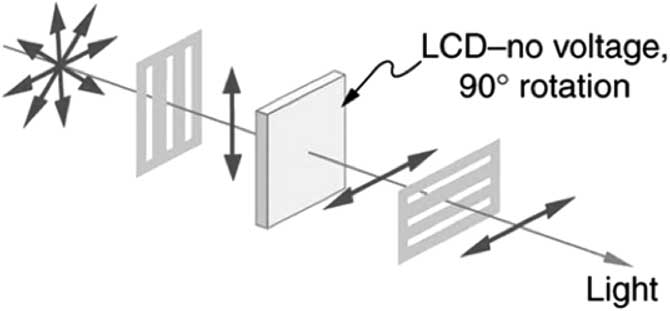
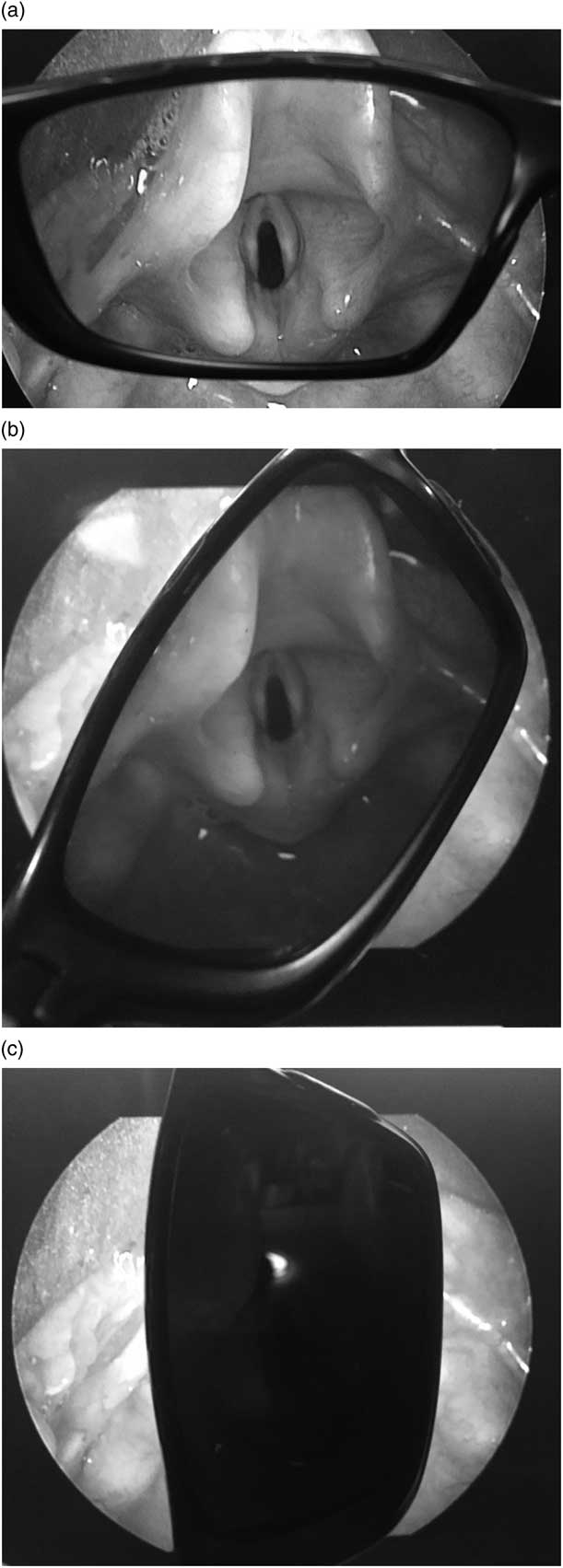
Polarized filters are also an important component in LCDs. A unique property of liquid crystals is that they can rotate polarized light by 90o. In LCDs, a light source is located at the back of the screen. In front of this light source is a polarized filter that blocks out all light that is not oriented in the plane of the filter. The polarized light then passes through a layer of pixels containing liquid crystals. When no voltage is applied, the liquid crystals twist, rotating the light 90o in orientation. Finally, the light passes through a second polarizing filter oriented at 90o from the first filter. Thus, all light emitted from the LCD of a video laryngoscope is oriented in the same plane as the second filter (Figure 1).Reference Urone and Hinrichs 24 – Reference Woodford 26 If the provider performing an intubation is wearing sunglasses with polarized lenses oriented in a different plane than the light emitted from the LCD, the screen could appear dark (Figure 2).
Liquid Crystal Display Design.
Note: When no voltage is applied to the liquid crystal, the vertically polarized light is rotated 90o before passing through a second horizontally oriented filter allowing the display to appear bright. Abbreviation: LCD, liquid crystal display.
Smith © 2018 Prehospital and Disaster Medicine

(a) Liquid Crystal Display Visualized through Polarized Sunglasses. (b) When Sunglasses are Rotated 45o, the Image Becomes Slightly Darker. (c) When the Sunglasses are Rotated 90o, the Image Becomes Nearly Black as the Polarized Light from the LCD is Blocked. Abbreviation: LCD, liquid crystal display.
Smith © 2018 Prehospital and Disaster Medicine

The negative effect of polarized sunglasses on the visibility of displays is a phenomenon that is well-described in other fields. For example, a publication by the Federal Aviation Administration (FAA; Washington, DC USA) regarding sunglasses for pilots states, “Polarized lenses are not recommended for use in the aviation environment. While useful for blocking reflected light from horizontal surfaces such as water or snow, polarization can reduce or eliminate the visibility of instruments that incorporate anti-glare filters.”Reference Montgomery and Nakagawara 27 Theiler, et al noted that sunglasses improved the visualization of the video laryngoscope screen for the McGrath (Medtronic; Minneapolis, Minnesota USA) and KingVision (Ambu; Copenhagen, Denmark) devices, but not the C-MAC display.Reference Theiler, Nabecker, Riggenbach, Kotarlic, Kleine-Brueggeney and Greif 22 However, they did not comment whether or not the sunglasses were polarized. It appears that this is the first case presentation demonstrating that polarized sunglasses may reduce the likelihood of successful endotracheal intubation by worsening visualization of the video laryngoscope LCD.
Limitations
A major limitation of this Case Report is that the negative effect of polarized lenses is only described with the C-MAC video laryngoscope. Thus, this information should not be generalized to video laryngoscopes from other manufacturers.
Conclusion
As previously mentioned, multiple prehospital intubation attempts are associated with negative patient outcomes and increased mortality.Reference Erlich, Seidman, Atallah, Haque and Helmkamp 7 , Reference Mort 8 Thus, it is important for both emergency physicians and prehospital providers to be aware of this potential source of difficult intubation in order to avoid a potential patient safety issue. It is the opinion of these authors that every provider should test his or her sunglasses with all available video laryngoscopes to ensure that the polarized filters are compatible to improve the likelihood of successful intubation. Furthermore, Loughnan, et al found that allowing an assistant to visualize the video screen of the C-MAC resulted in an improved laryngoscopic view.Reference Loughnan, Gunasekera and Tan 28 However, if the assistant is wearing polarized sunglasses, the view may be limited if he or she is not properly aligned with the LCD.