Introduction
An extensive body of scholarship in political science, economics, and sociology has claimed that generous welfare states might be incompatible with large-scale immigration (Freeman Reference Freeman1986; Alesina and Glaeser Reference Alesina and Glaeser2004; Baldwin and Huber Reference Baldwin and Huber2010; Kumlin and Rothstein Reference Kumlin and Rothstein2010; Reeskens and van Oorschot Reference Reeskens and Van Oorschot2012; Kulin et al. Reference Kulin, Eger and Hjerm2016; Soroka et al. Reference Soroka, Johnston, Kevins, Banting and Kymlicka2016).
Whereas the micro-level evidence for the association between immigration and support for redistribution seems to be predominantly negative (for the USA: Gilens Reference Gilens1995; Reference Gilens1999; Manza Reference Manza2000; Fox Reference Fox2004, Reference Fox2012; Reese Reference Reese2005; Luttmer and Singhal Reference Luttmer and Singhal2011; Kearns et al. Reference Kearns, Bailey, Gannon, Livingston and Leyland2014; Garand et al. Reference Garand, Xu and Davis2017; for Europe: Bay and Pedersen Reference Bay and Pedersen2006; Finseraas Reference Finseraas2008; Senik et al. Reference Senik, Stichnoth and Van der Straeten2008; Mau and Burkhardt Reference Mau and Burkhardt2009; Eger Reference Eger2010; Larsen Reference Larsen2011; Schmidt and Spies Reference Schmidt and Spies2014; Harell et al. Reference Harell, Soroka and Iyengar2016; Eger and Breznau Reference Eger and Breznau2017; Alesina et al. Reference Alesina, Harnoss and Rapoport2018a, Reference Alesina, Murard and Rapoport2019), the macro-level evidence for a negative effect of ethnic diversity on welfare spending is far from conclusive. On the one hand, scholars from the US have widely accepted the view that the racial diversity of their society prohibits European-like levels of social spending (for reviews see: Soss et al. Reference Soss, Schram, Vartanian and O’Brien2001; Alesina and Glaeser Reference Alesina and Glaeser2004; Fellowes and Rowe Reference Fellowes and Rowe2004; Katznelson Reference Katznelson2005; Hero and Preuhs Reference Hero and Preuhs2007; Fox Reference Fox2012; Xu Reference Xu2017). On the other hand, international studies find at best limited evidence for a negative relationship between immigration and spending. Sometimes social spending seems to be restricted by immigration (Alesina and Glaeser Reference Alesina and Glaeser2004; Lipsmeyer and Zhu Reference Lipsmeyer and Zhu2011; Kim and Lee Reference Kim and Lee2021), or slowed down (Soroka et al. Reference Soroka, Johnston, Kevins, Banting and Kymlicka2016), sometimes increased social spending seems to be the reaction (Banting et al. Reference Banting, Johnston, Kymlicka and Soroka2006; Gaston and Rajaguru Reference Gaston and Rajaguru2013; Fenwick Reference Fenwick2019), whereas Xu points to contextual associations (Reference Xu2017). Thus, while anti-immigrant sentiments and welfare criticism might be direct consequences of (perceived) immigration at the individual level, this association is unable to explain social spending patterns at the macro-level.
We address this analytical puzzle and focus on the conditions under which immigration influences the welfare attitudes of citizens and ultimately leads to higher or lower welfare spending. For this, we first summarize the arguments about individual-level attitudes toward immigration and welfare and then focus on the resulting incentive structure of parties and governments faced with large-scale immigration into their welfare states. We will argue that both individual and policy reactions depend on the design of social programs. Different institutional designs affect the contribution-benefit ratio of natives vis-à-vis immigrants and, thus, change natives’ commitment to social programs. In the following, we will refer to this rationale with the concept of natives’ interest in welfare, defined by the contribution-benefit ratio of natives vis-à-vis immigrants. We hypothesize that immigration eventually leads to budget cuts in areas from which immigrants are assumed to benefit disproportionally, but not in those where natives are the main beneficiaries. Thus, the relationship between immigration, welfare attitudes, and welfare policies may not be universally negative but may depend on the welfare domains and regimes. For example, immigration can reduce the willingness for redistribution in the domain of unemployment benefits and simultaneously increase it in the domain of pensions.
To assess the role of social program design on welfare attitudes and spending, we develop specific indices for natives’ interest in the areas of unemployment, sickness/disability, and pensions by capturing central characteristics, such as means-testing, coverage, generosity, and stratification of welfare programs. Our empirical evidence, based on multilevel ordered logit models, TSCS models, and Kernel density estimators for 18 countries between 1980 and 2010, mostly supports our theoretical expectations. We find a sizeable negative effect of immigration on preferences for unemployment but not for pension spending. However, the effect of immigration on support for unemployment spending turns positive when natives have sufficient self-interest in the program. This qualified finding is also reflected in the macro-level association between immigration and welfare spending. We find a negative association between immigration and spending only for programs with low or medium levels of native interests, especially in the area of unemployment and sickness/disability. In contrast, immigration seems to spur spending for highly generous universal programs and even to a higher degree for stratified ones, such as contribution-based pension schemes. We discuss the theoretical relevance of these findings in the concluding section and point to worthwhile avenues for further research.
The impact of immigration on welfare attitudes and social spending
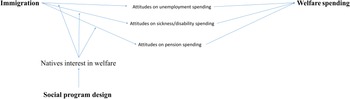
We first discuss the theoretical mechanisms and empirical evidence connecting immigration with individuals’ welfare attitudes. In a second step, we argue that the institutional design of social programs influences the contribution-benefit ratio of natives, which explains why immigration may increase or decrease support for spending across different welfare areas. In a third step, we connect the insights from the individual-level to the macro-level relationship between immigration and welfare spending. Based on our discussion of the moderating role of social program designs, we argue that immigration can provide incentives for an increase as well as a decrease in welfare spending. Figure 1 illustrates the pathway from immigration over citizens’ attitudes to welfare spending.
From immigration to welfare spending.

Immigration and welfare attitudes
The relationship between migration-induced ethnic heterogeneity and welfare attitudes has received considerable attention from several academic disciplines. Important arguments regarding the incompatibility of immigration and welfare stem from psychology and sociology and point to the role of negative prejudices as well as racially or ethnically based ‘group loyalty’ (Blalock Reference Blalock1967; Quillian Reference Quillian1995; Luttmer Reference Luttmer2001: 501; Miller Reference Miller2001), stating that individuals belonging to an in-group will, in general, be more willing to support fellow members. Several experimental studies seem to confirm that in-group members not only tend to exclude out-groups from benefits (Cappelen and Midtbø Reference Cappelen and Midtbø2016; Wright and Reeskens Reference Wright and Reeskens2013; Harell et al. Reference Harell, Soroka and Iyengar2016) but also allocate resources in a way that maximizes differences between groups, even if this means that in-group members receive less (Tajfel et al. Reference Tajfel, Billig, Bundy and Flament1971; Bay and Pedersen Reference Bay and Pedersen2006). The psychological mechanism of in-group solidarity is reinforced by negative outgroup prejudice. Those may be related to objective observations, such as the welfare participation rate of immigrants (Garand et al. Reference Garand, Xu and Davis2017), but it is also strongly dependent on subjective stereotypes about immigrants’ welfare reliance and their attitudes. Immigrants are perceived as being less competent and untrustworthy (Lee and Fiske Reference Lee and Fiske2006; Cuddy et al. Reference Cuddy, Fiske and Glick2008) and characterized as the least deserving group of welfare recipients (van Oorshot Reference Van Oorschot2006). Many stereotypes have been experimentally revealed as misperceptions of natives about the number of immigrants and their welfare reliance (Alesina et al. Reference Alesina, Harnoss and Rapoport2018a). However, even when experimentally confronted with objective information, priming respondents with the issue of immigration is sufficient to reduce their willingness for redistribution (Alesina et al. Reference Alesina, Miano and Stantcheva2018b).
In short, it has been argued that in-group loyalty and out-group prejudice are relevant factors in shaping natives’ redistributive attitudes, and from these general findings follows the expectation that increasing ethnic heterogeneity might reduce the willingness of native citizens to redistribute resources via the welfare state. Indeed, individual survey data show a strong relationship between racial- and welfare-oriented attitudes of US citizens (Gilens Reference Gilens1995; Reference Gilens1999; Fox Reference Fox2004; Luttmer and Singhal Reference Luttmer and Singhal2011; Kearns et al. Reference Kearns, Bailey, Gannon, Livingston and Leyland2014), which is seen as an important explanation for the notoriously low welfare support by (White) Americans (Gilens Reference Gilens1999). This relationship has been observed in other contexts too and the debate moved from a focus on race to a more generic relationship between immigration and welfare (Garand et al. Reference Garand, Xu and Davis2017). Within the discourse on the immigrationalization of welfare, many studies have provided evidence for a negative relationship between immigration and individuals’ welfare support (Lee et al. Reference Lee, Roemer and Van der Straeten2006; Finseraas Reference Finseraas2008; Senik et al. Reference Senik, Stichnoth and Van der Straeten2008; Eger Reference Eger2010; Larsen Reference Larsen2011; Dahlberg et al. Reference Dahlberg, Edmark and Lundqvist2012; Schmidt-Catran and Spies Reference Schmidt-Catran and Spies2016; Steele Reference Steele2016; Eger and Breznau Reference Eger and Breznau2017; Eger and Breznau Reference Eger and Breznau2017; Garand et al. Reference Garand, Xu and Davis2017; Alesina et al. Reference Alesina, Harnoss and Rapoport2018a, Reference Alesina, Miano and Stantcheva2018b, Reference Alesina, Murard and Rapoport2019).
However, other studies have found a positive or nonsignificant relationship between immigration and individual support for welfare (Crepaz Reference Crepaz2008; Finseraas Reference Finseraas2008; Mau and Burkhardt Reference Mau and Burkhardt2009; Burgoon et al. Reference Burgoon, Koster and Van Egmond2012; Hjerm and Schnabel Reference Hjerm and Schnabel2012; Brady and Finnigan Reference Brady and Finnigan2014; Xu Reference Xu2017; Auspurg et al. Reference Auspurg, Brüderl and Wöhler2019). These findings are typically explained by the compensation thesis (Walter Reference Walter2010; Reference Walter2017). In this perspective, immigration triggers insecurity due to increased labor market competition, leading to rising demands for social protection, in particular in the domain of unemployment benefits (Burgoon et al. Reference Burgoon, Koster and Van Egmond2012). Intergroup contact theory (Allport Reference Allport1954) provides another prominent mechanism leading to the expectation that immigration increases the willingness for (intergroup) redistribution, due to the prejudice-reducing effect of increased contact with out-groups (Schlueter and Wagner Reference Schlueter and Wagner2008; Wagner et al. Reference Wagner, Christ, Pettigrew, Stellmacher and Wolf2006). There is widespread evidence that prejudice can be reduced by contact, but there is little evidence that contact increases support for intergroup redistribution (see Cappelen and Peters Reference Cappelen and Peters2018).
In short, immigration might trigger at least three distinct psychological mechanisms with consequences for the welfare attitudes of natives. Whereas in-group solidarity in combination with out-group prejudice is associated with a negative effect of immigration on individual support for redistribution, the compensation and contact mechanisms should lead to a positive association. In the next section, we point to the underdeveloped perspective of natives’ self-interest in welfare programs that should moderate the effect immigration has on redistributive attitudes and ultimately welfare spending. This self-interest is crucially shaped by the institutional design across and within different welfare domains.
Social program design and natives’ interest in the welfare state
The net impact of immigration on individuals’ support for welfare crucially depends on (1) the social area in question (we separate unemployment, sickness/disability, and pensions) and (2) the institutional designs within these areas. This is not a new argument. There has been much speculation among US scholars interested in the relationship between race and welfare about what might have happened if the means-tested part of their welfare state had been designed more universally (Skocpol Reference Skocpol, Weir, Orloff and Skocpol1988; Quadagno Reference Quadagno1994; Lieberman Reference Lieberman1998). Also, arguments about the moderating effects of social programs’ institutional designs have been put forward by studies analyzing the impact of immigration-related concerns on individual welfare support (Finseraas Reference Finseraas2008; Crepaz and Damron Reference Crepaz and Damron2009; Goldschmidt Reference Goldschmidt2015; Muňoz and Pardos-Prado Reference Muñoz and Pardos-Prado2019, Burgoon and Rooduijn Reference Burgoon and Rooduijn2021) or welfare spending (Soroka et al. Reference Soroka, Johnston, Kevins, Banting and Kymlicka2016; Xu Reference Xu2017). This literature has addressed relevant aspects of social program designs, such as the role of generous benefits (Finseraas Reference Finseraas2008; Crepaz and Damron Reference Crepaz and Damron2009) or the effect of contribution-based programs (Finseraas Reference Finseraas2008; Soroka et al. Reference Soroka, Johnston, Kevins, Banting and Kymlicka2016: 176–177), but we still lack a systematic discussion of the role social program designs play for the link between immigration, welfare attitudes, and welfare policies.
Let us start with the impact of immigration on spending for different social areas, namely unemployment, sickness/disability, and pensions. Previous studies provide strong evidence that immigrants are overproportioned predominantly in the reliance on social assistance and unemployment benefits but less on both sickness/disability insurance and pension benefits (Brücker et al. Reference Brücker, Epstein, McCormick, Saint-Paul, Venturini, Zimmermann, Boeri, Hanson and McCormick2001; Morissens and Sainsbury Reference Morissens and Sainsbury2005; Nannestad Reference Nannestad2007; Boeri Reference Boeri2010), while studies adjusting for immigrant’s attributes, such as age or education, find welfare dependency of immigrants equal or even lower compared to nonimmigrants (Huang et al. Reference Huang, Kaushal and Wang2021 or Barrett and McCarthy Reference Barrett and McCarthy2008 for an overview). The discrepancy between both perspectives, in our view, shows that immigrants are on average more reliant on specific welfare schemes, but that this has predominantly to do with their socio-demographic characteristics (Brücker et al. Reference Brücker, Epstein, McCormick, Saint-Paul, Venturini, Zimmermann, Boeri, Hanson and McCormick2001; Boeri Reference Boeri2010). Nevertheless, these different patterns of immigrants’ welfare dependency may be related to natives’ attitudes regarding both immigration and welfare in a potentially conflicting way. Not only are many natives in general unwilling to support immigrants with social benefits (Senik et al. Reference Senik, Stichnoth and Van der Straeten2008; Larsen Reference Larsen2011), but they also regard different groups of welfare recipients as more or less deserving.
Analysing the attitudes toward four groups of needy people in several European countries, Van Oorschot (Reference Van Oorschot2006) identifies a clear rank order: people are ready to support the old and the sick, less so the unemployed. Immigrants stand out as the group that native citizens are least willing to support. Thus, immigrants rely more heavily on those types of benefits that natives are in general most critical about. Combined with the limited self-interest of many better-off natives in unemployment, but not in sickness/disability or pensions because of their risk profile (see Korpi and Palme Reference Korpi and Palme1998, Reference Korpi and Palme2003), this leads to a highly conflictual setting, which is further reinforced by the subjective bias of native citizens. Not only are immigrants to a higher degree reliant on unemployment benefits, the subjective bias of natives further aggravates this reliance (Alesina et al. Reference Alesina, Miano and Stantcheva2018b), and on top, cultural stereotypes shift the blame of this reliance to the immigrants (Lee and Fiske Reference Lee and Fiske2006; Cuddy et al. Reference Cuddy, Fiske and Glick2008). In sum, we expect that a negative effect of immigration on support for social programs is most likely in the domain of unemployment benefits, while the natives’ interest in other kinds of benefits may prevent this effect. Our expectations are summarized in hypothesis 1:
H1: The effect of immigration on individual preference for welfare spending differs among social areas. It depresses support where natives’ interest is low (for example unemployment) but increases support where natives’ interest is high (for example pensions).
Inside the same area, it may also depend on the institutional design of social programs, which further moderates the interest native citizens have in it. This expectation is motivated by the wider literature on comparative welfare state institutions (Esping-Andersen Reference Esping-Andersen1990; Green-Pedersen Reference Green-Pedersen2001; Korpi and Palme Reference Korpi and Palme2003) and welfare state retrenchment (Pierson Reference Pierson1996, Reference Pierson2001), which suggests that some programs are in general much more vulnerable to budget cuts than others. Vulnerability depends on the differences in the economic self-interest of (native) citizens and the resulting incentive structure for politicians interested in retrenchment but also in re-election. For both variables, the difference between means-testing and universalism is seen as decisive.
Starting with means-testing, it is a well-established finding from comparative welfare state research that targeted programs enjoy only limited public support (Bean and Papadakis Reference Bean and Papadakis1998; Andreß and Heien Reference Andreß and Heien2001) – irrespective of any potential effects of immigration. According to Larsen (Reference Larsen2008), means-tested programs tend to blame recipients for their situation and stigmatize and distinguish them from nonrecipients. Taken together with the limited self-interest of better-off citizens, who finance means-tested benefits through their taxes, public support for such programs is in general rather limited (Esping-Andersen Reference Esping-Andersen1990).
In addition, means-tested programs are also seen to accentuate the relation between attitudes toward ethnic minorities and individual support for welfare – the theoretical core of the NPD debate. In the USA, White respondents critical of African-Americans (Gilens Reference Gilens1995) or Latino immigrants (Fox Reference Fox2004) seem willing to cut budgets of means-tested programs, but such sentiments are not related to their support for more universal programs (Gilens Reference Gilens1995, Reference Gilens1999). Goldschmidt (Reference Goldschmidt2015), analyzing the German case, concludes that opposition to immigration increases opposition to means-tested programs, especially if these disproportionally benefit immigrants. Making use of a survey experiment and analysing support for child benefits, Muňoz and Pardos-Prado (Reference Muñoz and Pardos-Prado2019) also find that means-tested programs with targeted spending seem to exacerbate the negative effect of immigration on public support for redistribution.
In contrast to the effects of means-testing, universalism is often portrayed as a remedy for the potentially negative effects of immigration on social spending. Not only are universal programs often highly popular (Bean and Papadakis Reference Bean and Papadakis1998), but they are also seen to close the discussion about deservingness by blurring the boundary between receivers and payers (Crepaz and Damron Reference Crepaz and Damron2009). Previous studies in the NPD camp have also addressed their moderating role in the relationship between anti-minority sentiments and individual welfare support. Universal programs have been found to downplay natives’ welfare chauvinistic attitudes (Crepaz and Damron, Reference Crepaz and Damron2009; Eger, Reference Eger2010; Larsen, Reference Larsen2011) and to limit the negative effects of immigration-related concerns on general welfare support (Finseraas Reference Finseraas2008; Mau and Burkhardt Reference Mau and Burkhardt2009). From the perspective of politicians interested in retrenchment, budget cuts targeting universal programs are thus much more difficult to achieve. Not only are they more popular but their recipients are also regarded as more deserving, and the self-interest of many voters is considerably higher than for means-tested programs (Huber and Stephens Reference Huber and Stephens2001; Starke Reference Starke2006; Brooks and Manza Reference Brooks and Manza2007; Bonoli and Natali Reference Bonoli, Natali, Bonoli and Natali2012). Universal programs might also make it harder for politicians to link natives’ immigration-related concerns to retrenchment. As this argument depends on the actual definition of universalism – a term used quite differently – we will discuss three of its parts that we will also use for our program-specific indices of native interest in welfare: coverage, generosity, and levels of stratification. American authors tend to define universalism as the opposite of means-tested programs by stressing differences in what they cover (Skocpol Reference Skocpol, Weir, Orloff and Skocpol1988; Lieberman Reference Lieberman1998). Even if ethnic-majority voters would be highly critical of ethnic minorities and their dependence on welfare, general budget cuts are not to be expected, as these would necessarily hit both ethnic minority and majority members.
However, coverage is not the only theoretically relevant criterion for universalism. As argued by Esping-Andersen in his description of the ideal social-democratic welfare regime, it provides not only universal cover but also – in its ‘universalism of middle-class standards’ (Esping-Andersen Reference Esping-Andersen1990: 69) – generous benefits. Thus, even programs universal in their coverage might not enjoy high levels of public support if they cannot guarantee an adequate replacement of former income, including for better-off citizens. If coverage is not accompanied by high replacement rates, higher income strata, in particular, might look for private alternatives, making them potential allies for the retrenchment of public programs. We hypothesize that the interest is even lower when less generous programs disproportionally benefit ethnic out-groups. Empirically, Finseraas (Reference Finseraas2008) finds a negative effect of social democratic regimes on the link between immigration and redistributive support in contrast to the conservative regime. Burgoon and Rooduijn (Reference Burgoon and Rooduijn2021) present similar findings on the generosity of the welfare state.
We think this has to do with the issue of stratification – both concerning its relationship to universalism and the interest of natives in social programs. Means-tested programs do inhibit the highest level of redistribution, as payers and recipients are separated because of the means-test. As we have argued, it is thus easy to link immigration to the self-interest of those who pay, opening the way for retrenchment. On the contrary, universal programs are said to blur the boundary between receivers and payers (Crepaz and Damron Reference Crepaz and Damron2009) which makes redistribution hard to track. While this might be an accurate statement for tax-financed programs with universal flat-rate benefits, it is an inadequate description of contribution-based programs. Such programs – the German but also the USA public pensions system being prime examples – provide nearly universal coverage, but do not blur redistribution as their (comparatively high) benefits are tightly linked to former contributions. Contribution-based systems have the highest degree of stratification as they sustain unequal living standards in periods of welfare dependence (Esping-Andersen Reference Esping-Andersen1990: 69). Benefits based on contributions are often perceived as being ‘earned’ – and cuts in these benefits might violate feelings of fairness much more than cuts in benefits financed by more general and less comprehensive taxation (Mau and Veghte Reference Mau and Veghte2007).
Support for redistribution is undermined because immigrants are perceived as not contributing to the welfare state. Thus, contribution-based systems should mute the negative association between immigration and reduced support for redistribution (see also Finseraas Reference Finseraas2008 or Soroka et al. Reference Soroka, Johnston, Kevins, Banting and Kymlicka2016). In addition, natives might also see immigrants as rightfully receiving even high benefits so long as they have contributed their share to the programs’ finances. Besides concepts of fairness and deservingness, being based on former contributions over the (working) life cycle, stratifying programs benefit long-term residents much more than more recent members, which naturally disadvantages immigrants vis-à-vis native citizens. In short, stratified programs skew the benefits in favor of natives.
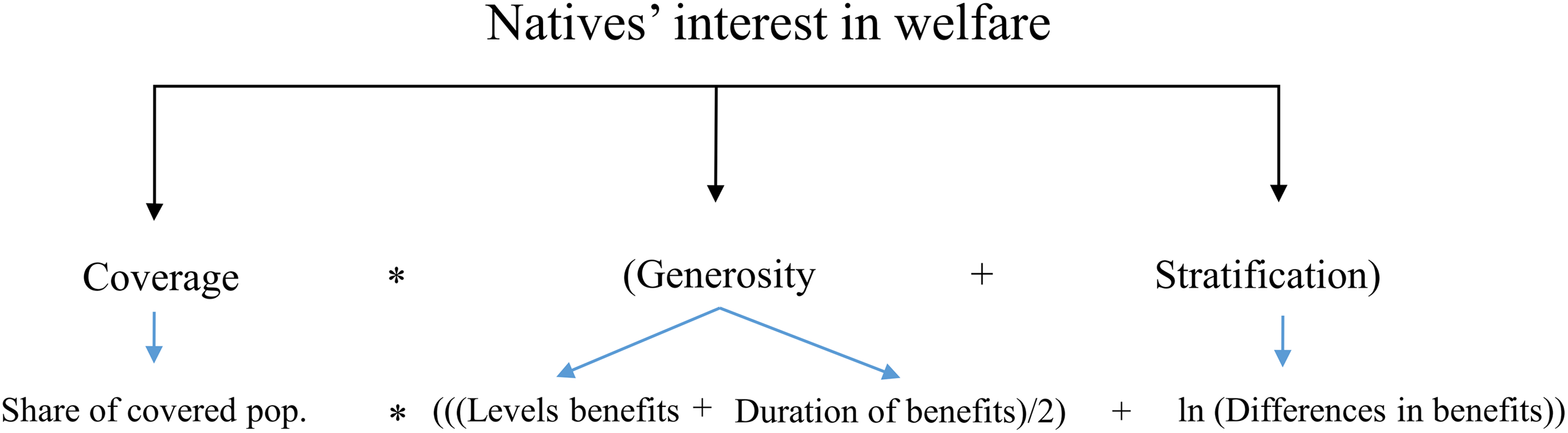
Summing up, social program’s coverage, generosity, and stratification alter the relative benefits of natives vis-à-vis immigrants and moderate the redistributive approval of native citizens as depicted in Figure 2.
Immigration and individual support of welfare spending.

Our expectations are summarized in hypothesis 2:
H2: Within a given social area (i.e., unemployment, sickness/disability, or pensions), the effect of immigration on individual preferences for welfare spending is moderated by the level of natives’ interest. Immigration reduces support for spending on programs with low levels, but not on those with high levels of natives’ interest.
Immigration and welfare spending
Citizens’ attitudes toward spending potentially influence actual welfare policies via the democratic process. We assume that politicians are aware of the interest natives have in different welfare programs, leading to reservations in cutting programs that are highly relevant for native voters and opening the floor for retrenchment where natives’ interest is low. From the perspective of politicians interested in retrenchment, means-tested programs are an ideal target (Pierson Reference Pierson1994). If immigrants tend to rely heavily on means-tested programs, we might expect a further decline in public support with rising immigration, because many better-off natives already show low willingness to redistribute between rich and poor even within their ethnic group. Immigration into countries with means-tested programs should thus make room for politicians interested in retrenchment. Retrenchment is especially likely when the proportion of immigrants among beneficiaries is so high that program cuts will exclusively or at least disproportionally hit the ethnic out-group – a setting that well describes the US pattern of race and welfare (Lieberman Reference Lieberman, Schram and Fording2003; Reese Reference Reese2005).
Universal programs have been among the prime examples of Pierson’s (Reference Pierson1994) seminal study on the resilience of the welfare state, as they make “frontal assaults on the welfare state politically suicidal in most countries” (Pierson Reference Pierson2001: 282) and in this way influences the possibilities of politicians to retrench programs when confronted with immigration. For Europe, comparable analyses of the policy espoused by political parties are rare but are discussed in the literature on Populist Radical Right Parties (PRRPs) and their voters. It has been shown that PRRPs' retrenchment attempts are limited to the areas of social assistance and unemployment benefits (Afonso Reference Afonso2015). In contrast, PRRPs have been reluctant to support efforts to reduce spending on pensions and health-related programs that might also be in the interest of their voters (Röth et al. Reference Röth, Afonso and Spies2018; Rathgeb Reference Rathgeb2021).
More generally and derived from our micro-level argument, we would not expect a strong general direct relationship between immigration and welfare spending because parties and governments are confronted with different incentives across programs when faced with immigration into their welfare states (also see Soroka et al. Reference Soroka, Johnston, Kevins, Banting and Kymlicka2016). In sum, much seems to speak for the argument that the conflictual USA pattern regarding anti-minority attitudes and welfare does not necessarily travel to welfare states where social programs are designed differently. In line with the contextual perspective, comparative studies regressing social spending on immigration find very mixed results, ranging from decreasing (Alesina and Glaeser Reference Alesina and Glaeser2004), slowing down (Soroka et al. Reference Soroka, Johnston, Kevins, Banting and Kymlicka2016), or even increasing social spending (Gaston and Rajaguru Reference Gaston and Rajaguru2013; Fenwick Reference Fenwick2019).
H3: The effect of immigration on social spending differs among social areas. It depresses spending when natives’ interest is low (unemployment) but not when natives’ interest is high (pensions).
H4: Within a given social area (i.e., unemployment, sickness/disability, or pensions), the effect of immigration on spending is moderated by the level of natives’ interest. Immigration reduces spending on programs with low levels but not on those with high levels of natives’ interest.
Data and methods
We start by testing the moderating effect of program design on the association between immigration and individual preferences in the domains of unemployment and pensionsFootnote 1 using pooled ISSP waves on the role of government (1985, 1990, 1996, 2006; Bechert and Quandt Reference Bechert and Quandt2010). We use the items ‘governments should spend money’ on unemployment or pensions and items asking for the ‘government’s responsibility’ in providing for the unemployed and retired.
Furthermore, we estimate models on the macro-level for three dependent variables: spending on unemployment, sickness/disability, and pensions. Each of these is measured as a percentage of gross domestic product (OECD 2019a, 2019b), which represents the standard approach in comparative research on welfare and also in the few comparative macro-studies related to the NPD debate (Alesina and Glaeser Reference Alesina and Glaeser2004; Gaston and Rajaguru Reference Gaston and Rajaguru2013; Soroka et al. Reference Soroka, Johnston, Kevins, Banting and Kymlicka2016).
Our first main independent variable, immigration, is the percentage of the foreign-born population (UN 2009). These data are provided every five years, and we use linear interpolation and extrapolation to supply the missing values. The second independent variable of theoretical interest is natives’ interest in social programs, which we treat as moderators of the effect of the foreign-born population. These indices are calculated separately for each social area (unemployment, sickness/disability, and pensions), using data offered by the Social Insurance Entitlement Dataset and its successor, the Social Citizenship Indicator Program (Swedish Institute for Social Research 2015a, 2015b). For each of the three social areas, we construct an index of native interest by multiplying the cover rate (proportion of the covered populationFootnote 2 ), with the average of the standardized level of generosity (calculated by the replacement rate for an average production worker in the first 26 weeks combined with the duration of benefits in weeks) and the standardized level of stratification (defined as the ratio of the maximum benefit level and the benefit level for an average production worker). The Swedish Institute for Social Research provides data at intervals of five years and we applied the same interpolation rule that we used for the foreign-born population. Figure 3 illustrates the logic of the index of natives’ interest. As discussed in the theory section, low coverage reduces the interest of natives in general because immigrants are perceived to disproportionally benefit from means-tested programs in comparison to universal ones. Accordingly, we multiplicatively connected coverage with the other two components of natives’ interest. These are stratification and generosity. Following the theoretical discussion, generous universal programs are preferred because only when adequate replacements are given, do middle-class and higher income natives refrain from opting into private alternatives. However, highly stratified or contribution-based systems are the least vulnerable to migration because ‘natives’ are the prime beneficiaries of those programs. Accordingly, generosity and stratification are complementary and should be connected via addition. We adjusted several aspects of the original data (for a detailed description of the coding decision and the index construction compare Online Appendix Part 2).
The index of natives’ interest of welfare.

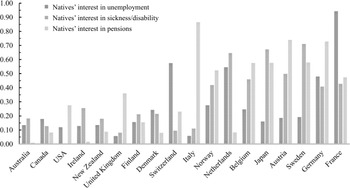
The resulting and standardized area-specific indices range between 0 (low coverage, low stratification, and low generosity) and 1 (for maximal native interest defined by highly stratified and generous benefits with high coverage). Universal programs with high generosity occupy the middle ground of the scale. Figure 4 illustrates the average country scores for the three welfare programs. For example, Australia ranks very low on natives’ interest in all three welfare domains because eligibility is tied to means-tests and, thus, restricts a relevant part of the citizens from access to benefits. Higher ranks are typically occupied by countries like France or Germany with generous, but, more importantly, highly stratified benefits. Besides discussing the face validity of specific countries, it is important to note, that many countries show significant differences across the three welfare domains. The variance over time within countries is masked by the averages in Figure 2, but, generally, differences are systematically bigger across than within countries over time.
Natives’ interest by country.
Note: In Italy and Switerland (in case of sickness/disability) caution is warrented because the stratification data might be wrong.

We control for several variables that might confound the relationship between immigration, natives’ interest, spending attitudes, and social spending. In the multilevel models of attitudes toward spending, we control for sex, age, education, ideological position (from right to left), union membership, unemployment, retirement, and permanently disabled.
For the macro-level association between immigration and welfare spending, we measure the government participation of PRRPs using the selection of Röth et al. (Reference Röth, Afonso and Spies2018). Furthermore, we control for the proportion of left-wing parties as a percentage of total cabinet posts, the inflation rate, the unemployment rate, the GDP growth rate per capita, the government debt as a percentage of GDP, the cyclically adjusted primary balance of general government as a percentage of potential GDP, the openness of the economy (defined as total trade as a percentage of GDP), and de-industrialization (defined as the proportion of employees working in the service sector). The analysis of sickness/disability and pension spending additionally includes the proportion of the population over 65 years of age. All of these variables are taken from Armingeon et al. (Reference Armingeon, Engler and Leemann2020). The final data set consists of 546 to 556 observations in 18 countries for the period 1980 to 2010, depending on the spending category.Footnote 3 Our time series ends in 2010 because more recent data for the index of natives’ interest are not available. We discuss the role of confounders and effect of heterogeneity across countries in closer detail in the Online Appendix part 6.
In the micro-level models, we treat the dependent variables as ordinal scaled. We estimate the effect of immigration on these individual attitudes using three-level ordered logit models with individuals nested in years nested in countries, following Schmidt-Catran and Fairbrother (Reference Schmidt-Catran and Fairbrother2016). As a note of caution, we are aware of the fact that our country-level estimates are underpowered: 13 countries are conventionally seen as too few to arrive at robust and unbiased country-level estimates (see Bryan and Jenkins Reference Bryan and Jenkins2016). Therefore, we only draw careful inference from the country-level estimates in the models of individual-level attitudes and assess their stability with a series of robustness checks (see Online Appendix Table A3).
The country-level effect can be more robustly inferred from the macro-analysis because the macro-sample has more country-level observations. For the macro-level, we estimate TSCS models with random effects to exploit between- and within-country variation with corrected standard errors using panel-specific autocorrelation structures (see Beck and Katz Reference Beck and Katz1995; Bell and Jones Reference Bell and Jones2015). Theoretically, we assume the impact of immigration on individual attitudes and on social spending to be dependent on the social area (H1 and H3) and further moderated by the specific level of native interest (H2 and H4). Accordingly, we model interactions between the share of immigrants and program-specific levels of native interest on individual preferences for welfare spending and the actual welfare spending in the macro-level models.
For the macro-level models, interaction effects are sensitive to frequent misspecifications. The distribution of the moderator variable can cause massive interpolation in areas where only a few observations exist and might not be linear (Berry et al. Reference Berry, Golder and Milton2012; Hainmueller et al. Reference Hainmueller, Mummolo and Xu2019). To have more confidence in our estimated conditional effects, we model nonlinear interaction effects with a kernel-density estimator, a locally weighted estimator adding precision to specific areas of the distribution (Xu et al. Reference Xu, Hainmueller, Mummolo and Liu2017; Hainmueller et al. Reference Hainmueller, Mummolo and Xu2019).
As kernel density interaction effects calculate local marginal effects, there is hardly a way to present them in tabled format, instead, these estimates are easier to comprehend by visualization. A summary of a series of robustness tests concludes the results section. A detailed description of the data, their sources, the indices of natives’ interest, and robustness is presented in the Online Appendix.
Results
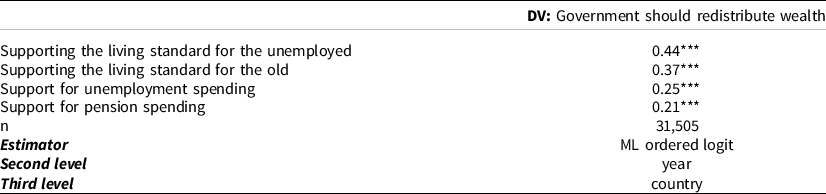
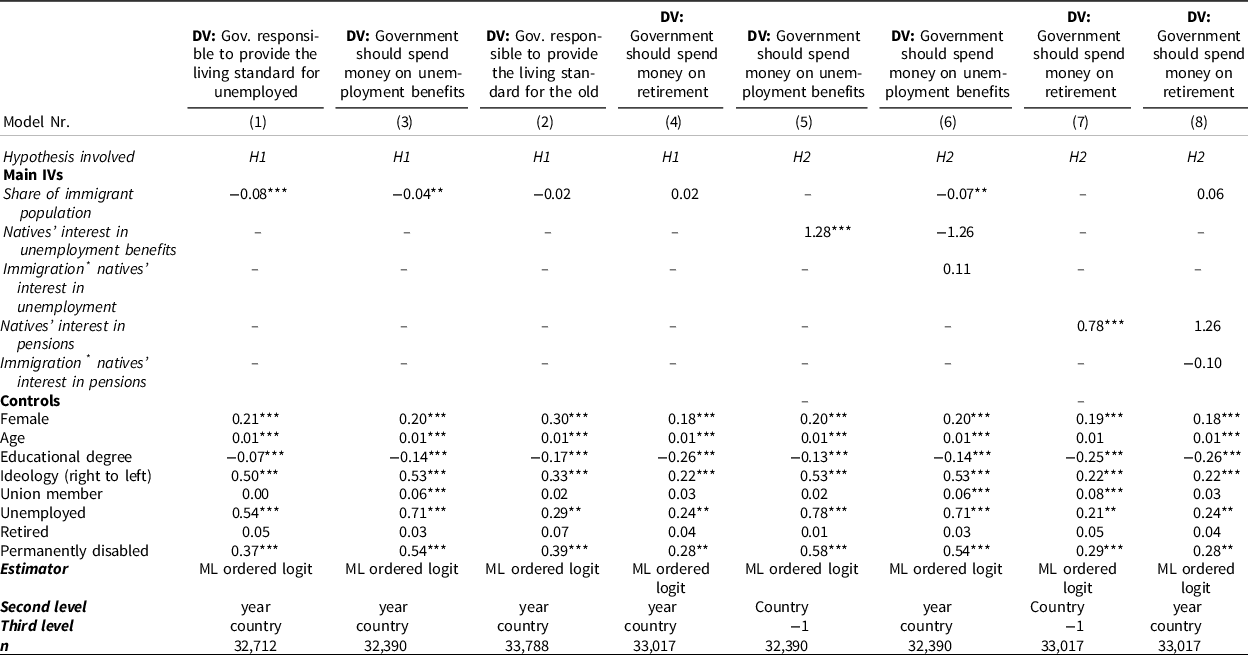
Following hypothesis 1, we expect that immigration has different effects across welfare domains. To demonstrate the differences in the redistributive character across welfare programs on the level of individual attitudes, we estimate a multilevel ordered logit model using the item ‘government should redistribute wealth’ as the dependent variable and the four spending items as independent variables. Table 1 confirms the expected differences. Support for living standards resonates with associations of means-tested programs which we have argued to be the program with the least support from natives and the highest perceived reliance of immigrants. As expected, support for general pension spending shows the lowest association with redistribution.
The redistributive commitment of different welfare attitudes

Note:*P < 0.10, **P < 0.05, P < 0.01.
In the next step, we regress the different spending attitudes on immigration. In the domain of unemployment, with a high redistributive and low appeal of deservingness, immigration negatively affects support for spending (Table 2). With higher shares of immigrants, natives reduce their willingness to spend on unemployment, and in particular natives reduce the support of adequate living standards for the unemployed. In contrast, the support for pension spending is hardly affected by immigration. In short, the effect of immigration on the support for welfare spending depends on the degree of redistribution and deservingness of a particular welfare program, lending firm support for hypothesis 1 on the level of individual attitudes.
Multilevel regression results

Note:*P < 0.10, **P < 0.05, ***P < 0.01. -1 the three-level model does not converge; a two-level model was estimated instead.
Hypothesis 2 puts the importance of the program design within welfare programs at the center. The higher the natives’ interest, the higher the support for that program and as a consequence the lower the negative effect of immigration on natives’ support. In models 5 and 7, we confirm that the index of natives’ interest in a particular social program indeed substantially raises the support for spending in the domain of unemployment as well as pensions. Following hypothesis 2, we furthermore expect that natives’ interest positively moderates the effect of immigration on support for welfare spending in a given domain. In the domain of unemployment, the interaction effects are positive but insignificant (in some specifications the interaction term is significant; see Online Appendix part 3). In the domain of pensions, we do not find a significant main effect of immigration and consequently also no significant interaction term. Two notes of caution are warranted for the interpretation of the country-level effects in our multilevel models. First, our sample includes 13 countries across four survey waves. This number is too low to allow for robust and unbiased country-level estimates in multilevel models (see Bryan and Jenkins Reference Bryan and Jenkins2016). The problem of too few observations aggravates in the case of country-level interactions. However, at the level of individual attitudes, we see strong evidence in support of hypothesis 1 and only partial evidence for hypothesis 2.
Before we turn to the macro-level analysis, we should briefly elucidate the relevance of the individual-level findings for the link between immigration and welfare spending on the macro-level. Assuming that natives’ preferences affect spending patterns of countries, we would not necessarily assume that immigration exerts pressure on welfare spending. Although we confirm existing findings that immigration exerts pressure on unemployment spending, a welfare domain resonating with redistributive preferences, we do not see the same pattern in the domain of pensions. Given, that pension spending outweighs unemployment spending in all democracies, we might even expect a positive net effect of immigration on overall welfare spending. However, even this conclusion would be premature because support for retrenchment hinges on natives’ interest which can be affected by program design even within a welfare domain.
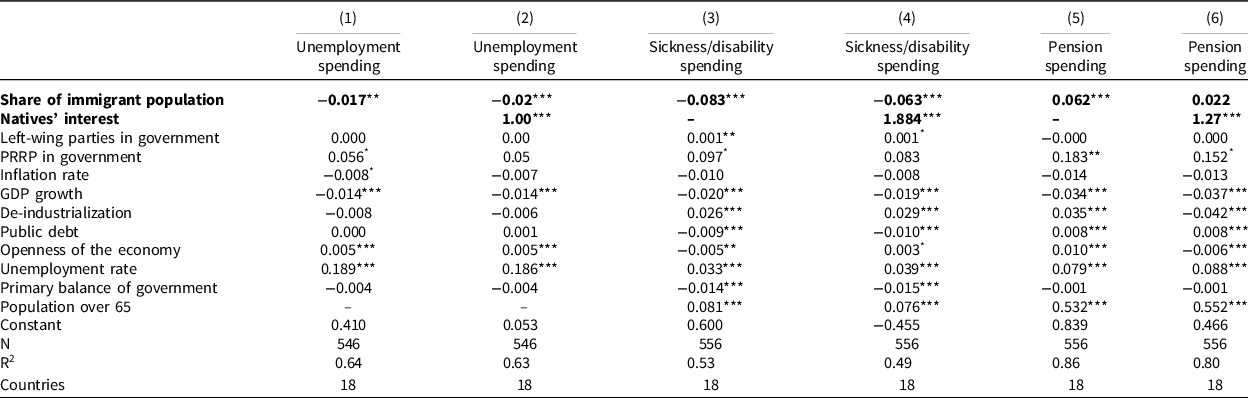
Such a nuanced link between immigration and welfare spending is precisely what we find in our macro-level analysis. The macro-level analysis has better properties to address hypothesis 2 because of more observations at the country level. Table 3 shows that the main effect of immigration on spending is conditioned by the social area in question. More precisely, we see that immigration is negatively related to spending on unemployment and sickness/disability but positively associated with spending on pensions (Models 1, 3, 5). Concerning hypothesis 3, in which we suggested that immigration will especially decrease spending for programs that disproportionally benefit immigrants, the main effects support our argument. Pension systems benefit natives relatively more and are the only welfare area where higher shares of immigrants are associated with significantly higher spending.
Regression results for spending on unemployment, sickness/disability, and pensions

Note:*P < 0.10, **P < 0.05, ***P < 0.01. The ten missing cases in the model for unemployment spending consist of France and Austria between 1980 and 1985 where spending data are not available.
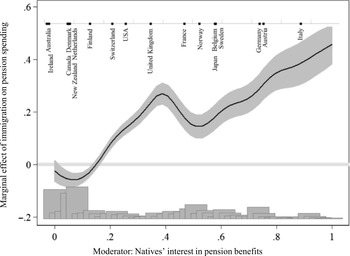
Our fourth hypothesis stated that the effect of immigration on social spending is not only dependent on the social area in question but also on the level of natives’ interest in the respective program. On the individual level, the program-specific indices of natives’ interest have been associated with higher support for spending. The same pattern is revealed on the macro-level where in all social areas the index of natives’ interest is substantially and significantly associated with higher public spending (Models 2, 4, 6). The interaction effects presented in Figure 5 (unemployment), 6 (sickness/disability), and 7 (pensions) confirm our expectations from hypothesis 4.
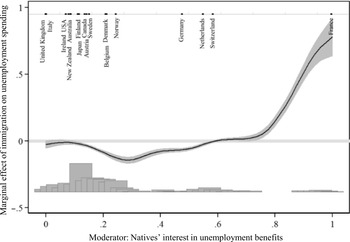
Effect of immigration on unemployment spending conditional on natives’ interest.
Note: The interaction is based on kernel density estimation. Country labels are placed at their averages on natives interest in unemployment benefits.

Depending on the level of natives’ interest in unemployment, immigration can result in anything from significant retrenchment to increased budgets (Figure 5). We see that immigration is negatively related to unemployment expenditures in contexts in which natives’ interest is not particularly high – and at the same time, we also see that the number of cases with low or medium levels of natives’ interest in unemployment is considerable. However, for cases with high levels of natives’ interest in unemployment (>0.8), the negative effect of immigration turns significantly positive. This finding is predominantly influenced by France, a country with the highest degree of unemployment benefit stratification in the entire sample. One additional observation is also noteworthy. In the countries with the lowest levels of natives’ interest, we do not find a significant negative effect; we assume this is the case because in these programs generosity levels are so low that replacements resemble a kind of social assistance and further retrenchment would not be viable.
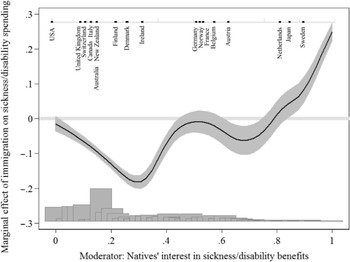
Turning to the effects of immigration on sickness/disability spending (Figure 6), the general lesson resembles that of unemployment. The effect of immigration is significant and negative for cases with low and positive for cases with high levels of natives’ interest. In other words, we observe that sickness/disability spending decreases with immigration in targeted contexts but increases where many native citizens get substantial benefits. Above the threshold of 0.8, we find Sweden (until 1992), the Netherlands, and Japan. Similar to the findings in the domain of unemployment, we have a null finding for the country that ranks lowest on the index. The absence of a public health system in the USA leaves little room for retrenchment. In contrast, we find a very pronounced negative effect in Denmark, casting doubt on the linear nature of the effect. Indeed, Denmark is a case where very generous and accessible benefits (at least until the early 2000s) coincide with low stratification. This is a scenario where we would expect immigration to impose retrenchment pressure. Such a dynamic is very visible in the Danish discourse, followed by a political response including severe restrictions on welfare access for immigrants (Mouritsen and Olsen Reference Mouritsen and Olsen2013; Römer et al. Reference Römer, Röth and Zobel2022).
Effect of immigration on sickness/disability spending conditional on natives’ interest.
Note: The interaction is based on kernel density estimation. Country labels are placed at their averages on natives interest in sickness/disability benefits.

Turning to pension spending (Figure 7), the picture does not fully resemble the ones presented for the other two domains. For many pension programs with very low levels of natives’ interest, immigration is associated with lower spending levels (for example, Australia, Ireland, Denmark, Canada, New Zealand, or the Netherlands). Some of them introduced means-tests for the public pension pillar.Footnote 4
Effect of immigration on pension spending conditional on natives’ interest.
Note: The interaction is based on kernel density estimation. Country labels are placed at their averages on natives interest in pension benefits.

The effect of immigration turns positive for many of the programs with medium and high levels of natives’ interest (for example, in Italy, Germany, Japan, Austria, Norway, Belgium, Sweden, and France). Pension systems seem to hold the highest interest of native citizens and increase spending even when confronted with immigration in many countries.
In sum, the results presented in Figures 5–7 support our theoretical expectations. The effect of immigration on social spending does vary between the areas of unemployment, sickness/disability, and pensions, and it is further moderated by the interest of natives in these areas.
Robustness
Both the macro and micro-level analysis are based on pooled cross-section data with at least four fundamental limitations which we want to lay out transparently. First, we applied a newly developed index of natives’ interest in different welfare programs. The indices might be subject to validity concerns, as welfare systems are, indeed, complex and our index can only capture part of this complexity. However, our approach is still more nuanced than existing comparative studies and we encourage to approach even more fine-grained comparisons. In the Online Appendix Part 2, we discuss the construction of the index as well as its specific components in closer detail and demonstrate in Online Appendix Part 4.1 that our patterns hold even when removing ambiguous cases from the models.
Second, the time horizon between cause and effect is neither theoretically nor empirically sufficiently specified. Country-year combinations in the macro-level models might be suitable to arrive at average effects (even for long periods) but hardly reflect appropriate time horizons for the process from immigration over individual attitudes to welfare spending. In the Online Appendix Part 4.2, we present results with one-year, two-year, and five-year time lags. In the five years interval, we simply removed all imputed observations. Alternative periodizations lead to comparable results to those portrayed above.
Third, TSCS data and our case selection leave many entry points to endogeneity concerns. Some of them are addressed with the test for time lags, country-fixed effects estimation, and the control of potential confounders, which are further discussed in the Online Appendix Part 3 (for the individual-level analysis) and Online Appendix Part 4 (for the country-level analysis).
A fourth limitation is that our argument hinges to a certain extent on the assumptions that immigrants have indeed access to welfare benefits, a question discussed under the labels of ‘welfare chauvinism’ or ‘immigrants’ welfare rights’ (Sainsbury Reference Sainsbury2012; Römer et al. Reference Römer, Röth and Zobel2022). In cases where immigrants hardly have access to welfare, we would assume that the link between natives’ interest and immigration on welfare spending is weaker. On the other hand, limiting the access of immigrants to welfare can be exactly one way to reduce welfare spending. An extreme example is Luxembourg. Luxembourg has one of the most generous welfare states in the world, maintaining Scandinavian standards without any signs of cutbacks or cost-containment measures in the last decades. At the same time, Luxembourg has the highest number of foreign-born workers all over Europe. Luxembourg established an extremely trans-nationalized labor force by attracting cross-border commuters while keeping the dependency ratios very low. Crossers contribute fully to the welfare system but are not fully entitled to benefits, as Hartman-Hirsch summarizes: ‘Immigration is sometimes considered to be a threat to the sustainability of welfare schemes; in Luxembourg however immigrants and crossers were the main factors for expansion’ (Reference Hartmann-Hirsch2010: 1). Similarly, Switzerland has increasingly decoupled immigrants’ benefits from their contributions. Luxembourg and Switzerland, having both very high shares of immigrants, are typically included in studies where individual attitudes for redistribution are positively affected by immigration (see Finseraas Reference Finseraas2008; Burgoon et al. Reference Burgoon, Koster and Van Egmond2012; Steele Reference Steele2016; an exception is Brady and Finnigan Reference Brady and Finnigan2014). Without a doubt, the welfare rights of immigrants deserve a closer look in comparative studies of immigration and welfare.
Conclusions
During the past decades, a substantial body of scholarship has emerged about the consequences of large-scale immigration on the welfare state. Overall, the tenor of this debate has been sceptical that encompassing welfare states and large-scale immigration are compatible. Indeed, there is a large body of evidence that ethnically diverse societies might find it hard to redistribute public goods via the welfare state, as many native citizens are hesitant to share public resources with ethnic out-groups. Evidence for such problem-laden expectations has mainly been identified at the level of individual attitudes.
The theoretical argument and empirical findings of this study motivate the qualification of such a sceptical tenor. The path from immigration, over individual welfare support to welfare spending, is crucially influenced by the design of welfare institutions. For these design effects, we have pointed to some well-known findings of comparative welfare state research, showing that program design affects the degree to which natives develop a self-interest in welfare programs that will find it easier to be combined with ethnic diversity.
We find evidence for such a qualified relationship between immigration and welfare on the individual level of welfare attitudes as well as on the macro-level linking immigration with welfare spending. Immigration not necessarily coincides with a decline in welfare support and spending but rather with a shift of priority across welfare schemes. Immigration puts pressure on redistributive welfare schemes such as the support for unemployment benefits while increasing the relative support for schemes where natives benefit the most, such as pensions. Furthermore, we also show that even within welfare domains, the link between immigration and individual support for welfare spending is moderated by welfare institutions. In short, natives’ self-interest can turn immigration even into a driver for welfare expansion. For example, pension schemes as the costliest part of modern welfare states typically benefit natives more than immigrants because they tend to tie pay-offs to contributions.
Our qualification to the widespread scepticism is also mirrored in the macro-level relationship between immigration and welfare, linking immigration with welfare spending. On the one hand, immigration seems to be problematic for budgets related to unemployment but not so much for areas from which immigrants might benefit less, such as pensions. On the other hand, even inside the area of unemployment, where immigrants can be expected to be overrepresented among beneficiaries, immigration pushes down spending levels only for programs with a low degree of native interest, i.e., a combination of low coverage, limited generosity, and high inter-ethnic redistribution. In contrast, immigration can even have positive effects on welfare spending. For example, when programs provide generous benefits and even to a stronger extent if they are stratified like contribution-based systems.
The shifting support across welfare schemes has far-reaching distributional consequences. Based on our findings, generous and in particular stratified welfare schemes do not necessarily respond with retrenchment to immigration but immigration appears to undermine targeted programs and thus immigration seems to undermine the support for benefits designed for those in strongest need – regardless of whether those are natives or immigrants.
Supplementary material
For supplementary material accompanying this paper visit https://doi.org/10.1017/S1755773922000327
Acknowledgments
We are very grateful for all the helpful comments we received on this manuscript from many scholars and reviewers, but we want to channel our gratitude at this place to Dennis Spies. Dennis Spies contributed to this study in many important ways: theoretically, empirically and as a great team player, who brought us together. Unfortunately, he was not able to cross the finishing line with us. Much too early, Dennis Spies passed away in 2021 and we miss him deeply as a friend and colleague.
Leonce Röth and Alexander Schmidt-Catran.