Introduction
The French people have opted for change … I shall be implementing this change because this is the mandate I have received from the people and because France needs it.Footnote 1
The above were the words of the then president-elect Nicolas Sarkozy in his victory speech in a Paris concert hall. Sarkozy’s passage is illustrative of the first question under scrutiny in this paper: is public opinion influenced by the temper of the times? Many studies have investigated the link between elite and mass opinion. Yet few cross-national studies explore this proposed connection. This article focuses on the influence of government and political leadership, measured through the party manifestos of governing parties, on public opinion toward income distribution. By investigating individuals in 23 European countries, my aim is to shed some light on the comparative element: do the political elites of different countries influence their citizens to adopt their own opinions? A given government, despite belonging to a certain spectrum of the political landscape, can also play a unifying role. This impersonation may function as a guiding star for the attitudes of some of its citizens. For example, in 1997, after 18 years in opposition, the ‘New’ Labour Party won the election in Britain. In his speech outside Downing Street, Prime Minister Tony Blair made the following remark: ‘Above all, we have secured a mandate to bring this nation together, to unite us – one Britain.’Footnote 2
Political elites are in a particularly important position considering that they consist of lawmakers and the executive. In addition, elite views can be perceived as the prevailing opinion of a given society, thus leading people to hold similar beliefs. A simple bivariate model with elite opinion plotted against countries’ mean values on attitude toward redistribution shows some support for this bandwagon effect, indicating that there is indeed a link between the opinions of the political elite and those of the public. Yet when using a multilevel ordered logit model controlling for other factors, this apparent effect proves to be spurious. This is due primarily to the introduction of a control for whether or not a respondent voted for one of the ruling parties. My starting point is that the governing parties’ policy toward income distribution at time t influences the views of individuals at a later time. However, I acknowledge that the views individuals hold toward income distribution may have been instrumental when electing the governing party, thereby raising the question of causal inference. I circumvent this by regressing individual views at time t on the policy stated in the party programs of the preceding election. Party policies toward economic questions are also known to be relatively stable over time.
In addition to testing for a direct bandwagon effect, two more hypotheses are also examined in this paper. First, there is firm support for the self-interest argument: that is, persons belonging to the upper socio-economic strata are found to hold more rightist opinions on wealth distribution. The third hypothesis is more intriguing. Based on critical theory, I argue that highly educated persons tend to react against elite values. This hypothesis is tested by a cross-level interaction term, and the results support this proposed relationship. Education is shown to have contradictory effects. On the one hand, it can strengthen opposition to income redistribution because education increases one’s income. On the other hand, it can also lead to a reduction in a person’s dependence on ‘accepted truths,’ hence spurring a reaction against elite values.
The elite–public link
The dependent variable of this study is an ordinal question about whether or not the government should reduce differences in income level. Attitudes toward income inequality are an important dimension of people’s left–right political orientations, linking it to the main cleavage in party politics. The left–right continuum has often been given economic meaning. In this respect, income inequality, as opposed to equality, is a measure of economic conservatism. Capitalism deepens the divide between the rich and the poor. Thus, economic conservatism indicates acquiescence to economic inequality (Thorisdottir et al., Reference Thorisdottir, Jost, Livatan and Shrout2007: 179).
There are several schools of thought concerning the analysis of democracy and elitism, or the opinion–policy relationship. For simplicity, these competing theories can be classified into two main schools (Petry, Reference Petry1999). First, the democratic responsiveness model is based on Dahl’s (Reference Dahl1967) pluralist conception of the formation of mass opinion. This faction sees public opinion as an independent force capable of directly or indirectly influencing political decisions. The public’s influence is channeled through several policy linkages, such as political parties, interest groups, and the courts. This model thus predicts that there will be consistency between public opinion and the policies implemented in a society. Followers of the democratic responsiveness school include Page and Shapiro (Reference Page and Shapiro1983), Brettschneider (Reference Brettschneider1996), and Monroe (Reference Monroe1998). The other main approach to explaining the opinion–policy relationship is the democratic frustration model. Researchers in this school hold a more elitist view, contending that ruling elites play a greater part in policy decisions. The democratic frustration school is followed by scholars such as Lindblom (Reference Lindblom1977) who sees market mechanisms and authority structures as instruments of social coordination and control. In those cases where mass opinion differs from that of the ruling elite, the elite view will prevail, thereby leading to predictions of inconsistency between opinion and policy (Brooks, Reference Brooks1985). Followers of this direction in opinion–research include Rose (Reference Rose1967), Lindblom (Reference Lindblom1977), Manley (Reference Manley1983), and Brooks (Reference Brooks1985, Reference Brooks1990).
Simply put, I follow the latter line of argument. My a priori assumption is that mass opinion reflects the dominant values of the ruling elite because of its influence on opinion formation and also due to socialization (Brooks, Reference Brooks1990: 513). Dahl (Reference Dahl1982) admits that given the sheer size of the government, the average citizen is not capable of exerting much influence over it. According to Zaller (Reference Zaller1992), individuals establish their views based on political information. This information is to a large extent determined by political elites, and is made available through mass media, which is considered to be the primary source of popular information about political issues. There exists a rich literature on how to make causal inferences about the relationship between media coverage and knowledge. This includes observational studies, laboratory experiments with simulated media coverage, and studies with media content that make between-subject comparisons.Footnote 3 Barabas and Jerit (Reference Barabas and Jerit2009) state that policy-specific information can influence the degree to which people emphasize certain social and political issues. Ginsberg (Reference Ginsberg1986) argues that elites have the resources necessary to control public opinion. More recent research has found a relationship between political discussion and political knowledge, though some evidence suggests that this is channeled through information-processing behaviors (Eveland, Reference Eveland2004). Following this line of reasoning, the starting point of the present article is that the government and political leadership may influence public opinion.
The Zeitgeist of an era?
Public opinion research is described as ‘a mode of interpreting and expressing the soul of a people, the temper of the times, the Zeitgeist of an era’ (Alpert, Reference Alpert1956: 494). In many instances in life, people, consciously or unconsciously, follow societal norms. As a result of psychological pressure, and in order to reduce social anxiety, a person will behave in a certain way. If the surroundings follow one set of behavior, the individual in question internalizes this and takes this set of actions for granted (Berger and Luckmann, Reference Berger and Luckmann1966; Giddens, Reference Giddens1984). Socialization and interaction contribute to internalizing norms and values. Formal and informal sanctions attached to some types of behavior lead us to behave in a certain way, often in accordance with what the majority perceive to be correct. The concepts of conformity and identification also apply to political opinion. People have an ability to perceive what the majority think, leading them to remain silent rather than express divergent views and thereby risk sanctions such as social isolation. Yet one does not only alter one’s actions or opinions to avoid sanctions, but also to achieve positive feedback. This, together with what Noelle-Neumann (Reference Noelle-Neumann1984) calls the ‘spiral of silence,’ contributes to making the dominant public opinion a Zeitgeist powerful enough to form a general public opinion.
This novel argumentation draws on the literature of social psychology. One can separate public conformity without private acceptance and public conformity with private acceptance. The first – compliance – represents an aspect of social conformity, and occurs when an individual accepts influences because he hopes to gain some sort of reward or to avoid punishment. The latter is deeper, and forces an individual to re-evaluate his or her opinions. This identification implies that the individual adopts what he or she perceives to be the prevailing opinion, confirming the opinion both publicly and privately (Kelman, Reference Kelman1958). This line of argumentation is related to the adjustment hypothesis, which states that members of the public will adjust their beliefs to stay in accordance with the values of their society (Listhaug and Aalberg, Reference Listhaug and Aalberg1999; Aalberg, Reference Aalberg2003), as well as to Stimson’s (Reference Stimson1991) argument that mass opinion can be identified as policy moods. One might even use the term bandwagon effect – that is, that the perception of strong support for one line of thinking may lead a person to ‘jump on the bandwagon.’ There are examples of countries where a wish to adjust to perceived public values influences personal opinions toward redistribution (Corneo and Grüner, Reference Corneo and Grüner2002). In a recent study, Alesina and Fuchs-Schündeln (Reference Alesina and Fuchs-Schündeln2007) find different preferences for redistribution among East and West Germans, the former being more in favor of redistribution and state intervention. They hold this to result largely from exposure to Communism. However, over time, there is a convergence in attitudes, where Eastern Germany becomes more similar to Western Germany (Svallfors, Reference Svallfors2010). Some research on the bandwagon effect exists in the election studies literature. An analysis of exit polls in Britain between 1979 and 1987 shows some support for the notion that voters will favor a party that has been doing well in opinion polls (McAllister and Studlar, Reference McAllister and Studlar1991). Yet others argue for another driving force, namely the underdog effect. Butler (Reference Butler1996), however, states that evidence for both phenomena is vague and inconclusive, and that no systematic pattern can be detected.
To summarize the literature review, the options on the table in the context of this paper are: (a) there may be a direct effect where government (majority) opinion leads the public to identify with the values of the political elite, namely an identification effect; (b) there is a compliance effect – that is, the public still cling to their private values yet desist from displaying them in public; and (c) there is neither an identification nor a compliance effect. From this reasoning, I deduct the following hypotheses:
H1a: There is no effect of incumbent party preferences on public opinion toward redistribution.
H1b: A person will adjust his or her opinions to coincide with the perceived temper of the time.
Hypothesis H1b is thus a test of the bandwagon (Zeitgeist) effect. If supported, this would suggest that we are dealing with an identification effect – that is, the public incorporates and adopts surrounding values (option a). If rejected, the effect is not direct. One explanation in the latter case could be that the ‘spirit of the times’ only leads to compliance; an alternative explanation is that there is simply no identification or compliance effect (alternatives b and c). In the case of options b and c, the null hypothesis (H1a) will not be rejected.
Education: self-interest vs. critical thinking
The self-interest argument states that those who would benefit from a rightist redistributive policy are likely to support it. People belonging to the upper socio-economic strata can be expected to hold rightist views on economic questions, because individuals will generally opt for solutions that best promote his or her own self-interest (Downs, Reference Downs1957). This is confirmed in several empirical studies (e.g. Edlund, Reference Edlund1999; Svallfors, Reference Svallfors2004; Jæger, Reference Jæger2006; Konrad and Spadaro, Reference Konrad and Spadaro2006). The best proxy for the self-interest argument is income. Following this line of thinking, those with high income would quite naturally be more negative toward income redistribution.
Konrad and Spadaro (Reference Konrad and Spadaro2006) explore the empirical relationship between perceptions about personal abilities and attitudes to income distribution. Their findings suggest that education and wealth play a part, with the poor and uneducated asking for more redistribution. Education, I hold, consists of several constituent components, the most important being self-interest. Since more highly educated people are often rewarded in both monetary and status terms, this group can be assumed to harbor rightist views. The opposite is also true: less highly educated individuals are likely to prefer redistributive policies. Yet there is another factor associated with education, namely critical thinking. Habermas (Reference Habermas1968) presented his critical social theory as a form of self-reflective knowledge, which reduces a person’s dependence on accepting the truth as told by the established elites. In other words, turning from a sozialiserte Mitspieler into an unparteiische Beobachter, and thus understanding that: ‘[w]irklich ist, was unter den Interpretationen einer geltenden Symbolik erfahren werden’ (Habermas, Reference Habermas1968: 237). This reasoning has since gained a foothold in education theory (see Giroux, Reference Giroux1983a, Reference Girouxb). Critical thinking may lead to reaction and resistance against hegemonic opinions, for example, those proclaimed by incumbent political parties. It has been found to mediate state effects of schooling on political attitudes (Fairbrother, Reference Fairbrother2003), as well as having a direct effect regarding moral economic issues (Eriksen and Fallan, Reference Eriksen and Fallan1996; Fallan, Reference Fallan1999). In his critical theory, Habermas highlighted the growth of the mass media, which pacifies the general public, making it more prone to elite influence. Education might serve as ‘protection’ against uncritical acceptance of dominating views. Those with higher levels of education are assumed to be better trained and equipped to learn and filter political information than those with less education (Eveland and Scheufele, Reference Eveland and Scheufele2000; Liu and Eveland, Reference Liu and Eveland2005).
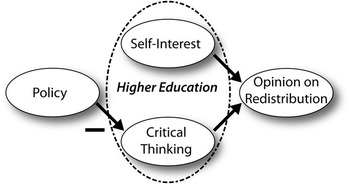
This is illustrated in Figure 1. The minus sign indicates that people are likely to react against the dominant policy through the critical thinking mechanism. The self-interest part of education is expected to carry more weight than the critical thinking part. Thus, from the self-interest argument, I deduct the following hypothesis:
H2: A person belonging to the upper socio-economic strata holds rightist views on income redistribution.
The two components of education.

In other words, I expect both income and education to be positively associated with conservative economic opinions. Even so, I still reckon the critical thinking argument to yield some explanatory power, which can be tested using multilevel models. This effect is expected to be present when examining the conditional effect of education and the specific economic policy statements of a given country. In line with Downs (Reference Downs1957), a highly educated person would be assumed to hold rightist opinions regardless of national policy statements. But, as is deduced from critical social theory, this rightist effect would be less pronounced in countries where the dominant political opinion is against redistribution, as the critical thinking component comes into play. This is also illustrated in Figure 1: there is a reactionary effect of policy on education, which is decisive for redistribution opinions. If the hegemonic opinions are rightist, then critical thinking will lead a person to hold more leftist attitudes. Thus, a new hypothesis emerges:
H3: The rightist effect of education on economic left–right opinions is smaller in countries where the political elites are negative toward redistributive policies.
Processes other than self-interest and critical thinking can be argued to be at work here. Education has a general liberalizing effect, and yet this is most noteworthy when investigating other dimensions of the left–right continuum, like social tolerance and nationalism. In addition, the cognitive mobilization thesis assumes that party attachments are used as a solution for under-informed persons who wish to cast a ballot with minimal cognitive effort. Education as well as the mass media contributes to increased knowledge among the citizens, thus leading to fewer votes being cast for the same party across elections. This is achieved through the cognitive mobilization of the voters (Dalton, Reference Dalton2007). However, a recent finding by Albright (Reference Albright2009) suggests that cognitive mobilization actually increases the probability that a person shows attachment to a specific party.
Party programs as a measure of government policy
This analysis will investigate whether there is covariance between party programs and people’s economic left–right opinions. For my country-level explanatory variable – economy – I rely on data from the Comparative Manifesto Project (Budge et al., Reference Budge, Klingemann, Volkens, Bara and Tannenbaum2001; Klingemann et al., Reference Klingemann, Volkens, Bara, Budge and McDonald2006). I use a measure of government policy positions on economic left–right issues consisting of statements made about party positions on free enterprise, economic orthodoxy, control of the economy, market regulation, economic planning, privatization, and state control over the economy. I have created an additive index from these statements (as advised by Finseraas, Reference Finseraas2010).Footnote 4 This index functions as a proxy for the elite opinions the public is exposed to through media and other information channels. Weights are applied based on the proportion of parliamentary seats held by each party in a government.Footnote 5 Taking into account that the form and interpretation of party programs differ from country to country, and in order to reduce undue influence from outliers, I have chosen to log-transform this variable.
The basis of the country-level measure is the election programs of the governing parties of each country studied. These programs are representative statements for the whole party, and their coding can be regarded as complementary rather than overlapping with other methods for determining party positions, like expert surveys (McDonald et al., Reference McDonald, Mendès and Kim2007; Volkens, Reference Volkens2007). One strength of the manifesto approach is its capacity to identify changes in different parties’ competitive strategies, whereas expert surveys have a tendency to place most parties at given left–right positions over time (Volkens, Reference Volkens2007: 109). The Comparative Manifesto Project data are regarded as a reliable source of comparative data on party positions, and have accordingly been used in several recent studies (e.g. Koch, Reference Koch2007; Manow et al., Reference Manow, Schafer and Zorn2008; Walgrave and Nuytemans, Reference Walgrave and Nuytemans2009; Finseraas, Reference Finseraas2010) as well as in tests of its validity and reliability (e.g. Franzmann and Kaiser, Reference Franzmann and Kaiser2006; McDonald et al., Reference McDonald, Mendès and Kim2007; Netjes and Binnema, Reference Netjes and Binnema2007; Volkens Reference Volkens2007). Yet even though variables drawn from these data are regarded as valid and plausible, one must take into account that different measures of party positions are not directly interchangeable (Ray, Reference Ray2007).
It is important to stress that elite thinking is not equivalent to the election programs of governing parties. Political parties are influenced by the political context, the nature of the constitution, and also by the opinion polls. Schmidt (Reference Schmidt2002) highlights governments’ ability to gain agreement for their view through political discourse, which is understood as both a set of ideas and an interactive process. Whether or not people respond to the political elite depends on the success of the legitimating discourses. In addition, more consensual polities might tend to generate manifesto policies that are directed at constructing support across a range of groups and parties, while majoritarian polities, such as the United Kingdom, may tend to have more simple class splits in manifesto statements. Nevertheless, party manifestos are a useful and quantifiable measure which can be used to test the hypotheses presented in this article.
One obvious drawback of using Manifesto Data to construct an explanatory variable is that of endogeneity. Economic opinions influence votes, and to a large degree this is separate from partisan bias (Lewis-Beck et al., Reference Lewis-Beck, Nadeau and Elias2008). It can, with good reason, be argued that people’s attitudes on income distribution affect party programs through two principal mechanisms. First, voters elect the government, and second, the political elite use opinion polls to test public opinion on important issues. Contrary to this, recent research shows that political parties do not easily adapt to popular wishes or real-world impulses (Walgrave and Nuytemans, Reference Walgrave and Nuytemans2009). Even so, I have taken two precautionary measures to avoid or minimize the endogeneity problem (in addition to my theoretical argument linking elite influence to public opinion). Temporality is essential for making causal inferences. This analysis includes the introduction of a time lag on the main explanatory variable. The Manifesto data are from the party programs of the election prior to the survey (which was conducted in 2004). The year of the previous election differs from country to country. In addition, I include a control for whether or not a person voted for one of the parties in government in the previous election. The data used are hierarchically nested, and I include a random slope coefficient for this control, allowing the effect to vary from country to country. I present an additional model replacing the random slope coefficient with an interaction term composed of voted government and lneconomy. This, together with the time lag, helps control for the part of the dependent variable that would explain the Comparative Manifesto data. The voted government variable functions as a moderator, that is, a ‘variable that affects the direction and/or strength of the relation between an independent or predictor variable and a dependent or criterion variable’ (Baron and Kenny, Reference Baron and Kenny1986: 1174).
Data and variables
The analysis presented here is based on the second round of the European Social Survey (ESS), containing individual-level data from 2004 (Jowell et al., Reference Jowell2005).Footnote 6 There are 23 countries and 30,683 individuals included in the study. The dependent variable in this paper is a five-point ordinal scale pertaining to individual opinion on income distribution. The respondents in the ESS survey were asked to comment on the following statement: ‘Government should reduce differences in income levels’ with the reply categories ranging from ‘agree strongly’ to ‘disagree strongly.’ Thus, high values on the dependent variable indicate rightist economic opinions. The individuals in the survey are nested in countries. To test the hypotheses presented here, I therefore rely on multilevel modeling. This choice of method allows me to model outcomes as a function of independent variables at both the individual and country levels.Footnote 7
The first theoretically important individual-level variable is scale of incomes (1–12). This is the main measure of the self-interest argument from which the second hypothesis is drawn. higher education is a dummy variable denoting whether or not the respondent has attended at least the first stage of tertiary education.Footnote 8 In addition, five control variables are included in the analysis. Gender is operationalized through the dummy variable woman. Women are expected to be more favorable to income distribution than men (Aalberg, Reference Aalberg2003). Inglehart (Reference Inglehart1990) argues that post-materialism leads to more individualistic values, that is, younger people should hold more rightist redistribution values than members of the older generation. I use age to control for generational effects, along with a squared age term to capture any nonlinear relationships with the dependent variable (age squared).Footnote 9institutional trust (0–30), life satisfaction (0–20), political interest (0–1), and voted government (0–1) are also included to provide a good model fit.Footnote 10 The effects of the latter two variables are allowed to vary from country to country.
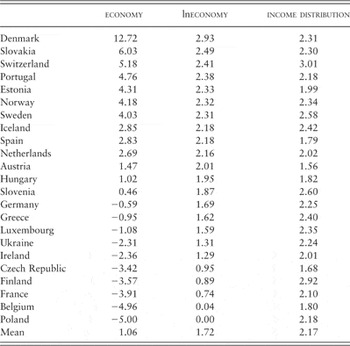
I have also included two country-level measures. The first – the natural logarithm of the economy measure described in the section about party programs – is in effect a measure of the political elite (see Table 1 for values). As a control measure for country-level variation, I use the Human Development Index (HDI) for 2003. This is a composite variable made up of three constituent parts: GDP per capita; life expectancy; and education (UNDP, 2005). I have also tested the models by including a nation-level control for the extent of inequality in each country (the GINI index). The effect of this variable was not statistically significant. I also found no significant difference between former communist states and other countries with regard to their score on the dependent variable.
Government positions on the economic left–right dimension, high values indicate rightist positions

Note: Taking into account that the form and interpretation of party programs differs from country to country, I have chosen to log-transform the economy variable to reduce undue influence from outliers. Since one cannot use log transformation when there are values on the variable that are equal to or below zero, I have added the score 6 to all units before log-transforming the variable.
Results
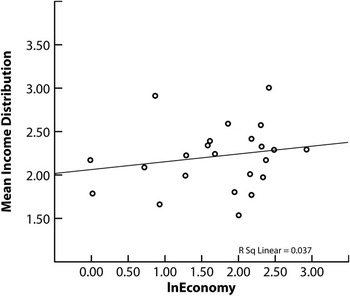
The first hypothesis deals with the direct link between party manifestos and mass opinion toward redistribution. In Figure 2, the governments’ economic left–right positions are plotted against the mean values on income distribution for each country in the analysis.
The effect of rightist government on attitudes toward redistribution, mean values for countries.

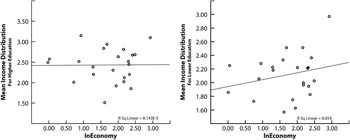
We see from the figure that there is a positive linear tendency, though not a very steep one. Thus, the more economically rightist the incumbent party (parties) of a country is (are), the more negative toward redistribution is its population. With regard to the third hypothesis, Figure 3 shows the same link, with the mean values for persons with and without higher education, respectively. When looking at the two subgroups, we see no co-variation between the party manifestos and the redistributive opinions of those with higher education. On the other hand, the positive linear trend is stronger for less educated respondents. The bivariate relation between party manifestos and redistributive values seemingly supports the first hypothesis, at least with regard to persons without higher education. As expected, higher educated persons are on average closer to the conservative end of the left–right spectrum.
The effect of rightist government on attitudes toward redistribution, categorized into respondents with high education, and without high education, mean values for countries.

Still, this is a very crude comparison of country means, without controls for other relevant factors. To combine information at the micro level (respondents) and macro level (countries), we need to apply multilevel models. The models include the important control for whether or not the respondent voted for the incumbent parties, namely the voted government variable. This article aims to identify predictors of opinion toward redistribution. Since I am using an ordered logit model, the dependent variable can be described as:

Note: y = observed ordinal response, y* = underlying left–right opinion, and τ = cut-off points that divide y* into ordinal categories.
I present three models in this paper. The first tests the direct link between party manifestos and public opinion toward redistribution. The second and third models investigate the suggested twofold nature of education on redistributive opinions:


Using these model specifications means that the signs of the coefficients presented are turned to obtain the natural interpretation.Footnote 11 In the first and second equations, the regression coefficients for political interest and voted government are allowed to vary among the countries. The second equation comprises a cross-level interaction term (higher education*lneconomy) to test the third hypothesis. In the third equation, there is in addition a cross-level interaction term consisting of voted government and lneconomy, which implies that the effect of having voted for the incumbents varies according to the left–right positions of the country to which the individual belongs. voted government is therefore not a random effect variable in Equation (3).
Before viewing the main regression models, we must remember the nature of the main explanatory variable, lneconomy. As already mentioned, this is a proxy for the hypothesized influence of the political elite on mass opinion. Party manifestos, however, are based on the wordings of the parties in government, and are not necessarily representative of the politics of the country in question. What one says and what one does can clearly be two different things. This can be illustrated in a simple correlation matrix, presented in Table 2.
Correlation matrix for economy, lneconomy, and government outlay

Note: Pairwise correlations. Estonia, Slovenia, Switzerland, and
Ukraine are missing from the government outlay variable.
We see that lneconomy (where high values indicate rightist views) is actually positively correlated with the size of the government sector as proxied by total government outlay (OECD, 2005). One additional explanation for this apparent mismatch is that it takes time to increase or decrease the size of the public sector. In this paper, I argue that what politicians state may influence public opinion regardless of their actual policies.
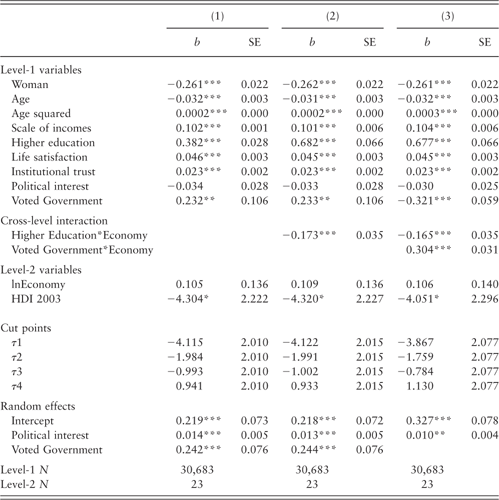
The three models of this analysis are presented in Table 3. I have also performed a sensitivity analysis (see Appendix B), using a linear model. The results from the ordered logit model and the sensitivity model do not differ substantially. From model 1, we see that after including controls for other factors, there is no significant effect of political elites’ left–right views on mass opinion toward redistribution. Thus, one cannot reject H1a, even though the sign is positive. Therefore, after controlling for voted government and other relevant independent variables, we find that there is no significant effect of incumbent party preferences on public opinion toward redistribution. There is no direct influence of government (or majority) opinion that leads the public to identify with the values of the political elite, and the bandwagon effect is not supported when investigating party manifesto data.
Ordered logit model with attitude toward income distribution as dependent
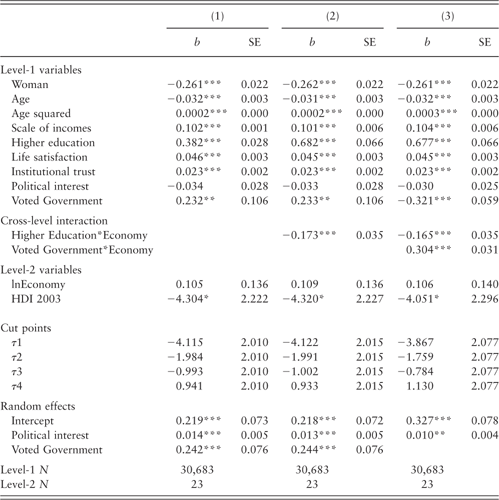
Note: High values on the dependent indicate rightist attitudes toward redistribution. scale of incomes ranges from 1–12, religiosity from 0–22, life satisfaction from 0–20, and institutional trust from 0–30. woman, higher education, and political interest are dummy variables. High values indicate that the government holds rightist economic views.
Levels of statistical significance are indicated by asterisks: * significant at 10%; ** significant at 5 %; ***significant at 1%. The probability values are calculated using a two-tailed test.
The second hypothesis – A person belonging to the upper socio-economic strata holds rightist views on income redistribution – is confirmed in all three models. The income proxy – scaleof incomes – is positive and significant, and it is also the most robust determinant of economic left–right attitudes. Further, backing the self-interest argument, higher education is also positive and significant in all models. I argue that self-interest is an important component of education, expecting this variable to be positively associated with conservative economic opinions.
The third hypothesis – The rightist effect of education on economic left–right opinions is smaller in countries where the political elite are negative toward redistributive policies – is also confirmed. This becomes apparent in models 2 and 3, which show a negative and significant interaction effect of education and party manifestos. One must, however, bear in mind that the effect of lneconomy is not significant (neither positive nor negative) for persons with higher education.Footnote 12 It is, in fact, the rightist effect of education (which is a level-1 effect) that is significantly lower (yet still rightist) for highly educated persons that live in economically conservative regimes. This finding is in line with the reasoning that those with higher levels of education are better equipped to filter political information (Eveland and Scheufele, Reference Eveland and Scheufele2000; Liu and Eveland, Reference Liu and Eveland2005) and that another factor associated with education plays an important part, namely that of critical thinking (Giroux, Reference Giroux1983a, Reference Girouxb; Fairbrother, Reference Fairbrother2003).
I also control for other characteristics that influence people’s economic left–right opinions. Women and older generations are, as expected, more in favor of redistributive policies than men and younger generations, respectively. Persons with high scores on life satisfaction and institutional trust hold more rightist opinions than their less satisfied and less trusting counterparts. The effects of political interest and whether or not one voted for one of the incumbent parties vary depending on country of residence. The interaction term composed of voted government and lneconomy, which was introduced in model 3, shows that the governing parties’ followers are very much in line with their respective parties’ policy statements. Individuals who voted for economically conservative incumbents are significantly more rightist than those who voted for more economically leftist incumbents.
Discussion
In this paper, I have introduced party programs as a measure of elite influence on mass opinion. This variable was constructed using data from the Comparative Manifesto Project. The central finding of this article is the dual effect of higher education on public opinion. My aim has been to contribute to elite-public opinion research by carrying out a cross-national investigation spanning 23 European countries, using multilevel ordered logit modeling. Three hypotheses were tested, the first pertaining to the direct influence of the political elite on mass opinion. This is based on the concepts of conformity and identification, as well as literature on the bandwagon effect. Testing the robustness of the self-interest argument, the second hypothesis also functions as a lead-up to the third and final question: whether or not there is any cross-level interaction effect between policy-elite opinion and education, my argument being that education is not only a measure of self-interest. It also includes a critical thinking component that would reduce the rightist effect of higher education in countries where policy elites are economically conservative.
Summarizing the results, this study has shown that there is little direct effect of incumbent party preferences on public opinion toward redistribution. Although a positive tendency is discernible, its effect is not statistically significant. This non-finding is in accordance with parts of the literature (e.g. Butler, Reference Butler1996). There is no evidence for either the bandwagon or the underdog effect, after controlling for whether or not the respondent has voted for an incumbent party. Much of the explanation for this is attributed to the highly relevant voted government control, which can be said to function as a moderator variable. It was included in the analysis based on the argument that economic opinions influence the vote. Unsurprisingly, the models show that those who voted for the incumbents agree with their policy statements. The self-interest argument stands out as the most robust finding of this paper: people belonging to the upper socio-economic strata are generally more opposed to redistribution than low-income people. This finding is in line with most empirical literature on redistributive opinions. Both income and higher education are strong positive predictors of rightist attitudes.
Lastly, the novel theoretical argument of this paper was the proposed mixed effects of the two components of education. Higher education, I argue, is not only a measure of self-interest, but also includes a portion of critical thinking. Education increases critical thinking, which again can lead to reaction and resistance against hegemonic opinions. As expected, education was associated with conservative economic views. Yet, by introducing a cross-level interaction term, I tested my third hypothesis: the rightist effect of education on economic left–right opinions is smaller in countries where the political elites are negative toward redistributive policies. Models 2 and 3 supported this. I attribute this finding partly to the critical thinking argument. In addition, the reasoning that higher education makes people better able to filter political information should also work as a counter force to the bandwagon effect.
This study investigates the link between political elites and the public, without finding evidence of a direct link between the opinions of these groups. The new contribution to the literature is primarily the conditional effect between the political elite views and schooling. Education, I argue, is of a twofold nature, an argument that is supported by the results from the present analysis. It may seem, as was the intention of Habermas and others, that education actually does promote critical thinking with regard to the economic left–right orientations of the public. The ruling political elite may play a part in influencing its citizens, yet the evidence presented here does not support this claim. There is a bivariate effect, however, but this can be explained largely by partisan bias. I believe it is of importance for both political science in general, and the study of public opinion in particular, to address questions pertaining to the link between macro factors and micro level attitudes. In this paper, I have shown that there is an interplay between the policies of governing parties and education. Some caveats concerning this study nonetheless deserve mention: first and foremost, the problem of endogeneity and the nature of the party manifesto variable. Even so, I hope that this paper has contributed to shedding some new light on the elite-public link.
Acknowledgment
I would like to thank Ola Listhaug, Kristen Ringdal, Bernt Aardal, Trond Petersen, Jon S. E. Jakobsen, John G. Taylor, Louisa Parks, and the anonymous referees for comments and useful suggestions.
Appendix Appendix A. Variables included in the economy measure
Economic position: Per401 Free enterprise: Positive – Per403 Market Regulation: Positive – Per404 Economic Planning: Positive – Per412 Controlled Economy: Positive + Per414 Economic Orthodoxy: Positive + Per4011 Privatization: Positive + Per4012 Control of Economy: Negative – Per4132 Privatization: Negative.
Appendix B. Sensitivity analysis: model with income distribution (1–5) as dependent, random slope

Note: Units are weighted to achieve equal N for each country. High values on the dependent indicate rightist attitudes toward redistribution. scale of incomes ranges from 1–12, religiosity from 0–22, life satisfaction from 0–20, and institutional trust from 0–30. woman, higher education, and political interest are dummy variables. The level-2 variable economy is log transformed. High values indicate that the government holds rightist economic views.
Levels of statistical significance are indicated by asterisks: *significant at 10%; **significant at 5%; ***significant at 1%. The probability values are calculated using a two-tailed test.
Appendix C. Tolerance values for the explanatory variables

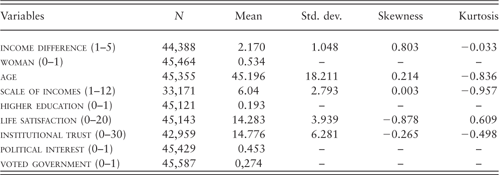
Appendix D. Descriptive statistics for individual-level variables
Appendix E. Principal component analysis from the European social survey (2004 data), using varimax rotation

Note: All factor loadings less than 0.40 are suppressed. The Kaiser-Meyer-Olkin (KMO) measure of sampling adequacy is 0.893. Units are weighted to achieve equal N for each country. Cronbach’s Alpha values for variables whose factor loadings are in bold. immigrationworse/better, immigration cultural life, immigration economy, and make up political opinion have been turned to correspond with the other variables.