Introduction
During previous decades poultry species have received increasing interest as sources of proteins of animal origin dedicated to feeding a growing world population. This rapid success has resulted in a rapid shift of poultry meat production towards second place after swine meat production (FAO sources). Such a huge progression in poultry productivity is a consequence of several biological, genetic and management factors, including short inter-generation intervals, high heritability of several traits (e.g. egg production, growth rate) associated with rapid progress in management systems and feed availability and quality. However, a continuous selection for growth rates, high meat yield and feed utilisation has also significantly impaired aspects of reproductive performances including semen quality, egg fertility, embryo survival and the number of chicks hatched per hen (Renema et al., Reference RENEMA, RUSTAD and ROBINSON2007). In the case of geese, the reproductive efficiency has also been impaired, but to a lesser extent than in more intensively selected species such as the chicken or turkey.
In contrast with most poultry species and despite the fact that geese were probably the first domesticated avian species (Crawford, Reference CRAWFORD1990), their reproductive characteristics are still relatively comparable with wild geese regarding traits such as reproductive seasonality, low male to female ratio (usually no more than 3 to 4 females per one male in the parent flock), social and sexual behaviour, and high adaptivity to various environments. As a consequence of this, some fertility problems observed in geese reproductive flocks at different periods of their reproductive cycle are similar to that of other intensively produced poultry species, however in other cases they may require different approaches than those used in species expressing traits issued from domestication (e.g. chickens). For example, the partial or total replacement of males in the course of the reproductive cycle (known as ‘spiking’) or separate sex feeding as is practised in naturally mated broiler breeder flocks cannot be of the same practical value in geese.
Another characteristic of the goose is that its digestive tract can ingest and digest large quantities of relatively cheap and easy accessible, high fibre feedstuffs. Despite this, and also despite the fact that juveniles grow rapidly and are easy to manage (Romanov, Reference ROMANOV1999), geese production has, up to date, been limited to a few Asian and European countries.
Phylogenetically, geese are represented by 35 species, but the most popular commercial breeds have been selected from only two wild species;
• the swan goose (Anser cygnoides L.).
• the true goose - greylag (Anser anser L.), itself represented by two subspecies:
o the western type (A. a anser).
o the eastern type (A. a. rubrirostris) (Crawford, Reference CRAWFORD1990).
Both wild ancestors and derived breeds differ in size and body weight, feather colour, behaviour, physiology (e.g. reproductive performance), as well as in the quality of the carcass, flavour and chemical composition of the meat. Such differences result mainly from the local availability of the breeds, performed intensity of selection and genetic improvement.
In regards to reproductive characteristics, the various breeds of domesticated geese share some specifications which may act as limiting factors to their development as an intensively used poultry species. Thus, compared with other poultry species, domesticated geese are characterised by a relatively low reproductive performances and a strict seasonality of their reproduction, making it difficult to produce goose meat all year round for a given market. On the other hand, in contrast with other poultry species, goose breeders may be kept for several seasons (usually 3 to 4) as is routinely practiced in European countries (Rosiński et al., 1986; Nitsan et al., Reference NITSAN, NIR and DVORIN1988; Toth et al., 1988; Behr and Hartmann, Reference BEHR and HARTMANN1992). In some cases, depending on economic conditions, fertility performances may remain at acceptable levels up to 6 seasons (Bielińska and Rosiński, 1988). According to data published by the National Poultry Council - Chamber of Commerce (2009) White Koluda® geese (derived from Anser anser L.) produce on average, from 49 (2nd reproductive cycle) to 40 hatching eggs (4th cycle) with a laying intensity varying from 29 to 33%; egg fertility from 79% (in the 4th reproductive cycle) to 82% (in the 2nd cycle), while hatching success of set eggs ranges from 60 to 65%. According to Nitsan et al. (Reference NITSAN, NIR and DVORIN1988) goose egg fertility in naturally mated flocks varies from 48 to 79%.
Interests in artificial insemination in geese
As in other species raised for economic purposes, an important aspect of geese production is to maintain the reproductive performance at acceptable levels for a prolonged period of time. Under natural mating conditions, this objective is often difficult to attain as a number of uncontrolled factors may alter egg fertility and embryo development. Thus, poor semen quality is often observed in most breeds while behavioural problems, such as preferential mating of a male with a single female, may cause durable alteration to reproductive performance. Other causal factors known to impair fertility in these flocks include male leg disorders, excessive body weight, and copulatory organ malformation, low biological value of eggs and low efficacy of sperm acceptance in the oviduct of aging females.
In order to circumvent these problems, artificial insemination (AI) has been used as a powerful alternative to natural mating conditions as it provides a range of ways to control, replace or improve the defective factors causing fertility problems. Of practical use for decades in turkeys, ducks and guinea fowl, AI know-how has, over recent years, demonstrated its usefulness in geese and chickens, thus emerging as a significant achievement of poultry physiologists transferred to the industry. In addition to providing alternative solutions to control fertility and reduce gosling costs by decreasing the male/female ratio, AI is also of practical interest in selection, as this technique creates favourable conditions for a more efficient use of the best sires in pedigree farms (e.g. 1♂:10-12♀ in AI flocks compared with 1♂:3-4♀ in naturally mated flocks). Overall, this results in stronger selection pressure on favourable traits and additional genetic gains at each generation. Another profitable and promising advantage of AI is crossbreeding or integeneric crossing leading to increases in meat content and decreased fatness of progeny carcasses. Such improvement can be obtained by crossing commercial goose breeds with goose from conservation flocks of local origin (Mazanowski and Smalec, Reference MAZANOWSKI and SMALEC1998), wild goose Anser anser L. (Chrzanowska and Chełmońska, Reference CHRZANOWSKA and CHEŁMOŃSKA1997; Mazanowski and Chełmońska, Reference MAZANOWSKI and CHEŁMOŃSKA2000) or Branta canadensis L. (Kowlaczyk et al., 2007a; 2007b; 2008).
In addition to pre-cited advantages, AI practice in geese selection and multiplication should also be considered as an interesting and relatively cheap way to limit the risks of transferring pathogens during copulation. Thus, ejaculates may be either checked individually for the presence of pathogens and the correspondent male(s) treated or, semen can be diluted in diluents containing ad hoc antibiotics, thus suppressing the transfer of pathogens to the female oviduct (however, not every type of antibiotic allows optimal sperm survival in in vitro storage).
Another interesting aspect of AI and semen technology is to facilitate the transportation of male gametes from a male to a female site. This has, indeed, been of practical interest to the turkey industry (‘stud farms’) to optimise production costs and facilitate yield management in breeder flocks. In geese, as in other poultry species, the duration of in vitro sperm storage remains relatively limited (1 to 2 hours), but recent progress in semen cryopreservation offers new pathways to protect gene pools and limit the risks of extinction in endangered breeds (Blanco et al., Reference BLANCO, WILDT, HOFLE, VOELKER and DONOGHUE2009).
Assuming the above, it appears that AI practice in geese breeding and multiplication offers several definite advantages including:
• general improvement of fecundity levels;
• more efficient use of ganders with high genetic potential;
• acceleration of genetic progress due to higher selection pressure;
• risk limitation of pathogens and diseases transferred during natural mating;
• possibility of transferring genes from point A to point B without moving birds;
• facilitates integeneric/interbreed crosses if natural mating has proven unsatisfactory, or in order to produce progeny of different meat taste and quality;
• cryo-preserved semen allows gene pool preservation.
Difficulties and limiting factors to perform AI in geese
Despite recent progress, AI technology (which includes semen collection, its assessment and handling, as well as semen deposition in the female tract) remains relatively complex to perform in the goose. In practice, the avian semen collection is currently performed using one of the two following methods:
• dorso-abdominal massage (Burrows and Quinn, Reference BURROWS and QUINN1937), as routinely used in turkeys, chickens, and several feral species (Blanco et al., Reference BLANCO, GEE, WILDT and DONOGHUE2000; Saint Jalme et al., Reference SAINT JALME, LECOQ, SEIGNEURIN, BLESBOIS and PLOUZEAU2003; Klimowicz et al., Reference KLIMOWICZ, ŁUKASZEWICZ and DUBIEL2005; Siudzińska and Łukaszewicz, Reference SIUDZIŃSKA and ŁUKASZEWICZ2008). This method was first transferred to ganders by Johnson (Reference JOHNSON1954);
• stimulation of the male by the presence of a teaser female (technique also known as artificial vagina method) used in Muscovy ducks, quails and ostriches (Rybnik et al., Reference RYBNIK, HORBAŃCZUK, NARANOWICZ, ŁUKASZEWICZ and MALECKI2007; Chełmońska et al., Reference CHEŁMOŃSKA, JERYSZ, ŁUKASZEWICZ, KOWALCZYK and MALECKI2008).
From the two above methods, the dorso-abdominal massage, although usually applied for gander semen collection, remains quite inefficient, in contrast to other poultry. Its success rate is relatively limited (e.g. only 40% Landes ganders respond to semen collection procedure under these conditions) with ejaculates averaging 0.3 ml in volume and 150x106 sperm/ml (Sellier et al., Reference SELLIER, RUSSELOT-PAILLEY and DE REVIES1995). Meanwhile, it appears that the response to this stimulation may be breed-dependent as shown by studies by Chełmońska and Łukaszewicz (Reference CHEŁMOŃSKA and ŁUKASZEWICZ1995). These authors indicated that the frequency of positive reactions of non-selected White Italian ganders (Anser anser L.) ranges between 60 and 70%, while Kuban ganders (Anser cygnoides L.) respond positively in about 90% of the cases. Despite these encouraging observations, it remains however, that only 30% and 50 %, respectively, of the positive responses result in ejaculates classified as ‘valuable’ for insemination purposes.
Overall, it appears from the author's experience, that the success of AI in geese depends mainly on the genetic origin of male breeders, along with the semen collection and handling procedures, AI equipment and insemination techniques. However, the basic criterion for successful AI operations is the reproductive value of male and female breeders, associated with a thorough expertise of the staff at controlling flock environment (light, feed, floor surface allowance and preparation).
Factors affecting semen quantity and quality
Compared with males from other poultry species, such as chickens, ducks or turkeys, ganders have a relatively limited testicular development at adulthood, which results in fewer sperm produced per unit time than in other species (Chełmońska, Reference CHEŁMOŃSKA1972). As a consequence, sperm concentrations are relatively low, as are the main other quantitative characteristics of ejaculates (e.g. 1 ejaculate characteristics of Anser anser L. derived ganders: volume = 0.15 to 0.3 ml; sperm concentration: 340-1020x106/ml (Łukaszewicz, Reference ŁUKASZEWICZ2002); e.g. 2 ejaculate characteristics of Anser cygnoides L.: volume = about 0.4 ml; sperm concentration: 700x106/ml (Liu et al., Reference LIU, ZHENG and YANG2008)).
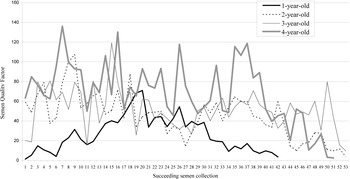
Interestingly, one characteristic of geese sperm which makes it distinguishable from other poultry, is its extremely low percentage of morphologically normal sperm which, depending on many elements (i.e. age, breed, reproductive season), may vary from only 27 to 50% of the total population when it is in the 80-85% range for chickens and turkeys. Thus, values above 50% of morphologically normal and viable sperm are only sporadically observed in gander semen (Łukaszewicz, Reference ŁUKASZEWICZ2002; Liu et al., Reference LIU, ZHENG and YANG2008), while the level of viable sperm is generally within 90-95%, a range similar to that observed in turkeys or chickens. This indicates that gander sperm should be assessed for parameters, which, besides viability/motility, should also include microscopic observation to assess their morphology. This explains why the authors have been interested in developing a global test known as Semen Quality Factor (SQF), which comprises the three most important semen characteristics; volume, cell concentrations and percentage of live normal spermatozoa (Łukaszewicz and Kruszyński, Reference ŁUKASZEWICZ and KRUSZYŃSKI2003), which has since proven valuable to predict the potential of fertilization of collected semen. It allows the estimation of the number of cells expected to become candidates for the fertilization of an ovum and how many insemination doses can be made from a particular semen sample. In ganders it varied from 26 (Łukaszewicz, Reference ŁUKASZEWICZ2002) to 84 (Liu et al., Reference LIU, ZHENG and YANG2008) (Figure 1), while it reaches values over 130 in the chicken (Siudzińska and Łukaszewicz, Reference SIUDZIŃSKA and ŁUKASZEWICZ2008). Moreover, Liu et al. (Reference LIU, ZHENG and YANG2008) found high (P≤0.01) correlation between SQF and fertility in Anser cygnoides L.(r=0.985).
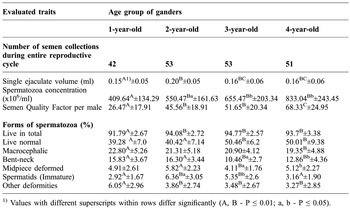
Table 1 shows the characteristics of semen collected during the entire reproductive cycle from 1-, 2-, 3- and 4-year-old ganders kept in the same environmental system.
Effect of age of White Italian (Anser anser L.) gander on the fresh semen characteristics evaluated within one reproductive cycle lasting from February to the middle of June (means ± SD; each group represented by 10 males) (Łukaszewicz, Reference ŁUKASZEWICZ2002).

1) Values with different superscripts within rows differ significantly (A, B - P ≤ 0.01; a, b - P ≤ 0.05).
The quality of fresh semen is one of the most important features in regards to its insemination and short or long term storage. The quantity and quality of semen collected manually from ganders depend on various factors including species (Stasko et al., Reference STASKO, MASAR and SPRONC1973; Chełmońska and Łukaszewicz, Reference CHEŁMOŃSKA and ŁUKASZEWICZ1995), male age (Merritt and Leman, 1963; Csuka and Ledec, Reference CSUKA and LEDEC1984; Bieliński and Rosinski, 1988) (Table 1), reproductive cycle (Guangxi et al., Reference GUANGXI, JIAQI and SHANSHAN1988; Łukaszewicz, Reference ŁUKASZEWICZ2002) (Table 2; Figure 1), management system (Rosinski et al., 1995; Sellier et al., Reference SELLIER, RUSSELOT-PAILLEY and DE REVIES1995; Willin and Kovats, Reference WILLIN and KOVATS2000; Brun et al., Reference BRUN, DELAUNAY, SELLIER, ALLETRU, ROUVIER and TIXIER-BOICHARD2003), feeding (Sauveur et al., Reference SAUVEUR, ROUSSELOT-PAILLEY and SELLIER1988), semen collection technique and collection frequency (Grunder and Pawluczuk, Reference GRUNDER and PAWLUCZUK1991; Łukaszewicz, Reference ŁUKASZEWICZ2000), as well as on individual gander properties (Tsarenko et al., Reference TSARENKO, KURBATOV and MAVRODINA1979; Łukaszewicz, Reference ŁUKASZEWICZ2002).
During the semen collection procedure, certain few factors have to be taken into consideration. Firstly, due to differences in the copulatory organ structure of Galliformes and Anseriformes, as well as the way of ejaculation, in order to maximise the semen quality, particular care has to be taken during collection to avoid any semen contamination with the cloacal products. Gander erection centre, as in all male birds, is located near the cranial end of the kidneys, therefore properly performed massage has to simultaneously stimulate both the dorsal part of the gander's body and the abdomen, as the female does during natural mating. Moreover, the avian male reproductive tract, unlike the mammal one, does not possess any accessory sex gland. Seminal plasma (known as ‘transparent fluid’) is excreted from the vascular body of the cloacal wall during copulatory organ erection and semen ejaculation. Thus, proper and sufficient stimulation has to be made in order to provoke the gander for spontaneous ejaculation which, together with the slight pressure applied above the receptaculum, should help to collect dense, good quality semen. To maximise the percentage of ganders producing semen and to ensure good semen quality, males should be kept individually and their feed should be removed 12 hours before semen collection.
Semen Quality Factor of 1, 2, 3 and 4-year old White Koluda ganders.

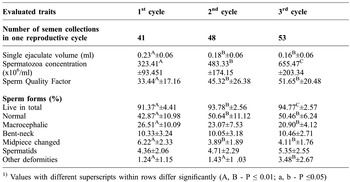
Table 2 presents the quantitative and qualitative traits of semen collected from the same ganders in their 1st, 2nd and 3rd reproductive cycle.
Characteristics of White Italian (Anser anser L.) gander fresh semen collected in their 1st, 2nd and 3rd reproductive cycle (means ± SD) (Łukaszewicz, Reference ŁUKASZEWICZ2002.

1) Values with different superscripts within rows differ significantly (A, B - P ≤ 0.01; a, b - P ≤0.05)
Ganders subjected to semen collection for the first time, as well as older males, have to be trained for holding and massage once or twice a week at the onset of every reproductive cycle, as well as selected on the basis of their positive reaction to massage, i.e., reaction ending with ejaculation, the appearance of the copulatory organ and quality of the first ejaculates. These characteristics determine the degree of gander usefulness as reproducers. A high significant correlation (r=0.80) between the number of positive reactions during the first three weeks of the reproductive cycle and the results of the total amount of semen and average ejaculates volume during the entire season has been reported (Chełmońska, Reference CHEŁMOŃSKA1972). This correlation enables an early pre-selection of males. The experiments of Kurbatov et al. (Reference KURBATOV, TSARENKO and POPOV1976) indicated that selecting ganders for AI purposes is significant and therefore worth performing. With the heritability of h2=0.24, the selection can be effective (Stasko et al., Reference STASKO, MASAR and SPRONC1973).
Despite the gander age, a decline in semen quality can be observed about six weeks before the end of the reproductive cycle. Also, during the first month of reproduction, 1-3-year-old ganders produce ejaculates of lower quality. Unfavourable changes in the spermatozoa morphology also occur, which significantly affect the effectiveness of insemination, particularly in the second half of the reproductive period. The results of experiments (Łukaszewicz, Reference ŁUKASZEWICZ2000; Łukaszewicz et al., Reference ŁUKASZEWICZ, FURUTA, XI and FUJIHARA N.2000) suggest that semen collection can best be done twice a week during the periods of lowered fertilising potency of ganders and three times in the middle of the cycle. Moreover, a decline in semen quality of ganders of different ages occurred in different months of the reproductive cycle and semen quality was male age dependent. In the case of AI, this problem can be overcome by pooling semen of age-differentiated males. It can be supposed also, that differences in fertility rate of naturally mated geese, observed within the entire reproductive cycle and resulting probably from fluctuations in semen quality, can be eliminated by having ganders of different ages in the geese flock.
Goose insemination
In most cases, artificial insemination in the goose is used throughout the entire reproductive cycle at a frequency of one insemination per week. Alternatively it is also performed once or twice a week as a complement to natural mating, at periods when fertility is impaired. Techniques to introduce semen into the lower oviduct may vary from farm to farm, depending on the inseminator's experience and skills. Since, contrary to chicken or turkey hens, it is difficult to evert the goose oviduct, the safest and most effective way for semen deposition is, to our view, the finger guided method (also known as the palpation method) (Johnson, Reference JOHNSON1954; Tai, Reference TAI1984; Grunder and Pawluczuk, Reference GRUNDER and PAWLUCZUK1991; Łukaszewicz, Reference ŁUKASZEWICZ2002). Alternatively, the finger can be replaced by a speculum. Finger or speculum-guided palpation is required to determine the opening of the oviduct. In most occasions, semen is deposited intravaginally and, as suggested by Kurbatov et al. (Reference KURBATOV, TSARENKO and POPOV1976), at a depth of 3 to 4 cm. For intergeneric crosses semen may be deposited deeper (i.e., closer to the utero-vaginal junction) to limit the high intensity of sperm selection in the lower part of vagina. An alternative to deep intra-vaginal insemination is intra-magnal insemination which is more effective and seems to have little impact on the number of oviposited eggs. Depending on the technique in use, artificial insemination is performed by either two (intra-vaginal) or three (intra-magnal) people.
As in other species, for AI success, it is very important to maintain the fertilizing potency of spermatozoa kept in vitro. Therefore, unless insemination is performed within 20 to 30 minutes of semen collection, diluents have to be added (Bakst, Reference BAKST1990). No decrease in fertility rate was observed after geese insemination with semen diluted 1-fold with EK diluent (Łukaszewicz, Reference ŁUKASZEWICZ2002) and stored for 3 hours at 4°C.
The percent of fertile eggs depends on the spermatozoa number introduced into the female reproductive tract, the frequency of insemination, and the insemination technique. For fertility, the proper timing for insemination is particularly important, so that critical periods coinciding with the ovulation stage, egg-shell formation, or oviposition can be avoided (Raud and Faure, Reference RAUD and FAURE1990). Since most geese lay eggs during early morning, the best time for insemination is at midday or 1 to 2 hours before. Moreover, it is well known that as the reproductive cycle progresses, there is an increasing demand for spermatozoa to be deposited in the oviduct in order to sustain a high and persistent fertility rate, whereas the male's reproductive capacity decreases (Brillard, Reference BRILLARD1993). This phenomenon is particularly well seen in fertility rates of geese mated naturally (Chełmońska, Reference CHEŁMOŃSKA1972; Behr and Hartmann, Reference BEHR and HARTMANN1992). It can be overcome, however, by the use of AI.
Opinions on the frequency of geese insemination and number of inseminated spermatozoa necessary for satisfactory fertility level are not univocal. However, one observation seems to be clear; geese do not need as many spermatozoa to be deposited in order to gain a satisfactory fertility rate compared to chickens and turkeys. For domestic chicken hens a dose consisting of 100 million progressively motile sperm cells is recommended for each weekly fresh semen insemination. For geese insemination Davtian and Pimenow (1970) suggested 30 to 40 million spermatozoa every 6 days, while Grunder and Pawluczuk (Reference GRUNDER and PAWLUCZUK1991) inseminated geese once or twice a week with 14 million progressively motile sperm cells, and obtained respectively 54% and 83% fertile eggs. According to Borys et al. (Reference BORYS, BIELINSKI and STASIAK1978), fresh gander semen dose should contain 2.7 million spermatozoa per day and geese two years and older can be inseminated at 12 days intervals, while one year old flocks need insemination every 9 days. In the experiments of Łukaszewicz (Reference ŁUKASZEWICZ2002), 9 million progressively motile, live normal spermatozoa inseminated weekly with fresh semen resulted in 89% fertility, while the increase in sperm number to 20 million resulted in 95.5% fertile eggs.
Conclusions
Artificial insemination can now be considered as an efficient method of reproduction in geese breeding and reproduction. Studies conducted over the past decade have demonstrated its ability to improve the effectiveness of commercial geese production by increasing the number of goslings and by facilitating the feasibility of performing crossbreeding and intergeneric crosses for genetic purposes. Despite this, geese reproduction remains relatively complex due to the physiological and behavioural specificities of the species. This justifies additional research to better comprehend the underlying mechanisms which can impact on sperm quality. Research on geese spermatogenesis and on genetic x physiological interaction at this level may be of major interest in the future.