INTRODUCTION
Fire has been an important large-scale disturbance in Amazonia over the last millennium (Uhl et al. Reference UHL, NEPSTAD, BUSCHBACHER, CLARK, KAUFFMAN, SUBLER and Anderson1990). Ground fires penetrate forests subject to seasonal drought (Nepstad et al. Reference NEPSTAD, VERÍSSIMO, ALENCAR, NOBRE, LIMA, LEFEBVRE, SCHLESINGER, POTTER, MOUTINHO, MENDOZA, COCHRANE and BROOKS1999), such as those in the south-west Amazon (Sombroek Reference SOMBROEK2001). Due to the low wind speed in the understorey, fires in unlogged Amazon forest expand symmetrically, forming scars with rounded borders (Nelson Reference NELSON1994). During a severe drought in 2005, ground fires with rounded borders penetrated 3370–4170 km2 of forests in the south-west Amazon, including bamboo-dominated forests (Pantoja & Brown Reference PANTOJA, BROWN, Epiphânio and Galvão2009).
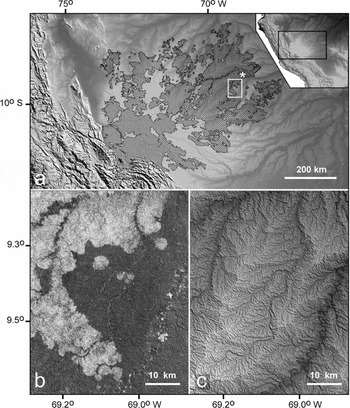
About 165 000 km2 of the south-west Amazon is covered by an irregularly shaped area of forest with a high density of two semi-scandent woody bamboos, Guadua sarcocarpa Londoño & P.M. Peterson and G. weberbaueri Pilg. (Figure 1a), that crush the understorey, cause crown breakage of mid-size trees (Griscom & Ashton Reference GRISCOM and ASHTON2006) and form large gaps in the upper forest canopy. Their meristems are protected on underground rhizomes and their culms grow quickly into the middle canopy of the forest where they bind to trees by means of recurved spines. After flowering, they undergo synchronous mortality in large patches, each hundreds of square kilometres in size. At the mature stage of the bamboo life cycle, these forests have a spectral pattern similar to that of secondary forest in images from orbital sensors. Borders of some forests dominated by these two lowland Guadua species are circular or rounded in these satellite images (Figure 1b), resembling the geometry of scars left by concentrically expanding ground fire.
Extent and rounded borders of forests dominated by scandent Guadua spp. in the south-west Amazon. Cross-hatched area is the full extent (map by Milton Bianchini, based on Landsat image interpretation), base map and inset are a hill-shaded digital elevation model from the Shuttle Radar Topography Mission (SRTM) where the brightest tone indicates all heights more than 300 m asl, asterisk is study site (a); Landsat Thematic Mapper near-infrared image of area indicated by white rectangle, rounded borders of bamboo-dominated forest (bright tones) are unrelated to local topography (b); SRTM topography of area in white rectangle, hills are gently rolling, total amplitude of relief in this subset is 120 m (c).

These two species follow a ‘guerilla’ strategy of vegetative expansion, forming a diffuse network of culms mixed among the trees and connected by long rhizomes. Bamboos with this growth strategy are generally favoured by disturbance (Franklin et al. Reference FRANKLIN, PRIOR, HOGARTH and McMAHON2009, Gadgil & Prasad Reference GADGIL and PRASAD1984, Gagnon & Platt Reference GAGNON and PLATT2008, Griscom & Ashton Reference GRISCOM and ASHTON2006, Stern et al. Reference STERN, JUDZIEWICZ, CLARK, Judziewicz, Clark, Londoño and Stern1999, Wong Reference WONG1991). Keeley & Bond (Reference KEELEY and BOND1999) argued that periodic thinning of trees by fire in temperate and subtropical forests has a central role in the maintenance of bamboo dominance and in the evolution of synchronized semelparous reproduction, typical of many woody bamboos. According to this model, fires occur about once in every life cycle when an entire bamboo population dies synchronously, providing dry fuel.
The well-established relationship between disturbance and bamboo stand density, the growth and reproductive strategies of semi-scandent Guadua and the geometry of bamboo forest edges, all favour the hypothesis that bamboo-dominated forests with rounded borders are a consequence of vegetative expansion abetted by disturbance that increases canopy openness. We suggest that infrequent ground fires, which themselves have rounded edges, are one of the sources of this disturbance.
This hypothesis cannot be tested directly. But it requires that the bamboo has competitive advantages over other species when re-colonizing the gaps left by ground fires. In this study we used 100-m2 clear-cuts, a disturbance that emulates these gaps. Specific objectives were: (1) in clear-cut fire-simulation plots, compare the recovery rate of pre-disturbance basal area and biomass of the bamboo with the recovery rate of its competitors (dicot trees and palms); (2) compare the recovery of cut culms of bamboo in clear-cut plots and in intact forest control plots; and (3) compare the results from the clear-cuts with similar measurements in a single burned plot, to examine the efficiency of clear-cutting for simulating ground fire effects.
STUDY SITE
The study site was at 68°50′W, 8°58′S, 25 km west of the town of Sena Madureira in the Brazilian state of Acre (Figure 1). Field work was conducted in 1998, when the forest was dominated by a 10-y-old cohort of Guadua sarcocarpa. Cohort age was determined from satellite images showing synchronous mortality of the previous bamboo generation in 1988. Given that mature culm diameters and heights had not yet been achieved in these bamboo stands, we assume that no adults survived post-reproductive mortality.
Local climate is hot and humid with average annual temperature of 24.8 °C (Hijmans et al. Reference HIJMANS, CAMERON, PARRA, JONES and JARVIS2005). Annual rainfall is ~2200 mm y−1 but three months are dry, with <100 mm mo−1 (Sombroek Reference SOMBROEK2001). A wetter season goes from November to May. Cold fronts penetrate the region from April to July, when the thermometer can briefly drop as low as 12 °C (Salati & Marques Reference SALATI, MARQUES and Sioli1984). Guadua-dominated forests of the south-west Amazon are associated with an uplifting zone (Regard et al. Reference REGARD, LAGNOUS, ESPURT, DARROZES, BABY, RODDAZ, CALDERON and HERMOZA2009) of highly erodible cambisols containing 2:1 clays rich in cations, as evidenced by the high conductivity (Mascarenhas et al. Reference MASCARENHAS, BRABO, SILVA, FAYAL, JESUS and SANTOS2004) and high suspended sediment load of local rivers.
METHODS
Data collection
Twenty plots, each measuring 10 × 10 m, were spaced evenly along 1 km in the bamboo-dominated forest. In 10 plots all plant stems were coppiced (cut just above the soil). The remaining plots were used as controls. Treatment and control plots were alternated. All bamboo stems were coppiced in all 20 plots in order to distinguish the effects of removing competitors and of coppicing, which itself stimulates bamboo to sprout multiple stems from the base. To eliminate rhizome penetration or translocation of photosynthates from uncut bamboos outside the plots, rhizome connections were cut at the borders of all 20 plots by digging a 30-cm deep ditch. The clear-cut plots were about the size of a gap caused by a single tree fall. The small size and the shade from the surrounding intact forest make this a disturbance similar to the partial canopy removal caused by ground fires.
Prior to cutting, the diameter at the base (db) of each bamboo culm was measured and each was labelled using aluminium tags. All culms were larger than 2.5 cm db. The pre-cut census and the cutting occurred in September 1998. After 11 mo of recovery including the entire rainy season, all 20 plots were recensused, noting the number and basal diameter of new sprouts, all presumed to be from rhizomes or stumps of the cut bamboo. In the 10 clear-cut plots additional data were noted to compare the regeneration of bamboo with its competitors: (1) above-ground fresh-weight biomass of re-sprouted bamboo, (2) diameter at base of all cut stumps of woody dicots and palms over 2.5 cm db to estimate their pre-cut fresh biomass, and (3) above-ground fresh-weight biomass of woody stems of dicots and palms resprouting from any stumps over 2.5 cm db plus the biomass of all new stems over 2.5 cm db derived from seeds.
A 50 × 50-m burn plot and a nearby 50 × 50-m control plot were also established in September 1998. In both plots, we first measured the number and basal diameter of all bamboo culms over 2.5 cm diameter at breast height (dbh). To provide dry fuel, all bamboos and all woody stems under 9.5 cm dbh were cut and allowed to dry for 15 rainless days. Under the early afternoon sun, the plot was ignited at several places to provide a homogeneous ground fire. About 75% of the original canopy was removed or burned, including partial mortality of burned trees >9.5 cm dbh. No trees or bamboos were cut in the control plot. In both plots bamboo basal area and density (individuals >2.5 cm dbh) were re-censused annually during 3 y of post-fire recovery. A 5-m-wide border was excluded from the recovery census in the burn plot, to reduce the effect of shading by the surrounding forest.
Data analysis
In the 10 × 10-m plots censused at pre-cut and 11 mo post-cut, we used four indicators of bamboo recovery in the face of disturbance. (1) Recovery of bamboo density was compared by ANCOVA between the control and clear-cut treatments. Pre-treatment culm density affects the number of post-treatment sprouts, so this covariate effect was removed. A large tree-fall occurred in one of the control plots, opening the canopy. This plot was excluded from all analyses. (2) A similar comparison was made between the control and the clear-cut plots’ recovery of pre-cut bamboo basal area, removing the effect of pre-treatment basal area per plot via ANCOVA. (3) Per cent recovery of pre-cut fresh biomass was compared for bamboo and its competitors (dicots and palms) sprouting from stumps over 2.5 cm db. This was a comparison of different life forms’ recovery after simulated fire disturbance, so only the 10 clear-cut plots were included. Using per cent recovery eliminates the effect of pre-cut biomass on post-cut biomass. The two groups of plants were compared by ANOVA. Pre-cut dry-weight biomass total per plot for each life form was estimated from stem diameters using appropriate allometric regressions (Brown et al. Reference BROWN, GILLESPIE and LUGO1989, Nelson et al. Reference NELSON, MESQUITA, PEREIRA, AQUINO, SOUZA, BATISTA and COUTO1999, Overman et al. Reference OVERMAN, WITTE and SALDARRIAGA1994) adjusted for the average wood density in bamboo-dominated forest at the study site (Nogueira et al. Reference NOGUEIRA, NELSON, FEARNSIDE, FRANÇA and OLIVEIRA2008). Dry weight was divided by 0.522 to obtain fresh weight (Nelson et al. Reference NELSON, MESQUITA, PEREIRA, AQUINO, SOUZA, BATISTA and COUTO1999). Post-recovery fresh biomass of sprouting bamboo, dicots or palms was measured directly by harvesting and weighing all stems sprouting from stumps >2.5 cm db, plus any new stems >2.5 cm db germinating from seeds. This was done in the late dry season when intact bamboo culms store no water in their hollow internodes. (4) Finally, fresh biomass accumulated in 10 clear-cut plots was compared at 11 mo between the same two groups of plants (bamboo versus competitors) using the same harvested and weighed material mentioned above. Fresh weights were log-transformed to obtain similar variances before comparing averages by t-test.
Statistical analyses were made with Systat 8.0 (SPSS Inc., Chicago).
RESULTS
Biomass recovery of bamboos and competitors
Guadua sarcocarpa demonstrated a large advantage over its competitors in advancing towards its pre-cut biomass in the 10 fire-simulation clear-cut plots. By 11 mo, bamboo had recovered to 21% ± 12% (average ± 1 SD), whereas dicots + palms had recovered to only 0.4% ± 0.2% of pre-cut biomass. Even without normalizing to pre-cut values, raw accumulation of biomass by bamboo was greater than for its competitors (t = 3.64, df = 18, P = 0.003). Bamboo accumulated 33 ± 24 kg of fresh biomass. Competitors’ regrowth was only 7 ± 3 kg.
Culm density and basal area
By 11 mo after cutting, the number of bamboo culms per plot exceeded pre-cutting levels in all the clear-cut and all but two of the control plots. The increase in the forested control plots was significant in a paired t-test (t9 = 2.63, P = 0.027), indicating that coppicing caused the stumps and underground rhizomes to produce multiple new sprouts. Pre-cut culm density by plot varied by an order of magnitude and therefore had a strong effect on the number of sprouts per plot 11 mo later. After accounting for this covariate and for the effect of coppicing, removing the forest canopy in the clear-cuts caused an additional increase in culm density (ANCOVA F16 = 7.94, P = 0.012). Expressed on a per hectare basis, removal of the forest canopy led to 700 ± 400 more culms ha−1 (mean difference ± 95% CI).
Basal area of bamboo did not recover to pre-cut levels after 11 mo, except in two clear-cut plots that had very low initial basal area. There was no significant difference in the recovery rate of bamboo basal area in the fire-simulated clear-cuts compared with the control plots (ANCOVA F16 = 3.70, P = 0.072).
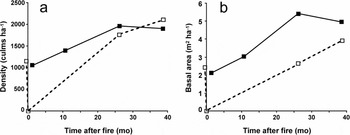
In the ground-fire experiment, bamboo stem density also recovered faster than did basal area (Figure 2). Eleven months after the burn, interpolated bamboo basal area was less than half that of the pre-burn levels, corroborating the results obtained in the clear-cut fire simulation plots at this same stage. The rapid recovery capacity of Guadua sarcocarpa becomes evident if followed for longer periods. By 2 y after the fire, bamboo basal area had fully recovered to pre-burn levels. By 3 y the burned plot's bamboo was approaching the basal area of the control plot. At the time of pre-burn census in September 1998 the burn and the control plots started out with similar basal areas of bamboo: 2.4 and 2.1 m2 ha−1, respectively. Control-plot bamboos were not cut in this experiment. By December 2000 the control plot had more than doubled its basal area, reaching a plateau of ~5.0 m2 ha−1. Accelerating bamboo dominance in the middle to upper canopy was also evident in satellite images of the area after 1998. The bamboo cohort in this region was 10 y old in 1998 and had just begun to reach the sunlit portion of the canopy, resulting in this accelerated vegetative bamboo growth.
Recovery of Guadua sarcocarpa during 39 mo after an experimental ground fire (broken line), compared with natural bamboo increase in a control area (solid line). Minimum dbh = 2.5 cm. Stem density (a); basal area (b).

DISCUSSION
Bamboo competitive advantage in fire-disturbed areas
Guadua sarcocarpa showed similar responses to clear-cutting small gaps of 10 × 10-m size and to burning a larger area with only partial canopy removal. In both cases, recovery to pre-disturbance density was very fast. The species gained biomass faster than its competitors in the clear-cut gaps and fully recovered to pre-burn basal area after 26 mo. In this clonal bamboo that sprouts from protected buds on underground rhizomes, clear-cutting to open small gaps simulated the effect of ground fire.
Clear-cutting or burning the forest may provide more than just increased light for the rapidly regenerating bamboo. Soil moisture and soil nutrients available to the bamboo may also increase when large trees are removed. Thus disturbance by infrequent fire or by deforestation favours increased density and dominance by G. sarcocarpa. The species does not, however, survive multiple frequent fires or repeated cutting of its culms, so can be easily controlled in agricultural fields and pastures.
Ground fires favour increased density of bamboo culms by two mechanisms: coppicing and opening of the forest canopy. This is consistent with prior observations of increased density after disturbance for other woody bamboo species (Franklin & Bowman Reference FRANKLIN and BOWMAN2003, Gadgil & Prasad Reference GADGIL and PRASAD1984, Gagnon & Platt Reference GAGNON and PLATT2008, Gagnon et al. Reference GAGNON, PLATT and MOSER2007, Keeley & Bond Reference KEELEY and BOND1999, Stern et al. Reference STERN, JUDZIEWICZ, CLARK, Judziewicz, Clark, Londoño and Stern1999). Biomass recovered more slowly than density, but was still impressive.
Average basal area per culm was lower at 11 mo (small clear-cut plots) and at 26 mo (burn plot) than at the start of the experiments, indicating smaller culm diameters. Smaller stems in the resprouts were expected, because coppicing removes auxin supression of lateral buds at the base of the cut culm. Furthermore, in the face of a sudden disturbance causing complete loss of culms, the clonal individual must draw on reserves in its rhizomes. Less energy is available to allocate to the sprouts and these are consequently smaller. When resprouting along roadsides, edges of pastures and in the regrowth of slash-and-burn fields, G. sarcocarpa shows the same tendency to produce many culms of small diameter.
Ground fire and alternative hypotheses
The competitive advantage that Guadua sarcocarpa has over trees and palms when colonizing disturbed areas by vegetative expansion is consistent with the hypothesis that the rounded edges between forests with and without bamboo in the south-west Amazon, and the maintenance of bamboo dominance once established in the forest, are attributable to infrequent ground fires that expanded concentrically outward into the bamboo-free forest. Nonetheless, other causes of Guadua dominance and of rounded expansion fronts are relevant. Mechanical damage to trees by the bamboo itself favours bamboo over its competitors in a positive feedback. Griscom & Ashton (Reference GRISCOM and ASHTON2006) found that, in a Peruvian Amazon forest with semi-scandent Guadua spp., trees of 5–29 cm dbh (thus reaching the middle and upper canopy) suffered seven times more crown breakage than trees in forest without bamboo. A hybrid situation has been shown for the temperate bamboo Arundinaria gigantea (Gagnon et al. Reference GAGNON, PLATT and MOSER2007). Forest damage by tornados and fires led to high bamboo density, but low densities were maintained under forest cover without these external disturbances. Radial clonal expansion of A. gigantea was no faster in the wind- or fire-disturbed areas than in the forested areas. Guadua sarcocarpa and G. weberbaueri relinquish dominance of very large patches of forest (hundreds of square kilometres) every ~30 y when adults die synchronously (Silveira Reference SILVEIRA1999). The new cohort of seedlings is confined to the understorey and middle canopy for several years, yet manages to reestablish dominance of the upper forest canopy by 15 y of age, generally without the aid of fire or large wind throws. Once a genet has reached the upper canopy it produces new sprouts at horizontal distances of up to 12 m from the established culms. These new shoots reach the middle canopy of the forest even before producing leaves.
Though there is some evidence for increased fire probability after die-back of south-west Amazonian Guadua species, post-reproductive fires are certainly not occurring once every life cycle in all bamboo forests of the south-west Amazon, as required by the Keeley & Bond (Reference KEELEY and BOND1999) model for the evolution of synchronized mortality and semelparity of bamboos in drier climates. This would require fire repeat cycles of ~30 y over an area of 165 000 km2.
ACKNOWLEDGEMENTS
This work was supported by the Brazilian CNPq – National Council of Scientific and Technological Development, via grants to BWN and a graduate student stipend to MS.