BACKGROUND
Prosody plays a pivotal part in language comprehension due to its manifold functions. Prosodic phrasing (or chunking) is particularly important for the disambiguation of temporal structural ambiguities because it highlights underlying structures and thus combines meaningful constituents into units (Cutler, Dahan, & Van Donselaar, Reference Cutler, Dahan and Van Donselaar1997; Kjelgaard & Speer, Reference Kjelgaard and Speer1999; Price, Ostendorf, Shattuck-Hufnagel, & Fong, Reference Price, Ostendorf, Shattuck‐Hufnagel and Fong1991; Vallduví & Engdahl, Reference Vallduví and Engdahl1996). Furthermore, prosody indirectly indicates the number of units in lists by highlighting whether more units are to follow or whether the list is complete. It is especially this last function, list intonation realized through rises and falls (Ladd, Reference Ladd2008), which should be very useful for memory recall because it prepares the listener to listen out for more or to perceive the end of a list. However, no study has as yet looked at the effect of prosody in memory recall of items in lists in L2.
Memory recall is typically tested in psychology and psycholinguistics with a digit span task where individual digits are presented auditorily or visually and participants need to recall a growing span of these digits (Daneman & Carpenter, Reference Daneman and Carpenter1980; Shipstead, Lindsey, Marshall, & Engle, Reference Shipstead, Lindsey, Marshall and Engle2014; Turner & Engle, Reference Turner and Engle1989). While the typical number of digits participants can hold in memory in such a task is 7+/–2 (Miller, Reference Miller1956), memory strategies can be used to increase the span length. Chunking of digits, for example, increases the number of digits participants with low and high spans remember (Mathy & Feldman, Reference Mathy and Feldman2012). Chunking here refers to the grouping of digits in arbitrarily defined units, with shorter durations within and longer intervals between chunks. Even though the chunks inherently have no meaning, the grouping superimposes a defined notion of how many members of which this group should consist. Thus, the differences in pauses within chunks and between chunks highlight that digits within a chunk are to be treated as one coherent unit, while consecutive chunks are separate units.
In natural speech, apart from pauses, pitch, intensity, and final-syllable lengthening highlight memberships within and between chunks (Berkovits, Reference Berkovits1993; Byrd, Reference Byrd2000; Edwards, Beckman, & Fletcher, Reference Edwards, Beckman and Fletcher1991; Shattuck-Hufnagel & Turk, Reference Shattuck-Hufnagel and Turk1998; Wightman, Shattuck-Hufnagel, Ostendorf, & Price, Reference Wightman, Shattuck‐Hufnagel, Ostendorf and Price1992). However, while all languages use the same phonetic correlates, the actual realization of prosodic boundaries is different in different languages. Differences can either occur at the phonological level (whether the intonational contour differs, i.e. rise vs. fall) or at the phonetic level (both might be phonological rises but the actual pitch height is different) (Grabe, Reference Grabe1997; Gussenhoven, Reference Gussenhoven2002). English and Greek (the two languages employed in this study) differ in the phonological and phonetic realization of contours. While both Greek and English employ the same boundary tones they crucially differ in the realization of the pitch accent within that phrase. In Greek a continuation rise is phonologically realized as L*H-H% (Arvaniti & Baltazani, Reference Arvaniti and Baltazani2000, Reference Arvaniti and Baltazani2005). Even though English also employs a rise at the boundary (H%) to signal continuation, the pitch accent realization is different, yielding H*LH% (Chen, Reference Chen2003). Thus, while the overall contour is a rise in both languages, the pitch and phrase accents differ substantially (L* vs. H*L). Note that it is possible to have an L-H% continuation rise at a boundary in Greek, but this is considered an “involved rise” (Arvaniti & Baltazani, Reference Arvaniti and Baltazani2000, p. 95), which would not typically be part of a list intonation. The final chunk within a list is marked phonologically similarly in both languages in terms of boundary tone with both ending in L%. However, again the combination of pitch accent and boundary tone differ between the two languages: in Greek broad focus leads to a declarative contour of L+H*L-L% (Arvaniti & Baltazani, Reference Arvaniti and Baltazani2000, Reference Arvaniti and Baltazani2005). In contrast, English uses H*+LL% contours (Grabe, Reference Grabe1997; Rietveld, Gussenhoven, Wichmann, & Grabe, Reference Rietveld, Gussenhoven, Wichmann and Grabe1999). Thus, while in both cases the final boundary is phonologically similar, it is the combination of pitch accent and boundary tone that unambiguously marks a prosodic boundary that differs in the two languages. Thus, language-specific differences in prosodic boundary marking are very subtle, but important for comprehension of speech.
However, it is unclear whether L2 learners have the same access to these prosodic cues as native speakers. Because the memory recall tasks are frequently used as a control to ensure different language groups are cognitively similar, it is important to know whether using a memory-based task such as the digit span is indeed a valid procedure in L1 and L2. And because digit span tasks (with or without chunks) are administered verbally by researchers, the stimuli will naturally contain prosodic cues. Thus, the comparability of the performance of L1 and L2 speakers hinges on the ability to perceive and use prosodic boundary cues, and might thus be crucially different in L1 and L2.
While the processing of prosodic boundaries is relatively well understood in first language acquisition (Jusczyk & Aslin, Reference Jusczyk and Aslin1995; Morgan & Demuth, Reference Morgan and Demuth2014; Nazzi & Ramus, Reference Nazzi and Ramus2003; Saffran, Newport, & Aslin, Reference Saffran, Newport and Aslin1996), only a few studies have looked at prosodic boundaries in L2. Because the exact implementation of boundaries through pitch and final-syllable lengthening is language dependent, L2 listeners need to employ inhibitory control to cope with competition through the activation of L1 prosody. Competition between L1 and L2 leaves speakers/listeners with indeterminacy and challenges the limited cognitive resources. In sentences in which prosody is crucial for disambiguation, memory resources need to be allocated for prosody and consequently fewer resources are available for semantics so that competition also affects the lexicon. L2 learners employ shallow processing of sentence structures routinely to such an extent that even syntax is not computed in a nativelike manner, and learners instead rely on semantics (Clahsen & Felser, Reference Clahsen and Felser2006). It would thus not be surprising if prosody, which often highlights syntactic structures, is also absent in the shallow processing of L2 learners. Thus, it is to be expected that learners struggle with sentences where prosody is the only cue to disambiguation.
Production studies have shown that the phonological implementation of prosodic boundaries is accurate but that the phonetic realization is not nativelike even in highly proficient learners (Jun & Oh, Reference Jun and Oh2000). To this date, not much is known about the perception of prosody in L2. Studies have mostly focused on affective prosody, which does not have any linguistic functions, or on syllable structure perception (Broselow & Finer, Reference Broselow and Finer1991; Brown, Reference Brown1998). The few studies on word boundary detection found significantly worse detection of boundaries in nonnative than in native speakers (Altenberg, Reference Altenberg2005). But because word boundary detection relies much more heavily on phonetic features such as coarticulation and knowledge of phonotactics, both of which play no part in phrasal boundaries, the results are not directly comparable. Nonetheless, the inability to produce phrasal boundaries adequately means that it is likely that the perception is not targetlike either.
The problem in the study of prosody in L2 is often that vocabulary, frequency of words, and complexity of structures could be a confound. This often makes comparisons between L1 and L2 speakers difficult. Consequently, in this study we avoid lexical or structural complexity by testing prosodic boundaries in sequences of digits. The lexical frequency of all test items is thus extremely high and the semantic content is comparable between all test items. To tease apart effects of prosody in language recall in L1 and L2 from general L2 recall effects, we will compare the recall of chunks of digits with and without prosodic cues in L2 in this study.
However, due to the different syllable makeup in different languages, different memory constraints might be imposed on listeners depending on the language of recall. If numbers are not stored holistically, that is as a semantic concept, but as a phonological trace, then numbers with more syllables should be more taxing for memory (Chincotta & Hoosain, Reference Chincotta and Hoosain1995; Chincotta & Underwood, Reference Chincotta and Underwood1996, Reference Chincotta and Underwood1997; Ellis & Hennelly, Reference Ellis and Hennelly1980; Stigler, Lee, & Stevenson, Reference Stigler, Lee and Stevenson1986). This then becomes especially important when testing listeners in a language that is not their L1. For example, while English has monosyllabic digits (apart from number 7), Greek digits are disyllabic (apart from number 4). Therefore, Greek digits should be harder to remember because the phonological trace for each digit has a longer duration and the amount of information held in short-term memory would be almost doubled. It is especially here where the interaction with an L2 becomes interesting. It is conceivable that Greek L1 speakers perform better in their L2 because English digits are shorter despite the advantage conferred through the language of maths instruction (Naveh-Benjamin & Ayres, Reference Naveh-Benjamin and Ayres1986).
RESEARCH QUESTIONS AND HYPOTHESES
Based on gaps identified in the literature, we pose the following research questions.
RQ1: Does prosody facilitate digit recall equally in L1 and L2?
H1: Mirroring production studies, L2 speakers have problems perceiving prosodic boundaries in their L2. Consequently, prosody only facilitates memory recall in L1, not in L2.
RQ2a: Are language-specific differences apparent in digit recall?
H2: Language-specific differences will be apparent in recall because the fewer syllables in English digits make recall easier than in Greek.
RQ2b: Is memory recall of digits easier L1 than in L2?
H2: Memory recall is not generally easier in L1. Instead, language-specific differences (shorter phonological traces in L2) will mitigate effects of increased processing difficulty in L2.
METHOD
PARTICIPANTS
Twenty-four Greek learners of English (henceforth Greek-English bilinguals) participated in the experiment. However, five had to be excluded because they did not complete the experiment or because of experimenter error, thus 19 Greek-English bilingual participants (mean age 30.4) were included in the analysis. In addition, 21 native speakers of English (mean age 26.5) formed the baseline. All Greek-English bilinguals learned English as a second language from the age of 6 onward (M = 7.5; range 6–9), had a B2 proficiency level according to the Common European Framework of Reference (CEFR), which corresponds to Advanced Low-/Mid-level according to the American Council on the Teaching of Foreign Languages (ACTFL), and had been in the United Kingdom for at least 3 years.
MATERIALS AND PROCEDURE
Chunk digits memory recall
Participants were presented with lists of digits with increasing length, and had to repeat each list. This task had two conditions: (a) simple chunks, in which digits were presented without prosody; and (b) prosodic chunks, in which chunks were manipulated to include prosodic information.
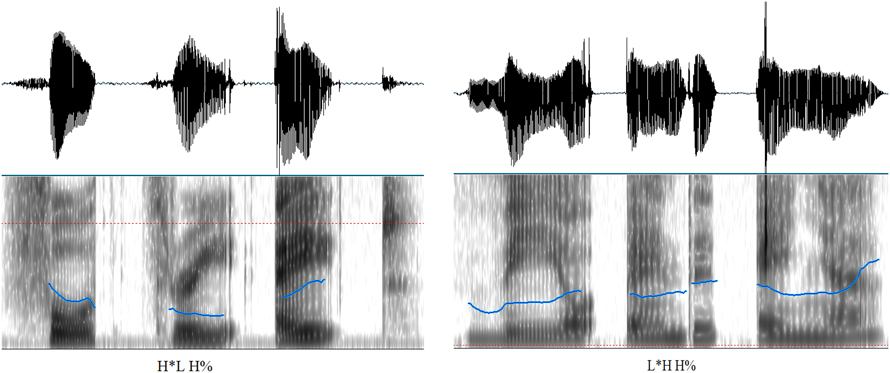
Individual digits were recorded by a native speaker from each language (i.e., English and Greek), who were instructed to produce digits with level intonation. The lists were used to analyze pitch excursions that were in the natural range for each speaker and to determine the amount of lengthening and pitch rises the speakers naturally produced before prosodic boundaries. This was in line with prosodic boundaries in English and Greek (Arvaniti & Baltazani, 2005; Grabe, Reference Grabe1997, Reference Grabe1998; Grabe & Post, Reference Grabe and Post2002; Reference Grabe, Post, Nolan and FarrarGrabe, Post, Nolan, & Farrar, 2000; Rietveld et al., Reference Rietveld, Gussenhoven, Wichmann and Grabe1999). Individual digits with level intonation were then used to form the stimuli for the experiment. For the simple chunks task, individual digits were simply concatenated. This was to ensure that the simple chunks did not contain any additional prosodic cues or coarticulation. In contrast, digits in the prosodic chunks task were then manipulated to contain prosodic cues in line with the cues the speakers had naturally produced in their native language so that the pitch range fell within the natural pitch range of the speakers (see Figure 1 for example pitch manipulations in English and Greek). This included a pitch accent, lengthening of the final syllable before the boundary, a pitch rise (continuation rise) on the last syllable at the end of each chunk apart from the final chunk in a list, as well as a pitch fall at the final syllable of the final chunk in each list.
Continuation rise manipulation in English (left) and Greek (right) with a high pitch accent in English (H*L) and a low pitch accent in Greek (L*H).

The extent of the lengthening and pitch rise in the two languages was based on the mean values of the speakers, and consequently differed for English and Greek. We decided to manipulate all prosodic items instead of using natural productions because this was the only way to ensure that prosody was indeed the only cue that was present. Any speaker-specific idiosyncrasies will therefore affect both conditions equally. Consequently, any effects thus obtained can be related with certainty to the prosodic manipulations. Each chunk consisted of three digits (triplet) with 50ms between digits, and 1,000ms between chunks. To keep the memory workload constant between triplets, the number 7 was excluded in English because it is disyllabic, and the number 4 was excluded in Greek because it is the only trisyllabic digit. Participants were instructed to listen to a list of digits and repeat them aloud afterward. All stimuli were presented through Sennheiser HD280-13 headphones. Participants always started with the simple chunk condition to ensure that they were not made aware that they could use prosodic cues to facilitate recall. Lists increased in difficulty, starting with two chunks (e.g., 958 481) and going up by a chunk if the participant managed to recall at least three out of four trials correctly per list length (e.g., 945 259 388 325 468). If fewer than three trials per length were recalled accurately, this part of the experiment ended. The final digit-memory-recall score for each task was the largest level (i.e., highest span length) correctly recalled.
Because the digit recall task we used is not a working memory test per se as it only requires recall but not complex computation of the material, it was important to have an independent task that can capture working memory abilities. A working memory task typically is a dual task and, therefore, requires maintenance and processing of new information to be retrieved at the end of each trial. After all, even though recall is not a measure of working memory capacity, working memory plays a role in the ability to recall items (Baddeley, Reference Baddeley1992, Reference Baddeley2003; Gathercole, Reference Gathercole1995).
Additionally, a questionnaire on language background evaluated L2 proficiency in bilinguals.
Verbal working memory
To assess verbal working memory (VWM) we used the listening span task (adapted from the reading span task by Unsworth, Heitz, & Engle, Reference Unsworth, Heitz and Engle2005). This task consisted of lists of sentences presented auditorily. After each sentence, participants had to indicate whether the sentence made sense. After a block of sentences participants additionally had to repeat the last word of each sentence in the block, with increasing length of sentences.
Language background
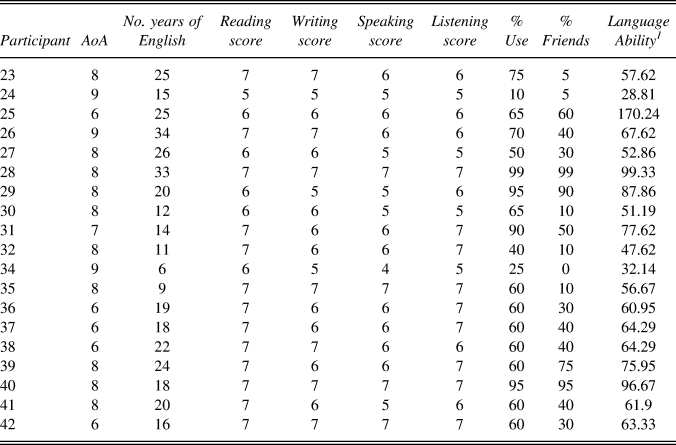
An adapted version of the Language History Questionnaire (Li, Sepanski, & Zhao, Reference Li, Sepanski and Zhao2006) was used to assess age of acquisition (AoA), amount of exposure, and proficiency of the bilinguals (see Table 1). This formed the Language Ability composite score.Footnote 1
Language background of bilingual participants

Note: Reading, writing, speaking, and listening scores were self-reported (1 out of 7, with 7 being the highest). % Use refers to the self-reported percentage of hours during which English is used on a daily basis. % Friends refers to the self-reported percentage of friends participants have with whom they converse exclusively in English.
DATA ANALYSIS
Three linear mixed effects (LME) models were carried out in R using lmer in lme4 (Bates, Maechler, & Bolker, Reference Bates, Maechler and Bolker2013). The dependent variable was always the largest level of chunks reached in the task.
A baseline analysis served to test how homogenous the bilingual group was and whether AoA or Language Ability affected the performance.
(1) In the first LME, we investigated whether prosody facilitates recall to the same extent in an L1 and L2 within the same group. We used the categorical variables Language (L1 Greek vs. L2 English), and Condition (simple vs. prosodic chunks), independent continuous variable VWM, as fixed factor, and Participant and Item, as random factors. Item refers to the chunks participants were exposed to at that time. Even though the combination of digits was randomized, there could have been some items that were easier than others, for example, because digits happened to be repeated, therefore including item as a random variable allows us to account for this possibility.
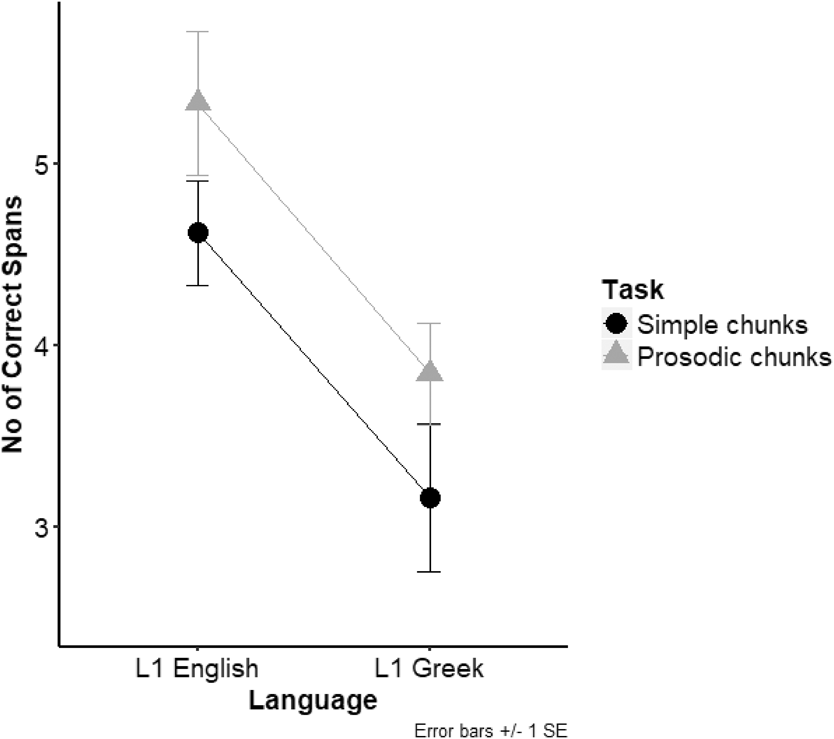
(2) The second LME looked at language-specific differences by comparing the two L1 performances with the factor Language (L1 English vs. L1 Greek), Condition, VWM, and Participant and Item, as before.
(3) In the third LME, we checked whether recall was generally worse in L2 than L1. Thus, we used the same fixed and random factors as in Analysis 2, with the only exception that Language was replaced with the factor Group (monolinguals [L1-English] vs. bilinguals [L2-English]).
We selected the optimal fixed structure by using stepwise comparisons from most complex effect (three-way interaction) to the simplest (main effect) and the optimal random effect structure according to the smallest Akaike Information Criterion (AIC) and Bayesian Information Criterion (BIC). We calculated p values with the anova function of lmerTest (Kuznetsova, Brockhoff, & Christensen, Reference Kuznetsova, Brockhoff and Christensen2017). The ANOVA served to compare different models to determine whether excluding factors from the analysis led to a better fit (Field, Miles, & Field, Reference Field, Miles and Field2012). Additionally, we calculated goodness of fit with the pamer.fnc function to explain deviance, and carried out post-hoc comparison with the testInteractions function in phia (De Rosario-Martínez, Reference De Rosario-Martínez2012). Explained deviance assesses the goodness of fit and measures the marginal improvement or reduction in unexplained variability in the fixed component taking into consideration the predictor effect (Pérez, Joseph, Bajo, & Nation, Reference Pérez, Joseph, Bajo and Nation2016). It thus serves as a generalization of R 2.
RESULTS
BILINGUAL BACKGROUND ANALYSIS
The first LME to determine whether the bilingual group is homogenous showed that removing AoA and LanguageAbility from the model did not worsen the fit. Thus, the factors had to be removed from the final model, and only language and condition reached significant effects (see Supplementary Material). However, we have explored these properly in the next LME where working memory was also included as a control variable.
PROSODIC FACILITATION IN L1 VS. L2
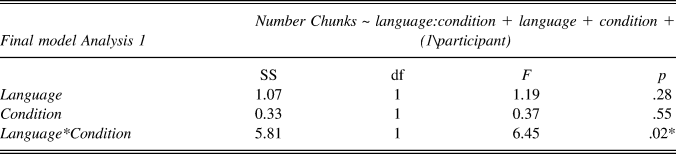
The LME that ran across languages for the bilingual group showed a two-way interaction of Language and Condition, p < .05. No other effect reached significance (all ps > .05) (see Table 2).
Linear mixed-effects model of effect of prosody on language and condition in bilinguals

Significance levels * = .05 ** = .01 *** = .001
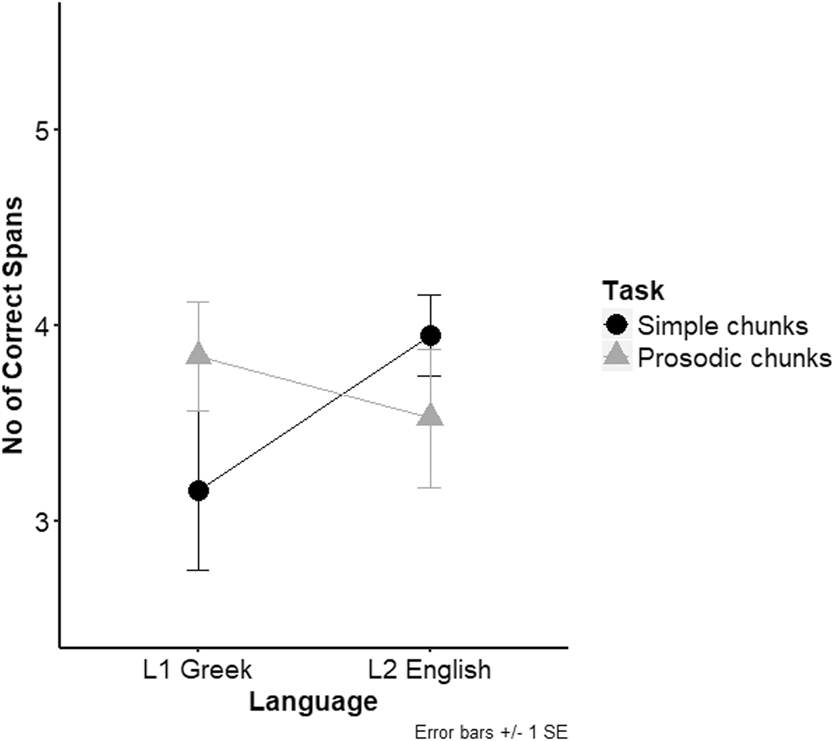
To understand the nature of the interaction, pairwise comparisons were carried out. In the L1 Greek, the two conditions differed, χ 2(1) = 4.95, p = .05, with better memory recall for the prosodic compared to the simple chunk condition, but not in L2 English, χ 2(1) = 1.87, p = .34, suggesting bilinguals did not benefit from prosodic cues when performing the task in their L2 (see Figure 2). These results showed that prosody only facilitated memory recall in L1 but not L2. But without prosodic cues, bilinguals performed better in English than in Greek, possibly as a result of lower number of syllables in English. However, the degree of variance also demonstrates that other factors seem to be at play.
Recall of simple and prosodic chunks in bilinguals in their L1 Greek and L2 English.

LANGUAGE-SPECIFIC FACTORS IN RECALL
We compared the performance of English monolinguals with that of Greek-English bilinguals in their L1, Greek. Results for the LME in this model showed a main effect of Group, p < .01, with better performance for L1-English than L1-Greek, and Condition p < .001, with better performance for prosodic than simple chunks (see Table 3).
Linear mixed-effects model of effect of prosody on group and condition in L1

Significance levels * = .05 ** = .01 *** = .001
This result demonstrates two points: first, memory recall was overall better in English than Greek (though note that nonverbal working memory results are not significant!), possibly due to the lower number of syllables in English digits, and secondly, that both groups benefited from prosodic cues to the same extent in their L1 (see Figure 3)
Recall of simple and prosodic chunks in L1 Greek (bilinguals) and L1 English (monolinguals).

L1 VERSUS L2 RECALL
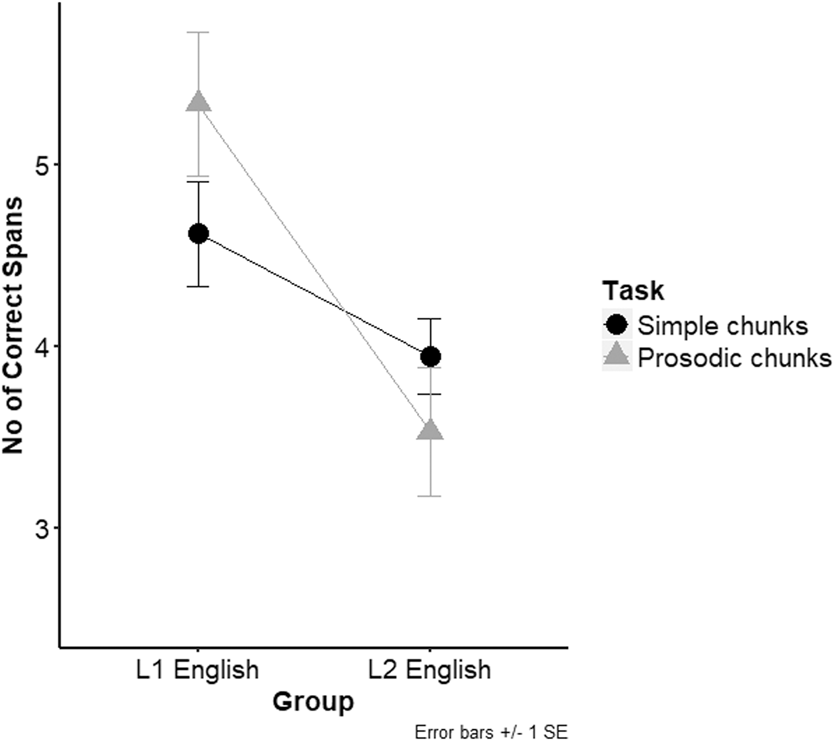
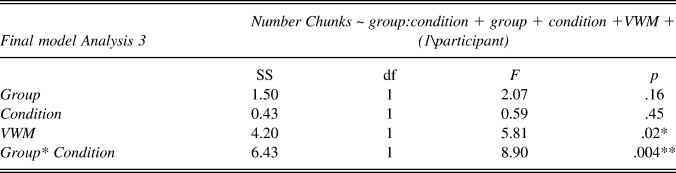
To see whether recall is generally more difficult in L2, keeping in mind the language-specific differences we observed, we performed an LME across groups for English. Results showed a main effect of VWM, p < .05 and a two-way interaction between Group and Condition, p < .01 (see Figure 4). No other effect reached significance (see Table 4).
Recall of simple and prosodic chunks in L1 English (monolinguals) and L2 English (bilinguals).

Linear mixed-effects model of effect of prosody on group and condition in English

Significance levels * = .05 ** = .01 *** = .001
To understand the nature of the interaction, we carried out pairwise comparisons that showed that the two conditions differed for the monolinguals, χ 2(1) = 7.41, p < .05, with better memory recall for the prosodic compared to the simple chunk condition but not in the bilinguals in English, χ 2(1) = 2.33, p = 0.25, suggesting bilinguals did not benefit from prosodic cues when performing the task in their L2. Additionally, monolinguals did not differ from bilinguals in the simple chunk (see Figure 4), but only in the prosodic chunk condition χ 2(1) = 6.10, p < .05. This demonstrates that recall in L2 was not generally worse, but only in instances in which prosody was a factor.
DISCUSSION
This study set out to explore whether prosody facilitates memory recall equally in L1 and L2. Prosody is pivotal in language comprehension as it is used to group meaningful sentence constituents together. However, the markings of prosodic boundaries are language specific. Production studies have found that even highly proficient learners fail to produce boundaries in a targetlike way. Here, we tested whether the same is true for perception, and whether language-specific differences could compensate for recall difficulties in L2.
DOES PROSODY FACILITATE DIGIT RECALL EQUALLY IN L1 AND L2?
Our results demonstrate that prosody does not facilitate recall equally in L1 and L2. Instead, the results show that prosody only provides an advantage in the L1. While the use of prosody as a facilitator to memory recall was entirely expected in L1, the inability of our participants to use prosody to a similar extent in their L2 is a novel result. Production studies (i.e., Huang & Jun, Reference Huang and Jun2011; Jun & Oh, Reference Jun and Oh2000) have shown that the phonetic implementation of prosodic cues to boundaries produced by L2 learners is not quite like those of native speakers, even though the phonological implementation is correct. Our study demonstrates similar results for perception. In the absence of any useful semantic cues to chunking, prosodic cues cannot be used adequately by L2 learners despite their high proficiency in English. This is in line with Altenberg’s (Reference Altenberg2005) study, which found that second language learners are significantly worse than native speakers at using word boundary cues, and Pennington and Ellis (Reference Pennington and Ellis2000) who found worse sentence recall in L2 listeners when the sentence differences were purely based on prosody. This further demonstrates that the shallow processing routinely employed by L2 learners (Clahsen & Felser, Reference Clahsen and Felser2006) does not just affect syntax but also prosody, a finding that has not been reported yet.
Importantly though, the extent to which prosody helps recall is the same across the two languages if students are tested in their L1. Due to its pivotal role in sentence comprehension, it is not surprising that speakers use prosodic cues to enhance their memory abilities. Even though sequences of digits do not contain the same semantic information as sentences, prosody can add a layer of meaning by highlighting underlying structures. Thus, prosody superimposes some sort of structure to a random sequence of digits, which appears to facilitate recall.
This finding is important because there are situations in which contextual information can be absent, for example in noise environments. Additionally, retrieving numbers on the phone typically works with an automated computer voice. Finally, digit span tests are routinely administered in language perception tests to control for working memory, and any machine administered tests string digits together without any prosodic cues. Because these tests are sometimes carried out in L1, sometimes in L2, it is important to know what the consequences of (lack of) prosody are on performance.
IS RECALL EASIER IN L1 THAN IN L2?
Our results of simple chunk recall show that Greek-English bilinguals and English monolinguals did not differ in English, provided no prosodic cues were included. This demonstrates that it is a valid approach to compare two groups from different language backgrounds within the same language, but only if the presentation of items occurs without prosody.
The results have important implications for memory recall and language processing in L2. Even though language processing in L2 is often described as more demanding than in L1, this does not seem to affect simple memory recall per se. Tasks that are taxing for short-term memory are not made more difficult by being in an L2, provided other factors such as complexity of structures are comparable. While only tested here with digits, this result has important implications for language processing in an L2 more generally, where often lots of information has to be held in short-term memory. While previous studies have demonstrated that L2 learners often employ shallow processing of sentences (Clahsen & Felser, Reference Clahsen and Felser2006), it was unclear whether prosody would be included in such processing. Our results show that, like syntax, prosody is not part of shallow processing by L2 learners. Thus, the important function that prosody often fulfils in disambiguating (temporal) ambiguities is absent in L2. It is possible that in their absence verb biases (i.e., transitive meanings in ambitransitive verbs) take over until they are untenable in temporal ambiguities, but it is unclear how the conflict is solved if the ambiguity can only be resolved through prosody. Even though our task might be seen as irrelevant to syntactic processing, it is far from it. There are many instances in which prosody is the only cue to disambiguation. In this study we have decided to simplify this and avoid additional challenges such as word frequency; however, the results are clear: without access to prosody, L2 learners cannot efficiently process utterances that are purely defined by prosody. Of course, it is possible that in other circumstances in which additional semantic, morphological, or syntactic information is available, L2 learners manage to compensate. Thus, it is conceivable that these difficulties will not be visible in conversational speech comprehension where semantics, syntax, and morphosyntax can be accessed for disambiguation. Future research will have to test this. However, it is clear that in “background tests” that routinely use a machine-administered version of the digit span task without prosody as an indicator of working memory, prosody should not be neglected, especially if the task is carried out in the L2 for some participants but in the L1 for others.
Finally, it needs to be kept in mind that we only tested English and Greek learners. It is possible that learners from other linguistic backgrounds behave differently. More research is needed on this topic. Additionally, it is clear that individual differences are apparent in performance that cannot be explained just with language proficiency. More research on individual differences in this area would be beneficial.
CONCLUSION
Prosody and prosodic boundaries are a crucial aspect of language comprehension because they highlight underlying structures, disambiguate structural ambiguities, and demonstrate dependencies between units in lists. Thus, prosodic boundaries facilitate language processing by reducing cognitive load. However, in this study we demonstrated that prosody only facilitates memory recall in the L1, but not in the L2. Even though all listeners exploited prosodic boundaries cues in their L1, our Greek-English bilinguals failed to perceive and process them in their L2, despite their high level of proficiency. We hypothesize that this is the result of the different language-specific ways of marking prosodic boundaries. Even though both languages use the boundaries, the actual phonetic implementation differs. This result is in line with many other studies that have found L1 interference in the production and perception of L2. It remains unclear whether and when L2 listeners reach nativelike attainment in the processing of prosodic boundary cues. More research is needed to address this question.
Our study also demonstrates that memory recall is generally not worse in an L2 than in the L1, provided prosody was not included. We take this to mean that language-specific differences can mitigate often cited effects of increased processing difficulties in L2s. Thus, testing in L2 does not necessarily disadvantage L2 learners.
These findings have important implications for researchers comparing L1 and L2 performance without controlling for the effects of prosody. Additionally, the results pose important questions on the role of prosody in the processing and production of ambiguous syntactic structures in L2, where prosody is often the only cue to disambiguation. Further research needs to establish whether prosody used for information structure, such as topicalization or focus, might show different results to digit recall. Research is also needed to determine whether L2 learners employ compensation strategies.