INTRODUCTION
Politics and political institutions in Africa have undergone important changes over the past generation: democratic rule has advanced, the distribution of resources is increasingly formalized, and governments have shown increasing respect for their constitutions (see Posner and Young Reference Posner and Young2007). Some of these changes, however, come into tension with longstanding institutions of political exchange in the region, most notably patrimonial rule, clientelism, and entrenched ethnic group favoritism (Hyden Reference Hyden2006). Thus, a central question that emerges in the study of comparative politics is what set of contemporary institutions shapes the choices and behaviors of individuals in the region, and how.
One perspective suggests that, since the expansion of democracy in Africa, formal political institutions have emerged as the essential factor constraining the behavior of political actors and their supporters (Horowitz Reference Horowitz1991; Lindberg Reference Lindberg2006; Posner Reference Posner2005). In that vein, familiarity with constitutional and other codified institutions is expected to supersede traditional norms. A second view holds that informal institutions built on customary norms and ethnic-based “big man rule” continue to guide the calculus of individuals, even as the formal institutions of democracy expand (Hyden Reference Hyden2006; Logan Reference Logan2013; van de Walle Reference Van de Walle2003). Formal institutions may outline access to resources, but so long as those institutions remain underdeveloped or weak, political exigencies are more likely to be addressed through traditional, kinship-based networks.
This study offers micro-level empirical evidence in support of the continued importance of informal institutions in Africa. In a departure from the literature on customary norms and ethnic-based patronage, however, it suggests that traditional big man rule is giving way, at least for some Africans, to an emerging, alternative form of big man rule — Charismatic Pentecostalism. An experiential religious movement rooted in promises of prosperity and miracles, new Pentecostalism has swept across the developing world. This is particularly true in sub-Saharan Africa, where up to a third of all residents are affiliated with the movement.Footnote 1 The argument here suggests that Pentecostal leaders now frequently adopt the role of providing resources where the state fails, and that their congregants provide loyalty and allegiance in return, thus replicating the conventional, informal institution of patron-client exchange while largely bypassing the resources of the state. The system guarantees a social safety net in a changing African political landscape, though it may also perpetuate inequalities and potential exploitation in a new, religious guise.
A burgeoning literature on the politics of Pentecostalism has noted anecdotal similarities between Pentecostal leaders and their traditional big man counterparts.Footnote 2 Yet, while the big man label fits appropriately with the crop of increasingly powerful Pentecostal pastors and churches in Africa, little systematic evidence has been leveraged, to this point, in support of that label. Do Pentecostals in fact demonstrate the exclusivity that a patron-client form of exchange implies? Do Pentecostal leaders benefit from greater loyalty and support than their non-Pentecostal counterparts? And critically, are Pentecostal congregants moving away from the ethnic channels of patronage that have long typified informal political exchange in Africa? If the charismatic Pentecostal movement indeed functions as an alternative institution of big man rule in Africa, evidence of these patterns should be apparent in a controlled, systematic analysis of individual-level behavior.
To answer the questions posed above, the study relies on data from a variant of the dictator game, a commonplace tool in experimental economics that allows for the testing of theoretical claims using randomized manipulations and behavioral measures for social preferences (List Reference List2007). Typically, our understanding of the effects of social and political conditions depends on observational studies. An inherent limitation of observational studies, however, is their inability to completely overcome concerns of endogeneity. In the case of the research topic at hand, it would be difficult to determine observationally whether Pentecostal structures encourage certain behaviors or if those behaviors might have emerged among the same individuals regardless of religious group membership.
The dictator games used in this study offer an escape from the risks of endogeneity that typically bedevil observational studies of individual-level behavior. The most straightforward form of dictator game is a one-stage decision task that matches a dictator with an anonymous receiver. The dictator starts with a fixed pool of resources and is given the opportunity to share none, some, or all of those resources with the receiver. Decisions are typically used as an indicator of generosity, altruism, or a sense of fairness, and they may be moderated by a host of characteristics such as gender, religiosity, and the expectation of repeated interactions (Ben-Ner, Kong, and Putterman Reference Ben-Ner, Kong and Putterman2002). Here, in a laboratory-like experiment conducted in Kumasi, Ghana,Footnote 3 I alter the standard dictator game in order to provide dictators with specific information about the receivers with whom they interact. By randomly assigning dictators to partners with different religious affiliations, and by including “big men” as receivers, the study offers new empirical insights into Pentecostal big man rule in Africa. It does not evaluate the actual distribution of resources from patrons to clients — observational studies are better equipped to that task — but it neatly evaluates the behaviors of loyalty and allegiance that clients might extend to patrons in an informal political arrangement.
The findings lend clear empirical support to the notion that the new Pentecostal movement in Africa replicates, and in some sense replaces, the standard form of ethnic-based patron-client exchange in the region. First, Pentecostals are significantly more generous to their in-group members (fellow Pentecostals) but less generous to out-group members, compared to non-Pentecostal subjects in the study. This finding is in keeping with the expectation that charismatic Pentecostals, as members of a distinct patron-client exchange network, view exclusive group membership as central to the institution. Second, when religious leaders are introduced as partners in the dictator games, Pentecostal participants are about 65 percent more generous with their Pentecostal pastors than other participants are with their own religious leaders. This outcome suggests an allegiance to big men in the Pentecostal setting that is unmatched in other religious networks. Finally, whereas the generosity of Pentecostal participants spikes in the presence of a Pentecostal pastor, the introduction of an ethnic group big man has no notable effect on Pentecostal participants. Non-Pentecostals, conversely, react with greater generosity when matched with an ethnic big man. Thus, while the traditional form of big man rule continues to shape the behavior of non-Pentecostals, charismatic Pentecostals in Africa are clearly embracing an alternative, religious form of patron-client exchange.
I locate the study in Kumasi, Ghana for a host of reasons. First, along with Nigeria, Uganda, Zimbabwe, and perhaps other states, Ghana is considered one of the hotbeds of charismatic Pentecostalism in Africa: anywhere from a quarter to half of all Ghanaians are affiliated with the movement, its former president was an outspoken Pentecostal, and many of the region's most recognizable Pentecostal churches, pastors, and church networks have their roots in Ghana (Anderson Reference Anderson2014). Furthermore, Kumasi — Ghana's second largest city, located in the Ashanti region — has churches on nearly every block as well as a mixed population of charismatic Pentecostals, mainline Protestants and Catholics, and Muslims; it also has a longstanding and proud traditional Ashanti culture that serves as a foundation for the typical ethnic-based form of big man rule to which Pentecostal big man rule can be compared. Finally, insofar as Ghana constitutes one of the settings in which the new form of revivalist, charismatic Pentecostalism in Africa got its start in the late 1970s, the Pentecostal movement there has achieved a degree of acceptance and maturity that allows for an evaluation of its individual-level impacts without inviting excessive suspicion or concerns that the nature of the study itself will introduce bias.
The study provides a step in furthering our empirical understanding of charismatic Pentecostalism — already labeled the most significant ideological reformation to reach the continent in a generation (Gifford Reference Gifford2004) — as a new and important informal institution in African politics. Whereas other studies depict the movement as an offshoot of occultist practices (Comaroff and Comaroff Reference Comaroff and Comaroff1999) or a realization of the Protestant work ethic (Meagher Reference Meagher2009), the evidence presented here offers grounds for viewing the movement as an alternative form of the traditional African practice of big man rule. The study also adds to recent advances in the use of dictator games and other laboratory-like experiments in field contexts. To my knowledge, it is the first study to incorporate elites — in the form of an experimental confederate — into a dictator game experiment. By providing information about counterparts in the games, and by introducing various forms of big men as partners, this research extends the use of dictator games beyond analyses of generosity and fairness in order to explore attachments to in- and out-group members and to cultural leaders. In addition, this article contributes to our understanding of identity change in African politics, by highlighting a transformation away from the ethnic identity that is consistent with constructivist accounts of elite competition and influence. Finally, the study expands the scope of religious influences in the study of comparative politics. Religious movements and organizations have garnered attention as institutions of sociopolitical importance (Helmke and Levitsky Reference Helmke and Levitsky2004), but this study explicitly pits Pentecostalism as an alternative to the traditional modes of exchange that dominate discussions of informal institutions in Africa. Thus, despite the limitations and concerns inherent in any laboratory-like experiment, the findings contribute to a new understanding of charismatic Pentecostalism as an important institution in African politics.
The remainder of the study proceeds as follows. I first characterize the charismatic Pentecostal movement in Africa as an alternative informal institution of patron-client exchange and offer hypotheses based on the observable implications of the argument. The next section summarizes the experimental design and the use of dictator games to test the hypotheses. The following section presents the findings, and the final section concludes.
PENTECOSTAL BIG MAN RULE
Since North's (Reference North1990) seminal description of political institutions as the “rules of the game,” understanding of the breadth of institutional impacts on politics has improved. Often overlooked in the study of institutional impacts, however, is the diversity of institutional forms that shape political behavior: formal, written statutes and constitutions receive much of the attention from institutionalists, but informal social norms, community structures, and customary routines also count as institutions that define individual incentives and choices (see Helmke and Levitsky Reference Helmke and Levitsky2004; Hyden Reference Hyden2006; North Reference North1990). The importance of those informal institutions is particularly acute in regions where formal institutions remain weak, since individuals must often look elsewhere for the provision of services, security, and well-being (Bratton Reference Bratton2007).
Political exchange in Africa has traditionally been described as following the informal institution of big man rule. Emerging in the context of perpetually weak states, and drawing on both pre-colonial norms and post-colonial institutions, big man rule developed to ensure support for elites and service provisions for the masses. Traditionally, the big men — or patrons — provide material resources, services, and opportunities to their clients in exchange for loyal support and allegiance (Hyden Reference Hyden2006; Lemarchand Reference Lemarchand1972). This patron-client relationship ensures that clients have their welfare needs met directly, and that big men enjoy the authority and legitimacy necessary to maintain power. Because patrons typically have access to resources (often from the state) that others do not, and because of the larger-than-life, patrimonial status that their access to resources affords, a culture of big man politics has developed alongside the formal institutions of African states.Footnote 4 Critically, the traditional relationship between patron and client hinges on ethnic or kinship ties: since patrons must trust clients to provide widespread support and clients must trust leaders to deliver material resources, kinship and ethnic ties between patrons and clients provide the sanctioning mechanism that prevents either party from reneging on the exchange. This is particularly true in settings of low information, where actors are more likely to rely on the demographic cue that ethnicity provides (Konroy-Krutz Reference Conroy-Krutz2012).
Big man rule alleviates some of the pressures that communities face when formal state institutions lack the capacity to provide public goods in a sustained and widespread manner. Patron-client relationships of this sort also run the risk, however, of undermining democratic values, weakening government accountability, and fostering corrupt leaders who use resources drawn from the state to support their personal interests (Kenny Reference Kenny2013; Lemarchand Reference Lemarchand1972). Even if its roots are well understood, therefore, its impact on the functioning of African governance remains unsettled.
As McCauley (Reference McCauley2013) argues, the traditional form of big man rule in Africa has recently shown signs of breaking down, and opportunities for new patron-client networks are emerging. First, the rash of economic crises, corrupt leaders, and political uncertainty, particularly from the late 1970s onward, invited a reevaluation of social values in the region. Religious revivalism thus became, for many, an answer to the falling wages and lack of access that traditional patron-client exchanges were unable to overcome (Marshall Reference Marshall2009). Second, the state is increasingly assuming control over elements of the patron-client exchange that were once solely the purview of informal, traditional institutions. In the Ashanti region of Ghana, for example, land use and land tenure rights, previously under the jurisdiction of the region's traditional rulers, are now subject to formal bureaucratic processes (Ubink Reference Ubink2008). Formalization of this sort provides much-needed tax revenue and oversight to the state; it also removes a key resource that patrons could previously distribute in exchange for loyalty. Third, even as the state expands into areas once managed through customary means, state institutions remain too weak in many African states to provide a full range of public goods. Aid dependence remains too high, and in terms of social safety nets, the state remains an inadequate replacement for traditional forms of patron-client exchange, leaving a void at the individual and local levels.Footnote 5 Finally, rapidly increasing urbanization in the region, a byproduct of economic growth, has an adverse effect on traditional big man rule: divorced from their village-based ethnic networks and connections to patrons, urban dwellers increasingly seek new kinds of patron-client relationships (Kessides Reference Kessides2005).
Just as the traditional form of big man rule has begun to break down, the charismatic Pentecostal movement in Africa has expanded. Distinguishing itself from mission-based Pentecostalism and mainline Protestantism, the new Pentecostal movement — alternatively labeled charismatic, born-again, or evangelical Pentecostalism — is characterized by experiential worship, an emphasis on prosperity, and a strong belief in the power of miracles (Anderson Reference Anderson2014). Beginning as an outlet for the urban poor, the movement soon expanded through student groups and into rural areas (Maxwell Reference Maxwell1998). Today, charismatic Pentecostals are counted among the wealthy and poor, urban and rural, and young and older. The charismatic Pentecostal movement is thus positioned as a contemporary alternative to traditional, ethnic ties for many Africans.
How might new Pentecostalism serve as an alternative institution of big man rule in Africa? Analogous to the traditional rulers, chiefs, and influential co-ethnics with access to state resources in the traditional form of big man rule are the Pentecostal pastors, preachers, and wealthy church benefactors; those patrons have both the capacity to provide resources to their supporters and the incentive to cultivate widespread support and loyalty. Churchgoing Pentecostal congregants are similarly analogous to kinship-based clients: they are willing to assign loyalty and allegiance to a leader in exchange for the resources that address basic needs. Unlike ethnic-based big man rule, which is generally based on perceived lineage, membership access in these Pentecostal patronage networks is open, making it a perfect alternative institution for new urban dwellers and upwardly mobile clients no longer entrenched in the traditional modes of exchange.
Charismatic Pentecostalism also offers a payoff structure very much in keeping with traditional forms of patron-client exchange. Whereas ethnic-based patrons distribute local and state resources, jobs, land, and other opportunities to their clients, Pentecostal big men have two sources of patronage at their disposal: they provide an increasingly wide array of church-based social services and support (Miller and Yamamori Reference Miller and Yamamori2007), and they offer the promise of miracles — often financial windfalls, improved job prospects, or freedom from physical ailments — to any client committed to the relationship (Kalu Reference Kalu2008). In exchange, Pentecostal clients assign loyalty and allegiance to their patrons, not in the form of votes or customary honors, as might be the case in traditional patron-client relationships, but instead through regular church attendance and, above all, tithing and donations.
Finally, Pentecostal networks encourage exclusivity in the same way that traditional, ethnic-based patronage networks do. Absent exclusive commitment to the community, clients cannot trust that resources will continue to flow in adequate supply, and patrons lack the certainty that a rival big man will not emerge to garner greater support and loyalty; that is true of any sustainable patronage network (Hyden Reference Hyden2006; Kaufman Reference Kaufman1974). Exclusivity in a Pentecostal form of big man rule manifests itself in two forms. Relationships with fellow group members are prioritized over out-group members, as a means of cultivating the widespread support for patrons that the system of exchange requires. Thus, charismatic Pentecostal networks described as insular or “holier than thou” (Lawless Reference Lawless1988) are in fact keeping with a pattern of exclusivity common to patron-client networks more broadly. Furthermore, new Pentecostals are explicitly encouraged to break ties with their pasts and with other forms of social support, particularly the traditional, ethnic-based ones (Meagher Reference Meagher2009; Meyer Reference Meyer1998). Charismatic Pentecostals are often asked to forego customary or traditional meetings and activities, and commitments to extended kin are discouraged in favor of the nuclear family and the church.
These patterns of big man rule are less evident among non-Pentecostal networks in the region. First, at least as a matter of degree, Muslim and mainline Christian groups do not give the same centrality to the blessing of miracles as a resource for distribution. Since the promise of miracles functions as a key resource at the hands of religious leaders in the new Pentecostal movement, those leaders are equipped to engage in direct patron-client exchange in a way that leaders of other religious groups are not.Footnote 6 Furthermore, the charismatic Pentecostal movement lacks the hierarchy that constrains direct or excessive exchange of resources for loyalty in other religious institutions.Footnote 7 With little institutional oversight, Pentecostal big men and their congregant followers can use the structures of Pentecostalism to replicate traditional exchanges of resources for loyalty in a manner unique among religious groups in the region.
If these descriptions of charismatic Pentecostalism as a new, alternative form of big man rule constitute an accurate account of the movement's informal political impact in Africa, several observable implications emerge. First, we should observe that charismatic Pentecostals in the research setting in Ghana demonstrate greater relative favor to in-group members than do their non-Pentecostal counterparts. This claim follows from the importance of exclusivity in patron-client networks: since non-Pentecostals largely maintain their ties to traditional forms of patronage, they should be less likely to demonstrate exclusivity along religious group lines. Conversely, the structure of big man rule in charismatic Pentecostalism should elicit unique commitment to in-group members. For testing purposes, it is useful to express a hypothesis explicitly in terms of dictator game outcomes, in the following manner:
Exclusivity hypothesis: Pentecostal dictators in the dictator game will share more with in-group members (fellow Pentecostals) and less with out-group members, compared to the distribution patterns of non-Pentecostal dictators. The difference-in-differences will thus be greater for Pentecostal dictators.
Second, if charismatic Pentecostalism in Africa functions as a form of big man rule, we should observe that Pentecostals show excessive allegiance to their religious leaders. Compared to non-Pentecostals, whose religious networks are not structured so clearly as patron-client relationships, new Pentecostals have stronger incentives to bestow favor on their patrons, as a means of cultivating the distribution of resources — especially the promise of miracles — in return. In terms of measurable outcomes in the dictator game, we should expect to see the following:
Big Man Allegiance hypothesis: Pentecostal dictators in the dictator game will share more when matched with their religious big men (Pentecostal pastors) than non-Pentecostals will with their own religious leaders.
Third, because charismatic Pentecostals engage in a form of big man rule that encourages them to cut ties with their past and with their traditional, kinship networks, we should expect to see that Pentecostals in this study do not demonstrate particular allegiance or loyalty to traditional ethnic big men, even as they explicitly favor their Pentecostal leaders. In terms of dictator game outcomes, the argument suggests the following hypothesis:
Break-from-the-Past hypothesis: Pentecostal dictators in the dictator game will be no more generous when matched with traditional big men than they are when matched with other receivers. Non-Pentecostals will share more with traditional big men than with the average receiver.
If these hypotheses are correct, the study will have provided systematic, individual-level evidence, from the client side of the relationship, to support the description of charismatic Pentecostalism as an alternative form of big man rule that shapes informal political exchange in Africa. Because the evidence is based on a measurable behavior (the distribution of fixed resources), the use of dictator games decreases the odds that participants manipulate the outcome or provide socially desirable responses that may introduce bias. In this sense, the study adds clear insight to an otherwise difficult to evaluate phenomenon in the informal politics of Africa.
EXPERIMENTAL DESIGN AND THE USE OF DICTATOR GAMES
The dictator game is one of several research strategies employed in experimental economics to measure other-regarding preferences. The classic version of a dictator game is a strictly zero-sum, one-stage decision task: an individual playing the role of dictator is assigned a fixed, divisible amount of money and is instructed to share none, some, or all of that money with a receiver. The receiver, typically an anonymous partner, has no choice node and cannot affect the amount that the dictator keeps. In this sense, the activity is straightforwardly an evaluation of the behavior of individuals in the dictator role.
Experiments of this sort benefit from the same advantages of laboratory-based experiments. Researchers using dictator games are able to carefully control the stimulus to which subjects are exposed and to minimize potentially confounding influences on outcomes; they can also conduct randomization of subjects to treatment and control groups in order to generate stronger causal inferences (Franzen and Pointner Reference Franzen and Pointner2013). A limitation of dictator games, and indeed any laboratory-like experiment in the social sciences, is their applicability to the real world: because the activities are abstract and removed from typical experiences, valid concerns arise over their external validity. Furthermore, experiments of this sort are often conducted among a unique population (e.g., university students), provide financial gains devoid of any context, and include subjects who are aware that their choices are scrutinized, thus leading to possible Hawthorne effects and other forms of systematic bias that make inferences regarding the real world more difficult (Adida, Laitin, and Valfort Reference Adida, Laitin and Valfort2010; Franzen and Pointner Reference Franzen and Pointner2013). I take steps in this study to minimize these shortcomings.
Researchers have employed dictator games in experimental economics for the past two decades, and their use is increasingly common in political science.Footnote 8 Despite the game-theoretic expectation that dictators simply keep all of the endowment, studies show that individuals playing the role of dictator consistently assign non-zero sums to their counterparts, ranging from 20 percent to half of the fixed pool of resources.Footnote 9 Outcomes can be affected by personal characteristics such as gender, religious background, and parental influence (Ben-Ner et al. Reference Ben-Ner, Putterman, Kong and Magan2004). Institutional choices in the setup of the game also influence outcomes: games may be double-blind to ensure anonymity between both the players and experimenters (Eckel and Grossman Reference Eckel and Grossman1996; Franzen and Pointner Reference Franzen and Pointner2013); they may involve repeated interactions (Ben-Ner et al. Reference Ben-Ner, Putterman, Kong and Magan2004); they may alter the stakes (Cherry, Frykblom, and Shogren Reference Cherry, Frykblom and Shogren2002); they may include activities to simulate earning the initial pot (Hoffman et al. Reference Hoffman, McCabe, Shachat and Smith1994); they may give dictators an option to take as well as give (Bardsley Reference Bardsley2008; List Reference List2007); and they may deliberately introduce information about the receivers in order to manipulate the social distance between players (Ben-Ner, Kong, and Putterman Reference Ben-Ner, Kong and Putterman2002). Comparisons across studies are thus somewhat less instructive than across-subject variation within each study.
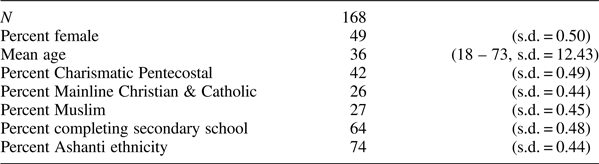
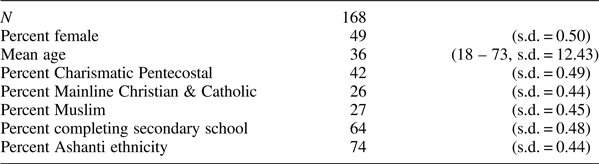
For this study of charismatic Pentecostalism, I recruited 168 participants as dictators, and an additional 36 to serve as receivers. Subjects were recruited via a randomized household protocol: individuals at randomly selected households participating in a separate, 500-household survey were invited to earn money by participating in financial exchange activities at a fixed location. They were paid 5 Ghana Cedis (abbreviation GHS; approximately 3.33 US Dollars) for transportation and were told they could earn up to 28 GHS (18.67 US Dollars).Footnote 10 Weighting was employed in predominantly Muslim neighborhoods to increase the number of Muslims in the sample. The overall success rate was 87 percent, with no systematic explanation for no-shows. Alternate participants were recruited in advance to ensure adequate numbers. See Table 1 for descriptive characteristics of the participants.
Descriptive statistics of subjects (dictators) in dictator game experiments
The experiments were not designed to test the actual exchange of resources for loyalty that typify relationships between patrons and clients in a setting of big man rule; a test of that sort would require repeated interactions between patron and client. Instead, this experiment aims to test the attachments that charismatic Pentecostals develop toward their in-group and their leaders, as evidenced in a series of non-repeating interactions. In that sense, the study represents a test of the behaviors of exclusivity, loyalty, and breaking from the past that clients learn in Pentecostal patron-client relationships.
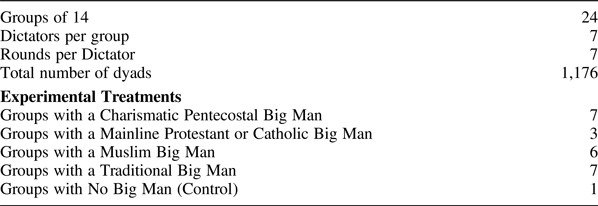
The activities took place over six weekend sessions in a centrally located, private meeting space in the Adum neighborhood of Kumasi. The location was chosen to be close to the central market district, in order to facilitate attendance on Saturdays. Dictators were divided into 24 groups of seven,Footnote 11 and each dictator was matched with a receiver, such that each group involved 14 participants.Footnote 12 After one round of decision-making between a dictator and receiver, dictators rotated to the next receiver in the group until each dictator had played seven rounds. Combining results from all groups, data was collected on a total of 1,176 dictator-receiver dyads.
Institutional decisions were made to alleviate some of the external validity concerns typically associated with dictator games. First, by recruiting participants from a random sample of Ghanaians in their homes in Kumasi, the study ensures that subjects approximately represent the composition of the environment of interest, rather than representing a unique and potentially biased pool of respondents, such as university students. Other researchers have similarly taken games of endowment division outside of the university laboratory to field settings in Peru (Karlan Reference Karlan2005), Brazil (Fehr and Liebbrandt Reference Fehr and Leibbrandt2008), Uganda (Habyarimana et al. Reference Habyarimana, Humphreys, Posner and Weinstein2007), France (Adida, Laitin, and Valfort Reference Adida, Laitin and Valfort2009), the Netherlands (Stoop Reference Stoop2012), and elsewhere. Doing so removes some of the concern posed by non-representative samples playing the games in insulated settings.
Second, the study employed a double-blind design to ensure anonymity in the endowment decision both between subjects and between subjects and experimenters. Dictators were given two envelopes for each round, one for themselves and one handed over by each receiver. Matched with a receiver, dictators then divided the endowment between the two envelopes (behind a dividing wall) and inserted the envelopes into personal boxes that remained with each participant (dictator and receiver).Footnote 13 At the completion of each group's seven rounds, receivers opened their boxes in the presence of experimenters. Envelopes were coded so that experimenters could match endowments to the dictators who distributed them, but receivers were given no indication of who donated what amount, and dictator choices were made out of view of both receivers and experimenters. This design helps to address concerns that the scrutiny of choices may alter outcomes in a systematic manner.
Third, subjects recruited as dictators completed a short geography quiz prior to their assignment to groups. The quiz was framed as a test of African geography: subjects were given a blank map of Africa and were asked to label as many countries as they could. Dictators were then informed that their performance on the quiz entitled them to money in the upcoming activities. Although the amount of money assigned to all dictators remained constant, at 4 GHS per round, the quiz was intended to create the impression that dictators “earned” the resources that they were then invited to keep or share. This strategy helped to add context to the endowments.
To test the hypotheses describing charismatic Pentecostalism as an alternative form of big man rule, I make two important departures from the basic dictator game. The first is to manipulate the social distance between dictators and receivers by providing demographic information on the receivers. In each group of 14 (seven dictators and seven receivers), receivers first introduced themselves with five specific pieces of information: family name, ethnic group, occupation, religious worship site and religion, and age. Religious information constituted the key data; receivers noted both their religious worship site and religion (e.g., “I attend the In Him Is Life Church, so therefore charismatic Pentecostal”) in order to distinguish charismatic Pentecostals more clearly from other mainline Protestants. The additional demographic data was included primarily to disguise from subjects the intention to evaluate their reaction to partners' religious affiliations, though the data also served as important control variables. The same five pieces of information were also written on the envelopes that receivers handed to dictators for the endowment division, to reinforce those characteristics at the dictators' choice node. While receivers provided identifying information to their dictator counterparts, dictators were never asked to identify themselves publicly and were instructed from the outset to avoid interaction with one another because they would be taking a quiz and making private decisions regarding financial endowments. This stipulation builds on the insight from Adida, Laitin, and Valfort (Reference Adida, Laitin and Valfort2010) that familiarity with the characteristics of co-participants can alter experimental outcomes in systematic ways.
The second departure from standard dictator games is that an experimental confederate was introduced as the seventh receiver in each group. The confederate represented various forms of big men, altering his demographic information to create distinct experimental treatments across groups. In all groups, the confederate introduced himself as Mr. Ansah, 50-years-old, and an Ashanti. His occupation (and religion), however, was systematically manipulated: he was alternately a Pentecostal pastor, Protestant reverend, Catholic priest, or Muslim imam to represent different types of religious leaders and big men. For groups receiving the Traditional Big Man experimental treatment, he introduced himself as an Ashanti prince and regional representative to the Ministry of Employment. The intention was to capture in one experimental treatment the key characteristics of traditional big men: noteworthy status in the local ethnic community as well as access to resources from the state. While each of these roles constitutes a clear position of power and influence, many such big men can exist in a town like Kumasi, and none of the roles is of the sort that the person would be widely recognized. Finally, in one group he introduced himself as an agricultural development worker (and a Protestant), to create a control group with no big man present. Importantly, the same individual served as the experimental confederate for all groups; this design ensured that only his status as a big man, and nothing about his individual appearance or character would vary across groups. The big man's attire was altered per treatment to establish consistency with his stated occupation (though in all cases he was “off-duty”).Footnote 14
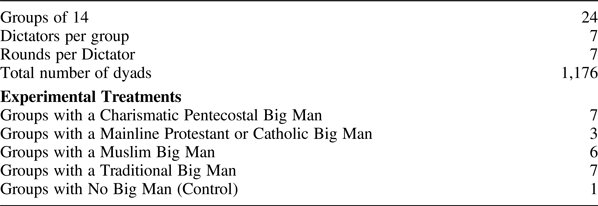
In post-experiment debriefing, only one dictator-receiver dyad indicated knowing one another previously. Fifteen percent of dictators indicated that they suspected a receiver to be misrepresenting her/himself, but most cited a randomly assigned receiver (likely for idiosyncratic reasons); only 5 percent of dictators expressed doubt regarding the confederate's status. Furthermore, only 6 percent mentioned the big man confederate when asked what they thought the purpose of the day's activity was. Table 2 presents summary information on the dictator game groups and their respective experimental treatments.
Summary of dictator game experiments
To summarize, the process for data collection took place as follows: subjects were recruited to attend the activities and completed brief informational surveys. Those assigned to the role of dictators were led to one room where they completed quizzes to “earn” their endowment amount of 4 GHS for each of seven rounds. They were then informed that a separate group did not receive endowments, and that they as dictators would be matched with members of that group, one by one for seven rounds, and given an opportunity to share their endowment for each round if they so choose. Six members of the receiver group were randomly assigned; the seventh was an experimental confederate who played the role of various religious big men, a traditional big man, or no big man, in order to create treatments and controls. Dictators were informed that all receivers were randomly selected from various neighborhoods of Kumasi. Receivers introduced themselves to the group of dictators, and dictator-receiver dyads then sat face-to-face at distribution stations. Receivers handed their envelopes (with demographic information labels) to the dictators, who divided that round's endowment using five choices: no money to the receiver, 1 GHS, 2 GHS, 3 GHS, or all 4 GHS to the receiver. The distribution was placed in the envelope behind a divider and out of view of the receiver. After one round, dictators rotated to the next distribution station and the activity was repeated between new dictator-receiver dyads. After the completion of the seven rounds, dictators answered exit surveys and were free to leave with their envelopes. Receivers met with experimenters to tabulate and code distributions from the dictators.
The dependent variable in the study measures the degree to which subjects, as dictators, voluntarily share resources with their counterparts. The measure is a simple accounting of the amount of money distributed to receivers in each round. Key independent variables include the religious affiliation of the subjects; the religious affiliations of their counterparts (the receivers); the presence of a big man; and the status of a subject's counterpart as a religious big man, traditional big man, or otherwise average participant. According to the Exclusivity hypothesis, we should expect to see that Pentecostal participants playing the role of dictator assign differential amounts to Pentecostal and non-Pentecostal counterparts, and that the difference is greater than the difference in in-group/out-group distributions made by other, non-Pentecostal participants. According to the Big Man Allegiance hypothesis, we should observe that Pentecostal dictators matched with a Pentecostal big man give more money to that receiver than other, non-Pentecostals give to their own religious leaders. According to the Break-from-the-Past hypothesis, we should expect to find that Pentecostal dictators are no more generous when matched with a traditional big man than they are when matched with average receivers, but that other, non-Pentecostals share more with the traditional big man than they do with other receivers.
RESULTS
The conventional purpose of dictator games is to establish a quantitative measure of other-regarding preferences in specific contexts, by evaluating the portion of a fixed endowment that participants share with their counterparts. In this study of 1,176 dyads, the average amount shared with receivers was 1.14 out of four GHS (std dev = 0.89), or 28 percent of the endowment, a figure in keeping with dictator game outcomes from around the world (see Camerer Reference Camerer2003).
Comparing Charismatic Pentecostals to the rest of the pool of participants, Pentecostals shared 0.99 GHS (std dev = 0.99) with their randomly assigned counterparts, as compared to 1.24 GHS (std dev = 0.80) shared by non-Pentecostals, a difference that is statistically significant at the 99-percent confidence level. The standard dictator game interpretation would thus suggest that Pentecostals in the study area are less generous or altruistic than their non-Pentecostal counterparts. In this study, however, the outcome of interest is not generosity per se but the systematic reaction of participants to differences in their counterparts. How generous are Pentecostals to in-group versus out-group members, relative to non-Pentecostals? How do Pentecostals and non-Pentecostals react when matched with a religious leader? How do they react when assigned a traditional big man? Thus, of interest is the variation in generosity conditional on the characteristics of receivers.
Test of the Exclusivity Hypothesis
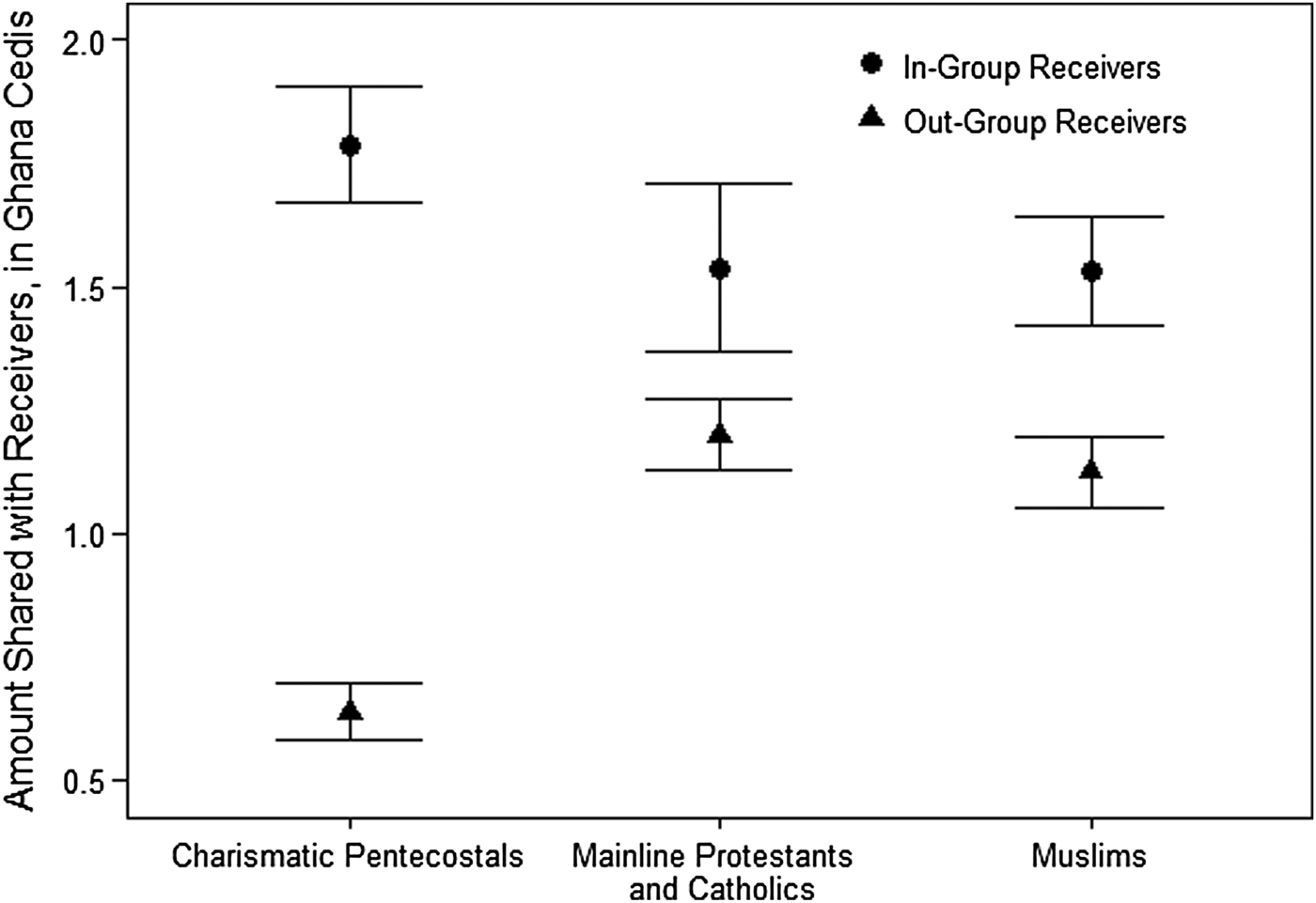
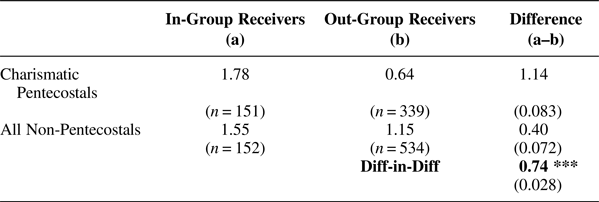
If new Pentecostalism in Africa acts as a form of big man rule, congregants in these churches should demonstrate greater exclusivity in their network, relative to their non-Pentecostal counterparts. Figure 1 illustrates the striking difference across Pentecostals and non-Pentecostals in this regard.Footnote 15 Pentecostal dictators assigned to divide a fixed endowment of 4 GHS with a fellow charismatic Pentecostal were the most generous sub-group in the study, sharing an average of 1.78 GHS, or 45 percent of the total. Conversely, Mainline Protestants and Catholics (aggregated in the figure) shared 1.54 GHS with their in-group members, and Muslims shared 1.53 GHS with fellow Muslims. Yet, Pentecostals assigned to play rounds of the dictator game with non-Pentecostals were the stingiest sub-group, sharing only 0.64 out of 4 GHS, compared to the 1.15 GHS that non-Pentecostals shared with their out-group counterparts, on average.
Dictator game outcomes, by religion of dictators and receivers. Notes: Y-axis indicates the amount of Ghana Cedis (out of four) that participants shared with receivers. X-axis categorizes the religious groups of dictators. One GHS is equivalent to approximately 0.65 US Dollars. Bars indicate 95-percent confidence intervals, calculated according to Schenker and Gentleman (Reference Schenker and Gentleman2001).

Table 3 presents the difference-in-differences across charismatic Pentecostals and non-Pentecostals, in terms of the share of resources given to in-group and out-group members. A t-test confirms that the difference-in-differences is significant at p < 0.001. Insofar as patron-client relationships demand clients' exclusivity to the network, the charismatic Pentecostal movement in the study area can be taken as a form of big man rule in a manner that other religious networks cannot.
Dictator game outcomes
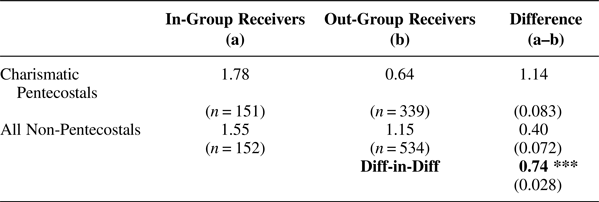
Note: ***p < 0.001 in t-test calculations of the difference in differences. Number of observations and standard errors in parentheses. The Non-Pentecostal category represents Mainline Protestants, Catholics, Muslims, Traditionalists, and Others. In-group dyads represent pairings within those disaggregated groups.
Test of the Big Man Allegiance Hypothesis
The argument also suggests that, as an alternative form of big man rule, charismatic Pentecostalism's members should demonstrate unique loyalty to their leaders. Thus, Pentecostals in the treatment groups in which the experimental confederate introduced himself as a Pentecostal pastor should offer more to that big man than non-Pentecostals offer to their own religious leaders (in other treatment groups).
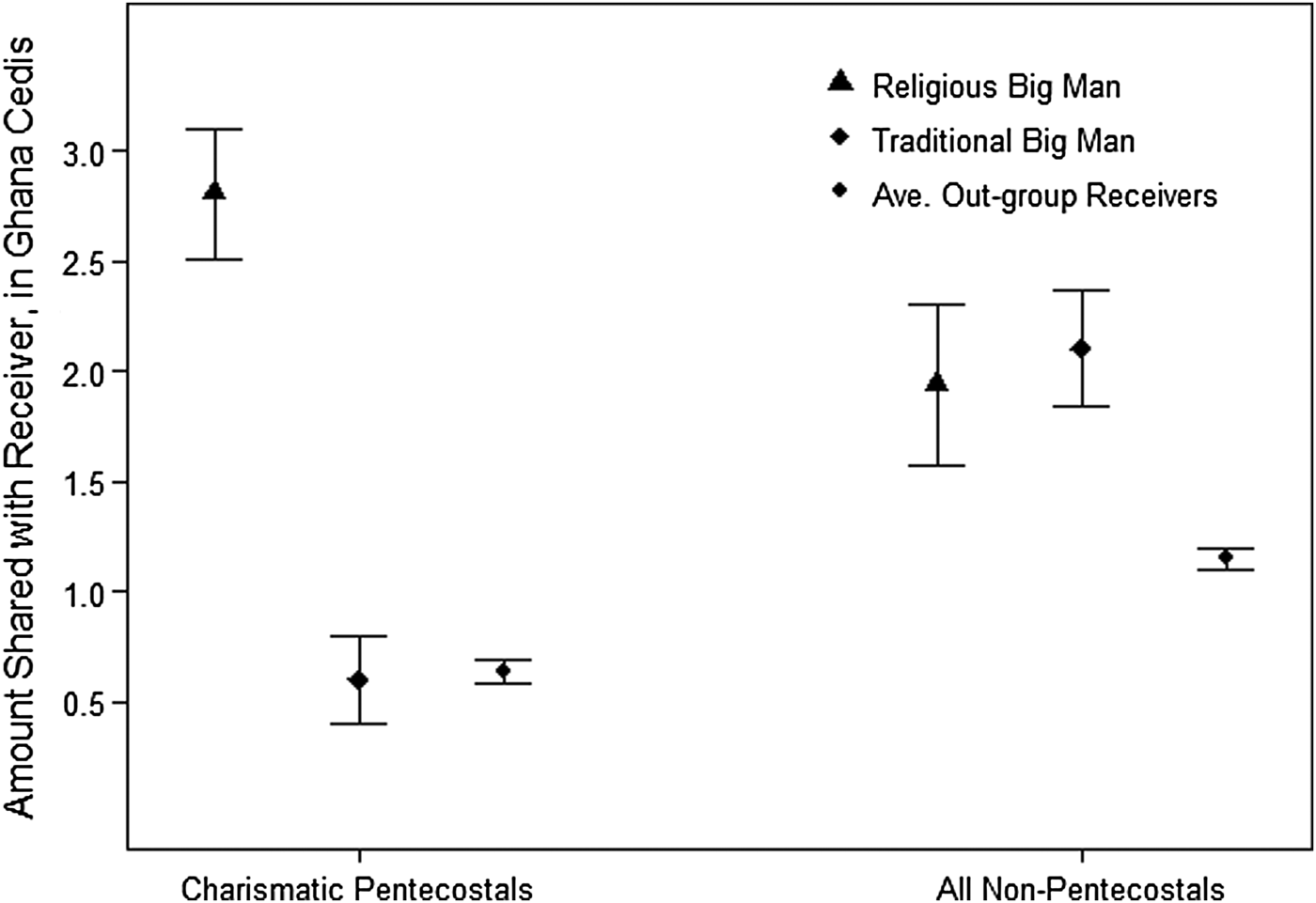
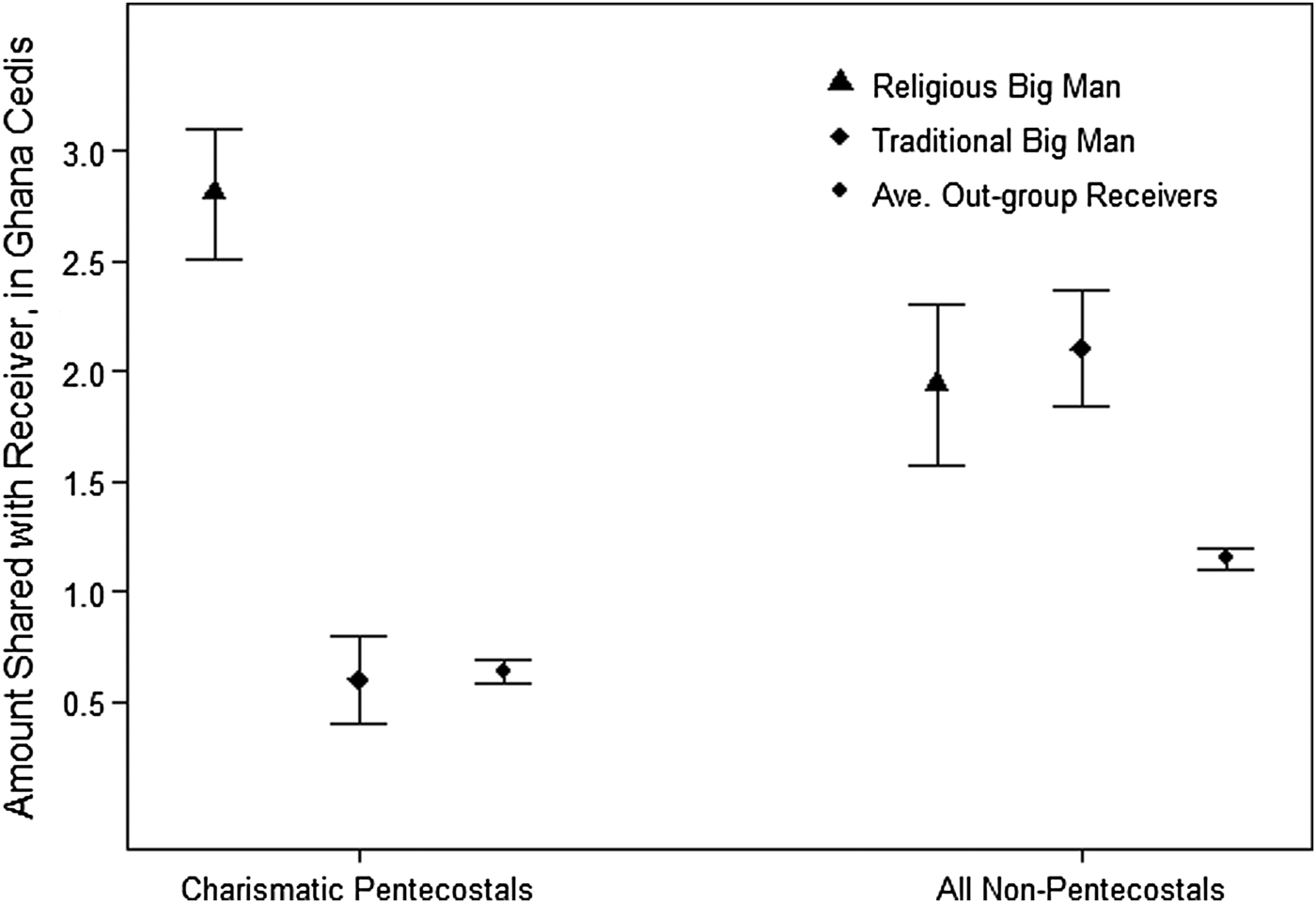
The point estimates marked with triangles in Figure 2 illustrate the extent to which this is true. Because the sample sizes for treated sub-groups are much smaller,Footnote 16 I aggregate all non-Pentecostals and compare the endowments shared by Pentecostals with their big men versus the share that non-Pentecostals give to their own religious leaders in other treatment groups. Pentecostals who play dictator rounds with a Pentecostal big man (n = 21) share an average of 2.81 GHS, or 70 percent of the total endowment for the round, while non-Pentecostals who play in treatment groups with their own respective religious leaders (n = 20) give 1.81 GHS, or 45 percent (p = 0.002). Thus, while all religious leaders enjoy greater allegiance than average respondents who are not cultural leaders (and who thus serve as a control), non-Pentecostal religious leaders lag far behind their Pentecostal counterparts in this regard.
Dictator game outcomes for Pentecostal and non-Pentecostal participants, by religious big man and traditional big man treatments. Notes: Y-axis represents the donation to a receiver out of a possible endowment of four Ghana Cedis. Religious Big Man represents donations to one's own religious leader (played by an experimental confederate). Traditional Big Man represents contributions to the Ashanti prince and representative to the ministry of employment (played by the same experimental confederate).
This finding helps to establish that charismatic Pentecostals are beholden to their leaders, or patrons, in a way that others are not. Of course, the results could be indicative of something other than allegiance to the big man, such as a wish to strengthen the religious institution financially. There is no reason to believe, however, that Pentecostal churches are in greater need than non-Pentecostal churches, and even if true, that perception itself would be consistent with the power of the Pentecostal leader as a patron demanding allegiance. Thus, provided that generosity in a dictator game can be taken as an indicator of loyalty or commitment to a counterpart, charismatic Pentecostals treat their leaders as patrons, or big men, in a manner that non-Pentecostals do not.
Test of the Break-from-the-Past Hypothesis
Finally, if charismatic Pentecostalism is indeed replacing the traditional form of big man rule for some Africans, it must be that those Pentecostals are turning away from their ethnic-based patrons with ties to state resources, long the backbone of patron-client relationships in Africa. This hypothesis suggests two outcomes. First, we should see that non-Pentecostals continue to prioritize relationships with traditional big men, so they should be more generous when matched with the experimental confederate as the customary prince and ministry representative than they are when he is introduced as their respective religious leader. Second, Pentecostals should demonstrate weaker commitment to traditional big men than they do to Pentecostal big men, thus sharing less under the Prince treatment than under the Pentecostal pastor treatment.
Returning to Figure 2, the results are consistent with expectations. Depicted in the right-most histogram, non-Pentecostals were more generous with the traditional big man (n = 29) than with their religious leaders (2.1 GHS vs. 1.81 GHS, p = 0.29); the difference in means does not reach standard levels of statistical significance, but it is in the expected direction. More importantly, from the left-most histogram, the evidence strongly supports a distinction in Pentecostal attachments to their religious big men compared to a traditional big man: whereas the charismatic Pentecostal participants in the study gave 2.81 GHS to the confederate when he introduced himself as a Pentecostal pastor, they actually gave less to the traditional big man (0.60 GHS, n = 20) than they did to average out-group receivers (0.64 GHS). The difference in Pentecostals' generosity to a Pentecostal big man versus a traditional big man is significant at p < 0.001. Given a research design that used the same individual in the roles of Pentecostal and traditional big man, and the fact that the assigned treatments were credible to subjects, the evidence overwhelmingly supports the claim that charismatic Pentecostalism encourages Africans to break from their ethnic-based patron-client networks and to express allegiance to a new, religious big man.
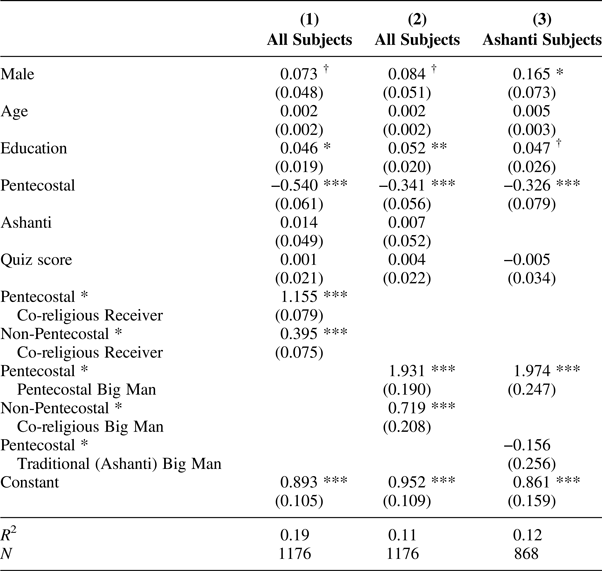
As a robustness check, I evaluate the same hypotheses in a multivariate regression framework. Regression analysis unnecessarily imposes parametric assumptions on the experimental data, but the results (shown in Appendix A) are nevertheless instructive. Column 1 indicates that, while Pentecostals were less generous as a group, they were substantially more generous to co-religionists, compared to non-Pentecostals playing with co-religionists and to subjects playing with non-coreligionists (the omitted category). In Column 2, the coefficients on the interaction terms show that Pentecostal dictators were more than twice as generous to the Pentecostal pastor as non-Pentecostals were to their own religious leaders, supporting the Pentecostal Big Man Allegiance hypothesis. Column 3 restricts the sample to the 74 percent of subjects who listed their identity as Ashanti; because the traditional big man in the experiment was an Ashanti prince, it is important to pit allegiance toward the Pentecostal big man directly against allegiance to the traditional big man among those subjects with the strongest chance of having conflicting loyalties. The results indicate that Pentecostal Ashantis giving to a Pentecostal big man were significantly more generous than the baseline, whereas Pentecostal Ashantis giving to the traditional Ashanti big man were not. This result confirms a breaking from the traditional past among charismatic Pentecostals. Males and more educated subjects were also somewhat more generous than their counterparts. Results from the map quiz had no correlation to distribution patterns in the dictator games.
CONCLUSION
Charismatic Pentecostalism is changing the African social and political landscape. To this point, however, its institutional impact has not been well understood. In this study, I use experimental evidence from dictator games to argue that the movement's primary impact is to alter micro-level attachments to the informal institution of big man rule. Whereas Africans have long relied on an ethnic-based exchange of resources for loyalty with their well-positioned traditional big men in order to meet their basic needs, this research suggests that Pentecostal networks now play that role for many Africans. Over a generation that has seen socioeconomic and political crisis, increasing bureaucratic control over previously customary domains, continued weakness in state institutions, and rapid urbanization, both the need and the opportunity for a new form of big man rule has emerged, and charismatic Pentecostalism is fulfilling that role. Thus, informal institutions continue to shape exchange in Africa, though no longer simply in an ethnic, traditional form.
Evidence from the dictator games indicates that charismatic Pentecostals form a uniquely exclusive network: they were more generous with in-group members and less generous with out-group members, compared to non-Pentecostals. Pentecostal participants also demonstrated greater allegiance to their big man: they shared more of their endowments with a Pentecostal pastor confederate than non-Pentecostals shared with their own religious leaders in the experimental treatments. Finally, the evidence suggests that African Pentecostals are breaking from their traditional ethnic-based networks of patron-client exchange: despite their generosity to Pentecostal pastors, they were no more generous to traditional big men than they were to average out-group members, even as non-Pentecostals remained more committed to the traditional big man. This study does not address the patrons who provide resources, but it provides strong support for the conclusion that Pentecostal clients assign loyalty in a manner consistent with patron-client exchange.
The study adds new insight to our understanding of informal institutions and the role that religious groups might play where state structures remain weak. The temptation has been to view the Pentecostal movement as a radical break from traditional, customary social norms; indeed, the offer of a new and fresh start with the opportunity for health, prosperity, and miracles has served to enhance the image of the movement as a powerful alternative for both the poor and the upwardly mobile in Africa (Maxwell Reference Maxwell1998). Yet, this study suggests that Africans who become members of charismatic Pentecostal churches are instead perpetuating the practical, informal structures that have long underpinned sociopolitical exchange in the region. Only now, the structures of exchange exist in a different and modern religious format.
This transformation has important implications, furthermore, for our understanding of the fluid nature of identity attachments in African politics. Contrary to the perspective that ethnic ties in Africa are entrenched with primordial importance (Horowitz Reference Horowitz1985), the expansion of a Pentecostal form of big man rule adds to a growing body of evidence that politically salient identities can be altered and constructed when new types of cultural elites emerge (see, for example, Chandra Reference Chandra2004; Laitin Reference Laitin1986). Here, the rapid growth of the new Pentecostal movement in Africa not only reshapes the conventional channels of patron-client exchange in the region; it also offers a new option for political identity to its members.
Charismatic Pentecostalism may similarly begin to reshape informal political exchange in other regions where its spread has been notable, though with some limitations. In Latin America, Pentecostals leaders have sought more active roles in electoral politics (Freston Reference Freston2001), suggesting that Pentecostal patron-client exchange there might draw more explicitly on resources from the state in addition to donations and the promise of miracles. However, given the importance of party machines in the region (Stokes Reference Stokes2005), the direct exchange of resources for loyalty in which Pentecostal pastors and their congregants engage in Africa may be tempered by other institutional constraints in Latin America. In Asia (Anderson Reference Anderson2014), Eastern Europe (Merdjanova Reference Merdjanova2001), and elsewhere, the sociopolitical importance of Pentecostalism is similarly on the rise, though the foundation of ethnic-based big man rule may not exist there to the degree that it does in sub-Saharan Africa.
Formal political institutions will continue to develop in Africa, and many individuals in the study region will continue to rely on traditional, informal networks. The argument here suggests, however, that Pentecostalism replicates traditional patron-client relationships and replaces those customary institutions for the members of charismatic Pentecostal churches. In a movement that accounts for as many as a third of all Africans, this shift in institutional importance is increasingly difficult to ignore.
Appendix. Amount shared in dictator games (in Ghana Cedis)