Introduction
The understanding of geographical variations in the composition, abundance and diversity of parasite communities is one of the most important challenges in parasite ecology (Luque & Poulin, Reference Luque and Poulin2007; Timi et al., Reference Timi, Lafranchi and Luque2010). Factors such as diet, habitat (Poulin, Reference Poulin1995; González et al., Reference González, Vásquez and Acuña2008), phylogeny of parasites (Poulin, Reference Poulin1998; González & Oliva, Reference González and Oliva2006), phylogenetic distance between host populations, vagility and dispersal rates of the host, in addition to environmental gradients, habitat fragmentation, and the composition and structure of the parasite supracommunity (Krasnov et al., Reference Krasnov, Shenbrot, Mouillot, Khokhlova and Poulin2005; Pérez del Olmo et al., Reference Pérez del Olmo, Fernández, Raga, Kostadinova and Morand2009; Timi et al., Reference Timi, Lafranchi and Luque2010), affect parasite distributions.
The structure and similarity of the parasite communities of fish can be evaluated at two different hierarchical levels: component communities (between localities or host populations) and infracommunities (between individual hosts). Component communities are considered to be long- lived assemblages that can last as long as the host population persists; thus, they reflect processes occurring over a longer time, such as speciation, extinction, colonization or host switching, whereas infracommunities are more ephemeral assemblages that reflect demographic processes influenced by the characteristics of individual fish (Poulin, Reference Poulin2004, 2007b). However, infracommunities allow for robust statistical testing and, compared with component communities, they are negligibly affected by rare species (Poulin, Reference Poulin2004; Timi et al., Reference Timi, Lafranchi and Luque2010). Both hierarchical levels have been used successfully to assess variations in the parasite composition of fish at regional (biogeographic) scales (e.g. González & Poulin, 2005a, b; Hutson et al., Reference Hutson, Ernst, Mooney and Whittington2007; Timi, 2007). However, studies evaluating the consistency in observations between the two hierarchical levels at smaller geographical scales are scarce (Chávez et al., Reference Chávez, Valdivia and Oliva2007; Henríquez et al., Reference Henríquez, González, Licandeo and Carvajal2011).
The present study is based on parasite assemblages of the serranid Paralabrax humeralis (Valenciennes, 1828). This fish species is distributed along the Pacific coast from Ecuador (5°S) to Chile (33°S) (Chirichigno & Vélez, Reference Chirichigno and Vélez1998; Rodrigo & Pequeño, Reference Rodrigo and Pequeño2001). It exhibits generalist feeding habits (Medina et al., Reference Medina, Araya and Vega2004; Cisternas & Sielfeld, Reference Cisternas and Sielfeld2008), and populations are generally segregated by location based on their preference for two subsystems of kelp, Lessonia trabeculata and/or Macrocystis integrifolia (Cisternas & Sielfeld, Reference Cisternas and Sielfeld2008, Ortiz Reference Ortiz2010), each of which results in different patterns of habitat heterogeneity and macro-invertebrate richness (Villegas et al., Reference Villegas, Laudien, Sielfeld and Arntz2008). Therefore, it is expected that differences in habitat based on these ecological subsystems will be reflected in the composition of parasite populations in the fish, at both component community and infracommunity levels.
In the present study, the composition of the metazoan parasite communities of P. humeralis at four sites in northern Chile are compared, to assess, by means of multivariate analysis, the variability or similarity of parasite assemblages at the component community and infracommunity levels, and to evaluate the consistency of findings between these two hierarchical levels at a small geographical scale.
Materials and methods
Collection and examination of fish
The data set includes the parasite communities of P. humeralis sea bass from four sites in northern Chile. The first site, El Fierro (EF; 22°51′S; 70°22′W), is characterized by a formation of small bights. The subtidal area is characterized by the presence of scarce L. trabeculata kelp. The second site, Punta Angamos (PA; 23°02′S; 70°31′W), is characterized by an exposed coast. The low intertidal zone is characterized by Lessonia nigrescens kelp, but in rocky subtidal environments there are mixed kelp formations consisting of M. integrifolia and L. trabeculata. The third site, Isla Santa María (ISM; 23°25′S; 70°40′W), presents more diverse environments with abundant L. nigrescens, L. trabeculata and M. integrifolia kelps. Finally, Bahía San Jorge (BSJ; 23°38′S; 70°33′W) shows high heterogeneity on the coast, with exposed and protected sectors. In rocky subtidal environments, there are small, low-density patches of L. trabeculata (Vásquez et al., Reference Vásquez, Piaget, Tala and Alonso2010).
During the summer, 124 specimens of P. humeralis were collected by local fishermen by spear fishing. Specimens of fish were either examined fresh or frozen. After thawing, body length (BL) (to the nearest centimetre) and sex were determined for each fish. Parasitological examination was conducted according to the method described by Henríquez et al. (Reference Henríquez, González, Licandeo and Carvajal2011). First, the skin, fins, gill arches and mouth in all P. humeralis specimens were examined to record the presence of ectoparasites. The internal organs (stomach, intestine, liver, heart, gonads and mesentery) were examined for helminth parasites. All organs were washed with running water and sieved through a 175μm filter. The retained material was inspected stereomicroscopically. Parasites were collected, preserved and stained using techniques described in the literature. Ectoparasites and helminths were identified to the lowest taxonomic level possible.
Data analyses and population descriptors
Population descriptors (prevalence, mean intensity, abundance and mean abundance) were calculated as described by Bush et al. (Reference Bush, Lafferty, Lotz and Shostak1997). Taxonomic richness (community descriptors) was determined as the number of species present in the infracommunity and component community sensu Bush et al. (Reference Bush, Lafferty, Lotz and Shostak1997). All the parasites found within an individual host composed an infracommunity, and those within a host population composed a component community.
Due to the non-normality and non-homogeneity of the variances of the data set (Kolmogorov–Smirnov test, Levene test; both P< 0.001), a Kruskal–Wallis test was used to evaluate differences in BL between sites (Zar, Reference Zar1999). Independent Spearman rank correlations (rs) were used to evaluate the possible association between BL and the abundance of each parasite species (Zar, Reference Zar1999). The same types of analyses were used to evaluate the association between BL and parasite species richness. These analyses were applied considering all sites together and for each site separately.
To analyse possible differences in the parasite composition of the infracommunities across sites, linear discriminant analyses (LDAs) were performed (Quinn & Keough, Reference Quinn and Keough2002) separately for ectoparasites (direct life cycle) and helminths (indirect life cycle). As parasite counts were zero in some fish, abundance data were transformed as ln(n+1) prior to analysis. Forward stepwise procedures were used to eliminate those parasites that did not improve the overall correct discrimination. The LDA included BL, which varied significantly across sites. At the component community level, a correspondence analysis (CA) was performed to evaluate the possible association between parasite prevalence and sites (Quinn & Keough, Reference Quinn and Keough2002). CA was also performed separately for helminths and ectoparasites.
To evaluate the similarity in parasite species composition at the component community and infracommunity levels, we used permutation-based one-way analysis of similarity (ANOSIM; Clarke, Reference Clarke1993) with the Bray–Curtis index as the similarity measure (Magurran, Reference Magurran1988) for abundance data. The statistical significance of the differences between and within sites was assessed after 1000 permutations. These multivariate analyses were performed using the PRIMER package (V6, Clarke & Warwick, Reference Clarke and Warwick2001; Clarke & Gorley, 2006). Similarity percentages (SIMPER, Clarke, Reference Clarke1993) of parasite assemblages were calculated for: (1) abundance in all possible pairs of individual fish within sites (infracommunities); and (2) mean abundance among sites (component communities). In all multivariate analyses, only those parasite species with a prevalence ≥ 10% in at least one site were included.
Results
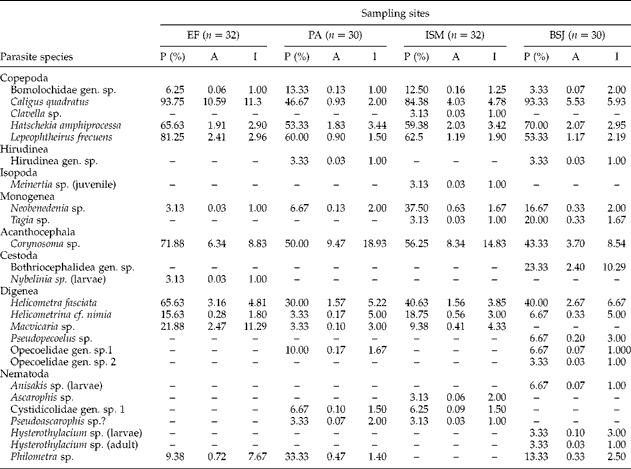
Twenty-five parasite species were found at the four sampled sites. Of these species, 9 were ectoparasites and 11 were helminths. Only Nybelinia sp., Anisakis sp. and Hysterothylacium sp. were found in larval stages. In total, 97.6% of the fish were infected with at least one parasite species. The prevalence, mean abundance and mean intensity of the parasite species recorded in P. humeralis are given in table 1.
The prevalence (P %), mean abundance (A) and mean intensity (I) of metazoan parasites of Paralabrax humeralis, in four sites of northern Chile (n=number of fish).

EF, El Fierro; PA, Punta Angamos; ISM, Isla Santa María; BSJ, Bahía San Jorge.
The most common species were as follows: Caligus quadratus, Hatschekia amphiprocessa, Lepeophtheirus frecuens (Copepoda), Neobenedenia sp. (Monogenea), Corynosoma sp. (Acanthocephala) and Philometra sp. (Nematoda) (table 1). Species richness was highest at the BSJ site, followed by PA and ISM; the lowest richness was reported at site EF.
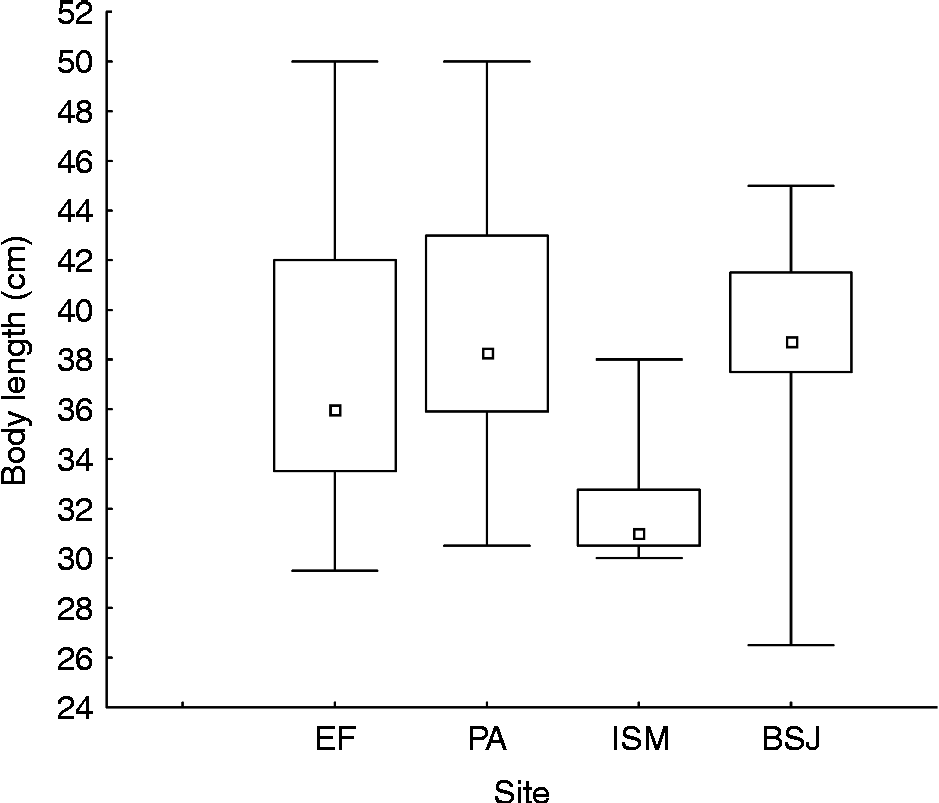
BL varied between 26.5 and 50 cm (mean ± SD 36.8 ± 5.5 cm) (fig. 1). There were significant differences in BL among sites (K–W, H3,124= 46.16 P< 0.001), and the smallest fish were found at ISM (fig. 1). However, there was little correlation between parasite abundance and BL. When fish from the four sites were analysed together, none of the parasite species was correlated with host size. When fish from each site were analysed separately, only H. amphiprocessa (rs= 0.57, n= 32, P< 0.05) was positively correlated with BL at site EF, and Corynosoma sp. (rs= 0.69, n= 30, P< 0.05) was positively correlated with host size at site PA. BL was not correlated with total helminth parasite richness (rs= 0.08, n= 124, P>0.05) nor with total ectoparasite richness (rs= 0.01, n= 124, P>0.05); however, when fish from the four sites were analysed separately, BL was correlated with the helminth parasite richness at site BSJ (rs= 0.42, n= 30, P< 0.05), whereas BL was correlated with ectoparasite richness only at site EF (rs= 0.42, n= 32, P< 0.05).
Distribution of the body length (BL) of Paralabrax humeralis in each site; El Fierro (EF), Punta Angamos (PA), Isla Santa María (ISM) and Bahía San Jorge (BSJ); square symbols represent median values, boxes enclose values between 25 and 75 percentiles and the whiskers indicate minimun and maximun observations.
The population descriptors (prevalence, mean abundance and mean intensity) varied quantitatively and qualitatively among sites. Several species were common to all four sites, but they varied in quantity (e.g. Bomolochidae gen. sp., C. quadratus, H. amphiprocessa, L. frecuens, Neobenedenia sp., Corynosoma sp., Helicometra fasciata and Helicometrina cf. nimia). In contrast, species belonging to the Isopoda, Cestoda, Hirudinea and Nematoda taxa were only found in one or two of the four sites, and their prevalences were low. Digeneans and nematodes showed significant species richness, but their prevalence and mean abundances were usually low (table 1).
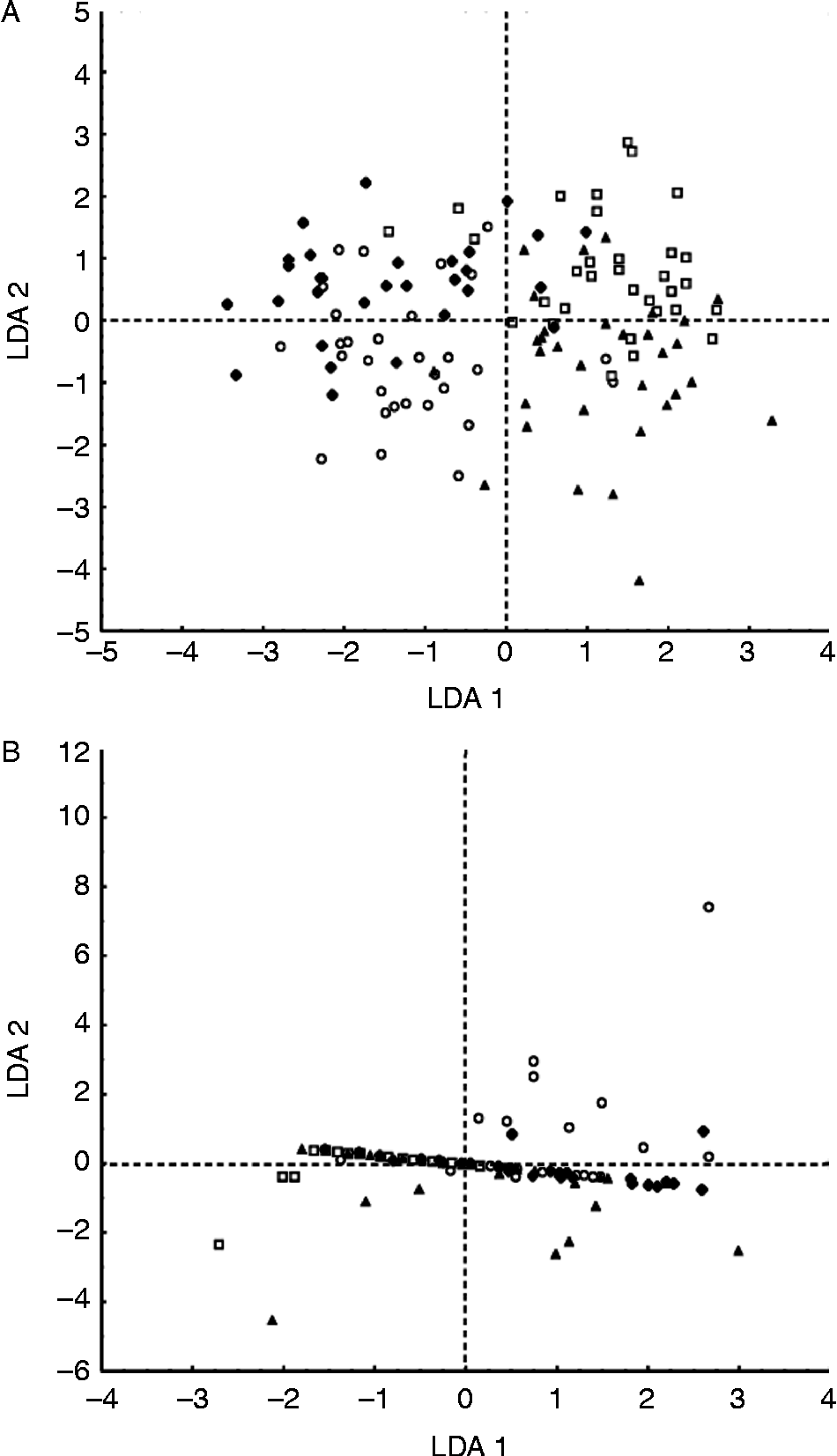
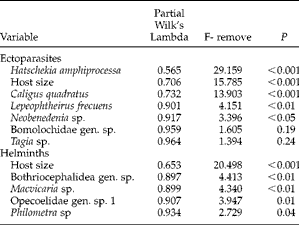
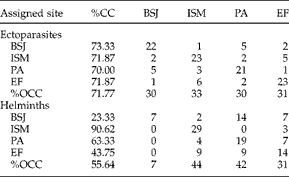
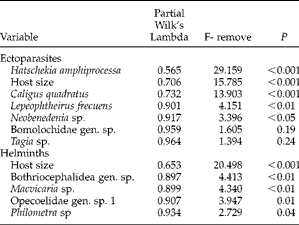
At the infracommunity level, there were significant inter-site variations in ectoparasite abundance in P. humeralis (correct classification 71.77%, Wilks' λ = 0.17, F 21.327= 12.832, P< 0.001) (fig. 2A). The variables that explained the observed differences among sites and showed the greatest discriminating power (F to remove) were as follows: H. amphiprocessa (P <0.001), host size (P< 0.001), C. quadratus sp. (P< 0.001), L. frecuens (P< 0.01) and Neobenedenia sp. (P< 0.05) (table 2). The classification matrix showed an important overall correct classification, and fish of all sites showed greater than 70% correct assignment (table 3). The endoparasite abundances also showed significant differences at the infracommunity level across sites, but the total correct assignment was only 55.64% (fig. 2B). The variables that best explained these differences were the following: host size (P< 0.001), Bothriocephalidea gen. sp. (P< 0.01), Macvicaria sp. (P< 0.001), Opecoelidae gen. sp. 1 (P< 0.05) and Philometra sp. (P< 0.05) (table 2). Only fish from the ISM site showed a high degree of correct assignment because the fish at this site were smaller (table 3).
Discriminant analysis of parasite abundances in Paralabrax humeralis from northern Chile: (A) ectoparasites and (B) helminths. Bahía San Jorge (O), Isla Santa María (□), Punta Angamos (♦) and El Fierro (▲).
Linear discriminant analyses performed separately for ectoparasites and helminths of Paralabrax humeralis from northern Chile.
Classification matrix of Paralabrax humeralis individuals from Bahía San Jorge (BSJ), Isla Santa María (ISM), Punta Angamos (PA) and El Fierro (EF) using linear discriminant analyses based on abundances of ectoparasites and helminths. Percent of individuals correctly classified (% CC); overall correct classification (% OCC).
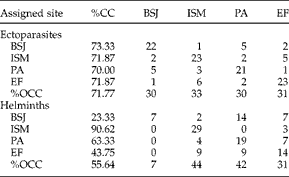
EF, El Fierro; PA, Punta Angamos; ISM, Isla Santa María; BSJ, Bahía San Jorge.
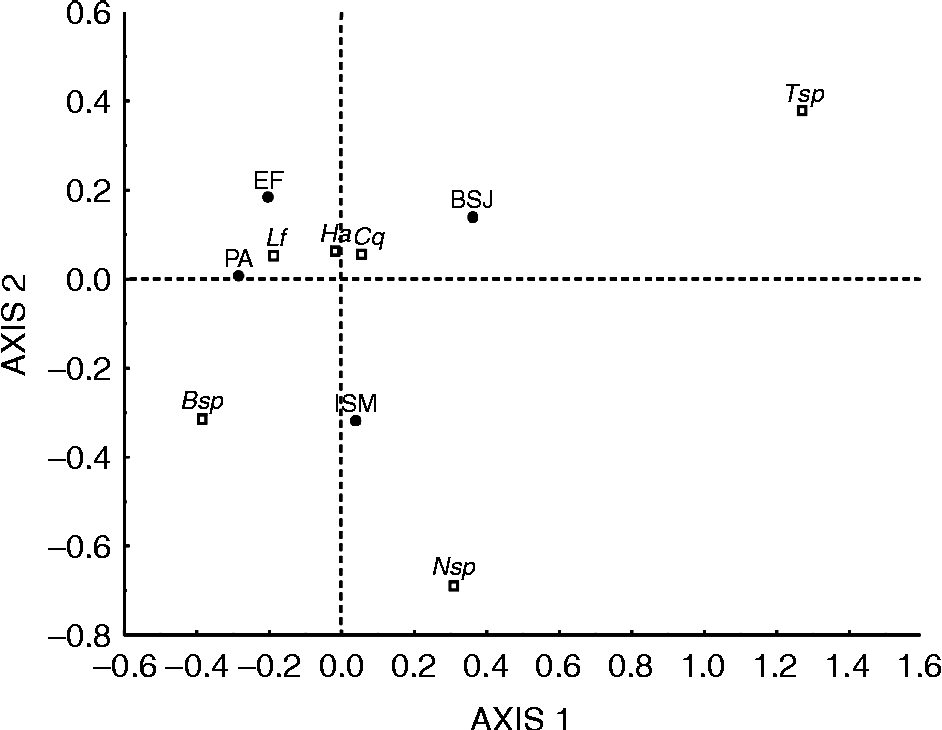
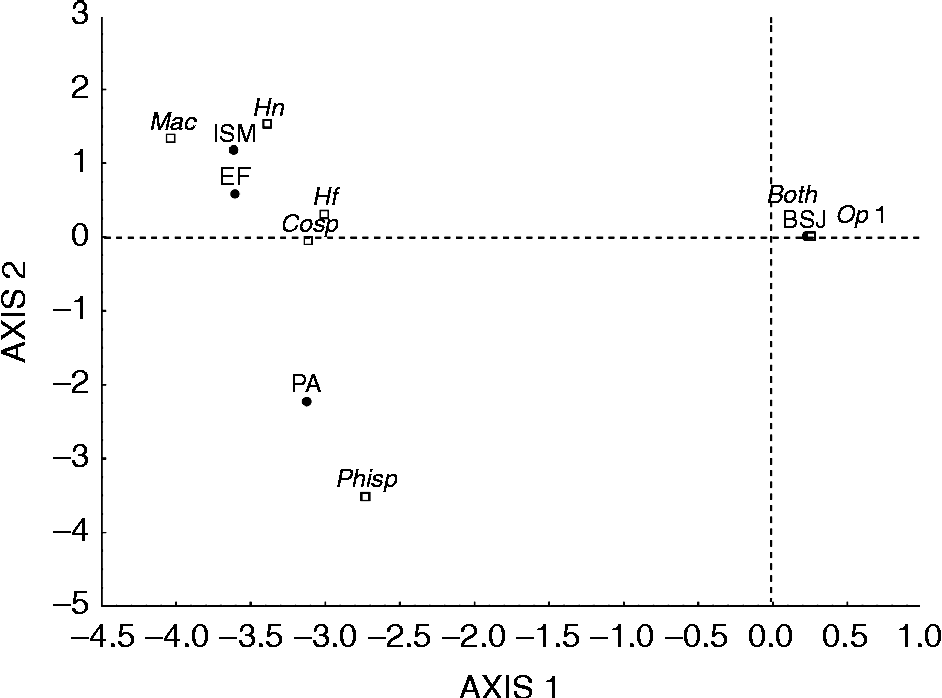
At the component community level, the CA performed on ectoparasite prevalence showed significant differences among sites (χ2= 107.87, df = 15, P< 0.001). The total variance explained in both axes was 91.42%, with 54.58% and 36.84% for the first and second dimensions respectively. The first dimension had an eigenvalue of 0.062, and the second dimension had an eigenvalue of 0.042 (fig. 3). The ectoparasite community was dominated mainly by copepods; species such as C. quadratus, H. amphiprocessa and L. frecuens showed high prevalence at all four sites. The differences observed in the CA were due mainly to Tagia sp., which were associated mainly with the BSJ site, and Neobenedenia sp. associated with the ISM site; these species were the most prevalent at both sites. The CA of helminth prevalence also showed significant differences across sites (χ2= 6617.48, df = 18, P< 0.001). The first dimension had an eigenvalue of 0.780 with 85.3% of the variance explained, and the second dimension had an eigenvalue of 0.121 with 13.3% of the variance explained. The total variance in both axes was 98.58% (fig. 4). Species such as Corynosoma sp., H. fasciata, H. cf. nimia and Macvicaria sp. were associated mainly with the ISM and EF sites. Otherwise, Philometra sp. was associated mainly with the PA site, where it was the most prevalent species. Finally, the digenean Opecoelidae gen. sp. 1 and the cestode Bothriocephalidea gen. sp. were most prevalent at the BSJ site, so the CA showed a higher species–site association.
Correspondence analysis for the ectoparasite communities of Paralabrax humeralis recorded in four sites in northern Chile. Parasites (□): Bsp, Bomolochidae gen. sp.; Cq, Caligus quadratus; Ha, Hatschekia amphiprocessa; Lf, Lepeophtheirus frecuens; Nsp, Neobenedenia sp.; Tsp, Tagia sp. Sites (●):BSJ, Bahía San Jorge; ISM, Isla Santa María; PA, Punta Angamos; EF, El Fierro.
Correspondence analysis for the helminth communities of Paralabrax humeralis recorded in four sites in northern Chile. Parasites (□): Both, Bothriocephalidea gen. sp.; Cosp, Corynosoma sp.; Hf, Helicometra fasciata; Hn, Helicometrina cf. nimia; Mac, Macvicaria sp.; Op1, Opecoelidae gen. sp. 1.; Phisp, Philometra sp. Sites (●): BSJ, Bahía San Jorge; ISM, Isla Santa María; PA, Punta Angamos; EF, El Fierro.
Finally, at the component community level, ANOSIM showed that the similarity in ectoparasite composition varied significantly across sites (R= 0.112; P= 0.001), except between the BSJ and ISM sites. Likewise, the distribution of helminth parasites of P. humeralis varied significantly across sites (R= 0.04; P= 0.004): there were differences between PA and ISM (P< 0.05), PA and EF (P< 0.01), and BSJ and EF (P< 0.05). In contrast, at the infracommunity level, ANOSIM showed that there were no significant inter-site differences in the similarity of ecto- (R= 0.09; P= 0.297) and endoparasite assemblages (R= − 0.131; P= 0.785).
Discussion
Eighteen parasite species had been recorded previously in P. humeralis along the Peruvian and Chilean coasts (Luque et al., Reference Luque, Iannacone and Farfán1991; Oliva et al., Reference Oliva, Bórquez and Olivares1992; Sarmiento et al., Reference Sarmiento, Tantaleán and Huiza1999; Tantaleán et al., Reference Tantaleán, Sánchez, Gómez and Huiza2005; Muñoz & Olmos, Reference Muñoz and Olmos2007, Reference Muñoz and Olmos2008; Iannaconne & Alvariño, 2009). Our results indicate high parasite species richness (25 taxa) in this host within the studied geographical area. Several species reported here represent new records for this host (e.g. Lepeophtheirus frecuens, Meinertia gaudichaudii, Neobenedenia sp., Bothriocephalidea gen. sp., Nybelinia sp., Pseudopecoelus sp., among others). This study also provides the first record of digeneans of the genus Macvicaria on the Chilean coast. The high recorded helminth species richness (mainly digeneans and nematodes) could be due to the feeding habits of the host, which exhibits a generalist feeding strategy (Medina et al., Reference Medina, Araya and Vega2004; Cisternas & Sielfeld, Reference Cisternas and Sielfeld2008) that could modulate the loss and acquisition of new parasites. In addition, the fact that P. humeralis is associated with two subsystems of kelps, L. trabeculata and/or M. integrifolia (Cisternas & Sielfeld, Reference Cisternas and Sielfeld2008; Ortiz, Reference Ortiz2010), influences the composition of helminth parasites because many invertebrates and other fish species are associated with Laminariales kelps, which serve as a habitat for feeding, recruitment, larval settlement and reproduction (Cisternas & Sielfeld, Reference Cisternas and Sielfeld2008). In contrast, ectoparasite composition was dominated mainly by copepods at all sites. However, some species were present at only one site: M. gaudichaudii was found only at the ISM site, and the monogeneans Neobenedenia sp. and Tagia sp. were associated with the ISM and BSJ sites, respectively. These differences in ectoparasite composition may be related to the characteristic circulation patterns of water masses in this region of northern Chile. At the BSJ site, we observed a phenomenon known as coastal upwelling, which, combined with wind forces and the topography of the coast on the bay, creates multiple areas of retention (Rutllant et al., Reference Rutllant, Fuenzalida, Torres and Figueroa1998; Escribano & Hidalgo, Reference Escribano and Hidalgo2001). These conditions could affect the dispersal ability of the infective stages of ectoparasites (González et al., Reference González, Vásquez and Acuña2008) and favour the retention of monogenean larvae. Likewise, the high prevalence of Neobenedenia sp. at the ISM site may be due to a higher abundance and diversity of kelps (L. nigrescens, L. trabeculata and M. integrifolia) found at this site (Vásquez et al., Reference Vásquez, Piaget, Tala and Alonso2010). The presence of these Laminariales kelps could favour the retention of larval monogeneans. Additionally, other fish species that also harbour this monogenean species are strongly associated with these kelps, leading to increased transmission among fish species.
Host body length can be an important factor in explaining parasite community composition and abundance. There were significant differences in fish size among the study sites. The ISM site has been described as a recruitment area for fish species (Angel & Ojeda, Reference Angel and Ojeda2001), and the fish in our samples from ISM were smaller. These differences in size could affect the infracommunities of P. humeralis. However, there was little correlation between host size and parasite abundance or species richness. For helminth parasites, this weak relationship may be due primarily to the generalist feeding strategy of this host (Medina et al., Reference Medina, Araya and Vega2004; Cisternas & Sielfeld, Reference Cisternas and Sielfeld2008) and, in the case of ectoparasites, circulation patterns in the coastal system (González et al., Reference González, Vásquez and Acuña2008). Moreover, the scarcity of larval stages indicates that parasites are not accumulating in the host over time (larval stages were observed for only three species). Oliva et al. (Reference Oliva, Bórquez and Olivares1992) observed a relationship between the sexual maturity of P. humeralis and the nematode Philometra sp. This pattern is confirmed in this study: fish at the PA site were larger, whereas those at the ISM site, where Philometra sp. was absent, were the smallest fish. Adult forms of the cestode Bothriocephalidea gen. sp. and Opecoelidae gen. sp. 1 also contributed to variability in parasite component community composition. These species were associated mainly with the BSJ site, a finding that may be explained by the availability of intermediate hosts (invertebrate and/or vertebrate prey), which influences the transmission of these helminths (González et al., Reference González, Barrientos and Moreno2006).
Infracommunities are ephemeral assemblages (Morand et al., Reference Morand, Rohde and Hayward2002; Poulin, Reference Poulin2004; González & Poulin, 2005a, b) and are influenced by individual characteristics of the hosts (Poulin, Reference Poulin2004). The helminth parasite infracommunities of P. humeralis showed quantitative and qualitative differences between sites. However, correct classification was achieved in only 55% of cases; these differences were explained mainly by host body length. Although species such as Bothriocephalidea gen. sp., Macvicaria sp., Philometra sp. and Opecoelidae gen. sp. 1 also had a significant effect, the F to remove was generally low compared with the effect of host size. Thus, the helminth parasite composition of infracommunities showed marked overlap between sites, and this finding was corroborated by ANOSIM analysis. Low variability at the infracommunity level has been explained by low rates of colonization or because parasites persist for a long time in the hosts (Balboa & George-Nascimento, Reference Balboa and George-Nascimento1998; Holmes, Reference Holmes, Esch, Bush and Aho1990; Díaz & George-Nascimento, Reference Díaz and George-Nascimento2001). However, in this case, the high similarity of infracommunities across sites could be due to individual movements of fish among sites as well as feeding habits (i.e. prey availability and selection). In contrast, the variability of ectoparasite infracommunities was mainly quantitative (table 2); the presence of the copepod H. amphiprocessa and host size were the most important variables in explaining the higher overall percentage of correct classification (>70%), but H. amphiprocessa abundance was correlated with host size. Therefore, these quantitative differences between ectoparasite infracommunities may be explained primarily by host body length.
Component communities are long-lived assemblages, and they constitute the local pool of parasite species from which infracommunities are formed. Their richness decreases when certain parasite species are extinct locally and increases when other parasites colonize the host population from other nearby populations (Poulin, Reference Poulin2004). Chávez et al. (Reference Chávez, Valdivia and Oliva2007) suggested that infracommunities may be considered as a proxy of the component community, arguing that they provide a good representation of the variability in the parasite composition of component communities of the pelagic fish Engraulis ringens in northern Chile. Similarly, Henríquez et al. (Reference Henríquez, González, Licandeo and Carvajal2011) recorded significant differences in the parasite composition of a littoral fish (Eleginops maclovinus) from geographically close localities, and these parasite differences were well represented at both the infracommunity and component community levels. However, in this study, inter-site differences between parasite assemblages were present neither at the infracommunity nor at the component community level. ANOSIM analyses showed that the component community composition of P. humeralis was significantly different across sites, although this was not reflected by differences in infracommunities.
In summary, the similarities and differences in the component communities of P. humeralis are not reflected in their infracommunities. Paralabrax humeralis is a littoral fish associated with subtidal algae species with varying degrees of heterogeneity of habitats. Thus, this lack of concordance between the infracommunity level and the component community level could be explained by the fact that component communities are reflective of fish population processes (e.g. population age/reproductive segregation) and the particular conditions of their respective habitats, whereas infracommunities reflect the movements of individual fish. Additionally, as noted by Timi et al. (Reference Timi, Lafranchi and Luque2010), the effects of rare species are negligible in infracommunity analyses compared with component community analyses. However, infracommunities are good models for local-scale studies because they can be completely quantified; such that the abundance, similarity and variability values are not estimated (they are observed data). This study demonstrates that infracommunities capture the local pool of parasite assemblages better than component communities when host populations are spatially segregated. Therefore, at small geographical scales, it is recommended to use infracommunities to evaluate the variability and similarity of parasite assemblages in littoral fish species.
Acknowledgements
This study was funded by the National Fund of Science and Technology Development (FONDECYT) No. 11090149, and Project Corporation of Productive and Innovation Development (INNOVA-CORFO) of the Chilean Government 09 CNN-145829.