Introduction
Enteroctopus megalocyathus (Gould, 1852) is distributed along the Magellanic biogeographic province, from Chiloe Island in the Pacific Ocean to the San Matias Gulf in the Atlantic Ocean (Ré, Reference Ré and Boschi1998; Ibáñez et al., Reference Ibáñez, Camus and Rocha2009), and is an important fishery resource in the southern tip of South America, Chile and Argentina, where it is fished along the Atlantic and Pacific coasts with hooks inserted into rock crevices (Uriarte & Farías, Reference Uriarte, Farías, Iglesias, Fuentes and Villanueva2014; Sauer et al., Reference Sauer, Gleadall, Downey-Breedt, Doubleday, Gillespie, Haimovici, Ibáñez, Katugin, Leporati, Lipinski, Markaida, Ramos, Rosa, Villanueva, Arguelles, Briceño, Carrasco, Che, Chen, Cisneros, Conners, Crespi-Abril, Kulik, Drobyazin, Emery, Fernández-Álvarez, Furuya, González, Gough, Krishnan, Kumar, Leite, Lu, Mohamed, Nabhitabhata, Noro, Petchkamnerd, Putra, Rocliffe, Sajikumar, Sakaguchi, Samuel, Sasikumar, Wada, Zheng, Tian, Pang, Yamrungrueng and Pecl2019). Fishery management of E. megalocyathus does not exist in Chile but is currently under development (IFOP, 2019). In Argentina, this octopus supports a small-scale artisanal fishery (Ortiz & Ré, Reference Ortiz and Ré2019). In addition, E. megalocyathus is a bycatch species of lobster (IFOP, 2019) and king crab fisheries in southern Chile (present study).
The king crab fishery in the southern tip of South America is an artisanal mixed fishery for centolla – Lithodes santolla (Molina, 1782) – and centollon – Paralomis granulosa (Hombron and Jacquinot, 1846). Both species are fished using traps and bait, a technique that also catches octopuses. Octopuses are a frequent component of the bycatch in pot and trap fisheries around the world (Brock & Ward, Reference Brock and Ward2004; Groeneveld et al., Reference Groeneveld, Maharaj and Smith2006; Conners & Levine, Reference Conners and Levine2017). For instance, species of Enteroctopus Rochebrune & Mabille, 1889 are collected as bycatch in the Alaskan and South African fisheries (Groeneveld et al., Reference Groeneveld, Maharaj and Smith2006; Barry et al., Reference Barry, Tamone and Tallmon2013; Conners & Levine, Reference Conners and Levine2017).
Studies on the genetic diversity of Enteroctopus are scarce (Strugnell et al., Reference Strugnell, Cherel, Cooke, Gleadall, Hochberg, Ibáñez, Jorgensen, Laptikhovsky, Linse, Norman, Vecchione, Voight and Allcock2011; Toussaint et al., Reference Toussaint, Scheel, Sage and Talbot2012; Barry et al., Reference Barry, Tamone and Tallmon2013). Spatial genetic structure as well as low haplotype diversity have been detected in Enteroctopus dofleini (Wülker, 1910) in Alaska (Barry et al., Reference Barry, Tamone and Tallmon2013). No study has yet investigated the genetic diversity in E. megalocyathus. The population genetic pattern of E. dofleini observed in Alaska may be mirrored in E. megalocyathus as both species share several characteristics; both species are merobenthic, have a similar paralarval period and similar paralarva size at hatching (Uriarte & Farías, Reference Uriarte, Farías, Iglesias, Fuentes and Villanueva2014). Nevertheless, studies about the genetic structure of other molluscs, fish and crustaceans in the Magellanic province have shown low genetic diversity and/or no genetic structure (molluscs, de Aranzamendi et al., Reference de Aranzamendi, Bastida and Gardenal2011, Reference de Aranzamendi, Bastida and Gardenal2014; fishes, Ceballos et al., Reference Ceballos, Lessa, Victorio and Férnandez2012; crabs, Barrera-García, Reference Barrera-García2016; González-Wevar et al., Reference González-Wevar, Hüne, Rosenfeld, Gérard, Mansilla and Poulin2016a, Reference González-Wevar, Nakano, Cañete and Poulin2016b). A lack of genetic structure in these groups is attributed to two types of factors: (1) historical, such as events that happened during the last glacial period (sea level regression, decrease in marine water temperature, ice sheet scouring and ice sheet calving); and (2) biological, such as larval dispersal, which is driven by currents. The aim of the present study is to determine the genetic diversity and identity of Enteroctopus megalocyathus in the southern tip of South America. Genetic data like these can be valuable for the management of fisheries because bycatch could lead to a reduction in the genetic diversity of this species.
Materials and methods
Sampling, DNA extraction, Polymerase Chain Reaction (PCR) and sequencing
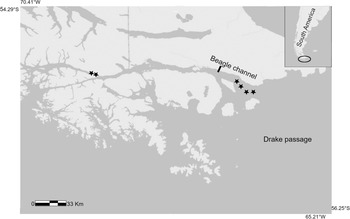
We obtained samples from 34 octopuses caught by the king crab fishery in the Beagle Channel, in the southern tip of Chile (54°54′–55°07′S 65°50′–69°19′W; Figure 1, Supplementary material Table S1). All samples were stored in 96% ethyl alcohol and kept at 4°C for subsequent molecular analyses at Laboratorio de Genética y Genómica del CEQUA (Centro de Estudios del Cuaternario Fuego, Patagonia y Antártica).
King crab fishery localities in South of Chile where octopuses were caught as bycatch (see Supplementary material Table S1).

Genomic DNA was extracted from arm muscle tissue and was subsequently purified using the QIAamp DNA Mini Kit (Qiagen) following the established manufacturer procedure. Polymerase chain reaction amplifications for the 16S rRNA, cytochrome c oxidase subunits I and III (COI and COIII, respectively) and the nuclear gene rhodopsin (Rho) were carried out. Each 25 μl reaction contained 2.5 μl of MgCl2 (2.5 mM), 12 μM of each primer, 200 mM of each dNTP, 1× PCR buffer, and 1.25 U of GoTaq polymerase (Promega). Universal primers (16Sar and 16Sbr) were used for the amplification of 16S rRNA fragments (Palumbi, Reference Palumbi, Hillis, Moritz and Mable1996). The COI (LCO1490 and HCO2198) and COIII (COIIIi3′ and COIIIi5′) primers used were those described by Folmer et al. (Reference Folmer, Black, Hoeh, Lutz and Vrijenhoek1994) and Barriga-Sosa et al. (Reference Barriga-Sosa, Beckenbach, Hartwick and Smith1995), respectively; rhodopsin (Rhod1243octfwd and Rhod1793octbck) primers were those described by Strugnell (Reference Strugnell2004). Polymerase chain reactions were conducted in a Mycycler (Bio-Rad) thermocycler using annealing temperatures of 52°C for 16S rRNA, 49°C for COI, 38°C for COIII and 57°C for Rho, and the following conditions: an initial cycle of denaturing at 94°C for 5 min followed by 30 cycles at 94°C for 45 s, an annealing step for 45 s, an extension step at 72°C for 90 s, and finally, an extension cycle at 72°C for 15 min. Bidirectional sequencing reactions were performed by Macrogen (Seoul, South Korea) and utilizing the primers used for PCR amplifications. Sequences were visualized, concatenated, and edited with the program BioEdit 7.0 (Hall, Reference Hall1999) and adjusted by eye. Sequence alignments were conducted in Clustal W (Thompson et al., Reference Thompson, Higgins and Gibson1994) implemented in MEGA X (Kumar et al., Reference Kumar, Stecher, Li, Knyaz and Tamura2018) and revised with the respective translation of amino acids for COI, COIII and rhodopsin.
DNA-based octopuses bycatch identification
Preliminary identification of bycatch species was performed using a sequence similarity search in the Barcode of Life Data Systems (BOLD; https://www.boldsystems.org/) (for COI) and GenBank (for all sequences) using the Basic Local Alignment Search Tool (BLAST) for highly similar sequences (Mega-BLAST) and using only publicly available sequences. Species were assigned based on the percentage of maximum similarity (>99%). To corroborate this, MEGA X (Kumar et al., Reference Kumar, Stecher, Li, Knyaz and Tamura2018) was used for sequence divergence calculation between reference and sample sequences for each mitochondrial marker. The Tamura–Nei distance model for 16S rRNA, and the Tamura 3 parameter for COI and COIII were used for estimating genetic distances among the four species of Enteroctopus. The Tamura–Nei distance model was used for estimating genetic distances among species of Muusoctopus. All models were specified by jModeltest 2 (Darriba et al., Reference Darriba, Taboada, Doallo and Posada2012).
Genetic analysis of Enteroctopus megalocyathus
The genetic diversity of E. megalocyathus in the southern tip of South America was investigated by estimating the number of segregating sites (S), haplotypes (K), nucleotide diversity (π) and haplotype diversity (Hd) in DnaSP 6 (Rozas et al., Reference Rozas, Ferrer-Mata, Sánchez-Del Barrio, Guirao-Rico, Librado, Ramos-Onsins and Sánchez-Gracia2017). The values for π and Hd were compared with those reported by Goodall-Copestake et al. (Reference Goodall-Copestake, Tarling and Murphy2012) for a wide variety of animals, including molluscs, to determine the level of genetic diversity of E. megalocyathus. Tajima's test (D) and Fu's Fs were performed to quantify the significant departure from mutation-drift equilibrium in ARLEQUIN (Excoffier et al., Reference Excoffier, Laval and Schneider2005). The same software was used to investigate the demographic expansion of the population of E. megalocyathus by comparing the distribution of pairwise differences among haplotypes with the expected distribution of a model of population expansion (mismatch distribution). For the latter, only the marker with more polymorphic sites was used because genes with high levels of polymorphism are better for inferring demographic histories (Grant, Reference Grant2015). Haplotype networks were constructed using the median-joining algorithm network in Network 10.2 software (FluxusTechnology Ltd, www.fluxus-engineering.com) to investigate the genealogical relationships among haplotypes for the three species of Enteroctopus from the southern hemisphere. For these analyses, homologous sequences of E. megalocyathus from GenBank, from Chiloe Island, Puerto Williams, and Falkland Islands were used (see Table 1 for GenBank accession numbers). In addition, sequences of E. magnificus (Villanueva et al., 1992) from South Africa and E. zealandicus (Benham, 1944) from New Zealand were included (see Table 1 for GenBank accession numbers).
GenBank sequences of species of family Enteroctopodidae and the outgroups, Bathypolypus and Octopus vulgaris used in the present study

16S rRNA, large ribosomal subunit; COI, Cytochrome c oxidase subunit I; COIII, Cytochrome c oxidase subunit III; Rhod, Rhodopsin. Bold GenBank accession numbers are the sequences generated in the present study.
Phylogenetic analysis
To determine the phylogenetic relationships between the four species of Enteroctopus, a phylogenetic analysis was conducted. Available public sequences for each gene were retrieved from GenBank for species of Enteroctopodidae and for the outgroup species of Octopus vulgaris Cuvier, 1797, and Bathypolypus Grimpe, 1921 (see Table 1 for GenBank accession numbers). These two species were used to root the phylogeny as several studies have shown that these outgroups are suitable for the Enteroctopodidae (Strugnell et al., Reference Strugnell, Cherel, Cooke, Gleadall, Hochberg, Ibáñez, Jorgensen, Laptikhovsky, Linse, Norman, Vecchione, Voight and Allcock2011; Ibáñez et al., Reference Ibáñez, Pardo-Gandarillas, Peña, Gleadall, Poulin and Sellanes2016, Reference Ibáñez, Díaz-Santana-Iturrios, López Córdova, Carrasco, Pardo-Gandarillas, Rocha and Vidal2021; Sanchez et al., Reference Sanchez, Setiamarga, Tuanapaya, Tongtherm, Winkelmann, Schmidbaur, Umino, Albertin, Allcock, Perales-Raya, Gleadall, Strugnell, Simakov and Nabhitabhata2018). Octopus californicus Berry, 1911, was included in the ingroup as it has been demonstrated to belong to the Enteroctopodidae (Strugnell et al., Reference Strugnell, Cherel, Cooke, Gleadall, Hochberg, Ibáñez, Jorgensen, Laptikhovsky, Linse, Norman, Vecchione, Voight and Allcock2011; Ibáñez et al., Reference Ibáñez, Díaz-Santana-Iturrios, López Córdova, Carrasco, Pardo-Gandarillas, Rocha and Vidal2021). jModeltest 2 (Darriba et al., Reference Darriba, Taboada, Doallo and Posada2012) was used to select the best-fit model for each dataset (separate genes) based on the Bayesian information criterion (BIC). Given that sequence availability per gene differs in GenBank, phylogenetic reconstruction was inferred using each gene independently and the sampled sequences were collapsed into haplotypes using DnaSP 6 (Rozas et al., Reference Rozas, Ferrer-Mata, Sánchez-Del Barrio, Guirao-Rico, Librado, Ramos-Onsins and Sánchez-Gracia2017). The Bayesian analysis (BA) consisted of two independent Monte Carlo Markov Chain (MCMC) runs, each consisting of 10 million steps sampled every 1000 points. TRACER v1.6 (Rambaut et al., Reference Rambaut, Drummond, Xie, Baele and Suchard2018) was used to determine acceptable burn-in (25%) and to ensure the analysis had reached stationarity (we report values ≥0.6 for bpp). For the maximum-likelihood (ML) analysis, node supports were assessed using 1000 ultrafast bootstrap (bs) replicates (Hoang et al., Reference Hoang, Chernomor, von Haeseler, Minh and Vinh2018), with values ≥60 reported in the present study. Inferences were performed in MrBayes 3.2 (Ronquist et al., Reference Ronquist, Teslenko, van der Mark, Ayres, Darling, Höhna, Larget, Liu, Suchard and Huelsenbeck2012) and IQ tree web server (Trifinopoulos et al., Reference Trifinopoulos, Nguyen, von Haeseler and Minh2016) for BA and ML analyses, respectively, and using only the mitochondrial markers. Because two best-fit models, TIM1 + G and TIM3 + G, cannot be implemented in MrBayes, the GTR + G model was used instead.
Results
DNA identification of octopus bycatch
A total of 129 sequences were obtained from 34 individuals with the following read lengths: 406 base pairs (bp) for Rho (MW562315–MW562317); 455 bp for COIII (MW562308–MW562314); 467 bp for 16S rRNA (MW509829–MW509832), and 600 bp for COI (MW549877–MW549881) sequences. Collapsed sequences yield three haplotypes for 16S rRNA, four for COI, seven for COIII, and two for rhodopsin. The haplotypes were identical or show >98% similarity to either Muusoctopus eureka (Robson, 1929) (99.8–100% for 16S rRNA, 99.8–100% for COI, 98.6–100% for COIII; six specimens) or Enteroctopus megalocyathus and E. zealandicus (99.8–100% for 16S rRNA, 99.8–100% for COI; 98.6–100% for COIII; 28 specimens) (Supplementary material, Tables S2–S4). Genetic divergence between sampled and reference sequences of E. megalocyathus ranged from 0–3.5% (16S rRNA), 0–4.6% (COI), and 0–6.1% (COIII). Genetic distances between Muusoctopus eureka and reference sequences of the species ranged from 0–4.6% (16S rRNA), 0–8.4% (COI) and 0–13.8% (COIII). The average genetic distances are shown in Table 2.
Genetic distances (%) for Enteroctopus and Muusoctopus species analysed in the present study

Values given as Min-Avg-Max. Values ≤1 shown in bold. Abbreviations: TN, Tamura–Nei distance model; T3P, Tamura 3 parameter. All models were specified by jModeltest 2 (Darriba et al., Reference Darriba, Taboada, Doallo and Posada2012).
Genetic diversity analysis of Enteroctopus megalocyathus
Our results suggest that the population of E. megalocyathus from southern Chile has low genetic diversity (Table 3). For all the mitochondrial markers, E. megalocyathus shows low nucleotide (0.003–0.0001) and haplotype diversity (0.06–0.32). Results for rhodopsin show a lack of both nucleotide and haplotype diversity. The 467 bp fragment of 16s rRNA from 41 individuals of E. megalocyathus (28 specimens from the present study and 13 sequences from GenBank) yielded five haplotypes that differed at 10 sites (Supplementary material, Table S2). The 600 bp fragment of COI from 39 individuals (28 specimens from the present study and 11 sequences from GenBank) yielded three haplotypes that differed at two sites (Supplementary material, Table S3). The 455 bp fragment of COIII from 40 individuals (28 specimens from the present study and 12 sequences from GenBank) yielded nine haplotypes that differed at 13 sites (Supplementary material, Table S4). These three mitochondrial markers resolved the correspondent haplotype H1 as the most frequent. The 406 bp fragment of rhodopsin from 21 individuals from the present study yielded a unique haplotype. Our results suggest that several of the resolved haplotypes from E. megalocyathus are shared with E. zealandicus (see Figure 2 and Supplementary material Tables S2–S4). Tajima's D test values were negative and not statistically significant for 16S rRNA and COI but were significant for COIII (see Table 3). Fu's Fs values were negative and not statistically significant for COI and COIII but were significant for 16S rRNA (see Table 3). The pairwise difference distribution among COIII haplotypes was L-shaped (Raggedness index = 0.368, P = 0.52; Figure 3).
Median-joining networks of haplotypes of Enteroctopus megalocyathus. (A) COIII, (B) 16S rRNA and (C) COI. Circles represent haplotype and their size is proportional to the number of individuals. White circles on branches represent one mutational substitution.

Mismatch distribution of observed and expected pairwise differences among COIII haplotypes of Enteroctopus megalocyathus.

Genetic parameters determined for Enteroctopus megalocyathus from South of Chile and best-fit models of substitution used in the phylogenetic analysis

16S rRNA, large ribosomal subunit; COI, cytochrome c oxidase subunit I; COIII, cytochrome c oxidase subunit III; Rhod, Rhodopsin; N, number of individuals; bp, base pairs; S, number of segregating sites; π, nucleotide diversity; Hd, haplotype diversity; K, number of haplotypes. *P < 0.05.
The median-joining networks of mitochondrial genes (see Figure 2) included haplotypes of Enteroctopus magnificus (from South Africa) and E. zealandicus (from New Zealand) and show a single ubiquitous haplotype for each gene (see Figure 2B, C). These ubiquitous haplotypes occurred in 37 individuals for 16S rRNA and COI genes and in 29 individuals for COIII gen (see Supplementary material). The haplotypes from E. megalocyathus and E. zealandicus are different by one to three substitutions (see Figure 2A) in COIII, one or two substitutions in 16S rRNA, and one substitution in COI. The 16S rRNA and COI most frequent haplotypes are shared by E. megalocyathus and E. zealandicus. Unique haplotypes from E. megalocyathus are restricted to the Beagle Channel (COIIIH2–COIIIH5 and 16SH5) and Chiloe Island (16SH3 and 16SH4). The nuclear allele is shared by both E. megalocyathus and E. zealandicus. The only sequence for 16S rRNA available for E. magnificus yielded a unique haplotype that is separated from the most common 16SH1 haplotype by seven mutational sites. This haplotype is shared by E. megalocyathus and E. zealandicus (see Figure 2B).
Phylogenetic analysis
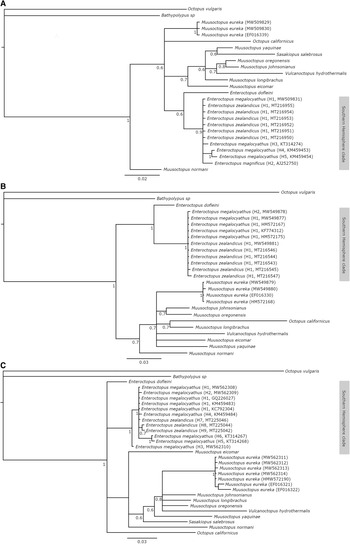
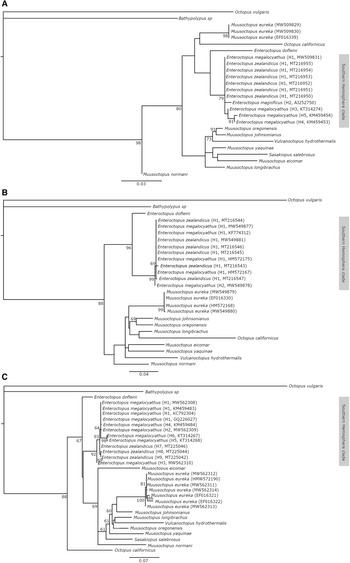
The resolved mitochondrial phylogenies (Figures 4 and 5) revealed two results about Enteroctopus: (1) the sequences from E. megalocyathus clustered with those from E. zealandicus in a well-supported monophyletic clade, except in the 16S rRNA ML phylogeny (Figure 5A); and (2) E. dofleini is the sister species of the E. megalocyathus/E. zealandicus clade. Interestingly, E. magnificus (AJ252750) was included in the E. megalocyathus/E. zealandicus clade in the 16S rRNA tree (Bayesian posterior probability = 1, bs = 79). In addition, our analysis confirmed the phylogenetic position of Muusoctopus eureka as the haplotypes resolved in the present study cluster in a highly supported clade (both BA and ML) with the M. eureka sequences from GenBank.
Bayesian phylogeny of Enteroctopus megalocyathus based on homologous sequences of 16S rRNA (A), COI (B) and COIII (C). Bayesian posterior probability values (≥0.6) are shown beside nodes.

Maximum likelihood phylogeny of Enteroctopus megalocyathus based on homologous sequences of 16S rRNA (A), COI (B) and COIII (C). Bootstrap values (≥60) are shown beside nodes.

Discussion
Genetic diversity of Enteroctopus megalocyathus
The estimates of π and Hd for samples of Enteroctopus megalocyathus fall below the median value of genetic diversity for several molluscs, crustaceans, and other animals (Goodall-Copestake et al., Reference Goodall-Copestake, Tarling and Murphy2012); therefore, the genetic diversity of Enteroctopus megalocyathus could be considered as low. The low genetic diversity is not uncommon in octopuses and other molluscs from the same region; for instance, Octopus mimus (Gould, 1852), a merobenthic octopus from off Chile also shows low genetic diversity (Pardo-Gandarillas et al., Reference Pardo-Gandarillas, Ibáñez, Yamashiro, Méndez and Poulin2018). Gastropods of the genus Nacella from the Magellanic province with similar ecological traits to E. megalocyathus (e.g. an adult benthic lifestyle and an early planktonic stage; see below) show low levels of genetic diversity (de Aranzamendi et al., Reference de Aranzamendi, Bastida and Gardenal2011, Reference de Aranzamendi, Bastida and Gardenal2014) (see Supplementary material, Table S5). These levels have been associated with a demographic expansion that occurred after the last glaciation, and to the major ocean currents that favour larval dispersal (de Aranzamendi et al., Reference de Aranzamendi, Bastida and Gardenal2011, Reference de Aranzamendi, Bastida and Gardenal2014; González-Wevar et al., Reference González-Wevar, Hüne, Rosenfeld, Gérard, Mansilla and Poulin2016a, Reference González-Wevar, Nakano, Cañete and Poulin2016b; Pardo-Gandarillas et al., Reference Pardo-Gandarillas, Ibáñez, Yamashiro, Méndez and Poulin2018). These historical and ecological traits might also be responsible for the observed low genetic diversity of E. megalocyathus. Its paralarval stage can last up to three months (Uriarte & Farías, Reference Uriarte, Farías, Iglesias, Fuentes and Villanueva2014), which is long enough for paralarvae to be dispersed by ocean currents. The low genetic diversity might also reflect a post-glacial recolonization of E. megalocyathus as has been suggested for several molluscs from South America (de Aranzamendi et al., Reference de Aranzamendi, Bastida and Gardenal2011, Reference de Aranzamendi, Bastida and Gardenal2014; González-Wevar et al., Reference González-Wevar, Hüne, Rosenfeld, Gérard, Mansilla and Poulin2016a, Reference González-Wevar, Nakano, Cañete and Poulin2016b; Pardo-Gandarillas et al., Reference Pardo-Gandarillas, Ibáñez, Yamashiro, Méndez and Poulin2018). The hypothesis of a recent event of expansion in the population of E. megalocyathus is supported by the haplotype frequency distribution, by the negative D and Fs values, and by the unimodal mismatch distribution of pairwise differences among COIII haplotypes. The mitochondrial haplotype frequency pattern of E. megalocyathus is similar to the haplotype frequency of Octopus mimus from Chile (Pardo-Gandarillas et al., Reference Pardo-Gandarillas, Ibáñez, Yamashiro, Méndez and Poulin2018) and to the haplotype frequency of Nacella spp. from the southern tip of South America (de Aranzamendi et al., Reference de Aranzamendi, Bastida and Gardenal2011; González-Wevar et al., Reference González-Wevar, Hüne, Rosenfeld, Gérard, Mansilla and Poulin2016a, Reference González-Wevar, Nakano, Cañete and Poulin2016b), which show a ubiquitous haplotype and some singletons for each molecular marker. The presence of one dominant haplotype in O. mimus, N. magellanica (Gmelin, 1791) and N. mytilina (Helbling, 1779) along their distribution range suggests a recent geographic expansion (de Aranzamendi et al., Reference de Aranzamendi, Bastida and Gardenal2011; González-Wevar et al., Reference González-Wevar, Hüne, Rosenfeld, Gérard, Mansilla and Poulin2016a, Reference González-Wevar, Nakano, Cañete and Poulin2016b; Pardo-Gandarillas et al., Reference Pardo-Gandarillas, Ibáñez, Yamashiro, Méndez and Poulin2018).
Although the low genetic diversity of Enteroctopus megalocyathus is not associated with its fishery, the results are novel for the species and could be used for future studies on the genetic connectivity and structure of E. megalocyathus that could provide valuable information for the management of this fishery. Given that we use mitochondrial genes and one nuclear gene instead of a single locus, our results could be representative of the genetic diversity of E. megalocyathus in South America; however, further nuclear data such as microsatellite data or single nucleotide polymorphisms in addition to a larger sample from the Falkland Islands and the South of Chile could help corroborate the genetic pattern observed herein.
Species of Enteroctopus from southern hemisphere
The presence of common haplotypes is not rare in closely related sympatric species (e.g. gastropods, Kemppainen et al., Reference Kemppainen, Panova, Hollander and Johanneson2009; de Aranzamendi et al., Reference de Aranzamendi, Bastida and Gardenal2011) but is uncommon in allopatric species because introgressive hybridization is not possible. While E. megalocyathus has been described for South America, E. zealandicus has been for New Zealand; both species thus occur in non-overlapping geographic distributions. Two hypotheses could explain the observed genetic pattern presented. The first hypothesis is that E. megalocyathus and E. zealandicus share haplotypes due to incomplete lineage sorting evidenced by both species sharing mitochondrial haplotypes and a nuclear allele, and by both species exhibiting non-reciprocal monophyly. Nuclear markers have larger effective population size than mitochondrial markers, so lineage sorting takes longer to occur in nuclear genes (Sotelo et al., Reference Sotelo, Duvetorp, Costa, Panova, Johannesson and Faria2020). The second hypothesis is that E. megalocyathus, E. magnificus and E. zealandicus are conspecifics. This suggests that one Enteroctopus species occurs along the southern hemisphere, which is evidenced by the close relationship between the three taxa in the phylogenetic trees resolved in the present study, and previously stated in other studies (Hudelot, Reference Hudelot2000 cited by Norman et al., Reference Norman, Finn, Hochberg, Jereb, Roper, Norman and Finn2014; Ibañez et al., Reference Ibáñez, Fenwick, Ritchie, Carrasco and Pardo-Gandarillas2020). However, both E. megalocyathus and E. zealandicus differ morphologically from each other in several characteristics (Ibáñez et al., Reference Ibáñez, Fenwick, Ritchie, Carrasco and Pardo-Gandarillas2020). Either hypothesis requires further investigation. In addition, we conclude that Enteroctopus megalocyathus has low genetic diversity because of its life history and historic events that occurred during the last glaciation rather than to the king crab fishery.
Supplementary material
The supplementary material for this article can be found at https://doi.org/10.1017/S0025315422000625.
Data
Data available within the article or its supplementary materials. The authors confirm that the data supporting the findings of this study are available within the article [and/or its supplementary materials].
Acknowledgements
We thank Centro Regional Fundación CEQUA, NIWA for providing access to the invertebrate collection, Mark Fenwick and Sadie Mills for the sample of Enteroctopus zealandicus kindly donated to us. We also thank the Mernoo Bank Scampi Trawl Survey research programme, Fisheries New Zealand (former Ministry for Primary Industries), and Mario Oyarzún and Cesar Nahuelquen, artisanal fishermen from Chile. We thank Jose Alberto García-Lazaro for helping us to correct and edit the English version of this manuscript. We also thank the anonymous reviewers whose comments and suggestions undoubtedly improved this manuscript.
Author contributions
RPC, contributed by analysing the data, interpreting the findings and writing the article. DChSchA, conducted field and laboratory work. PEAG, contributed by formulating the research question(s), designing the study, carrying out the study. BSIDLA, contributed by formulating the research question(s), designing the study, analysing the data, interpreting the findings and writing the article.
Financial support
This study was partially supported by Universidad Autónoma Metropolitana (IDLABS, grant number 147.09.07), to CEQUA and grants R16A10002 and R20F0009 ANID-Chile.
Conflict of interest
The authors declare no conflict of interests.