Introduction
Malignant spinal cord compression (MSCC) occurs when metastatic disease infiltrates the spinal canal, resulting in indentation and/or displacement of the spinal cord. MSCC is a familiar oncological emergency, affecting between 2·5 and 5% of cancer patients,Reference Prasad and Schiff1 and despite prompt treatment, median survival is poor—about 3 months.Reference Abraham2, 3 MSCC can arise from any solid tumour but most commonly from breast, prostate and lung cancersReference Loblaw, Smith and Lockwood4 and has a propensity to develop most frequently at the thoracic spine level, followed by the lumbosacral and cervical levels, respectively.Reference Schiff5 Best-practice guidelines suggest that MSCC patients should be treated within 24 hours of diagnosis,3, Reference Husband6 with radiotherapy being a common treatment option,Reference Prewett and Venkitaraman7 should surgery not be possible.
In some oncology departments, the practice is not to distinguish between a compression of the spinal cord itself and a compression of the thecal sac, and to include both in the category of ‘MSCC’. However, in other institutions, compression of the thecal sac, without any visible pressure on the spinal cord itself is denoted ‘Impending Malignant Spinal Cord Compression’ (IMSCC), similar to the definition by Williams et al.Reference Williams, Cherryman and Husband8 The IMSCC phenomenon, when differentiated from MSCC, is commonly considered a precursor to true MSCC.
Much data have been published regarding the natural history and outcomes in the treatment of MSCC,Reference Loblaw, Perry, Chambers and Laperriere9–Reference Rades, Lange and Veninga14 allowing an evidence-based approach to clinical investigation and treatment. There is also a clear consensus that an urgent approach is necessary when providing treatment for these patients.Reference Husband6, Reference Poortmans, Vulto and Raaijmakers15 For IMSCC, however, lack of similar accurate data and a perception that these patients may have a better prognosis may result in less urgent and more varied treatment approaches. This perception may also influence the clinician when discussing prognosis with patients and their families. As surgery has no proven efficacy for IMSCC, the treatment of choice is external beam radiotherapy. In our institution, multiple fractions and a higher total dose are commonly prescribed for IMSCC, with the view that this group of patients may survive long enough to risk the development of an in-field recurrence.
We designed a prospective study to evaluate the presenting symptoms, clinical course and subsequent outcomes of patients with IMSCC. The primary objective of this research study was to prospectively document the demographics, management, functional outcome and survival of IMSCC patients in our institution. The secondary objective was to compare the IMSCC data with similar data for true MSCC patients to provide evidence to support the distinctions and similarities of the two phenomena.
Materials and methods
All patients attending our institution with a diagnosis of IMSCC were eligible for inclusion in the study. The enrolment period was between September 2007 and February 2010. We identified a total of 28 potentially eligible patients, all of whom were included in the study.
Each of the 28 patients with IMSCC included in this study was simulated using a simple two-dimensional technique and treated on a cobalt-60 machine or linear accelerator. Radiotherapy treatment fields typically included the site of IMSCC plus one to two vertebrae above and below. The radiotherapy fractionation varied and was at the discretion of the treating physician. Twenty-seven patients were diagnosed via full spinal magnetic resonance imaging (MRI); the remaining patient had a full spine computed tomography (CT) scan.
Study data included gender, age, primary oncological diagnosis, pain assessment, performance status using the Karnofsky Performance Status (KPS) scale and neurological status, determined by physical examination. Patients were asked to score their pain with a number between 0 and 10 (0 = no pain; 10 = unbearable pain).
Patients were then followed, either by phone or in person, at 1 and 5 weeks post treatment and every 3 months thereafter until their death to document their subsequent neurological status, any treatment-related toxicity and their overall survival. Toxicity was graded using the Acute and Late Radiation Therapy Oncology Group Toxicity Criteria.Reference Cox, Stetz and Pajak16 Overall survival was calculated from the date of diagnosis of IMSCC (date of MRI) to the date of last contact or date of death.
In some cases, some variables could not be obtained because of the difficulty in following up patients in this palliative patient cohort, as is often observed in palliative research.Reference Grande and Todd17, Reference Jordhøy, Kaasa, Fayers, Øvreness, Underland and Ahlner-Elmqvist18
The IMSCC data from this study were compared with similar data on 67 patients with MSCC. These comparative data were drawn from the screening database of an ongoing, randomised Phase III Spinal Cord Compression Trial (The All-Ireland Co-operative Oncology Research Group 05-03 Trial)19 comparing two fractionation schemes. In this trial, patients were randomised to receive either 20 Gy/5 fractions or 10 Gy/1 fraction.
The worst severity toxicity documented was considered the final toxicity, even if the complication resolved later on.20 The patient characteristics were compared using Mann–Whitney and χ 2 tests. The Kaplan–Meier method was used to estimate survival times.Reference Kaplan and Meier21 Survival functions were compared using the log-rank test. All statistical tests were two-sided and assessed for significance at the 0·05 level. All statistical analyses were performed using statistical package for the social sciences (SPSS) version 18 (SPSS Inc., Chicago, IL, USA).
This study has received approval from the local Research Ethics Committee.
Results
Patient data
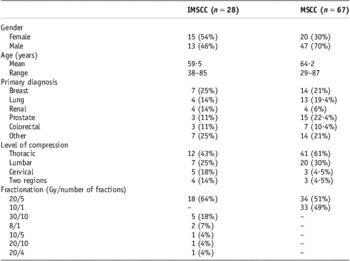
Table 1 presents the demographics, the site of primary malignancy, the level of compression and the fractionation schedule for both the IMSCC and MSCC patient groups.
Patient characteristics, levels of compression and fractionation schedules

Note: Data are for number of patients, unless otherwise specified.
Abbreviations: MSCC, malignant spinal cord compression; IMSCC, impending malignant spinal cord compression.
For the IMSCC group, the median number of days from diagnostic MRI/CT to the date of first treatment was 1; however, the range was large (0–30 days). The median time from the diagnosis of the primary malignancy and the diagnosis of the IMSCC (date of MRI) was 14 months, range: 0·13–46 months. The most common vertebral level of IMSCC was thoracic, followed by lumbar and cervical spine (Table 1).
At the time of presentation, patient's KPS ranged from 50 to 100, with a median of 60. The KPS distribution was the following: 50–60—13 (46%), 70–80—5 (18%) and 90–100—10 (29%). Pain was reported in all 26 patients (100%) for whom we had Pain data, with 16 of the 26 (62%) reporting a Pain Score of 8–10. Two (7%) patients were affected by urinary incontinence. Ten out of 23 patients (43%) for whom we had neurological data had a neurological abnormality on physical examination. Sixteen (57%) patients were mobile, eight (29%) required a walking aid and four (14%) were bed bound.
Outcome and toxicity of the IMSCC patients
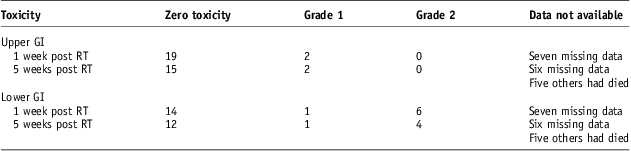
See Table 2 for a description of acute gastrointestinal (GI) toxicity experienced by the IMSCC patients. No notable late toxicity was recorded.
Acute GI toxicity of IMSCC group
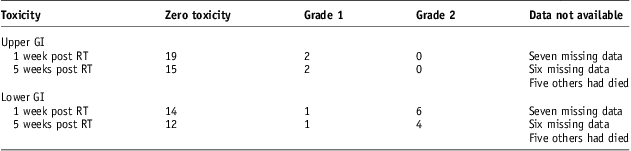
Abbreviations: GI, gastrointestinal; IMSCC, impending malignant spinal cord compression.
At 5 weeks follow-up, 16 of the IMSCC patients had unaltered mobility status, one had improved, four had deteriorated and five had died (data missing for two patients) At the same time point, 15 of the IMSCC patients experienced improved pain levels, one was stable, one had deteriorated and five had died (data were missing for six patients).
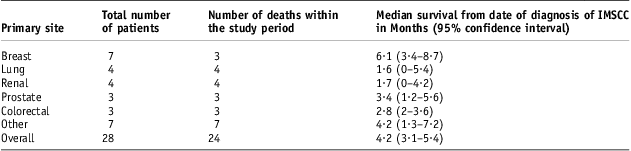
Median survival from diagnosis of IMSCC (date of MRI) was 4·2 months, with a range of 15–826 days (95% confidence interval: 3·1–5·3 months). Median survival times were 5·2 months for those who walked unaided (n = 16) at presentation, 3·4 months for those who needed a walking aid (n = 8) and 1·1 months for the four patients who were bed bound. There was no statistically significant difference in survival between these three groups (p = 0·116). The probabilities of surviving for at least 4 months were 62%, 50% and 50%, respectively. The percentage of IMSCC patients still alive at 9 months was 14% and all of these patients had breast cancer.
Table 3 shows the number of deaths within the study period and the median survival by the primary site of malignancy.
Deaths and median survival of IMSCC patients by primary site
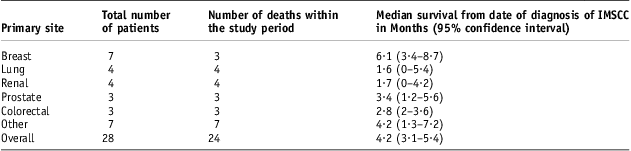
Abbreviation: IMSCC, impending malignant spinal cord compression.
Comparison with true MSCC
It was found that there were a relatively high number of patients with two to three vertebral levels of involvement in the IMSCC group, including the involvement of two to three segments within a specific region. A χ 2 test for independence (with Yates continuity correction) indicated a statistically significant association between number of levels involved and whether the compression was IMSCC or true MSCC (p = 0·024, n = 95). There were also a relatively high number of patients with cervical spine involvement in the IMSCC patients.
A Mann–Whitney U test revealed no significant difference in the age of those in the IMSCC group (median = 56 years, n = 28) and those in the true MSCC group (median = 66 years, n = 67), p = 0·103.
A χ 2 test for independence (with Yates continuity correction) indicated a borderline significant association between gender and whether the compression was IMSCC or true MSCC (p = 0·051).
Discussion
To the authors’ knowledge, this is the first description of the characteristics and outcomes in this group of patients in the literature. From the results of this study, we have shown that, despite IMSCC patients presenting with mid to high KPS, the group has a similar median survival to the MSCC group, significant neurological and clinical symptoms and a poor functional outcome.
Survival
Although a perception exists that IMSCC patients may survive significantly longer than the typical MSCC patients, our results suggest otherwise. We found a median survival of 4·2 months, which is quite similar to the documented median survival of MSCC patients (∼3 months).Reference Loblaw, Laperriere and Mackillop22 This should have an impact on discussions between patients and their families and their clinicians regarding prognosis. Families should be given the opportunity to discuss making wills and preferences for end of life care; however, these subjects may not be broached if the possibility of limited prognosis is not made clear.
This finding of a similar survival time should also be considered when deciding the radiotherapy fractionation. Despite the poor survival we report here, only two (7%) patients were treated with a single radiotherapy fraction and 25 (89%) patients had at least one full week of treatment. Although no randomised evidence is available to guide treatment prescription in this patient population, single fractions have been used to good effect in both painful bony metastasisReference Lutz, Berk and Chang23 and MSCC.Reference Rades, Stalpers, Hulshof, Zschenker, Alberti and Koning24 Both in terms of resources and patient quality of life, it seems prudent that short-course radiotherapy should be given consideration in this patient cohort. Maximising quality of life is a crucial consideration, especially for those patients who do not have a long life expectancy. Minimising hospital attendances and facilitating discharge from the acute hospital setting to home or hospice care may be the key factors in this.
As stated earlier, a higher total dose and multiple fractions are often thought necessary for IMSCC because these patients may survive to develop an in-field recurrence. In addition to the higher dose, another consideration may be the higher biological equivalent dose (BED) associated with longer course treatment—BED = 75 Gy2 for 30 Gy/10 fractions versus 60 Gy2 and 40 Gy2 for 20 Gy/5 fractions and 8 Gy/1 fraction, respectively (α/β = 2 Gy).Reference Fowler25 It appears from the outcome data for patients in the upper end of the survival range in this study that recurrences in long-term survivors should be taken into account [four patients (14%) were alive at 9 months follow-up]. However, when considering the low survival rate in the population as a whole, it would be optimal if it were possible to identify these ‘better prognosis’ patients at the time of diagnosis of IMSCC. It is not surprising that the patients with a breast primary who developed IMSCC had the longest survival (6·1 months), whereas those with a lung primary had the shortest survival (1·6 months). Much work has been conducted in developing prognostic scoring criteria for MSCC patients;Reference Tang, Harvey, Dorsay, Jiang and Rathbone26 however, these criteria need to be similarly validated for the IMSCC group. It should also be noted that it has been estimated that clinicians can overestimate survival in 63% of patient cases.Reference Glare, Virk and Jones27 This illustrates the importance of providing proven objective indicators to guide treatment prescription.
Clinical symptoms
Despite the fact that IMSCC is often denoted as ‘sub-clinical’ cord compression, all of the IMSCC patients for whom we have pain data with reported pain at presentation, with a significant proportion (62%) reporting severe pain (scores 8–10). This illustrates the clinical importance of the IMSCC event. It also correlates with reports regarding the incidence of pain in the MSCC patient, one author reporting it as 83–96%.Reference Abraham2 In terms of pain relief, radiotherapy did achieve some positive results—with 15/17 (88%) of patients that survived for 5 weeks follow-up, reporting some improvement in pain.
In addition, 43% of patients had some form of impaired mobility at diagnosis of IMSCC; this appears to be somewhat less than the reported level of two-thirds of patients being non-ambulatory at the diagnosis of MSCC.Reference Prasad and Schiff1 This record of impaired mobility was in conjunction with our finding of 43% having neurological abnormality on physical examination and 7% (two patients) presenting with urinary incontinence. Although the result was not significant, it was not surprising that there is a trend with IMSCC patients with better mobility living longer, as ambulatory status is a prognostic indicator for MSCC patients.Reference Rades, Rudat and Veninga12 One author investigating the role of MRI in the detection of MSCC found that 4% of their patient population had IMSCC or ‘thecal sac compression’.Reference Husband, Grant and Romaniuk28 This group suggested that the neurological deficit identified in these patients might have arisen from a vascular cause. Similarly, Rades et al.Reference Rades, Stalpers, Hulshof, Zschenker, Alberti and Koning24 suggested that the reason why one of the predictors of functional outcome in MSCC is the length of time for developing motor function deficits before treatment start may be the differing mechanisms: fast-growing tumours may irreparably damage the cord's arterial blood supply, whereas slower proliferating tumours may simply temporarily disrupt the venous network.Reference Rades, Fehlauer and Stalpers29 However, regardless of the mechanism underlying IMSCC, it is clear from this study that IMSCC patients have similar clinical symptoms to that of the MSCC patients, although perhaps slightly less severe in nature.
Referral after diagnostic MRI
The wide range in number of days (0–30) from diagnosis of IMSCC to the date of first radiotherapy treatment illustrates the differences in the clinician's opinions relating to treatment urgency. As stated earlier, best-practice guidelines for MSCC suggest that patients should be treated within 24 hours of diagnosis.3, Reference Husband6 In contrast, in this study, although the median number of days was 1, almost half of our IMSCC patients were not treated in accordance with this guideline. The importance of early detection and treatment in MSCC in terms of functional outcome is well documented, but it is beyond the scope of this study to suggest whether this should apply to IMSCC also. However, this result does clearly show the lack of consensus among clinicians about the treatment urgency in IMSCC.
The role of surgery
As stated previously, patients presenting with IMSCC in our institution were not sent for neurosurgical opinion before commencing radiotherapy because of the lack of evidence for surgical intervention. PatchellReference Patchell, Tibbs and Regine30 showed superior functional outcome and a survival advantage in MSCC patients who had decompressive surgery plus radiotherapy, compared with radiotherapy alone; therefore, perhaps there is a need for similar randomised trials to explore the possible efficacy of surgery in the IMSCC group.
Primary site, gender
In reviews of the MSCC patients, the frequency of MSCC arising from particular primary sites is a function of their tendency to metastasise to bone. This gives rise to a typical distribution of primaries, where breast, lung and prostate each account for ∼20% of the MSCC population.Reference Loblaw, Smith and Lockwood4 In contrast to this, there was a wide range of malignant primaries in this study of IMSCC patients, which did not fit the typical MSCC distribution. Compared with the distribution of primaries in MSCC, there were a relatively low number of primary prostate IMSCCs detected and a relatively high number of renal IMSCCs.
Similarly, it is interesting to note the finding of a borderline significant gender difference between the groups (p = 0·051). From the demographics of our ICORG 05-03 MSCC trial, the male:female ratio is roughly 70:30, whereas the ratio for IMSCC is ∼50:50. Again, if IMSCC is an event that occurs before full MSCC, one would expect the distributions to be approximately equal. This finding of a difference in the gender distribution may be because of the above finding of a higher proportion of prostate primaries in the MSCC group. However, a larger data set is required to determine whether this borderline difference in the genders is related to the primary cancer site.
In MSCC, the frequency of vertebral compression levels is also well documented. Thoracic spine, lumbrosaccral spine and cervical spine account for ∼60%, 30% and 10% of MSCCs, respectively.Reference Schiff5 This is thought to be both an effect of the spine's structural kyphosis and the greater intrathecal cross section.Reference Prasad and Schiff1 Interestingly, in the IMSCC population, there are a relatively high number of cervical spine IMSCCs and also a relatively high number of multiple levels of involvement.
These findings may simply be because of the small data set used in this single institution study.
Conclusion
The results of this study give a preliminary description of a group of patients with IMSCC. Despite the fact that IMSCC patients are perceived as having a better prognosis, their survival is not largely different to that of the MSCC patient. In addition, we have shown that these patients have significant neurological deficits and clinical symptoms. As this is a single institution study with a small number of patients, further studies are needed to substantiate our findings and to provide further information about this patient group. In the absence of such data, the poor survival and functional outcome of these patients should be the impetus for frank clinician–patient conversations regarding prognosis. Clinicians should also consider the role of short-course radiotherapy to palliate symptoms while maximising quality of life for this cohort of patients whose remaining lifespan may be severely limited.
Acknowledgements
The authors thank the Radiotherapy Department, Saint Luke's Radiation Oncology Network, Rathgar for their support to this study. The authors also acknowledge Dr Aoife Shannon and the All Ireland Co-operative Oncology Research Group (ICORG) for their role in the ICORG 05-03 Spinal Cord Compression Trial. This project was supported in part by the Health Research Board, Ireland.