Under the late eighteenth and nineteenth century Konbaung dynasty, Burmese sociopolitical thinking transformed dramatically. Three periods were particularly rich in sociopolitical and cultural change: the reign of King Bagyidaw (1820s–1830s), the early years of King Mindon (1850s–1860s), and the late Konbaung period (end of the 1870s–1890s).Footnote 1 During this period, European notions of race, nation, and consular protection to nationals progressively informed the Burmese concepts of ‘categories of people’ (lumyo) and ‘subject’ (kyun). This conceptual development constituted a necessary prerequisite for colonial discourse to develop, at a later stage, a political strategy of ethnic differentiation, which further escalated in post-colonial times.Footnote 2
The pre-colonial Burmese ‘technologies’,Footnote 3 or practices of conception and categorisation of peoples, changed in the 1820s–1830s following the annexation of the western Burmese province of Arakan by British India in 1824. This was the first step in the semantic evolution of the Burmese concepts of lumyo and kyun. Then, in the 1850s–1860s, after Britain annexed Lower Burma in 1852, the concept of ‘categories of people’ (lumyo) came to be progressively associated with the early European concept of ‘nation’, a people with common origins.Footnote 4 Another semantic change occurred in the 1870s, when British consular protection extended to several freshly categorised ‘nations’ (lumyo), such as Shan, Karenni, and Kachin.
Pre-colonial Burmese categorisation of people
The first question is whether the term ‘categories of people’ (lumyo) necessarily conveyed an idea of ethnicity, as linked to notions of otherness, foreignness, and/or nationalism in pre-colonial Burma. We must consider the various emergent pre-colonial representations and categorisations of people in terms of theory, practice, and in the discourse of the elites of the Burmese royal city.
Primordial hierarchy, geo-cosmology and the Buddhist concept of social conditions
Conceptions of social organisation and hierarchy in pre-colonial Burma drew heavily on Indic origin myths and Buddhist cosmology. According to one important Theravada Buddhist cosmological narrative popular in pre-colonial Burma, Mahāsammata was the first king of the world and the founding father of the Śākya lineage. Mahāsammata was the ancestor of Siddharta Gautama (6 BCE), the Buddha of the current era (kappa), who was born into the Śākya lineage. In the sutta on the origins of the world (the Aggañña sutta of the Dīghanikāya), Gautama Buddha relates that the first human beings chose the wisest and the most charismatic among them, and addressed him as Mahāsammata (‘elected by the people’), khattiya (Lord of the Earth), and rāja (king). These names became the attributes of the group (Sanskrit varṇa, literally ‘colour’) of warriors, and afterwards, three more groups came into being, the Brahmin priests (brāhmaṇa), the rich (vessa), and the poor (sudda).Footnote 5
After centuries of adaptation and enrichment, the Burmese version of the myth of Mahāsammata was completed in U Kala's Great Royal Chronicle composed in the royal city of Ava in the early eighteenth century.Footnote 6 The myth stated that kingship was responsible for the division of society into four early ‘categories’ (amyo in Burmese).Footnote 7 According to the Great Royal Chronicle, Mahāsammata belonged to the first category, the Lord-warriors (khattiya in Pali, min or ‘lord’ in Burmese). The second was the category of the Brahmin priests (brāhmaṇa, in Burmese pounna) who ‘live on donations of rice and whose function is to fight the Law of Decline’ (that produces wrong deeds). The rich (vessa in Pali, in Burmese thuhtei thukywe) came in third position; they all had a home, and worked in the fields or traded their products. Finally, the mass of the less fortunate was ‘pressured’ and formed the category of the poor (sudda in Pali, in Burmese hsin'yetha).Footnote 8
Along with this articulation of a social order couched in terms of a local understanding of the Indic varṇa system came the notion of purity of lineage. In theory, the status of the three first categories was maintained by ‘purity of lineage’ (amyo sinzek hman in Burmese). Although inter-class marriages were common in pre-colonial Burma, the notion of purity was essential to the Lord-warriors who had practised endogamy since the fifteenth century.Footnote 9
However, the Buddhist conception of the world, imbued with the notions of saṁsāra (cycle of rebirth) and of karma, conflicts with the idea of a social condition that is unchangeable and unvarying.Footnote 10 The laws of cause and effect and of karma explain why an individual can improve his social condition and status in this present life. Thus, the Burmese pre-colonial discourse referred to a social hierarchy established on karmic criteria. Beings were classified according to their merit and, as Michael Aung-Thwin states, karma was a natural law that determined the position of each being in the universe.Footnote 11 In this sense, the king bestowed ‘positions’ (aya), literally ‘places’ or offices, which conferred upon individuals their social role, status, and position in the order of precedence during royal ceremonies. It was the prerogative of the king, who had the highest royal position (ayadaw), to ‘position’ individuals in order of status. Put differently, the king gave out the positions, offices, honours, and titles, all of which were designed to distinguish the elite from the rest of the population.
Burmese conceptions of social organisation also drew on Buddhist geo-cosmological conceptions of the world, where four continents surround Mount Meru, the centre of the universe. As early as the seventeenth century, when major administrative and fiscal reforms were undertaken at the Burmese court, royal orders referred to lists of 101 categories of people (lumyo) who were supposed to live on the continent of Jambudīpa; the names of these lumyo were sometimes similar to the ethnolinguistic terms in use nowadays, and they were classified in larger categories (amyo). The Myanma were then associated with one of these categories, as well as the Mon (often referred to as Talaing), the Shan, and the Kala. Categorisations varied over time, and the names of the lumyo under each category were often very different from one list to the other. Although the Myanma-myo — the Myanma category — consistently encompassed seven lumyo, they were not always the exact same seven lumyo. And this was also true for the other categories, whose subcategorised lumyo were not fixed. In a royal order dated to 1679, the Kala-myo included more than sixty subsidiary lumyo supposed to live to the west of Jambudīpa and of the Burmese king's ‘sphere of influence’ (naingngandaw) as well.Footnote 12
As Mikael Gravers has shown, although ethnicity, along with language, physical traits, and culture, was part of individual identification and personal relations, it was not part of the pre-colonial model of power as a mechanism of difference and exclusion. According to Edmund Leach and James Scott, the most powerful distinction was between the people living in the cities, and those dwelling in the forests.Footnote 13 So it was in the case of lumyo. In Burmese representations, lumyo were ranked in the social hierarchy according to their position in the territory — the ‘further’ from the capital city the ‘wilder’ (ayaing).Footnote 14
In practice: Locale and the divisions of ahmudan and athi
In pre-colonial Burma, the lay population (pyithu taingthu) (thus excluding monks and priests) was divided into two administrative categories: ahmudan (crown servicemen) and athi (taxpayers).Footnote 15 Groups of crown servicemen and taxpayers were regularly surveyed, and their records (sittan) or lists (sayin) amended accordingly. Ahmudan were supposed to serve the king exclusively and were not subject to local authority. In this sense, they were differentiated from athi and from other servicemen attached to local institutions, either lay or religious (monasteries, pagodas, temples). However, individuals serving religious institutions (hpayakyun) shared two characteristics with the ahmudan groups: they had to serve their respective masters exclusively, and they did not have to pay taxes. The taxpayer groups of athi (also called akhundan in the nineteenth century) had to fulfil local labour duties. The poor (hsin'yetha), social outcasts, and ‘barbarians’ (ayaing) living in the border regions of the kingdom were not subject to the systematic imposition of taxes or service.
The relationship an individual had to a locale determined the degree of ‘indigenousness’ or ‘foreignness’. Following administrative divisions of the population, the status of athi resulted from affiliation to birthplace or permanent residence. Athi were differentiated from people coming from other places (kapa), and from people for whom at least one parent was born in a different location (ala). Along with the division between athi and ahmudan came further subdivisions into units (asu) also associated with specific areas.
Lumyo in emergent sociopolitical discourse
A royal order from 1813 reveals how sociopolitical discourse among the Burmese elites blended abstract and pragmatic social categorisations and hierarchies:
The division into four categories (amyo) dates back to the beginning of this world when it was decided that men would contribute ten per cent of their revenues. Places where the division into four categories does not exist are called ‘peripheral regions’. So as to divide the population accordingly, make lists of crown servicemen [ahmudan] and taxpayers [akhundan].
Here is how we can define crown servicemen [ahmudan ludo] and taxpayers [akhundan ludo]. (…) the king awards positions and distinctions and among them, the status of ‘good person’ [thukaung]Footnote 16 (…) and positions of dignitaries (hmumat) must be bestowed upon crown servicemen only. Taxpayers are the category (amyo) of the rich men who make a living and, according to the law, have contributed ten per cent of their revenues since the time of king Mahāsammata. Positions, distinctions and status of ‘rich’ must be bestowed upon the category of taxpayers (akhundan lumyo) only.Footnote 17
In this discourse, the word ‘people’ (lu), which is exclusively used to designate laypersons, is used alternatively with ‘category of people’ (lumyo). Indeed, the group of taxpayers is either called akhundan lumyo or ahmudan ludo. Actually, it is the only category of people that matches one of the four early categories (amyo): the rich, the only ones supposed to pay taxes.
Toshikatsu Ito's study of the taxation of Karens in Lower Burma during the early Konbaung era (late eighteenth, early nineteenth century) corroborates the significance of what we would call today an ethnolinguistic reading of lumyo in Konbaung administrative practices.Footnote 18 However, Yoshinari Watanabe's analysis of the concept of ‘nation’ in early Konbaung vernacular sources demonstrates that nouns expressing ethnicity were most often associated with the pluraliser -to (such as in myanma-do, kayin-do, etc.) and less frequently with the term lumyo. In fact, lumyo was almost exclusively used to designate ‘other kinds of people’ (lumyo cha), or nationals external to the naingngandaw and originally subjects (kyundaw) of a foreign king, as it was the case for tayouk (Chinese) and ingaleik (English). Kala lumyo signified either ‘natives of India’ or ‘Europeans’.Footnote 19 But as soon as they chose to swear allegiance to the Burmese king by living in his naingngandaw, paying taxes, or serving him, these former foreign nationals would immediately become his subjects.
On the eve of the colonial era, the term lumyo was thus used in two different contexts: first, to identify any group for administrative purpose, such as akhundan lumyo, a usage derived from the early hierarchy model (amyo); and second, to label the 101 lumyo thought to live on Jambudīpa. When these imagined lumyo actually matched existing ones, they were associated with specific regions, as well as linguistic and racial traits, and they were ranked accordingly in social conceptions. All lumyo had something in common: they belonged to a classification, either geo-cosmological or administrative.
In pre-colonial Burma, the notion of ‘foreignness’ occurred locally, being intertwined with the relation of a group or an individual to a specific place. At the scale of the naingngandaw, ‘otherness’ was first determined by the proximity/remoteness from the royal city, which embodied civilisation, and second, by subjugation (or not) to the Burmese king.
The semantic evolution of lumyo in the 1820s–1830s
The First Anglo–Burmese War, which saw the defeat of the Court of Ava in 1824, marked Bagyidaw's reign (1819–1837). The Konbaung dynasty had to cede the provinces of Manipur, Arakan and Tenasserim to the British East India Company under the Peace Treaty of Yandabo in 1826. The negotiations between the British and the Konbaung government — and the necessary translation work entailed — fostered conceptual and semantic changes in Burmese in relation to the terms under discussion.
Reverend Adoniram Judson (1788–1850), founder of the Baptist mission in Burma and main interpreter during the peace treaty negotiations, had trouble finding Burmese expressions to translate the English words ‘nation’, ‘foreigner’, and ‘national’ into the Burmese version of the treaty he prepared. Here is an extract from the official English translation of the original Burmese version of the treaty,Footnote 20 showing the limited use Judson made of lumyo:
Article 6 : ‘Subjects of the Burmese king’ (Myanma shinbayin kyun) who have sided with Westerners (Kala) during the war, of their own free will or not, and Westerners who have sided with the Burmese, of their own free will or not, shall not be molested.
Article 8 : All debts contracted prior to the war, including those contracted by dignitaries of the Burmese king, shall be entirely liquidated. Westerners (Kala) and Burmese (Myanma) must have good faith. Either party shall take no advantage in consequence of the war. According to the Law of Nations (Kala htounzan), it is stipulated that the property of a ‘subject of the English king’ (Ingaleik shinbayin kyun) who may have died in the dominions of the Burmese king during the war shall, in the absence of legal heir, be placed in the hands of the British representative in the said dominions. In like manner, the property of subjects of the Burmese king dying under the same circumstances, in any part of the British dominions, shall be made over to the Burmese representative in the British dominions.
Article 11 : This Treaty shall be signed by the plenipotentiaries of the Burmese king. All Western prisoners, either British, American, white or black, shall be delivered over to the British plenipotentiaries. The signed treaty shall be delivered to the ruler of the Indian Company. The Ratification shall be delivered to the Burmese king within four months. The Burmese (Myanma lumyo) prisoners shall be delivered over to their own government.
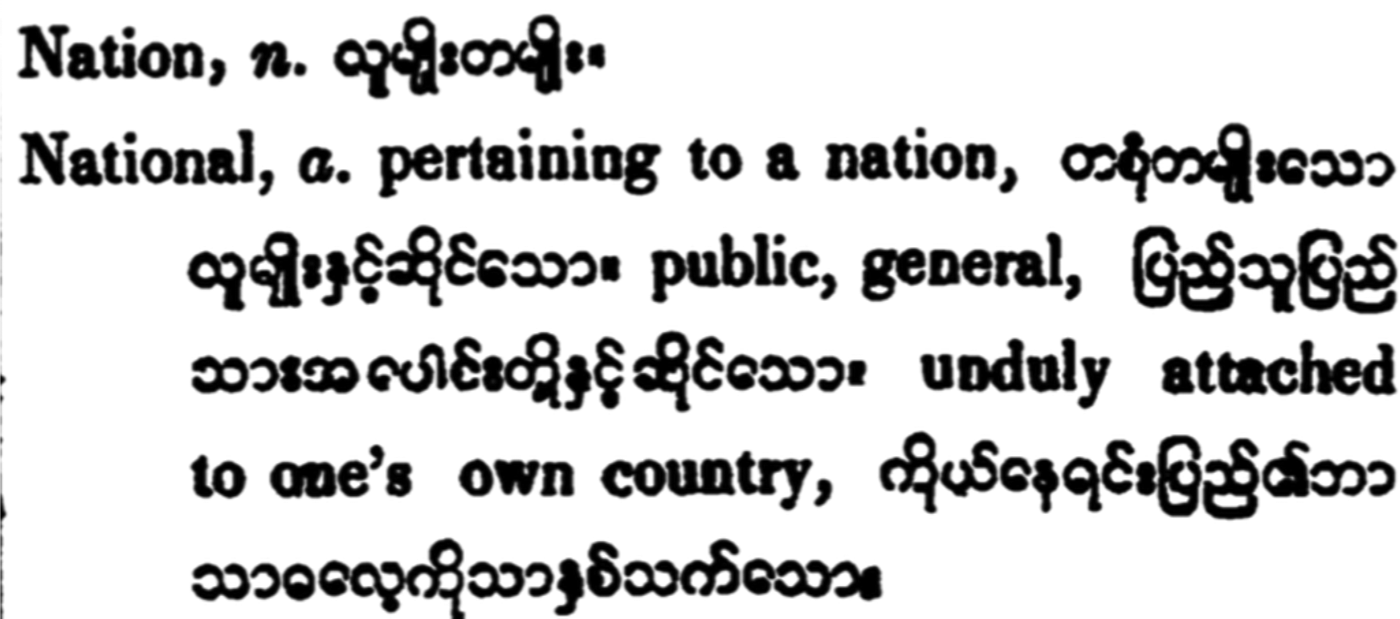
Here, the Burmese has been rendered by Myanma lumyo. In other parts of the treaty, lumyo is also used as a translation for ‘nation’ in the sense of a group of people with a common origin. Although no entry for lumyo is found in Judson's first Burmese–English dictionary (1826), the term is used to translate ‘nation’ in his English–Burmese dictionary (1849) as shown in fig. 1.
Adoniram Judson, A Dictionary, English and Burmese (Moulmein: American Mission Press, 1849), p. 330

In the Yandabo Treaty, Judson does not use lumyo to translate the categories of ‘foreigner’ versus ‘native’. Foreigners, that is, the British nationals in Burmese territory, are identified as Kala, which meant anyone from anywhere west of Burma. Judson also had to find a way to express the concept of ‘race’ in Burmese, which had no direct semantic equivalent. The Burmese categorisation scheme reflected concepts of lineage and hierarchy, whereas the term ‘race’ in English was an emergent category, which changed over the nineteenth century, ranging from ideas of ‘nation’ to ideas of an essential level of cultural sophistication, or suitability for certain occupations. For this purpose, Judson used the term amyo (categories).Footnote 21
Moreover, Judson was confronted with a Burmese conception of ‘subject’ very different from the contemporaneous nineteenth-century British one, which reflected republican thought.Footnote 22 Anyone living permanently in the king's naingngandaw and performing the duties of taxpayer or servant of the king was a royal subject (kyundaw). The word kyun appears several times in the Burmese version of the treaty, but Judson used kyun to express the republican concept of ‘subject’, one in which a national or subject of the law is a person — physical or juridical — who has rights and responsibilities. For instance, the sixth clause of the treaty refers to the ‘subjects of the Burmese king’ (Myanma shinbayin kyun) as opposed to the people from the west (Kala). The eighth clause mentions ‘international law’ — rendered ‘Westerners’ Custom’ — which stipulates that the estate of a person deceased in a foreign country must be surrendered to that person's consulate. Here, the deceased foreign national is referred to as a ‘subject of the English king’ (Ingaleik shinbayin kyun).
To the British, kyun conveyed the idea of deprivation of freedom, and Judson translated kyun as ‘subject or slave, one under authority’ in his dictionary.Footnote 23 Although he had apparently considered using the term kyun to translate the concept of ‘prisoner of war’ in the eleventh clause of the treaty, he finally did not do so because the Burmese government regarded this translation with kyun as degrading. Judson used the word lumyo instead and simply referred to the Burmese prisoners of war as Myanma lumyo.Footnote 24 Furthermore, the use of the term kyun would have been humiliating for King Bagyidaw: according to the Burmese conception, all people living in the territory of the Burmese king were his subjects. The expression ‘Burmese prisoners of war in India’, if translated using kyun, would have meant a change of allegiance. Thus former Burmese subjects would have been now considered subjects of the Governor General of India.
Despite Judson's efforts to express in Burmese some of the fundamentals of international law, the Treaty of Yandabo did not clearly stipulate the legal status of British nationals in Burma. The British ambassador John Crawfurd, sent to Burma two years after the signing of the treaty, attempted to find a solution in a commercial agreement he drafted with the Burmese ministers. The initial agreement included eight clauses regarding the rights of both Burmese and British subjects, but the Burmese government rejected them in the end.Footnote 25 The final version of the agreement provided for merchants travelling from one country to the other (Burma and India) to be allowed to go freely and to transport their goods at will. However, British merchants had to carry a valid passport to enter the Burmese king's territory.Footnote 26
As agreed in the treaty, King Bagyidaw had the authority to administer justice to British nationals and natives of India. There were few complaints regarding the jurisdiction over British subjects; the British recognised that the Burmese magistrates’ verdicts usually respected the ‘standards of civilised nations’ and often favoured them over the locals, especially for civil matters such as debt, inheritance, and litigation. The main judicial issue concerned the jurisdiction of King Bagyidaw over Burmese ‘British’ subjects, that is Burmese living in the British colony of Burma. A trial could concern a person from British Burma travelling or transiting through Konbaung territory, or a rebel who had run away into British territory, or a person who had decided to start a new life in British Burma. The latter was often the case for ‘servants’ (azeikyun) who fled their masters. The British generally considered these servants as ‘debt slaves’, and were thus reluctant to surrender them to the Burmese authorities.
The treaty did indeed raise the question of political asylum, a concept totally alien to the Burmese understanding of sovereignty. From 1824 onwards, there were debates regarding the existence of a category of ‘political refugees’. Burmese insurgents who took refuge in East India Company territory automatically became, in the eyes of the British, political refugees. For Konbaung ministers, these so-called ‘political refugees’ were mere criminals and had to be punished accordingly, which meant execution in most cases. One of the priorities of Henry Burney, British minister and resident at Ava, was then to investigate crimes perpetrated on both sides of the frontier; he had to differentiate politically motivated crimes from others, especially in the aftermath of an insurgency in Martaban, which was by that time British territory, in 1829.Footnote 27
Discussions of international law started to influence Burmese semantics in the early 1830s. In Burmese, neologisms were created to express the English terms ‘British subject’ and ‘political refugee’. In a letter written to the Burmese Council of Ministers in 1832, Blundell, Burney's assistant, refers to a British subject, rendered as Ingaleikmin kyundaw myo (literally, ‘the English king's subjects category’). This expression is related to the definition of subject — kyun, or a national and subject of the law — given by Judson in the Burmese version of the Treaty of Yandabo, and is associated with amyo, which here conveys the idea of ‘category’ (as in lumyo).Footnote 28 In a further communication with the Konbaung ministers, Burney rendered the term ‘political refugee’ with the Burmese khowin layaukthu, literally ‘person who entered clandestinely’ in reference to the Shan chief of Thaung Thouk.Footnote 29
Correspondence between the British and the Burmese reveals a continuous work on semantics in the 1830s, based on the Burmese terminology found in the Treaty of Yandabo. The Burmese officials generally accepted and used lumyo as a translation for ‘nation’, in the sense given by Judson in the treaty. For instance, the Burmese ministers refer to the ‘westerners’ as Kala lumyo in most of their correspondence with Macfarquhar, who replaced Blundell between September 1832 and August 1833.Footnote 30
The Burmese also made use of amyo as a translation for ‘race’ in the meaning Judson gave in the treaty. In June 1838, the Burmese Council of Ministers instructed the British Governor of Rangoon to control communications between the British, the Armenians, and the Persians of Rangoon and Amarapura. These three groups were referred to as amyo, and individual members of each amyo as amyotha, or ‘children of the race’. This expression was then regularly used in subsequent correspondence.Footnote 31
The translation of the Treaty of Yandabo facilitated the integration of western notions into Burmese expressions of social relations. In pre-colonial Burmese geo-cosmological conceptions, all human beings were distributed among 101 lumyo. The Burmese version of the Yandabo Treaty ‘provided’ each lumyo with a common ancestry. From then on, Anglo-American and European ideas seeped into the Burmese conception of lumyo. The Burmese started to conceive of lumyo as connected to categories (amyo), which were increasingly perceived in terms of race in the contemporaneous English sense as differences in hereditary physical and mental traits. When these human groups organised into societies, they had to choose a ruler and become his subjects (kyun).
Burmese-language neologisms and new meanings given to old Burmese expressions proved to be useful for the British. In less than eight years, through discussion and debate with Burney, the Konbaung ministers came to understand perfectly certain principles of international law, including the legal status of foreign nationals. Although the Burmese ministers kept trying to negotiate on the extradition of all fugitives, they acknowledged the existence of the category of political refugees. They eventually used the notion at the expense of British India: in 1838 the Burmese Governor of Martaban (Burmese dominion) granted political asylum to criminals from Tenasserim (British territory).Footnote 32 Acknowledging the existence of the category ‘political refugee’, and making use of that notion when dealing with the British, was one further step towards the Burmese recognising different nations or lumyo associated with territories. In this new understanding, insurgents had an alternative to retreating into forested peripheral regions, the traditional zone of rebellion in Burma: they could now take refuge in another sphere of influence, the naingngangdaw of a powerful neighbour.
New semantic changes in the 1850s–1860s
Another period of intense sociopolitical change took place after the Second Anglo–Burmese War in 1852, which had cost King Pagan (r. 1845–1852) the province of Lower Burma. This period of turmoil profited his brother Prince Mindon, who eventually seized power. In the first two decades of his reign (1852–1878), a new generation of scholars and officials, who grew up in the shadow of British power and at a time of rapidly increasing knowledge about the outside world, came into power.Footnote 33 In 1862, King Mindon signed a commercial treaty with Arthur Phayre, the commissioner of British Burma. Two years later, Phayre and the Burmese ministers drafted the Law on Travellers, meant to protect British nationals travelling in Burma. The writing of these legal texts, in both English and Burmese, promoted once again the evolution of the Burmese concept of lumyo.
Debates on the protection of foreign nationals rose again, as in the 1830s. This topic was extremely controversial, because it questioned the jurisdiction of the Burmese king over his subjects (kyundaw). The Burmese version of the 1862 treaty stipulated that the Burmese king had to ‘protect the merchants and the poor’, who were subjects of the English king, ‘just like they were his own subjects’ (third clause). According to Phayre's interpretation, this protection had to be extended to all British nationals, whether civilian or military. Moreover, the seventh clause of the treaty, as well as the Law on Travellers, enabled foreign merchants to purchase everything they needed, including land to build houses.Footnote 34
Yet the emphasis was now on British subjects as a group, regardless of their origin, including British nationals, natives of British India, and Burmese people from British Burma as well. This concern led to new developments in the categorisation of people. In the Law on Travellers, ‘British subjects’ (Ingaleik kyundaw myo) were differentiated from the ‘British nationals’ (Ingaleik lumyo) and from ‘other nations’ (acha lumyo) as well.Footnote 35
In the ninth clause of the 1862 treaty, lumyo was used to translate the English ‘nation’, thus validating and formalising Judson's first attempt in the Yandabo Treaty:
People from whatever country (taingpyi) or nation (lumyo) who may wish to proceed to the British territory, the Burmese ruler shall allow to pass without hindrance.
This clause was formulated as a response to three recurrent matters of dispute between the British and the Burmese: wives of expatriates, who were Burmese and therefore subjects of the Burmese king, were forbidden to follow their husbands abroad; Chinese could not transit through Konbaung Burma easily; and rebels were prevented from taking refuge in British territory. Reciprocity was not provided, and the British reserved the right to authorise individuals to enter into Burmese territory ‘according to their nation’.
The impact these conceptual changes had on Burmese sociopolitical thinking was originally limited to the elites of Mandalay and did not affect common ideas. However, the inhabitants of British Burma became increasingly conscious of their rights and started to develop a sense of entitlement towards those rights. The best illustration of this growing awareness occurred in 1863 in Malun, the first port on the Irrawaddy north of the border between the British and the Konbaung territories. The 1826 commercial agreement had provided for a reduction of the inland duties levied in Malun on goods transported on the Irrawaddy. From then on, the British and most westerners were exempted from certain taxes, while Burmese people were not. This remained the case after the annexation of Lower Burma to British India in 1852. Nearly ten years later, Burmese merchants started to complain to the British authorities — as ‘subjects of the English king’ (Ingaleikmin kyundaw myo), they claimed they were entitled to the same rights as the British nationals and demanded to be exempted from taxes too. Clement Williams, the British diplomatic agent in Mandalay, had to explain to the Burmese government that inland duties had to be the same for all merchants from British Burma, regardless of their ‘nationality’.Footnote 36 The evolution of the semantics of lumyo and kyun, and the conception of a new paradigm of nation/lumyo and race/amyo, began to nurture the growing Burmese nationalism in Lower Burma.
The Karenni problem and the political turn of the 1870s
In the 1850s–1860s, British consular protection extended to several freshly categorised lumyo, such as ‘Shan’, ‘Karenni’, and ‘Kachin’. This categorisation took a dramatic turn in the 1870s when imperialists in Europe pressed for further intervention in the newly conquered territories. While commercial interests in Upper Burma were growing, British officials became increasingly involved in internal Burmese politics.Footnote 37 In Lower Burma and in the peripheral areas, especially along the border with the Burmese and Thai dominions, the British authorities were also attempting to map more systematically the territories of the various lumyo defined in the 1830s. Simultaneously, they came to see rebellions against the Burmese court as ‘racially’ motivated.
The British undertook a mapping of the territories of the lumyo they had identified, because in their political thinking, each lumyo had to have its own territory. The process was deeply intertwined with conflicts in the border regions. After the Second Anglo–Burmese war, the Burmese and the British came to share the complex management of the border with Siam: the British in southeastern Lower Burma, and the Konbaung king in the northeastern periphery. They also had to deal with increased criminality along the border between the Burmese and the British territories: the east of Upper Burma under the authority of the Burmese king, and the west of Lower Burma under colonial rule.Footnote 38 The mapping process included drawing a line of demarcation between the two Burmas, and the boundary of peripheral areas as well.
As Jane Ferguson puts it, the British bureaucratically solidified the idea of an intrinsic, ‘mappable’ connection between a ‘people’ and a ‘territory’ by using contemporary ideas of ethnological and geographical mapping.Footnote 39 They also used political criteria such as dependency on or independence from Mandalay. As most of the chiefs of what are now northern Kayin State and Kaya State regularly paid tribute to the Burmese king, the British mapped that region as part of his dominion. They called the area ‘Eastern Karenni’ as opposed to an imagined ‘Western Karenni’, more or less what is now Kayin State. The British considered Western Karenni independent because the most powerful chiefs there did not pay tribute to the Burmese king.
This redefinition of tribute-based relationships into nation-based ones had a strong impact on Burmese ideas of peripheral areas.Footnote 40 Soon, Mindon came to doubt the loyalty of his remote subordinates and accused some of having pledged allegiance to the British. For instance, a report dated 30 December 1856 revealed that the British commissioner of Toungoo had signed a friendship treaty with the Karen living in the region.Footnote 41 The eastern peripheral zone was also the perfect hideout for rebel princes and minlaung — ‘would be kings’ or pretenders to the throne — in the late 1850s. In 1857–1859 especially, two minlaung took refuge in the ‘Eastern Karenni’ and from there raided the ‘Western Karenni’.Footnote 42
At the same time, non-tributary Shan chiefs began to conceive of British Burma as a refuge. Although Phayre did not encourage British officials in Calcutta to systematically grant political asylum, several people were given it in the early 1860s. In 1863, the Shan chief of Maing Hsat (Möng Hsat), suspected of siding with Chiang Mai, ran away to Shwegyin in British territory. There, the British commissioner gave him protection.Footnote 43 In October 1863, Nga Naw Bwa, ex-chief of Nyaungshwe, fled Mandalay and attacked Nyaungshwe before taking refuge in Toungoo, which was in British territory.Footnote 44 Consequently, diplomatic tensions and disputes between the British and the Konbaung court increased dramatically. In July 1864, Burmese ministers demanded the British hand over Nga Naw Bwa. Calcutta agreed to deport him on the condition he would not be found guilty of acting on political motives. However, the complex bureaucratic procedure dissuaded the Burmese ministers from demanding Nga Naw Bwa, who was in the end not surrendered.Footnote 45
In the eyes of the Burmese, the British were gradually becoming supporters of the so-called ‘insubordinate’ chiefs of the Western Karenni territory, and also of other ‘threats’ to the throne. This added to a coup fomented by two of Mindon's sons, Myingun and Myin Khoun Daing. On 2 August 1866, the princes sent armed men to the parliament building (hluttaw) in Mandalay. After they injured several ministers and assassinated Prince Kanaung — Mindon's brother and heir-apparent — the rebels fled to Lower Burma.Footnote 46 In the aftermath of the crisis, there were rumours of a coalition between the British, the rebel prince Myingun, and the two most powerful Western Karenni chiefs, Kye Bo Gyi and Kye Bo Galay.Footnote 47 The rumour disappeared finally when the British arrested Myingun in August. He never had more than sixty fighters devoted to his cause. He was exiled to the Andaman Islands as a political prisoner, and Kye Bo Gyi died soon thereafter.Footnote 48
Diplomatic tensions grew over the Karenni question from October 1873 onwards. People started to spread the rumour in Mandalay that King Mindon was about to attack Saw La Bo, an Eastern Karenni chief who had offended him. The king was alleged to have ordered Dipa, a loyal Eastern Karenni chief, to gather troops for this purpose.Footnote 49 In reality, Khonti, son of the late Kye Bo Gyi, went to seek British help in Toungoo. While Mandalay and Calcutta were arguing over the independence of the Western Karenni, Lloyd, the assistant commissioner of Toungoo, signed an agreement with Khonti in March 1874.Footnote 50
The border with China created another diplomatic row between Burma and the British Empire. Following the Second Opium War, the British signed the Treaty of Tientsen with China in 1860 and eagerly sought to open trade routes from Burma to China. Mindon authorised the British diplomatic agent Edward Sladen to explore the roads up to Tali, in Yunnan, but the expedition got stuck because of the Panthay (Hui Muslims from Yunnan) Rebellion, which had started in the 1850s.Footnote 51 However, Sladen was eventually able to reach Momein (Tengyue) and signed agreements with several local chiefs, mostly Kachin, to guarantee the security of British traders. Fear took hold of Mandalay when Sladen came back together with the Kachin chiefs. Rumours of an alliance between the British, the Panthay and the Kachin began to grow and spread in the late 1860s and early 1870s.Footnote 52
As the rebellion came to an end in 1873, China was able to resume diplomatic and commercial ties with Burma, and a delegation from Yunnan arrived in Mandalay in April and stayed for about eight months. In June 1874, Mandalay sent troops to Theinni (Hsenwi) — a city currently located in northern Shan State — to defeat a supposed alliance between the Karenni and the Burmese Nga Hsin He, a follower of rebel prince and pretender to the throne Kye Myin.Footnote 53 A series of diplomatic clashes fuelled political rumours about the alliance. On the first of October, the British diplomatic agent, Strover, declared that the Western Karenni polity ought to remain independent, otherwise the English–Burmese friendship would be jeopardised. After that, the two imagined ‘anti-Mindon’ coalitions merged into one. A rumour ran that Chinese troops had besieged the Panthay city of Momein, forcing the governor Tasakhon to run away and join the Burmese rebel Nga Hsin He, now leader of the Shan–Karenni coalition.Footnote 54 Diplomatic tensions and rumours reached new heights in 1875, when the British organised a double exploration mission from Burma to China, and China to Burma, via Yunnan. Margary, the British consul in Shanghai in charge of the China–Burma mission, was murdered in Yunnan and the British immediately suspected the involvement of the Burmese.Footnote 55
A new era in British–Burmese relations had started in the early 1870s, driven by new policies in London and Calcutta. After Margary died, the British made a unilateral decision on the Karenni question. Douglas Forsyth, envoy of the Viceroy of British India, forced the hand of the Burmese prime minister, Kinwun Mingyi, to sign an agreement on the independence of the Western Karenni territory. Tensions arose again in 1876 when a mission left Mandalay to demarcate the border between the two Karenni regions. Duncan, the newly arrived British resident in Mandalay, accused Burmese troops of trespassing in Western Karenni. Finally, the Viceroy approved the line of demarcation and requested King Mindon to withdraw his troops.Footnote 56
This situation forced Kinwun Mingyi to compromise on the matter of political refugees. In April 1875, two Panthay leaders, sons of the governor of Momein, took refuge in the British residence in Bhamo, and requested asylum.Footnote 57 Calcutta pressured Mandalay to let the refugees travel in Upper Burma to reach Lower Burma and Rangoon.Footnote 58 The case was set as a precedent, and afterwards many self-declared political refugees flocked to the British residence in Bhamo. Villagers from Kaungtong, to the west of Bhamo, came to seek political asylum in 1876. In 1877–1878, the British residents in Bhamo reported that many Shan, Yunnanese and Panthay migrants wished to seek refuge in British Burma.Footnote 59
Debates on matters of international law intensified when rebel princes started to request political asylum. In January 1878, a nephew of Mindon took refuge in Rangoon. The Burmese government demanded the British surrender him, as had been the case in 1863 when Prince Thonze had run away to British Burma. But the British resident refused and suggested sending a delegation to Rangoon to meet the prince. In September, Princes Nyaung Yan and Nyaung Ok sought refuge in British Burma. These sons of Mindon had been accused of plotting against their father in 1866 and 1872. They fled, but were caught and forgiven. In September 1878, after their brother Prince Thibaw was nominated regent, Nyaung Yan and Nyaung Ok were summoned to the palace. The brothers, who feared for their lives, took refuge in the British Residence in Mandalay. Calcutta granted them asylum and escorted them to Rangoon. In October, after Prince Thibaw was crowned king, Prince Naga Bo ran away to British Burma as well.Footnote 60
In the 1870s, the conception of ‘racially’ identified lumyo increasingly filtered into the power politics in the Burmese peripheral regions, which for local leaders had been based for centuries on the subtle game of choosing to pay allegiance and tribute (or not) to the Burmese royal city on the one hand, and to support (or not) rebel princes and pretenders to the throne on the other. By categorising the Karenni according to the criteria of allegiance to/independence from the Burmese centre of power, and by artificially mapping two distinct territories, the Eastern and the Western Karenni, the British contributed to the creation of two distinct groups of people. Furthermore, the Burmese officials, as well as the independent chiefs from peripheral areas, increasingly saw the British as pretenders to the Burmese throne, as well as supporters of rebel princes and non-tributary newly identified lumyo (through the systematic use of political asylum granted to Karenni, Shan, Panthay, Kachin non-tributary chiefs, and rebel princes who sought refuge in British Burma). This situation fuelled conflicts and rebellions, and paved the way for a forthcoming discourse on ‘ethnic’ nationalism.Footnote 61
Conclusion
The initial question was whether ethnic categories existed in Burma prior to the systematic mapping and census process undertaken by the British in the late nineteenth century. In the thought of pre-colonial Burmese court elites, human beings were differentiated and categorised through the core concept of amyo (category). The first narrative was a primordial distinction of four social categories (amyo), which were progressively divided into smaller groups (whether imagined or real). The second was the classification of 101 lumyo populating the continent of Jambudīpa, which were sub-divisions of larger categories (amyo). They came to be correlated through the common concept of amyo years before the first encounter with the British; a royal order of 1813 reveals that the term lumyo was already used in connection to the early hierarchy model (amyo) to differentiate between various sections of the population (taxpayer lumyo vs crown serviceman lumyo).
Although some of the 101 lumyo (and their overarching amyo) matched existing ethnic groups (such as Myanma, Mon, Shan, Chin, Karen), there were no reified ethnic categories: the classification of amyo and their subdivisions of 101 lumyo could vary considerably from list to list, and nothing was actually fixed until the twentieth century (U Tin attempted a systematic approach in his Myanmamin outchoutpon sadan in 1931).Footnote 62
What changed in the encounter with Europe and the Anglo-American world was the use of existing Burmese concepts to reflect political and social theory which had its origins in the Enlightenment. Burmese amyo became the English ‘races’, interconnected with pre-existing or newly identified lumyo, equivalent to the English ‘nations’ of the time, which became progressively associated with territories separated by borders. These semantic and conceptual changes, along with the impact the British and Burmese co-management of the eastern peripheral region in the 1850s to 1870s had on politics, pervaded the traditional power games both at the centre and at the periphery level. In this regard, the growing Burmese nationalism in British Burma, and what we would call today the emerging ‘ethnic’ nationalism in the peripheral regions, can be seen as the outcome of a discourse co-produced by the Burmese court elites and the British officials.