Introduction
Climate change has prompted a large amount of research investigating how species respond to changing abiotic factors (e.g., temperature, precipitation, wind; Parmesan et al. Reference Parmesan2006; Bornette and Puijalon Reference Bornette and Puijalon2011; Hirabayashi et al. Reference Hirabayashi, Mahendran, Koirala, Konoshima, Yamazaki and Watanabe2013). Temperature and precipitation are some of the most studied abiotic factors (see Wu et al. Reference Wu, Dijkstra, Koch, Peñuelas and Hungate2011), but much less emphasis has been placed on understanding the effects of wind (in general, Barton Reference Barton2017), or specifically the potential consequences of altered wind–plant–insect interactions (de Langre Reference de Langre2008). Yet, we need to better understand these interactions as wind is decreasing and expected to continue decreasing globally (Vautard et al. Reference Vautard, Cattiaux, Yiou, Thépaut and Ciais2010; Zhao et al. Reference Zhao, Luo and Jiang2017). Many factors contribute to global wind declines, including disproportional warming at the poles that decreases thermal gradients and human land use patterns that decrease unobstructed wind (e.g., afforestation and urbanisation) (McVicar et al. Reference McVicar, Roderick, Donohue, Li, Van Niel and Thomas2012). Current research suggests wind can be a key factor for many organisms in relation to locomotion, communication, and foraging (Cherry and Barton Reference Cherry and Barton2017). This work supports the need for an even broader understanding of how species generally respond to the direct and indirect effects of wind. This will help to disentangle the multiple factors that may impact organisms and their relationship to the environment under global climate change.
Previous research on the effects of wind includes investigations of predators (Cherry and Barton Reference Cherry and Barton2017) and plants (Gardiner et al. Reference Gardiner, Berry and Moulia2016). Predators have been shown to be indirectly impacted by changes in wind patterns due to pheromone signalling and the physical ability to hunt (observe prey, fly to catch prey) (Cherry and Barton Reference Cherry and Barton2017). In direct response to increasing wind exposure, herbaceous plants develop thicker cell walls, allocate more resources to roots, and produce chemicals that increase lignification (de Langre Reference de Langre2008). Increased lignification enables plants to withstand mechanical stress – physically being moved but not necessarily damaged – and secondary stressors such as pests (Gardiner et al. Reference Gardiner, Berry and Moulia2016). Because wind impacts predators and plants, herbivorous insects are likely to be indirectly affected by wind through changes to these other organisms (e.g., Chen et al. Reference Chen, Biere, Gols, Halfwerk, van Oers and Harvey2018). These indirect effects would be caused by wind influencing the plant (or predator) in a way that then modifies its relationship with the herbivore. This contrasts with potential direct effects of wind on herbivorous arthropods that may occur due to changes in locomotion ability (Cherry and Barton Reference Cherry and Barton2017) or wind-induced mortality from moving plants (Dixon Reference Dixon2005). However, relatively little research is available on how insects indirectly respond to wind and mechanical stress (de Langre Reference de Langre2008), particularly through changes in their host plants.
The few studies on plant-mediated indirect effects of wind on herbivores have been researched using two main methods that each expose the plant to a mechanical stimulation that may come from wind exposure. The first approach uses wind itself to gently move the plant and provide one type of mechanical stimulation. The second approach focusses on a different mechanical stimulation that wind might induce, specifically increased plant contact. In both cases, after treating the plants with a type of mechanical stimulation, researchers move the plants to a common environment and test the response of herbivorous arthropods feeding on the differently treated plants (e.g., Moran and Cipollini Reference Moran and Cipollini1999; Markovic et al. Reference Markovic, Nikolic, Glinwood, Seisenbaeva and Ninkovic2016). This technique means the insect is never directly exposed to the wind or other mechanical stimulation, and all wind effects are indirect and mediated through changes to the host plant.
Using this indirect, plant-mediated approach to applying wind can negatively affect aphids (Hemiptera: Aphididae) fed wind-exposed plants (reduced acceptance or fecundity) compared to control plants not exposed to wind (Moran and Cipollini Reference Moran and Cipollini1999). However, negative effects of wind are not found in every instance (see Barton Reference Barton2014). Simulating wind and plant contact by touching plants either with a brush (Markovic et al. Reference Markovic, Glinwood, Olsson and Ninkovic2014) or plastic strip (van Emden et al. Reference van Emden, Macklin and Staunton-Lambert1990) has also negatively affected aphids fed touched plants compared to untouched control plants (van Emden et al. Reference van Emden, Macklin and Staunton-Lambert1990; Markovic et al. Reference Markovic, Nikolic, Glinwood, Seisenbaeva and Ninkovic2016). Both methods appear to induce physiological changes in plants (Moran and Cipollini Reference Moran and Cipollini1999; Markovic et al. Reference Markovic, Glinwood, Olsson and Ninkovic2014) that indirectly affect the arthropods, but less is known how both these methods compare to each other and whether they may interact.
The current available research suggests mechanical stimulation in a laboratory may be a good simulation for wind effects on insects (van Emden et al. Reference van Emden, Macklin and Staunton-Lambert1990; Markovic et al. Reference Markovic, Glinwood, Olsson and Ninkovic2014), and different types of mechanical stimulation could even be complementary. However, the relationship between these methods could be more complex, especially if different types of mechanical stimulation do not necessarily influence plants and their herbivores in the same way. For example, common plantain (Plantago major Linnaeus; Plantaginaceae) responded differently when exposed to mechanical stimulation from wind compared to brushing (Anten et al. Reference Anten, Alcalá-Herrera, Schieving and Onoda2010). Although herbivores may respond differently than plants, only one study has tested the response of insect herbivores to multiple types of mechanical stimulation in the same experiment, but the experiment failed to find a plant-mediated effect of either treatment method on aphids (Barton Reference Barton2014).
Our goal was to add to the growing body of research investigating potential species interactions under global climate change by testing two different hypotheses relating to indirect effects of wind-induced mechanical stimulation on aphids. Our experiments simulated changes to wind, which is currently changing on a global scale and expected to decrease in the future (McVicar et al. Reference McVicar, Roderick, Donohue, Li, Van Niel and Thomas2012). First, we tested for indirect effects of touch on pea aphids (Acyrthosiphon pisum (Harris); Hemiptera: Aphididae), a pest on legumes, including fava bean (Vicia faba Linnaeus; Fabaceae) (Stoddard et al. Reference Stoddard, Nicholas, Rubiales, Thomas and Villegas-Fernández2010), using methodologies similar to previous research on potato aphids (Macrosiphum euphorbiae (Thomas); Hemiptera: Aphididae) (Markovic et al. Reference Markovic, Nikolic, Glinwood, Seisenbaeva and Ninkovic2016), green peach aphids (Myzus persicae (Sulzer); Hemiptera: Aphididae) (Markovic et al. Reference Markovic, Nikolic, Glinwood, Seisenbaeva and Ninkovic2016), and soybean aphids (Aphis glycines Matsumura; Hemiptera: Aphididae) (Barton Reference Barton2014) that used a brush or leaf tissue to simulate plant contact. Then, unlike what has been done in the past, we tested for indirect wind effects on pea aphids by adding both wind and the chance for increased plant-to-plant contact to better understand the differences in wind effects and how they are investigated.
Methods
Aphid selection and rearing
We used a single line of pea aphids in our experiments to reduce variation between individuals. Pea aphids maintain parthenogenetic reproduction while under laboratory conditions (Miura et al. Reference Miura, Braendle, Shingleton, Sisk, Kambhampati and Stern2003), so we were able to produce a monoclonal colony of female pea aphids. We selected individuals from a single clone of pink-morph aphid with no known secondary symbionts (line 82B-AB, University of Georgia, Athens, Georgia, United States of America). We reared pea aphids on fava bean plants, which are commonly used in laboratory experiments with pea aphids because these have high growth rates and are easy to establish indoors (Gwynn et al. Reference Gwynn, Callaghan, Gorham, Walters and Fellowes2005; Simon et al. Reference Simon, Boutin, Tsuchida, Koga, Le Gallic and Frantz2011).
We established pea aphid cohorts before each experiment to ensure pea aphids were approximately the same age. To do so, we removed adult pea aphids from the original colony and placed them on a fava bean plant free of other pea aphids. Then, we removed adult pea aphids after they had 24 hours to reproduce, so only first instar pea aphids remained on the plants. Finally, we isolated first instar pea aphids until they reached adulthood, approximately nine days, to use in experiments. We deposited voucher specimens with the North Dakota State Insect Reference Collection in Fargo, North Dakota, United States of America.
Objective one: touch effects
We conducted two experiments to evaluate touch effects: one experiment to test different methodologies for implementing plant contact, and a second experiment using the results from the first with expanded replication. In the first experiment, we planted fava bean plants individually in pots to avoid any touching between plants and started the experiments when leaves were large enough to open and be used for plant-to-plant contact (approximately nine days). We had three blocks for the experiment and grew eight fava bean plants per treatment per block.
We used a brush or plant leaf for mechanical stimulation to simulate plant contact caused by wind exposure (Moran and Cipollini Reference Moran and Cipollini1999). The brush was chosen to closely mimic what was done in other experiments (Markovic et al. Reference Markovic, Glinwood, Olsson and Ninkovic2014), and plant leaves were chosen to more closely simulate wind actually brushing two plants against each other. To simulate the touch effect that occurs when wind pushes plants together, we either took the leaf from a live plant and touched all parts of a separate experimental plant (leaf-to-plant) or touched plants with the brush (brush-to-plant) for two minutes a day for six days. Our methodology was similar to previous experiments (Markovic et al. Reference Markovic, Glinwood, Olsson and Ninkovic2014, Reference Markovic, Nikolic, Glinwood, Seisenbaeva and Ninkovic2016) except that we doubled the duration of contact (one minute to two minutes) in an attempt to ensure a strong effect from mechanical stimulation. We directly applied the leaf or brush in a back-and-forth motion (Markovic et al. Reference Markovic, Glinwood, Olsson and Ninkovic2014) to the experimental plant for the defined amount of time and made sure to contact each part of the plant with either touch method. The contact to the plant was gentle enough not to harm any part of the plant but firm enough for definitive contact between the experimental plant and the moving leaf or brush. Control plants were left untouched. We wore plastic gloves (powder-free soft nitrile examination gloves; VWR, Radnor, Pennsylvania, United States of America) while applying the touch treatments to avoid introducing hand oil on plants. All plants were kept in the same room with the same conditions throughout the experiment.
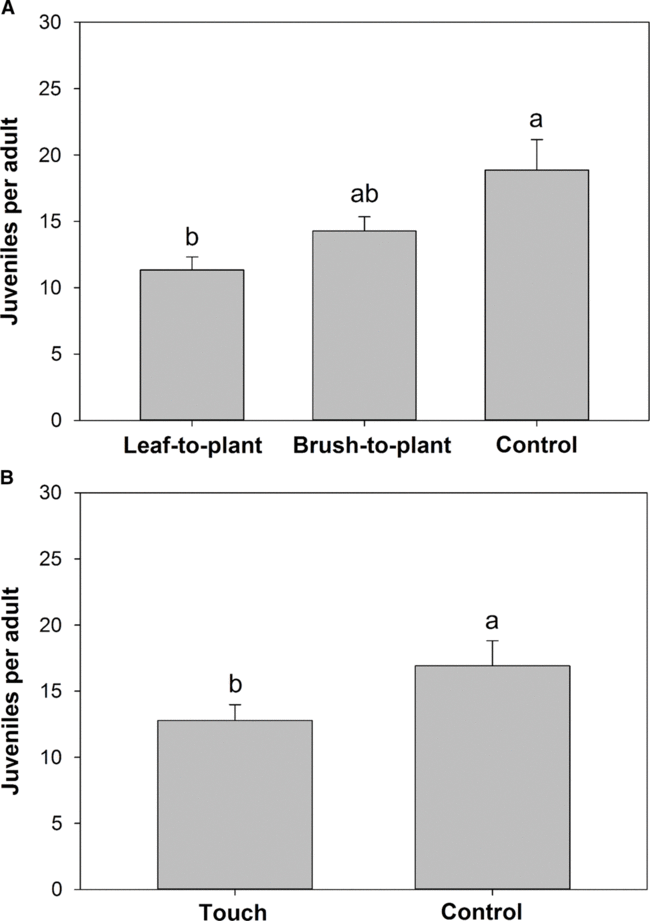
After six days of treatment application, we placed four apterous adult pea aphids on each plant and covered the plant and pea aphids with a tube cage. We assessed pea aphid fecundity after three days by recording the number of juveniles and adults on each plant. From the results (Fig. 1), we decided to use a leaf to simulate plant contact in further experiments because leaf-to-plant touching had a clearer difference from the control as compared to the brush.
Pea aphid fecundity after three days on fava bean plants. A, First experiment to evaluate potential methodologies; B, secondary experiment with expanded replication to evaluate pea aphid responses after mechanical stimulation. Different letters denote a significant difference at P ≤ 0.05. Standard error bars are included for each mean.

We therefore conducted a second touch effects experiment with expanded replication to more firmly establish potential indirect effects of leaf-to-plant touching on aphid fecundity. We again planted fava bean plants individually in pots to avoid any touching between plants and started the experiments when leaves were large enough to open and be used for leaf-to-plant contact (approximately nine days). We had seven blocks for this experiment and grew 112 fava bean plants per treatment over all blocks. The number of plants per block changed based on laboratory space, but we averaged 16 pots per treatment in each block.
We used the same procedures from the leaf-to-plant treatment in the first experiment to simulate plant contact from wind. We took a leaf from a live plant and touched all parts of a separate experimental plant for two minutes each day for six days (touch treatment). Plants in the control treatment were not touched. All plants were kept in the same room with the same conditions throughout the experiment.
We placed four apterous adult pea aphids on each plant after six days of treatment application and covered the plant and pea aphids with a tube cage. We assessed pea aphid fecundity after three days by recording the number of juveniles and adults on each plant.
Objective two: wind effects
We used the wind effects experiment to quantify how wind and plant density in a laboratory setting indirectly influenced aphid fecundity. We planted fava bean plants in pots approximately 10 days before starting the experiment. We had five blocks for the experiment and grew fava beans in 45 pots per treatment over all blocks. The number of pots per block changed based on laboratory space, but we averaged nine pots per treatment in each block. We planted either one or three fava beans in each pot and started the experiment when the three plant pots were large enough to touch each other when wind was applied.
To address differences between wind mechanical stimulation from just wind and the mechanical stimulation that would come from wind and plant contact mechanical stimulation, we established four treatments: (1) no wind and one plant per pot, (2) no wind and three plants per pot, (3) wind and one plant per pot, and (4) wind and three plants per pot. We increased the number of plants per pot in treatments two and four to increase the potential for plant-to-plant touching, especially when the pot was being exposed to wind. We observed that fava bean leaves move horizontally, compared to vertically, when exposed to wind. Therefore, placing three plants in close proximity to each other increased the amount of leaf-to-leaf touching compared to pots with only one plant, where the potential for leaf contact is limited due to leaf spacing within a plant. We applied wind to treatments three and four with four oscillating fans set at the four cardinal directions to create wind from all directions. We applied wind to the treatments for two, two-hour intervals a day (09:00–11:00 and 17:00–19:00) at a rate of 4.5 m·s−1 for four days, which was again similar to established methods (Moran and Cipollini Reference Moran and Cipollini1999) except that we doubled the amount of time (one hour to two hours) to ensure a strong effect from wind.
After four days of treatment application, we placed four apterous adult aphids on plants and covered the plant and aphids with a tube cage. In treatments with three plants per pot, we randomly removed two of the plants from the pot by cutting each plant at the base of its stem. Therefore, aphids only had one plant for feeding and reproduction in all treatments. We assessed aphid fecundity after three days by recording the number of juveniles and adults on each plant.
Analyses
We took the total number of juveniles counted on each plant on the third day and divided by the number of adult aphids observed to get an estimate of juveniles per adult for plants in both experiments. For objective one, we used a one-way analysis of variance to compare differences in aphid fecundity between treatments in the first (leaf-to-plant, brush-to-plant, and control) and second (touch and control) touch experiments. For objective two, we used a two-way analysis of variance to compare differences in aphid fecundity between multiple factors (wind and plant density) and their interaction. Before using analysis of variance, we determined that all assumptions had been met. No transformations were necessary. We used block as a random effect and set an α ≤ 0.05 to denote a statistically significant difference. If significant differences were found, we used a Tukey’s honestly significant difference for pairwise comparisons. All analyses were conducted in JMP, version 13.2.1 (SAS Institute 2017).
Results
Indirect effects of plant contact on aphids
In the first experiment, to evaluate potential methodologies, pea aphid fecundity was significantly different (F 2,239 = 6.05, P = 0.003) among treatments (Fig. 1A). Mechanical stimulation in the form of leaf-to-plant touching produced significantly less juveniles than the control in the pairwise comparison, but mechanical stimulation in the form of brushing was not different from either other treatment (Fig. 1A).
In the second experiment with expanded replication of the most effective treatments, pea aphid fecundity was again significantly different (F 1,166 = 5.58, P = 0.02) between the touch treatment (leaf-to-plant mechanical stimulation) and the control (Fig. 1B). The touch treatment had approximately three less offspring per adult compared to the control (Fig. 1B).
Indirect effects of wind and plant density on aphids
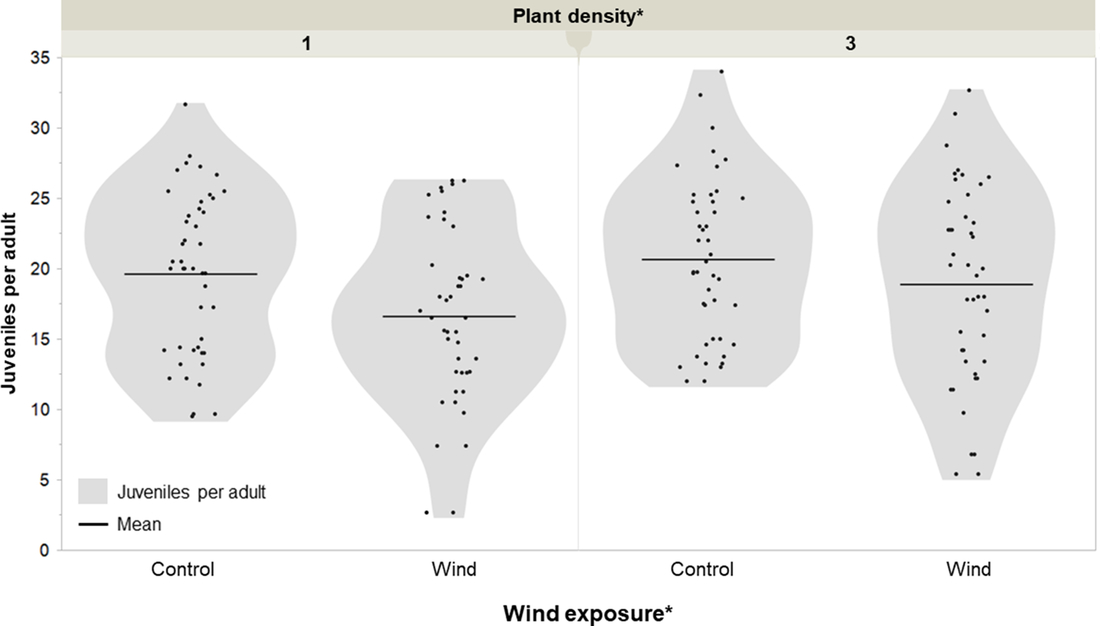
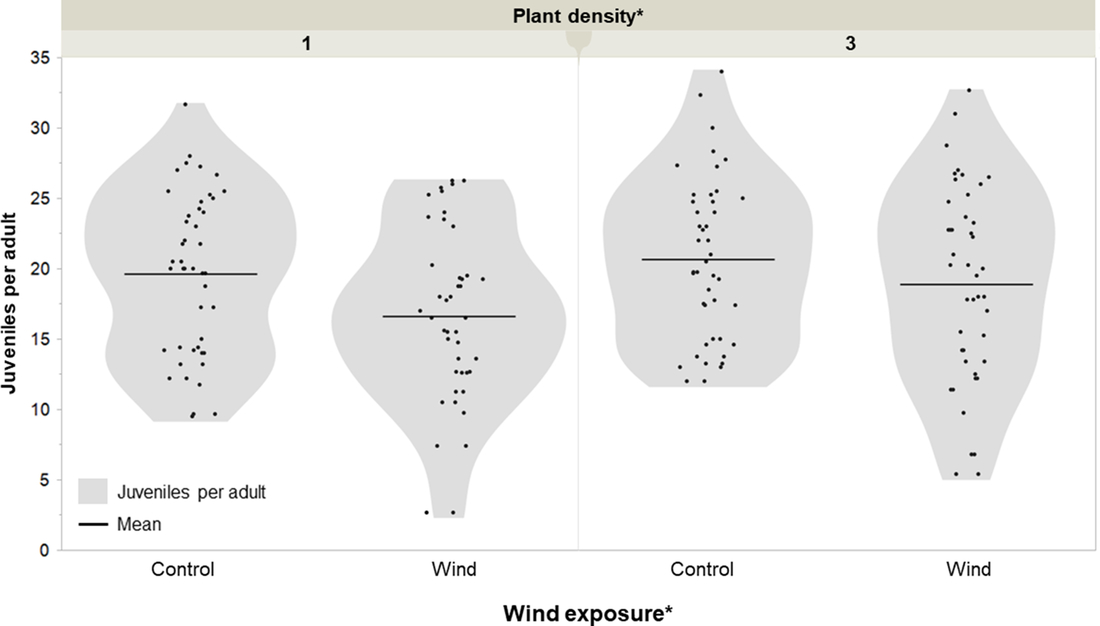
We did not observe an interaction effect of wind and density on pea aphid fecundity (F 7,168 = 0.83, P = 0.36; Fig. 2), indicating that the effect of wind on pea aphid fecundity did not change based on whether the plant was grown alone or with two other plants. Despite a lack of an interaction, pea aphid fecundity was significantly affected by the wind treatment (F 1,168 = 14.3, P < 0.001) and by plant densities (F 1,168 = 3.91, P = 0.05). We found a 11.4% decrease in pea aphid fecundity when plants were exposed to wind compared to no wind (average ± SE: wind 17.8 ± 0.70 versus no wind 20.1 ± 0.61). Across wind treatments, we found a 9.4% increase in aphid fecundity when comparing plants grown alone compared to three plants per pot (average ± SE: one plant 18.1 ± 0.64 versus three plants 19.8 ± 0.68).
Pea aphid fecundity after three days on fava bean plants that were in one of four treatments. Treatments were arranged as a 2 × 2 factorial with plants either exposed to wind or no wind crossed by plants either grown with one or three plants per pot. Treatment means are represented with a black horizontal bar. The responses of pea aphids on each plant are shown with separate circles, with responses grouped by treatment (jittering within treatment to help show each point). Violin plots (grey shading in each treatment) show the distribution of points within each treatment with the widest points showing the areas with the most points. Asterisks denote a significant difference at P ≤ 0.05 for both wind exposure and plant density treatments. There was no significant interaction between wind and density.
Discussion
A variety of climatic changes are expected to impact organisms in the future, including reduced average wind speeds (Cherry and Barton Reference Cherry and Barton2017). Research thus far indicates that wind could have direct and indirect effects on herbivorous insects. However, relatively little is understood about the different types of indirect effects of plant–insect interactions that may come from decreasing winds (de Langre Reference de Langre2008), and the available research is inconsistent in methodology and results (e.g., Cipollini Reference Cipollini1997; Barton Reference Barton2014). Our results showed another plant-herbivore system where changing wind can indirectly impact aphid fecundity through their host plants. We observed that mechanical stimulation in the form of plant contact and wind from fans both significantly reduced pea aphid fecundity compared to control treatments. However, in the second experiment, we did not find an interaction between wind and the ability for increased plant contact. These results further the idea that future reduced winds could alter pea aphid populations, but more research is necessary to determine exactly how wind and its different aspects may ultimately affect aphids.
We found that pea aphids had reduced fecundity when placed on plants previously exposed to mechanical stimulation from either leaf-to-plant contact or wind from a fan. Plants undergo physiological changes (e.g., increased lignification) when these are mechanically stimulated that help them withstand additional stressors (Gardiner et al. Reference Gardiner, Berry and Moulia2016). These types of stress-induced changes to the plant are likely the reason we saw an effect even though we released aphids on plants after treatments were applied. Plants can respond differently to several types of mechanical stimulation (e.g., Anten et al. Reference Anten, Alcalá-Herrera, Schieving and Onoda2010), but it was not clear if pea aphids would show similar responses to different types of mechanical stimulation. The only previous study that included multiple types of mechanical stimulation (wind or mechanically moving the plant) failed to find a plant-mediated effect of mechanical stimulation (Barton Reference Barton2014). In contrast, pea aphids in this study consistently had reduced fecundity on mechanically stimulated plants treated with either touch or wind. Differences in responses across studies could be due to differences in aphid or plant species, type of mechanical stimulation, or intensity and duration of mechanical stimulation. Future studies could address such differences specifically by designing experiments to test a range of techniques, species, intensities, and experiment settings (laboratory versus field) simultaneously.
Aphid fecundity was reduced by wind-induced mechanical stimulation from a fan and plant density (one versus three plants per pot), but pea aphid fecundity was not impacted by the interaction of these two treatments. We hypothesised that fecundity would be significantly influenced by the interaction of wind and plant density due to our results from the touch experiment, as we would expect increased mechanical stimulation by having both wind and plant-to-plant touching when there were multiple plants in the same pot. There was a significant effect of both factors even though the magnitude of each effect was modest. However, we did not find evidence for an interaction on pea aphids, which is similar to results observed for plant responses to multiple stressors (e.g., Atkinson and Urwin Reference Atkinson and Urwin2012). While we did not measure plant characteristics such as lignin or soluble peroxidase, such additional information could help determine the plant-specific responses to plant contact and wind combinations (e.g., Moran and Cipollini Reference Moran and Cipollini1999) and potentially help explain pea aphid responses. More explanations may also come from better understanding the tremendous variation in pea aphid responses (Fig. 2) and whether there was something different about pea aphids that showed particularly low fecundity when exposed to wind.
Our results suggest that decreasing winds could alter pea aphid populations in the future. However, to predict what may happen in the field, additional aspects need to be considered. For example, how will the controlled treatments in the laboratory translate to what plants experience in the field? Laboratory experiments are often less extreme than field conditions and may not reflect realistic scenarios (Markovic et al. Reference Markovic, Glinwood, Olsson and Ninkovic2014), including the increased variation in abiotic conditions such as wind. Moreover, we only explored the indirect relationship between wind and pea aphids through their host plant. Besides wind potentially altering the pea aphids themselves, aphids are part of complex food webs that include other organisms such as predators. In less windy conditions, predators can increase their ability to find prey species (Chen et al. Reference Chen, Biere, Gols, Halfwerk, van Oers and Harvey2018), including aphids (Barton Reference Barton2014). Therefore, reduced winds may decrease the ability of plants to withstand pea aphid infestations, but reduced winds could also increase predator success while also changing other biotic interactions.
Ecologists often investigate how organisms respond to abiotic factors, especially as global change alters the typical range of parameters (e.g., increasing drought conditions). In doing so, we continue to understand the relationship between organisms and changing abiotic factors (Parmesan et al. Reference Parmesan2006; Bornette and Puijalon Reference Bornette and Puijalon2011), and it becomes clearer that one metric alone is not always suitable for realising the potential ways abiotic factors influence certain species. For example, increased average temperature is one metric often used to study the impacts of climate change. However, the increase in average temperature may not be as important as the variation in temperature (Vasseur et al. Reference Vasseur, DeLong, Gilbert, Greig, Harley and McCann2014) or the timing of temperature increases (Speights et al. Reference Speights, Harmon and Barton2017). Consequently, more emphasis has been placed on understanding the complex dynamics of abiotic factors such as when and how those factors are expected to change instead of just using the general direction of change. In that same way, our results highlight how wind can be a complex abiotic factor – potentially involving mechanical stimulation through wind moving a plant or touching other plants, with results potentially dependent on the specific details of how wind treatments are simulated. Therefore, understanding wind–plant–insect interactions would benefit from research that measures how various types of mechanical stimulation under different parameters (e.g., plant density, temperature, and timing) influence plant physiology and indirect insect responses.
Conclusions
We found pea aphids were negatively influenced by mechanical stimulation (wind and plant contact) indirectly mediated by their host plants. However, the two types of mechanical stimulation did not have an interactive effect on pea aphids. These results inform wind–plant–insect interactions, which have previously produced varying results. The different techniques used for mechanical stimulation impacted pea aphids similarly and may indicate a relatively generalised response from the pea aphid perspective. Consequently, pea aphid infestations could potentially increase in the future. As average wind speeds decrease in response to global change, it is increasingly necessary to understand direct and indirect effects of abiotic factors on organisms, including more research to compare techniques and incorporate additional factors that will undoubtedly influence wind–plant–insect interactions in the field.
Acknowledgements
We would like to thank Momina Chaudhry and Dhruvika Patel for their work on experiments as part of the North Dakota Governor’s School programme. We also appreciate Candida Braun and the programme itself for their support. We would also like to thank Jamie Kopco, Ashley Dew, and other members of the Harmon Laboratory for their help. Helpful comments were also provided by the editor and anonymous reviewers. Funding for this project was provided by the North Dakota Governor’s School and United States Department of Agriculture, National Institute of Food and Agriculture Hatch Project number ND 02391.