Introduction
The World Alzheimer's report estimates that the total number of people living with dementia worldwide was 35.6 million in 2009 and this is expected to reach 115.4 million in 2050 (World Health Organization, 2012).
Dementia can lead to serious cognitive impairments, behavioral changes, increased dependency, and caregiver burden, which in turn increase the likelihood of need for institutional care (World Health Organization, 2012). Data from the United Kingdom (UK) suggest that a third of people who have dementia reside in a care home (Knapp et al., Reference Knapp2007) and at least two-thirds of people living in care homes have dementia (National Audit Office, 2007).
Concerns regarding the skills, training, and consequent ability of the workforce to deliver dignified and appropriate care to people with dementia continue to be articulated (Fujisawa and Colombo, Reference Fujisawa and Colombo2009; Rycroft-Malone et al., Reference Rycroft-Malone2014). It is evident that appropriate workforce development approaches are required to nurture and support the consistent delivery of quality care in these settings (Department of Health, 2013).
Person-centered care is a philosophy of care espousing a group of core values focused on the promotion of quality of life and the recognition of the essential humanity of all people (Brooker, Reference Brooker1995; Reference Brooker2003; Kelly, Reference Kelly2010). Instead of assuming a trajectory of irrevocable decline related to neurodegenerative changes, person-centered care recognizes that the individual's response to dementia is not solely determined by neuropathology but also by psycho-social factors (Kitwood and Bredin, Reference Kitwood and Bredin1992).
Kitwood's extensive work on person-centered care led to the development of Dementia Care Mapping: A structured observational tool that aims to operationalize and sustain person-centered care in formal care settings (Kitwood and Bredin, Reference Kitwood and Bredin1992). The tool can be used either as an assessment of residents’ well-being and quality of life or as an intervention to promote practice change.
The use of Dementia Care Mapping as an intervention involves a cycle of five components: (1) briefing, (2) observation, (3) analysis, (4) feedback, and (5) action planning. It usually comprises one or two trained observers sitting in areas such as a lounge or dining area and observing what happens to people with dementia over the course of a typical day. At the end of a period of observation the results are fed back to staff and afterward a number of action plans are developed by the staff team, with the purpose of implementation over an agreed period. This cycle is repeated at regular intervals (usually every 4–12 months) to monitor progress and identify new action plans.
Dementia Care Mapping has been used reportedly successfully over the last 20 years (Beavis et al., Reference Beavis, Simpson and Graham2002; Brooker, Reference Brooker2005). Although the wide range of validated tools reported in the literature (The Health Foundation, 2014), Dementia Care Mapping provides a means to gather in depth information that allows moving dementia care from a task-focused model into one that respects people living with dementia as human beings (Brooker, Reference Brooker2005). There are very few other observational tools that aim to do this (The Health Foundation, 2014) and only Dementia Care Mapping has been recognized in key policy and guidance. For example, the Social Care Institute for Excellence and National Institute for Health and Clinical Excellence (2006) guideline on supporting people with dementia and their carers in health and social care discusses the role of Dementia Care Mapping in changing practice. Also, the National Audit Office (2010) report on improving dementia services in UK recognizes Dementia Care Mapping as a method for measuring quality of life.
Dementia Care Mapping reportedly has strong face validity within the practice field (Cooke and Chaudhury, Reference Cooke and Chaudhury2013). Those who have conducted research into the tool have demonstrated its usefulness as an audit tool (Brooker et al., Reference Brooker, Foster, Banner, Payne and Jackson1998; Martin and Younger, Reference Martin and Younger2001), and a number of anecdotal reports described its value in improving residents’ well-being (Brooker et al., Reference Brooker, Foster, Banner, Payne and Jackson1998; Martin and Younger, Reference Martin and Younger2001; Brooker, Reference Brooker2005) and helping staff see care from the point of view of the person with dementia (Mansah et al., Reference Mansah, Coulon and Brown2008). Yet, the evidence to support its effectiveness as an intervention is still limited.
Aims of this systematic review
The purpose of this study was to undertake a systematic review in order to identify the extent and nature of evidence to support the use of Dementia Care Mapping as an intervention in care settings.
Methods
Search strategy
We searched PubMed, Web of Knowledge, CINAHL, PsychINFO, EBSCO, and Scopus with no restrictions on date of publication for papers published in English using the terms “Dementia Care Mapping” and/or “DCM” up to January 2017. References of included papers were hand searched for additional papers meeting the inclusion criteria.
Inclusion and exclusion criteria
We included studies that fulfilled the following criteria:
-
• primary research studies, which used Dementia Care Mapping as an intervention;
-
• involved observation of people with a diagnosis of dementia living in care homes.
Studies were excluded if they
-
• used Dementia Care Mapping as an outcome measure only or as an audit tool;
-
• secondary research (e.g. editorials, commentaries to articles, study protocols) and abstracts of communications or meetings;
-
• explicitly stated to involve participants with conditions other than dementia (e.g. people with learning disabilities).
Study selection
Titles and abstracts of studies were read and screened by the first author. Subsequently, full-text articles were screened and independently selected for inclusion in the systematic review by two authors (AB and AB) based on the eligibility criteria. Discrepancies within selection were discussed and resolved by consensus.
Assessment of quality
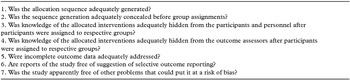
Two researchers (AB and KL) independently assessed the methodological quality of the papers using the Cochrane Risk of Bias Tool (Higgins and Green, Reference Higgins and Green2011). This assessment takes into account the risk of bias of randomized controlled trials (RCTs) and addresses the following types of biases: selection bias (method of randomization, allocation concealment), performance bias (blinding of participants, personnel, and outcome assessors), attrition bias (incomplete outcome data), and reporting bias (selective outcome reporting). The tool was not developed with non-randomized controlled trials in mind, however, the general structure of the tool and the assessments have been considered useful to follow whether allocation is randomized or not (Higgins and Green, Reference Higgins and Green2011). A list of the seven items is presented in Table 1.
Criteria used in quality assessment of (non) randomized studies

The decision whether each item was fulfilled or not was based on the information provided in the paper. Authors of studies were also contacted if there was missing data or need for further methodological details. We gave one point for meeting each of the criteria, with each study then assigned a quality rating score from 0 to 7, and higher scores indicating higher quality studies. The two researchers compared their ratings, discussing any difference of view and through this reaching consensus.
Results
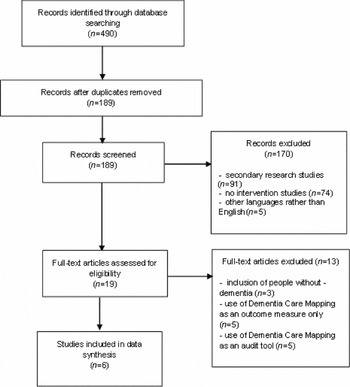
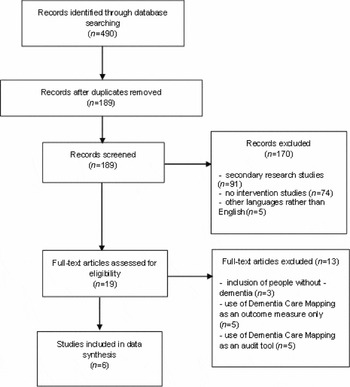
A total of 490 references were identified through the initial literature search. After duplicates were removed, the title and abstract of 189 records were screened for content, with application of study inclusion/exclusion criteria resulting in 183 of these being excluded. The final search yield was six studies (see Figure 1).
PRISMA diagram.
Study design and quality
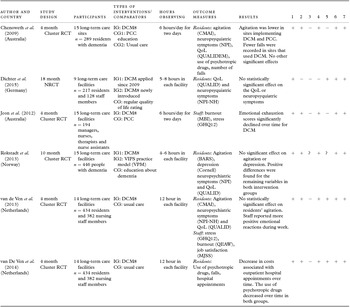
The characteristics and quality ratings for the six identified studies are detailed in Table 2. Five were large scale, RCTs (Chenoweth et al., Reference Chenoweth2009; Jeon et al., Reference Jeon2012; Rokstad et al., Reference Rokstad2013; van de Ven et al., Reference van de Ven2013; Reference Van De Ven2014) and one was a quasi-experimental study (Dichter et al., Reference Dichter2015). For all studies, it had not been possible to blind staff and residents in homes where mapping was taking place due to the nature of the intervention. All studies reported data on whether any changes were maintained after a period of follow-up and five took steps to ensure that the assessment of outcomes was carried out by assessors blind to care mapping allocation (Chenoweth et al., Reference Chenoweth2009; Jeon et al., Reference Jeon2012; Rokstad et al., Reference Rokstad2013; van de Ven et al., Reference van de Ven2013; Reference Van De Ven2014). Three studies described following an intention-to-treat analysis plan (van de Ven et al., Reference van de Ven2013; Reference Van De Ven2014; Dichter et al., Reference Dichter2015), and in three studies details of attrition were reported (Chenoweth et al., Reference Chenoweth2009; Jeon et al., Reference Jeon2012; Rokstad et al., Reference Rokstad2013).
Study characteristics

RCT: Randomized Controlled Trial; NRCT: Non-Randomized Controlled Trial; IG: Intervention Group; CG: Control Group; DCM: Dementia Care Mapping; PCC: Person-centered care; QoL: Quality of Life; CMAI: Cohen–Mansfield Agitation Inventory; NPI: Neuropsychiatric Inventory; QUALID: Quality of life in Late Stage Dementia; GHQ12: General Health Questionnaire; QEAW: Questionnaire about Experience and Assessment of Work; MJSS: Maastricht Job Satisfaction Scale for Healthcare; + low risk of bias; − high risk of bias;? unclear risk of bias
Impact of Dementia Care Mapping on people living with dementia
Agitated behaviors (n = 3)
The number of agitated behaviors in people with dementia who had been observed was the primary outcome in three studies (Chenoweth et al., Reference Chenoweth2009; Rokstad et al., Reference Rokstad2013; van de Ven et al., Reference van de Ven2013).
There was mixed evidence about the impact of Dementia Care Mapping on this variable. The high-quality study of Chenoweth et al. (Reference Chenoweth2009), conducted for four months in 15 Australian residential facilities found that after using the Cohen-Mansfield Agitation Inventory (CMAI): agitated behaviors significantly increase in the control group – usual care sites (i.e. settings that maintained usual-care practices) – during the study period and persisted at follow-up (p = 0.03); at four month follow-up assessment, and compared to usual care sites, significantly less agitated behaviors were recorded in the sites providing Dementia Care Mapping (mean difference between groups: 10.9, confidence interval (CI) (0.7, 21.1), p = 0.04) and person-centered care education (mean difference between groups: 13.6, CI (3.3, 23.9); p = 0.01).
Rokstadt et al. (Reference Rokstad2013), after conducting a 10-month RCT in Norway, observed that the numbers of agitated behaviors using the Brief Agitation Rating Scale (BARS) decreased over time in both intervention groups (i.e. Dementia Care Mapping and VIPS Practice Model (VPM).Footnote 1 However, no statistically significant differences were found between the control (education about dementia) and the intervention groups (Dementia Care Mapping versus control: −2.0, CI (−5.1; 1.1), p = 0.19; and VPM versus control: −1.1, CI (−3.8; 1.6), p = 0.42).
After implementing Dementia Care Mapping for four months in 11 care homes in the Netherlands, van de Ven et al. (Reference van de Ven2013) observed that residents’ agitated behavior using the CMAI slightly increased over time in Dementia Care Mapping sites. Yet, no significant differences between the intervention and the usual care sites were found (mean difference between groups: 2.4, CI (2.7−7.6), p = 0.34).
Neuropsychiatric symptoms (n = 4)
Four studies used the number of neuropsychiatric symptoms displayed by residents as a secondary outcome (Chenoweth et al., Reference Chenoweth2009; Rokstad et al., Reference Rokstad2013; van de Ven et al., Reference van de Ven2013; Dichter et al., Reference Dichter2015). Further mixed evidence on the impact of Dementia Care Mapping upon residents was reported.
Rockstadt et al. (Reference Rokstad2013) observed that the neuropsychiatric symptoms, as measured with the Neuropsychiatric Inventory (NPI), were significantly reduced at 10 months follow-up for both the intervention groups (Dementia Care Mapping versus control: −2.7, CI (−4.6; −0.7), p = 0.01 and VPM versus control −2.4, CI (−4.1, −0.6), p = 0.01).
In Chenoweth et al. (Reference Chenoweth2009), a non-significant increase of neuropsychiatric symptoms was noticed immediately after implementing Dementia Care Mapping; this was followed by a slightly decrease at four months’ follow-up. Residents’ symptoms significantly improved over time in sites providing person-centered care education (p = 0·04).
Through a quasi-experimental study conducted over 18-months in nine German care homes, Dichter et al. (Reference Dichter2015) found that the residents’ symptoms were both reduced in sites where Dementia Care Mapping had been newly introduced and in settings where a standardized quality of life rating had been integrated into the usual care (control group). No statistically significant differences were obtained (p = 0.23).
van de Ven et al. (Reference van de Ven2013) found that, compared to usual care, significantly more neuropsychiatric symptoms were recorded in sites providing Dementia Care Mapping (p = 0.02) after using the Neuropsychiatric Inventory-Nursing Home questionnaire (NPI-NH).
Quality of life (n = 4)
Four studies assessed residents’ quality of life with proxy measures (i.e. residents’ quality of life was rated by care staff) (Chenoweth et al., Reference Chenoweth2009; Rokstad et al., Reference Rokstad2013; van de Ven et al., Reference van de Ven2013; Dichter et al., Reference Dichter2015).
Rockstadt et al. (Reference Rokstad2013) found that during the 10 months from baseline to follow-up, the observed quality of life measured in the control group deteriorated significantly more than in the Dementia Care Mapping intervention group (mean difference between groups: −3.0, CI (−5.5, −0.6), p = 0.03).
In Chenoweth et al. (Reference Chenoweth2009), a slight increase in residents’ quality of life was observed in the Dementia Care Mapping intervention group, yet no significant differences were reported when compared to usual care.
van de Ven et al. (Reference van de Ven2013) found a poorer quality of life over time in both intervention and control groups (p = 0.01) and according to Dichter et al. (Reference Dichter2015) a non-significant decrease in residents’ quality of life was found in intervention groups between baseline and the 18-month follow-up.
Depression (n = 1)
One study reported data on the levels of depression among residents (Rokstad et al., Reference Rokstad2013). A significant increase in the rate of depression was observed in sites providing Dementia Care Mapping after using the Cornell Scale for Depression in Dementia (p > 0.01). Residents’ depression for the VPM intervention was significantly reduced compared with the usual care (−2.6 CI (−4.8, −0.4), p = 0.02).
Use of psychotropic drugs, number of falls, and admission to hospitals (n = 2)
Two studies reported data on the use of psychotropic drugs with residents, number of falls and rates of admission to hospitals (Chenoweth et al., Reference Chenoweth2009; van De Ven et al., Reference Van De Ven2014).
Chenoweth et al. (Reference Chenoweth2009) found that the proportion of residents experiencing falls significantly decreased from baseline to follow-up with Dementia Care Mapping, whereas it increased with person-centered care education and usual care (mean difference between Dementia Care Mapping and usual care: 0.24, CI (0.08–0.40), p = 0.02). Statistically significant group effects was also detected for the use of antipsychotic drug doses, which were higher in person-centered care sites than in either Dementia Care Mapping or usual care sites at baseline and follow-up.
van de Ven et al. (Reference Van De Ven2014) found a significant reduction in the use of psychotropic drugs in both intervention and control groups (p = 0.01) and reduced rates of hospitalization over time following the use of Dementia Care Mapping (p = 0.05).
Impact of Dementia Care Mapping on care workers
Stress and burnout (n = 2)
Two studies reported data on levels of stress in care workers using the General Health Questionnaire-12 (GHQ-12) (Jeon et al., Reference Jeon2012; van de Ven et al., Reference van de Ven2013).
Both studies found a decline in stress over time in intervention and control groups; this decline was statistically significant in the study of Van de Ven et al. (Reference Van De Ven2014) (p < 0.01).
Jeon et al. (Reference Jeon2012) also measured staff burnout with the Maslach Burnout Inventory and noted that emotional exhaustion was significantly reduced over time after using Dementia Care Mapping compared to usual care (F[2.82]= 5.49, p = 0.006). Using the Questionnaire about Experience and Assessment of Work, van de Ven et al. (Reference van de Ven2013) observed that care workers in the intervention group reported significantly less negative emotional reactions, such as nervousness and more positive reactions, such as optimism, over time than care workers in the control group (p = 0.03).
Job Satisfaction (n = 1)
One study measured care workers’ job satisfaction using the Maastricht Job Satisfaction Scale for Healthcare (van de Ven et al., Reference van de Ven2013). Staff in the Dementia Care Mapping group was slightly more satisfied with their job over time than the control group. However, no significant changes between groups were found (p = 0.069).
Discussion
Key findings
This paper analyzed the findings of studies that had sought to evaluate the potential impact of Dementia Care Mapping when used as an intervention. The six identified studies had measured the effects upon staff and residents. Five of the studies were large-scale and high-quality RCTs as assessed by the authors. Two were conducted in the Netherlands, two in Australia, one in Germany, and one in Norway.
Given the heterogeneity in terms of outcome measures applied across the studies it was not possible to undertake a meta-analysis of the data. This variability in selection of outcome measures reflects the lack of consensus in literature about what the benefits of the Dementia Care Mapping intervention might be.
Findings suggest that Dementia Care Mapping may reduce the use of psychotropic drugs, number of residents' falls, and rates of admission to hospitals. There was also at least one high-quality study reporting significant positive effects of Dementia Care Mapping on residents' agitated behaviors, neuropsychiatric behaviors, and quality of life. These are promising early results that indicate the consciousness-raising impact of this intervention and suggest that Dementia Care Mapping can make a difference to the quality of care and hold benefits for people with dementia. Yet, further research to confirm and extend this evidence is needed. The fact that not all studies reported positive effects may have several explanations. First, used outcome measures may lack responsiveness to changes over time. For example, the CMAI asks participants to rate the frequency of residents’ behaviors over the last two weeks, which can be a short period of time to capture meaningful changes. Second, studies did not take into consideration the residents’ perspective, which is reflected in the repeated incidence of care workers’ perspectives prioritized over the perspectives of people with dementia (e.g. quantitative measures of quality of life were all assessed by a third part). This is important, as it cannot be assumed that a good outcome for care workers invariably equates to a good outcome for people with dementia. Third, all studies relied on quantitative data; the use of qualitative data meets recent calls for more mixed methods in the field of practice research, as these can produce more in depth findings. Finally, there may have been contextual elements that could conceivably explain some of the differences found across studies. The effect of culture contexts (e.g. staffing levels, levels of work-related demands, or support from managers) requires further research.
Two studies provided some indication that Dementia Care Mapping may reduce care workers’ stress and burnout. This finding is encouraging and highlights that Dementia Care Mapping as an intervention can offer a better preparation for the challenging task of providing dementia care, enabling staff to become more at ease with their role, and with less personal impact on themselves. It also suggests that by taking part in Dementia Care Mapping, care workers are able see the direct effect of their practices on those in their care, and could take positive actions. These changes in work practices are indicative of the consciousness-raising impact of this intervention. Still, studies assessing staff outcomes are still erratic and further research is needed.
Despite the time Dementia Care Mapping has been in existence, this research field within dementia care research is rather limited. There are two potential reasons for the lack of studies on the topic: (i) practical and methodological challenges may hinder the implementation and assessment of Dementia Care Mapping; and (ii) Dementia Care Mapping as an intervention has been used, but results have not been published; this might be explained by the fact that most Dementia Care Mapping users are social/healthcare practitioners without a research background.
The Universities of Bradford and Leeds are currently conducting a large cluster-RCT in British care homes (the EPIC trial), which will almost certainly provide more in depth data about the impact of Dementia Care Mapping on both care workers and people living with dementia (ref. ISRCTN82288852).
Strengths and limitations
Due to our inclusion/exclusion criteria, we reviewed a relatively small number of studies and their heterogeneity, in terms of outcome measures, made it difficult to come to firm conclusions regarding the effectiveness of Dementia Care Mapping as an intervention. We recognize that bias may exist, as only studies published in English and in scholarly peer-reviewed journals were included. It must be acknowledged that these could represent a biased sample of the studies undertaken on this topic. Despite the limitations, this has been, to our knowledge, the first systematic review assessing the impact of the Dementia Care Mapping intervention on both care workers and people living with dementia.
Implications for practice
It is premature to provide a conclusive indication of the effectiveness of this intervention on care workers or people living with dementia. While the evidence base for the impact of Dementia Care Mapping is limited, high-quality studies do exist. Cost-effectiveness studies are lacking; this gap needs to be addressed as this may determine whether or not a care home will adopt Dementia Care Mapping.
Implications for research
The major work ahead is to continue to raise the care of people living with dementia in care settings and improve the experience and knowledge of care staff. We would argue that the present review has provided important insights into the potential value of Dementia Care Mapping as an intervention designed to support care staff and people living with dementia, and how this might be developed in the future.
Any future research should seek to evaluate a wider range of outcomes (e.g. residents’ well-being and mood). Besides, all studies used quantitative methods which may not have been specific enough to pick up subtle changes. Further research combining quantitative with qualitative methods is needed in order to get more in depth data. It has been observed that the impact of Dementia Care Mapping depends upon the context in which it is used (e.g. staffing levels, levels of work-related demands, or support from managers) (Surr et al., Reference Surr2015). Thus, exploring the elements of culture change, processes, and supportive mechanisms used by care settings to support regular Dementia Care Mapping activity would be beneficial to understanding the optimal setting conditions. Finally, limited data were collected on what care workers changed as a result of the intervention or if the cycle of five components was implemented as intended. Hence, when care workers’ behavior is not measured, it is unclear whether the intervention has been unsuccessful because of implementation error or because the care worker´ behavior has changed but has not brought about the desired improvement in residents (Low et al., Reference Low2015). Addressing the barriers and facilitators proactively as part of the intervention design may increase the chances of success.
Conclusion
Existing studies on the impact of Dementia Care Mapping as an intervention consist mainly of large-scale and good-quality trials that provide a reliable source of evidence. This review has indicated that there is promising evidence that Dementia Care Mapping may reduce care workers’ stress and burnout and benefit people with dementia in a range of ways; for example by reducing agitated behaviors, neuropsychiatric symptoms and falls, and improving quality of life. Future research should build on some of the successful studies to date, improving methodologies where necessary and using other outcomes to better understand the benefits of Dementia Care Mapping on both staff and people with dementia.
Conflict of interest
None.
Description of authors’ roles
A. Barbosa drafted the paper, read, and screened titles and abstracts of studies. A. Blighe independently read potential studies. K. Lord rated the quality of included studies and critically revised the paper. G. Mountain critically revised the paper and gave final approval for this version to be published.