Introductory notes
This essay has a double purpose: to deliver a short history of the Theatre Historiography Working Group in IFTR/FIRT and to present its contributions to the development of theatre studies over the last two decades. In writing the essay, the authors have been in close dialogue with numerous colleagues and members of the group. Without their contributions, this essay could not have been completed. However, the authors are aware that self-reflection and self-description are always problematic and often unreliable modes of reporting. No witness is completely reliable; no document explains itself; no historian is free of interpretative assumptions and agendas that may distort the historical inquiry. For this reason our compilation of information is (without doubt) incomplete, and our judgements are open to critique. But whatever the limitations, we believe that in the main we have identified and represented many of the significant activities and achievements of the Historiography Working Group. And of paramount importance – our dependence upon our colleagues in writing this essay illustrates an essential trait of the working group: as historians we may do research alone, but we think and write within a community of scholars. Our scholarship takes place within an affiliated network that shapes the key aspects of our research methods and writing (and, equally important, rewriting). Moreover – and this is our thesis and justification for the essay – the transnational communities and networks of the historiography group have not only been beneficial to individual members’ projects but have also contributed to the transformation of historical scholarship in the broadly based discipline of theatre history. In this way the working group has become an invaluable professional home away from home for many of us who have dedicated ourselves to historical inquiry.
How it all began; or, recovering the origin
The embryonic idea for a scholarly ‘working group’ on theatre historiography emerged during the eleventh World Congress of the International Federation of Theatre Research/Fédération internationale pour la recherche théâtrale (IFTR/FIRT), held in Stockholm (29 May–4 June 1989). The title of the conference was New Directions in Theatre Research. Although prior to 1989 there had been growing support for major changes in the Federation (e.g. discussions at the Glasgow World Congress in 1985 for revising the constitution on voting methods for individual members),Footnote 2 the Stockholm conference proved to be a catalyst for the evolution, if not revolution, of the aims and organizational structure of the Federation.
The 1989 conference, organized by Willmar Sauter and his colleagues in the Department of Theatre and Film Studies at Stockholm University, featured twelve keynote speakers and ninety-four papers. Instead of dividing the papers into a series of panels for three or four presenters, the organizers decided to distribute the papers among eight research topics or categories.Footnote 3 By this means, the Stockholm conference established both a new organizational model and a new pattern for intellectual dialogue. The purpose for these topical sessions, as Sauter explained, was to ‘unite the specialists in smaller sections, where seminar-like discussions could take place to provide an intimate atmosphere for the exchange of ideas, the presentation of work in progress, and the testing of new approaches and perspectives’.Footnote 4 Sauter's prescient rationale now appears to be a formula, even a mandate, for the creation of working groups.
Of the eight topical areas, three drew the most papers: theatre history, sociopolitical theatre, and performance theory (with audience reception or perception folded into it). For theatre history there were three separate groups, chaired by Martine de Rougemont, Cesare Molinari and R. W. Vince.Footnote 5 Twelve papers were delivered in each group, which had three meetings, each for three hours. This arrangement, which brought together the same group of scholars over two or three days, provided opportunities for the members of each group to respond to one another's papers and to exchange ideas on methodological issues. Because each paper was read and discussed, the twelve scholars in each group collectively developed some ideas (and debates) on research methods and practices in theatre history. In essence, then, this model for bringing together a group of scholars on a shared topic became – and has remained – the basic model for working groups in the Federation.
One immediate result of the Stockholm conference was the birth of a new working group in performance analysis. It thus has the honour of being the first and oldest of more than thirty working groups that have been created in the Federation over the last two decades. Although the Theatre Historiography Working Group did not get established in 1989, several of the theatre historians who participated in the Stockholm conference began to develop plans for a new working group which would follow the lead of the performance analysis group. But because neither of the small conferences in 1990 (Glasgow) and 1991 (Prague) proved conducive for launching the new working group, the plan came to fruition in 1992 at the IFTR conference in Dublin, held at Trinity College. The Performance Analysis Working Group met the day before the conference officially began, then during the conference various scholars delivered papers on theatre history. On the basis of these presentations, Frank Peeters (Belgium), Thomas Postlewait (USA) and Jean-Marc Larrue (Canada) devised plans for a new ‘theatre historiography symposium’, which had about twenty initial members who wished to study historical issues and questions.Footnote 6 As the 1992 Report of the University Commission reveals, Willmar Sauter, who became the newly elected president, was a leader that year in the birth of the working groups. Supported by a broad range of newer scholars in the Federation (including some members of both the Executive Committee and University Commission), he had begun to implement the organizational ideas that had defined the Stockholm conference.Footnote 7
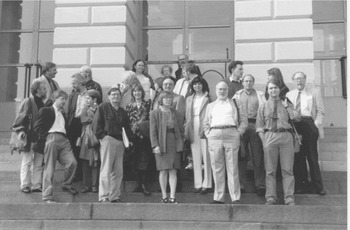
The first complete meeting of the Theatre Historiography Working Group, with a call for papers, took place in August 1993 in Helsinki. Peeters and Postlewait organized the historiography sessions (while Larrue began preparations for the Montreal conference in 1995). The IFTR conference for 1993, originally scheduled for India, had been cancelled, so Pirkko Koski (University of Helsinki) invited the two new working groups to hold their meetings in Helsinki. The Federation's Executive Committee and University Commission were also invited to Helsinki by Koski. Theatre Historiography met on 16–17 August and Performance Analysis on 19–20 August, each with about twenty participants. (See Fig. 1 for a photograph of some participants in both groups.) Because of the separate dates for the two meetings, a few scholars delivered papers in both groups. And most of the participants attended both sessions. The members of the Executive Committee and University Commission met on 18 August (and sometimes concurrently with the working group meetings). They were kept busy planning the 1994 Moscow conference with Alexei Bartoshevitch and crafting a new constitution and guidelines for the integration of working groups into IFTR.Footnote 8 As time allowed, some of the Federation's officers attended the two working-group sessions. Of note, many of the leaders of the Federation for the next two decades, including president Willmar Sauter and future presidents Josette Féral, Erika Fischer-Lichte, Janelle Reinelt and Brian Singleton, participated in the Stockholm, Dublin and/or Helsinki meetings. Likewise, a number of the scholars in the two new working groups served on the Executive Committee during the next two decades. Thus these three gatherings in Stockholm, Dublin and Helsinki proved crucial for the birth of the working groups in IFTR, and these meetings initiated new developments in international scholarship on theatre history and performance studies.
The participants in the symposium and the meeting of the IFTR Executive Committee in Helsinki, August 1993. The symposium included the meetings of the Theatre Historiography Working Group, which at that time was beginning its work, and the Performance Analysis Working Group. Left to right, back row: Martine de Rougemont, Selma Jeanne Cohen, Tom Postlewait; middle row: Gad Kaynar, Dean Wilcox, Henri Schoenmakers, Helen Peters, Ronald Vince, Bruce McConachie, Steve Wilmer, Heta Reitala; front row: Freddie Rokem, Christopher Balme, Willmar Sauter, Janelle Reinelt, Alexei Bartoshevitch, Janne Risum, Pirkko Koski, Michael Anderson, Josette Féral, Laurence Senelick, Tor Trolie, Michael Quinn, Marvin Carlson. Photographer unknown, courtesy of Pirkko Koski.

The Helsinki meeting quickly solidified the standard procedures for the Theatre Historiography (working) group. At each meeting, besides the discussions on each submitted paper, a ‘business meeting’ is held. It provides a record on the current meeting, selects the organizers for the next conference, chooses a possible theme for the next meeting, and attempts to anticipate any special needs or problems (see for example, the Appendix for the locations of meetings, the identities of the organizers and the theme, if there was one, for each gathering of the working group). About six to eight months before a conference, a call for papers goes out to anyone who has shown interest in the group. Over the years, the list of possible participants has continued to grow and change, with about twenty people involved in 1993 and over seventy people by 2009. Typically, ten to fifteen papers are discussed at a historiography group meeting, though the number of participants varies from year to year (as the Appendix reveals).
From the start in 1993, a decision was made that no one would read his or her paper at the group meeting; instead, each year the papers are mailed (or, more recently, electronically distributed) to all of the participants at least a month before the meeting date. The participants read the essays beforehand (admittedly sometimes on the aeroplane). At each meeting a thirty-minute discussion is held on each paper. The author takes only a few minutes to explain the key issues and questions pertaining to his or her paper, then an energetic discussion always follows. A primary challenge for whoever organizes the meeting each year is to keep the participants on schedule so that each of the papers receives a full discussion. The working language of the meetings is English, and the great majority of papers are written in English, though occasionally a paper in French gets submitted. Of note, despite the dominance of English, some papers are subsequently published in another language.
Theatre historiography, not theatre history
The working group is committed to the study of theatre historiography. Although a submitted paper can be written on any possible topic in theatre history, the author is asked to consider the historiographical implications of his or her research projects. As the 1998 announcement stated, the aim of the working group ‘is not primarily to report on results of historical research, but instead on historiographical issues’.Footnote 9 In the discussions on the papers, the basic aim is to discover how and why historiographical factors and concerns contribute to the procedures and aims of the authors. Even though many participants in a specific discussion may lack detailed knowledge of the topic of the paper under discussion, they can still engage in a valuable dialogue by attending to the historiographical issues that pertain to the paper.
Although each essay generates its own historiographical concerns, there are many basic questions that can be applied to any and all essays, as the following catalogue illustrates: how well has an author constructed and used the archival sources? What are the author's methods for identifying and generating evidence? How does the author use (or misuse) analytical and theoretical models? What are the interpretive assumptions and ideas that guide the investigation? How does the author identify, define and apply categorical terminology and concepts (such as period concepts, ideas of agency and change)? How well has the author created and controlled the historical persona in the writing? Does the persona establish and maintain its authority? Do we trust the voice and judgement of the author? What are the argumentative tactics and strategies? How well is the essay organized? How else might it be organized? Does the writing style enhance or diminish the essay? How so and why? What are the narrative tropes and techniques of the essay? Potentially there are many issues to discuss within a half-hour. Some discussions are quite effective, some stumble along in search of the key issues.
In principle the historiographical guideline of the working group has remained an important requirement ever since 1993 – as the published scholarship of the members illustrates. For example, Theatre Culture in America, 1825–1860 (1997) by Rosemarie Bank (USA) was developed in part in the working group. It raises major historiographical issues about the writing of American theatre history and expands the conventional notions of performance by exploring various forms of representation of gender, race and social identity in nineteenth-century America. Bank thus demonstrates the value of presenting cultural history in terms of historiographical reflections.
Since 1993, many scholars, like Rosemarie Bank, have used the working-group discussions to develop and improve their research projects. Some authors have returned to the group over a period of several years, especially to work on a book-in-progress. Others have selectively benefited from the working group, perhaps using it just once or twice to get some feedback on a particular issue or to fine-tune and complete a project. Whatever the purpose and needs, the participants in the working group have usually been able to respond helpfully to a writer's project. Year by year a wide range of scholarship has emerged from these sessions.
For instance, four quite distinct studies of the last decade reveal valuable contributions, large and small, from the working group. New Readings in Theatre History (2003) by Jacky Bratton (UK) investigates the place of theatre and performance within British national culture, especially popular theatre of the nineteenth century. By attending to historical conditions both on and off the stage, Bratton analyses performers and performances. In the process of mapping out a major revisionist genealogy for theatre careers, Bratton delivers the historiographical basis for studying performance practices. Of Borders and Thresholds: Theatre History, Practice, and Theory (1999), edited by Michal Kobialka (USA), explores the interpretive metaphors and concepts of borders and border crossings in theatre studies. The collected essays examine not only specific kinds of closure and opening in theatrical events and practices but also the historiographical methods for interpreting the boundaries and marginal traits of the events and their conditions. The Making of Theatrical Reputations (2008) by Yael Zahry-Levo (Israel) presents a select group of case studies that reveal how the history of London theatre since 1956 has been written and understood. She offers a historiographical analysis of the ways that theatre critics, academic scholars, publishers, media agents, and funding organizations have mediated the historical representations and reputations of key playwrights, productions and theatre companies. And The Cambridge Introduction to Theatre Historiography (2009) by Thomas Postlewait (USA) provides a systematic investigation of the methods, problems and goals of research in theatre history. Dedicated to the basic principles of historiography – and indebted to the scholarship of many of the members of the working group – this book is a microcosm of working-group discussions over the last two decades. It thus may serve both as a classroom textbook for seminars in theatre historiography and as a practical guide for issues and problems in university courses in theatre history.
Despite the focus on historiography in the working group, most of the essays and books published by the members are not exclusively or primarily concerned with historiographical issues, problems, questions and debates. Yet these studies have all benefited from the working-group discussions. The historical topics of these publications vary greatly. The projects include the biography of the Finish writer and dramatist Hella Wuolijoki, Kaikessa mukanaa. Hella Wuolikjoki ja hänen näytelmänsä (2000), written by Pirkko Koski (Finland); a comprehensive study of over five hundred Victorian women playwrights, Women's Theatre Writing in Victorian Britain (2005), compiled and analysed by Kate Newey (UK); an annual record of ticket sales in Rotterdam, “Did Men of Taste and Civilization Save the Stage? Theatre-Going in Rotterdam, 1860–1916” (2003), a statistical analysis by Henk Gras (the Netherlands); and a social and political study of the significance of censorship and symbolic representation in the theatre for young people in Communist Russia, Moscow Theatres for Young People (2006), investigated by Manon van de Water (USA). These are but a few of the representative studies that have developed in the working group since 1993.
As is to be expected, members of the working group have developed various ways to apply and integrate historiographical issues into their research projects. For instance, two studies of performative methods and agendas during the Cold War era not only place the performances within their political contexts but also reveal how and why historiographical assumptions, categories and values operated in the actions of the historical agents. In turn, these two studies also reflect upon the historiographical assumptions, categories and values of the historians themselves.
In Stages of Emergency: Cold War Nuclear Civil Defense (2007) Tracy C. Davis (USA) offers a cross-cultural analysis of the performative traits and missions of civil-defence exercises in the United Kingdom, Canada and the United States during the Cold War era. She presents a political and ethical critique of the performative ideas that guided the organizers of these events, and in the process she considers her own performative ideas that contribute to her critique. And in American Theater in the Culture of the Cold War: Producing and Contesting Containment, 1947–1962 (2003) Bruce McConachie delivers a series of case studies of Cold War ideas and ideologies that shaped American plays and productions at the height of the Cold War. Besides offering a historical analysis of the Cold War mentality that operated at the time, McConachie spells out in his opening section the historiographical models and aims of his analysis. Both Davis and McConachie demonstrate that historical scholarship, besides benefiting from a dedication to archival research, requires an epistemological understanding and interpretation of key historical concepts that determined, in great measure, not only the cultural actions and conditions of a period but also their own historical assumptions and the analytical methods that guide research and writing.
Understandably, the analytical approaches of the working-group scholars represent a cross-section of historical study today. The scholarship is pluralistic. During the last two decades the ‘postpositivist’ approach, as Bruce McConachie termed the new historical scholarship,Footnote 10 has drawn upon various theoretical models for foundational ideas and analytical methods (such as cultural materialism, postcolonialism, post-structuralism, deconstructionism, feminist history and historiography, ethnic and racial studies, theatre semiotics, performance theories, phenomenology, hermeneutics).Footnote 11 Although the Historiography Working Group did not initiate these analytical methods and developments, it did contribute importantly to the international promotion of new approaches to theatre history.
The development of the Theatre Historiography Working Group
In the early years of the group no specific topic was required for the annual meetings. People tended to submit drafts of either separate essays or chapters from books-in-progress. The working group adjusted to whatever project a member wished to submit. But beginning in 1997, with the two meetings in Puebla, Mexico and Helsinki, Finland, a theme was announced for the call for papers, and this practice has persisted to the present day. Sometimes the topic aligns with the conference topic, but often it is quite specific to the historiographical concerns of the group's current members. The annual topic provides not only a control on possible submissions and a focus for discussions but also a way to nudge writers to take up and consider historiographical issues. In this way, the announced topic sets up a ‘crossroads’ at which the discussions of the individual papers intersect. Because recurring themes, issues and problems in historiography tend to emerge, the discussions usually avoid being merely a ‘sieve’ for sifting a dozen or more unrelated topics among the papers.
The announced topics each year concern the fundamental aspects of research methods, including the processes of historical research, analysis and writing. Since 1997 the topics have been quite various: audiences – history and theory (1997); re/writing national theatre histories (1997); borders and boundaries in theatre historiography (1998); narrative models for writing theatre history (1999); acting space and perception (2000); archives (2001); memory and history (2002); evidence and agency (2003); frames and framing (2004); ethics and history (2005); matters and measures of consequence (2006); dynamics of change and processes of erasure and inscription (2007); mechanisms of control and power (2008); naming, mapping and the production of knowledge (2009); and modernity as prejudice (2010).Footnote 12 Besides the focus on research methods and writing procedures, the topics often point to contextual matters, such as organizing concepts and sociopolitical conditions in historical inquiry.
The composition of the group each year is always international. In recent years the group meetings have often featured scholars from Finland, Israel, Ireland, Germany, the Netherlands, Australia, Slovenia, the United Kingdom and the USA. In addition, scholars from several other countries also participate, especially at World Congress meetings, which tend to attract many IFTR members. Every effort is made to maintain a comprehensive mailing list for the working group so that a broad and various community of historians will continue to be involved.
Unlike some working groups, such as the Theatrical Event group, the historiography group does not organize sessions in order to publish a set of essays on a shared theme, written by the group members. The members of the working group have shied away from such publishing temptations. However, an exception to this principle occurred a few years ago. After the meeting of the working group in Helsinki, in 1997, Steve Wilmer (Ireland) proposed and edited a collection of essays entitled Writing and Rewriting National Theatre Histories (2004). This historiographical problem of national histories had emerged repeatedly in submitted papers over the years. But Wilmer did not limit the book to working-group members. His collection also features essays by scholars who are not members of the Historiography Working Group.Footnote 13
As a general guideline, the working group has attempted to maintain an egalitarian principle that invites any interested scholar to submit a paper for a working-group meeting. The only requirement, beyond the annual topic, is that the paper should address, either directly or indirectly, some aspect of historiography. Because publishing is not a factor in the selection of papers each year, the principle of historiographical analysis and critique remains primary. Beyond the exchanges of commentary on papers each year, the contacts among members of the group have encouraged other forms of international cooperation that individual members may wish to develop, ranging from separate publication projects and conferences to the international exchange of university lecturers. For instance, recently Tracy C. Davis co-edited (with Peter Holland) The Performing Century: Nineteenth-Century Theatre's History (2007), a collection of essays on new approaches to nineteenth-century British theatre history. Among the dozen contributors, she tapped several members of the Historiography Working Group for essays.Footnote 14 Likewise, some of the European members of the working group have been active in the Erasmus programmes, which allow for pedagogical partnerships of various kinds in the universities across national lines. Here, too, these partnerships have nothing directly to do with IFTR, but the working group provides a network of scholars in European universities who have, on occasion, reconnected in the Erasmus programmes.
The group also provides an important forum for the exchange of knowledge between younger and older academics. In this spirit of reaching across the generations, the group enables graduate students in the field of theatre history to obtain intellectual support and advice on writing projects, including guidance on where to publish. Thanks to this cooperative principle, a number of younger researchers, who may have first submitted papers to the working group as graduate students, have later joined the core group of permanent members, creating for themselves opportunities to participate in the international community. Then, in subsequent years, some of these younger members have undertaken organizational responsibilities in the group. During the last decade these members have included (but are not limited to) Ken Cerneglia (USA), Leigh Clemons (USA), Jan Lazardzig (Germany), Hanna Korsberg (Finland), Jo Robinson (UK) and Barbara Sušec Michieli (Slovenia).
Throughout its history, the group has successfully balanced the double-edged mission of offering encouragement and appraisal for authors. Only occasionally have discussions become too heated, overly personal or misdirected. The discussions of everyone's papers have been dedicated to support as well as to critique. As Jim Davis recently indicated in an email message to the two authors, ‘the working group has managed to combine academic rigor with a friendly and supportive structure and developed a very effective network’.Footnote 15 Rosemarie Bank, who admires the ways in which the participants have been supportive of one another, lauds the group's ‘collegiality’ – which has been for her ‘the key feature’ in the group's operation and survival.Footnote 16
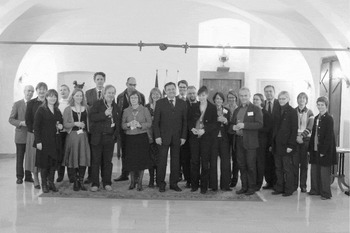
Of special note, unlike most of the working groups in IFTR, the theatre historiography group has sometimes held meetings apart from and in addition to the annual IFTR conference. For instance, in 1997 well over a dozen members gathered in Helsinki, thanks to an invitation and organization by Pirkko Koski. In addition, the group held meetings in Utrecht, the Netherlands (2001, organized by Henk Gras), and Worcester, England (2003, organized by Claire Cochrane). And in 2008, as a supplement to the conference in Seoul, Korea, the Historiography Working Group held a second meeting in Ljubljana, Slovenia (organized by Barbara Sušec Michieli; see Fig. 2 for group photograph for this 2008 meeting.) These separate meetings have often brought together some of the regular members of the group, especially those who have sought additional opportunities to develop work-in-progress. This is yet another way that the community in the working group has developed a strong international network for scholarship.
The meeting of the Theatre Historiography Working Group in Ljubljana, March 2008. Reception given by the mayor of Ljubljana. Left to right, back row: Heikki Koski, Rosemarie Bank, Marja Wilmer, Steve Wilmer, Jan Lazardzig, Kate Newey, Mikko-Olavi Seppälä, Pentti Paavolainen, Eeva Mustonen, Aleš Valič (dean of the Academy of Theatre, Radio, Film and Television, University of Ljubljana); front row: Lucie Sutherland, Jo Robinson, Jim Davis, Pirkko Koski, Zoran Janković (mayor), Barbara Sušec Michieli, Yael Zarhy-Levo, Helmar Schramm, Barbara Orel, Maja Šorli, Marina Gumzi. Photo: Miha Fras. © Miha Fras.

International networking and influence
It is always dangerous to generalize about such a diverse group of scholars as those who participate in the Theatre Historiography Working Group. Still, it is possible to see that a number of theatre historians in the 1990s focused their attention on primary issues in historiography, especially new methods of representing historical events. Matters of historical narrative also received attention. In the search for ‘postpositivist’ models of historical analysis, participants in the group shared, at least in general terms, a basic mission to reformulate the field of research. They diverged, however, on which methods and theories to embrace.
Then, during the last decade, various theatre historians have more often been asking questions about contextual conditions for theatre and performance, including but not limited to the social and political implications of historical research. And perhaps less noticeably, yet still important for the discipline, theatre historians have attempted to convey new knowledge about once-marginalized theatre phenomena, such as civic spectacle and popular culture, although the latter (on such topics as circus and pantomime) is also being addressed by the newly formed Popular Entertainment Working Group, with whom the historiography group held a joint session in Lisbon in 2009. In this project, the broadly defined concept of performance often took precedence over the familiar definition of theatre. Research thus moved beyond the theatre buildings.
Throughout the last two decades, theatre historians have continued to define, describe, analyse and interpret the ideas of ethnicity, gender and the rather comprehensive concept of ‘otherness’. These ideas and issues are notable in postcolonial studies, but for historians they are relevant for all eras and places of theatre throughout the world. Equally consuming for a number of scholars has been the complex issue of national theatre in relation to national identity, especially in the countries where cultural differences and sociopolitical tensions exist between ethnic and language groups. Besides the development of national theatres in various countries during the late nineteenth and early twentieth centuries, this issue has gained new significance in several regions of the world after the Cold War. Political changes after 1989 – that important date again – proved especially relevant with the downfall of communism in the Soviet empire and the establishment of new national states in Central and Eastern Europe. These developments are also related, in various ways, to globalization, the ‘quiet revolution’ of South Africa, the emergence of China as a world power, a new rise in nationalistic discourses, and the war against ‘terrorism’. All of these events and developments have encouraged historians, including theatre historians, to attempt a critical analysis of the complex connections between cultural and political history. In turn, these contemporary occurrences have also challenged historians to rethink some of the past events and the methods of identification as well as the categories of organization. Not surprisingly, then, some members of the historiography group have confronted questions on the nature of historic change, which remains one of the most challenging issues in historical explanation.
Illustrating some of the ways that members of the group have tackled sociopolitical issues in theatre history, Barbara Sušec Michieli has recently edited Mechanisms of Control and Power, a special issue of the journal Amfiteater (2008).Footnote 17 In their award-winning book Reflecting the Audience: London Theatregoing, 1840–1880 (2001), Jim Davis and Victor Emeljanow revitalize audience research by taking a sociological perspective on the diverse theatre communities in the neighbourhoods of London. And Claire Cochrane, who has delivered a set of papers in the working group in recent years, is completing the monograph Twentieth-Century British Theatres: Industry, Art and Empire. It explores the social and economic factors that have shaped the multiple models of ‘British’ theatre in the twentieth century, including amateur and community theatres as well as professional theatre. Not limited to theatre in London, her study examines the multiple ethnicities and cultural interests that shape theatre communities throughout the United Kingdom in modern times. Her research, which attempts to demystify the ‘self-evident’ traditional narratives for British theatre history, directs attention towards fundamental categories of identification and representation in theatre history research.
Although most of the members of the working group come from Western nations, the members of the group recognize the limitations of a ‘Western view’ of theatre history and historiography, especially when the papers and discussions become tied rather exclusively to the national agendas of the scholars. Accordingly, in its closing discussion in 2006 the group members pointed out the need ‘to recognize a non-Eurocentric view of theatre (history)’ in the group deliberations from year to year.Footnote 18 Despite the fact that ‘non-European topics’ are given more attention in recent years than they used to be (and despite the additional fact that IFTR conferences have been held in non-Western countries), the membership of the group remains mostly limited to countries in Europe and North America, with some additional participants from Australia and South Africa. For this reason, the group seeks future cooperation with recently established working groups for Asian, African, and Arabic theatre. These relationships are deemed important for the future of the Historiography Working Group. Another related issue that requires attention is the question of how to shift historical research away from the (traditional) study of national theatres. National theatre history continues to be the fundamental framework for many projects, despite the fact that during the last decades this approach has been extensively and critically reviewed owing to the establishment of new methods such as micro-historical study and poststructuralist deconstruction, for instance. In all likelihood this delicate research field will require new conceptual and theoretical tools if discussions on historiography are to become more inclusive and move beyond immediate national topics.
During the last twenty years the landscape of theatre history – its topics, methods and goals – has changed significantly. The idea of the archive has been radically reformulated (in part because the idea of theatre has been opened up to encompass multiple types, methods and venues of performance). Likewise, the identity of the theatre event – what constitutes it and how to formulate and represent it – has become a sophisticated and often troubling problem in historical inquiry, open to numerous modes of representation and understanding. And the methods for creating (not merely discovering) the cultural, social, political and environmental contexts for theatrical events have become even more complex than the events themselves. Without question, the methods and aims for historical scholarship today require an understanding of multiple interpretive tactics and strategies. For this reason, most theatre historians – especially those who have participated in the working group discussions on theatre historiography – recognize that history and narrative, as Paul Ricoeur, Hayden White and others have demonstrated, are joined irrevocably. This is the case in the archival documents as well as in the representative methods of the historians.
Consequently, the IFTR/FIRT Historiography Working Group, which contributes to the study and dissemination of the principles of theatre historiography, has not only provided an international community for discussing these principles as they operate in the individual scholarship of the participating members, but also contributed to major changes in the writing and teaching of theatre history today. At their best, the scholars in the group have developed an academically demanding approach to historical study. The membership of the group includes authors of seminal essays and books in theatre historiography. Collectively, the members of the group over the last two decades have played an important role in the reformulation of theatre history in the academy. Additionally, during the last few years, the ideas of the working group have contributed to the formation of new undergraduate courses on theatre history and historiography at many universities in the United States, Canada, Australia and greater Europe. Equally important, new seminars at the graduate level in theatre historiography have led to major changes in doctoral programmes in theatre studies.
Finally, the working methods that have been developed by the group have spread to other constituencies, such as the regional and national associations of theatre researchers and similar organizations. For example, the British Theatre and Performance Research Association (TaPRA), established in 2004, started a historiography group based on the IFTR model. Likewise, within Performance Studies International, the group on History in Performative Paradigms, among its several agendas, takes up research issues similar to those pursued by the Theatre Historiography Working Group in IFTR/FIRT. Thus both within and beyond the Federation, this working group, entering its third decade next year, has provided a vital forum in historical methods and understanding for several dozen international scholars, including some of the most notable figures in the field of theatre history. But even more tellingly, the ideas that have developed in the annual meetings and worked their way into the many different publications have helped to transform the cultural history of theatre. Both scholarship and the classroom have benefited directly and indirectly from the Theatre Historiography Working Group. Collectively, these various accomplishments warrant some well-measured praise, especially when we consider that the idea for a working group was born only two decades ago in Stockholm in 1989 – a rather significant year for many developments in the modern world, as history has been demonstrating and helping us to understand.
Appendix: annual meetings of the Theatre Historiography Working Group in the International Federation of Theatre Research/Fédération internationale pour la recherche théâtrale (IFTR/FIRT)
NB: We have provided titles only in English because of the word limit for the essay.
1992: Dublin, Ireland. 29 September–3 October. Conference title: Cultural Politics and the Theatre. Also identified as a ‘Professors’ Conference’ to distinguish the meeting from a full IFTR conference. Conference organizer: Steve Wilmer and members of the Samuel Beckett Centre, Trinity College Dublin. Though the Theatre Historiography Working Group was not yet fully organized before this conference, a number of theatre history papers were delivered. The formation of the working group was officially announced to the Federation's University Commission on 3 October. Working-group conveners: Tom Postlewait (USA); Frank Peeters (Belgium); Jean-Marc Larrue (Canada). Approximately fifteen papers and twenty participants.
1993: Helsinki, Finland. 16–21 August. Off-year symposium (because the planned conference for India had to be cancelled). Meeting of Federation Executive Committee, in conjunction with two working groups: Performance Analysis and Theatre Historiography. Organizer: Pirkko Koski (Finland). Working-group conveners: Tom Postlewait (USA), Frank Peeters (Belgium); Jean-Marc Larrue (Canada). Nineteen papers, approximately twenty-five participants. Historiography papers on 16–17 August; performance analysis papers on 19–20 August. On 22–26 August, a number of members from the two working groups went on a theatre excursion to Estonia, Latvia and Lithuania.
1994: Moscow, Russia. 6–13 June. Conference title: Performance, Past and Present. XII World Congress. Conference organizer: Alexei Bartoshevitch (Russia); FIRT/IFTR liaison administrator: Michael Anderson (UK). Working-group conveners: Frank Peeters (Belgium); Bruce McConachie (USA). The working group sessions were split into three groups in order to accommodate over twenty papers and participants: Erika Fischer-Lichte (Germany) chaired the twentieth-century papers; Bruce McConachie (USA) and Frank Peeters (Belgium) chaired the nineteenth-century papers; Ron Vince (Canada) chaired the pre-nineteenth-century papers.
1995: Montreal, Canada. 21–7 May. Conference Title: Actor, Actress on Stage: Body/Acting Technique/Voice. L'acteur, l'actrice en scène – corps, jeu, voix’. Conference organizers: Jean-Marc Larrue (Canada) and Josette Féral (Canada). Working-group convener: Frank Peeters (Belgium). No working group theme. Approximately eight papers and participants.
1996: Tel Aviv, Israel. 16–21 June. Conference title: Theatre and Holy Scriptures: Ritual and Mythological Dimensions. Conference organizers: Tel Aviv Department of Theatre Studies (including Freddie Rokem and Eli Rozek). Working-group conveners: Tom Postlewait (USA); Frank Peeters (Belgium). No working-group theme. Twelve papers.
1997: Puebla, Mexico. 23–8 June. Conference title: Theatres and Cultures in the World: Theories and Practices in Today's Theatre. Conference organizer: University of Americas–Puebla/Université de las Americas–Puebla. Working-group conveners: Steve Wilmer (Ireland), Frank Peeters (Belgium). Working-group theme: ‘Audiences: History and Theory’. Three participants (who joined six members of the Performance Analysis Working Group in two joint sessions).
Helsinki, Finland. 22–4 August. A separate working-group meeting was held at the resort of Jarvenpaa. Theme: ‘Re/Writing National Theatre Histories’. Organized by Pirkko Koski (Finland). Working-group conveners: Frank Peeters (Belgium), Steve Wilmer (Ireland). Approximately twenty papers, twenty-six participants. Following the sessions, some of the participants took an excursion to St Petersburg.
1998: Canterbury, United Kingdom. 6–12 July. Conference title: Theatre and Theatre Research: Exploring the Limits. XIII World Congress. Conference organizer: Michael Anderson (UK). Working-group conveners: Michal Kobialka (USA), Frank Peeters (Belgium), Steve Wilmer (Ireland), Bruce McConachie (USA). Working-group theme: ‘Borders and Boundaries of Theatre Historiography’. One joint session held with the performance analysis group, then the working group met in separate sessions. Approximately eight papers and thirty participants.
1999: Amsterdam, the Netherlands. 12–14 March. No FIRT/IFTR conference this year. A separate working group meeting was held at the Theatre Institute in Amsterdam. Working-group conveners: Claire Cochrane (United Kingdom), Rosemarie K. Bank (USA), Henk Gras (the Netherlands). Working-group theme: ‘What Are Current Social Models and Narratives for Writing Theatre History’. Over a dozen papers; close to two dozen participants, including some members of the Federation Executive Committee, which also met at this same location and time.
2000: Lyon, France. 18–23 September. Conference Title: Theatre: Sound Space, Visual Space. Conference organizer: Christine Hanon Siréjols (France). Working-group conveners: Rosemarie Bank (USA), Henk Gras (the Netherlands). Working-group theme: ‘Acting Space and Perception’. Seven papers and participants.
2001: Sydney, Australia. 8–13 July. Conference title: Transactions: Culture and Performance. Conference organizer: Jim Davis and John Golder, School of Theatre, Film, and Dance at the University of New South Wales. Theatre Historiography Working Group did not meet in Sydney, though a handful of theatre historians delivered papers at the conference itself.
Utrecht, the Netherlands. 30 August–1 September. A separate working group meeting. Theme: ‘Dealing with the Archive’. Organized by Henk Gras (the Netherlands). Working-group conveners: Henk Gras (the Netherlands), Claire Cochrane (UK), Steve Wilmer (Ireland). Twelve papers, fifteen participants.
2002: Amsterdam, the Netherlands. 30 June–6 July. Conference title: Theatre and Cultural Memory: The Event between Past and Future. XIV World Congress. Conference organizer: Peter Eversmann and colleagues, Department of Theatre Studies, University of Amsterdam. Working-group conveners: Claire Cochrane (UK), Henk Gras (the Netherlands), Steve Wilmer (Ireland). Working-group theme: ‘Memory and History’. Sixteen papers, eighteen participants.
2003: Jaipur, India. 4–10 January. Conference title: Ethnicity and Identity: Global Performance. Conference organizer: Ravi Chaturvedi (India). Theatre Historiography Working Group did not meet in Jaipur, but Claire Cochrane attended as the group representative; she spoke to some delegates about the group and its aims.
Worcester, United Kingdom. 10–12 July. A separate working-group meeting. Theme: ‘Evidence and Agency’. Organized by Claire Cochrane (UK). Working-group conveners: Claire Cochrane (UK), Henk Gras (the Netherlands). Thirteen papers, fifteen participants.
2004: St Petersburg, Russia. 22–7 May. Conference title: Director in the Theatre World. Conference organizer: Alexander Chepurov (Russia). Working-group conveners: Henk Gras (the Netherlands), Claire Cochrane UK). Working-group theme: ‘Frames and Framing’. Fourteen papers, sixteen participants.
2005: College Park, Maryland, USA. 26 June–2 July. Conference title: Citizen Artist. Conference organizer: Frank Hildy (USA). Working-group conveners: Ken Cerniglia (USA), Kate Newey (UK), Barbara Sušec Michieli (Slovenia). Working-group theme: ‘Ethics and History’. Eighteen papers, approximately thirty participants.
2006: Helsinki, Finland. 7–12 August. Conference title: Global vs Local. XV World Congress. Conference organizer: Pirkko Koski (Finland). Working-group conveners: Ken Cerniglia (USA); Barbara Sušec Michieli (Slovenia); Kate Newey (UK). Working-group theme: ‘Measures and Matters of Consequence’. Twelve papers, fourteen participants.
2007: Stellenbosch, South Africa. 10–13 July. Conference title: Theatre in Africa, Africa in the Theatre. Conference organizer: Temple Hauptfleish (South Africa). Working-group conveners: Barbara Sušec Michieli (Slovenia); Hanna Korsberg (Finland); Kate Newey (UK). Working-group theme: ‘Dynamics of Change: Processes of Erasure and Inscription’. Six papers, seven participants.
2008: Seoul, South Korea. 14–19 July. Conference title: Re-constructing Asian-ness(es) in the Global Age. Conference organizer: Chung-Ang University (South Korea). Working-group conveners: Hanna Korsberg (Finland); Jim Davis (UK). Working-group theme: ‘Mechanisms of Control and Power’. Four papers, five participants.
Ljubljana, Slovenia. 28–30 March. A separate working group meeting. Organized by Barbara Sušec Michieli (Slovenia). Working-group conveners: Barbara Sušec Michieli (Slovenia); Hanna Korsberg (Finland); Jim Davis (UK). Working-group theme: ‘Mechanisms of Control and Power’. Fifteen papers, seventeen participants.
2009: Lisbon, Portugal. 14–17 July. Conference title: Silent Voices/Forbidden Lives. Conference organizer: Maria Helena Serôdio (Portugal). Working-group conveners: Jim Davis (UK), Hanna Korsberg (Finland), Jan Lazardzig (Germany). Working-group theme: ‘Naming, Mapping, and the Production of Knowledge’. One joint session held with the popular entertainments group. Eighteen papers, twenty participants.
2010: Munich, Germany. 26–31 July. Conference title: Cultures of Modernity. XVI World Congress. Conference organizer: Christopher Balme (Germany). Working-group conveners: Jan Lazardzig (Germany), Jim Davis (UK), Yael Zahry-Levo (Israel). Working-group theme: ‘Modernity as Prejudice’.