INTRODUCTION
A surge in support among women voters following Hillary Clinton's teary moment is widely thought to have contributed to her win over Barack Obama in the 2008 New Hampshire presidential primary. Fifteen years earlier, in the 1993 Canadian federal election, women voters had been more attracted than men to the two parties led by women (O'Neill Reference O'Neill1998). Under certain conditions, women are more likely than men to vote for women candidates, a phenomenon referred to as a “gender affinity effect” (Dolan Reference Dolan2008; see also Brians Reference Brians2005; Cook Reference Cook, Cook, Thomas and Wilcox1994; Dolan Reference Dolan1998, Reference Dolan2001, Reference Dolan2004, Reference Dolan2010; Goodyear-Grant Reference Goodyear-Grant, Anderson and Stephenson2010; King and Matland Reference King and Matland2003; Paolino Reference Paolino1995; Plutzer and Zipp Reference Plutzer and Zipp1996; Sanbonmatsu Reference Sanbonmatsu2002; Smith and Fox Reference Smith and Fox2001; Tolleson-Rinehart Reference Tolleson-Rinehart1992; Zipp and Plutzer Reference Zipp and Plutzer1985). The mechanisms connecting women voters to women candidates include women voters' gender consciousness, their greater support for liberal social policy, the use of candidate sex as an information shortcut to vote choice, and the “party-sex overlap” (Dolan Reference Dolan2008).
Existing literature, however, has little to say about whether gender affinity effects exist in contexts beyond the American case. There are many countries where women are gender conscious, have demands for descriptive representation, support generous social policy more than men, and need shortcuts to the vote, and in which both women voters and women candidates gravitate in disproportionate numbers toward left parties. But in other systems with similar motivations for gravitating toward women candidates, do women have the same incentives and opportunities to vote for women? The answer likely is no, but institutional variation as a source of contextual effects has been underanalyzed in this area of voting behavior research.
We examine whether gender affinity effects between candidates and voters arise in Westminster-style parliamentary systems, which tend to be comparatively less focused on candidates and more leader and party centered. While local candidates are generally not decisive in Westminster elections, certain voters may be relatively more sensitive to candidate considerations, such as “flexible” voters, a term we use to refer collectively to independents, partisan leaners, and defectors. Voters who do not have strong partisan attachments or who defect temporarily from those attachments may be prime terrain for candidate-focused thinking. Independent voters, for example, tend to rely on assessments of candidate performance because partisan cues are of little use to their vote decisions (Iyengar and Petrocik Reference Iyengar, Petrocik, Thurber, Nelson and Dulio2000). When candidate considerations are elevated, greater potential arises for gender affinity effects between women voters and women candidates. With the general understanding that candidate effects on the vote are small in Westminster systems, our examination of flexible voters is motivated by this question: When women voters are “available,” do they gravitate toward women candidates?
This article uses data from the 2000 and 2004 Canadian Election Studies (CES), each combined with constituency data on candidates, to address two questions. First, is there evidence of gender affinity effects between women voters and candidates? Second, among citizens whose votes are available—independents, leaners, and defectors—are women more likely than men to vote for women candidates?
WHAT DRAWS WOMEN VOTERS TO WOMEN CANDIDATES?
Women voters can be a particular base of support for women candidates. This can include women who switch parties to vote for women (e.g., Brians Reference Brians2005; Cook Reference Cook, Cook, Thomas and Wilcox1994; Fox Reference Fox1997; Plutzer and Zipp Reference Plutzer and Zipp1996). In other words, the gender affinity effect is sometimes so influential that women voters cast ballots for women candidates waving a rival party's banner. In the United States, this scenario is typically one in which Republican women vote for female Democrats when the Republican candidate in a district is a man, an effect amplified in states that have relatively liberal Republican identifiers and elites (Plutzer and Zipp Reference Plutzer and Zipp1996). Such instances of female crossover voting demonstrate that candidates' sex can cross-pressure voters (e.g., Fiorina Reference Fiorina1976; Hillygus and Shields Reference Hillygus and Shields2008), who must then manage the resulting tension between their political interests and partisanship.
Past findings are not uniform. In some elections, candidates' sex mattered little to the vote (e.g., King and Matland Reference King and Matland2003; McDermott Reference McDermott1997; Thompson and Steckenrider Reference Thompson and Steckenrider1997), and in some elections, the gender affinity hypothesis was turned on its head, with men voting in greater proportions than women for women candidates (e.g., Dolan Reference Dolan2004). Overall, women were nine percentage points more likely than men to vote for women in U.S. House elections from 1990 to 2000 (Dolan Reference Dolan2004, 101); the clearest evidence for a gender affinity effect between American women voters and candidates comes from the 1992 “Year of the Woman” congressional elections.
Explanations for the gender affinity effect illustrate the variety of forms that gendered considerations can take as women voters confront the opportunity to vote for women candidates. One point to note at the outset is that women voters do not seem to vote for women candidates simply because they are women. While there is some evidence that a simple in-group bias can motivate women's preference for same-sex representation (e.g., Sanbonmatsu Reference Sanbonmatsu2002), in general, scholars have tended not to see shared sex as the ultimate cause of gender affinity effects on the vote. Paolino concludes that “women did not vote for female Senate candidates simply because of their gender” (1995, 300). Similarly, Dolan (Reference Dolan2008, 79) cautions:
[T]here may be legitimate reasons to assume that women would be more likely than men to support female candidates, but focusing foremost on voter and candidate sex does run the risk of neglecting the complexity that gendered considerations can bring to elections. Evidence suggests women voters are often more likely to support women candidates than are men but that this support is not automatic and is often based on additional considerations beyond candidate sex.
(See also King and Matland Reference King and Matland2003; McDermott Reference McDermott1997; Thompson and Steckenrider Reference Thompson and Steckenrider1997). Characterizing the literature, Dolan notes that “the relationship between women voters and female candidates is often conditioned by forces beyond a shared sex identity” (2008, 80). There is usually some additional mechanism, often attitudinal, linking voter sex with candidate sex, although the process through which this linkage occurs is not likely to be experienced consciously by most voters. Without a critical linking mechanism, women voters would not be expected to gravitate toward women candidates because shared gender is unlikely to become relevant to the political decision at hand.
Several mechanisms can provide the linkage between voter and candidate gender that leads, in turn, to a gender affinity effect on the vote. In the literature, gender consciousness is one of the most prominent mechanisms motivating women voters to support women candidates. Gender consciousness has a cognitive component whereby group members understand women's economic, social, and political disadvantage, and see it as the result of systemic discrimination, not individual failure; gender consciousness also has an affective component whereby group members resent the inequality and acquire feelings of connectedness with the group and its interests as a response (Tolleson-Rinehart Reference Tolleson-Rinehart1992). In other words, gender consciousness has several components: identification with the gender group, positive affect toward it, and knowledge that the group is disadvantaged as a result of its distinguishing characteristic(s). When women voters are faced with the opportunity to vote for women candidates, gender consciousness provides an attitudinal link between their gender identity and that of woman candidates, with the result that women vote for women candidates in larger proportions than men do. Similar to the idea that gender consciousness draws women voters toward left parties in greater proportions than men (e.g., Box-Steffensmeier, De Boef, and Lin Reference Box-Steffensmeier, Boef and Lin2004; Gidengil et al. Reference Gidengil, Blais, Nadeau, Nevitte, Tremblay and Trimble2003; Gilens Reference Gilens1988; Studlar, McAllister, and Hayes Reference Studlar, McAllister and Hayes1998), its role in drawing women voters to women candidates is an example of how “political orientations are constructed according to what the individual believes will be in the group's interest or expressive of the group's special point of view” (Tolleson-Rinehart Reference Tolleson-Rinehart1992, 32).
A second, related explanation for the gender affinity effect is that women voters seek descriptive representation (e.g., Sanbonmatsu Reference Sanbonmatsu2003), a sound claim given that many voters seem to have “baseline gender preferences” for same-sex representation (Sanbonmatsu Reference Sanbonmatsu2002, 20). Similar to the first, this explanation sees gender identity as a basis for vote choice. The critical distinguishing feature is that women voters are seen as having a concrete understanding of their underrepresentation, which then becomes the primary motivation for voting for women.
Third is what we call the “social policy” explanation, which holds that the high salience of and/or liberal attitudes toward social policy among women motivates their electoral support for women candidates. The mechanism driving the gender affinity effect in this case is women voters' policy concerns, coupled with the belief that women candidates are more likely than male candidates to prioritize social policy and/or hold liberal positions on the issues. Put simply, women candidates are seen as more likely to “act for” or substantively represent women.
Women tend to be more skeptical than men of economic deregulation and more supportive of maintaining or increasing social spending (e.g., Erie and Rein Reference Erie, Rein and Mueller1988; Gidengil et al. Reference Gidengil, Blais, Nadeau, Nevitte, Tremblay and Trimble2003; Shapiro and Mahajan Reference Shapiro and Mahajan1986). Women's relatively more liberal stances on these issues can have various sources. Women's economic vulnerability can be an important force in this relationship (Carroll Reference Carroll and Mueller1988), resulting in women's greater reliance on the welfare state for employment and benefits. The vulnerability explanation can be further divided into self-interest and gender consciousness variants. Material self-interest can encourage a liberal position on social policy if a woman herself relies on the welfare state for benefits or employment (e.g., Gidengil Reference Gidengil1995; Welch and Hibbing Reference Welch and Hibbing1992). Vulnerability need not be a personal condition in order to pull women's attitudes to the left, though. Knowledge that women as a group are more economically vulnerable and thus more dependent on the state can produce liberal policy attitudes in order to protect the group, similar to the role of “group-salient issues” in Paolino's (1995) analysis. The gender consciousness variant of the social policy explanation reminds us that the different mechanisms motivating gender affinity effects in vote choice can interact.
At the same time, interests need not be the driving force behind women's relatively liberal positions on social policy. An alternative explanation is gender differences in moral orientations. The most influential statement of this work is Gilligan's In a Different Voice (Reference Gilligan1982), which argues forcefully that socialization produces distinct perspectives in men and women. The female “care” perspective emphasizes nurturance of others, interrelatedness, and cooperation, whereas the male “justice” perspective emphasizes competition, justice, and autonomy. Applied to policy attitudes, the result is greater concern for “the distresses of the generalized other” (McCue and Gopoian Reference McCue and Gopoian2000, 2) among women, leading to their greater support for activist government compared to that of men (e.g., Conover and Sapiro Reference Conover and Sapiro1993; Shapiro and Mahajan Reference Shapiro and Mahajan1986).
Critical to the social policy explanation are voters' perceptions of women candidates as particularly attentive to social policy issues, competent to handle such issues, and/or more likely than male candidates to hold liberal policy positions. These perceptions may be based on women candidates' platforms or track records (e.g., Herrnson, Lay, and Stokes Reference Herrnson, Lay and Stokes2003) or on stereotype-based inferences (e.g., Alexander and Andersen Reference Alexander and Andersen1993; Burrell Reference Burrell1994; Dolan Reference Dolan2010; Huddy and Terkildsen Reference Huddy and Terkildsen1993; Lawless Reference Lawless2004; McDermott Reference McDermott1997; Sanbonmatsu Reference Sanbonmatsu2002).
A fourth explanation for gender affinity effects between women voters and candidates is the heuristic account. This particular mechanism is addressed less frequently than the previous three in most studies of gender affinity effects on vote choice (but see Cutler Reference Cutler2002). Yet it is an important issue because the use of “low-information shortcuts” (Popkin Reference Popkin1991) to the vote is widespread, and candidate characteristics, particularly readily visible cues such as gender and race, provide common footing for shortcutting (e.g., Lau and Redlawsk Reference Lau and Redlawsk2001). Women tend to be less politically knowledgeable than men (e.g., Delli Carpini and Keeter Reference Delli Carpini and Keeter1996). Thus, female voters should be more likely to employ heuristics to compensate, increasing the proportion of women relative to men who make use of demographic similarity as a shortcut to the vote.
A final explanation for gender affinity effects is the “party-sex overlap” (Dolan Reference Dolan2008). In the United States, 65% of women candidates have run under the Democrat banner, and 55% of American women are Democrats (Dolan Reference Dolan2008). Patterns have been similar in Canada. In the 2000 Canadian federal election, for example, 24% of women candidates ran for the New Democratic Party (NDP) and another 17% ran for the Liberals, the left-of-center and center parties in the Canadian political spectrum, respectively. The two right-of-center parties had substantially lower portions of the women candidates—9% ran for the Canadian Alliance (CA) and 10% for the Progressive Conservatives (PCs). Partisan gender gaps in vote choice were similar, with more women voting NDP than men and more men voting Canadian Alliance than women (Gidengil et al. Reference Gidengil, Blais, Nadeau, Nevitte, Tremblay and Trimble2003; Gidengil et al. Reference Gidengil, Hennigar, Blais and Nevitte2005; Gidengil et al. Reference Gidengil, Blais, Everitt, Fournier and Nevitte2006). Since women voters and candidates gravitate disproportionately to the same parties, women voters often cast more ballots than men do for women candidates. Accordingly, the key to identifying “true” gender affinity effects is to see if women prefer female candidates even after considering party (Dolan Reference Dolan2008).
GENDER AFFINITY EFFECTS IN WESTMINSTER PARLIAMENTARY SYSTEMS
Non-U.S. work on voter–candidate gender affinity effects is sparse. There are several studies on affinities between women party leaders and women voters (Banducci and Karp Reference Banducci and Karp2000; Cutler Reference Cutler2002; O'Neill Reference O'Neill1998) that modify the question of whether women voters are a natural constituency for women politicians when Westminster systems are analyzed. Parties do seem to experience a boost among women voters when they are led by women (Banducci and Karp Reference Banducci and Karp2000; O'Neill Reference O'Neill1998). The 1993 Canadian federal election is particularly interesting in that women led the chief national parties of the Right and the Left. Kim Campbell was the Progressive Conservative leader (and incumbent prime minister), and Audrey McLaughlin was the NDP leader. Both women leaders enjoyed disproportionate support among women (O'Neill Reference O'Neill1998), a finding consistent with Banducci and Karp's (2000) comparative analyses indicating that parties led by women tend to do better among women voters and for reasons very similar to those discussed previously. Across the board, women gave higher evaluations to all the female leaders than men did. Even left-leaning women in Canada gave higher ratings than men did to right-of-center leader Kim Campbell, a self-professed feminist, a finding that fits well with O'Neill's (1998) results. The difference was quite small in the case of Margaret Thatcher, perhaps another indication that gender affinities between voters and politicians are not automatic or necessarily the result of a straightforward in-group bias. Cutler's (2002) analysis of vote choice in the 1993 and 1997 federal elections demonstrates that men and women voters were equally likely to support parties whose leaders were of their sex. Considered together, the three articles provide evidence of gender affinity effects between women voters and women party leaders in Westminster systems. The crucial question is whether the relationship exists between voters and candidates.
The sole published piece that systematically analyzes gender affinity effects between voters and candidates in Canada focuses on the 2004 and (to a lesser extent) the 2006 federal elections, and finds no evidence of such an effect between women voters and women candidates (Goodyear-Grant Reference Goodyear-Grant, Anderson and Stephenson2010). In fact, male voters were more likely than female voters to support women candidates in both of these elections, a finding consistent with work on the 1994 U.S. Senate races, for example (Dolan Reference Dolan2004).
An examination of the fundamentals of political life in Westminster-style parliamentary systems reveal that there are forces that may facilitate gender affinity effects between women voters and candidates, but there are also forces that discourage them. Starting with the latter, American elections tend to be far more candidate centered, and for various reasons. The separation of the executive and the legislature in the United States means that executives do not rely on the majority support of Congress to maintain tenure. This is an important factor, together with others, that causes looser party discipline in the U.S. Congress compared to Westminster systems, a situation that provides considerable “scope for individually-chosen behavior, relatively free from the constraints of party” (Studlar and McAllister Reference Studlar and McAllister1994, 385). That said, party discipline is still an important part of life in Congress (e.g., Aldrich Reference Aldrich1995; Cox and McCubbins Reference Cox and McCubbins1993; McCarty, Poole, and Rosenthal Reference McCarty, Poole and Rosenthal2001). Additional factors encourage American voters to focus on candidates in elections, including the sizable resources that members of Congress control as legislators (e.g., Cain, Ferejohn, and Fiorina Reference Cain, Ferejohn and Fiorina1987) and the possibility that a voter's district will receive benefits as a result of earmarks. More so than the average member of Parliament, the average member of Congress has access to incumbency resources that permit credit-claiming opportunities (Mayhew Reference Mayhew1974). Finally, candidate-centered campaigning is widespread in U.S. elections, making candidates highly visible to the electorate. Voters elevate candidate considerations in their vote calculus, in short, because individual legislators are highly visible and often have opportunities for discretion over legislation and other forms of political outputs.
Conventional wisdom says the opposite about Westminster systems. The fusion of the legislature and the executive, conventions such as party discipline and Cabinet solidarity, executive control of the legislative agenda, adversarialism, and the tendency toward single-party government produce party- and leader-centered electoral politics, leaving relatively little room for local candidates to affect vote choice (e.g., Blais et al. Reference Blais, Gidengil, Dobrzynska, Nevitte and Nadeau2003; Cunningham Reference Cunningham1971; Krashinsky and Milne Reference Krashinsky and Milne1986, Reference Krashinsky, Milne and Seidle1991). Voters tend overwhelmingly to cast ballots on the basis of party and leader considerations, a natural response to the fact that backbenchers are not powerful (e.g., Blidook Reference Blidook2010; Docherty Reference Docherty1997, Reference Docherty and Seidle2003; Franks Reference Franks1987; Savoie Reference Savoie1999).
Few would dispute the claim that gender affinity effects between voters and candidates are more likely to emerge in U.S. elections than those in Westminster systems, but the conventional wisdom may unduly ignore the influence of candidates in the latter. Some of the most compelling evidence marshaled in support of this claim focuses on candidates' abilities to develop a personal vote in Britain, Canada, Australia, New Zealand, and others (e.g., Bean Reference Bean1990; Blais et al. Reference Blais, Gidengil, Dobrzynska, Nevitte and Nadeau2003; Cain, Ferejohn, and Fiorina Reference Cain, Ferejohn and Fiorina1987; Cunningham Reference Cunningham1971; Krashinsky and Milne Reference Krashinsky and Milne1986, Reference Krashinsky, Milne and Seidle1991; Norris, Vallance, and Lovenduski Reference Norris, Vallance and Lovenduski1992; Norton and Wood Reference Norton and Wood1990, Reference Norton and Wood1993). In Canada, 5% (Blais et al. Reference Blais, Gidengil, Dobrzynska, Nevitte and Nadeau2003) to 10% (Cunningham Reference Cunningham1971) of voters consider candidates decisive to the vote, and a much greater portion have preferences for a local candidate—44% in the 2000 Canadian federal election (Blais et al. Reference Blais, Gidengil, Dobrzynska, Nevitte and Nadeau2003, 660). Clearly, there is a segment of the Canadian electorate that cares a great deal about candidates, and an even larger group that pays attention to candidates, even if candidates are not decisive to their vote choices.
CONTEXT, DATA, AND METHODS
We test whether there are gender affinity effects between women voters and candidates in the 2000 and 2004 Canadian federal elections using data from the CES, which are combined with constituency data on candidates for the major parties in the race.Footnote 1 Five major parties contested the 2000 election: the governing Liberal Party under incumbent Prime Minister Jean Chrétien; the CA under Stockwell Day; the PCs under Joe Clark; the NDP under Alexa McDonough, the sole woman leader; and the Bloc Québécois (BQ) under Gilles Duceppe.
In the 2004 Canadian federal election, four major parties contested seats: the incumbent Liberals led by Prime Minister Paul Martin; the recently united right wing of the political spectrum represented by the Conservative Party of Canada (CPC), led by Stephen Harper; the NDP led by Jack Layton; and the BQ led still by Duceppe. The 2004 Canadian federal election is a likely case for gender affinity effects. Three of the four leaders of major parties were relatively new to the post in 2004: Martin, Harper, and Layton. None of the three had previously led his party in a general election campaign. Voters likely had less crystallized opinions about the new leaders than they would have had about long-standing leaders, perhaps providing openings for candidate-based considerations to affect the vote. Another important feature of the 2004 election was the absence of female party leaders for the first time since 1988. The significance of this fact is that there were no female leaders to cue gender-based candidate considerations or, equally important, to “detract” from women candidates. If women voters wanted to support women office seekers in 2004, then women candidates provided the only outlet.
The third factor that makes 2004 a likely case for a gender affinity effect is the high number of open seats—54 versus 22 in 2000—meaning no powerful (male) incumbent in an uncommonly large number of constituencies. If research on U.S. elections provides any indication, then voters are more willing to take a chance on a woman candidate in an open-seat race (e.g., Smith and Fox Reference Smith and Fox2001; Paolino Reference Paolino1995), an effect that seems even stronger for women voters (Smith and Fox Reference Smith and Fox2001).
While there are factors that make 2004 a likely case for gender affinity effects, there are reasons to be pessimistic about the salience of gender to both campaigns analyzed here. Public opinion and political behavior are based, in part, on the information provided by the political environment (Zaller Reference Zaller1992), and so the cuing of gender-related concerns during a campaign can be an important contextual feature encouraging gender-based voting. Cuing is part of the reason for the strong gender affinity effects in the 1992 Year of the Woman elections (Dolan Reference Dolan1998, Reference Dolan2001), a year in which the information environment was gendered by various factors: women who campaigned “as women”; the Anita Hill—Clarence Thomas hearings, which drew attention to sexual harassment in the workplace; Supreme Court decisions that reactivated attention to abortion; and policy initiatives around maternity leave (Dolan Reference Dolan1998, 272). The most prominent issues in the 2004 Canadian federal election were the Sponsorship ScandalFootnote 2 and health care, although the NDP and Liberal Party did place child care on their election platforms, an issue of perennial concern to women and to the organized women's movement. In 2000, the primary issue was health care. In short, there was no unusual gender cuing in either campaign, a point to which we return in the final section of the article and which may be part of the explanation for the lack of gender affinity effects found in our analyses.
In 2000, women represented nearly 21% of all candidates (373 of 1,808). There was at least one woman in 210 of the 301 constituencies, but only 173 with at least one woman from a major party, which represented 57% of constituencies. In 2004, women represented 23% of all candidates (391 of 1,685). There was at least one woman candidate in 236 of the 308 federal constituencies, but only 172 with at least one woman from a major party, which represented 56% of constituencies.
The dependent variable we use in our logistic regression models is whether the local candidate the respondent voted for was female or male.Footnote 3 Respondents from constituencies with no major-party women candidate(s), who did not vote for one of the major parties, who abstained, or whose federal constituencies were indeterminable are excluded.
We use various explanatory variables in our regression analyses.Footnote 4 The party-sex overlap variable is coded 1 for strong partisans who lived in constituencies where their preferred party ran a female candidate, 0 for all others. Strong partisans refer to those with moderate or strong attachments to a political party (weak partisans are categorized as leaners). All models include controls for the number of major-party women candidates in the constituency, female incumbents (coded 1 for female incumbent in the constituency), and NDP women candidates (coded 1 if female candidate is NDP). The number of women candidates and female incumbency should increase the probability of voting for women, whereas NDP candidacy should decrease the probability given the lower competitiveness of the party in federal elections.
We include a control for respondents' gender ideology, a concept that refers to one's orientations toward “a division of paid work and family responsibilities that is based on the notion of separate spheres” (Davis and Greenstein Reference Davis and Greenstein2009, 88; see also Tolleson-Rinehart Reference Tolleson-Rinehart1992). In other words, gender ideology refers to one's view of the appropriate gender arrangements in the public and private spheres. Gender ideology can range from conservative (those who accept the division) to liberal (those who reject it), with shades in between. While related to gender consciousness, gender ideology is theoretically distinct, referring to beliefs about equality between the genders and their places in social, political, and economic structures, as separate from the question of cognitive or affective ties to one's gender group or to its status in the public and private spheres. We operationalize this variable with responses to the statement: “Society would be better off if more women stayed home with their children.Footnote 5” Responses range from “strongly agree” (a more conservative view, coded 1), to “strongly disagree” (a more liberal view, coded 0), with the expectation that traditionalists may react negatively to women office seekers.
In all models, we include variables that operationalize the mechanisms hypothesized to motivate women to vote for women candidates, and each of these variables is interacted with voter sex. First is the gender consciousness explanation, which we operationalize with a variable that asks respondents “How much should be done for women?” Few suitable questions exist in the data sets for operationalizing the multidimensionality of gender consciousness, and we are aware that, alone, responses to the statement “more should be done for women” do not fully measure the concept. Responses to “more should be done for women” do get at the “we-ness” involved in gender-based group consciousness and dissatisfaction with the status of women as a group relative to that of men as a group (thus “more should be done”). In each of our data sets, there is a question measuring respondents' feelings toward feminists, which we considered incorporating into our gender consciousness variable. Other scholars use affect toward feminists/feminism to measure aspects of gender consciousness (e.g., Gurin Reference Gurin1985), or use the terms “gender consciousness” and “feminist consciousness” virtually interchangeably, but there are problems with this strategy. Gender consciousness and feminist consciousness are not equivalent (e.g., Conover and Sapiro Reference Conover and Sapiro1993; Plutzer and Zipp Reference Plutzer and Zipp1996), even if feminist consciousness is a manifestation of gender consciousness (Tolleson-Rinehart Reference Tolleson-Rinehart1992). Gender consciousness can be either feminist/liberal or traditional/conservative (e.g., Klatch Reference Klatch1987; Schreiber Reference Schreiber2002), not to mention the fact that many women reject the feminist label, even when they adhere to feminist values (e.g., Griffin Reference Griffin, Skevington and Baker1989; Kamen Reference Kamen1991; O'Neill Reference O'Neill, Tremblay and Trimble2003).
The second variable hypothesized to link voter and candidate gender is the desire-for-descriptive-representation explanation, which is operationalized with a question about respondents' attitudes toward the underrepresentation of women in the House of Commons. Third is the social policy explanation, which we operationalize with an index coded 0 to 2 that combines two variables: 1) the importance respondents assign to social programs as an election issue; and 2) their commitment to social spending, measured by whether respondents support increasing, decreasing, or maintaining current spending levels across several areas (welfare, health care, and education). Higher values on each of these first three variables should be associated with greater likelihood of voting for women among women.
We use an index comprised of three variables to assess the heuristic explanation. This index combines low attention to the election, low political knowledge, and preference for a local candidate in a single measure coded 0 to 3. Low levels of knowledge and low attention to the election are the key precursors for women voters' use of candidate gender as a shortcut to the vote, for these voters would tend not to have the policy or issue knowledge required to make a comparative assessment of candidates' positions or the proximity of the candidates' positions to their own political interests. Inclusion in the index of a variable that measures whether voters had a preference for one of the candidates in the constituency is an effort to deal with the important issue of whether low-information voters can actually identify candidates or, more specifically, candidates' genders, which is necessary for the heuristic to function. We simply do not have variables that measure respondents' knowledge of the candidates or their genders, so stating some preference for a local candidate is used as a proxy for knowledge. Though an imperfect proxy, voters would be unlikely to profess some attachment to a particular candidate if they had no idea who any of them were.
Finally, we have a dummy variable that operationalizes the concept of the flexible voter. Our interest lies in discerning whether flexible women voters—being in one way or another more available than loyal partisan voters—are more likely than flexible male voters to gravitate toward women candidates. The flexible voter variable is coded 1 for independents (no partisan attachments), partisan leaners (weak partisans and those who feel close to some party), and partisan defectors (moderate or strong partisans who voted for a rival party). Moderate and strong partisans who voted loyally are the reference category, coded 0.
There are several good reasons to focus on flexible voters in the search for gender affinity effects between voters and candidates in Westminster systems. Although independents and leaners are often less engaged in and knowledgeable about politics than are partisans (e.g., Hillygus and Shields Reference Hillygus and Shields2008), we avoid thorny questions around such issues because our analyses exclude nonvoters. Female independents seem to be particularly motivated by candidate gender, at least in U.S. congressional elections (e.g., Plutzer and Zipp Reference Plutzer and Zipp1996; Zipp and Plutzer Reference Zipp and Plutzer1985). For defectors, our thinking is informed by work on “consistent” and “cross-pressured” voters (Fiorina Reference Fiorina1976; see also Hillygus and Shields Reference Hillygus and Shields2008). Consistents are those whose party offers the most attractive platform, whereas political identification and political interests conflict for the cross-pressured. Cross-pressures can arise as a result of issues, candidates, or other factors. Most relevant to the analyses that follow is evidence that American women voters sometimes defect in order to support women candidates (e.g., Brians Reference Brians2005; Cook Reference Cook, Cook, Thomas and Wilcox1994; Fox Reference Fox1997; Plutzer and Zipp Reference Plutzer and Zipp1996). Cross-pressured voters do not always defect. Some abstain, and some vote loyally, depending on the strength of their party identification and the size of the party differential in the vote calculus (Fiorina Reference Fiorina1976). For independents, leaners, and defectors, the influence of parties on the vote is lower, creating greater possibilities for gender affinity effects.
RESULTS
We start with tabular analyses, and immediately apparent is the fact that women did not vote in greater proportions than men for women candidates in either election (Table 1). In 2000, there was no difference between male and female voters, and in 2004, it was men who appeared to gravitate toward women candidates in slightly greater proportions (p < .10), though the difference is not large.
Distribution of votes, by sex of candidate and sex of voter

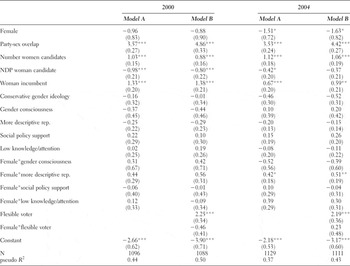
Moving to our multivariate analyses, Table 2 models the predictors of voting for women candidates in each election, starting with models that include all of the contextual, attitudinal, and political knowledge/attention variables (Model A), moving then to models that add variables for flexibility in vote choice (Model B). Starting with the initial models (Model A), voter sex had no direct effect in 2000, and it was male voters who preferred women candidates in 2004. In other words, tabular findings (see Table 1) hold up to multivariate analyses.
Logistic regression equations predicting voting for a female candidate

Notes: DV = 1 if vote for woman candidate.
Logit coefficients reported in columns, standard errors in parentheses.
*** = p < 0.001 ** = p < 0.01 * = p < 0.05
Sources: 2000 and 2004 Canadian Election Studies; 2000 and 2004 candidate data.
Turning to Model A for both election years, three contextual variables stand out as strong predictors of voting for women across both elections. Naturally, the party-sex overlap powerfully affects whether one will cast a ballot for a woman candidate; this is the largest coefficient in both models. Predictably, the presence of a woman incumbent in the constituency increases the probability of voting for a woman candidate (the woman incumbent, as opposed to one of her rivals, in the vast majority of cases). Compared to candidates from other major parties, NDP candidacy harms voters' support for women candidates. While a fixture in Canadian federal elections, the NDP is a third party, akin to the UK's Liberal Democrats. NDP candidates are the majority of third-place finishers in federal constituencies, and the party has had the largest proportion of women candidates in nearly all elections since the 1960s. Voters with sincere preferences for parties that finish third in constituencies are more likely to vote strategically than voters who prefer contending parties (e.g., Alvarez and Nagler Reference Alvarez and Nagler2000; Cox Reference Cox1997). One in eight Canadian voters who faces this scenario defects to a contending party (Blais Reference Blais2002). Put together, the result is that women candidates are in particular danger of losing voters' support due to strategic considerations.
There are two major differences between the two election years. First is the conditional effect of the desire for descriptive representation on women voters in 2004 (see also Goodyear-Grant Reference Goodyear-Grant, Anderson and Stephenson2010). Women voters who were critical of the underrepresentation of women in Parliament were more likely to vote for women candidates in this race compared to male voters who held the same critical attitude. Why this effect would manifest in 2004 and not in 2000 is a matter on which we can only speculate here, but it may be the case that the presence of a female party leader in 2000 gave women voters the sense that they were represented in important ways at the top of the political ladder during that election. In 2004, this representation would have been absent, for all the major party leaders were men. Putting this question aside, it is interesting that the desire for descriptive representation is the only one of the typical attitudinal explanations for gender-based affinity effects to have an effect in our models. Indeed, this is an overtly political variable in that it asks about electoral politics, and it is also a variable that provides a very direct, simple connection between the voter's gender group and the gender of the candidates. Given that we view the descriptive representation explanation as closely related to the gender consciousness explanation, it is surprising that the latter had no effect in any of our models. One possibility is that gender consciousness is poorly measured here. The use of a one-dimensional variable to measure a multidimensional concept may be responsible for the null finding, a point to which we return in the conclusion.
The second major difference between the two elections is the direct effect of voter gender in 2004 whereby male voters were particularly drawn to women candidates. One possibility is that male voters turned in greater proportions for women candidates in 2004 as a result of the Sponsorship Scandal. In times of corruption or scandal, women may benefit from “fairer sex” stereotypes that depict them as more honest or ethical than men (e.g., Burrell Reference Burrell1994). This may be part of the story with the effect of sex in 2004. The addition of anger about the scandal and its interaction with voter sex to the 2004 models diminishes the direct effect of sex to the point of insignificance (results not displayed). Further analyses would be needed to build confidence in this interpretation, but it is consistent with the firmly established fact that gender-based stereotypes about candidates' traits can powerfully influence voters' decisions.
Overall, the results for Model A in 2000 and 2004 suggest that, under certain conditions, some voters are more likely to vote for women, but being female does not lead one directly to prefer women candidates. This finding has been reported previously for 2004 and 2006 Canadian federal elections (Goodyear-Grant Reference Goodyear-Grant, Anderson and Stephenson2010), as well as for several U.S. elections (e.g., Dolan Reference Dolan2004; King and Matland Reference King and Matland2003; McDermott Reference McDermott1997; Thompson and Steckenrider Reference Thompson and Steckenrider1997).
Our next step was to analyze flexible voters, a group for whom candidate considerations may, in principle, play a strong role in vote choice. This is not to deny the importance of parties and leaders to the vote among independents, leaners, and defectors, for we must avoid unduly exaggerating differences in the vote calculus between the two groups. Indeed, the system itself encourages party- and leader-centered voting, even among the temporarily and permanently de-/unaligned. For each election, Model B adds two variables: vote flexibility and its interaction with voter sex. According to our hypothesis, the variable interacting voter sex with vote flexibility should be positively signed and statistically significant. Such an outcome would indicate that gender affinity effects are conditional upon the relative absence or temporary loosening of partisan bonds that structure vote choice. Obviously, this is not the outcome produced by our data, as Table 2 illustrates, for both interactions are statistically insignificant. As a follow-up, we reestimated these models separately using the individual variables that make up the flexible voter group (independents, leaners, and defectors), and individually, their effects are not different (results not displayed), despite evidence of crossover gender affinity voting in the United States (e.g., Brians Reference Brians2005; Cook Reference Cook, Cook, Thomas and Wilcox1994; Fox Reference Fox1997; Plutzer and Zipp Reference Plutzer and Zipp1996). There is no evidence here that women flexible voters are more likely than their male counterparts to vote for women candidates.
In Model B, the flexible voter variable indicates the effect of flexibility on male voters. In both election years, the conditional effect of voter flexibility on men is to increase considerably the probability that they will vote for women candidates. To explain this outcome, one might suggest that male flexible voters were more likely to support center and left-of-center parties (the Liberals, Bloc, and NDP) than male strong partisans who voted loyally in both races, but that the same effect is not present for female voters. Center and left-of-center parties tend to have greater proportions of female candidates than their right-wing counterparts, a generalization that held true in both elections under study. There are significant differences in the voting patterns of male flexible voters versus male loyal partisans along these lines, particularly if we look at the right wing of the party spectrum (results not displayed). In 2000, for example, nearly 30% of male loyal partisans voted for the Canadian Alliance—at that time the most right-wing major party in Canada—while the same was true for only 20% of male flexible voters. Among the major parties in the 2000 federal election, the Alliance had the smallest proportion of female candidates. For women voters, however, there was no such gap. In this election, 16% of women loyal partisans and 17% of women flexible voters cast ballots for Alliance candidates (results not displayed). A preliminary observation, therefore, might be that women flexible voters are not all that different from women loyal partisans in their vote choices, an observation that does not hold for male voters, among whom flexibility in voting seems to be correlated with choosing parties that tend to run more women candidates. Whether this is because center and center-left parties have more women candidates is doubtful, although we do not test the proposition here.
There is virtually no evidence in any of the analyses presented in Table 2 of gender affinity effects between women voters and candidates, even conditional upon the availability of voters. The only result linking female voters with female candidates is the finding that critical views of women's political underrepresentation boosted women voters' probability of voting for women candidates in 2004, but not in 2000, and this conditional effect is actually the smallest in magnitude among the significant predictors of voting for women in 2004.
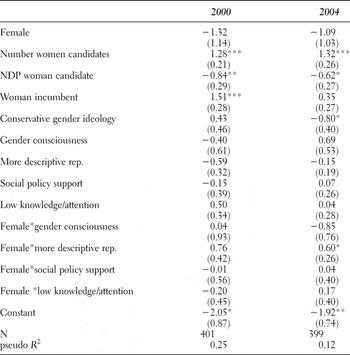
Our final step was to reestimate models with the flexible voter subsample of respondents, obviously excluding the party-sex overlap variable (Table 3). This strategy tests whether the effect of flexibility on women voters is itself conditional upon voters' orientations toward the typical explanations for gender affinity effects. Put plainly, our question is this: Among flexible voters, are women who have the key characteristics—gender consciousness, support for social policy, a desire for descriptive representation, and low political knowledge and attention—more likely than men to vote for female candidates? The answer is mostly no, with the exception, again, of the positive effect of women's desire for descriptive representation on voting for women candidates. Once more, however, the magnitude of this variable is the smallest among the significant predictors of voting for women.
Logistic regression equations predicting voting for a female candidate, selecting for flexible voters

Notes: 1 if vote for woman candidate.
Logit coefficients reported in columns, standard errors in parentheses.
*** = p < 0.001 ** = p < 0.01 * = p < 0.05
Sources: 2000 and 2004 Canadian Election Studies; 2000 and 2004 candidate data.
DISCUSSION AND CONCLUSIONS
Our analyses reveal very little evidence of gender affinity effects between women voters and women candidates in Canada. In fact, in 2004 a greater proportion of men than women cast ballots for women candidates (see Tables 1 and 2; see also Goodyear-Grant Reference Goodyear-Grant, Anderson and Stephenson2010). This finding conflicts with the assumption that women voters are a natural constituency for women candidates. For example, a 2008 Liberal campaign co-chair expressed the view that “by having 44 percent women candidates … we'll be better able to attract female voters.Footnote 6” Another article describes former Prime Minister Jean Chrétien's appointment of female candidates in selected constituencies in 1993 and 1997 as “part of the Liberals' largely successful bid to claim large parts of the female vote in Canada.Footnote 7” Focusing on the 2005 provincial election in British Columbia, a pollster attributes a 10% swing in women's vote intentions from the NDP to the Liberals in midcampaign to the latter's “recent efforts to attract prominent female candidates.Footnote 8” Gender affinity effects between candidates and voters are commonly assumed among party strategists and pollsters, but our analyses raise considerable doubt about whether the intended payoffs actually materialize.
This is not to deny that parties need to grow their proportions of women candidates, that women candidates should appeal to women voters, or that women voters are pleased to have large numbers of women as candidates. Also, it certainly may be the case that a party can, in fact, draw women voters when it places a comparatively large number of women on its electoral slate overall. Our findings here do not really speak to these propositions. Our conclusion is a more limited one: Women voters in Canada do not seem to cast a greater proportion of their ballots for women candidates than men voters do, even when conditions seem fertile for such an occurrence, or at least as fertile as they can be in a type of system that tends to insulate the vote from candidate considerations. The one exception is the sex-conditional effect of attitudes toward women's underrepresentation in Parliament on the vote for women candidates. Clearly, women do prioritize voting for women to “stand for” them, although the lack of effects for the social policy explanation raises questions about whether women view women candidates as “acting for” them. While the coefficient for the descriptive representation effect is relatively small in magnitude, this is no trivial effect, for quite a large number of women were critical of women's political underrepresentation in the 2004 CES—34% compared to 23% of men. Among this 34% of the female electorate, there was a stronger probability of voting for women compared to the 66% of women who were not all that critical of women's underrepresentation, as well as the 23% of men who were.
One of our objectives was to assess whether vote flexibility conditions the relationship between voter gender and candidate gender, but here, too, we find no evidence of the hypothesized effect. Even when women are relatively less encumbered by strong partisan loyalties—a situation in which candidate considerations could come to the fore in the vote calculus—women voters are still no more likely than male voters to vote for women. We went a step further to analyze whether among the flexible voter subsample the four common explanations for gender affinity effects drew women voters to women candidates. The answer in three of four cases was no, with descriptive representation motivating women flexible voters toward women candidates in 2004, much as we saw in the omnibus 2004 models in Table 2. Our interpretation of the consistent effects of descriptive representation considerations on women voters in 2004 relates, in part, to the lack of a woman leader to provide gender-based representation in 2004, coupled with the fact that the descriptive representation concern provides an easy, direct connection between voter and candidate gender.
Although our findings are quite suggestive of a relative lack of gender affinity effects in the Canadian setting, some caution is warranted in extending these findings. Two considerations are important. First, some of the variables we have used to operationalize complicated concepts are suboptimal, particularly our gender consciousness variable, which does not fully capture the various key dimensions of the concept. As such, the null finding for gender consciousness may be the result of poor operationalization. Second, this article has not considered the effect of cuing. Dolan's work (e.g., 1998 and 2001) provides a strong reminder that gender-based considerations can be cued or primed differently across electoral contexts. Gender was not particularly salient in the 2000 and 2004 Canadian federal elections, either through issue-based priming or attention to women candidates or as a result of women candidates campaigning “as women.” Perhaps it is not surprising, then, that gender affinity effects did not emerge in these contexts, and it leaves open the possibility that such effects may emerge in more gendered electoral environments. Indeed, women voters do not gravitate to women candidates simply because they are women. Some mechanism is required to link voter and candidate gender. A gender-salient campaign-information environment may provide the catalyst for the activation of gender consciousness or gender-based policy considerations among women voters, in turn motivating them to select women candidates in greater proportions than men.
As noted at the outset, institutional variation as a source of contextual effects has been underanalyzed in this area of voting behavior research. Our analyses suggest that the Canadian context is quite different from the U.S. context, at least for candidates if not for party leaders (e.g., Banducci and Karp Reference Banducci and Karp2000; Cutler Reference Cutler2002; O'Neill Reference O'Neill1998). The natural question is whether the findings reported here are characteristic of Westminster systems generally, and this article lays some groundwork for deeper, more directly comparative analyses of gender affinity effects across Westminster systems. National variation in institutions, rules, or practices within this family of political systems alters the influence of local campaigns on vote choice, which has the potential, in turn, to alter the development of gender affinity effects between women voters and candidates.