1. Introduction
This paper deals in detail with the birth and development of some ideas for improving a basic feature of Ptolemy's planetary models in medieval Islamic astronomy, i.e., the progressive motion of the apsidal lines of the five planets.
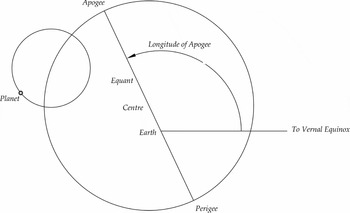
All that a reader not previously acquainted with Ptolemaic planetary models needs to know about them is that both models Ptolemy constructs for the planets – the one for Venus and the superior planets and the other, more complicated, one for Mercury – consist of two components. A planet revolves on a small circle, “epicycle,” in order to account for the synodic phenomena, the center of which is carried on a bigger circle, “eccentric deferent,” whose center is displaced from the Earth (see fig. 1). The distance between the Earth and the center of the eccentric defines the “eccentricity,” which is one of the oldest known fundamental orbital elements of the planets. It forms the essential basis of the simple ancient solar eccentric model, making a periodic variation in the distance between a planet and the Earth in order to account for the observed differences in its apparent motion, which is sometimes faster and sometimes slower. Except for Mercury, the extremal distances of a planet from the Earth lay on the prolongation of the eccentricity to both directions, which are called the two “apses”: the point of the eccentric locating in the greatest distance from the Earth, “apogee,” and that indicating the least distance, “perigee.” The line connecting the two is called the “apsidal line.” These terms are still in use for the Earth and Moon, although they have been replaced, respectively, by “aphelion” and “perihelion” in the case of the planets. In Ptolemaic astronomy, the heavenly motions and positions are visualized and are measured with reference to a tropical coordinate system, that is, a system referred to the ecliptic, that is, the Earth's orbital plane or the path of the apparent annual motion of the Sun through the stars. Two coordinates are represented: longitude showing the angular distance along the ecliptic with the vernal equinox point serving as the zero-point, and latitude indicating the perpendicular angular distance from the ecliptic. The vernal equinox point itself has a regressive motion, known as precession, a consequence of which is a steady increase in the stellar longitudes. By definition, a sidereal reference system is one in which a fictitious star on the ecliptic having no proper motion serves as the zero-point of longitudes.
Ptolemy's model for Venus and the superior planets

This paper is organized according to the following parts: in section 2, we briefly review Ptolemy's demonstration of a progressive motion for the apsidal line of Mercury and his finding that the speed of its motion is equal to the rate of precession, which he generalizes to the apogees of the other planets. In section 3, the modern values for the progressive motions of the planetary apogees in a tropical reference system are presented. In the next section, the values for the rate of precession measured during the medieval Islamic period are introduced. In section 5, constituting the core of the paper, we first discuss the discovery of the motion of the solar apogee in the ninth century, along with Bīrūnī and Ibn al-Zarqālluh's idea of assigning a proper motion to it. Then, focusing on the characteristic facts about planetary measurements both in early and late Islamic astronomy, we examine the values for the longitudes of the apogees of the Sun and planets in the most important works written in the Middle East during the medieval period. Next, we present Ibn al-Shāṭir's significant and fascinating contribution, which has not yet received proper attention (if any) in the modern literature: his idea that the motion of the apogees is greater than precession. Also, a plausible scenario is suggested for the reconstruction of the line of reasoning which may have led him to such an outcome. The last section coherently summarizes the findings set forth in this study and highlights its underlying purpose, that is, to show how medieval Islamic astronomers treated Ptolemy's generalization as a rational basis and a methodological axiom of astronomy in parallel with their noteworthy empirical discoveries that caused substantial changes in Ptolemy's proposition about the motion of the planetary apogees and its relation to precession.
2. Ptolemy's considerations about the spatial motion of the planetary spheres
In Almagest VII.2, from Hipparchus's and his own observations of the star Regulus (α Leo), Ptolemy determines the rate of precession as 1° per century. He attempts to confirm this result in the next chapter (VII.3) by a detailed examination of the changes in the declination of some stars in the vicinity of the equinoctial points, according to the ancient Greek observations that came down to him (Toomer Reference Toomer1998, 327–338; see, also, Pannekoek Reference Pannekoek1995; Duke Reference Duke2006). Later, in Almagest IX.5 and IX.7, Ptolemy asserts that he finds it consistent with the phenomena associated with the planets that their apsidal lines shift slowly and uniformly about the center of the ecliptic in the direction of increasing longitude. As a provisional estimation on the basis of evidence available to him, namely, according to his derivation of the direction of the apsidal line of Mercury both for his own time and about 400 years earlier, he concludes that its motion is equal to the rate of precession of 1° in every 100 years (Toomer Reference Toomer1998, 443, 453). Ptolemy does not return to the issue of the apsidal line motion in the case of any of the other planets. Rather, he takes it for granted that the apsidal lines of all of the five planets move in common with a velocity equal to the rate of precession.Footnote 1 Consequently, in Ptolemaic astronomy using the ecliptic as a reference system, the spatial directions of the planetary orbs are sidereally fixed.
Such a treatment constitutes a methodological cornerstone of Ptolemy's astronomy. For Ptolemy, it is reasonable to draw a conclusion based on the generalization of a fact discovered and proved in the case of a sample, especially when the sample itself (i.e., Mercury) is one of the only five members of the whole (i.e., the five planets), and therefore, can be taken reasonably as representative of the whole. Medieval Middle Eastern astronomers strictly adhered to this methodological axiom of the Almagest.Footnote 2 A prominent example is that when they discovered the progressive motion of the solar apogee about seven centuries after Ptolemy, they finally found it necessary to assume that its motion obeyed the precessional motion, like the planetary apogees (see below).
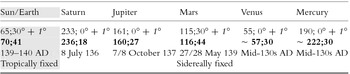
For the purpose of comparison in the subsequent discussion, Ptolemy's values for the solar and planetary apogees are given in Table 1 (Almagest, III.4, IX.7,8, X.1,2, X.7, XI.1, XI.5: Toomer Reference Toomer1998, 154–157, 449–450, 454, 470–471, 498, 519, 537). The numbers in bold indicate the true values at the times computed from the modern theories.Footnote 3
Ptolemy's values for the longitude of the solar and planetary apogees.

The dates given here for the superior planets are those of the last of Ptolemy's trios of observations of their oppositions to the mean Sun as given in the Almagest, because he remarks that the values he derived for the longitudes of the apogees are for the times of those oppositions. In the case of the inferior planets, Ptolemy makes use of a variety of observations spreading from the late 120s to the early 140s.
As can be obviously seen, the aggregate error resulting from all of the observational deficiencies and computational impreciseness committed by Ptolemy produce no error exceeding 3° in the case of the superior planets and Venus. The Sun and Mercury are indeed exceptional cases, each having its own historical and technical complications.
3. The values for the rate of precession in medieval Middle Eastern astronomy
After Ptolemy, medieval Middle Eastern astronomersFootnote 4 measured non-Ptolemaic values for the rate of precession from the ninth through the fifteenth century, which are without exception better estimations than Ptolemy's; a concise summary follows:
-
(i). 1°/72.5y, derived by the Banū Mūsā (mentioned in their On the solar year; see Neugebauer Reference Neugebauer1962, 279; Goldstein Reference Goldstein1994, 190) from the comparison between a value for the longitude of the star Regulus (α Leo) observed in 830–831 AD and Hipparchus's corresponding value measured in 128–129 BC (Almagest VII.2: Toomer Reference Toomer1998, 328; Pedersen Reference Pedersen1974, 415, no. 46).
-
(ii). 1°/72y, adopted in the Tāj al-Azyāj (Crown of the zījes) by Muḥyī al-Dīn al-Maghribī (d. June 1283) (Dorce Reference van Dalen and Dold-Samplonius2002–Reference Dorce2003, 198; Reference Dorce2003, 111, 180), an excellent medieval approximation to the true value of 1°/71.6y.Footnote 5
-
(iii). 1°/701/4 y, Ibn Yūnus's (d. 1009 AD) formal value for the rate of precession (Ibn Yūnus, L: 123, 125).
-
(iv). 1°/70y, the formal value employed in late Middle Eastern Islamic astronomy. It comes back to the comparison between the longitudes of Regulus observed by Ibn al-A‘lam (d. 985 AD) in 975–976 AD and the Mumtaḥan astronomers in 829–830 AD.Footnote 6 In his Ḥākimī zīj, chap. 5 (L: 106–108; Caussin Reference Caussin de Perceval1804, 143–155), Ibn Yūnus lists the twelve values for the longitude of Regulus measured by six individuals or groups of astronomers belonging to the early Islamic period (e.g. the Mumtaḥan observers and the Banū Mūsā and Banū Amājūr families) in the period from 826–827 through 975–976 AD and nicely tries to demonstrate that all of them are in accordance with the rate of precession of 1°/70y. Also, Abū al-Rayhān al-Bīrūnī independently arrived at a value very close to it on the basis of a comparison of Abu ’l-Wafā’ and Hipparchus's observations of Regulus made, respectively, in 974–975 AD and 128–129 BC (al-Qānūn al-mas‘ūdī VI.8: Bīrūnī 1954–Reference al-Bīrūnī1956, 2:676–678, F: ff. 100r–v, B: ff. 150r–v).
-
(v). 1°/69y, derived by Bīrūnī by comparing his own and Timocharis's observations of Spica (α Vir) carried out, respectively, on 2 July 1009 AD and 9/10 March 294 BC (Almagest VII.3: Toomer Reference Toomer1998, 335–336; Pedersen Reference Pedersen1974, 410, no. 13).Footnote 7
-
(vi). 1°/66y, the frequently-measured value in medieval Islamic astronomy that was usually derived whenever the Islamic astronomers compared their observed stellar longitudes with those in Ptolemy's star catalogue in Almagest VII.5–VIII.1. The examples are: the Mumtaḥan astronomers,Footnote 8 the Banū Musā (using their value for the longitude of Regulus compared with Ptolemy's corresponding value measured on 23 February 139; Almagest VII.2: Toomer Reference Toomer1998, 328; Pedersen Reference Pedersen1974, 420, no. 83; Neugebauer Reference Neugebauer1962, 281–282), al-Battānī (Zīj al-Ṣābi’, chap. 51: Nallino [1899–1907] Reference Nallino1969, 3:187–190), and Muḥyī al-Dīn al-Maghribī, adopted in his last zīj, the Adwār al-anwār (on the basis of his systematic stellar observations made in Maragha from January 1267 to September 1268; al-Maghribī, Talkhīṣ VII.1–2: L: ff. 111r–115r; Adwār, M: f. 82v, CB: f. 80v).
Whenever the medieval Middle Eastern astronomers compared their own observed stellar longitudes with those registered in Ptolemy's catalogue, always with an extension of them to Menelaus's time, they obtained values close to 1°/66y for the rate of precession; but, when they compared their observed stellar longitudes either with those recorded by Ptolemy from his Greek predecessors, or with those of their Islamic predecessors, they yielded smaller values, very often about 1°/70y. The latter value was dominant in the late Islamic period. It was adopted in the official works connected to the two observatories founded at Maragha and Samarqand, specifically, the Īlkhānī zīj (P: f. 56v, T: f. 100r, M1: f. 100v, M2: f. 86v, C: 195) and Ulugh Beg's Sulṭānī zīj (III.13: P1: f. 116v, P2: f. 132v), as well as in Ibn al-Shāṭir's Jadīd zīj (chap. 19: O: f. 61v, L1: ff. 23r–v, L2: ff. 28v–29r, PR: ff. 30v–31r) and al-Kāshī’s Khāqānī zīj (IO: f. 166r).
4. The modern values for the motion of the planetary apsidal lines
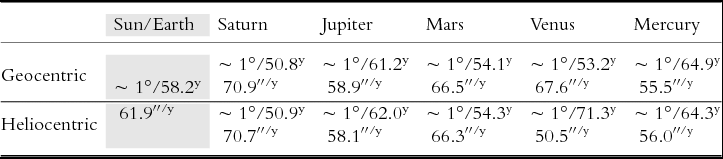
The heliocentric apsidal lines of all of the planets slowly rotate in the direction of increasing longitude at various rates. In order to derive the angular velocities of their geocentric apsidal lines, the motion of their heliocentric apsidal lines should be combined with that of the apsidal line of the Earth.Footnote 9 The annual motion of the geocentric and heliocentric apsidal lines is compared in Table 2 (both in degree per year and arc-seconds per year).Footnote 10
The modern values for the motion of the solar and planetary apogees.

It is conspicuous that the motion of the planetary geocentric apsidal lines is not equal to the rate of precession, neither the modern value 1°/71.6y, nor any of the historical values mentioned above. Furthermore, the rates of the motion of the apsidal lines in an astronomical system based upon the tropical longitudes differ to a degree that will be evident from the comparison between the tolerably-accurate observations made over a long interval of time, say, Ptolemy's observations and those made by any competent medieval observer. Accordingly, in a sufficiently long period after Ptolemy, the discovery that his assumption can no longer be held was probable.
5. New findings for the motion of the apsidal lines of the Sun and planets in Islamic astronomy
5.1. The Sun: a general overview
Early Islamic astronomers in the ninth century confronted a problem arising from unambiguous observational evidence: it was discovered that the solar apogee, which was assumed to be tropically fixed in the Almagest, has a progressive motion. The Banū Mūsa dealt at length with this problem in their On the solar year. Drawing an analogy between the assumed dependence of the motion of the planetary apogees on that of the fixed stars (i.e., precession) and the solar apogee motion, they, in fact, generalized the Ptolemaic assumption of the equality of the motion of the apsidal lines of the planets with precession to include the observed motion of the solar apogee as well (e.g., see Neugebauer Reference Neugebauer1962, 265–266). So, in the beginning of the tenth century, it had been accepted that the solar apogee is subject to precession, for example, in such a highly influential work as al-Battānī’s Ṣābi’ zīj (chap. 33: Nallino [1899–1907] Reference Nallino1969, 3:108). Nevertheless, a bit over one century later, Bīrūnī found it necessary to devote a good part of his opus magnum, al-Qānūn al-mas‘ūdī, book VI, to a comprehensive analysis and interpretation of the findings of his Muslim predecessors (for a thorough, detailed discussion of this topic, see Mozaffari Reference Mozaffari2013a, esp. Part 2). Bīrūnī first draws the conclusion that the motion of the solar apogee is faster than the rate of precession, and computes the rates about 1°/46y and 1°/60y for its motion (note that the latter is close to the true rate of about 62″ given earlier) by the comparison of his value about 85° for its longitude measured in 1016–1017 AD with the value 65.5° determined, respectively, by Ptolemy in 140 AD and by Hipparchus about the middle of the second century BC. But, he later discarded this idea for the following two obvious reasons. The first was the sensitivity of the methods of the derivation of the solar orbital elements. Second, Ptolemy's value for the longitude of the solar apogee was not trustworthy, because, as Bīrūnī thought, it was expected that Ptolemy would have detected its motion in the long period that had passed after Hipparchus, as he had discovered the motion of the planetary apogees. At the time of the writing of al-Qānūn, the 1030s, when Bīrūnī passed the last years of his career, he was still uncertain whether the center of the motion of the solar apogee coincides with the Earth or lies outside of it. He states that from what Ptolemy quotes from Hipparchus, one can imagine that the latter believed that the apogee rotates about a point outside of the center of the universe, on account of the various values he derived for its motion, sometimes speedy and sometimes retarded.Footnote 11 He concludes that the Sun has an annual equation (i.e., the so-called “equation of center”), and that the deviation or difference due to the assumption that the center of the apogee's motion does not coincide with the Earth makes a second equation for the Sun's motion, by which the first equation should be adjusted, and which would be perceptible in two years. He seems to have considered this idea since he says next that “it circulates in my mind for my knowledge of such deviations” (he refers to his lengthy discussion of the determination of the solar parameters as regards a thorough analysis of his observations and those made by his Islamic predecessors). But, he immediately changes his argumentation and concludes that Indian astronomical traditions and, afterwards, his Islamic predecessors maintain that the motion of the solar apogee is around the center of the universe.Footnote 12 Thus, he decides to provisionally accept it, since nothing else appears,Footnote 13 but he passes the problem to the next generations to find a solution for it in the future (al-Qānūn VI.8: Bīrūnī Reference al-Bīrūnī1954–Reference al-Bīrūnī1956, 2:656, 661, 676, 680, 685; Mozaffari Reference Mozaffari2013a, Part 2, 322, 326; also, see Hartner and Schramm Reference Hartner, Schramm and Crombie1961, 218). To the best of our knowledge, except for Ibn al-Shāṭir of Damascus (ca. 1305–ca. 1375 AD), all of the medieval Middle Eastern astronomers simply chose the latter option; no one dealt with this enigmatic problem again, and therefore, no one departed from the generalization of Ptolemy's assumption of the correlation between the motion of the planetary apogees and precession to the motion of the solar apogee.
Nevertheless, the Western Islamic astronomers (in northwestern Africa and Andalus in Spain) followed a different line of reasoning in astronomical thinking. Contrary to the Middle-Eastern Islamic astronomers, they seriously took into account secular changes and periodic variations in the parameters that are assumed to be constant in Ptolemaic astronomy. Ibn al-Zarqālluh invented a solar model with variable eccentricity and also adopted a proper motion of 1°/279 Julian years in the direction of increasing longitude for the solar apogee, which should be added to the value of 1°/66y for the rate of precession. The resulting annual motion of 67.4″ is, however, substantially larger than the true value of 61.9″ (see Mozaffari Reference Mozaffari2013a, Part 2, 402, 408, and the references mentioned therein).Footnote 14
More than five centuries later, Taqī al-Dīn Muḥammad b. Ma‘rūf (1526–1585 AD), the director of the short-lived observatory at Istanbul, significantly improved this value, following Bīrūnī’s procedure. From the value about 95;33° for the longitude of the solar apogee he measured in 1579 AD and the Hipparchian value 65;30°, taking Hipparchus's observed time of the vernal equinox of 24 March 146 BC as the origin, he derived an annual motion of about 63″, which is, indeed, the best estimation of the motion of the solar apogee in medieval and early modern Islamic astronomy.Footnote 15 Of course, it should be noted that Taqī al-Dīn does not deal with the planets and fixed stars in his two zījes, as no material related to them can be found in either, maybe because the Istanbul observatory was destroyed in the early 1580s (see Sayılı [1960] Reference Sayılı1988, 290–292) before its observers found time enough to bring their productive observational program to a desired end.Footnote 16 Accordingly, it is not known to us whether Taqī al-Dīn believed that the solar and planetary apogees are sidereally fixed, or whether his value 63″ should be considered to contain a proper motion for the apogee of the Sun. However, the first seems to be the case here, because usually the Middle Eastern Islamic astronomers either measured the motion of the solar apogee and then, held that result as the motion of the planetary apogees and fixed stars (e.g., Ibn al-Fahhād; about him, see below), or, inversely, they determined the motion of some bright reference zodiacal stars and then, maintained the value obtained for the rate of precession as the motion of the solar and planetary apogees (e.g., al-Battānī, Bīrūnī, and Muḥyī al-Dīn al-Maghribī) (the references have been mentioned earlier in section 3, (iv) and (vi)).
5.2. The planets
It is of great historical interest that if medieval Islamic astronomers also compared their values for the longitudes of the planetary apogees with Ptolemy's corresponding values, they would have inevitably had to confirm that the motion of the planetary apsidal lines are neither identical to each other, nor equal to the rate of precession. Nevertheless, the majority of them strictly maintained the Ptolemaic assumption. However, a few astronomers belonging to Western Islamic astronomical tradition applied Ibn al-Zarqalluh's value for the proper motion of the solar apogee to the motion of the apogees of the planets as well (e.g., see Samsó and Millás Reference Samsó and Millás1998, 269). (Note that the yearly motion of 67.4″ is, by coincidence, nearly equal to the modern value for the annual motion of the geocentric apsidal line of Venus as well as very close to the modern value of the annual motion of the geocentric apsidal line of Mars, as given earlier.)
The principal problem a historian of astronomy comes across in the pursuit of this subject is that it is very often not known whether and how the unprecedented values for the planetary orbital elements adopted in the Islamic zījes were derived from actual observations. In fact, unlike in the case of the Sun and Moon, the accounts of the observations and subsequent computations for the derivation of the planetary orbital elements from the observational data can be very seldom found in medieval Middle Eastern astronomy. The only surviving work on this topic is Muḥyī al-Dīn al-Maghribī’s Talkhīṣ al-majisṭī (Compendium of the Almagest), which includes his extensive systematic observations carried out in the Maragha observatory from 1262 to 1274 AD. Of course, scattered, random observations can be found here and there, which cannot have anything to do with the measurement of the planetary orbital parameters.Footnote 17 Writing a while after the turn of the eleventh century, Bīrūnī complains that the Islamic astronomers from the day of al-Ma'mūn to al-Battānī and afterwards did not mention their measurements in the same manner that Ptolemy mentioned his own ones, and did not explain how they derived the planetary motions and positions through the continuous attempts those astronomers made to attain them (Bīrūnī Reference al-Bīrūnī1954–Reference al-Bīrūnī1956, 3:1193, P: f. 169r; a similar remark can be found in ibid., 1197). Bīrūnī was very interested in collecting and precisely scrutinizing the findings of his predecessors. His complaint indicates that in the materials available to him (if not in the whole legacy of Islamic astronomy until his time), there was not a single account of the derivation of a specific planetary parameter from observations.
In fact, there is no evidence to believe that in a good number of the prominent works in Islamic astronomy, which exerted notable influence on later works, the longitudes of the apogees of the planets were derived from observational data. It should be noted that in order to measure the orbital elements of the superior planets, at least, the observations of three oppositions of a planet to the mean Sun are required, from which, first, the eccentricity is computed according to Ptolemy's iterative procedure, and then, the direction of the apsidal line is determined. The changes in the geocentric eccentricities of Saturn and Jupiter during one millennium after Ptolemy are noticeable to the extent that it is, by-and-large, improbable that they would remain obscure in a medieval systematic observational program.Footnote 18 Accordingly, in the case of a few Islamic astronomers for whom we can be certain that the new parameter values adopted in their works are observational achievements, both sets of the eccentricities and apogee longitudes have values independent from Ptolemy. Examples that provide undisputable pieces of evidence for it are: the non-Ptolemaic values derived from the observations carried out by Ibn al-A‘lam at Baghdad in the latter part of the tenth century, by Muḥyī al-Dīn al-Maghribī in the Maragha observatory and, contemporarily, by a group of Persian astronomers in the Islamic Astronomical Bureau in Beijing under the control of the Mongolian Yuan dynasty in the latter part of the thirteenth century (about it, e.g., see van Dalen Reference van Dalen and Dold-Samplonius2002a, Reference van Dalen and Ansari2002b; Yabuuti Reference Yabuuti1997), as well as by the astronomers in the Samarqand observatory over one century later.Footnote 19
As a first step, in section 5.2.1, we shall select and discuss some examples from important zījes written in the medieval Middle East where the values adopted for the longitudes of the apogees of the five planets either do not appear to have been based upon a firm observational ground, or were, obviously, derived from the Almagest. Then, in section 5.2.2, we will turn our attention to the works, mainly belonging to the late Islamic period, where the longitudes of the planetary apogees are, either certainly or quite probably, observational achievements.
5.2.1. The apogee longitude values not based on “new” observations
Example 1: Bīrūnī
The first example is borrowed from Bīrūnī. In his al-Qānūn al-mas‘ūdī X.4, he corrects Ptolemy's values for the planetary mean daily motions in longitude in a strange way. He first finds that the longitude of the mean Sun as extracted from the Almagest for his epoch, i.e., the noon of Tuesday, the first day of the year 400 Yazdigird (henceforth, denoted as “Y”)/9 March 1031 for the longitude of Ghazna (Modern Ghazni, Latitude = 33.55° and Longitude = 68.43°) is less than the value he himself measured for the given time by 5;0,21,36,24,10,1°.Footnote 20 Next, he adds this amount to the increments of the mean longitudes of the superior planets in the time interval between Ptolemy's observations of the third oppositions of these planets to the mean Sun (which Ptolemy used in the derivation of the orbital elements of these planets) and his epoch, computed from Ptolemy's values for the mean daily motions. Then, the resulting increments are divided by those time intervals, which result in a new set of values for the planetary mean daily motions, which, inevitably, turn out to be larger than Ptolemy's by about 0;0,0,3,19°.Footnote 21 This method cannot be employed for the correction of the mean daily motions in anomaly of the inferior planets as well as for the longitudes of the planetary apogees, as Bīrūnī himself states. Thus, he simply converts Ptolemy's values for the longitudes of the planetary apogees to his epoch on the basis of the value 1°/69y he had already measured for the rate of precession (see above, section 3, (v)). Bīrūnī takes the mid-time of Ptolemy's observations of the first and third mean oppositions of the superior planets and the mid-time of Ptolemy's pairs of observations of the inferior planets, which he utilized in order to derive the longitudes of their apogees, as the origins (note that in the case of the superior planets, Ptolemy takes his measured values for the longitudes of the apogees of the superior planets for the times of his third mean oppositions). The incremental values in the longitudes of the apogees from Ptolemy's times in the 130s to Bīrūnī’s epoch amount to about 13°, which Bīrūnī adds to Ptolemy's values. In the end, he appears to have found it necessary to emphasize again that “we have said that the moderns (al-muḥaddithīn) did not mention how they did their works, as Ptolemy mentions [his measurements]. Thus, to us, they became as the puzzles and mysteries” (Bīrūnī Reference al-Bīrūnī1954–Reference al-Bīrūnī1956, 3:1193–1197, P: f. 169r).
Example 2: Ibn Yūnus
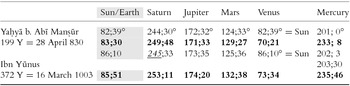
The next example is Ibn Yūnus who gives, in his Ḥākimī zīj, chaps. 6 (L: 120–121; Caussin Reference Caussin de Perceval1804, 217–220),Footnote 22 8, and 9 (L: 125, 145, 147, 149, 151, 153)Footnote 23 (in the beginning of the tables for the planetary mean motions in longitude), the values for the longitudes of the planetary apogees along with the corresponding values from Yaḥyā b. Abī Manṣūr's Mumtaḥan zīj (E: f. 86v, L: ff. 60v–61r) as summarized in Table 3.Footnote 24
Yaḥyā and Ibn Yūnus's values for the longitude of the solar and planetary apogees.

Obviously, all of Ibn Yūnus's values for the longitudes of the apogees of the five planets except for Venus appear to be more than Yaḥyā’s values by 1;3°. But, this increment is less than the half of the expected values produced by either of the precessional rates of 1°/66y, 1°/70y, or 1°/701/4 y (Ibn Yūnus's own value), and therefore, it is not known to us how Ibn Yūnus derived it. It should be noted that for Mercury, the first value is given in chap. 6, but the second in chaps. 8 and 9. Insofar as the accuracy is considered, the second value has evidently no advantage over the first, but may be quite probably considered a case of confusion in writing down the alphanumerics, which is a common feature of the medieval astronomical corpus.
Of course, we do not know how Yaḥyā obtained his own values for the longitudes of the apogees of the planets, except for Venus, for which both Yaḥyā and Ibn Yūnus simply used their values for the longitude of the solar apogee for that of Venus’ apogee. All that we possess from the astronomical observations carried out by Yaḥyā (and, generally, by the astronomers associated with the Mumtaḥan scientific circle – who observed in Baghdad and Damascus in the first half of the ninth century on the order of al-Ma'mūn, the seventh Abbāsid caliph from 813 to 833 AD) are related to the measurements of the solar parameters and the obliquity of the ecliptic and a number of the stellar observations, especially, Yaḥyā’s non-Ptolemaic star table. Of course, as shown elsewhere (see Mozaffari Reference Mozaffari2016d), just as in the Almagest star catalogue, we find a systematic error of ~ –1° in the stellar longitudes in Yaḥyā’s star table. Yaḥyā’s values for the longitudes of the planetary apogees might have been dependent upon the Almagest in one way or another, although the differences between them amount to 11.5° in the case of Jupiter and Saturn, 11° for Mercury, and 9° for Mars.
We have found that Ibn Yūnus's values for the longitudes of the planetary apogees are dependent upon Yaḥyā’s. However, he sometimes criticizes Yaḥyā for the deviations observed between the quantities computed on the basis of his Mumtaḥan zīj for some astronomical phenomena such as the planetary conjunctions and near approaches to the stars and the data that he and his Muslim predecessors obtained from making direct observations of them during the two centuries intervening between Yaḥyā and him. A worthwhile example is Ibn Yūnus's estimation of the time of the conjunction between Jupiter and Saturn in 1007 AD. From an observation made from Cairo early in the morning on 7 November 1007, he estimated that the conjunction would occur about noon on the given date, but according to the Mumtaḥan zīj, in that time Jupiter should be 22′ in longitude ahead of Saturn, and so this conjunction should have occurred about 6 equinoctial hours after noon on 31 October 1007, i.e., about one week earlier (Ibn Yūnus, L: 119–120; Caussin Reference Caussin de Perceval1804, 210–215).Footnote 25 A further example is Ḥabash's critical remarks about the Mumtaḥan zīj, as recorded in Ibn Yūnus's Ḥākimī zīj (see Mozaffari and Steele Reference Mozaffari and Steele2015, 344).
It seems necessary to emphasize that the extensive planetary observations either made by Ibn Yūnus himself or those he records from his Muslim predecessors only include the planetary conjunctions and the near appulses of the planets to stars (usually, Regulus). At best, these observations can be utilized in order to evaluate the accuracy of the ephemerides computed on the basis of a specific set of astronomical tables, as well as for the measurement of the sizes of the epicycles of the planets. Ibn Yūnus appears to have used them precisely in such ways; besides his remarks about the correction of the earlier zījes, he is the only medieval Middle Eastern astronomer who has non-Ptolemaic values for the radii of the epicycles of the inferior planets. These might have been derived from his observational data, and constitute his unique contribution to planetary astronomy.Footnote 26
Example 3: Ibn al-Fahhād
A further example is Ibn al-Fahhād, who compiled six zījes. The first five of them are now lost, and only the last, titled the ‘Alā’ī zīj, survives in a unique manuscript. The latter is a highly influential work in medieval Middle Eastern astronomy. For instance, Athīr al-Dīn al-Abharī’s Mulakhkhaṣ zīj (d. ca. the first half of the 1260s AD), the Shāmīl zīj, and an anonymous treatise named Kitāb fī Ṣinā‘at al-majisṭī (Book on the Art/Industry of the Almagest) dedicated to Najm al-Dīn Alī b. ‘Umar Dabīrān al-Qazwīnī (d. 1276 AD), one member of the main staff of the Maragha observatory, are entirely dependent upon Ibn al-Fahhād's ‘Alā’ī zīj.Footnote 27 Also, the parameter values adopted in this work were employed in Muḥyī al-Dīn al-Maghribī’s ‘Umdata al-ḥāsib, the first zīj he compiled after joining the Maragha team and before he started to make his own extensive observations in the Maragha observatory, and in the Īlkhānī zīj.Footnote 28 It is interesting that for the derivation of the orbital elements of the Moon and Mars, Muḥyī al-Dīn provisionally made use of Ibn al-Fahhād's mean daily motions in order to compute the differences in the mean longitude of these celestial objects between his triple observations made in the Maragha observatory.Footnote 29 The ‘Alā’ī zīj was translated into Greek by Gregory Chioniades under the supervision and instructions of Shams al-Dīn Muḥammad al-Wābkanawī, the outstanding figure of the second period of the astronomical activities in the Maragha observatory, in the 1290s.Footnote 30
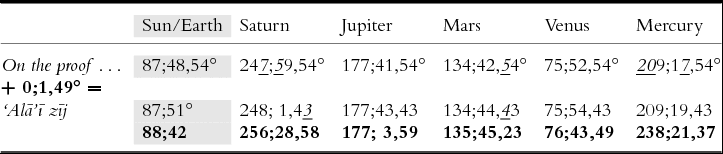
It is curious to see how Ibn al-Fahhād derives his own values for the longitudes of the planetary apogees. No explanation or dated observation is given in the instructional chapters of the ‘Alā’ī zīj. The key evidence to help clarify this issue can be found in a treatise in Persian partially preserved in Iran, Parliament Library, MS. no. 184, ff. 243v–244r (only its first two pages are preserved in this MS) titled On the proof of the solar equation (of center), its (longitude of) apogee, its mean motion, and its eccentricity by the observations. The author gives the lengths of the solar year, spring, and summer from his observations performed in 539 Y/1170–71 AD, from which he derives the same values 2;4,35 and 1°/66y, respectively, for the solar eccentricity and the rate of precession as measured by Yaḥyā b. Abī Manṣūr about three centuries and a half before him.Footnote 31 The length of the solar year is given as 365;14,30d as well as an adjusted value 365d5h46m 52s 24″′ (= 365;14,27,11d), corresponding to a mean daily motion of 0;59,8,20,35,25°. There exist strong reasons to believe that the author of this treatise is ‘Alī b. ‘Abd al-Karīm al-Fahhād. He was no doubt the most high-ranking astronomer at the time. The epoch of his Alā’ī zīj is the beginning of the year 541 Y/2 February 1172. In the prologue of ‘Alā’ī zīj (p. 5), Ibn al-Fahhād states that [the data he obtained from] his solar and lunar observations were close to [those computed on the basis of the parameter values derived from] the observations of Ḥabash, Yaḥyā, Khālid, ‘Abbās b. Sa‘īd al-Jawharī (the so-called Mumtaḥan group). The most convincing reason is that the abovementioned unprecedented values for the length of the solar year and its correspondent solar mean daily motion were, indeed, adopted in the ‘Alā’ī zīj (the solar mean motion tables in the ‘Alā’ī zīj can be found on pp. 70–72). More support also comes from the values our author gives for the longitudes of the apogees of the planets for the year 539 Y (on f. 244r; see Table 4). In the ‘Alā’ī zīj the same longitudes have been adjusted for the two Persian years later as explained in the following:Footnote 32 Given the value 1°/66y for the rate of precession, the increment in the longitudes of the apogees in two years amounts to 0;1,49°. The difference between the two sets of the values for the Sun, Venus, and Jupiter exactly match this increment, and the deviations found in the case of the other three planets can be plausibly explained by taking into account the likely scribal errors in writing down the abjad numerals with similar forms as follows. It can also be clearly recognized that all the longitudes in the treatise end with 54 while those in the zīj end with 43.Footnote 33
Ibn al-Fahhād's values for the longitude of the solar and planetary apogees.

Our main concern here is how Ibn al-Fahhād derived his values for the longitudes of the planetary apogees. In the On the Proof . . ., these values are listed immediately after our author explains how he measured the solar parameters, but without providing any details about how they are related to the solar parameters. That all numbers end with the same sexagesimal digits leaves no doubt that all of them should have been adjusted from an unknown earlier source by a procedure unknown to us (maybe, analogous to what Bīrūnī did within two centuries before Ibn al-Fahhād). In any case, whatever the employed method was and regardless of how precise his values are (notably, there are small errors of about ±1° for Jupiter, Mars, and Venus), it is less probable that he actually took the heavy burden of measuring the planetary orbital elements consisting in a long-term process of making observations and doing Ptolemy's iterative computational method for the superior planets, like what, for example, Muḥyī al-Dīn did in the Maragha observatory about one century after him. However, it merits mentioning that Ibn al-Fahhād made some significant contributions to planetary astronomy in the late Islamic period, the most important of which is perhaps his rejecting the false hypothesis of the equality of the orbital elements of the Sun and Venus, which was dominant in early Islamic astronomy.Footnote 34
The three examples briefly discussed above illustrate how uncertain and dubious it may be that the values for the longitudes of the planetary apogees in some highly influential works of medieval Middle Eastern astronomy actually stemmed from observational data followed by the essential procedures in Ptolemaic context. Until now, curious readers have probably recognized an amazing feature of the earlier-mentioned sets of the Islamic values for the longitudes of the apogees: Ptolemy's value for the longitude of the Mercury's apogee is about –32.5° off, an error which can also be conspicuously found in the corresponding values by Yaḥyā, Ibn Yūnus, and Ibn al-Fahhād. It does not leave any room for doubt that the latter values are dependent upon Ptolemy's. In fact, this error is present in all of the values adopted for the longitude of the apogee of Mercury in the Islamic zījes, except for the early works which were based upon the Indian astronomical traditions (e.g., al-Khwārizmī’s Zīj).Footnote 35
5.2.2. The apogee longitude values derived from observational data
As noticed earlier, despite of what we have seen in the three cases mentioned in the preceding sections, there are some works in Islamic astronomy where we can be certain that the values adopted for the longitudes of the apogees of the planets in them have to be considered as observational achievements in a true sense. Among them are Muḥyī al-Dīn al-Maghribī’s Talkhīṣ al-majisṭī, which is, in reality, a unique treatise containing his dated observations and detailed accounts of the computational procedures for the derivation of the Ptolemaic parameters from the observational data (about this work, see Saliba Reference Saliba1983; Reference Saliba1985; Reference Saliba1986; Mozaffari Reference Mozaffari2014c), and Ulugh Beg's Sulṭānī zīj, in which a good number of the unprecedented values for the planetary orbital elements are adopted.Footnote 36
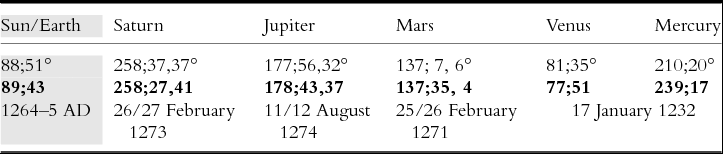
In his Talkhīṣ, Muḥyī al-Dīn presents his trio of observations of the oppositions of each superior planet to the mean Sun, and then explains his procedure of the re-quantification of Ptolemaic planetary models. The unique surviving manuscript of this work is incomplete, so that all of the parts pertained to the inferior planets and planetary latitudes are dropped from it. In Table 5, his values for the longitudes of the apogees are summarized.
Muḥyī al-Dīn al-Maghribī’s values for the longitude of the planetary apogees measured in the Maragha observatory.

In the case of the Sun and superior planets, the dates are for the last of his triple observations, from which he counts back in time in order to compute his own epoch positions for the last day of the year 600 Y/17 January 1232, which are used in his third, and last, zīj, named the Adwār al-anwār (al-Maghribī, Talkhīṣ, ff. 126v, 131v, 135v; Adwār, CB: fol. 80v, M: fol. 82v); for the inferior planets, we quote the epoch values from the latter work.
The values in Ulugh Beg's Sulṭānī zīj (P1: ff. 134r, 137r, 140r, 143r, 146r, P2: ff. 151r, 154r, 157r, 160v, 164r), given for the epoch of its tables, the beginning of the year 841H/4 July 1437, are given in Table 6.
The values for the longitude of the planetary apogees measured in the Samarqand observatory.

As can be seen, Muḥyī al-Dīn has excellent values for the longitudes of the apogees of the superior planets (with errors of only about +10′ for Saturn, within one degree for Jupiter, and less than –1/2° for Mars). But, on the contrary, Ulugh Beg has a more precise value for the longitude of the apogee of Venus.Footnote 37 Nevertheless, both of them show an error of about –30° in the longitude of the apogee of Mercury, as in the other sets of values already put forward in this paper, which gives rise to doubt that any Islamic observer in reality attempted to determine anew the orientation of the geocentric orbit of Mercury.
Considering the motion of the apogees, if Muḥyī al-Dīn, for example, compared his own measured values with Ptolemy's, he could readily find that the planetary apogees do not share the same rate in their progressive motion (the aggregate errors in Ptolemy and Muḥyī al-Dīn's values results the rates about 1°/44y for Saturn, 1°/67y for Jupiter, and 1°/52y for Mars). Nevertheless, dependent upon the tradition he belonged to, he found it necessary to adhere to the authorities who maintained that the motion of the fixed stars equals that of the solar and planetary apogees (al-Maghribī, Talkhīṣ, L: ff. 62r, 128r). Consequently, he did not proceed to state any comparison between the values he measured for the longitudes of the solar and planetary apogees and Ptolemy's or those adopted by his Islamic predecessors. Perhaps, a main reason for this omission was to avoid explaining why the resulting rates are not equal to, but rather, are significantly larger than, precession. Such a situation is also the case with Ulugh Beg and his team of astronomers in Samarqand.
5.2.3. Ibn al-Shāṭir's bisection of the apogeal and precessional motions
In the period between the Maragha and Samarqand observatories, Ibn al-Shāṭir of Damascus made a substantial change in the Ptolemaic generalization by rejecting the idea that the motion of the solar and planetary apogees are equal to precession.
In the prologue to his Jadīd zīj (K: f. 2v, O: f. 2v, L1: f. 2r, L2: f. 2r), he states:
Know that, in the investigation of the observations, I trod the nearest ways [i.e. simplest methods] and the longest intervals of time. And in doing so, I utilized the ancient observations with which all of the researchers agree, and which are taken from the observations of Hipparchus the virtuous and his predecessors, not the observations of Ptolemy. (Emphasis added)
The most evident result of such a choice was to confirm the achievement of all of his Islamic predecessors since the latter part of the tenth century by accepting a precessional rate of 1°/70y, because “it is according to the use of Hipparchus's observations,” as mentioned in the apparatus to the table of the precessional motion in his Jadīd zīj (K: f. 51v, 52r, O: ff. 28r, 30v, 31r; L1: ff. 49v–50v; L2: ff. 62v, 65r, 65v; PR: ff. 61v, 99v, 100r).
In that place, he also says that “this motion [i.e., precession] is not equal to the motion of the apogees, which is equal to 1° in 60 Persian years [of 365 days unvarying], for which we set down a proof in our book named the Ta‘līq al-arṣād (Accounting for observations).” This work is now lost, and so, unfortunately, we do not know how Ibn al-Shāṭir arrived at such a result. Of course, it is apparent that he by no means completely broke his tie with the Ptolemaic generalization, but only excluded the motion of the encompassing orb of the fixed stars from it. This exclusion seems to have been a ripe fruit that could, maybe, have been achieved even earlier. But, Ibn al-Shāṭir is the only Islamic astronomer that, at least, discovered a part of the truth about the motion of the planetary apsidal lines, namely, that in an astronomical system using tropical longitudes, they are by no means equal to precession, but are significantly larger than it.Footnote 38 Although this discovery could be verified and even improved in the later observations, say, in the Samarqand observatory, none of the later Muslim astronomers followed Ibn al-Shāṭir in this regard.
Ibn al-Shāṭir's value for the motion of the solar and planetary apogees is very close to the true motions of the apsidal lines of the Sun/Earth and Jupiter (see above). In his Jadīd zīj, he gives a table for the longitudes of the solar and planetary apogees from the beginning of the Hijra era through the year 900 H in intervals of 30 years. Assuming his discovery to have been based upon the actual observations, let us see how he could deduce it. We choose the values given for the beginning of the year 750 H/21 March 1349 AD (shown in Table 7), which falls within his lifetime, since he should have measured his own values for the longitudes of the apogees about this time, and then, should have computed ahead and back in time those for the other times in that 900-year interval.
Ibn al-Shāṭir's values for the longitude of the planetary apogees.

We need to pay attention to Ibn al-Shāṭir's fragment quoted above. What did he understand by the “ancient observations” he referred to? Ibn al-Shāṭir did not have any ancient values for the longitudes of the apogees of the superior planets and Venus with which he could compare his own values. It is only in the cases of the Sun and Mercury that the Almagest provides the ancient values for the longitudes of the apogees: Hipparchus's measurement of a longitude of 65;30° for the solar apogee for about 146 BC and Ptolemy's derivation of a longitude of about 186° for the apogee of Mercury for some 400 years before him (Almagest IX.7: Toomer Reference Toomer1998, 450–453). If Ibn al-Shāṭir's values are compared with them, the motions of about 1° in 60.5 years and 1° in 59.5 years result for, respectively, the apogees of the Sun and Mercury, which are nearly equal to his figure of 1°/60y. For the longitudes of the apogees of the superior planets and Venus, there can be found some values for the third century BC in the Almagest, which, flawed by misinterpretation, can be counted as the ancient values, as shall be explained in what follows. In order to correct the planetary mean motions, Ptolemy makes use of the ancient observations carried out in the third century BC, and in order to derive the longitudes of the apogees at the times, he only computes back in time from his values for the longitudes of the apogees measured in the 130s with the rate of precession/apogee motion of 1°/100y:Footnote 39

If we compare this set of Ptolemy's values with those given by Ibn al-Shāṭir, the following values for the motion for the planetary apogees result (rounded to one half-year):

It can be readily seen that all the derived motions are about Ibn al-Shāṭir's figure of 1°/60y, except for Jupiter, in which case, Ibn al-Shāṭir's value for the motion of the apogees can be directly deduced from a comparison between his and Ptolemy's values for the longitude of its apogee: ((181;10,10° – 161°)/(1349 – 135) ≈ 0;1°/y). Note that it is only in the case of Jupiter that the difference between Ibn al-Shāṭir and Ptolemy's values for the longitude of its apogee is in good agreement with an apogee motion of 1°/60y, while in the case of the other planets, no agreement can be found between them.
The considerations set forth above can illustrate on the whole a probable way in which Ibn al-Shāṭir could arrive at his specific value for the motion of the solar and planetary apsidal lines. As we have already remarked, Bīrūnī initially found a value of 1°/60y for the motion of the solar apogee on the basis of the comparison of Hipparchus's and his values for its longitude, which is faster than any of the precessional rates available in his time. It is tempting to conjecture that Bīrūnī’s value might have served as a point of departure for Ibn al-Shāṭir to speculate about the fact that the longitudes of the solar and planetary apogees increase at a faster speed than the rate of precession. He might have verified this result later, presumably, by a comparison of his measurement of the longitude of the solar apogee with Hipparchus's corresponding value, dated to the middle of the second century BC, or by a comparison between his own derivation of the longitudes of the planetary apogees (with the exception of Mercury; more probably, the superior planets) with the alleged values attributed to the ancient observations recorded in the Almagest (in the case of the Sun, Saturn, Mars, and Venus) or Ptolemy's (in the case of Jupiter). Of course, the apogee longitude values Ptolemy gives for the times of the ancient observations (except for the Sun and Mercury) are actually his own values measured in the 130s that have been easily converted to the times in the four centuries before him by the rate of precession of 1°/100y. So, if Ibn al-Shāṭir in reality followed such a line of reasoning, his value for the motion of the planetary apsidal lines is partly dependent upon Ptolemy's longitude values. Note that the reason why we exclude Mercury is the existence of an error of about –30° in Ibn al-Shāṭir's value for the longitude of its apogee (indeed, the most prevalent error in Islamic planetary astronomy), which indicates that his value stems from Ptolemy's derivation. Analogously, the errors in both sets of Ptolemy and Ibn al-Shāṭir's values for the longitudes of the apogees of the other planets are nearly of the same sign and order (Saturn: ~ –3°/–5°; Jupiter: ~ +1°; Mars: ~ –1°; and Venus: ~ –2.5°/–2°).
6. Conclusion
To sum up, from his determinations of the longitude of the apogee of Mercury in his time and from the recorded observations of some 400 years before him, Ptolemy found that with respect to a tropical reference system of longitudes, the motion of the apogee of Mercury in this time interval was equal to the precessional motion computed on the basis of his rate of precession of 1°/100y. Then, he generalized this finding to the apogees of the other planets. He also found that the solar apogee is fixed and the lunar apogee has a regressive motion.
Shortly after the rise of astronomy in medieval Islam, the motion of the solar apogee was discovered, in the ninth century. This was undoubtedly an observational achievement, although some theoretical considerations appear to have been involved in it.Footnote 40 The Ptolemaic generalization of the equality of the motion of the apogee of Mercury with precession to the motion of the apsidal lines of the other planets served as a useful methodological axiom showing medieval Middle Eastern astronomers a potential way in which they could proceed in order to both justify and, provisionally, quantify the motion of the solar apogee. So, the Banū Mūsā argued that the motion of the solar apsidal line is equivalent of that of the apogees of the planets, an idea that appears to have been firmly established about the turn of the tenth century. However, through a detailed, precise analysis of the quantitative observational data achieved by his Muslim predecessors, Bīrūnī first hesitated to accept this hypothetical equivalence and even expressed doubt about the uniformity of the motion of the solar apogee. On the basis of a comparison of his value for the longitude of the solar apogee measured in 1016–1017 AD with Ptolemy and Hipparchus's value 65.5° dated, respectively, to the middle of the second century AD and of the second century BC, he found the angular velocity of the solar apogee to be equal to, respectively, 1°/46y and 1°/60y. Treating this issue as an open question demanding the passage of time to be solved by the later generations of astronomers, he, provisionally, accepted the extension of Ptolemy's generalization to cover the motion of the solar apogee. Nevertheless, despite the fact that planetary astronomy received considerable attention in late Islamic astronomy (especially, in the Maragha and Samarqand observatories), so that a good number of the non-Ptolemaic values were determined for the planetary orbital elements and inclinations, medieval Middle Eastern astronomers, except for Ibn al-Shāṭir, neither turned back to reexamine the motion of the solar apogee, nor to evaluate anew the Ptolemaic generalization in the case of the equality of the motions of the apogees.
The principal reasons behind it, constituting the basic features of the medieval Middle Eastern astronomical thought system, can be summarized as follows. In the extremely tradition-based scientific knowledge of the medieval period, such methodological axioms as the Ptolemaic generalization were to a considerable extent (if not ultimately) necessary in addressing the unprecedented fundamental questions, in understanding new phenomena observed, and in overcoming insufficient information available about a specific subject at a given time. This applies, specifically, to the data available about the motion of the solar and planetary apogees, making it very difficult to ascertain their motions. If an underlying tradition was not able to provide the medieval astronomers with a suitable methodological axiom, an applicable hypothesis, a widely-accepted dogma, and so on, then, in order to cope with any of such issues, they had to appeal to other astronomical traditions, embedding them in the formal tradition.Footnote 41 As we have already seen, notwithstanding his repeatedly referring to the undisputable observational data indicating the motion of the solar apogee, Bīrūnī still found it necessary to bring into attention, although passingly, that this motion existed in Indian astronomy. Accordingly, such a system of astronomical thought seldom put aside a general hypothesis in favor of new items of empirical evidence that not only contradicted it, but also, did not agree with each other. Moreover, at a practical level, the other contributing reason was Islamic astronomers’ awareness of the empirical limitations, mainly, the difficulties with making astronomical observations. Consequently, observed inexplicable deviations were customarily attributed to the imperfection of observations or the deficiency of the instruments employed.Footnote 42 Therefore, generally, any secular change in the constants of Ptolemaic astronomy was not permitted, and, as a result, it was thought that the fixed stars and apogees share a common progressive motion. To Islamic astronomers, the values for the rate of precession could be improved, as new and, assumedly, gradually better observations were made, but the equality of the spatial motions of the encompassing nesting celestial spheres of the stars, Sun, and planets could be in no way put under question.
Ibn al-Shāṭir made notable progress by distinguishing between the motion of the fixed stars and that of the solar and planetary apogees, and recognizing that the latter is faster than the former by a motion of 1° in 420 years (= 1°/60y – 1°/70y). However, he maintained the main line of the Ptolemaic generalization that the apogees of the Sun and all the planets move with the same motion. This can be counted as an important observational finding that Ibn al-Shāṭir achieved during his fruitful career. Perhaps, this is a more important achievement than his other observational findings, such as his values for the range of the variation of the apparent angular diameters of the Sun and Moon (see Saliba Reference Saliba1987; cf. Mozaffari Reference Mozaffari and Orchiston2015, 133–134), or his planetary models constructed solely for the purpose of resolving the physical difficulties in Ptolemy's planetary models (on Ibn al-Shāṭir's planetary models, see Roberts Reference Roberts1957; Reference Roberts1966; Kennedy and Roberts Reference Kennedy and Roberts1959; Abbud Reference Abbud1962; Kennedy and Ghanem Reference Kennedy and Ghanem1976; and a concise summary in Saliba Reference Saliba and Rashed1996).
Ibn al-Shāṭir claimed that in the derivation of the heavenly motions, he, specifically, employed the ancient observations preceding Ptolemy, especially those carried out by Hipparchus. As we have already remarked, Bīrūnī initially found a value of 1°/60y for the motion of the solar apogee on the basis of the comparison of his and Hipparchus's values for its longitude, which is faster than any of the precessional rates available in his time. It is tempting to conjecture that Bīrūnī’s value might have served as a point of departure for Ibn al-Shāṭir to speculate about the fact that the longitudes of the solar and planetary apogees increase at a faster speed than the rate of precession. He might have verified this result later, presumably, by a comparison of his probable measurement of the longitude of the solar apogee with Hipparchus's corresponding value, dated to the middle of the second century BC, or by a comparison between his own derivation of the longitudes of the planetary apogees with the alleged values attributed to the ancient observations recorded in the Almagest. The latter, as explained earlier, are just Ptolemy's values measured in the first half of the second century AD converted to some times in the third century BC by his rate of precession of 1°/100y.
In the astronomical system developed in Western Islamic lands, a shift or deviation from Ptolemy's generalization occurred with Ibn al-Zarqālluh's opinion that the solar apogee has a proper motion in longitude of 1°/279y in a sidereal reference system, but the later astronomers belonging to that tradition generalized this proper motion to the apsidal lines of the planets. Thus, it can be said that the Ptolemaic generalization was revived in a new form and was utilized in the construction of a new hypothesis: the motion of the apogees is not related to precession, but greater than it, and so they are neither tropically, nor sidereally fixed. This suggestion is similar to Ibn al-Shāṭir's hypothesis, but it is a purely theoretical achievement in essence, apparently resulting from following the main line of reasoning of Ptolemy in the Almagest, and does not have any basis in observational astronomy.
In brief, the ninth-century Islamic astronomers, followed by Bīrūnī, Ibn al-Zarqālluh, and Ibn al-Shāṭir, as well as, to some extent, later Western Islamic astronomers, each contributed to the substantial changes in a particular proposition of Ptolemy's astronomy, that is, the motion of the planetary apogees and the correlation between it and precession. These contributions took form, first, by including the motion of the solar apogee in Ptolemy's proposition and, later, by making a distinction between the motion of the apogees and precession, but did not alter a fundamental axiom of Ptolemy's astronomical methodology, i.e., the generalization in the case of the equality of the motions of the apogees.
Acknowledgments
The author owes a debt of gratitude to Prof. Peter Barker (United States) and the two anonymous referees for their helpful comments. He is also very grateful to have been able to finish this article during a fellowship of the project Ptolemaeus Arabus et Latinus at the Bavarian Academy of Sciences and Humanities in Munich, Germany. This work has been financially supported by the Research Institute for Astronomy and Astrophysics of Maragha (RIAAM) under the research grant no. 1/4717-162.