Introduction
Seed mass, also described as seed size in the literature, is an important plant functional trait linked to plant recruitment via germination and seedling establishment. Current evidence suggests an inter- and intraspecific recruitment advantage for relatively large seeds when confronted with establishment hazards such as competition, shading and burial depth. Alternatively, smaller seeds are dispersed and incorporated into the soil seed bank more easily, leading to increased persistence and decreased depredation (Tripathi and Khan, Reference Tripathi and Khan1990; Leishman et al., Reference Leishman, Wright, Moles, Westoby and Fenner2000; Moles and Westoby, Reference Moles and Westoby2004; Lehtila and Ehrlen, Reference Lehtila and Ehrlen2005).
Considerable intraspecific seed mass variation commonly occurs in nature, and differences in seed mass at the species level influence germination ability (Vaughton and Ramsey, Reference Vaughton and Ramsey1997). For example, higher-mass seeds tend to germinate to a greater percentage and at a faster rate compared to lower-mass seeds (Hendrix, Reference Hendrix1984; Tripathi and Khan, Reference Tripathi and Khan1990; Baskin and Baskin, Reference Baskin and Baskin2014). However, studies conducted over the past 40 years utilized non-stressful temperatures to study the effect of intraspecific seed mass variation on germination (see supplementary Table S1). Most authors attempted to simulate temperatures that occurred during the season that germination was likely, or used constant temperatures near 20–25°C, which are presumably optimal. The influence of abiotic stress on mass-based germination dynamics and viability loss requires more investigation, since it is reasonable to assume that seeds may face greater levels of thermal stress and deterioration due to global climate change.
To begin confronting this problem, we compared germination responses of mass-separated Rudbeckia mollis seeds following exposure to a range of stressful and non-stressful temperatures and increasing durations of ageing stress. We selected R. mollis because it is a wild taxon, occurring in a region outside of sub-arctic or montane zones projected to continue experiencing increasing surface temperatures (Ingram et al., Reference Ingram, Dow, Carter and Anderson2013). R. mollis also expresses reduced germination ability and increased seed viability loss following relatively small increases in supra-optimal temperature (Kettner and Pérez, Reference Kettner and Pérez2012). Moreover, R. mollis potentially displays variable mass-dependent germination responses. For instance, preliminary studies with seeds stored for 1 year on the laboratory benchtop [c. 23–24°C, 30–40% relative humidity (RH)] indicated that seed mass significantly influenced germination following exposure to alternating seasonal temperatures (supplementary Fig. S1A–D, χ2 2 = 32.99; P < 0.0001). This paper describes: (1) the influence of seed mass on kinetics of early germination processes (i.e. imbibition and lag phase) at an optimum temperature; (2) relationships between seed mass, simulated seasonal temperatures or supra-optimal temperatures, and radicle protrusion or viability; and (3) the influence of ageing stress on subsequent mass-based germination responses.
Materials and methods
Plant material
R. mollis (Heliantheae, Asteraceae) is an herbaceous, summer-blooming annual found throughout the south-eastern United States from Alabama to South Carolina. The southern range of R. mollis extends into north-central Florida (Wunderlin, Reference Wunderlin1998). R. mollis produces achenes, referred to hereafter as seeds, typically shed from September through November. This species occurs within sandhill ecosystems that experience frequent, low-intensity ground fires. Sandhill physiognomy consists of nutrient-poor, deep, well-drained and consistently dry, coarse sands or sandy clays (Myers and Ewel, Reference Myers and Ewel1990). This type of ecosystem also experiences rapid temperature, humidity and soil moisture fluctuations due to the xeric environment and open canopy structure.
Establishing mass-based seed classes
Mechanical seed harvest occurred during September 2013 after plants senesced and seeds began to separate naturally from infructescences. Wildflower seed producers use this as a standard method to minimize the likelihood of collecting immature seeds. We collected nine seed fractions following passage of the seed lot through an air density separator (STS-WM2-SV, SeedTech Systems, Inc., Wilton, California, USA). Next, we selected 25 seeds randomly from each fraction and divided the samples into five sub-samples of five seeds each. We determined the mean fresh mass of each sub-sample gravimetrically and divided the overall mean difference between the lightest and heaviest fractions by three, to delineate light, intermediate and heavy mass-based classes. We combined fractions that fell within the light, intermediate or heavy range of mass. We stored all seeds at about 4°C until germination experiments commenced, on 24 January 2014 (simulated seasonal temperature experiment), 9 April 2014 (constant temperature experiment) and 11 September 2015 (saturated salt accelerated ageing).
Mass-based imbibition kinetics
We examined water uptake within each mass class to determine the influence of seed mass on early stages of germination. We assigned three Petri dishes randomly to each mass class. Each dish contained one sheet of germination blotter (Blue Steel, Anchor Paper, St. Paul, Minnesota, USA) moistened with 7 ml of autoclaved (117.7 kPa, 121°C, 40 min) deionized water. We selected 30 seeds randomly from each class and divided samples into three sub-samples of 10 seeds each. We then assigned one sub-sample randomly per dish. We wrapped the dishes with two layers of plastic laboratory film (Parafilm, Bemis Flexible Packaging, Neenah, Wisconsin, USA) and placed the dishes in an incubator set to 25°C without supplemental illumination. We measured the fresh mass of each sub-sample gravimetrically after 0, 0.25, 0.50, 0.75, 1, 1.5, 2–6, 12, 18 and 24 h, having placed all seeds on a dry blotter to absorb water on the testa surface. We maintained a consistent supply of moisture in the dishes by adding water after each 1- and 6-h interval.
Germination testing
General methods
We collected lots of 200 (i.e. simulated seasonal temperatures) and 250 (i.e. constant temperatures) seeds randomly from each mass-based class and divided these into samples of 50 seeds each. We further divided the samples into five sub-samples of 10 seeds each and loaded each sub-sample into 60-mm Petri dishes containing three sheets of germination blotter moistened with 7 ml of autoclaved deionized water. Dishes were wrapped with four layers of plastic laboratory film to minimize water loss. We assigned sub-samples randomly to incubators and a thermogradient table, so that each temperature received five sub-samples from each mass class. We observed germination progress daily for 28 d and defined germination as radicle protrusion ≥2 mm. Water was added to the dishes as necessary, and germinated or contaminated seeds were removed during each observation.
Germination under simulated seasonal and constant temperatures
We derived simulated seasonal alternating temperatures from average maxima and minima collected by the Southeast Regional Climate Center over a 30-year period at sites across Florida. Simulated temperatures represent conditions experienced during the winter (22/11°C), late autumn or early spring (27/15°C), early autumn or late spring (29/19°C) and summer (33/24°C). We conducted simulated seasonal germination tests within incubators (I-30-Vl, Percival Scientific, Inc., Perry, Iowa, USA) programmed with alternating temperature and light schedules. Thermo- and photoperiods alternated every 12 h and illumination coincided with the high temperature.
Preliminary tests with non-refrigerated, 1-year-old R. mollis seeds and work by Kettner and Pérez (Reference Kettner and Pérez2012) showed that the optimal constant temperature for germination was 25.0°C. Therefore, we focused on exposing seeds to supra-optimal constant temperatures of 27.5, 30.0, 32.5, 35.0 and 37.5°C on a thermogradient table (Model 5010.00, Seed Processing Holland BV, Enkhuizen, Netherlands). Photosynthetic photon flux density (PPF) at seed level was 57 ± 7 μmol m−2 s−1 (mean ± SD) within the chambers and 52 ± 5 μmol m−2 s−1 on the thermogradient table.
Saturated salt accelerated ageing
We conducted saturated salt accelerated ageing (SSAA) to assess the ability of mass-separated R. mollis seeds to tolerate increasing durations of ageing stress. Seeds from each mass class (n = 1750) were selected randomly and divided into lots of 250 seeds. We assigned one lot to each of seven SSAA durations: 0, 5, 10, 15, 20, 25 and 30 d. We distributed seed lots evenly on an 18-mesh (1.0 mm) wire screen (AAT; Hoffman Manufacturing, Inc., Jefferson, Oregon, USA) suspended above 60 ml of saturated NaCl solution inside plastic ageing containers (156C; Hoffman Manufacturing, Inc.). The NaCl solution was made by heating deionized water to 45°C followed by incremental addition of NaCl until saturation was achieved. The solution was reheated to 45°C before being poured into each ageing container, to ensure complete saturation at the beginning of each treatment. We completed each SSAA duration independently and transferred ageing containers to an incubator programmed to 41.0°C with no supplemental illumination. Ageing containers were removed individually from the incubator following all ageing durations. One hundred randomly selected seeds were divided into four sub-samples of 25 seeds for water content determination (data not shown). Next, 100 additional seeds were counted and divided into four 25-seed sub-samples for germination assays at 25.0°C.
Viability testing
We assessed viability of all non-germinated and non-infected seeds remaining at the conclusion of germination tests, via the tetrazolium staining method according to Peters (Reference Peters2000). We soaked seeds in a 1% tetrazolium chloride (TTC) solution within aluminium foil-covered beakers for 24 h at 25°C. We assessed staining patterns with a dissecting microscope at 500 × magnification and calculated the viable seed fraction as the sum of germinated seeds plus any seeds that stained positively following TTC assays.
Data analyses
We conducted all data analyses using SAS software (v. 9.4, SAS Inc., Cary, North Carolina, USA).
Mass-based seed classes
We performed one-way analysis of variance (ANOVA) by fitting a general linear model with the least squares method and checked assumptions of normality and constant variance graphically. We separated means with the Bonferroni method at α = 0.05.
Comparing imbibition kinetics among mass classes
We conducted analysis of covariance (ANCOVA) on log-transformed data by fitting a mixed linear model to examine the relationship between seed mass and water uptake from 0 to 6, 0.25–6 and 6–24 h. We performed ANCOVA on models including and excluding the zero time point during the first 6 h to account for the rapid initial increase in fresh mass.
Germination testing
We used non- and semi-parametric time-to-event analyses to evaluate temporal patterns of germination and to construct Cox regression models. Germination was the event of interest. Therefore, we coded germinated seeds as one and censored seeds as zero. Censored observations included seeds that did not germinate or that displayed fungal contamination within the 28-d period.
We generated Kaplan–Meier estimates of survivor functions for seeds exposed to simulated seasonal temperatures, constant supra-optimal temperatures and increasing durations of SSAA. The functions were stratified by mass-based class, germination temperature or SSAA duration, as appropriate. We tested the null hypothesis that temporal patterns of germination (i.e. survivor functions) were the same between treatments via the log-rank statistic. We generated median germination times (t 50) from the product-limit survival estimates output. This value corresponds to the smallest event times given that the probability of not germinating was >0.50. We calculated germination rate as the inverse of median germination time (1·t 50 −1).
We built extended Cox regression models by evaluating the proportional hazards assumption via graphical and residual analyses (Allison, Reference Allison2010). We used the exact method during residual analysis and subsequent model building to account for large proportions of tied event times. We then extended Cox models when necessary by including appropriate interaction terms as time-dependent covariates (e.g. temperature × day) and repeated the model building procedure. We tested the null hypothesis that slope coefficients were equal among treatments with orthogonal contrasts.
Counts of viable seeds
We analysed counts of viable seeds for the temperature, SSAA and mass-based class datasets via Poisson regression for incidence densities according to Stokes et al. (Reference Stokes, Davis and Koch2012). We calculated incidence densities as:
 $n_{ts}\; \cdot \; N_{ts}^{ - 1} $
, where n
ts equals the count of viable seeds (i.e. germinated + non-germinated, viable) and N
ts equals the total number of seeds for a given temperature or SSAA duration treatment (t) and mass-based class (s) combination. The offset variable was equal to log(N
ts). We examined count data against temperature and mass class using a log-linear model with the distribution specified as Poisson.
Results
Seeds corresponding to the light, intermediate and heavy R. mollis classes displayed an average fresh mass of 393 ± 35, 423 ± 29 and 474 ± 38 μg (mean ± SE), respectively. Seeds in the heavy class were significantly heavier than seeds in either the intermediate (t 0.05,42 = 3.74; P = 0.002) or the light class (t 0.05,42 = 6.85; P < 0.001). However, seed mass was not significantly different between the light and intermediate classes (t 0.05,42; P = 0.104).
Mass-based imbibition and lag phase kinetics
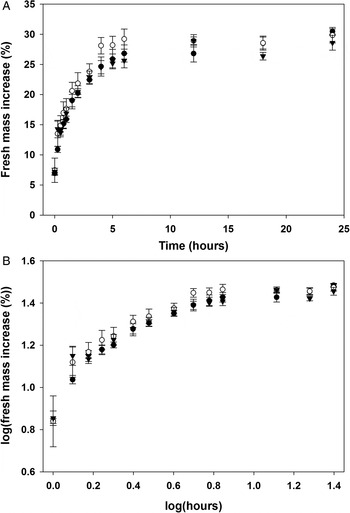
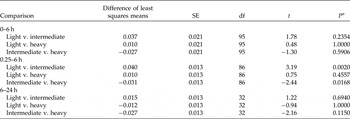
Seed fresh mass increased by 25–30% in a similar pattern for each class over the first 6 h of imbibition. Fresh mass remained stable for the next 18 h, indicating that imbibition was complete by hour 6 (Fig. 1). We accepted the null hypothesis of equal slopes in models containing (F 2,93 = 0.53; P = 0.5875) or excluding (F 2,84 = 1.37; P = 0.2596) the zero time point. Therefore, imbibition rate was similar in all mass classes. Pairwise comparisons for mass-adjusted treatment means were similar during imbibition from 0 to 6 h. However, the mass-adjusted mean for the intermediate class was larger compared to the light and heavy classes when we examined imbibition from 0.25 to 6 h (Table 1). Fresh mass during the germination lag was similar (F 2,30 = 1.08; P = 0.3517) in all mass classes. Likewise, mass-adjusted means were similar among all classes from 6 to 24 h (Table 1).
Change in fresh mass of Rudbeckia mollis mass-based seed classes exposed to water for 24 h at 25°C. (A) Imbibition progress curves and (B) log-transformed imbibition progress curves. Symbols represent the light (solid circles), intermediate (open circles) and heavy (inverted solid triangles) mass classes. Common slope values for water uptake from 0–6, 0.25–6 and 6–24 h are 0.5701, 0.4458 and 0.0559, respectively.

Analysis of covariance pairwise comparisons of mass-adjusted treatment means for Rudbeckia mollis imbibition models. Comparisons are based on seed mass classes denoted light, intermediate and heavy. Increase in fresh mass was recorded after 0, 0.25, 0.50, 0.75, 1, 1.5, 2–6, 12, 18 and 24 h of imbibition at an optimal germination temperature of 25°C.

a P values were adjusted with the Bonferroni method.
Germination under simulated seasonal temperatures
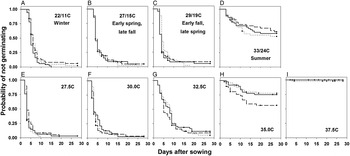
Temporal patterns of germination were similar among mass-based classes following exposure to simulated winter (22/11°C), spring (27/15°C) and autumn temperatures (29/19°C) (Fig. 2A–D). The probability of not germinating decreased to <0.15 across mass classes by day 10 at these temperatures. In contrast, the probability of not germinating under simulated summer temperatures (33/24°C) was comparatively higher and ranged from about 0.53 to 0.61 for all mass classes by day 28. Additionally, temporal patterns of germination for seeds exposed to 33/24°C began diverging between mass classes by day 11 (Fig. 2D). Final germination percentage averaged across mass classes did not exceed 44% following exposure to simulated summer temperatures. Alternatively, final germination percentage was about 2.0- to 2.6-fold greater under winter, spring and autumn conditions. Germination rate was reduced under simulated winter temperatures (1·t 50 −1 range 0.17–0.20) but increased slightly in all mass classes (1·t 50 −1 = 0.25) following exposure to early autumn/late spring (29/19°C) and late autumn/early spring (27/15°C) temperatures (supplementary Table S2). We rejected the hypothesis that temporal patterns of germination were similar among simulated seasonal temperatures and mass-based classes (log-rank χ2 11 = 231.43; P < 0.0001).
Kaplan–Meier survival functions for the germination response of relatively fresh mass-separated Rudbeckia mollis seeds exposed to simulated seasonal (A–D) and supra-optimal constant (E–I) temperatures. Simulated winter, late autumn or early spring, early autumn or late spring and summer temperatures are 22/11°C (A), 27/15°C (B), 29/19°C (C) and 33/24°C (D), respectively. Constant temperatures are 27.5°C (E), 30.0°C (F), 32.5°C (G), 35.0°C (H) and 37.5°C (I). Lines represent the light (solid), intermediate (short dash) and heavy (dotted) mass classes. Black circles represent censored observations. Point-wise 95% confidence intervals are excluded for clarity. The estimated survivor functions displayed in each panel begin at time = 0 with a probability of not germinating = 1.0 for all individual seeds. In other words, no seeds have germinated at time = 0 and we assume that germination time is always greater than 0. A constant value of 1.0 early in the experiment denotes the lag period for germination. However, as time increases, survivor functions begin to decrease in a stepwise manner, indicating that germination is taking place. Hence, the probability of not germinating will decrease as germination events increase. The probability of not germinating will reach 0 if all seeds germinate within the experimental period.

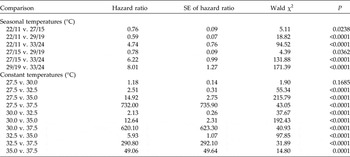
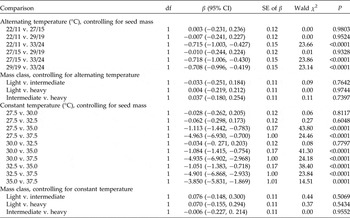
Further analyses showed that simulated seasonal temperature and not seed mass significantly affected germination (Table 2). All orthogonal contrasts indicated that R. mollis seeds displayed a seasonally dependent germination response. Hazard ratios of 0.59 and 0.78 suggest that optimal germination is likely to occur following exposure to early autumn/late spring temperatures (29/19°C). Moreover, the magnitude of differences in germination was smaller for contrasts between winter, spring or autumn temperatures than for comparisons to summer conditions. Germination was 4.7–8.0 times more likely during exposure to simulated winter, spring or autumn temperatures compared to summer conditions (Table 3).
Overall Cox regression models for the germination response of Rudbeckia mollis seeds of different mass exposed to simulated seasonal and supra-optimal constant temperatures. Simulated seasonal temperatures represent diurnal fluctuations during summer (33/24°C), early autumn or late spring (29/19°C), late autmn or early spring (27/15°C) and winter (22/11°C) throughout Florida. Constant temperatures represent exposure to 27.5, 30.0, 32.5, 35.0 or 37.5°C.

Orthogonal contrasts for the germination response of Rudbeckia mollis seeds of different mass exposed to simulated seasonal temperatures and supra-optimal constant temperatures. Seasonal temperatures alternated every 12 h and simulated conditions during the summer (33/24°C), early autumn or late spring (29/19°C), late autumn or early spring (27/15°C) or winter (22/11°C) throughout Florida.

Germination following exposure to supra-optimal temperatures
Temporal patterns of germination varied considerably across supra-optimal constant temperatures. For instance, Kaplan–Meier survivor functions remained tightly clustered and decreased rapidly for seeds exposed to 27.5 and 30.0°C. The probability of not germinating was <0.15 by about day 10 at these temperatures. However, at 32.5°C, germination patterns began shifting upwards from days 5–9, denoting germination sensitivity among mass classes. Germination sensitivity became more evident following exposure to 35.0°C. For example, the probability of not germinating ranged from 0.57 to 0.78 for all mass classes exposed to 35.0°C. Moreover, temporal patterns of germination for the intermediate class were clearly separate from the light or heavy classes at this temperature. Only one seed germinated in the heavy class at 37.5°C (Fig. 2E–I).
Germination percentages were ≥86% for all mass classes exposed to 27.5, 30.0 and 32.5°C, but ranged from 0 to 38% at 35.0 or 37.5°C. Interestingly, total final germination for the intermediate class at 35.0°C was 1.7 times higher than the mean final germination percentage of the light and heavy classes. Moreover, germination rate was about twice as rapid following exposure to 27.5 or 30.0°C than at 32.5°C (supplementary Table S2). We rejected the hypothesis that survivor functions were similar across supra-optimal constant temperatures and mass classes (log-rank χ2 14 = 632.92; P < 0.0001).
Constant temperature and not seed mass was a significant predictor regarding germination response (Table 2). Orthogonal contrasts indicated that germination sensitivity increased with temperature above 30.0°C. For example, the likelihood of germination was about 2 to 732 times higher at 27.5 or 30.0°C compared to that at temperatures between 32.5 and 37.5°C (Table 3).
Germination following increasing ageing stress duration
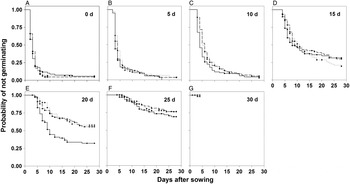
Temporal patterns of germination were similar following 0 and 5 d of saturated salt accelerated ageing but began diverging between mass classes and shifting upwards by day 10. Temporal germination patterns shifted upwards considerably after day 10, denoting increased germination sensitivity to SSAA. The temporal pattern of germination for the light class clearly separated from patterns for the intermediate and heavy classes by day 20. For example, by day 20, the probability of not germinating fell to 0.32 for the light class, but did not decrease below 0.55 for the remaining classes. Some separation between temporal patterns was also evident between the light class and intermediate or heavy classes at day 25. Here, the probability of not germinating ranged between 0.69 and 0.76 across mass classes. Only one seed germinated in the light class following 30 d of SSAA (Fig. 3).
Kaplan−Meier survival functions for the germination response of mass-separated Rudbeckia mollis seeds exposed to increasing levels of saturated salt accelerated ageing duration. Lines represent the light (solid), intermediate (short dash) and heavy (dotted) mass classes. Black circles represent censored observations. Point-wise 95% confidence intervals are excluded for clarity.

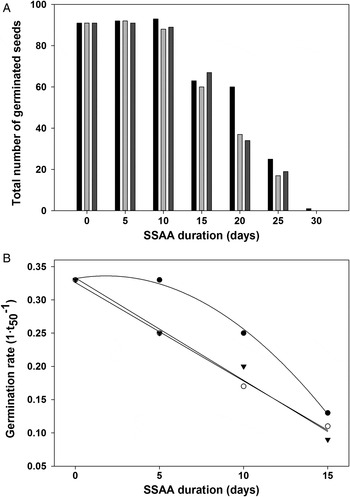
The total number of germinated seeds ranged between 88 and 93 across mass classes for the first 10 d of SSAA, but decreased considerably (range 0–67) with increasing SSAA duration (Fig. 4A). Light seeds maintained more rapid germination compared to intermediate or heavy classes as SSAA duration increased. Moreover, the nature of the inverse relationships between germination rate and SSAA duration differed such that a threshold in germination rate was evident in the light class up to 5 d of exposure to SSAA. Alternatively, germination rate decreased in a linear fashion for the intermediate and heavy classes as SSAA duration increased (Fig. 4B). We rejected the hypothesis that survivor functions were similar across SSAA durations and mass classes (log-rank χ2 20 = 1773.65; P < 0.0001).
Germination parameters for Rudbeckia mollis mass-based seed classes following saturated salt accelerated ageing (SSAA) for 0–30 d. (A) Total number of germinated seeds and (B) germination rates (1 · t 50 −1) across SSAA durations and mass classes. Shading in (A) represents the light (black), intermediate (light grey) and heavy (dark grey) mass classes. Symbols in (B) represent the light (solid circles), intermediate (open circles) and heavy (inverted solid triangles) mass classes. Lines in (B) are included as a visual aid. Germination rates were calculated from Kaplan–Meier survivor functions (see supplementary Table S3). The Kaplan–Meier estimator did not reach a failure probability >0.50 for seeds in the intermediate or heavy classes following 20 d of SSAA. Thus, germination rate was not calculated. An adjusted t 50 could be calculated in these cases by multiplying the final germination percentage by 0.50. It is then possible to use product-limit survival estimates to find the smallest event time in days corresponding to the probability of germination (i.e. 1 − Kaplan–Meier estimator that was greater than the adjusted germination proportion of interest). However, comparisons to unadjusted t 50 values would be misleading since the adjusted values represent a different percentile of the seed population.

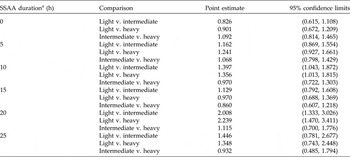
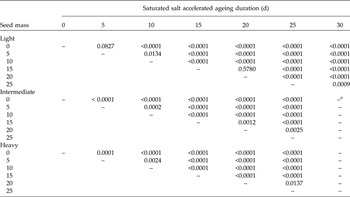
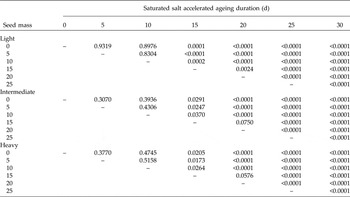
Seed mass and SSAA duration significantly influenced germination response. Inclusion of time-dependent covariates suggests that the effect of seed mass and SSAA duration on germination increased with time (Table 4). Orthogonal contrasts suggested that germination of seeds from the light class was about 1.4–2.2 time more likely than for intermediate or heavy seeds after 10 and 20 d of SSAA. However, the likelihood of germination was similar among mass classes for the remaining SSAA durations (Table 5). Almost all orthogonal contrasts between SSAA durations within a seed mass class were significant. However, the likelihood of germination for seeds in the light class was not significantly different when comparing responses at 0 and 5 or 15 and 20 d of SSAA (Table 6).
Overall Cox regression models for the germination response of Rudbeckia mollis seeds of different mass exposed to increasing saturated salt accelerated ageing duration.

Orthogonal contrasts for germination of Rudbeckia mollis mass classes exposed to increasing levels of saturated salt accelerated ageing (SSAA) duration. Contrasts are for mass classes controlling for SSAA duration. Point estimates with confidence limits encompassing 1.0 are not significantly different from 0 at α = 0.05.
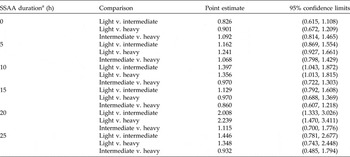
a The 30-d SSAA treatment was omitted due to lack of germination for intermediate or heavy mass classes.
Orthogonal contrast P values for germination of Rudbeckia mollis seeds exposed to increasing duration of saturated salt accelerated ageing (SSAA). Contrasts are for SSAA durations controlling for seed mass. Statistical significance determined with α ≥ 0.05.

a P values omitted due to lack of germination for seeds in the intermediate or heavy classes following 30 d of SSAA.
Relationships between seed mass, abiotic stress and seed viability
Exposure to simulated summer temperatures resulted in death for over half of the seed population in all mass-based classes. In contrast, seed viability ranged from 90 to 100% at other simulated seasonal temperatures. Similarly, seed viability ranged between 86 and 98% for all mass classes following exposure to supra-optimal temperatures between 27.5 and 32.5°C. At 35°C, however, seed viability loss occurred in up to 76% of seeds. Interestingly, viability loss at 35°C was less for the intermediate compared to light or heavy mass classes. Seed viability was virtually nil at 37.5°C (supplementary Table S2).
Overall, a decreasing trend for the incidence of viable seeds as simulated seasonal and constant temperatures increased was detected (Table 7). Additionally, the influence of temperature on decreased viability always increased as the difference in seasonal or constant temperatures widened. Orthogonal contrasts revealed that simulated summer temperatures had the strongest influence on decreased seed viability. Comparisons of seed viability between winter, spring or autumn temperatures were not significant. Similarly, wider constant temperature differentials or temperatures above 32.5°C exerted the strongest influence on seed viability loss. Nonetheless, mass was not a significant predictor for the incidence of viable seeds despite a considerable influence of temperature (Table 7).
Poisson regression models characterizing Rudbeckia mollis seed viability following exposure to simulated seasonal alternating temperatures or constant temperatures. Counts of viable seeds are from data in supplementary Table S2.

Seed viability remained high (range 88–93%) across mass classes after exposure to ageing stress for up to 10 d. However, after this point, seed viability decreased considerably (range 0–67%) for all mass classes with increasing SSAA duration. A small reduction (1.6%) in viability occurred for seeds in the light class between 15 and 20 d of SSAA. Alternatively, viability decreased between 36 and 48% for intermediate and heavy seeds over the same durations (supplementary Table S3).
The incidence of viable seeds decreased across SSAA durations and seed mass. For example, parameter estimates for SSAA durations between 5 and 30 d decreased from 0.0073 to −4.9163, respectively. Similarly, parameter estimates decreased from −0.0902 to −0.1056 for the heavy and intermediate classes. Nonetheless, only SSAA duration (χ 2 6 = 575.92; P < 0.0001) and not seed mass (χ 2 2 = 2.67; P = 0.2632) significantly predicted the incidence of viable seeds. Orthogonal contrasts suggested a seed viability threshold at 10 d of SSAA (Table 8).
Orthogonal contrast P values for counts of viable Rudbeckia mollis seeds exposed to increasing levels of saturated salt accelerated ageing (SSAA) durations. Contrasts are for SSAA durations controlling for seed mass. Counts of viable seeds are from data in supplementary Table S3. Statistical significance determined with α ≥ 0.05.

Discussion
The seed to seedling transition requires individuals to pass through imbibition, lag and radicle protrusion phases of the germination process. Likewise, hydrated seeds must effectively sense thermal cues and respond to ageing stress to increase the probability of successful seedling establishment. Previous studies have shown that seed mass influences germination rate and percentage following exposure to favourable temperatures. However, the relationship of this important plant functional trait on the germination process in response to thermal and ageing stress remains untested.
In R. mollis, we found that seed mass was not a significant driver of early (i.e. imbibition, lag phase) or late (i.e. radicle protrusion) germination dynamics despite an annual life history in a harsh sandhill ecosystem. In other words, our experiments show that temperature selected for similar temporal germination patterns, numbers of germinating individuals and viability loss at the population level across seed mass classes. However, ageing stress selected for differential germination favouring lower-mass seeds. To our knowledge, this is the first report of mass-based germination and viability dynamics in response to a gradient of favourable to elevated thermal scenarios and ageing stress.
Mass-based imbibition and lag phase kinetics
Genna (Reference Genna2015) found mass-related morphological differences for R. mollis seeds, including direct relationships between pericarp thickness, embryo length, seed or embryo width and seed mass. However, disparities in R. mollis seed mass and morphological variation do not correspond to differential imbibition kinetics as reported for sunflower (Hernandez and Orioli, Reference Hernandez and Orioli1985). These authors conclude that larger sunflower achenes displayed faster imbibition than smaller fruits, due to a comparatively greater proportion of pericarp tissue. However, larger fruits exhibited slower germination rates in contrast to smaller fruits because of a considerable gap between testa and pericarp tissue that most likely delayed water transfer to seeds. Unlike the findings for sunflower, the embryo and endosperm of R. mollis are appressed to the testa and the testa contacts the pericarp throughout the locule (Genna, Reference Genna2015). Therefore, the close association of fruit and seed tissue layers likely facilitates similar water movement in all R. mollis seed mass classes at 25°C.
Imbibition rate may vary depending on initial seed moisture content, seed mass and imbibition temperatures. Specifically, temperature-dependent viscosity changes of water induce variable imbibition rates over large temperature ranges (Vertucci and Leopold, Reference Vertucci and Leopold1983). Therefore, the similar water uptake rates for R. mollis mass classes imbibed at 25.0°C described in this paper may diverge at sub- or supra-optimal temperatures. Although we did not measure seed water content in this study, higher initial water content in intermediate R. mollis seeds could account for the initially higher fresh mass observed during water uptake studies (Fig. 1). Regardless, higher initial fresh mass for seeds of the intermediate class did not translate into a germination advantage. We speculate that R. mollis seed mass phenotypes experience similar temporal patterns of imbibition to exploit periods of adequate soil moisture in habitats with otherwise highly variable hydration and temperature conditions.
Germination under simulated seasonal and constant temperatures
The similarity between temporal patterns of R. mollis germination across mass-based classes suggests that seed mass variation plays a limited role at the earliest stage of the seed to seedling transition in relatively fresh seeds. Other members of Asteraceae, such as Ambrosia artemisiifolia (Heliantheae; Guillemin and Chauvel, Reference Guillemin and Chauvel2011) and Centaurea eriophora (Cynareae; De Clavijo, Reference De Clavijo2002), that possess an annual life history and adaptations to arid, warm habitats, also display mass-independent germination. These authors suggest a link between seed mass and adaptations for surviving in highly variable environmental conditions, such as formation of a persistent seed bank. At present, we do not know the ability of R. mollis seeds to persist in the soil seed bank. However, available evidence indicates that the annual habit evolved as an adaptive response for survival in hot and dry environments (Friedman and Rubin, Reference Friedman and Rubin2015). We propose that corresponding temporal patterns of germination (Fig. 2, supplementary Table S2) and consistent likelihood of germination across a range of temperatures (Table 2) displayed by individual seeds of variable mass represent adaptations to support maintenance of the annual life-history strategy.
The range of simulated seasonal and constant supra-optimal temperatures used in this study selected for temperature-dependent germination responses. For example, seeds from all R. mollis mass-based classes germinated rapidly and to high proportions following exposure to autumn (29/19°C), winter (22/11°C) and spring (27/15°C) conditions, or constant temperatures between 15 and 30°C. However, thermal sensitivity became apparent at constant 32.5°C, and detrimental at simulated summer temperatures (33/24°C) and constant temperatures ≥35°C.
The rapid and nearly complete germination response under autumn conditions suggests that germination may occur soon after shedding. Early autumn may be the optimum time for germination since air temperatures are cooler and the dry season has not yet commenced in the south-eastern United States. This agrees with previous work by Kettner and Pérez (Reference Kettner and Pérez2012). Similarly, R. mollis seeds germinated well under simulated winter and spring conditions, indicating that cooler temperatures do not inhibit radicle emergence. Therefore, seedlings may have evolved mechanisms to tolerate freezing conditions typical during winter and early spring. Germination and seedling establishment during periods of freezing air and soil are possible for other wildflowers of the region (Pérez et al., Reference Pérez, Almira and Brennan2009). However, establishment may be limited in colder months because these conditions coincide with the dry season.
Alternatively, germination is restricted in a mass-independent manner for the majority of seeds following exposure to summer conditions. This occurs despite adaptions of R. mollis to the hot and dry conditions of a sandhill ecosystem. Nonetheless, a portion of the seed population germinated in response to summer temperatures. Ipomopsis rubra (Polemoniaceae), a co-occurring sandhill species, displays similar patterns of reduced germination during summer (Pérez and Kettner, Reference Pérez and Kettner2013). These authors suggest that germination during periods of adverse temperatures may not have adaptive significance since seedling establishment is most likely low as abiotic stress increases. Then again, the risk of establishment during unfavourable conditions may be less than the cost of losing some individuals to temperature stress. Successful seedling establishment in the face of stressful temperatures and other hazards (e.g. competition) could result in temporal distribution of age and size classes within a population, combined with associated fitness consequences (Donohue, Reference Donohue2002).
Germination following increasing ageing stress duration
We expected to find similar germination responses across mass-based classes for relatively fresh (i.e. storage time ≈ 6 months; storage temperature ≈ 4°C) R. mollis seeds used in the current study and 1-year-old seeds stored on the laboratory bench at about 23–24°C and 30–40% RH. However, conflicting germination responses between different storage methods suggest that R. mollis seeds may experience mass-dependent ageing reactions, such that lower-mass seeds retain higher germination ability over time (supplementary Fig. S1, Fig. 2). Fresh R. mollis seeds did not exhibit a mass-based germination response because cold storage may have reduced the rate of ageing reactions (Walters, Reference Walters1998).
Interestingly, exposure to accelerated ageing stress yielded mass-dependent germination responses similar to preliminary germination tests conducted under simulated seasonal temperatures. R. mollis seeds of different mass express similar tolerance mechanisms following up to 5 d of ageing stress. However, intermediate and heavy seeds experience greater deterioration compared to light seeds following this point. For example, the apparent germination rate threshold for light seeds in response to 5 d of SSAA implies that seeds in this class maintained similar tolerance levels to untreated seeds. Nevertheless, comparatively reduced germination rates for intermediate and heavy seeds suggest accumulation of deterioration damage (Walters, Reference Walters1998). Likewise, a germination percentage threshold was manifest in all mass classes after 10 d of SSAA. The combination of reduced germination capacity and slower germination rates after day 10 most likely mark the onset of deleterious stress and breakdown of tolerance mechanisms in large portions of the seed population. Yet, despite overall reductions in germination, light seeds maintain a considerable germination advantage over intermediate or heavy seeds following 20 d of SSAA. Collectively, these findings suggest a mass-dependent deterioration mechanism for R. mollis seeds.
Relationships between seed mass, abiotic stress and seed viability
Exposure to relatively short periods of simulated summer temperatures (33/24°C) induced seed mortality to a considerably greater degree compared to other seasonal temperatures. Consequently, summer is potentially the most stressful period for remaining, non-germinated R. mollis seeds. Likewise, the onset of seed death at constant 32.5°C indicates a threshold for viability, followed by a near complete collapse of viability at higher temperatures. Seedling establishment will most likely be limited when average soil temperatures exceed 32.5°C. Soil temperatures under shaded conditions in north Florida frequently surpass this threshold during the summer months (supplementary Fig. S2). We expect sandhill ecosystems to possess higher soil temperatures than those recorded under a shade structure.
Deleterious physical and physiological reactions, such as loss of membrane integrity, lipid peroxidation and decrease of free-radical-scavenging enzymes, are associated with seed viability loss following exposure to supra-optimal temperatures and ageing stress (Bailly et al., Reference Bailly, Benamar, Corbineau and Côme1996; Corbineau et al., Reference Corbineau, Gay-Mathieu, Vinel and Côme2002). These types of reactions most likely mediated viability loss of R. mollis seeds. The negative influence of abiotic stressors on seed viability has implications for the remaining non-germinated seeds. For example, residual seeds must be able to recover from ageing stress imposed by high temperature and relative humidity conditions in order to persist and contribute to subsequent generations. This seems challenging, since viability loss will continue for non-germinated seeds in the soil, especially those exposed to supra-optimal temperatures. Additionally, Pérez et al. (Reference Pérez, Almira and Brennan2009) report that sandy soils in Florida can maintain a hydration status during periods of supra-optimal temperatures sufficient to promote seed ageing (Priestly, Reference Priestly1986; Walters, Reference Walters1998). Future climate scenarios predict more intense and frequent heatwaves, higher mean surface temperatures and increased incidence of reduced soil moisture throughout the R. mollis range (Ingram et al., Reference Ingram, Dow, Carter and Anderson2013; IPCC, Reference Pachauri and Meyer2014). Von Holle et al. (Reference Von Holle, Wei and Nickerson2010) suggest that increased variability in surface temperatures due to climate change have already influenced plant responses in Florida. Subsequent altered germination patterns and increases in seed mortality can be maladaptive (Donohue, Reference Donohue2002).
Conclusion
Achieving population continuity in harsh environments requires a suite of adaptations that increase plant fitness. Production of mass-based phenotypes with similar germination patterns (i.e. imbibition and radicle emergence) may be an essential strategy for temperature-based germination cueing during relatively short periods of favourable environmental conditions. Seed ageing, however, may select for differential mass-dependent germination patterns and viability loss within a seed population as post-shedding time increases. The reasons for comparatively reduced ageing-stress sensitivity in lower-mass compared to higher-mass seeds remains elusive. Therefore, a comprehensive understanding of the interactions between mass-based germination dynamics for fresh seeds and revaluation of germination dynamics following a period of artificial or natural ageing stress is essential for a complete understanding of species-specific germination phenology.
Supplementary material
To view supplementary material for this article, please visit http://dx.doi.org/10.1017/S0960258516000180
Acknowledgements
We thank Jillian Rio for technical assistance. We also thank Terry Zinn for donating seeds and allowing us access to his air density separator for this research. We appreciate the helpful comments provided by Tia Tyler, Amber Gardner, Gabriel Campbell and anonymous reviewers.
Financial support
Financial support to the first author was provided by the Gary Henry Florida Native Wildflower Endowment and a University of Florida College of Agriculture & Life Sciences Matching Graduate Assistantship.
Conflicts of interest
None.