The concept of empowerment receives wide recognition in organizational studies as a crucial element of management and organization effectiveness, as this increases when power and control are shared (Keller & Dansereau, Reference Keller and Dansereau1995). Moreover, it facilitates responding to change in due course (Ergeneli, Ari, & Mertin, Reference Ergeneli, Ari and Metin2007). Due to these advantages, studies of empowerment have increased in recent years, though within the organizational context, experts have studied it from a variety of perspectives.
The first such perspective defines empowerment as the psychological state employees should experience when management provides them with an appropriate level of power and control (Spreitzer, Reference Spreitzer1995). Therefore, this perspective implies psychological empowerment.
The second perspective considers empowerment as a series of activities and practices that, when carried out, give subordinates power, control, and authority. This type of empowerment has been termed structural empowerment. According to this view, empowerment implies that the organization guarantees their employees will receive information, have the knowledge and skills to contribute to goal achievement, have the power to make fundamental decisions, and will be rewarded based on organizational outcomes (Chen & Chen, Reference Chen and Chen2008). This view is more grounded in practice than the first.
Despite this concept’s eminence, no questionnaire that measures it has been adapted into the Spanish language. It is for that reason that the present research’s objective is to adapt and validate a structural empowerment questionnaire.
Structural Empowerment
Focusing our attention on structural empowerment, Kanter (Reference Kanter1993) argues that the impact of organizational structure on employees’ behavior exceeds the impact of employees’ personalities on their behavior. According to this author, access to empowerment structures increases the specific job characteristics and interpersonal relations that reinforce effective communication (formal and informal power, respectively).
Such structures can include resources, information, and support. Access to resources refers to one’s ability to acquire the financing, materials, time, and support necessary to do the job. Access to information refers to having the formal and informal knowledge necessary to be effective in the workplace. Access to support implies receiving feedback and direction from subordinates, co-workers with the same hierarchical level, and superiors.
Consequently, this author maintains that having access to opportunities to learn, grow, and advance within the organization will result in greater employee satisfaction, commitment and productivity.
Grounded in this concept of structural empowerment, Laschinger (Reference Laschinger1996b) developed a questionnaire, the Conditions of Work Effectiveness Questionnaire (CWEQ), to measure the four empowerment structures described above. Laschinger et al. (Reference Laschinger, Finegan, Shamian and Wilk2004) later reduced the number of items, creating the CWEQ-II, after observing that using only three items from each sub-scale was enough to adequately measure their respective constructs.
The CWEQ-II is made up of four subscales, each measuring perceived access to a corresponding empowerment structure: (a) support, (b) resources, (c) information, and (d) opportunity (Laschinger et al., Reference Laschinger, Finegan, Shamian and Wilk2004). To compute one’s total level of structural empowerment, the average of their scores on the subscales is taken, so that the highest scores represent the highest perceived structural empowerment.
Our objective in this study is to adapt and validate the CWEQ-II into Spanish. The main reason driving us to conduct this research is that there is currently no scale adapted into Spanish that measures the structural empowerment construct, making it impossible to study in Spanish-speaking populations.
Method
Participants
A total of 164 working individuals participated in this study; all were completing a course in the Occupational Science undergraduate program at Universidad de Granada (Spain). To participate in the study, one had to have at least one year’s work experience and be actively employed at the time the research was conducted. The study’s sample had an average age of 25.92 years-old, ranging from 19 to 58 years of age, and had been working for their respective companies for an average of 3.76 years. Two out of every three participants were women. Data were collected in the months of October and November, 2010.
Instruments
Structural Empowerment: To measure structural empowerment, we used the CWEQ-II (Laschinger et al., Reference Laschinger, Finegan, Shamian and Wilk2004) described above. Responses were given on a Likert-type scale from 1 (none) to 5 (a lot). Scores of reliability on the CWEQ-II have ranged from .67 to .95 (Greco, Laschinger, & Wong, Reference Greco, Laschinger and Wong2006). In the process of adaptation, we solicited the authorization from the original questionnaire’s author, which was duly granted.
Formal Power: To measure this dimension, we used the Job Activities Scale II (JAS-II) (Laschinger, Finegan, Shamian, & Casier, 1996). The JAS-II measures employees’ personal perceptions according to Kanter’s (Reference Kanter1993) conception of formal power in the workplace. Responses are given on a Likert-type scale from 1 (none) to 5 (a lot).
Informal Power: We applied the Organizational Relationship Scale II (ORS-II) (Laschinger, Reference Laschinger1996a), which measures informal power in the workplace. These responses are also given on a Likert-type scale from 1 (none) to 5 (a lot).
Affective Commitment: We applied the Affective Commitment Scale (Meyer & Allen, Reference Meyer and Allen1997; Meyer, Allen, & Smith, Reference Meyer, Allen and Smith1993) using the Spanish adaptation by Arciniega and González (Reference Arciniega and González2006). Such version consists of six items. Responses are given on a 7-point Likert-type scale from 1 (strongly disagree) to 7 (strongly agree).
Autonomy: This was measured using the Spanish adaptation by Fernández-Ballesteros and Sierra (1989) of the Work Environment Scale (WES) by Moos, Moos, and Trickett (Reference Moos, Moos and Trickett1987). Participants answered the questionnaire by indicating whether they believed each statement presented was true when applied to their workplace, or false.
Procedure
The first step to conducting this study was to back-translate the items on the CWEQ-II into Spanish in accordance with Hambleton’s procedure (2005). We first sought the collaboration of four university professors in the field of Human Resources that did not participate in the study, who translated the questionnaire from English to Spanish independently of one another. We subsequently compared the four translations and debated the differences between them until reaching a consensus about each item, thereby obtaining a single version of each in Spanish.
The next step was to translate the Spanish version obtained from the original questionnaire back into English. This was done by a professional translator whose first language is English and who had nothing to do with the first translation. We later compared the two English versions, the original and the translation of the Spanish version, analyzing the translation’s quality by seeing what items coincided in the two questionnaires (Valor-Segura, Expósito, & Moya, 2009; Hambleton, Reference Hambleton, Hambleton, Merenda and Spielberger2005), making modifications when necessary.
To analyze the validity of the newly created Spanish scale, each item was evaluated by expert judges (Balluerka, Gorostiaga, Alonso-Arbiol, & Aramburu, Reference Balluerka, Gorostiaga, Alonso-Arbiol and Aranburu2007; Carretero & Pérez, 2007). We sought the participation of three experts, two on the construct being assessed, and one on constructing scales.
In order to effectively carry out the assessment, they were provided with the concepts of structural empowerment, along with the dimensions that comprise it. They were subsequently given a list of all the items and the judges’ task was to classify each into the dimension to which they thought it belonged. They were also asked to give their opinions about whether the number of items was sufficient to measure each dimension. Finally, they were asked to evaluate whether or not the items were written clearly (Carretero & Pérez, 2005).
The resulting expert judgment yielded very favorable results in that all three judges correctly classified all items. They also agreed that the dimensions could be perfectly measured by three items. Nevertheless, one was modified so it read more clearly.
The outcome of the phases described above was the Spanish version of the CWEQ-II, made up of 12 items, three for each component of structural empowerment: Support, Resources, Information, and Opportunity. Responses were given on a Likert-type scale from 1 (none) to 5 (a lot). As in the original questionnaire, one’s total structural empowerment score would be the average of his or her item scores (see the adapted questionnaire in Appendix A).
Once the CWEQ-II was translated into Spanish, we proceeded to data collection, then quantitative analysis of the items.
Results
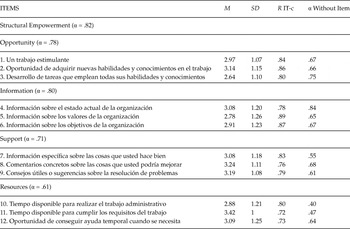
Following data collection, we carried out initial, descriptive analyses (each item’s mean and standard deviation, the corrected correlation coefficient between the item score and its corresponding dimension’s total), analyses of the reliability of the original questionnaire’s dimensions (Laschinger et al., Reference Laschinger, Finegan, Shamian and Casier2001), and each dimension’s reliability if the item were eliminated.
In the present study, we will consider an item adequate if it meets the following criteria (Carretero & Pérez, 2005): that scores’ average distance from the scale’s midpoint and standard deviation be greater than 1 (Nunnally & Bernstein, Reference Nunnally and Bernstein1995), that the corrected correlation coefficient between item score and dimension exceeds .30, and that the dimension’s reliability does not increase when the item is eliminated.
Observing Table 1, we see that all the items’ averages are around 3, the scale’s midpoint, with average scores ranging from 2.64 to 3.42. In addition, all have a standard deviation greater than 1 and the correlations with their source dimensions are over .30.
Mean (M), Standard Deviation (SD), Corrected Correlation Coefficient (R IT-c), Each Dimension’s Reliability (α), and Each Dimension’s Reliability if the Item Is Eliminated (α Without Item)

Moving on to the analyses of reliability, all dimensions were found to have acceptable reliability except for “Resources” (α = .61). However, we found it appropriate to retain that dimension, considering that if were we to eliminate it, the structural empowerment questionnaire’s overall reliability would decrease to .81. Looking at each dimension’s reliability if a particular item were eliminated, it becomes apparent that in the case of information, reliability would increase by eliminating the item “Information about the current state of the organization” Similarly, if we eliminated the item “Opportunity to acquire temporary help when needed” from the “Resources” dimension, reliability would also increase. In neither case did reliability increase very significantly, however, so we decided not to eliminate either of the two items.
Next, to analyze the dimensions’ homogeneity, an analysis was conducted of the correlation between item scores and the dimensions’ total scores. In this case, the criterion used to consider an item appropriate was that the difference between its correlation with its source dimension and its correlation with the rest of the dimensions, which must exceed .20 (Jackson, Reference Jackson and Spielberger1970).
The results indicate the different items are much more highly correlated with the dimensions they originally belonged to than with other dimensions, meeting Jackson’s (Reference Jackson and Spielberger1970) criterion.
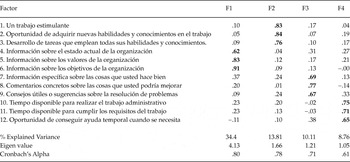
To determine the internal structure of the Spanish version of the CWEQ-II, an exploratory factor analysis was carried out on the 12 items. The method of factor extraction used was PCA and the type of rotation was varimax.
Exploratory Factory Analysis of the 12 Items

From the results of such analysis, we determined that the questionnaire’s internal structure consists of a total of four factors that together explain 67.08% of variance in the sample. Like the original scale in English, it is comprised of four dimensions: “Opportunity,” “Information,” “Support,” and “Resources,” each of which includes three items.
We see that factor 1 (F1) explains the highest percentage of variance (F1 = 34.40) and has a reliability of .80. Items from the original version of the CWEQ-II’s “Information” dimension are grouped into this Factor. Factor 2 (F2) explains 13.81% of variance and has an internal consistency of .78. All items belonging to the “Opportunity” dimension are found in this second factor. The third factor (F3) accounts for 10.11% of variance and has a reliability of .71; items from the “Support” dimension fall into this factor. The fourth and final factor (F4) explains 8.76% of variance. This encompasses items belonging to the “Resources” dimension.
In order to examine the scale’s dimensionality, we later applied confirmatory factor analysis, comparing different structural equation models.
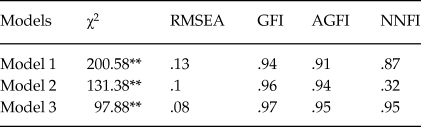
Since exploratory factor analysis did not yield different models, instead perfectly fitting the model proposed at the outset, to construct the remaining models, we performed various factor analyses, specifying the number of factors to obtain. We used three alternative models: in the first, we considered empowerment a single-factor variable, so it would consist of one factor comprised of all the scale’s items. Conversely, since the best exploratory factor analysis results suggested three dimensions, the second model included three factors: the first factor comprised of items 1, 2, and 3, the second of items 4, 5, 6, 7, 8, and 9, and the third of items 10, 11, and 12. Last, model 3 follows the original scale’s four-factor structure.
To evaluate the models’ fit to the data, various statistical indices were taken into account because, as established by Carretero and Pérez (2005), making a decision based solely on chi-squared is ill-advised due to its susceptibility to variations in sample size. Therefore, this study took the following into consideration: the Goodness of Fit Index (GFI), the Adjusted Goodness of Fit Index (AGFI) (Jöreskog & Sörbom, Reference Jöreskog and Sörbom1993; Valor-Segura et al., 2009), the Root Mean Square Error of Approximation (RMSEA), and the Tucker and Lewis (Reference Tucker and Lewis1973) Non-Normed Fit Index (NNFI) Footnote 1 .
Evaluation of the Three Proposed Measurement Models’ Fit to the Data

Note:
*p < .05, **p < .01.
The model that best fits these data is the one originally proposed by the authors, number 3. In addition, it is the only one whose scores on all the indices used fall within the indicated cut-off points for considering a model to adequately fit data. Hence, these results corroborate the internal structure of the Spanish version of the CQWE-II.
With respect to external evidence of validity, we carried out two different analyses: First, an analysis of the scale’s convergent validity and second, an analysis of its criterion validity.
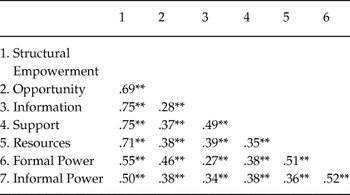
In the case of convergent validity, we analyzed the relationship between structural empowerment, its different dimensions, and formal and informal power. This analysis was done because the three constructs ought to exhibit a significant link due to their similarity (Laschinger et al., Reference Laschinger, Finegan, Shamian and Wilk2004). This involved carrying out correlational analysis (Table 4).
Matrix of Correlations among Structural Empowerment, its Dimensions, Formal Power, and Informal Power

Note:
*p < .05, **p < .01.
We observed that structural empowerment and all its subscales are significantly correlated with both formal and informal power.
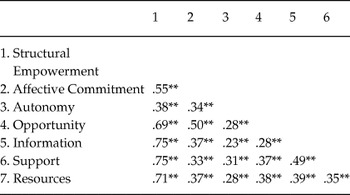
To analyze criterion validity, we examined the relationship between structural empowerment and its dimensions with affective commitment and autonomy. The objective was to determine whether structural empowerment, measured by means of the Spanish version of the CQWE-II, predicts these two variables as previous studies have found (Laschinger, Finegan, & Wilk, Reference Laschinger, Finegan and Wilk2009; Chen & Chen, Reference Chen and Chen2008). To do so, we first performed correlational analysis, followed by several regression analyses to test that prediction.
Table 5 conveys that structural empowerment and all its dimensions are significantly, positively correlated with affective commitment and the autonomy variable.
Matrix of Correlations among Structural Empowerment, its Dimensions, Affective Commitment, and Autonomy

Note:
*p < .05, **p < .01.
After conducting regression analyses, we went on to examine whether or not structural empowerment is significantly related to affective commitment (β = .55, p = .01) and level of autonomy (β = .38, p = .01). We also applied regression analysis between the different subscales (Opportunity, Information, Support, and Resources) and both affective commitment and autonomy. By means of this analysis, we found that each of the CQWE-II’s subscales are actually also predictors of both affective commitment (Opportunity, β = .50, p = .01; Information, β = .37, p = .01; Support, β = .33, p = .01; Resources, β = .37, p = .01) and the autonomy variable (Opportunity, β = .28, p = .01; Information, β = .23, p = .01; Support, β = .31, p = .01; Resources, β = .28, p = .01).
Discussion
The present study’s objective was to adapt the CWEQ-II (Laschinger et al., Reference Laschinger, Finegan, Shamian and Wilk2004) into Spanish so as to measure structural empowerment. Having carried out the translation phase of the original questionnaire, along with the pertinent statistical analyses, we assert that the Spanish version of the CWEQ-II proposed in this study is perfectly valid, based on the fact that scores from the analyses of internal and external validity demonstrate the model’s adequate fit to the data.
The Spanish version of the CWEQ-II ultimately being proposed (see Appendix 1) consists of four subscales with three items each (Opportunity includes items 1, 2, and 3; Information includes 4, 5, and 6; Support includes 7, 8, and 9; and Resources includes 10, 11, and 12). That four-dimensional structure, furthermore, is aligned with the one originally proposed by Laschinger in 1996b, then again in 2004 when the second version was released. Four-dimensional structure was observed in both of those instances and these results reinforce that finding.
We have also succeeded in establishing empowerment’s relationship with other, highly important organizational variables such as commitment and autonomy.
Various authors have established that employees’ practical participation and implication in an organization is a basic component of creating an efficient, healthy organization (Jáimez & Bretones, Reference Jáimez and Bretones2011; Grawitch, Ledford, Ballard, & Baber, Reference Grawitch, Ledford, Ballard and Barber2009; Grawitch, Trares, & Kohler, Reference Grawitch, Trares and Kohler2007) characterized by highly-performing employees with high levels of well-being and good financial health (Arnet & Blomkvist, 2007). Of such practices, among the most widely known, and among those that get the best organizational empowerment outcomes, is structural empowerment. This is due to its positive link to variables such as organizational commitment and occupational well-being (Lashinger et al., 2009; Lashinger et al., 2001) and its negative link to behaviors like employee quitting (Nedd, Reference Nedd2006). In light of these considerations, we believe it is imperative to have access to an instrument that measures this construct that is of such crucial value to our organizations.
The empowerment variable’s multidimensional nature, which the present research has confirmed, demands we take each dimension and its influence on employees’ attitudes into consideration separately. By that token, of the different dimensions, opportunity has been revealed to have an especially strong connection to commitment. Consequently, organizations trying to increase their employee commitment levels should do much more to incentivize professional development and enrich the work.
Therefore, we believe developing the tools to measure this concept in other cultural contexts would help improve the psychological conditions of an organization’s wide array of members.
While we believe the Spanish adaption of the CWEQ-II this study produced provides researchers with a useful, important tool with which to study structural empowerment, it is only appropriate that we take into account certain limitations it may have had.
We think new studies must be conducted and cultural adaptations in other countries should be carried out to verify the instrument’s factor structure.
Moreover, it would be positive to conduct additional studies in other samples, considering certain difficulties we encountered, especially gathering a gender-balanced sample.
Finally, we also think it necessary to conduct further studies employing this instrument and analyzing its relation to other organizational variables so as to create the most complete possible representation of organizational relations.
We argue that all the above would benefit people by improving their adaptation and well-being in the workplace and in the organizations to which they belong.
Appendix A Spanish version of the Conditions of Work Effectiveness Questionnaire II( CWEQ-II)
A continuación, indique el grado en el que cada una de las siguientes características se da en su puesto de trabajo. Para ello, escriba el número correspondiente al final de cada frase teniendo en cuenta que 1 es “poco/a” y 5 “mucho/a”.
1 2 3 4 5
Poco Regular Suficiente Bastante Mucho
¿Qué características considera usted que tiene su trabajo actual?
1. Un trabajo estimulante_____
2. Oportunidad de adquirir nuevas habilidades y conocimientos en el trabajo_____
3. Desarrollo de tareas que emplean todas sus habilidades y conocimientos_____
4. Información sobre el estado actual de la organización_____
5. Información sobre los valores de la organización_____
6. Información sobre los objetivos de la organización_____
7. Información específica sobre las cosas que usted hace bien _____
8. Comentarios concretos sobre las cosas que usted podría mejorar_____
9. Consejos útiles o sugerencias sobre la resolución de problemas_____
10. Tiempo disponible para realizar el trabajo administrativo _____
11. Tiempo disponible para cumplir los requisitos del trabajo _____
12. Oportunidad de conseguir ayuda temporal cuando se necesita_____