Nomenclature
-
 ${m_{tot}}$
-
total mass of the stratospheric aerostat
-
${m_{add}}$
-
additional quality
-
$B$
-
total buoyancy
-
$D$
-
aerodynamic resistance in the altitude direction
-
$h$
-
altitude
-
${v_h}$
-
vertical velocity
-
${V_{total}}$
-
total volume of the aerostat
-
${\rho _{air}}$
-
atmospheric density
-
${C_D}$
-
drag coefficient
-
$S$
-
reference area
-
$n$
-
number of valves
-
${A_{valve}}$
-
cross-sectional area of a single valve
-
$C$
-
exhaust coefficient of a single valve
-
${\rm{\Delta }}{P_{valve}}$
-
pressure difference between inside and outside the valve
-
${V_{in}}$
-
air flow into the air bag per unit time
-
$u$
,
$v$
-
wind speed components in the east-west direction and north-south direction
-
${v_x}$
,
${v_y}$
-
aerostat speeds in the horizontal direction
-
$x$
,
$y$
-
displacements of aerostat in the horizontal direction
-
${\eta _{ps}}$
-
overall efficiency of the propulsion system
-
${P_{ps}}$
-
propulsion system power
-
${v_r}$
-
aerostat airspeed
-
$W$
-
distribution area of each stratospheric aerostat
-
$f$
-
measurement cost of the stratospheric aerostat
-
$Q$
-
restricted area
-
${V_i}$
-
sub-regions
-
${C_{{V_i}}}$
-
centre of mass of the Voronoi subregion
-
${R_c}$
-
communication radius
-
$Rati{o_{{\rm{co}}{{\rm{v}}_{}}}}$
-
coverage rate
-
$Rati{o_{{\rm{con}}}}$
-
connectivity rate
-
${h_{{\rm{expect}}}}$
-
expected altitude
-
${O_Q}$
-
boundary of the area to be covered


Greek symbol
-
$\varphi $
-
angle between the wind direction and the north direction
-
$\delta $
-
angle between the motion direction and the wind direction


1.0 Introduction
Stratospheric aerostat is a kind of low-dynamic aircraft that can be launched by buoyancy and operate smoothly in near space. It is characterised by long endurance, low cost and high resolution [Reference Lee and Yee1]. The aerostat performs communication relay, reconnaissance, and surveillance tasks by carrying specific mission payloads [2]. It primarily includes stratospheric airships and high-altitude balloons [Reference Zuo, Song, Zheng and Qing-Long3–Reference Cathey5]. In recent years, a novel aerostat has attracted extensive attention from scholars at home and abroad. This aerostat utilises wind layers by adjusting its altitude to achieve trajectory control [Reference Du, Lv, Li, Zhu, Zhang and Wu6–Reference Yoder, Gemmer and Mazzoleni8]. Additionally, it can realise long-term airborne and continuous ground monitoring through small energy consumption [Reference Bellemare, Candido, Castro, Gong, Machado, Moitra, Ponda and Wang7, Reference Jiang, Lv, Qu and Zhang9].
For aerostat that uses wind field to achieve trajectory control, its movement direction is strongly dependent on seasonal wind field [Reference Xu, Liu, Du and Lv10, Reference Du, Lv, Zhang, Zhu, Wu and Li11]. When the wind speed at flying altitude is small and an east-west shear wind field is present, the aerostat is more capable of maintaining station-keeping control [Reference Du, Lv, Zhang, Zhu, Wu and Li11]. Conversely, under poor wind field conditions, the aerostat may drift outside the target area, making station-keeping control challenging [Reference Bellemare, Candido, Castro, Gong, Machado, Moitra, Ponda and Wang7]. The continuous monitoring of the station-keeping for long endurance requires dynamic adjustment and cooperative coverage among multiple aerostats [2, Reference Zuo, Song, Zheng and Qing-Long3, Reference Zhang, Zhu and Chen12].
A distributed fault-tolerant controller for unmanned airship formation is designed using the pilot-following method in the article [Reference Yu, Zhang, Jiang, Su, Fu, Jin and Chai13], and it is combined with fuzzy neural network to reduce the adverse effects of individual controller faults through queue reconstruction and composite fault learning. The paper focuses on the fault-tolerant formation control of low-altitude unmanned craft, proposing a distributed fault-tolerant time-varying formation-containment control scheme for two-layer networked unmanned airships, but the influence of wind field is ignored in the control design. In order to obtain the desired formation of stratospheric airship position and attitude, the distributed event triggered adaptive control strategy is studied in the literature [Reference Kim and Yoo14]. The results show that the proposed formation tracking algorithm not only guarantees the stability of the closed-loop system, but also effectively deals with the influence of unknown heterogeneous nonlinearity following the airship, and verifies the effectiveness of the control system. However, this paper focuses on the formation tracking control of airships, which is suitable for maintaining a fixed formation, and does not consider the long-term monitoring and coverage of a restricted area. Bicho et al. [Reference Bicho, Moreira, Diegues, Carvalheira and Monteiro15] used the artificial potential field method to study the column, line and oblique formations of multiple airships, and the obstacle avoidance problem was considered in the study. For stratospheric airships, a pilot-following method based on path tracking is proposed. The linear and circular formation of advective airships are simulated. The results show that the path tracking method has high control accuracy, stable formation operation and can avoid collision between airships.
The trajectory control ability of stratospheric airship is relatively strong, and it cannot form a specific geometric formation for aerostats controlling trajectory through wind field [Reference Vandermeulen, Guay and McLellan16, Reference Chen, Wang and Duan17]. Due to the innovative concept, there are few literatures on the formation control of aerostats controlling trajectory through wind field [Reference Yang, Yang and Deng18]. Adam et al. [Reference Sniderman, Broucke and D’Eleuterio19] studied the formation control problem of high-altitude balloons. Based on the distributed architecture, a block-cycle decentralised controller was designed, which can be used in large-scale control systems. The controller has strong robustness and can control more agents without affecting the behaviour of the entire system, but its model is only applicable to uniform surround distribution near the equator. Vandermeule et al. [Reference Vandermeulen20] designed a distributed extremum search controller to study the formation control of high-altitude balloons on a global scale. Simulation in the actual wind field shows that the effect of uniform distribution of high-altitude balloons on a global scale can be achieved, but the scientific balloon model is oversimplified and applies to the global distribution, without considering the constraints of the restricted area. Bewley et al. [Reference Bewley and Meneghello21] combined model predictive control and feedback control strategies to achieve the maximum coordinated multi-stratospheric aerostats to follow the target track of hurricanes, conduct continuous sampling of hurricanes, and maintain formation distribution for a long time, the online real-time solution of model predictive control takes a long time. In addition to the above research, some famous companies in the world have also studied the aerostats networking problem [22]. In terms of high-altitude balloon networking experiments, in recent years, the Loon team has regularly connected dozens of balloons to several ground stations, with a total connection distance of thousands of kilometers, some across South America, and some almost across Africa.
The main contributions of this paper are emphasised as follows.
-
1) Compared with the literature above, this paper takes into account the actual wind field conditions, and the dynamic model of aerostat using wind field to control trajectory is established.
-
2) Considering the stability of distributed control and the optimisation of real-time solution time, this paper designs a distributed control method in the restricted area based on the Voronoi segmentation method.
-
3) The virtual force method,
${A^{\rm{*}}}$
algorithm and Voronoi segmentation algorithm are combined to make the aerostats fly back to the restricted area, respectively, so as to increase the coverage efficiency and communication rate among the aerostats of the restricted area.

The article organisation is as follows: Section 2 establishes the mathematical model, covering the working principle, the dynamic model, the optimal coverage problem and two motion control methods. Section 3 presents the motion control flow for stratospheric aerostats focused on area coverage. Section 4 provides the simulation analysis. Finally, the conclusion is presented in Section 5.
2.0 Mathematical model
2.1 System composition and working principle
The density of the local atmosphere and the weight of the stratospheric aerostat can have an effect on the altitude of the aerostat. In order to control the horizontal displacement of the stratospheric aerostat, the altitude control system is designed by pumping or venting air.
The composition and schematic diagram of the stratospheric aerostat system is shown in Fig. 1. The compressor and valve adopt an integrated design method, and the valve must be opened first when the air is pumped into the air bag by the compressor. When the valve discharges air, the pressure inside the aerostat decreases which causes the helium bag to expand. Because the pressure within the super-pressure aerostat is always greater than atmospheric pressure, the aerostat’s total volume and buoyancy remain constant. Therefore, combining the overall design and payload of the aerostat, the gravity and buoyancy of the aerostat can be adjusted by inflation or deflation of air bag inside the envelope and vertical motion can be realised.
The structure of stratospheric aerostat using wind fields.

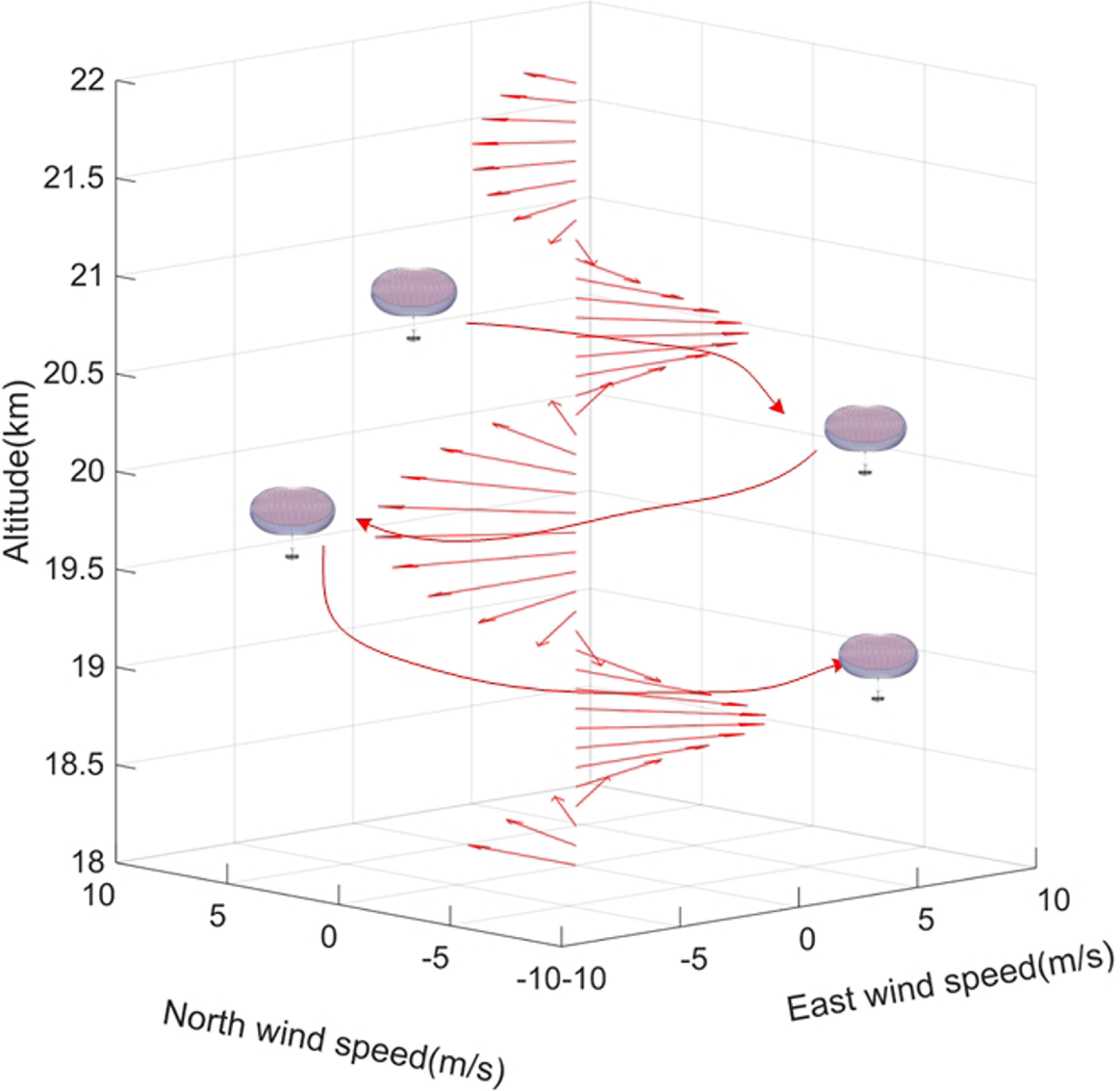
The operating principle of the stratospheric aerostat is illustrated in Fig. 2. When the aerostat operates within the quasi-zero wind layer, it maintains altitude at a lower speed that closely matches the wind speed. To navigate in a desired direction, the aerostat adjusts its altitude by either charging or discharging air, thereby optimising its position to effectively harness the energy of the wind field. The wind field data utilised in this analysis is derived from ERA5 reanalysis data. Figure 3 displays the horizontal wind field at an altitude of 20km, with warmer-colour temperatures indicating higher wind speeds. The arrows in the figure represent both the direction and magnitude of the wind speed.
The principle of stratospheric aerostat station keeping control method.

Horizontal wind environment (altitude is 20km).

To study the station-keeping control performance of a stratospheric aerostat, the following dynamic assumptions are made in this paper:
-
1) The aerostat is assumed to be minimally affected by attitude changes during flight. Therefore, the attitude change of the system is ignored, and the entire system is treated as a particle.
-
2) The thermodynamic changes in the system and the elastic deformation of the aerostat’s spherical structure are assumed to be negligible.
-
3) The Earth is assumed to be a homogeneous sphere.
-
4) The aerostat is assumed to be capable of providing all the energy required for its power system.
2.2 Kinetic model
2.2.1 Dynamics model
The forces experienced longitudinally by the stratospheric aerostat include buoyancy, gravity, aerodynamic resistance and the dynamic equation can be expressed as (positive upwards):
 \begin{align}\left\{ {\begin{array}{*{20}{l}}{\left( {{m_{tot}} + {m_{add}}} \right)\frac{{d{v_h}}}{{dt}} + {{\dot m}_{tot}}{v_h} = B - {m_{tot}}g - {D_h}}\\{\frac{{dh}}{{dt}} = {v_h}}\end{array}} \right.\end{align}
where
 ${m_{tot}}$
is the total mass of the stratospheric aerostat,
 ${m_{add}}$
is additional quality,
 $B$
is total buoyancy,
 ${D_h}$
is aerodynamic resistance in the altitude direction,
 $h$
is altitude,
 ${v_h}$
is vertical velocity.
The buoyancy force and longitudinal aerodynamic resistance of the stratospheric aerostat can be expressed as Equation (2).
 \begin{align}\left\{ {\begin{array}{*{20}{l}}{B = {\rho _{air}}{V_{total}}g}\\{{D_h} = \frac{1}{2}{\rho _{air}}{v_h}\left| {{v_h}} \right|{C_d}S}\end{array}} \right.\end{align}
where
 ${V_{total}}$
is the total volume of the aerostat,
 ${\rho _{air}}$
is atmospheric density.
 ${C_D}$
is drag coefficient,
 $S$
is aerostat reference area.
The altitude adjustment of the stratospheric aerostat is mainly achieved by the adjustment of valves and compressor. When the stratospheric aerostat is in the process of rising, the air valve opens, the air in air bag is discharged, and the quality of the air changes as Equation (3):
 \begin{align}\frac{{d{m_{air}}}}{{dt}} = - n{A_{valve}}C\sqrt {2{\rm{\Delta }}{P_{valve}}{\rho _{air}}} \end{align}
where
 $n$
is the number of valves,
 ${A_{valve}}$
is the cross-sectional area of a single valve,
 $C$
is the exhaust coefficient, which is obtained by considering the difference between theoretical flow and actual flow,
 ${\rm{\Delta }}{P_{valve}}$
is pressure difference between inside and outside the valve.
When the aerostat is in the process of descending, the air outside is compressed by the compressor into the air bag, and the mass flow rate can be expressed as:
 \begin{align}\frac{{d{m_{air}}}}{{dt}} = {\rho _{air}}{V_{in}}\left( h \right)\end{align}
where
 ${V_{in}}$
is the air flow into the air bag per unit time.
The horizontal kinetic equation can be expressed as:
 \begin{align}\left\{ {\begin{array}{*{20}{l}}{\left( {{m_{tot}} + {m_{add}}} \right)\frac{{d{v_x}}}{{dt}} = \frac{1}{2}{\rho _{air}}\left( {{v_x} + u} \right)\left| {{v_x} + u} \right|{C_d}S}\\{\frac{{dx}}{{dt}} = {v_x}}\\{\left( {{m_{tot}} + {m_{add}}} \right)\frac{{d{v_y}}}{{dt}} = \frac{1}{2}{\rho _{air}}\left( {{v_y} + v} \right)\left| {{v_y} + v} \right|{C_d}S}\\{\frac{{dy}}{{dt}} = {v_y}}\end{array}} \right.\end{align}
where
 $u$
and
 $v$
are the wind speed components in the east-west direction and the north-south direction,
 ${v_x}$
and
 ${v_y}$
are aerostat speeds in the horizontal direction,
 $x$
and y are displacements in the horizontal direction.
2.2.2 Description of the optimal coverage problem in the restricted aera for stratospheric aerostats
Considering that
 $n$
stratospheric aerostats are randomly distributed in the restricted area
 $Q \subset {R^2}$
, the position information of the aerostat is
 $P = \left\{ {{p_1},{p_2}, \ldots, {p_n}} \right\}$
, and the sensitivity function corresponding to any point
 $q$
in the restricted area is
 $\phi\! \left( q \right)$
, indicating the importance of the point information to the aerostat [Reference Zuo, Yan and Yan23]. To quantitatively describe the coverage effect of stratospheric aerostat on a restricteded area, the cost function is defined:
 \begin{align}J\left( {P,W,\phi } \right) = \mathop \sum \limits_{i = 1}^n \mathop \int \nolimits_{{W_i}} f\!\left( {{p_i},q} \right)\phi\! \left( q \right)dq\end{align}
where,
 $W = \left\{ {{W_1},{W_2}, \ldots, {W_n}} \right\}$
represents the distribution area of each stratospheric aerostat, and
 $f\!\left( {{p_i},q} \right)$
represents the measurement cost (distance, time, etc.) of the stratospheric aerostats
 $i$
from its position
 ${p_i}$
to any point
 $q$
within the distribution area.
As can be seen from the above formula, the formation coverage effect of multi-stratospheric aerostats is related to the position information
 $P$
of the aerostat, the area
 ${W_i}$
assigned to each aerostat, and the sensitivity function
 $\phi\! \left( q \right)$
[Reference Ma, He, Wang and Yao24]. In this section, the distribution area of each aerostat is adjusted to minimise the total cost function by the stratospheric aerostat dynamics model and altitude adjustment using the wind field model.
Voronoi partition is an important content in computational geometry. According to the degree of adjacence of points
 ${p_i}$
in a region, the region
 $Q$
is divided into several sub-regions, which are called sub-regions
 ${V_i}$
of the region. The Euclidean distance from the point
 ${p_i}$
to the sub-region is smaller than the distance from the other points
 ${p_j}$
to the region.
The uniform coverage of stratospheric aerostats in a restricted area is mainly considered in the study, and the spatial configuration of multiple aerostats can be regarded as a two-dimensional area. The cost function
 $f\!\left( {{p_i},q} \right)$
can be defined as the Euclidean distance from the point
 $q$
to the stratospheric aerostat
 ${p_i}$
, and the above formula can be expressed as:
 \begin{align}{V_i} = \{ q \in Q|\|{p_i} - q \|\le \|{p_j} - q\|,\forall i \ne j,\forall i,j \in n\} \end{align}
The cost function can be expressed as:
 \begin{align}J\!\left( P \right) = \mathop \sum \limits_{i = 1}^n \mathop \int \nolimits_{{V_i}} \|{p_i} - q\|\phi\! \left( q \right)dq\end{align}
Taking the derivative of the cost function along the trajectory of each stratospheric aerostat yields:
 \begin{align}\begin{array}{*{20}{l}}{\frac{{\partial J\left( P \right)}}{{\partial {p_i}}} = \mathop \smallint \nolimits_{{\!V_i}} \frac{\partial }{{\partial {p_i}}}{{({p_i} - q)}^2}\phi\! \left( q \right)dq + \mathop \smallint \nolimits_{{\!V_i}} \frac{{\partial {q_{\partial {V_i}}}\left( P \right)}}{{\partial {p_i}}}{n_{\partial {V_i}}}{{({p_i} - q)}^2}dq}\\[5pt]{ + \mathop \sum \limits_{j \in {N_i}} \mathop \smallint \nolimits_{{\!l_{ji}}} \frac{{\partial {q_{{l_{ij}}}}\left( {{p_i},{p_j}} \right)}}{{\partial {p_i}}}{n_{{l_{ji}}}}{{({p_j} - q)}^2}dq}\end{array}\end{align}
where,
 $\partial {V_i}$
and
 ${q_{\partial {V_i}}}$
are respectively the boundary and the point on the boundary of the Voronoi subregion
 ${V_i}$
, are the normal direction of the boundary of the subregion,
 ${N_i}$
are the set of neighbours of the Voronoi subregion
 ${V_i}$
,
 ${l_{ij}}$
are the boundary between the subregions
 ${V_i}$
and
 ${V_j}$
,
 ${q_{{l_{ij}}}}\left( {{p_i},{p_j}} \right)$
and
 ${n_{ji}}$
are the any point on the boundary and normal direction of
 ${l_{ij}}$
.
The Voronoi region boundary of a restricted region can be divided into two parts: the internal boundary of a Voronoi unit and the boundary of a restricted region. By the nature of the Voronoi partition, we know that
 $\partial {V_i}$
consists of components
 ${l_{ij}}$
, where the directions between
 ${l_{ij}}$
and
 ${l_{ji}}$
are opposite. Therefore, the above formula can be expressed as:
 \begin{align}\begin{array}{*{20}{l}}{\frac{{\partial J\left( P \right)}}{{\partial {p_i}}} = \mathop \smallint \nolimits_{{\!V_i}} \frac{\partial }{{\partial {p_i}}}{{({p_i} - q)}^2}\phi\! \left( q \right)dq + \mathop \smallint \nolimits_{\!Q} \frac{{\partial {q_{\partial Q}}\left( P \right)}}{{\partial {p_i}}}{n_{\partial {V_i}}}{{({p_i} - q)}^2}dq}\\[5pt]{ + \mathop \sum \limits_{j \in {N_i}} \mathop \smallint \nolimits_{{\!l_{ji}}} \frac{{\partial {q_{{l_{ij}}}}\left( {{p_i},{p_j}} \right)}}{{\partial {p_i}}}{n_{{l_{ji}}}}[{{({p_i} - q)}^2} - \left( {{p_j} - q{)^2}} \right]{{({p_j} - q)}^2}dq}\end{array}\end{align}
Since the boundary of the restricted region
 $\partial Q$
is fixed and unchanging, and
 $\frac{{\partial {q_{\partial Q}}\left( P \right)}}{{\partial {p_i}}} = 0$
, Equation (10) can be simplified to:
 \begin{align}\frac{{\partial J\!\left( P \right)}}{{\partial {p_i}}} = \mathop \int \nolimits_{{V_i}} \frac{\partial }{{\partial {p_i}}}{({p_i} - q)^2}\phi\! \left( q \right)dq\end{align}
According to the convex optimisation theory, if
 $\frac{{\partial J\left( P \right)}}{{\partial {p_i}}} = 0$
, we can obtain:
 \begin{align}p_i^{\rm{*}} = \mathop \int \nolimits_{{V_i}} q\phi\! \left( q \right)\!dq/\mathop \int \nolimits_{{V_i}} \phi\! \left( q \right)dq = {L_{{V_i}}}/{M_{{V_i}}} = {C_{{V_i}}}\end{align}
where,
 ${M_{{V_i}}} = \mathop \smallint \nolimits_{{V_i}} \phi\! \left( q \right)dq$
is the mass of the Voronoi subregion
 ${V_i}$
,
 ${L_{{V_i}}} = \mathop \smallint \nolimits_{{V_i}} q\phi\! \left( q \right)dq$
is the static moment, and
 ${C_{{V_i}}}$
is the centre of mass of the Voronoi subregion [Reference Du, Faber and Gunzburger25, Reference Lloyd26].
In the process of aerostat formation coverage, the Lloyd algorithm is employed to dynamically update the Voronoi segmentation, with the cycle being repeated [Reference Lloyd26]. By adopting this method, each aerostat is equipped with a controller, and information is shared among nearby aerostats, which aligns with the principles of distributed control. When an aerostat enters or exits the restricted area, its influence on other aerostats is relatively minimal, thereby demonstrating the robustness of the control method.
Assuming that the coverage radius of each aerostat is
 ${r_c} = 100{\rm{km}}$
, and the communication radius
 ${R_c}$
is
 $\sqrt 3 {r_c}$
. The connectivity between aerostat is defined as follows [Reference Yang and Xia27, Reference Yao, Liao, Liu and Yang28]:
 \begin{align}{p_c}\!\left( {{b_i},{b_j}} \right) = \left\{ {\begin{array}{*{20}{l}}{1{\rm{\;\;\;\;\;\;\;\;}}d\!\left( {{b_i},{b_j}} \right) \le {R_c}}\\{0{\rm{\;\;\;\;\;\;\;\;}}d\!\left( {{b_i},,{b_j}} \right) \gt {R_c}}\end{array}} \right.\end{align}
where,
 ${p_c} = 1$
means that the network single-hop connectivity is realised between the aerostats
 $i$
and
 $j$
, and
 ${p_c} = 0$
means that the aerostats is not connected.
 $d\!\left( {{b_i},{b_j}} \right)$
indicates the distance between two aerostats. For aerostats that cannot be directly connected, multi-hop connectivity can be performed through other aerostats connected with single hop, and the aerostat not connected with other aerostats is called isolated system [Reference Yang and Xia27]. To describe coverage performance, define multistratospheric aerostats coverage rate:
 \begin{align}Rati{o_{\mathop {{\rm{cov}}}\limits_{} }} = \frac{{\left( {{S_{cover,i}} \cup {S_{cover,j}} \cup \cdots } \right) \cap {S_{rest}}}}{{{S_{rest}}}} \times 100{\rm{\% }}\end{align}
where
 ${S_{cover,i}}$
represents the area covered by each aerostat.
 ${S_{rest}}$
represents the restricted area to be covered.
Define the connectivity rate:
 \begin{align}Rati{o_{con}} = \frac{{{N_{p\_total}} - {N_{islo}}}}{{{N_{p\_total}}}} \times 100{\rm{\% }}\end{align}
According to the established aerostat dynamic model, the optimal coverage of the aerostats in the restricted area (east-west direction
 $500{\rm{km}}$
, north-south direction
 $500{\rm{km}}$
) is calculated under the condition that the aerostat only relies on altitude adjustment and uses the wind.
In the coverage range, 10 particle positions are randomly generated as the initial position of the aerostats. The sensitivity function
 $\phi\! \left( q \right) = 1$
is assumed, and the wind field condition is assumed to be:
 \begin{align}\left\{ {\begin{array}{*{20}{l}}{{v_w} = 10{\rm{m}}/{\rm{s}}}\\{\varphi = \left( {h - {h_{{\rm{min}}}}} \right)/{h_0} \cdot 2\pi }\\{{h_{{\rm{min}}}} \le h \le {h_{{\rm{max}}}}}\end{array}} \right.\end{align}
where,
 ${v_w}$
is the size of the wind speed,
 $\varphi $
is the angle between the wind direction and the north direction, and
 ${h_0} = 2{\rm{km}}$
,
 ${h_{{\rm{min}}}} = 18{\rm{km}}$
,
 ${h_{{\rm{max}}}} = 22{\rm{km}}$
. The simulation results under the ideal wind field condition are shown in Fig. 4. In the region, multiple aerostats can achieve optimal coverage under this algorithm.
Simulation results in ideal wind.

2.2.3 Motion control of aerostat based on virtual force method
The assumed wind field environment is ideal, and the wind direction can be directed in any direction
 $\left[ {0,2\pi } \right]$
depending on the flying altitude of the aerostat. The actual wind direction is quite different from the ideal wind. The wind layer in the appropriate direction should be found according to the actual wind field to control the movement of the aerostat toward the centre of mass of the Voronoi.
Figure 5 shows the aerostat motion control strategy based on the virtual force method. A virtual gravitational field centred on the dynamic target point is constructed, and the aerostat is affected by the virtual force
 ${\vec F_b}$
under the action of the virtual force field. In order to make the aerostat move towards the target point, it is necessary to control the aerostat to reach the desired wind layer by inflating and deflating the air through the altitude adjustment system, and the wind direction of the desired wind layer is consistent with the direction of the virtual force. The altitude
 ${h_{expect}}$
corresponding to the desired wind layer is defined as:
 \begin{align}\begin{array}{*{20}{l}}{{\rm{min}}\,\delta = \delta \!\left( {t,h} \right) = {\rm{arccos}} \left({\frac{{{{\vec F}_b}\left( t \right) \cdot {{\vec k}_w}\left( {t,h} \right)}}{{\left| {{{\vec F}_b}\left( t \right)} \right| \cdot \left| {{{\vec k}_w}\left( {t,h} \right)} \right|}}} \right)}\\{{\rm{subject\;\;to}}\,:\,{h_{{\rm{max}}}} \le h \le {h_{{\rm{max}}}}}\end{array}\end{align}
where,
 ${\vec F_b}\!\left( t \right)$
is the virtual gravitational force between the aerostat at the time
 $t$
and the target point, and
 ${\vec k_w}\!\left( {t,h} \right)$
is the wind direction under the longitude, latitude and altitude
 $h$
of the aerostat at the time
 $t$
. This formula indicates that when the wind direction of the expected wind layer is inconsistent with the direction of the virtual force, the wind layer with the wind direction closest to
 ${\vec F_b}\!\left( t \right)$
is selected. When there are multiple wind layers with the same wind direction, the wind layer with higher wind speed is selected to control the aerostat to move quickly to the target point. In order to move the aerostat to the centre of mass of the Voronoi subregion, the centre of mass of the Voronoi subregion is set as the target point.
Schematic diagram of aerostat motion control strategy based on virtual force method.

2.2.4 Motion control of aerostat based on
${A^{{*}}}$
algorithm

While the aerostat motion control strategy based on the virtual force method effectively assists the aerostat in identifying the optimal wind direction from its current position to the target location, as well as in navigating back to the restricted area, it fails to account for wind speed at altitude and the duration required for return flight. This section presents a path planning method designed to optimise the return trajectory of an aerostat that has flied outside the restricted area, ensuring it can return in the shortest possible time.
The
 ${A^{\rm{*}}}$
algorithm is a heuristic graph search algorithm, which searches the minimum cost path in the space in the best priority way, thereby improving the search efficiency. Its core formula is as follows [Reference Yao, Liao, Liu and Yang28–Reference Miyombo, Liu, Mulenga, Siamulonga, Kabanda, Shaba, Xi and Ayodeji30]:
 \begin{align}f\!\left( n \right) = g\!\left( n \right) + h\!\left( n \right)\end{align}
where,
 $f\!\left( n \right)$
is the total cost function,
 $g\!\left( n \right)$
is the actual consumption from the start node to the current node.
 $h\!\left( n \right)$
is the estimated value from the current node to the target node, which is called the heuristic function and is the key to finding the optimal path.
 ${A^{\rm{*}}}$
algorithm is suitable for solving problems where the initial point and target point are known. In this section, the algorithm is designed for the task scenario of aerospace-restricted area coverage, so that it can dynamically search the target point near the restricted area and fly back to the restricted area in the shortest time. The boundary covered by the aerospace-restricted area is a rectangular area. The heuristic function for defining the algorithm is as follow:
 \begin{align}h\!\left( n \right) = h\!\left( {{h_i}} \right) = \frac{{{{\left| {\vec f} \right|}^2}}}{{\vec f \cdot \vec v\left( {{h_i}} \right)}}\\[-18pt]\nonumber\end{align}
 \begin{align}\vec f = {O_Q} - {p_i}\\[6pt]\nonumber\end{align}
where,
 ${p_i}$
is the horizontal position coordinate of the aerostat outside the area,
 ${O_Q}$
is the boundary of the area to be covered, and
 $\vec f$
is the vertical vector pointing to the boundary of the aerostat location.
 $\vec v\left( {{h_i}} \right)$
is the wind field at the latitude and longitude of the aerostat that varies with altitude.
In the case of altitude adjustment, the valve and compressor of the aerostat air bag and are controlled to make the aerostat enter the wind layer of different altitudes. It is necessary to limit the search altitude of the aerostat, so that the aerostat can reach the corresponding target air layer after the operation is performed:
 \begin{align}{\rm{\Delta }}h = \int {v_h}dt\\[-18pt]\nonumber\end{align}
 \begin{align}\left| {{h_j} - {h_i}} \right| \le {\rm{\Delta }}h\\[6pt]\nonumber\end{align}
where,
 ${\rm{\Delta }}h$
is the altitude difference before and after the altitude adjustment of the aerostat,
 ${h_1}$
and
 ${h_2}$
are respectively the altitudes of adjacent wind layers to be explored.
3.0 Stratospheric aerostats formation control flow for area coverage
Under certain wind field conditions, the wind direction exhibits minimal variation across different altitudes, which prevents the aerostat from adjusting its movement direction through altitude changes. At this time, for the aerostats coverage formation control in the restricted area, when the aerostat flies out of the restricted area, it is impossible to use the above dynamic coverage formation control scheme to determine the Voronoi centre of mass, and it is impossible to determine the charging and deflating operation of the aerostat altitude control system for effective control. As a result, the number of aerostat in the restricted area is reduced, and the coverage efficiency in the restricted area is reduced.
To achieve efficient resource utilisation with a limited number of aerostats and optimal coverage within a restricted area, the aerostat flying outside the restricted area needs to be guided back into the restricted area. On the one hand, the multiple aerostats in the restricted area should be controlled by the dynamic coverage algorithm. On the other hand, the aerostats flying out of the restricted area should be guided so that it can find the appropriate wind field and fly back to the restricted area, renetworking dynamic coverage with aerostats in restricted area. This paper adopts two ways to achieve the above goals, and the flow chart of the two ways is shown in the Fig. 6.
-
(1) When the aerostat is opereting within the restricted area, the flying target point and expected wind layer of the aerostat are determined by the Voronoi partition method. When the aerostat is opereting outside the restricted area, the virtual force method (the target point is the centre of the restricted area) is used to control the aerostat to fly back to the restricted area.
-
(2) When the aerostat is operating within the restricted area, the flying target point and expected wind layer of the aerostat are determined by the Voronoi partition method. When the aerostat is operating outside the restricted area, the path and expected wind layer are generated by the
${A^{\rm{*}}}$
algorithm to control the aerostat to fly back to the restricted area.

Formation control flow of stratospheric aerostats for area coverage.

Figure 7 shows the trajectory comparison between the virtual force method and the path planning algorithm. The trajectory obtained by path planning is less outside the restricted area and has a short flying time outside the restricted area.
Comparison of trajectories between virtual force method and
 ${A^{\rm{*}}}$
path planning method.

4.0 Results and discussion
4.1 Guided control outside the restricted area and optimal coverage inside the restricted area
Figure 8(a) displays the initial position distribution of the multi-aerostats, while Fig. 8(b) shows the formation on the second day. The pink area represents the area that the aerostat can cover, the red dots represent virtual points and the black line indicates that the aerostats can communicate with each other. Figure 9 is the status of each aerostat. If the aerostat flys in the restricted aera, the status of the aerostat is 0, else the status is 1. Figures 8 and 9 illustrate the effectiveness of the virtual force guidance. Initially, aerostats No.1 and No.6 leave the restricted area, but they are guided back under the virtual force mechanism to ensure optimal coverage.
Stratospheric aerostats network coverage (virtual force method is adopted outside the area to guide aerostats to fly back).

The status (in and out of the area) of each aerostat (if in: status = 0,else: status = 1).

Figure 10 illustrates the horizontal trajectory of the multi-aerostat formation control over a 10-day period. It shows that while aerostats No. 6 and No. 9 leave the restricted area on the ninth day, they exhibit a tendency to return under the control mechanism.
Horizontal trajectories of multiple stratospheric aerostats.

The variation of coverage rate in the restricted area of multiple aerostats is shown in Fig. 11(a). The variation of the coverage rate in the restricted area over time, as shown in Fig. 11(a), starts at a minimum of 40% and gradually increases to approximately 70%. This fluctuation is attributed to the aerostats leaving and re-entering the restricted area.
The coverage and connectivity rate of multiple stratospheric aerostats over the restricted area.

We can infer that multi-aerostats networking connection, compared with the simulation results that only adopt the optimal coverage algorithm, the connectivity rate of the network increases, and all aerostats are in the state of network connectivity for more than 60% of the time from Fig. 11(b). This algorithm can make the multi-aerostats have the optimal coverage in the restricted area for a long time.
4.2 Path planning outside the restricted area and optimal coverage within the restricted area
Path planning outside the restricted area, and the results of using the optimal coverage algorithm within the restricted area are shown in the Fig. 12.
Stratospheric aerostats network coverage (path planning method is adopted outside the area to guide aerostats to fly back).

Figure 11 is 10-day formation coverage effect of multiple aerostats. The position distribution of multiple aerostats at the initial moment is shown in Fig. 12(a), and is the same as that of the initial position distribution of the aerostats in the section above. Figure 13 illustrates the horizontal trajectory of the multi-aerostat formation control over a 10-day period. As can be seen from Figs. 12 and 13, aerostats flying out of the restricted area can all fly back to the restricted area under the path planning algorithm.
Horizontal trajectories of multiple stratospheric aerostats.

Figure 14(a) illustrates the variation in coverage rate within the restricted area of multi-aerostats. The minimum coverage rate is slightly above 40%, gradually increasing to approximately 70% over time. Figure 14(b) depicts the networking connections among multiple aerostats. A comparison of Figs. 11(b) and 14(b) reveals that, in contrast to the virtual force guidance outside the restricted area, the networking connectivity rate shows an increase. Most of the networking connectivity rates are 90% or above, and all aerostast are in the networking connectivity state most of the time. Compared with the virtual force method used in the Section 4.1 above, this method can effectively increase the connectivity of the network.
The status and horizontal trajectories of multiple stratospheric aerostats.

The analysis of the simulation results indicates that, under the specified wind field conditions, the guided control method significantly enhances area coverage in a short time. However, it is noted that not all aerostats are able to return to the restricted area. In contrast, the path planning method effectively enables the aerostats to return to the restricted area promptly, thereby facilitating long-term coverage and ensuring a higher communication connectivity rate.
5.0 Conclusion
Aiming at the optimal coverage of the restricted area for stratospheric aerostats, long-term communication and ground network coverage, this paper designs the optimal coverage design algorithm flow of stratospheric aerostats in the actual wind field (ERA5). The main work and conclusions are as follows:
-
(1) Considering the challenge that stratospheric aerostats face in determining the centre of mass of the Voronoi regions when they exit the restricted area, two methods for returning to the restricted area are proposed: the virtual force method, which is guided by the centre point of the restricted area, and a shortest time path planning method based on an improved algorithm. These methods are integrated with the Voronoi segmentation optimal coverage algorithm to facilitate the return of aerostats that have flown outside the designated area.
-
(2) Each stratospheric aerostat operates independently, utilising only its own measurements along with information received from nearby aerostats to execute the same algorithm, thereby eliminating the need for a central controller and enhancing computational efficiency. As the aerostat transitions in and out of the restricted area, it can continuously optimise its formation and achieve an improved operational state, demonstrating the robustness of the designed distributed controller.
-
(3) Simulation results for guided control outside the restricted area and optimal coverage inside the restricted area indicate that the return guidance for stratospheric aerostats can significantly enhance coverage within the restricted area and improve networking connectivity among the aerostats.
-
(4) The simulation results of path planning outside the restricted area and optimal coverage inside the restricted area reveal that stratospheric aerostats flying out of the restricted area can return to the restricted area after path planning, and the networking connectivity rate between aerostats is higher than that adopting the virtual force method.
The reanalysis data of ERA5 is used in this paper, and the uncertainty of wind field is not considered, but the wind field has uncertainty in a short period. One of the future research tasks is to establish an uncertain wind field model and realise the covering formation control of aerosols under uncertain wind field conditions, and the research method can adopt intelligent control method.
Acknowledgments
This work was supported by Distinguished Young Scholar Foundation of Hunan Province (2023JJ10056), Natural Science Foundation of Hunan Province(2023JJ30636), National Natural Science Foundation of China (52272445) and Key Research and Development Program of Hunan Province of China (2023GK2057).
Competing interest
The authors declare that they have no known competing financial interests or personal relationships that could have appeared to influence the work reported in this paper.