

Introduction
The second half of the seventeenth century witnessed a remarkable growth in the mathematical sciences, culminating in the publication of Isaac Newton's (1643–1727) Principia in 1687. This progress was particularly visible in London and was reflected not only in the newly established Royal Society, but also in an increasingly sophisticated level of practical mathematics, in fields such as accountancy, gauging, navigation and instrument-making. As a thriving port city with all the central offices of state, England's metropolis provided near-ideal conditions for this culture of figures, lines, weights and measures. New mathematical learning permeated workshops, warehouses, dockyards, coffee houses and taverns. It was disseminated by an army of teachers, many of whom were practitioners themselves, and transmitted either through personal instruction or, more commonly, through their books, which were inexpensive to buy and written expressly with their intended audience in mind. For those who lacked resources, self-study was the norm. Yet such was the importance of the mathematical sciences for the economic well-being of the country that the Oxford-trained mathematician and educational reformer John Newton (1621–1678) described them as ‘the support of all trade’.Footnote 1 At the same time, he was able to point out that before the foundation in London of Christ's Hospital Mathematical School, in 1673, ‘that famous City was without a Publick School for Mathematical Learning’. But that foundation only offered places to around forty boys. For the vast majority of men, young or old, the only option was either learning on one's own or private tuition. Nearly a decade later, in the preface to his Country-Survey-Book, the Nonconformist preacher and mathematical practitioner Adam Martindale (1623–1686) deplored the widespread ignorance of the fundamentals of arithmetic and geometry, noting that ‘Mathematical-Schools, where better things might be learned, are very rare, and an able Artist to instruct one in private is hard, and chargeable to be procured’.Footnote 2
Despite informing many aspects of everyday life in early modern London – from merchants’ accounts to timekeeping, from gauging to navigation – mathematical practice and the part it played in the growth of knowledge have previously been largely neglected by historians of science, who have tended to focus in the period under consideration on the role of institutions such as Gresham College or the Royal Society instead.Footnote 3 This article seeks to show that practical mathematicians were part of a thriving knowledge community that existed outside such institutions and that centred strongly on artisanal and mercantile milieus. In these non-academic social spaces, practitioners interacted closely with instrument-makers, merchants, printers and booksellers. They forged their own identities, supported each other both intellectually and materially, and organized themselves into mathematical societies or clubs which contrasted strongly with their more illustrious socially closed counterpart.
Mathematical teachers and their books
With little or no formal training in mathematics available before 1673, and then only for the selected few, much was down to chance or money, or both. Many practitioners advertised their services as teachers on broadsheets, or, more commonly, in one of the countless publications with titles such as The Merchants Mirrour or The Practical Gauger that adorned the shelves of London's entrepreneurial booksellers. The book would lead to the tutor, often the author himself, who would offer, if necessary, to help resolve the more difficult or intractable problems the student had encountered. Instruction, for an always undisclosed charge, sometimes took place in the author's rooms or sometimes in the premises of local instrument-makers, while wealthier clients could be taught in their own houses. It served to make the author more widely known, more firmly rooted in the local commerce of knowledge. Nonetheless, practical books were generally conceived as personal tutors, with the author addressing his reader as a friend and seeking to take him carefully, one step at a time, through the material treated. They sought to provide an answer to the absence of any possibility of formal instruction in the mathematical sciences for the majority of those interested, but were part of a constantly evolving, often precariously balanced, knowledge market. Authors vied with various other participants in this market for trade: printers, booksellers, instrument-makers and diallers. By providing personal instruction, they could supplement the paltry income they are likely to have received through the sale of their books. Indeed, one of the main purposes of publication is likely to have been self-promotion.
Not a few mathematical practitioners were occasionally in some form of government employment, for example as accountants or as gaugers of the Excise. However, at a time when depleted coffers at the Exchequer meant that such employees often had to wait months before receiving payments, and sometimes never received them at all, teaching no doubt represented not only a more constant form of income, but also a more reliable one. John Ward (fl. 1695–1709), who like numerous contemporaries styled himself ‘Phylomath’, had formerly been a general gauger to the Excise before turning to book authorship and teaching.Footnote 4 His Compendium of Algebra is typical of many other practical publications in seeking to combine the virtues of plainness of presentation with conciseness in order to make the book itself both understandable to the novice and, at the same time, affordable. Already the title page proclaims that the work contains ‘plain and easie rules for the speedy attaining’ of its subject matter. As Ward explains in the ‘Letter to the Reader’, the approach he follows means reducing the rules of algebra methodically and above all freeing them from obscurity by the generous use of examples – precisely as a pupil would expect from his teacher. But there are other considerations, too, of equal if not greater significance. While seeking to effect a concise presentation of the rudiments of algebra, Ward was also concerned not to omit anything ‘that might conduce towards the Learners Attaining to a perfect Knowledge of this Mysterious Art’. Above all, the work was not to be a weighty tome, but rather fit into a small volume ‘both for convenience of Price and Portability’.Footnote 5
The Compendium concludes, like so many other publications of similar nature, with two advertisements: one for a variety of mathematical books, and another announcing that Ward himself offered instruction in ‘several parts of the Mathematicks’ at his rooms in Well Street in Hackney. Alongside algebra ‘with the newest improvements’ in that discipline, he offered, as befitted one calling himself a philomath, a wide range of topics such as geometry, trigonometry, dialling, surveying and navigation, as well as the use of globes and other mathematical instruments. By the time the second edition of the Compendium appeared, three years later, Ward simply described himself as ‘Teacher of the Mathematicks’. He evidently felt he was able to dispense with a listing of the subjects he taught, having in the meantime moved to a more central location, to a house in Fleet Street – a locality with far greater provision of printers, booksellers and instrument-makers.Footnote 6
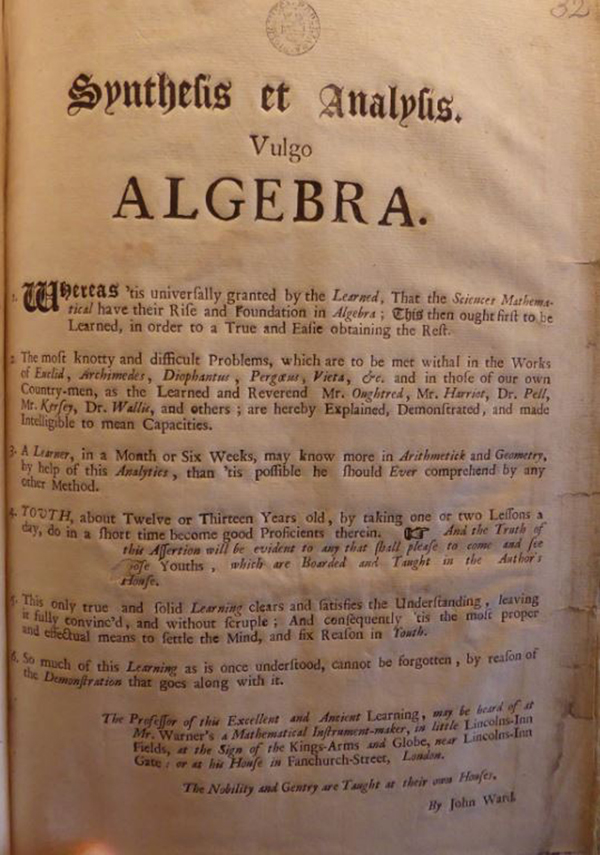
Ward's teaching seems to have been so successful that towards the end of the century he effectively ran a mathematical school of his own. A printed sheet under his name and with the imposing title ‘Synthesis et Analysis. Vulgo Algebra’ appeared at that time (Figure 1). From other sources we know that since the sixteenth century practical mathematicians had posted bills on street corners in London, offering instruction in various disciplines, and there is no reason to believe that this practice – alongside inserting advertisements in books – did not continue in the following century.Footnote 7 With good strategic sense in view of the subject matter of his most important publication, Ward draws the attention of potential pupils to the esteem in which algebra is held by learned scholars. Mathematical teachers were concerned to be up to date in what they taught; indeed this partly explains their pronounced interest in exchanging news amongst each other and gaining insight into the latest publications. Ward reflects this concern in noting that learned or academic mathematicians considered algebra to be the source and foundation of the mathematical sciences and that therefore a good understanding of the discipline ought to be acquired ‘in order to a True and Easie obtaining the Rest’. Employing typical phraseology in addressing a practical clientele, Ward undertakes to render comprehensible to ‘mean capacities’ the most difficult problems that are to be found in ancient and modern authors alike, ranging from Euclid (c.325–265 BCE) and Diophantus (third century CE) to John Pell (1611–1685) and John Wallis (1616–1703). And, just as other contemporaries would do, he sought to present his teaching as the best, suggesting that by means of his instruction in algebra a learner is capable of a far broader knowledge of arithmetic and geometry than he ‘should ever comprehend by any other Method’. By now living in yet another location, in Fenchurch Street, Ward had progressed to taking pupils in as boarders. Potential clients were welcome to visit his house and see for themselves the success of his approach to teaching. Nor does it seem that he was dealing principally with young men from a socially elevated section of London's populace, for it is stated explicitly that ‘The Nobility and Gentry are Taught at their own Houses’.
John Ward, Synthesis et Analysis. Vulgo Algebra, London, c.1698. Printed sheet advertising Ward's programme of instruction in algebra. © 2019 Bodleian Libraries, University of Oxford, MS Aubrey 10, f. 32.

A continuing tradition
Like Ward, but more than half a century before him, John Speidell (d. 1657), who described himself as ‘practitioner in the Mathematicks and professor thereof in London’, taught all branches of mathematics, including the use of instruments. Unusually among men of his profession he offered instruction not only in the vernacular, but also in French, Latin and Dutch – a clear reflection of his Germanic background. He was also for a time engaged as geometry professor at Sir Francis Kynaston's (1587–1642) academy in London, the Musaeum Minervae, styled along the lines of educational institutions then found on the Continent.Footnote 8 In the ‘Letter to the Reader’ prefacing his Geometricall Extraction, first published in 1616, the author emphasizes his experience, by pointing out that he has instructed many gentlemen and others in the mathematical sciences.Footnote 9 It is known that he took in pupils as boarders in his house and that his son, Euclid Speidell (d. 1702), followed him in this practice. Gathering material in his book partly collected from others, partly derived from his own endeavours – an approach to authorship replicated in many publications of early modern practitioners – John Speidell recommends the resulting work to his readers as being ‘performed by a more speedy way then by any former writer’. Again, facility in comprehension is sought by conciseness and the avoidance of whatever tends to obscure the subject matter. As Speidell explains,
I have indeauoured to be briefe, knowing that much superfluitie of words doth more let and hinder, then any way further, or aduance the matter, yet not so briefe, as thereby to obscure or darken the worke in any kinde, but to make it the more cleere, easie, and plaine to the reader, and for the better satisfaction of such as desire the demonstration of euery thing.Footnote 10
Speidell also uses the opportunity of Geometricall Extraction to introduce to his readers new engraved scales he has invented, claiming them to be a considerable improvement on an earlier design. By their means, he points out, heights and distances in diagrams and geometrical constructions can be correctly measured, notably in working through the book itself. This original invention had helped establish Speidell's reputation as a mathematician at the beginning of his career, particularly with the celebrated London instrument-makers Elias Allen (c.1588–1653) and John Thompson (fl. 1609–1648), whom he describes as ‘his loving friends’.Footnote 11 In reflection of the close professional ties between teachers of mathematics and instrument-makers, Speidell notes that his new scales can be obtained in brass at Allen's shop in the Strand and in wood from Thompson in Hosier Lane, Smithfield. For the instructions on their use, however, readers were to address the author.
Speidell exemplifies how closely linked the various actors in London's mathematical and mercantile community were. His readers would not only be acquainted with teachers and booksellers, but also with instrument-makers who provided essential tools for working through the printed material. Indeed, he always conveys a strong sense of wanting his readers to engage hands-on with the text in front of them. Speidell is by no means alone in this respect. But what is perhaps unique is the sheer degree to which he presents himself as willing to help his readers achieve the desired standard of mathematical knowledge for their employment, and the comprehensiveness of what he offers, right down to suitable paper. His remarks in Arithmeticall Extraction encapsulate, like no others, the idea of London's mathematical practitioners as part of a locally centred knowledge community:
Thus (gentle Reader) hast thou heere a small entrance into Arithmeticke, which if thou wilt but once passe ouer, I doubt not but it will make thee sufficient for any Merchant or tradesmans use, and if any thing be too hard for thee herein, if it please thee to repaire to me at my house in Queens street, I will not only assist thee herein, with the best and briefest wayes, but in all the other Rules of Arithmetike, and the Rule of Cosse or Algebra, as also in all other parts of the Mathematickes, as Geometrie, Astronomie, Nauigation, and Fortification, with the making of all kinds of Sunne-dyals, and the doctrine of Triangles, both right lined and sphericall, with the use of the Logarithmes, &c. There also may you haue this Treatise. Also a Geometricall extraction, and the Logarithmes, by me set forth. There is also to be had of the best Mathematicall paper.Footnote 12
Books for the popular market
One of John Speidell's former pupils, who became an important practitioner in his own right, was John Kersey (1616–1677). After serving as a private tutor to the Denton family in Buckinghamshire, where his interest in the mathematical sciences was first nourished, Kersey was by 1650 established as a teacher of mathematics in Charles Street in Covent Garden, at which time he was asked by Edmund Wingate (1596–1656) to revise and augment his popular book on arithmetic, first published in 1630, entitled Arithmetique made easie.Footnote 13 On the face of it, this was an unlikely collaboration, for Wingate was a university-trained scholar, who, after studying at the Queen's College, Oxford, had embarked upon a career in law. Once in London, alongside practising his profession he attended lectures at Gresham College. Inspired by Edmund Gunter (1581–1626), and later by Samuel Foster (c.1600–1652), Wingate indulged in mathematics, writing among others a tract on the use of Gunter's line and the Arithmetique, the latter being so successful that it continued to be published up to 1760.Footnote 14
In editing Wingate's Arithmetique, Kersey effectively sought to strengthen its appeal to the practical constituency, adding a section on vulgar and decimal fractions as well as a lengthy appendix comprising seven chapters on topics such as the rule of three, the exchange of coins, weights and measures, simple and compound interest, and the geometrical demonstration of the rule of alligation. The third edition, which came out in 1658, was extended further in order to make it, in Kersey's words, ‘a compleat storehouse of Common Arithmetick’ as well as being partly restructured to improve its usefulness ‘in Accompts, Trade, and such like ordinary employments’.Footnote 15
Kersey would eventually go on to produce an important work on algebra that could count Isaac Newton and Richard Towneley (1629–1707) among its subscribers. In fact, Kersey claimed that he was encouraged to produce the more scholarly text precisely on account of the positive reception his edition of Wingate's Arithmetique had received.Footnote 16 Nevertheless, in 1650, he was still very much the teacher and practitioner of mathematics. Following the final chapter of his appendix to Wingate's work, Kersey published a four-page conspectus of the ‘Arts and Sciences Mathematicall’ on which he offered instruction, either at his house in Covent Garden or at the lodgings of such as desired to be taught at home (Figure 2).Footnote 17 Clearly, different charges were to be applied. The topics ranged from algebra to navigation, from dialling and merchants’ accounts to the construction and use of mathematical instruments. But he also included what he calls ‘chirographie’, namely ‘the Art of accurate exact Hand-writing, in the English and Italique forms by genuine Principles, and plain Demonstrations’. Accountants especially were expected to write well, but here was a discipline that also had appeal beyond the sphere of mathematics, extending the potential client base.
Advertisement for John Kersey's teaching programme in the mathematical sciences, contained in his second edition of Edmund Wingate's Arithmetique made easie, London, 1650. © 2019 Bodleian Libraries, University of Oxford, 8o W3 Art. Seld.

While there was a flourishing market for inexpensively produced and correspondingly low-priced practical books, sustained by a steady stream of learners and budding practitioners, things were quite different with more theoretical works. The high costs of printing elaborate, often highly technical, text and diagrams on quality paper could scarcely be offset by a relatively small print run.Footnote 18 Kersey's Elements of that Mathematical Art commonly Called Algebra belonged to this category and, as he readily acknowledged in its preface, his friend the intelligencer John Collins (1626–1683), whom he describes as ‘an industrious Promoter of the Mathematicks in general’, had played a principal role in bringing about its publication.Footnote 19 Indeed, like no other contemporary figure, Collins became the linchpin of London's mathematical community in the second half of the seventeenth century. He was strongly rooted in practical milieus, yet he stood in constant dialogue with scholars such as James Gregory (1638–1675), Isaac Barrow (1630–1677), John Wallis or Isaac Newton. He was the chief conduit through whom foreign mathematical books entered and enriched scientific discourse in the metropolis. His knowledge of the ins and outs of the London book trade was in many ways unique and many mathematical books would likely never have been published without his agency. As Kersey's remarks indicate, he, too, was ultimately dependent on Collins to see his Elements through the press.
John Collins and the promotion of mathematical learning
Among the numerous epithets that adorned the title pages of Collins's own books over the years, that of ‘Philomath’ was most representative of his patchwork career in which the one constant was the study and promotion of the mathematical sciences. As a young man with only a partly completed apprenticeship to an Oxford bookseller to his name, he had had the good fortune to work for a time at the beginning of the 1640s under John Marr (fl. 1614–1647), clerk of the kitchen to the then Prince of Wales. Marr, who happened to be an accomplished mathematician and instrument-maker in his own right, provided Collins with probably the only instruction in mathematics he ever received, but this lasted only until the outbreak of the Civil Wars inevitably led to the reduction of the royal household and his loss of employment.Footnote 20 Thereafter, Collins appears to have built up his knowledge largely through self-instruction, for he notes that during the seven years he subsequently spent at sea, serving on board an English merchantman engaged by the Venetian navy, he applied himself in leisure time to studying, among other things, mathematics and merchants’ accounts. After returning to London in 1649 and having no other source of income, he turned to the practice of the knowledge he had successively acquired and became a teacher of accounting, some parts of mathematics, and handwriting. Although he later succeeded in obtaining employment in government offices, such as the Excise or the Council of Plantations, with the help of influential figures including Anthony Ashley-Cooper (1621–1683) and Robert Moray (1609–1673), his remuneration (or absence thereof) often reflected the parlous state of the Exchequer. In the preface to the third edition of his Introduction to Merchants-Accompts, by which time he was manager of the Farthing Office in Fenchurch Street and earning very little, he points out the practical services he offers in his spare time. To the end of obtaining new custom, he informs readers how and where he can be reached:
That I might take the opportunity of acquainting those who are, or may be concerned, That I spend part of my time in Stating Merchants-Accompts, Ship-Accompts, or any Controversal Intricate Accompts, and in computing of Interest, the Valuation or forbearance of Leases, Mortgages, and Annuities; and am to be heard of at Mr. Robert Horn's the Stationer, at the entrance on the Royal Exchange, for whom this Book was Printed.Footnote 21
As a means to self-promotion, Collins mentions at the same time the titles of other practical works he has published in earlier years, concealing this information rather disingenuously behind an aside to the effect that if time permits he hopes ‘to alter, amend, and re-print’ them. By citing particularly his treatise entitled Navigation by the Mariners Plain Scale new plain'd, published in 1659, he was able to make a connection to the Mathematical School at Christ's Hospital, where the master was tasked particularly with teaching navigation, noting that upon the advancement of this art ‘the splendor of the Government and the Trade and safety of this Nation doth so much depend, that any that love their Country cannot but be zealous for’.Footnote 22 An aside of this nature, however contrived, was acceptable for the purposes of advertisement. However, there was here a deeper significance. When Collins himself was offered the mastership, in April 1673, he turned it down, hoping that his impoverished friend, the tobacco cutter Michael Dary (1613–1679) might be appointed instead.Footnote 23 But this good deed on behalf of a valued friend and colleague came to nothing: the governors of the school, one of whom was Samuel Pepys (1633–1703), rejected Dary's appointment on account of his advanced years.Footnote 24
Plainness and brevity of style
Like Collins, the practical mathematician John Mayne (fl. 1673–1675) succeeded in progressing from teacher to government employee, but in an even shorter space of time. When he published his Socius Mercatorius: or the Merchant's Companion in 1674, he gave himself the epithet ‘Philo-Accomptant’ and evidently made his living by teaching merchants’ accounts along with all the other topics covered in the book, ranging from an introduction to arithmetic to stereometry, but also including simple and compound interest along the way. In an announcement on the final page of the book, he points out that not only diverse rules discussed in Socius Mercatorius, but also other mathematical arts, are taught by him. No address is given, for already when signing his preface he gives a precise description of where his house in Southwark is to be found. The breadth of topics offered, two of which, shorthand and fair writing, clearly fall outside the boundary of mathematics, again no doubt reflect the strength of competition among mathematical teachers existing at the time:
The Rules herein mentioned, and other Mathematical Arts, are taught by the Author, viz. Arithmetick, Vulgar, Decimal, and Logarithmetical; the Doctrine of Triangles, Plain and Spherical; the Use of the Globes, Quadrant, Sector, and other Mathematical Instruments; Fair Writing, and Merchants Accompts, by way of Debitor and Creditor; also the Art of Short Writing.Footnote 25
In common with other mathematical practitioners, Mayne advocated the avoidance of complexity in presenting material, but at the expense of making his own role as teacher somewhat opaque. Thus he describes his design as that of rendering the rules of arithmetic ‘so plain and obvious, as that they may be easily apprehended without the Assistance of a living Master’.Footnote 26 Nor does he presuppose any particular predisposition to mathematics on the part of his readers. On the contrary, in producing the Socius Mercatorius, he sought to deliver a work of such ‘plainness and brevity’ as to be ‘accommodated to those of mean Capacities and small Leisure’, asserting thereby that the ‘usefulness and excellency’ of the arts covered was universally recognized. Even the most hard-working artisan or labourer was to feel addressed.
The following year, in 1675, Mayne published precisely the same book using precisely the same typesetting, but under a new title, namely Arithmetick: Vulgar, Decimal, & Algebraical. The appearance was now altogether grander, the work being embellished with an engraving of the author as frontispiece. The way in which the section on stereometry was cast was also new, namely as ‘the Art of Cask-Gauging, for the Use of His Majesties Officers of the Excise’.Footnote 27 No doubt already at that time Mayne's appointment as gauger of the Excise was anticipated, for in 1676 he brought out a short volume entitled The Practical Gauger, dedicated to Peregrine Bertie (c.1635–1701), the recently appointed deputy searcher of customs. Through successful patronage, Mayne had evidently been able to leave behind the lowly existence of a mathematical practitioner in London. His gauging book, however, continued to serve that constituency and was included in the second edition of John Playford's (1623–1685/1686) Vade mecum, or the Necessary Companion, published in 1680, where it received the new title of A Companion for Excise-Men.Footnote 28
Patronage and the practice of mathematics
Patronage could take on different forms among London's mathematical practitioners. One who was probably considered more worthy of support than any other was the aforementioned Michael Dary, who, despite being self-taught, was valued as a mathematician by numerous contemporaries including Isaac Newton and James Gregory. Dary's mathematical skill enabled him to obtain employment for a time as a gunner at the Tower and gauger of the Excise in Bristol, while also producing a number of popular books including Dary's Diarie (1650), a tract on the use of the quadrant, and a collection of mathematical theorems drawn from diverse authors entitled Dary's Miscellanies (1669).Footnote 29 During the occasions in which he was not in employment, he engaged in the teaching of mathematics; his professional activities as tobacco cutter appear to have been largely unsuccessful. John Collins was particularly active on his behalf. Although, as we have seen, he came away empty-handed when trying to get Dary appointed as master of the Royal Mathematical School in 1673, his efforts two years earlier when his friend's trade was already failing were more fruitful. In a letter to Gregory, he informs the Scottish mathematician that he has managed to procure an employment for Dary as a gauger of the Excise in Newcastle.Footnote 30 Patronage fulfilled an important function generally in enabling English mathematicians to carry out their work throughout the sixteenth and seventeenth centuries. This also included a considerable number of practitioners in London, Jonas Moore (1617–1679) being only the best-known example.Footnote 31 Evidently, Dary's employment was only of short duration, but on the basis of the experience he had gained, he was able to publish, once back in London, a substantial tract called The Complete Gauger. Somewhat poignantly, he describes himself on the title page as ‘Philomath and heretofore Practical Gauger’.Footnote 32
As already exemplified in the case of John Speidell earlier in the century, mathematical practitioners would often draw on each other's work – sometimes more openly, often less so – in order to make their own publications more comprehensive or novel and therefore more appealing to potential buyers. In his tract on stereometry, John Mayne sought to avoid the more thorny issues of gauging by employing a method pioneered by his contemporary Michael Dary, while also drawing explicitly on the work of William Oughtred (1574–1660) and of John Smith (fl. 1673–1694).Footnote 33 Likewise, he cites in his Arithmetick a more exact method for dealing with equations that had been set out by John Collins in a printed sheet published in 1665.Footnote 34
Euclid Speidell, the above-mentioned son of John Speidell, appears to have offered lessons in mathematics in his rooms in a virginal maker's house in Threadneedle Street. He dedicated the second edition of his father's Arithmeticall Extraction to Nathaniel Denew (d. 1720) of Canterbury, who had boarded with him while receiving instruction, no doubt expecting some kind of patronage.Footnote 35 In 1671, he became an officer at the Custom House and from then on focused more on writing, in the process not only revising and enlarging the most important of John Speidell's works, but also publishing, in 1688, a tract on logarithms entitled Logarithmotechnia. To avoid false impressions, he points out that this tract was produced ‘during some leisure Hours’ from that official employment, a commonly used trope among mathematical practitioners in government service.Footnote 36 Noting the importance of logarithms in various fields, ranging from gunnery to surveying, from dialling to the calculation of annuities, Speidell cites at length a rule given to him by Dary for the making of hyperbolical logarithms. However, the spirit of collaboration, often found expressed in the publications of practical men, is qualified in this case, by the author recounting how Collins had on one occasion revealed to him that Gregory's Exercitationes geometricae (1668) had been the true source of the rule Dary apparently gave out as his own.Footnote 37 However, no one else appears to have viewed this transgression as being of consequence.
Persuasion and publication
Sometimes, practitioners would publish material by others that otherwise was likely to be lost or where the true author simply did not have the time or the inclination to produce written work himself. In either case, the higher aim of preserving important contributions to practice and thereby promoting the growth of mathematical knowledge within the community was served. John Mayne printed in his Arithmetick a table of square roots that had been calculated by the first professor of geometry at Gresham College, Henry Briggs (1561–1630), but had remained unpublished. It had subsequently been given to him by Collins with the express desire ‘to have them made more publick’.Footnote 38 Thematically, the table would not have fitted in any of Collins's own publications, but in passing it on to Mayne he was able to ensure its preservation to posterity. Similarly, Speidell in his Logarithmotechnia describes how two friends, Reeve Williams (fl. 1682–1703) and Peter Hoote (fl. 1670–1688), persuaded him to publish this tract on the doctrine and practice of hyperbolical logarithms and thereby saved it from oblivion.Footnote 39 Interestingly, the globe maker Philip Lea (fl. 1666–1700) only consented to publish it after receiving a favourable response to two sheets of the practical part of the work that were printed first of all. Publications on logarithms were not mainstream and preprints of this nature were an established means of testing the market.
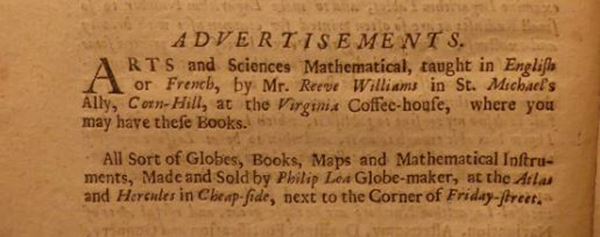
The friends mentioned incidentally by Speidell reflect the closely interwoven mathematical and mercantile networks in the metropolis. Hoote was an eminent London merchant, whose son visited France for health reasons and while there informed Collins, ever seeking to keep abreast of the latest developments, of mathematical books recently published in that country.Footnote 40 Williams was an engraver and teacher who kept a mathematical school at the Virginia Coffee House in Cornhill. His close ties to Euclid Speidell extend to the fact that the two men shared the same publisher, Lea, who occupied premises in Cheapside. Nor does Speidell simply advertise for his friend's teaching services in his books (Figure 3). He also takes pains in one of them, the second edition of Arithmeticall Extraction, to inform his readers about the English translation of the Claude-François Milliet de Chales (1621–1678) edition of Euclid's Elements that Williams published the previous year. Indeed, he goes into considerable detail in his description of that work, noting how the translator subjoined to each proposition in that classical text a section on its uses.Footnote 41 There was, however, possibly another reason for Speidell's detailed aside: in the same year, a second translation of the same work appeared under the imprint of the Oxford publisher Leonard Lichfield (1637–1686).Footnote 42 Both Williams and his publisher would have had a strong interest in promoting their new edition of Euclid.
Advertisements for Reeve Williams's mathematics teaching and Philip Lea's globes, books, maps and instruments, contained in Euclid Speidell's Logarithmotechnia: or, the making of numbers called Logarithms, London, 1688. © 2019 Bodleian Libraries, University of Oxford, Savile Mm. e. 37.

In the Art of Practical Gauging, John Newton also employed the self-effacing trope of being persuaded by friends when giving an account of his motivation for publishing tables for making gauging rods, as well as rules for measuring the whole or part of cask. He notes that these rules employ a technique developed by Dary, to whom he pays homage as ‘an ingenious Artist, and a Practiced Gauger’.Footnote 43 But equally, if not more, important for his readers would be the convenience of applying these rules, that ‘sutes better with the great haste that is required in this’. Although academic mathematicians, including the Savilian Professor of Geometry at Oxford, John Wallis, had also devised methods for measuring such volumes as those with which gaugers were concerned, they were simply not suitable for practitioners. As Newton emphasized, ‘in reference unto Practice’, such methods as those of Wallis ‘require, as we use to say, more Cost than Worship; that is, more Labour than it yieldeth Profit’.
John Collins excelled in the art of publishing on behalf of others. As he explained in the preface to Geometricall Dyalling, that book came about after his friend Thomas Rice (fl. 1655–1659), one of the gunners at the Tower and an experienced dialler, communicated to him a general method for inscribing the requisites of a dial on an oblique leaning plane. However, this was not the invention of Rice himself, but rather of Samuel Foster, sometime professor of astronomy at Gresham College, who had conveyed details of it to him in 1640.Footnote 44 Rice in turn, but almost two decades later, communicated the method verbally to Collins, requesting that he work out a demonstration and publish it. Since both Foster and his executor were now deceased, Collins was effectively tasked with ensuring the survival of this knowledge within the practical community. Indeed, although Collins in the published work cited a comparable method devised by the dialler Thomas Stirrup (fl. 1651–1659), alongside mentioning the multitude of other treatises on dialling, the whole thrust of Geometricall Dyalling is its asserted novelty.Footnote 45 At the same time, the work illustrates again the close links between mathematical practitioners and instrument-makers, in this case between Collins on the one side, and Henry Sutton (d. 1665), as well as his lesser known relative William Sutton (fl. 1653–1663), on the other. A strategically placed advertisement points out that from the former's premises in Threadneedle Street and from the latter's in Upper Shadwell not only could the scales referred to in the tract be obtained, but also ‘all manner of other Mathematical Instruments for Sea or Land, are made exactly in Brass or Wood’ (Figure 4).Footnote 46
Advertisement for Henry Sutton's mathematical instruments in John Collins's Geometricall Dyalling, London, 1659. © 2019 History of Science Museum, University of Oxford, Evans Collection, LE/Col.

Another book which Collins published in the same year came about in similar fashion, no doubt explaining why these publications should be bunched so closely together temporally. Thomas Harvey (fl. 1657–1663), a practitioner who was well known to Collins, Dary and Henry Bond (c.1600–1678), designed an innovative form of quadrant based on stereographic projection which he subsequently described to Henry Sutton. For a new instrument to be marketable an explanatory leaflet or booklet was required and thus, before undertaking its production, Sutton requested that Harvey, as the inventor, deliver an appropriate text. Harvey declined, blaming lack of time, and so Sutton commissioned the already-known author Collins instead. However, not content with filling ‘two or three sheets of the use of it’, as the instrument-maker had envisaged, Collins wrote a complete treatise entitled The Sector on a Quadrant.Footnote 47 Sutton evidently waited until Collins was finished before actually producing the instrument, but we have to look outside the book to gain further insight into this collaboration. In a letter to Wallis, accompanying an exemplar of the quadrant and a printed sheet, Collins reveals in a manner free from the deference to instrument-makers usually expressed in publications that he was more practically involved than we might otherwise gather in helping to obtain customers:
At the request of Mr Sutton I wrote a despicable treatise of quadrants. His designe was to demonstrate himselfe to be a good workeman in cutting the Prints of those quadrants, and thereby to obtaine Customers, mine to Improove the Prints by Vernish, which I was certaine I could accomplish 12 yeares since, to a better lustre then this I herewith send (togeather with a sheete of my Booke).Footnote 48
Social spaces and the construction of identity
The shops of instrument-makers were in many ways sites where those interested in the mathematical sciences in early modern London could meet and exchange information, while also establishing informal professional connections. Importantly, they served as places where teachers, as an alternative to using their own rooms, could offer instruction in mathematics. In this way, teachers could reach a wider audience, while also selling their books. But there were, of course, advantages for instrument-makers, too, who benefited through clients being drawn into their premises and encouraged to purchase their wares. Detailed accounts have not been handed down, but a chance remark in a letter from Collins to John Pell, where he mentions meeting a Cambridge scholar in the shop of Anthony Thompson (d. 1665), gives some indication of the pivotal role that instrument-makers played:
Being once in Mr. Thomson's shop, I met with a Cambridge Scholar, who suggested that the small anonymous Jesuit's Euclid, printed by Mr. Martyn, was now in good request amongst tutors and their scholars there, that they wanted the like for arithmetic and algebra.Footnote 49
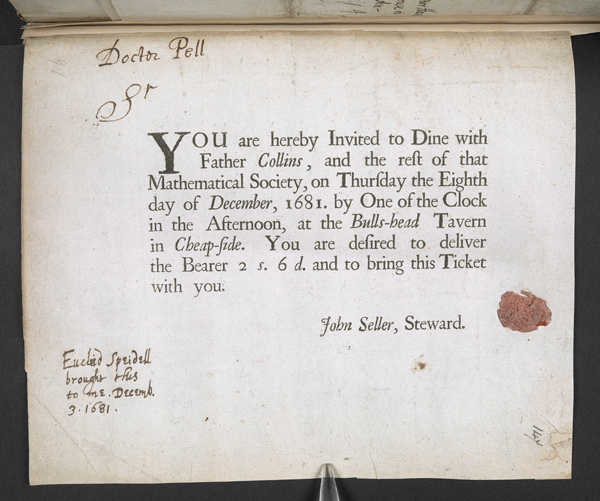
London also offered more formal social spaces in which mathematicians could meet, learn about the latest developments and publications and exchange ideas. Anthony Thompson, who worked under Foster at Gresham College, but later collaborated with practitioners such as Stirrup, was involved with one of several mathematical clubs that existed in the metropolis during the second half of the seventeenth century. In a note sent via the intelligencer Samuel Hartlib (c.1600–1662) in November 1658, he summoned John Pell to attend the meeting of a mathematical club in Moorfields, which numbered luminaries such as William Brouncker (1620–1684), Laurence Rooke (1622–1662) and Christopher Wren (1632–1723) among its members.Footnote 50 While this club appears to have had close ties to Gresham College, and been socially exclusive, others were not so. More than a decade later, Collins mentioned the existence of two clubs in London, the larger of which evidently drew its membership from a wide spectrum of those involved in artisanal and mathematical practice: ‘for of the two Mathematicall Clubbs here, one is a large one, consisting of Diverse ingenious Mechanicks Guagers Carpenters Shipwrights some Seamen Lightermen &c whose whole Discourse is about Æquations.’Footnote 51 Collins's reference to mechanics is significant, for instrument-makers and other specialized craftsmen in England were not required to be members of a single unique guild or other nominated home, as was the case in some continental European cities.Footnote 52 Although between 1660 and 1700 there were efforts to bring craftsmen of a particular trade into the guild of that trade, instrument-makers for the most part could belong to one of a large number of London guilds.Footnote 53 Men of disparate occupations and training, whose professional associations could be equally varied, were united by their interest in the mathematical sciences. No further contemporary evidence of these clubs mentioned by Collins appears to have survived. Nor do we know if they are related either to the club that met in Moorfields earlier or to the so-called ‘Mathematical Society’ that certainly existed in London some ten years later. As regards the latter, once more, the sole relict is a printed invitation. This time it is one sent by John Seller (d. 1698), a well-known compass maker and mathematical author with numerous books to his name, who signs himself as steward of the society concerned (Figure 5). The recipient, again John Pell, has noted in ink that Euclid Speidell, the bearer, brought the invitation to him on 3 December 1681.Footnote 54 The president or ‘father’ of the society, with whom the members are invited to dine at the Bull's Head Tavern in Cheapside, is simply named Collins. There is no reason to doubt that this could be anyone other than John Collins, whose standing within the practical community was unparalleled and who at this time was employed as accountant to the Royal Fishery Company.
Invitation from John Seller to dine with the Mathematical Society, delivered by Euclid Speidell to John Pell, 9 December 1681. © 2019 British Library Board, Add. MS 4398, f. 147r.

Again, there is evidence of a certain continuity of the existence of such associations outside the established system of guilds. Thus Robert Hooke (1635–1703), in a lecture delivered at Gresham College in 1683, noted that there was a club of mathematical instrument-makers that met regularly in London in the first half of the seventeenth century. Unfortunately, he tells us nothing more about this club except to point out that Elias Allen was its principal figure.Footnote 55
Practical mathematicians and their academic friends
Through membership of mathematical clubs or societies, as well as through their professional activities, London's mathematical practitioners ascribed themselves a distinct identity, reflected in the divers epithets they applied to themselves on the title pages of their books. But some of them also saw engagement with their academic counterparts as a natural extension of their interests in promoting the mathematical sciences generally.Footnote 56 As already mentioned, Michael Dary exchanged letters and problems with Isaac Newton and James Gregory just as he did with his friend and sometime patron John Collins. For his part, Collins was a prolific intelligencer, corresponding frequently with Wallis, Barrow, Newton and Gregory, not to mention his epistolary commerce with scholars on the Continent such as Jean Bertet (1622–1692), Giovanni Alfonso Borelli (1608–1679) or Gottfried Wilhelm Leibniz (1646–1716). Although Collins was elected to the Royal Society in 1667 and thereafter proudly displayed this membership almost as a trophy of scientific recognition on the title pages of his subsequently published books, he felt he was valued by the institution above all for supporting Henry Oldenburg (1618?–1677) in reviewing mathematical contributions and for the role he played in overseeing its accounts.Footnote 57 The only person he proposed for the fellowship during the more than fifteen years he was a member was Gregory.Footnote 58 In his preface to The Country-Survey-Book of Adam Martindale, Collins pointed out that Martindale's almanacs were esteemed by several members of the Royal Society, but also conceded that he had met with ‘some Discouragements from such as knew not how to judge of the Authors worth’.Footnote 59 When, in 1671, four years after admission to the Royal Society, Collins sought to establish a correspondence with Edward Bernard (1638–1697), Savilian Professor of Astronomy at Oxford, he described himself self-deprecatingly as a non-academic and lowly or mean-spirited person.Footnote 60 But later on Collins succeeded in establishing his reputation even in scholarly circles, and the former vice president of Magdalen College, Thomas Smith (1638–1710), happily described him in a letter written to the same academic addressee in 1676 as ‘your Brother Mathematician’.Footnote 61
Perhaps unintentionally, Smith's remark reflects another important fact. Particularly among mathematicians themselves, questions of social standing were often overlooked or ignored, especially when interests coincided. Thus Collins repeatedly served as publishing agent for Wallis and actively saw his Treatise of Algebra (1685) through the press.Footnote 62 There were shared thematic interests, too. Prominent among such common domains were algebra, the application of logarithms and stereometry: all areas where theory was undoubtedly the handmaiden of practice. In a letter sent to Gregory, probably in early March 1668, Collins emphasized to the Scottish mathematician the proximity of stereometrical problems dealt with on a day-to-day basis by practitioners to academic concerns about quadratures:
The quadrature of the hyperbola is a proposition very necessary in gauging, and consequently of great use in relation to the king's revenue; for many brewers’ tuns are like silver tankards trunci conici circulares, divided into two partitions with a plane erect to the base to hold liquors of different strengths, and also stooping, and the quadrature of the hyperbola doth capacitate us to a cube any segment of a cone.Footnote 63
These shared concerns are also reflected in the citation practice of London's mathematical authors. To a remarkable extent, practitioners such as Collins, Mayne, Dary and Euclid Speidell were well apprised of contemporary mathematical literature not only from the British Isles but also from continental Europe. In their publications they would cite Christiaan Huygens (1629–1695) or René François de Sluse (1622–1685) just as they might cite Wallis or Gregory. As we have seen, it was important especially for teachers to be able to offer instruction, suitably simplified or streamlined, in the most up-to-date methods and theories. Not least in this respect, exchanging ideas and discussing the latest mathematical publications from near or far was crucial to their success.
It is here, finally, that the practice of mathematics would appear to have undergone its most visible transformation during the second half of the seventeenth century, despite many instances of continuity in the production of books, the nature and provision of instruction, or the role of clubs and societies. While academically trained teachers of mathematics who deliberated on the practical applications of their discipline would still continue to talk disparagingly of their self-taught or informally taught practitioner counterparts well into the 1620s, such attitudes had all but disappeared by 1700. No longer were mathematical practitioners, surveyors, diallers or accountants charged with lacking sophistication or authority, of being somehow insufficient, because their practice was devoid of firm theoretical foundations.Footnote 64 The increasing professionalization of mathematics within the universities, which saw the essentially humanist approach of earlier years being at first complemented and then largely superseded by a new course-based approach, would appear to have contributed decisively to this development. When David Gregory (1661–1708), with the backing of Wallis, drew up a new scheme for the teaching of mathematics, he not only proposed that lectures be given in English, but also quite naturally included courses or ‘colleges’ on plain trigonometry, algebra and practical geometry, whereby the last might cover such topics as fortification, dialling or navigation.Footnote 65
Conclusion
London's mathematical practitioners were part of a thriving knowledge community in which they collaborated and transacted on a daily basis with instrument-makers, merchants, printers and booksellers. In the often squalid, bustling metropolis livings were eked out by offering tuition in everything from algebra to shorthand, by writing and selling books, and occasionally by assisting instrument-makers in perfecting their wares. Those who were fortunate enough to find influential patrons obtained employment in government offices as gaugers or accountants, but payment for their labours could often be more promise than reality. Patronage would sometimes be offered by practitioners themselves, as instanced by Collins during a more successful period of his career. On another occasion, empty-handed due to a depleted Exchequer, ‘England's Mersenne’, as Isaac Barrow termed him,Footnote 66 longed for the financial independence of a stationer, but was forced to give up this aspiration for lack of capital.Footnote 67
The practical book market in seventeenth-century London was considerable in size, reflecting a strong and constantly expanding need for numerate individuals across a wide range of activities, from merchants’ accounts to surveying, from gauging to the construction of sundials. Books for this clientele were often conceived and written as personal tutors, but authors also offered instruction against an always undisclosed financial payment. As a commodity, instruction was offered in a variety of locations, but mainly in the teacher's own rooms, in the workshops of instrument-makers or even on the premises of booksellers; these in turn served as informal meeting places, where news and information would be exchanged, where teachers would apprise themselves of the latest trends or technical advances, and their clients could purchase the mathematical instruments or publications they required. Teachers and instrument-makers would equally advertise their services in practical books, reflecting the strong sense of interdependency within the knowledge community.
Practitioners saw themselves as members of a clearly defined body with its own identity. Support was given wherever possible, such as when Dary found himself facing financial ruin with his trade as a tobacco cutter failing. Authors like Mayne and Collins assisted in making public the work of fellow mathematicians who, for various reasons, were unable to put their material into print themselves. They also gathered in more formal organizations, clubs and societies, which evidently drew in a diverse range of practitioners, instrument-makers, merchants, seafarers and others involved in the shipping trade, and which contrasted strongly with the more socially closed nature of the Royal Society. Yet like that institution these clubs and societies no doubt served to promote their shared interests, enabling members to learn about the latest developments in mathematics, and to exchange views on the matters that concerned them. Despite all the differences in the concerns and approaches to their subject that undoubtedly existed, London's practical mathematicians nonetheless willingly interacted whenever they could with their academic counterparts. There were not only good thematic reasons for them to share their ideas, but also a common aim of promoting the development of the mathematical sciences in a country where they had long been neglected.