Goat's milk and products are widely consumed in the world and may be used as an alternative to cows’ milk products for certain consumers (Wang et al. Reference Wang, Bao, Hendricks and Guo2012). However, the ‘goaty’ flavor may have an impact on consumer acceptance of fermented goat milk (Costa et al. Reference Costa, Belträo Filho, Sousa, Cruz, Queiroga and Cruz2016). The unique smell of goat milk may be primarily due to the presence of the short-medium chain free fatty acids (SM-FFA) (Chilliard et al. Reference Chilliard, Ferlay, Rouel and Lamberet2003). Caproic (C6), caprylic (C8), and capric (C10) acids are more abundant in goats’ milk than cows’ milk (Costa et al. Reference Costa, Balthazar, Franco, Mársico, Cruz and Conte2014). Goaty flavor was intensified with an increase of SM-FFA contents. Another possible mechanism is that goaty flavor may be the result of interactions between SM-FFA since there is no goaty flavor when these several SM-FFA exist alone (Feng et al. Reference Feng and Luo2008). Reducing the flavor has become necessary for certain populations to consume goat milk products (Santos et al. Reference Santos, Gonçalves, Carvalho, Fernandes and Ferrão2016), and has been done using technological or sensory strategies (Costa et al. Reference Costa, Monteiro, Frasao, Silva, Rodrigues, Chiappini and Conte-Junior2017). It has been reported that β-cyclodextrin (β-CD) reduces goat milk flavor efficiently by trapping small hydrophobic molecules, the short-medium chain free fatty acids (Sadooghysaraby, Reference Sadooghysaraby2011). Cyclodextrins are macrocyclic compounds consisting of a variable number of D-(+)-glucopyranose residues linked through alpha (1→4) bonds (Kollengode & Hanna, Reference Kollengode and Hanna1997). The number of glucose units determines the dimensions of the cavity. Beta-cyclodextrin (β-CD) contains seven glucose units (Ozawa et al. Reference Ozawa, Hashimoto, Yamauchi, Suzuki, Smith and Hayashita2008). Cyclodextrins have the remarkable ability to form inclusion compounds with various components, especially hydrophobic molecules. Arora & Damodaran (Reference Arora and Damodaran2011) described a β-CD-based process to remove protein-bound phospholipids and free fatty acids.
Whey protein isolate (WPI) is a mixture of globular proteins arising as a by-product of cheese production (Gao et al. Reference Gao, Yu, Bao and Guo2011). The main fraction of WPI is β-lactoglobulin (β-LG). β-LG is a member of lipocalin family and has the ability to bind small hydrophobic ligands, such as retinol, vitamins and fatty acids (Sponton et al. Reference Sponton, Perez, Carlos and Santiago2014). Simion et al. (Reference Simion, Aprodu, Dumitrașcu, Bahrim, Alexe and Stănciuc2015) confirmed the ability of β-lactoglobulin to bind oleic acid by forming complexes during heat treatment. Guo et al. (Reference Guo, Bellissimo and Rousseau2017) found that whey protein isolate showed an ability to protect canola oil by coating the oil droplets. Furthermore, the structure of β-lactoglobulin can be modified. When heated, β-LG shows protein unfolding, which is attributed to the extensive exposure of hydrophobic groups and highly reactive nucleophilic sites (–SH and ε-NH+3) (Mantovani et al. Reference Mantovani, Cavallieri and Cunha2016). Polymerized whey protein (PWP) was defined as ‘soluble whey protein aggregates which are formed by heated at a controlled temperature and protein concentration’ (Vardhanabhuti et al. Reference Vardhanabhuti, Foegeding, Mcguffey, Daubert and Swaisgood2001). The denatured whey proteins form complexes among themselves as well as with casein micelles, leading to the formation of large aggregates (Chandrapala et al. Reference Chandrapala, Zisu, Palmer, Kentish and Ashokkumar2011). Another important functional property of PWP is their ability to form acid-induced gel (Li & Guo, Reference Li and Guo2006). PWP has been successfully used as a gelation agent to improve yogurt consistency for fermented foods due to the acidic environment (Walsh et al. Reference Walsh, Ross, Hendricks and Guo2010).
Fermented goat milk, compared with cow milk products, have weaker body and poorer texture due to its chemical composition. Goat milk has a low level of, or lacks, αs1-casein, which affects formation of an almost semiliquid coagulum (Bruzantin et al. Reference Bruzantin, Daniel, Da and Spoto2016). PWP might have the ability to bind SM-FFA whilst also acting as a gelation agent for fermented goat milk manufacturing. Therefore, the objective of this study was to investigate the effects of PWP on goaty flavor as well as the texture of fermented goat milk in comparison with β-CD. Fermented goat milk samples added with PWP or/and β-CD were analyzed for sensory properties, short-medium chain free fatty acids (SM-FFA) contents, texture profile and apparent viscosity.
Material & methods
Preparation of yogurt samples
Polymerized whey protein was prepared as described by Wang et al. (Reference Wang, Bao, Hendricks and Guo2012). Whey protein isolate (WPI, 92% protein) was provided by Hilmar (CA, USA). Goat milk powder (Kemai Biotechnology Company, Changchun, China) was dissolved in pure water to get a 12% (w/v) concentration of reconstituted milk. Sugar (7%, w/v, COFCO, Tianjin, China) and PWP/β-CD (Beijing Chemical Works, Beijing, China) were added to goat milk at 40–50 °C with stirring for 30 min, and then pasteurized. After cooling, the mixture was inoculated with ABY-3 starter culture (0·008%, w/v; Chr. Hansen, Milwaukee, WI, USA) and incubated at 43 °C for 4·5 h. After incubation, the yogurt samples were stored at 4 °C for further analysis.
Experimental design
Fermented goat milk samples were prepared with addition of PWP, β-CD or combination of PWP and β-CD at different levels (Table 1). Fermented goat milk samples added with neither PWP nor β-CD was set as a control. All the samples were analyzed for sensory properties, texture and apparent viscosity. The combination levels of PWP and β-CD were determined by the results for the reduced goaty flavor by PWP and β-CD individually via sensory evaluation. The three samples with the largest goaty flavor reducing ability for PWP, β-CD and the combination were also determined for short-medium chain free fatty acids (SM-FFA) contents.
Formulations of fermented goat milks with individual polymerized whey protein or β-cyclodextrin and formulations of fermented goat milks with combined polymerized whey protein and β-cyclodextrin (%, w/v)

Sensory evaluation
Twenty trained panelists of both sexes were recruited from the Laboratory of Food Science Department, Jilin University. Sensory evaluation was based on the method described by Wang et al. (Reference Wang, Gao, Zhang, Wang and Guo2015) with little modification. Sensory properties (goaty flavor, body and texture, taste, appearance and color, and overall acceptability) were evaluated in a structured 5-point hedonic scale, (1 = extremely dislike to 5 = extremely like). Before tasting each sample, the panelists were required to rinse their mouth thoroughly with deionized water. Three replicates were measured using separate repeated samples.
Determination of short-medium chain free fatty acids (SM-FFA)
SM-FFA were determined using head-space solid-phase micro-extraction-gas chromatography-mass spectrometry (SPME-GC-MS) according to the method of Hettinga et al. (Reference Hettinga, van Valenberg, Lam and van Hooijdonk2008) with some modification. Fermented goat milk (5 g) was fermented directly in 20-mL GC vials to avoid loss of SM-FFA during sample preparation (Settachaimongkon et al. Reference Settachaimongkon, Nout, Antunes Fernandes, Hettinga, Vervoort, van Hooijdonk, Zwietering, Smid and van Valenberg2014). SM-FFA in the headspace were extracted at 50 °C for 40 min with a 75 µm CAR/PDMS fiber (Supelco, Bellefonte, PA, USA). The fiber was desorbed for 2 min in the GC injection port. The detection conditions were as follows: injection temperature of 250 °C; carrier gas (helium) flow rate of 3 ml/min; split ratio of 3 : 1 (v/v). The type of the column was Agilent19091N-136. The oven temperature was maintained at 80 °C for 3 min, then increased to 230 °C at 5°C/min and maintained for 10 min. The MS iron source was maintained at 230 °C with full scan. Electron impact mode was at 70 eV with the mass range (20–500) m/z.
Analysis of texture and apparent viscosity properties
Texture and apparent viscosity properties of all yogurt samples were analyzed based on the method described by Wang et al. (Reference Wang, Gao, Zhang, Wang and Guo2015). Texture was measured using a Texture Analyzer (CT-3, Brookfield Engineering Laboratories, Inc., Middleboro, MA, USA). All samples were analyzed in triplicates for three trials.
The apparent viscosity was measured using a Brookfield viscometer (DV-3, Brookfield Engineering Laboratories, Inc., Middleboro, MA, USA) equipped with a LV3 spindle. All samples were determined for 1 min at constant revolution of 200 rpm. All samples were analyzed in triplicates for three trials.
Statistical analysis
All data obtained from analysis were expressed as mean ± standard deviation (sd). Data were subjected to Leveneǐs test for homogeneity at P < 0·05 using Version SPSS 20 (SPSS Inc. Chicago, IL, USA). When the data were homogeneous, one-way analysis of variance (ANOVA) and then a least squared differences (LSD) model was used. All the figures were drawn by origin 8·0 (Origin Lab Corporation, Northampton. USA).
Results & discussion
Effects of PWP and β-CD on goaty flavor of fermented goat milk
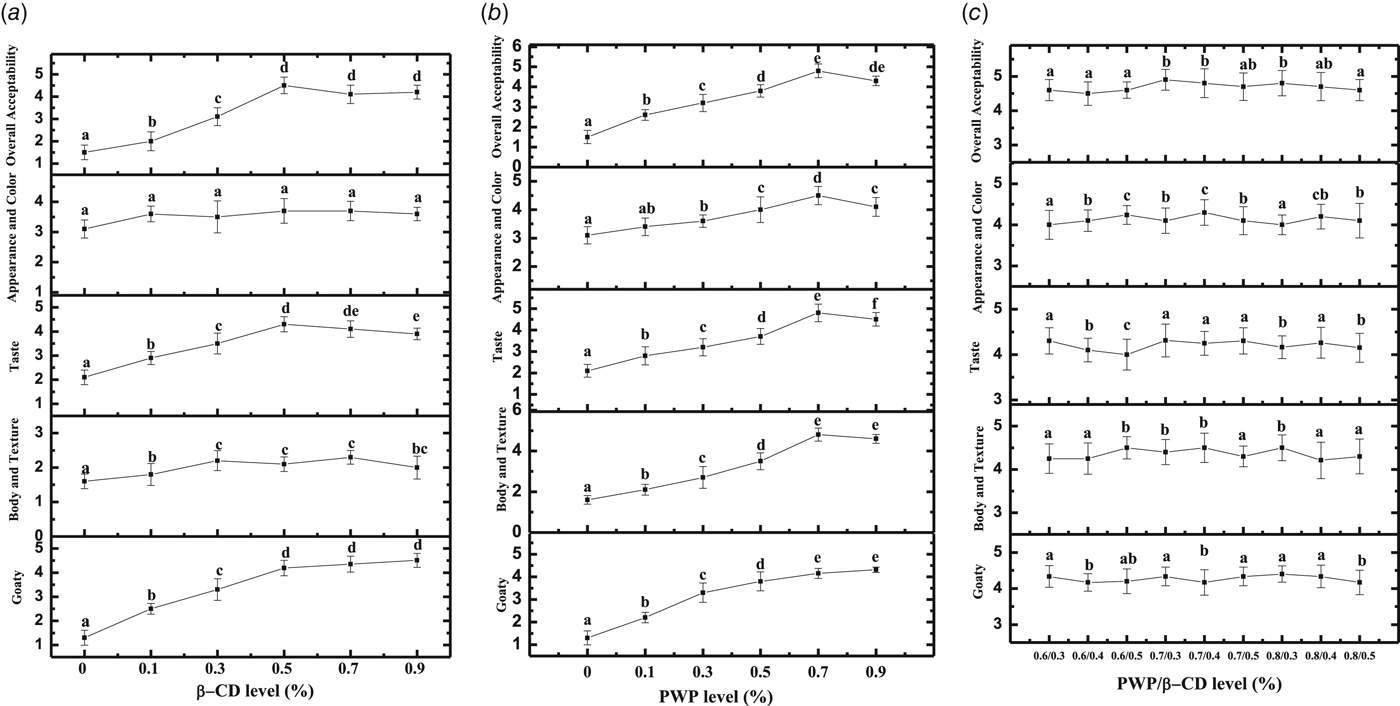
Skjevdal (Reference Skjevdal1979) described the goat's milk flavor as ‘irritating, bitter and soapy’. Sensory evaluation can clearly reflect changes in goaty flavor. β-CD level necessary to minimize the goaty flavor of fermented goat milk was determined by sensory analysis (Fig. 1a). Compared with control, samples with added β-CD showed increased acceptance score ranging from 2·50 ± 0·22 to 4·51 ± 0·29 when the level increased from 0·1% to 0·9%, indicating the effective capacity of β-CD for reducing the goaty flavor. Similar results were reported by others (Meier et al. Reference Meier, Drunkler, Luiz, Fett and Szpoganicz2001; Young et al. Reference Young, Gupta and Sadooghysaraby2012). The capacity of reducing goaty flavor of the yogurt (represented by score) was positively correlated to the β-CD (P < 0·05) in the range of 0·1%–0·9% (w/v). However, there was no significant difference in goaty flavor of samples when β-CD level ranged from 0·5% to 0·9% (P > 0·05). In term of body and texture, both control and fermented goat milks added with β-CD showed a liquid state, which was the most common texture defect for fermented goat milk (Ranadheera et al. Reference Ranadheera, Evans, Adams and Baines2012). However, samples added with β-CD showed more viscous consistency than the control. As for taste, dextrin flavor gradually appeared with increased β-CD level, especially in samples with β-CD above 0·5%. Therefore, 0·5% was selected as the optimized level due to the increased unpleased flavor of dextrin with high levels of β-CD.
Effects of β-CD (a), PWP (b), and combination of PWP and β-CD (c) on sensory properties of fermented goat milks.

Goaty flavor had undergone significant changes with PWP and sensory score increased from 2·20 ± 0·31 to 4·31 ± 0·12 (Fig. 1b). When PWP was up to 0·7%, goaty flavor was almost completely masked and there was no significant difference between samples with 0·7% and 0·9% (P > 0·05). Compared with samples added with β-CD, 0·7% PWP had the same effect of reducing goaty flavor as 0·5% β-CD. Therefore, PWP was effective in reducing goaty flavor intensity with a vivid manifestation of sensory result. It had a potential value to be used as a goaty flavor reducing agent for commercial fermented goat milk. In contrast to β-CD, PWP gave fermented goat milk a firm texture which can be classified as a set-type yogurt. The gelation ability of PWP in an acidic environment contributed to the structure development in fermented food, which was induced by lactic acid-producing bacteria (Alting et al. Reference Alting, Meulena, Hugenholtz and Visschers2004). Fermented goat milk samples were much firmer when PWP increased in the investigated range and the sample with the highest level (0·9%, w/v) was jelly. However, samples added with PWP up to 0·9% (w/v) had a taste of whey.
Effects of combinations of 0·6%−0·8% PWP and 0·3%−0·5% β-CD on sensory property of fermented goat milk were investigated (Fig. 1c). Samples showed both the advantages of PWP and β-CD with desirable texture score and more obvious reducing goaty flavor ability. Score of goaty flavor fluctuated from 4·17 ± 0·34 to 4·40 ± 0·23 with different addition of PWP and β-CD, which were much higher than the control (P < 0·05).
Effects of PWP and β-CD on SM-FFA contents of fermented goat milk
The intrinsic sensory characteristics of goat milk are related to the presence of short-medium chain free fatty acids (SM-FFA) such as caproic (C6), caprylic (C8), and capric (C10) acids. SPME-GC-MS was used to measure SM-FFA contents. In chromatographic analysis, peak height or peak area (the response value of the detector) is proportional to the number (or concentration) of the measured component under certain conditions. Relative change rate of fatty acid of fermented goat milk samples was calculated and expressed as the percentage to that of the control. It was reported that cyclodextrins has remarkable ability to form inclusion compounds with hydrophobic molecules (Sadooghysaraby, Reference Sadooghysaraby2011). As shown in Table 2, compared with control, the content of C6, C8, C10 decreased approximately by 22%, 71%, 54%, respectively, in fermented goat milk with 0·5% β-CD. This indicated the formation of an inclusion complex, the interactions occurred primarily between the hydrophobic regions of the β-CD cavity and the hydrocarbon chain of C6, C8, C10. Moreover, C8 decreased most significantly, indicating the more affinity of C8 with β-CD. These results were in accordance with those of Meier et al. (Reference Meier, Drunkler, Luiz, Fett and Szpoganicz2001), who proved that β-CD bound caprylic and capric acids to remove perception of goat milk flavor by differential scanning calorimetry (DSC) and proton magnetic resonance (1H NMR) spectroscopy analysis. Young et al. (Reference Young, Gupta and Sadooghysaraby2012) also found that β-CD bound 4-methyl branched chain fatty acids and their straight chain isomers in reducing goaty flavor intensity of yogurt.
Peak area of short–medium chain free fatty acids of fermented goat milk

Relative change rate of short-medium chain free fatty acids is given as % of control.
Note: – means decrease, + means increase.
Compared with control, we obtained 45, 58 and 71% decreases, respectively, in the content of C6, C8, C10 in fermented goat milk with 0·7% PWP. PWP showed a marked affinity for capric acids, which made C10 decrease more significantly. It proved the hypothesis that PWP can weaken the goaty flavor of fermented goat milk by decreasing the content of SM-FFA. This is likely due to β-Lactoglobulin (β-LG), the major protein in whey protein isolate exhibiting significant fatty acid binding via hydrophobic bonds (Maté & Krochta, Reference Maté and Krochta2010). Many experiments indicated that β-lactoglobulin can bind most of the saturated and unsaturated fatty acids (Liu et al. Reference Liu, Kitova and Klassen2011). It was documented that β-lactoglobulin could bind caprylic and capric acids with lower affinity (Loch et al. Reference Loch, Polit, Górecki, Bonarek, Kurpiewska, Dziedzickawasylewska and Lewiński2011). The fatty acid binding affinity depends on the chain length and larger ligand size corresponds to greater binding affinity (Evoli et al. Reference Evoli, Guzzi and Rizzuti2014). This can explain why C10 reduced more significantly than C6 and C8. Another possible mechanism for the reduced goaty flavor may due to the formation of PWP network during goat milk fermentation. The heat treatment of WPI solutions above 70 °C leads to partial unfolding of whey proteins, which can result in the exposure of hydrophobic residues and free sulfhydryl groups to aqueous environment. It can contribute to an increased possibility of hydrophobic attractions and formation of disulfide bonds between whey proteins (Ha et al. Reference Ha, Jin, Lee and Lee2013), which may result in increased aggregation of whey proteins molecules. An acid-induced cold-set gelation forms when pH is lowered to the isoelectric point of β-LG during goat milk fermentation, where the electrostatic repulsion trends to decrease and consequently trap SM-FFA in the network (Wang et al. Reference Wang, Bao, Hendricks and Guo2012).
As expected, the combination of PWP and β-CD exhibited a synergistic effect on reducing the goaty flavor in fermented goat milk. Compared with control, the combination of 0·6% PWP and 0·3% β-CD conferred more affinity for SM-FFA than adding 0·7% PWP or 0·5% β-CD individually, with reduced levels of C6, C8, C10 (by 89%, 90%, 79%, respectively). In similar fashion, Na et al. (Reference Na, Kim, Kim and Lee2011) used cyclodextrin and whey protein concentrate to encapsulate fish oil and found that the odor intensity of the encapsulated fish oil decreased to 30% of its original value.
Effects of PWP and β-CD on texture properties of fermented goat milk
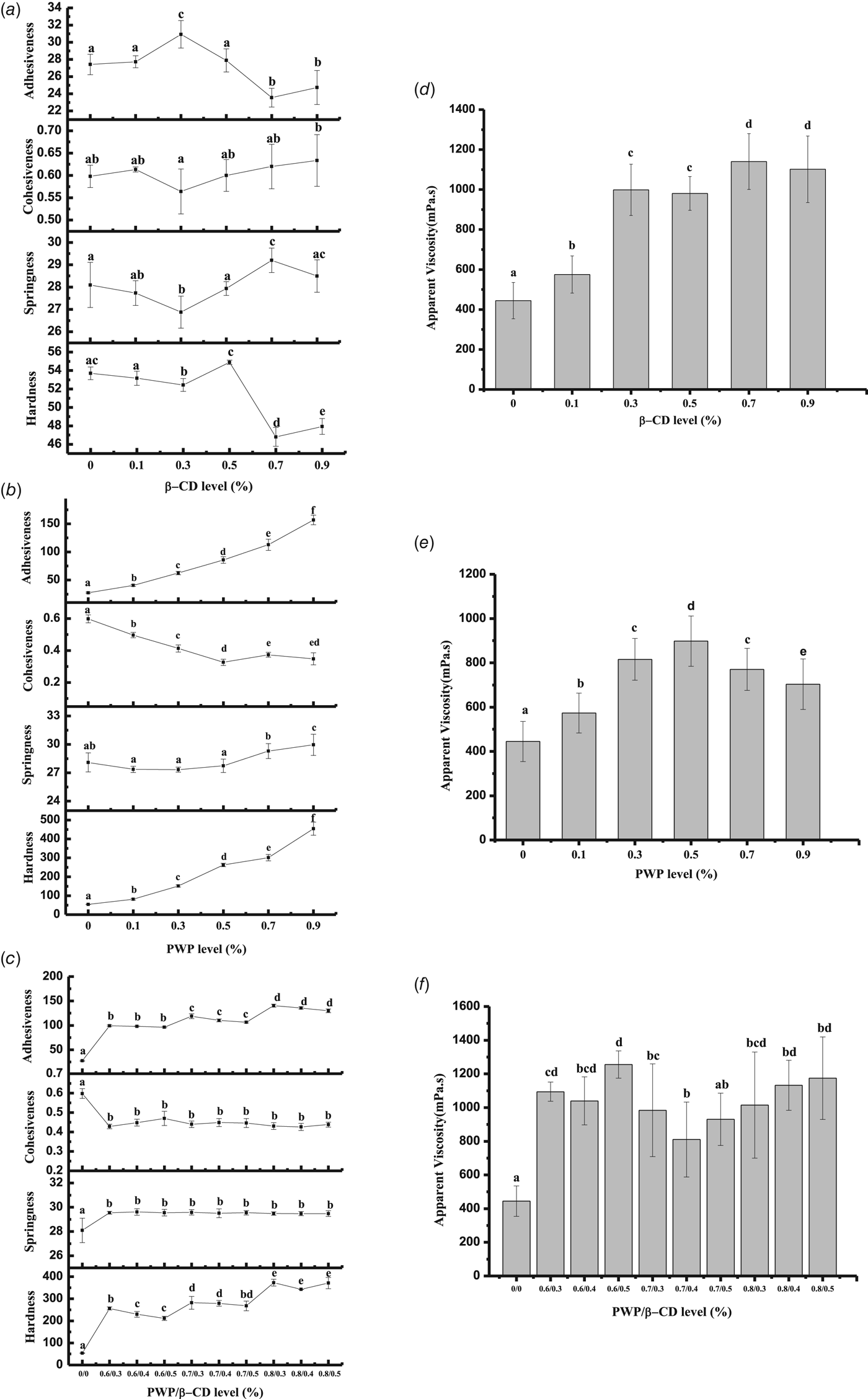
Gel formation is one of the main texture properties of yogurt, which is a result of casein aggregation as a consequence of pH decreasing and disulfide bonding between κ-casein and denatured whey proteins (Damin et al. Reference Damin, Alcântara, Nunes and Oliveira2009). Goat milk often produces weak curd yogurt due to the lack of αs1-casein (Zhang et al. Reference Zhang, Mccarthy, Wang, Liu and Guo2015), which makes it hard to manufacture fermented goat milk products with appropriate texture (Costa et al. Reference Costa, Monteiro, Frasao, Silva, Rodrigues, Chiappini and Conte-Junior2017). In this study, hardness of control was only 54·18 ± 1·12 g (Fig. 2). β-CD mainly showed a negative impact on hardness (P < 0·05), and only samples added with 0·5% β-CD were higher than control. Hardness value of samples with β-CD ranged from 54·9 ± 0·23 to 46·8 ± 1·02 g. As shown in Fig. 2b, as PWP level increased, the hardness of yogurt increased from 81·63 ± 4·10 to 454·17 ± 34·76 g and this change was statistically significant (P < 0·05). The addition of PWP resulted in a more rigid gel structure in yogurt due to the formation of aggregates via interactions between PWP and casein micelles (Andoyo et al. Reference Andoyo, Guyomarc, Cauty and Famelart2014). Data of other studies confirmed that polymerized whey protein isolate and/or whey protein concentrate can improve fermented goat milk hardness (Gursel et al. Reference Gursel, Gursoy, Anli, Budak, Aydemir and Durlu-Ozkaya2016). Hardness of experimental samples with combined β-CD and PWP decreased slightly as β-CD increased whilst PWP remained constant (P > 0·05), but the opposite trend was observed as PWP increased (P < 0·05), ranging from 211·5 ± 9·47 to 372·85 ± 15·48 g. The effect of PWP was much greater than that of β-CD on the hardness of fermented goat milk.
Effects of β-CD (a), PWP (b), and combination of PWP and β-CD (c) on texture properties of fermented goat milks, and effects of β-CD (d), PWP (e), and combination of PWP and β-CD (f) on the apparent viscosity of fermented goat milks.

Effects of PWP and β-CD on apparent viscosity of fermented goat milk
According to Park (Reference Park2007), the lower casein content and different proportions of αs1, αs2, β caseins in goats’ milk relative to cow milk causes a more fragile clot and lower apparent viscosity in the yogurts. This characteristic of fermented goat milk could affect appearance and acceptance of the products (Bezerra et al. Reference Bezerra, Souza and Correia2012). As shown in Fig. 2, the apparent viscosity of control was 444·85 ± 90·56 mPa.s. Yogurts with β-CD had higher apparent viscosity than control, as well as those samples with equivalent PWP. The apparent viscosity of fermented goat milks added with β-CD ranged from 575·18 ± 93·75 to 1140·52 ± 128·22 mPa.s. Similarly, Sook-Young & Mi-Jung (Reference Sook-Young and Mi-Jung2005) reported that the apparent viscosity of frozen soy yogurt can be improved by addition of cyclodextrin. Apparent viscosity of the fermented goat milks added with PWP firstly increased up to 0·5%, then decreased, ranging from 573·23 ± 49·85 to 898·195 ± 33·43 mPa.s. Wang et al. (Reference Wang, Bao, Hendricks and Guo2012) added PWP to fermented goat milk and found that apparent viscosity was progressively increased as PWP increased. Results showed that yogurt fortified with mixture of PWP and β-CD had higher apparent viscosity than those with single PWP or β-CD, ranging from 810·56 ± 222·38 to 1255·78 ± 81·14 mPa.s. No significant difference was found with increased β-CD when PWP was constant in samples with combined PWP and β-CD (P > 0·05).
Although β-CD increased yogurt apparent viscosity remarkably, texture of fermented goat milk was not influenced obviously. Texture defects of yogurt products include weak body, whey separation and gumminess. Addition of mixture of PWP and β-CD had both advantages of PWP and β-CD and resulted in a desirable texture of yogurt with increased apparent viscosity and mouth feeling. The combination of PWP and β-CD presented a more desirable texture and consistency in fermented goat milk.
In conclusion, the addition of polymerized whey protein significantly reduced goaty flavor of fermented goat milk, which may due to the interactions between PWP and SM-FFA especially for C6-C10. PWP also improved the organoleptic and textural properties of fermented goat milk compared with β-CD.