Introduction
In the USA, nearly 1 million older adults live in public housing (Burke, Reference Burke1998). People who have low incomes (income requirements vary by locale) and qualify as disabled, elderly, or as a family are eligible for public housing (US Department of Housing and Urban Development, 2011). Older adults living in public housing experience unique stressors as they tend to have limited incomes, live alone, are poorly educated, and have high levels of medical comorbidity and functional impairment (Rabins et al., Reference Rabins1996; Black et al., Reference Black, Rabins, German, McGuire and Roca1997). Furthermore, the prevalence of mental illness is 1.4 to 2.2 times higher among public housing residents than other community-dwelling adults (Rabins et al., Reference Rabins1996; Simning et al., Reference Simning, van Wijngaarden and Conwell2011a), with 37% of older adult residents needing mental healthcare (Black et al., Reference Black, Rabins, German, McGuire and Roca1997). Anxiety and depression in older adult public housing residents appear to be highly comorbid (Simning et al., Reference Simning, van Wijngaarden, Fisher, Richardson and Conwell2011b), and their comorbidity has been associated with higher levels of disability, more severe psychiatric symptoms, longer recovery times, more medical services utilization, and greater suicide risk (Stein, Reference Stein2001).
Late-life anxiety and depression are complex constructs with dozens of possible correlates, many of which are common to both psychopathologies (Vink et al., Reference Vink, Aartsen and Schoevers2008). When possible, anxiety and depression should be studied concurrently as anxiety and depression are highly associated constructs (Beuke et al., Reference Beuke, Fischer and McDowall2003). Examining anxiety and depression concurrently can help differentiate specific aspects of anxiety and depression (Beuke et al., Reference Beuke, Fischer and McDowall2003) and may be informative to future intervention studies. For example, if the correlates of anxiety symptom severity are highly similar to depression symptom severity, then intervention and prevention efforts in this setting that target one condition may positively impact the other as well. If there are substantial differences between their correlates, however, then knowledge of the correlates specific to anxiety as well as the correlates specific to depression could inform intervention efforts seeking to target either anxiety or depression in this setting.
Assessment of late-life anxiety and depression has been hampered because much research to date has been atheoretical (Magai et al., Reference Magai, Kerns, Consedine and Fyffe2003); that is, researchers often focus on defining risk correlates without attempting to incorporate them into an overarching theoretical framework. In contrast to an atheoretical approach, some researchers have relied on the Social Antecedent Model of Psychopathology to characterize and understand late-life mental illness (Cohen et al., Reference Cohen, Magai, Yaffee and Walcott-Brown2006; Reference Cohen, Colemon, Yaffee and Casimir2008; Robison et al., Reference Robison2009).
The Social Antecedent Model is a theoretical multi-stage model designed to explain psychopathology in which each higher model stage is hypothesized to represent an increasingly proximal set of mental illness risk correlates (George, Reference George, Busse and Blazer1989). The first stage evaluates demographic factors. The second and third stages examine early (e.g. education) and later (e.g. marital status) achievements and events. The fourth stage assesses social integration factors such as community engagement, religious involvement, and neighborhood stability. The fifth stage considers vulnerability and protective factors. Protective factors are posited to be various types of social support, whereas vulnerability factors may cover medical comorbidity, financial strain, and caregiving responsibility, among others. The sixth and most proximate stage to psychopathology includes provoking agents and coping efforts (George, Reference George, Busse and Blazer1989). Applying this framework facilitates a comprehensive examination of the demographic, social, medical, and behavioral correlates of late-life psychopathology. Most studies that have applied this framework have examined either anxiety (Cohen et al., Reference Cohen, Magai, Yaffee and Walcott-Brown2006) or depression (Magai et al., Reference Magai, Kerns, Consedine and Fyffe2003; Robison et al., Reference Robison2009) in isolation; late-life anxiety and depression have yet to be examined concurrently in this framework.
Among older residents in public housing, correlates of late-life mental illness span many of the Social Antecedent Model's stages and include age (Stage 1), gender (Stage 1), race (Stage 1), education (Stage 2), marital status (Stage 3), public housing residency duration (Stage 4), physical illness (Stage 5), social distress (Stage 5), stressful life events (Stage 6), and fewer leisure activities (Stage 6) (Rabins et al., Reference Rabins1996; Robison et al., Reference Robison2009). In older adult public housing residents, the Social Antecedent Model accounted for 35% to 57% of major depressive disorder variability in one study (Robison et al., Reference Robison2009). The Social Antecedent Model therefore appears well-suited for characterizing mental illness in this socioeconomically distressed population.
Although the correlates of late-life anxiety and depression symptom severity have been well described in the literature, there is considerable heterogeneity across study samples (Vink et al., Reference Vink, Aartsen and Schoevers2008), and anxiety and depression are infrequently examined concomitantly within a theoretical framework. Consequently, characterizing anxiety and depression symptom severity concurrently within the Social Antecedent Model framework is needed to help us better understand the comorbidity of anxiety and depression in public housing residents. A more complete understanding of the anxiety and depression symptom severity correlates specific to this socioeconomically disadvantaged population may better guide mental health interventions targeting symptomatic residents of public housing or similar low-income congregate living settings. To this end, we used bivariate and multivariate analyses to identify and compare the correlates of late-life anxiety and depression symptom severity in public housing residents.
Methods
Setting and participants
From May 2009 through June 2010 we conducted a cross-sectional study within four public housing high-rises designated for adults aged 50 years and older in Rochester, NY. The four public housing high-rises housed 553 residents with a median age of 64 years. Fifty-three percent of the residents were women, 75% were non-Hispanic, and 61% were black.
The University of Rochester Human Subjects Review Board approved this study, which was carried out in two phases. In Phase 1, public housing residents received a series of mailings (in English and Spanish) and had the opportunity to participate in onsite educational and recruitment activities. The primary purpose of Phase 1 was to engage residents in the study, provide data across demographic groups, and facilitate recruitment into the psychiatric research interview of Phase 2. During Phase 1 residents had the opportunity to complete a brief health questionnaire. Residents returned completed questionnaires to an onsite recruitment booth and received $5. Phase 1 had no exclusion criteria and 358 participants completed the questionnaire (65% response rate). On the questionnaire, residents indicated their willingness to participate in the Phase 2 psychiatric research interview.
In Phase 2, English-speaking residents aged 60 years and older with capacity to provide informed consent were eligible to participate in a 1.5 hour psychiatric research interview. We interviewed residents aged 60 years and older to be consistent with a prior public housing study (Rabins et al., Reference Rabins1996). Capacity to provide informed consent was evaluated using questions that assessed the participants’ understanding of the study. We did not use proxy informants. The interview examined characteristics spanning mental health, physical health, and social domains. Phase 2 participants received $25.
In total, 190 (180 non-Hispanic and 10 Hispanic) residents participated in the Phase 2 interview. We interviewed 180 (62%) of an estimated 292 non-Hispanic residents who were eligible. Among non-Hispanic Phase 2 eligible residents, interview participants were younger than the 112 non-responders (66 vs. 72 years, respectively; Mann-Whitney Test: z = 3.749, p < 0.001), but did not differ by gender or race. Eighty-nine Hispanic residents aged 60 years and older also lived in the high-rises, of whom 43 completed the Phase 1 health questionnaire. Only 13 of these 43 responders could speak English, however, and we interviewed 10 of these Hispanic residents. For the remaining 46 Hispanic residents, English-speaking status was unknown.
Anxiety and depression
The Generalized Anxiety Disorder assessment (GAD-7) is a seven-item anxiety scale scored from 0 to 21. A score of 10 or greater has a sensitivity of 68% and specificity of 88% for detecting generalized anxiety, posttraumatic stress, panic, and social anxiety disorders as compared to a structured psychiatric interview conducted by mental health professionals (Kroenke et al., Reference Kroenke, Spitzer, Williams, Monahan and Lowe2007). The Patient Health Questionnaire (PHQ-9) is a nine-item depression scale scored from 0 to 27. A score of 10 or greater has been reported to have both a sensitivity and specificity equal to 88% for detecting major depression as compared to a structured psychiatric interview conducted by mental health professionals (Kroenke et al., Reference Kroenke, Spitzer and Williams2001).
Social Antecedent Model of Psychopathology: independent variables
We examined late-life anxiety and depression symptom severity correlates that spanned the six stages of the Social Antecedent Model of Psychopathology.
Stage 1: Demographics. The demographics stage consists of self-reported information on age, gender, and race. We did not examine ethnicity because there were few English-speaking Hispanic participants (n = 10) and it is uncertain how representative these participants were of the other non-English-speaking Hispanic residents.
Stage 2: Early Events and Achievement. We examined education status (high school degree/GED; yes/no) and whether the participant lived in a two-parent household during the first five years of life (yes/no) (Magai et al., Reference Magai, Kerns, Consedine and Fyffe2003).
Stage 3: Later Events and Achievement. The variables included in this stage were marital status (married; yes/no) and living arrangement (lived alone; yes/no).
Stage 4: Social Integration. The social integration stage considers a person's environmental context (e.g. neighborhood stability) and attachment to social structures (e.g. religious affiliation). We evaluated the time in years a participant had lived in the high-rises, as well as a participant's organizational religiosity and social engagement. Organizational religiosity was assessed with two six-item questions from the Brief Multidimensional Measure of Religiousness/Spirituality (e.g. attendance at places of worship) (Fetzer Institute N. I. A. Working Group Report, 1999). Total organizational religiosity scores ranged from 2 to 12 with higher scores representing increased religiosity. The social engagement scale is a nine-item, yes/no scale scored from 0 to 9, which assesses participation in the wider community and contact with people outside the immediate household (Ramsay et al., Reference Ramsay2008); we modified the question on writing a personal letter to also examine writing personal emails in the last week.
Stage 5: Vulnerability and Protective Factors. We examined eight variables that were presumed to predispose an individual to anxiety and/or depression. We included activities of daily living (ADLs) and instrumental activities of daily living (IADLs); ADL and IADL impairments were coded as present or absent with total scores ranging from 0 to 6 and 0 to 8, respectively. The Mini-Cog, used to evaluate cognitive impairment, has comparable sensitivity (99%) and specificity (93%) to the Mini-Mental State Examination (MMSE) for detecting probable dementia (Borson et al., Reference Borson, Scanlan, Brush, Vitaliano and Dokmak2000). A list of medical conditions (adapted from the Minimum Data Set (Centers for Medicare and Medicaid Services, 2000)) was used to examine medical comorbidity severity. The Life-Space Assessment assessed mobility within an individual's home, immediate surroundings, neighborhoods, towns, and beyond with a total score ranging from 0 to 120 (Peel et al., Reference Peel, Sawyer Baker, Roth, Brown, Brodner and Allman2005). The Multidimensional Scale of Perceived Social Support characterized perceived social support from family, friends, and significant others with 12 questions; the total score ranged from 12 to 84 (Zimet et al., Reference Zimet, Dahlem, Zimet and Farley1988). Lastly, we asked participants how safe they felt in the apartment complex, which was rated from 1 (not safe) to 5 (very safe).
Stage 6: Provoking Agents and Coping Efforts. This stage included measures of recent life events and an individual's coping strategies. The Brief COPE evaluated coping and has 14 two-item subscales (Carver, Reference Carver1997). Based on adaptive and maladaptive coping research (Carver, Reference Carver1997; Lunsford et al., Reference Lunsford2006), we grouped the 14 coping subscales into adaptive coping (planning, using instrumental support, positive reframing, acceptance, religion, using emotional support, humor, active coping) and maladaptive coping (venting, behavioral disengagement, denial, self-distraction, self-blame, substance use). We summed the responses to create adaptive and maladaptive coping summary scores that ranged from 0 to 48 and 0 to 36, respectively. We modified the Louisville Older Persons Events Scale (Murrell et al., Reference Murrell, Norris and Hutchins1984) to characterize negative life events within the three months preceding the interview. The subjective impact of the worst reported event was assessed with three questions concerning (1) the amount of change attributed to the event, (2) how bad the event was, and (3) how much it has been on the participant's mind. The summary score ranged from 0 to 9, with higher scores representing a greater impact of the event.
Statistical analyses
Bivariate analyses examined the association of anxiety and depression symptom severity with each other and with independent variables spanning the six stages of the Social Antecedent Model. Since many of the variables were not normally distributed, we used non-parametric tests of significance in these bivariate analyses. Specifically, the Spearman correlation coefficient evaluated continuous independent variables (e.g. mobility score) and the Mann-Whitney test compared symptom severity between two groups, while the Kruskal Wallis test compared symptom severity across three or more groups. To characterize the amount of anxiety and depression symptom severity variability accounted for by the covariates, we included covariates with a p-value of 0.10 or less (based on the bivariate analyses) in simple linear regression models with anxiety symptom severity and depression symptom severity as the dependent variables. The multivariate linear regression models used a stepwise selection method with an entry and stay p-value of 0.10. We conducted our analyses with SAS statistical software version 9.2 (SAS Institute, Inc., Cary, NC).
Results
Anxiety and depression symptom severity bivariate analyses
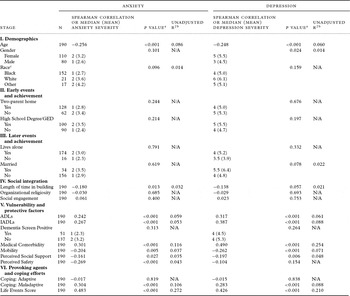
The correlation between anxiety and depression symptom severity was 0.61 (p < 0.001). There were many anxiety and depression symptom severity correlates spanning the six stages of the theoretical framework. Continuous variables that were significantly associated with either anxiety or depression symptoms had correlation coefficients between 0.16 and 0.49 (Table 1). The first four stages yielded few correlates, most of which had relatively weak associations. Table 1 also provides information from unadjusted linear regression for variables with a p-value of 0.10 or less, and variables in the first four stages accounted for 1% to 9% of anxiety and depression symptom variability. Stage 5, the vulnerability and protective factors stage, yielded the most correlates, some of which were highly associated with anxiety and depression symptom severity. In particular, ADLs, IADLs, and medical comorbidity were among the strongest correlates and accounted for between 5% and 12% of anxiety variability and between 6% and 25% of depression variability. Medical comorbidity, however, was more closely associated with depression (r = 0.49) than with anxiety (r = 0.30) symptoms. In Stage 6, the coping strategies and recent life events stage, maladaptive coping mechanisms and more severe life events were associated with symptom severity of both anxiety and depression. The negative subjective impact of recent life events accounted for 27% of anxiety symptom variability and 21% of depression symptom variability.
Anxiety and depression symptom severity correlates within the framework of the Social Antecedent Model of Psychopathology

Notes: N/A = not applicable; ADL = activities of daily living; IADL = instrumental activities of daily living.
a p values determined by Mann-Whitney or Kruskal-Wallis Tests for variables with median values and the Spearman correlation coefficient for continuous variables.
b Only variables with a p-values < 0.10 (based on bivariate analyses) were included in these unadjusted linear regression models.
c Race considered as either black or non-black in the unadjusted linear regression models.
Anxiety and depression symptom severity multivariate regression analyses
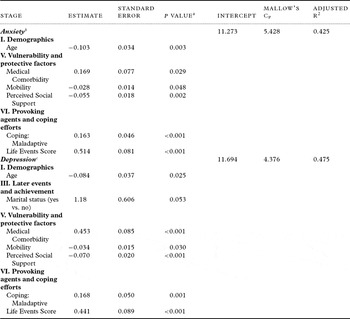
The anxiety symptom severity linear regression model using stepwise selection resulted in a pattern of correlates that was similar to that found in the depression symptom severity linear regression model (Table 2). In both models younger age, more medical illnesses, less mobility, less social support, more reliance on maladaptive coping mechanisms, and more severe recent life events were associated with worse symptom severity. The multivariate linear regression models accounted for 43% of late-life anxiety symptom variability and 48% of late-life depression symptom variability.
Anxiety and depression symptom severity multivariate linear regression models with stepwise selection

Notes: Only variables with a p-values < 0.10 (based on bivariate analyses) were included in the linear regression model that applied a stepwise selection method (entry and stay p-value of 0.10); n = 190.
a p values were based on the full multivariate model and were generated using t values with 1 degree of freedom.
b The anxiety linear regression model fit statistics for each step are as follows (R2, Mallow's Cp): Step 1 (Life Events Score added): 0.272, 43.608; Step 2 (Coping: Maladaptive added): 0.317, 31.576; Step 3 (Medical Cormorbidity added): 0.360, 19.889; Step 4 (Perceived Social Support added): 0.391, 12.086; Step 5 (Age added): 0.412, 7.372; Step 6 (Mobility added): 0.425, 5.428. Intercept estimate (standard error) is 11.273 (3.071).
c The depression linear regression model fit statistics for each step are as follows (R2, Mallow's Cp): Step 1 (Medical Comorbidity added): 0.254, 67.425; Step 2 (Life Events Score added): 0.367, 33.088; Step 3 (Coping: Maladaptive added): 0.404, 20.299; Step 4 (Perceived Social Support added): 0.441, 9.825; Step 5 (Marital Status added): 0.452, 8.095; Step 6 (Age added): 0.461, 7.079; Step 7 (Mobility added): 0.475, 4.376. Intercept estimate (standard error) is 11.694 (3.371).
Discussion
Older adults living in public housing suffer from complex socioeconomic disadvantages that may place them at risk for late-life mental illness. The study participants examined here often had limited educational attainment and high levels of medical comorbidity and functional impairment, characteristics that may increase the residents’ risk for both late-life anxiety and depression (Vink et al., Reference Vink, Aartsen and Schoevers2008). Congruent with the complex context of mental illness in public housing, the correlates of anxiety symptom severity and depression symptom severity spanned the Social Antecedent Model's six stages and overlapped considerably. In support of our theoretical framework, Stages 5 and 6 contained the variables that correlated most strongly with anxiety and depression severity. Our findings expand upon previous work that showed that late-life major depression was associated with younger age (Stage 1), more physical health diagnoses (Stage 5), and more social distress (Stage 5) in a black population (Robison et al., Reference Robison2009). In our multiple linear regression models, correlates included age (Stage 1), medical comorbidity (Stage 5), mobility (Stage 5), social support (Stage 5), maladaptive coping (Stage 6), and recent life events severity (Stage 6).
Overall, the regression models applying this framework accounted for nearly half of the observed variability in symptom severity of anxiety as well as depression. These levels are comparable to the performance of the Social Antecedent Model in another study examining major depression variability among older public housing residents (Robison et al., Reference Robison2009). In contrast, in a study that did not include medical illness or functional impairment, the Social Antecedent Model framework accounted for only 19% to 21% of late-life depression variance (Magai et al., Reference Magai, Kerns, Consedine and Fyffe2003). The exclusion of these health indicators may have partially contributed to the relatively worse performance of the Social Antecedent Model as medical illness and functional impairments can be important predictors of late-life depression (Vink et al., Reference Vink, Aartsen and Schoevers2008). After removing ADLs, IADLs, and medical comorbidities from our regression analyses, however, our models were still able to account for 41% of the variability in anxiety symptoms and 39% of the variability in depression symptoms (analyses not shown). This finding suggests that the demographic and socioeconomic circumstances are highly relevant for understanding both anxiety and depression symptom severity in older adults living in public housing.
There are subtle differences between the correlates of anxiety symptom severity and depression symptom severity among public housing residents. Our findings indicate that – more so than with anxiety symptoms – IADLs and medical comorbidity explained a larger amount of depression symptom severity variability. This stronger relationship between late-life depression symptoms and functional impairment and medical comorbidity is largely consistent with a review suggesting that, relative to late-life anxiety, depression is more likely if an older adult has functional limitations, chronic illnesses, and cognitive impairment (Vink et al., Reference Vink, Aartsen and Schoevers2008).
The similarity of the correlates of anxiety symptom severity and depression symptom severity in older adult public housing residents has important implications. First, in addition to the typical functional impairment indices (e.g. ADLs, IADLs), researchers should also consider examining mobility, social support, and coping skills in studies of late-life anxiety and depression in socioeconomically disadvantaged older adults. In medically and socially stressed older adults, our study suggests that these less medically focused measures can help capture much of the observed variability in anxiety and depression symptom severity. Second, our results indicate that physical illness, poor coping skills, and low social support are associated with worse symptom severity for both anxiety and depression; all of these have been previously linked with anxiety and depression (Vink et al., Reference Vink, Aartsen and Schoevers2008). Since the correlates of anxiety symptoms overlap so highly with those of depression symptoms, it follows that interventions in this setting targeting anxiety may also address depression (and vice versa). For example, there are many social support interventions that have been examined (Cattan et al., Reference Cattan, White, Bond and Learmouth2005), and conducting such an intervention (e.g. connecting residents with a volunteer program) may have the potential to improve both anxiety and depression in older adult public housing residents.
The study has some limitations. First, the sample was from a single geographical location and attracted a better response from non-Hispanics and younger residents, which may limit its generalizability. Study participation was relatively strong among non-Hispanic and blacks, however, which is relevant because only 19% of public housing residents nationally are Hispanic while 47% are non-Hispanic black (Burke, Reference Burke1998). Second, this study is cross-sectional, which precludes our ability to characterize cause-and-effect relationships between symptoms of late-life mental illness and sample characteristics. Many of the correlates revealed in our study, however, have been previously identified as risk factors in longitudinal studies (Vink et al., Reference Vink, Aartsen and Schoevers2008) and are stable over time, which lends support to the view that these correlates may contribute to late-life anxiety symptoms and depression symptoms in the public housing setting. Third, our analyses focused on anxiety and depression symptoms rather than disorders per se, and so the correlates we observed may not apply to affective and anxiety disorder diagnoses. Nonetheless, there is an increasing emphasis on dimensional (e.g. symptom severity) measures of psychopathology because they can better represent the spectrum of illness and improve the ability of researchers to examine associated characteristics (Kraemer, Reference Kraemer2007). Fourth, non-response was estimated to be about 40% and we had limited information on study non-responders, which weakened our ability to characterize them and examine potential response bias. Fifth, although there are strict income requirements for public housing residents, we did not assess the financial security of study participants and are therefore unable to examine the association of perceived financial strain with anxiety and depression symptom severity. Sixth, our analyses did not distinguish between participants with and without cognitive impairment, which could influence the association of participant characteristics with anxiety and depression symptom severity. Residents with moderate-to-severe cognitive impairment, however, were unlikely to have participated in this study because: (1) participants had to have the capacity to provide informed consent, (2) we did not use proxy informants, and (3) the public housing residents had to be able to live independently. When excluding residents with cognitive impairment, the bivariate point estimates were largely similar (data not shown). Lastly, we did not adjust for multiple comparisons in our analyses, which increases the possibility of Type I error. However, adjusting for multiple comparisons can be overly conservative (e.g. increase Type II error risk) (Perneger, Reference Perneger1998), so our covariates were selected based on a priori evidence, and our findings were generally consistent with previous studies.
To our knowledge, this is the first time that late-life anxiety and depression symptom severity in public housing residents have been examined concurrently within a theoretical framework. In this setting, late-life anxiety and depression symptom severity were moderately correlated, with both sharing correlates in the demographic, social, medical, and behavioral domains. The extent to which correlates of late-life anxiety and depression symptom severity overlapped in these residents suggests that interventions targeting either anxiety or depression in the public housing high-rises (and possibly other congregate living facilities for low-income older adults) could benefit both. The broad distribution of correlates also suggests that multidisciplinary collaborative care approaches may be needed for addressing late-life anxiety and depression in these residents. For example, linking more closely the in-home and social services with the primary care and behavioral health networks (e.g. 19% of participants received home health aide, visiting nursing, meal delivery, or homemaker services, and 43% of participants recently received assistance from the onsite social workers) may help alleviate anxiety and depression in this population. Such integration of service providers seems necessary as the context of mental illness in public housing appears to be complex and not limited to a single services domain.
Conflict of Interest
None.
Description of authors’ roles
A. Simning collected the data, conducted the data analyses, and wrote the paper. Y. Conwell, T.M. Richardson, S.G. Fisher, and E. van Wijngaarden contributed to the design of the study, helped guide data analyses, and assisted with writing the paper.
Acknowledgments
The authors thank the staff of the Rochester Housing Authority and Eldersource for making this work possible. Adam Simning is a trainee in University of Rochester's Medical Scientist Training Program funded by the National Institutes of Health (NIH) T32 GM007356 grant, and this research was supported in part by grants from the Agency for Healthcare Research and Quality (AHRQ) (R36 HS018246), National Institute for Mental Health (NIMH) (R24 MH071604), and the National Center for Research Resources (NCRR) (TL1 RR024135), a component of the NIH, and NIH Roadmap for Medical Research. The content is solely the responsibility of the authors and does not necessarily reflect the official views of the AHRQ, NIMH, NCRR, or NIH.