


Introduction
Anxiety disorders are among the most common psychiatric disorders in childhood with estimated prevalence rates between 4% and 19% (Graczyk and Connolly, Reference Graczyk, Connolly, Gullotta and Blau2008). These disorders have a negative impact on several areas of functioning, including occupational and social functioning (Massion, Warshaw and Keller, Reference Massion, Warshaw and Keller1993; Wells et al., Reference Wells, Browne, Scott, McGee, Baxter and Kokaua2006). Further, child anxiety is typically chronic in nature and precedes the onset of other psychiatric disorders including depression and substance abuse (Keller et al., Reference Keller, Lavori, Wunder, Beardslee, Schwartz and Roth1992; Massion et al., Reference Massion, Warshaw and Keller1993). Due to the levels of distress, chronic nature, and interference in functioning related to child anxiety, continued research is needed to understand the underlying processes associated with the development and maintenance of these disorders.
Research suggests that anxiety disorders tend to run in families (Ballash, Leyfer, Buckley and Woodruff-Borden, Reference Ballash, Leyfer, Buckley and Woodruff-Borden2006; Turner, Beidel and Costello, Reference Turner, Beidel and Costello1987), and several lines of research have been conducted to examine mechanisms of transmission of anxiety from parent to child. One line of research has focused on the role of parent cognitive bias, including anxious beliefs and expectations, in the development and maintenance of child anxiety disorders. For example, it has been hypothesized that parents of anxious children, and parents who are themselves anxious, may be more likely to overestimate potential harm, danger, or threats to their children. This bias may be transmitted from parent to child through behaviors such as overprotection, modeling of anxiety, and reinforcement of anxiety (Field and Cartwright-Hatton, Reference Field and Cartwright-Hatton2008; Mineka and Zinbarg, Reference Mineka and Zinbarg2006; van der Bruggen, Stams and Bögels, Reference van der Bruggen, Stams and Bögels2008).
A majority of the research on anxious parent cognitions and the impact on child anxiety has focused on parental interpretation of ambiguous situations and/or expectations regarding the child's responses to anxiety provoking stimuli. These studies are often based on a research paradigm developed by Barrett, Rapee, Dadds and Ryan (Reference Barrett, Rapee, Dadds and Ryan1996). Specifically, Barrett and colleagues asked anxious children to interpret and propose a solution to hypothetical social situations both before and after family discussion about the situation. When compared to non-anxious children, anxious children were more likely to select an anxious/avoidant solution following the family discussions, suggesting that parental threat interpretation may influence child interpretation and subsequent anxious/avoidant behavior.
Other studies focusing on parental expectations have found similar results. In particular, both parent and child anxiety have been found to be significantly associated with parent threat expectations regarding potential child avoidant behavior (Cobham, Dadds and Spence, Reference Cobham, Dadds and Spence1999; Creswell, Schniering and Rapee, Reference Creswell, Schniering and Rapee2005; Wheatcroft and Creswell, Reference Wheatcroft and Creswell2007). Further, maternal and child threat expectations have been found to be significantly associated, suggesting transmission of anxious cognitions from parent to child (Creswell and O'Connor, Reference Creswell and O'Connor2006; Creswell et al., Reference Creswell, Schniering and Rapee2005). Using longitudinal methodology, Creswell, O'Connor and Brewin (Reference Creswell, O'Connor and Brewin2006) assessed both mother and child interpretations of ambiguous situations, and the authors found that negative parent expectations regarding distress and avoidance were associated with increases in children's anxious cognitions over time. Further, experimental manipulation of anxiety has been found to produce similar biases in evaluation of ambiguous scenarios. In particular, Gallagher and Cartwright-Hatton (Reference Gallagher and Cartwright-Hatton2008) found that experimentally induced anxiety was associated with more threat interpretation and avoidant expectations when compared to a non-anxious condition. Using a slightly different paradigm, Lester, Field, Oliver and Cartwright-Hatton (Reference Lester, Field, Oliver and Cartwright-Hatton2009) examined bias in the interpretation of ambiguous sentences. In particular, parents were found to exhibit similar interpretative biases in situations involving themselves and their children. Further, parent anxiety was associated with more negative interpretative biases.
Collectively, the above studies suggest that anxious parent cognitive biases may be an important factor in the transmission of anxiety from parent to child, as anxious parents may be more likely to perceive or overestimate potential harm, danger, or threats to their children. Although this is a promising area of research, relatively few studies have focused on the actual parent cognitions that might drive their behavior. Further, most of the research discussed above focused on threat interpretation and parental expectations related to specific scenarios; however, little is known about other relevant cognitive variables that may relate to child anxiety. Consequently, more research is needed to elucidate parental cognitions that may be associated with parenting behavior and child anxiety.
One possible category of anxious parent cognitions that has yet to be systematically examined in the anxiety disorder literature is parents’ worry about their children. To illustrate the potential relevance of this construct, first it is noteworthy that worry is typically future-oriented and involves anticipation of possible negative outcome. In relation to their children, anxious parents may have a tendency to exhibit worry about potential negative outcome or harm in relation to their children, and consequently it is possible that parent worry may be a form of threat interpretation. A degree of parent worry is clearly normative; it is reasonable for parents to experience a degree of worry about their children. However, as with other anxious cognitions, it is possible that the parents of anxious children exhibit more frequent and more intense parent worry relative to non-anxious parents. Further, as with other forms of anxious cognitive bias, excessive worry may influence levels of child anxiety. For example, worries may be transmitted either directly or indirectly from parent to child. In addition, it is possible that parent worry may lead to overprotective behaviors. Wilson et al. (Reference Wilson, Budd, Chernin, King, Leddy and Maclennan2011) found an association between parent worry, as measured by the Penn State Worry Questionnaire, and adolescent worry. Although this study provides evidence for the association between parent and child worry, this study did not measure the degree to which parents worry about their children. To date, it appears that only one study has focused on parent worry in relation to their children. Specifically, DeVet and Ireys (Reference DeVet and Ireys1998) developed the Maternal Worry Scale (MWS); this measure was found to be associated with parental anxiety and depression along with child internalizing and externalizing behavior problems in a sample of children with chronic illness. This study provides initial support for the relation between parent worry and both child and parent adjustment. Overall, examination of parent worry may be a viable direction for research on anxious parent cognitions and has the potential to elucidate the processes of transmission of anxiety from parent to child. In particular, focus on parent worry has the unique potential to provide insight into the potential negative outcomes perceived by parents that may impact parent-child interactions.
The focus of this study was to examine parent worry as a construct and a potential category of anxious parental cognitions. For the purpose of the current study, we operationalize parent worry by focusing on content (i.e. the topics parents typically worry about in relation to their children) and on frequency (i.e. how often they experience these worries). In particular, the primary goal was to develop a comprehensive measure of parent worry, in terms of content and frequency, and through the use of exploratory factor analysis, categorize these worries. The second goal was to determine the degree to which parent worry is associated with both parent and child anxiety and to determine the degree to which parent worry mediates the association between parent and child anxiety. In particular, it was expected that elevated levels of parent worry are associated with higher levels of parent and child anxiety. Finally, a third goal of this study was to assess typical or normative parent worries, as parental worry as a normative and adaptive process has yet to be examined.
Method
Participants
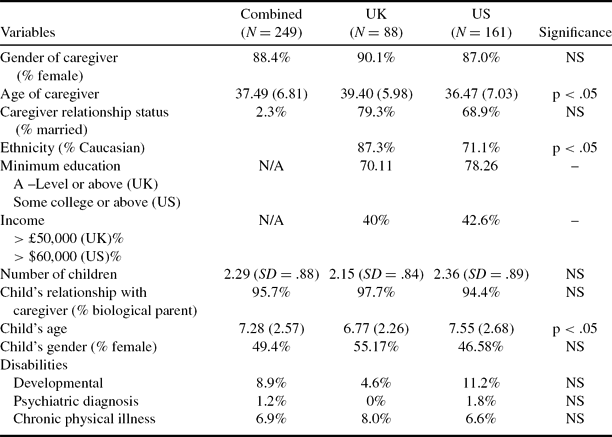
Participants were 249 parents or caregivers of children between the ages of 3 and 12 (88.4% female) who volunteered to participate in the study. The mean participant age was 37.49 years (SD = 6.81), and the sample consisted of 161 participants from the United States and 88 participants from the United Kingdom. A majority of the participants were the biological mothers of the target child (83.4%). A more detailed summary of the demographic variables combined and by nationality are provided in Table 1. It is noteworthy that the samples were found to be similar on most demographic variables. However, a few significant differences were found, as parents and children in the UK sample were significantly older and a higher percentage of the UK sample was Caucasian. Further, it is noteworthy that direct comparisons were not feasible for income and level of education of the caregiver because different scales of measurement were used. Regarding the demographic variables for the children who were the focus of parent/caregiver report, the mean age of the child was 7.28 (SD = 2.57), 49.4% of the children were female, and a majority were biological children (95.6%). Overall, the samples appeared to be similar in terms of demographics.
Demographic variables by nationality
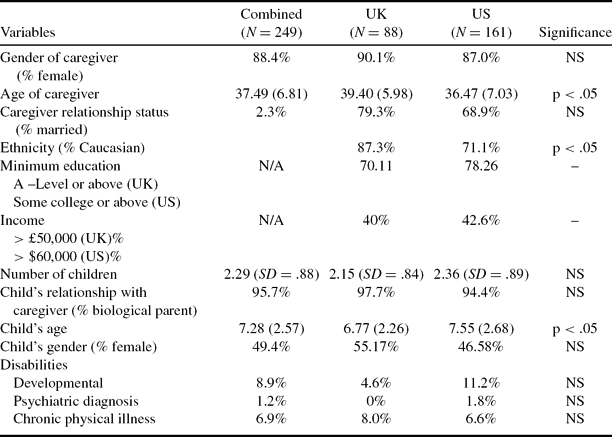
Notes: For comparisons across US and UK samples chi-square analyses were used for categorical variables and t-tests were used for continuous variables. Because different scales were used in the US and UK samples education level and income, significance tests were not conducted.
Measures
In addition to a demographics form, the following measures were completed by parents:
The Parent Worry Measure. The Parent Worry Measure (PWM) is a 34-item measure developed for the purpose of this study to assess the content of parent worries in relation to their children and the frequency in which parents experience these worries. In the context of the worry literature, this operationalization of worry is most consistent with the concept of Type I worry (Wells, Reference Wells1995) and the measurement of domains of worry (see Tallis, Eyesneck and Mathews, Reference Tallis, Eysenck and Mathews1992).
Thirty-three of the items were on a 5-point Likert scale, and were designed to assess the degree to which parents experience specific worries about their children. Response options ranged from 0 (never/almost never) to 4 (always/almost always). Items covered a wide range of potential worries, including worries about physical harm (e.g. “I worry that my child might get hurt on roads or in a traffic accident”), social adjustment (e.g. “I worry that my child will be disliked or rejected by others”), and academic adjustment (e.g. “I worry about my child's ability to learn and succeed in school.”) The final question was an open-ended question in which parents were asked to list the things they worry about the most in regards to their child. They were provided with five numbered lines in which to provide responses.
Item development. Regarding procedures for the development of the Likert scale items of the PWM, the goal was to develop a measure that incorporates a comprehensive list of potential worries that parents may experience in relation to their children. A literature search was first conducted to locate measures relevant to the construct of parent worry, and relevant items were incorporated into the PWM. Next, additional items were generated based on potential worries not covered in previously developed measures.
Based on the literature review, the following measures were obtained and reviewed:
Anxious Rearing Subscale of the EMBU (ARS; Muris, Meesters and von Brakel, Reference Muris, Meesters and von Brakel2003); Child Health Questionnaire-50 (CHQ-50; Landgraf, Abetz and Ware, Reference Landgraf, Abetz and Ware1996; Lipani and Walker, Reference Lipani and Walker2006); Maternal Worry Scale for Children with Chronic Illness (MWS; DeVet and Ireys, Reference DeVet and Ireys1998); and the Parent Experience of Child Illness (PECI; Bonner et al., Reference Bonner, Hardy, Guill, McLaughlin, Schweitzer and Carter2006). A total of 7 items on the PWM were reworded directly from the existing measures, including 2 items from the ARS, CHQ-50, and PECI, and 1 item from the MWS. Next, additional items were generated from relevant themes found in the content of the existing measures (e.g. concerns about the child's health, making friends, future). Finally, the authors generated additional items not covered by previously developed measures, and in generating these items, the authors drew upon their clinical experience in working with parents of anxious children.
Depression, Anxiety, and Stress Scale-21. The 21-item version of The Depression, Anxiety and Stress Scale (DASS) was administered. The DASS is a relatively brief measure of both depression and anxiety symptoms (Brown, Chorpita, Korotitsch and Barlow, Reference Brown, Chorpita, Korotitsch and Barlow1997). The subscales of the DASS (Depression, Anxiety and Stress) were developed based on a data-driven approach and are designed to provide discrimination between depression and anxiety (Brown et al., Reference Brown, Chorpita, Korotitsch and Barlow1997). It is noteworthy that the Anxiety and Stress scales both appear to assess dimensions of anxiety. More specifically, the Anxiety scale assesses symptoms consistent with physiological arousal and fearfulness, and the Stress scale assesses symptoms related to chronic tension, irritability, and feeling “on edge” (i.e. symptoms related to Generalized Anxiety Disorder).
The items of the DASS are measured on a 4-point Likert scale ranging from 0 “did not apply to me at all” to 3 “applied to me very much or most of the time”. Good construct validity has been demonstrated, as the Anxiety and Stress subscales have both been found to correlate significantly with the Beck Anxiety Inventory, and the DASS Depression scale has been found to correlate significantly with the Beck Depression Inventory (Lovibond and Lovibond, Reference Lovibond and Lovibond1995). Page, Hooke and Morrison (Reference Page, Hooke and Morrison2007) demonstrated that total scores on the DASS exhibits excellent internal consistency for the total scale (α = .97), and each of the subscales also exhibit excellent internal consistency (Depression = .96; Anxiety = .92; Stress = .95). A composite measure of anxiety, based on the Anxiety and Stress scales, was used in some of the statistical analyses discussed below, and the Cronbach's alpha for this variable was .89.
Spence Children's Anxiety Scale-Parent Version. The Spence Children's Anxiety Scale-Parent Version (SCAS) is a parent-report measure of child anxiety (Nauta et al., Reference Nauta, Scholing, Rapee, Abbott, Spence and Waters2004). This 38-item measure consists of response items on a 4-point Likert scale, ranging from 0 “never” to 3 “always”. In addition to a total score on the SCAS, the measure also includes the following subscales: separation anxiety, social phobia, generalized anxiety, panic/agoraphobia, physical injury fears, and obsessive compulsive disorder. The validity of the SCAS total scale is supported, including significant correlations with scores on the Child Behavior Checklist (CBCL) internalizing subscale. Further, the SCAS has good internal consistency, with a Cronbach's alpha of .89 for the total scale. Additionally, the Cronbach's alphas for the subscales have been found to range from .81 to .58 (Nauta et al., Reference Nauta, Scholing, Rapee, Abbott, Spence and Waters2004). Data for the SCAS was not included for children under the age of 6, as this measure has been developed for children aged 6 and older.
Design and procedures
Survey packets were distributed to the parents at local elementary and preschools. Parents were asked to complete the surveys along with informed consent forms and return these forms to the school in sealed envelopes to be picked up by a member of the research team. Parents also had the option of mailing the packets directly to the researchers. The surveys were estimated to take approximately 20–25 minutes to complete. It is noteworthy that surveys were completed without incentive, and although specific data are not available, the estimated response rate was approximately 15%. The study was approved by both British and American ethics boards/institutional review boards.
Results
Factor structure of the PWM
The PWM was subjected to an exploratory factor analysis via a principal axis analysis extraction method. An obtained value of .91 on the Kaiser-Meyer-Olkin measure of sampling accuracy (KMO) suggested that the correlation matrix was adequate for factor analysis. Examination of the scree plot and eigenvalues suggested a robust, single factor solution. The eigenvalue for this factor was 12.01, accounting for 36.48% of item variance. All items loaded significantly on this factor, with a range from .38 to .69. The scale exhibited strong reliability with a Cronbach's alpha of .95. Item-total correlations ranged from .42 to .68, and the deletion of items with the lowest item-total correlation values had minimal impact on overall reliability.
Descriptive statistics of study variables
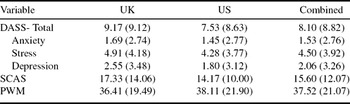
Descriptive statistics for the primary study variables, including the PWM, SCAS and DASS, are provided in Tables 2 and 3. In order to assess potential cross-cultural differences, the mean comparisons were conducted between the UK and US samples on the relevant study variables (see Table 2). In particular, one-way ANCOVAs were conducted, to determine whether the samples differ on parent internalizing symptoms, parent worry about their children, and child anxiety. Covariates included demographic variables that differed significantly between the UK and US samples (i.e. caregiver age, child's age, and ethnicity). No significant differences were found between the samples on relevant study variables: DASS (F (4, 226) = 1.24, p = ns); PWM (F (4, 227) = .731, p = ns); and SCAS (F (4, 177) = 1.93, p = ns).
Means and standard deviations of study variables

Notes: Values are sample means with standard deviations in parentheses. DASS = Depression, Anxiety, and Stress Scale, SCAS = Spence Children's Anxiety Scale-Parent version, PWM = Parent Worry Measure.
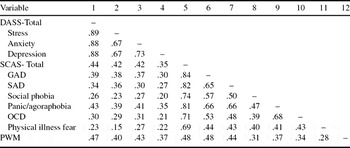
Correlation matrix of study variables

Notes: DASS = Depression Anxiety Stress Scales; SCAS = Spence Children's Anxiety Scale; PWM = Parent Worry Measure. All correlation values are significant at the .05 level unless otherwise noted. All correlations are significant at the .05 level.
Relation between parent worry and anxiety symptoms
A hierarchical regression analysis was conducted to determine the degree to which PWM scores predicted child anxiety beyond the variance accounted for by levels of parent symptoms of anxiety, stress, and depression. In the first step of the regression equation, the DASS was entered as the predictor variable, and the SCAS was the criterion variable. Inspection of the data suggested no robust violations of the assumptions of multiple regression. Tolerance (range.35 to .80) and variance inflation factor values (range 1.26 to 2.96) suggested that collinearity was in the acceptable range.
The first step of the model was significant, R = .20, F (1, 171) = 14.53, p < .001, and the addition of the PWM in the second step of the regression equation led to a significant improvement in the model, ∆R2 = .10, F (1, 170) = 23.82, p < .001. The final model was significant, R2 = .30, F (4, 170) = 18.31, p < .001, predicting 30% of the variance in child anxiety scores. Further, it is noteworthy that, based on an examination of the standardized beta weights, the PWM (β = .35) was a more robust predictor of child anxiety than the Anxiety, Stress, and Depression subscales of the DASS (β = .12, .20, and −.01, respectively).
Next, a meditational analysis was conducted, based on Holmbeck's (Reference Holmbeck2002) model for post hoc probing of mediation effects, to determine whether parent worry mediates the association between parent and child anxiety. The Anxiety and Stress subscales of the DASS were combined as a composite measure of parent anxiety, and SCAS-Total scores used to operationalize child anxiety. The model was significant, z = 4.11, p < .001, and the meditational pathway accounted for 34% of the variance in association between the parent and child anxiety (see Figure 1).
Meditational model of parent anxiety symptoms, parent worry about their children, and child anxiety.

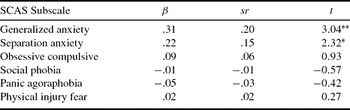
A follow-up exploratory analysis was conducted to determine the degree to which categories of child anxiety, as measured by the subscales of the SCAS, shared unique variance with the PWM. In particular, the subscales of the SCAS were regressed on the PWM. The overall model was significant, R = .20, F (6, 174) = 10.56, p < .001; however, only the GAD and SAD subscales shared unique variance with the PWM (see Table 4).
Standardized beta weights and semipartial correlation coefficient values for SCAS scores regressed on the Parent Worry Measure

Notes: *p< .01, *p< .05.
Open ended responses
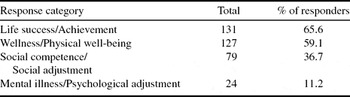
Open-ended responses were examined to provide additional insight into the nature of parent worry. In particular, the open-ended question provided an opportunity for the parents to generate a list of most salient worries in relation to their children. The open-ended responses were examined for general themes and, based on consensus amongst the authors, four general themes or categories were operationalized: Life success/Achievement; Wellness/Physical well-being; Social competence/Social adjustment; and Mental illness/Psychological adjustment. The categories and operational definitions were reviewed with two trained undergraduate research assistants, and the assistants subsequently coded participant responses (see Table 5). Adequate inter-rater reliability was found for each category, with the following obtained kappa values: Life success/Achievement, .88, for Wellness/Physical well-being .90, for Social competence/Social adjustment, .73, and for Mental illness/Psychological adjustment, .78. Discrepancies were resolved based on consensus between author and the research assistants.
Response based on open-ended worry question

Notes: Response rate for this item was 86.3% (N = 215). Value under Total is based on the percentage of participants who provide at least one response that fell within the designated category.
The mean number of responses was 2.55 (SD = 1.74), and the number of responses ranged from 0–6. A total of 215 (86.3%) of participants responded to the open-ended question. The two most common categories of worry included Life success/Achievement and Wellness/Physical well-being. In particular, of the responders to the open-ended question, 65.6% reported concerns about Life success and Achievement. Common responses in this category related to career success, school academic success, and concerns about engaging in negative behaviors (e.g. getting into crime, drugs). Worries about Wellness/Physical well-being were reported by 59.1% of the participants. Common concerns included being harmed by others, physical illness, general physical health, safety and accidents, and weight and appearance.
Although less commonly reported, a number of parents reported worries in relation to Social competence/Social adjustment. In particular, 36.7% of responders reported concerns in this area. Commonly reported concerns included having or making friends, being teased or rejected by peers, having adequate social skills, and excessive shyness. Finally, the category endorsed with the lowest frequency was Mental illness/Psychological adjustment, which was endorsed by 11.2% of responders. This category included concerns that the child would experience positive emotional development and concerns that the child would develop mental illness.
Following categorization of the open-ended responses and a review of descriptive data, a series of chi-square analyses were conducted to determine whether parents who report higher levels of anxiety were more likely to list particular categories of worry in the open-ended response section. Anxiety composite scores from the DASS were dichotomized based on a median split. Four dichotomous variables were created for each of the above worry categories, and separate chi-square analyses were conducted for each of the above categories.
Parents scoring higher in anxiety were more likely to endorse worries related to Social competence/Social adjustment, χ2 (1) = 5.69, p < .05, when compared to lower anxiety parents (high anxiety 39.0%, low anxiety 24.6%). Further, parents with higher levels of anxiety were more likely to endorse worry related to Life success/Achievement, χ2 (1) = 4.76, p < .05 (high anxiety 60.0%, low anxiety 45.8%). However, there were no differences in the endorsement of worries related to Physical wellness/Physical well-being, χ2 (1) = 0.88, p = .35 (high anxiety 54.0%, low anxiety 47.9%) and related to Mental illness/Psychological adjustment, χ2 (1) = 2.61, p = .11 (high anxiety 16.0%, low anxiety 9.2%).
Discussion
Previous studies have indicated that anxious cognitions in parents may be transmitted to their children. Research in this area has primarily focused on parental interpretation of ambiguous situations and expectations about the child's responses to anxiety provoking stimuli (Barrett et al., Reference Barrett, Rapee, Dadds and Ryan1996; Lester et al., Reference Lester, Field, Oliver and Cartwright-Hatton2009; Wheatcroft and Creswell, Reference Wheatcroft and Creswell2007). The current study adds to the literature by taking a novel approach in the examination of anxious parent cognitions by focusing on parent worry about their children rather than on the interpretation of ambiguous situations. One goal of this study was to categorize parent worry about their children through the use of exploratory factor analysis. A second goal was to examine the degree to which parent worry about their children relates to both parent and child anxiety symptoms. Finally, assuming a degree of parent worry about their children is a normative experience, an additional purpose of this study was to examine the content of typical parent worries.
When subjected to exploratory factor analysis, the 33 Likert scale items of the PWM loaded on a single factor, suggesting that parent worry about their children is a single, global construct. This finding indicates that parent worry about their children is a matter of frequency or degree and is not specific to particular domains or content areas. For example, it appears that parents who exhibit high levels of worry in relation to physical safety will also tend to worry about other domains, including social adjustment and life success. Although these results provide initial insight into parent worry about their children as a single-factor construct, follow-up research is needed to replicate these findings. Further, it is noteworthy that the Likert scale used in the current study focused on worry frequency and not distress or intensity. Consequently, it may be beneficial for follow-up studies to also consider level of distress related to parent worry. More specifically, it may be beneficial to include a second Likert scale on the PWM that assesses level of distress.
As hypothesized, the PWM was found to be a significantly associated with parent and child anxiety. It is particularly noteworthy that parent worry about their children was found to be a more robust predictor of child anxiety than parent anxiety symptoms. This finding is particularly relevant as parent anxiety symptoms have consistently been found to be a risk factor for the development of child anxiety. Further, the PWM was found to be a significant, partial mediator of the association between parent and child anxiety, accounting for 39% of the variance. Overall, these findings suggest that parent worry may be a potential pathway in the transmission of anxiety from parent to child, and because parent worry about their relation to their children is a novel construct, this is the first time that this pathway has been examined.
Based on the results of a follow-up regression analysis, the Generalized and Separation Anxiety subscales were the only subscales to share unique variance with the PWM. It is noteworthy that both of these subscales, along with the corresponding disorders in which they represent, include worry. In particular, worry is a central feature of generalized disorder and is also common in children with separation anxiety disorder. Consequently, although preliminary, the current findings suggest that parent worry about their children may be a risk factor specific to child worry, including worry related to Generalized Anxiety and Separation Anxiety.
In general, the current findings provide additional support for the potential role of anxious parental cognitions in the development and maintenance of child anxiety; however, the specific mechanism of transmission remains unclear. Although speculative, it is possible that anxious parent cognitions influence parent behaviors, including overprotective behavior. For example, as with general worry, parent worry about their children may lead to avoidance. More specifically, parents who exhibit high levels of worry about their child may overestimate the potential for danger or harm in relation to their child and, consequently, they may perceive the need to engage in overprotective behaviors to prevent their child from being harmed. In addition, parent worries may be directly communicated to the child. Finally, parent worry about their children may drive parent anxiety in the presence of the child, leading to increased modeling of anxiety. Overall, parent worry about their children and other anxious parent cognitions appear to be associated with child anxiety; however, research is needed to examine the mechanisms of transmission of anxious cognitions from parent to child.
The open ended response item, in which parents were asked to list their most salient worries in regards to their children, provided an opportunity to examine the worries most commonly experienced by parents and the worries that are of greatest concern. Interestingly, life success and physical well-being were the most commonly reported worries, with similar response rates (65% and 59.1% of respondents, respectively). The similarity in response rates suggests that typical worry covers a number of domains, including both physical safety and social standing. It is also noteworthy that, although less frequently reported, other themes included concerns that were reported about social competence and psychological adjustment.
In relation to the open-ended questions, high and low anxiety parents were equally likely to list worries related to wellness/physical well-being and mental illness/psychological adjustment. In contrast, high anxiety parents more frequently listed worries related to social adjustment and life and academic success. It is noteworthy that worries about physical health and mental illness involve concerns about more catastrophic outcomes. For example, parents may worry that the child will develop a severe illness, will be severely injured, or develop a more severe mental illness. In contrast, worries about the child's social life, academic success, and future careers success seem to be less catastrophic in nature. Consequently, it appears that both high and low anxiety parents are equally likely to report worries that involve more catastrophic outcome; however, high anxiety parents are more likely to report worry about less catastrophic concerns that are faced on a daily bases. This may result in more frequent day-to-day communication of worry to the child.
Overall, the above findings may have implications for the treatment and prevention of child anxiety. In particular, considerable discussion can be found in the research literature regarding the degree to which involvement of parents in cognitive-behavioral therapy for child anxiety improves treatment outcome. Interestingly, the added benefit of parent involvement has yielded mixed results (e.g. Khanna and Kendall, Reference Khanna and Kendall2009). Further, uncertainty remains over which parent-based interventions are most effective. It is possible that modification of anxious parent cognitions, including worry and interpretation bias, may be a relevant consideration in the development and refinement of parent-based interventions for children with anxiety disorders; however, at this time, little is known about the effectiveness of parent-based cognitive interventions in the reduction of child anxiety.
Although the findings are promising, a number of limitations and directions for future research are noteworthy. One noteworthy limitation relates to potential self-report bias and bias in the rating of child anxiety. In particular, the study relied on the parent as a single informant. Follow-up studies using additional methodological approaches, including the use of multiple-informants to assess both child and parent anxiety symptoms, is recommended. Further, it may be beneficial for follow-up studies to examine the convergent validity of PWM, including the convergent validity with other measures of anxious parent cognitions. Finally, it is noteworthy that, based on the current methodology, the direction of the relationship between parent worry and child anxiety can not necessarily be established. In particular, although it is possible that parent worry leads to increases in child anxiety, it is also possible that the behavior of anxious children increase levels of parent worry or that a reciprocal relationship exits. Consequently, a direction for future research is to include longitudinal methodology in order to elucidate the direction of this relationship.
Other limitations relate to the nature of the sample. In particular, the results of the current study were based on non-clinical convenience samples, and additional research is needed to determine the degree to which the current findings generalize to clinical samples. A related limitation has to do with possible volunteer bias and a relatively low response rate (approximately 15% of those invited to participate). It is possible that caregivers who opted to respond are not representative of the general population of parents. Consequently, follow-up research with more tangible incentives may reduce potential non-response bias.
Further, more research is needed to examine the psychometric properties of the PWM. As discussed above, the current findings are based on a single exploratory factor analysis of the PWM, and follow-up research is needed to confirm the factor structure. In addition, although the current study provides some initial evidence for incremental validity of the PWM, as the PWM predicted child anxiety after controlling for parent anxiety and depression symptoms, more research on the incremental validity of the PWM is needed. In particular, it is recommended that research is conducted to determine the degree to which parent worry, measured by the PWM, exhibits discriminant validity in relation to more general measures of worry symptoms, such as the Penn State Worry Questionnaire. Also, examination of additional components of parent worry, including perseveration and uncontrollability, is another potential direction for future research.
A number of additional directions for future research are also recommended. In particular, it is possible that norms in relation to parent worry may vary, based on the characteristics of the neighborhoods in which the participants reside. For example, parents in urban versus rural settings may experience different worries. Further, elevated concerns regarding physical safety may emerge in low SES, high crime, and high population density neighborhoods, in which children may actually be at greater risk for harm. Further, as mentioned above, it is recommended that follow-up studies examine both “frequency” and “distress” related to parent worry to determine if these dimensions have additive or interactive effects on child anxiety. It is recommended that future research focused on anxious parent cognitions explore the mechanisms of transmission from parent to child, including the possible mediating role of parenting behaviors such as overprotection and modeling.
Finally, it is noteworthy that the PWM was influenced by a construct referred to as Parent Perceptions of Child Vulnerability, which as been extensively studied in parents of children with chronic illnesses (Green, Reference Green1986; Green and Solnit, Reference Green and Solnit1964; Perrin, West and Culley, Reference Perrin, West and Culley1989). In particular, higher levels of parental perception of vulnerability have consistently been found to be negatively associated with parent and child functioning and have also been found to be associated with problematic behaviors in the parent-child relationship (Allen et al., Reference Allen, Manuel, Legault, Naughton, Pivor and O'Shea2004; Leslie and Boyce, Reference Leslie and Boyce1996; Mullins et al., Reference Mullins, Fuemmeler, Hoff, Chaney, Pelt and Ewing2004; Thomasgard, Reference Thomasgard1998). Of particular relevance, Parent Perceptions of Vulnerability has been found to be associated with parental anxiety (Allen et al., Reference Allen, Manuel, Legault, Naughton, Pivor and O'Shea2004; Leslie and Boyce, Reference Leslie and Boyce1996; Mullins et al., Reference Mullins, Fuemmeler, Hoff, Chaney, Pelt and Ewing2004; Thomasgard, Reference Thomasgard1998). Although it is possible that parents of anxious children possess perceptions of vulnerability similar to the parents of children with chronic illness, this construct has yet to be incorporated into the research on anxiety disorders.
In summary, despite these limitations and directions for future research, this study provides a unique contribution to the research on anxious parent cognitions. The study of parent worry, along with related anxious parent cognitions, may have implications for the development and refinement of child anxiety treatment and prevention programs.
Acknowledgements
Sam Cartwright-Hatton was supported by MRC Clinician Scientist Fellowship G108/604 and a Career Development Award from the National Institute for Health Research during the preparation of this manuscript.
We would like to thank Olivia Hernandez Gonzalez and Alison P. Bryant, research assistants at the University of North Florida, who assisted in the coding of the data.




Comments
No Comments have been published for this article.