1. Introduction
Mixed works are defined as electroacoustic compositions involving a live component with a visible sound source (a performer) and a non-live component projected electronically through loudspeakers. Mixed works are found in a variety of formats, with the live part ranging from solo instrument to full orchestra and with the non-live part ranging from being fixed on tape or CD to being highly interactive and indeterminate.Footnote 1 An attractive quality of mixed works is that they embrace and explore the application of technology to the music-making process while retaining the traditional live element in musical performance. However, a perceptual dissonance often arises between the visual and aural stimuli due to the fact that only one component is seen while many distinct components may be heard. Beyond just an issue of polyphony, disparity often arises between the physical gestures made by the performer and those implied by the music. Such inconsistency draws attention to the relationship between the live and non-live components, and it is arguably for this reason that component relations maintain a heightened level of significance in mixed works. Indeed, the relationship between the live and non-live sources may even play a central role in the compositional plan of a piece, making an understanding of its dynamism necessary for apprehension of the composer’s intentions.
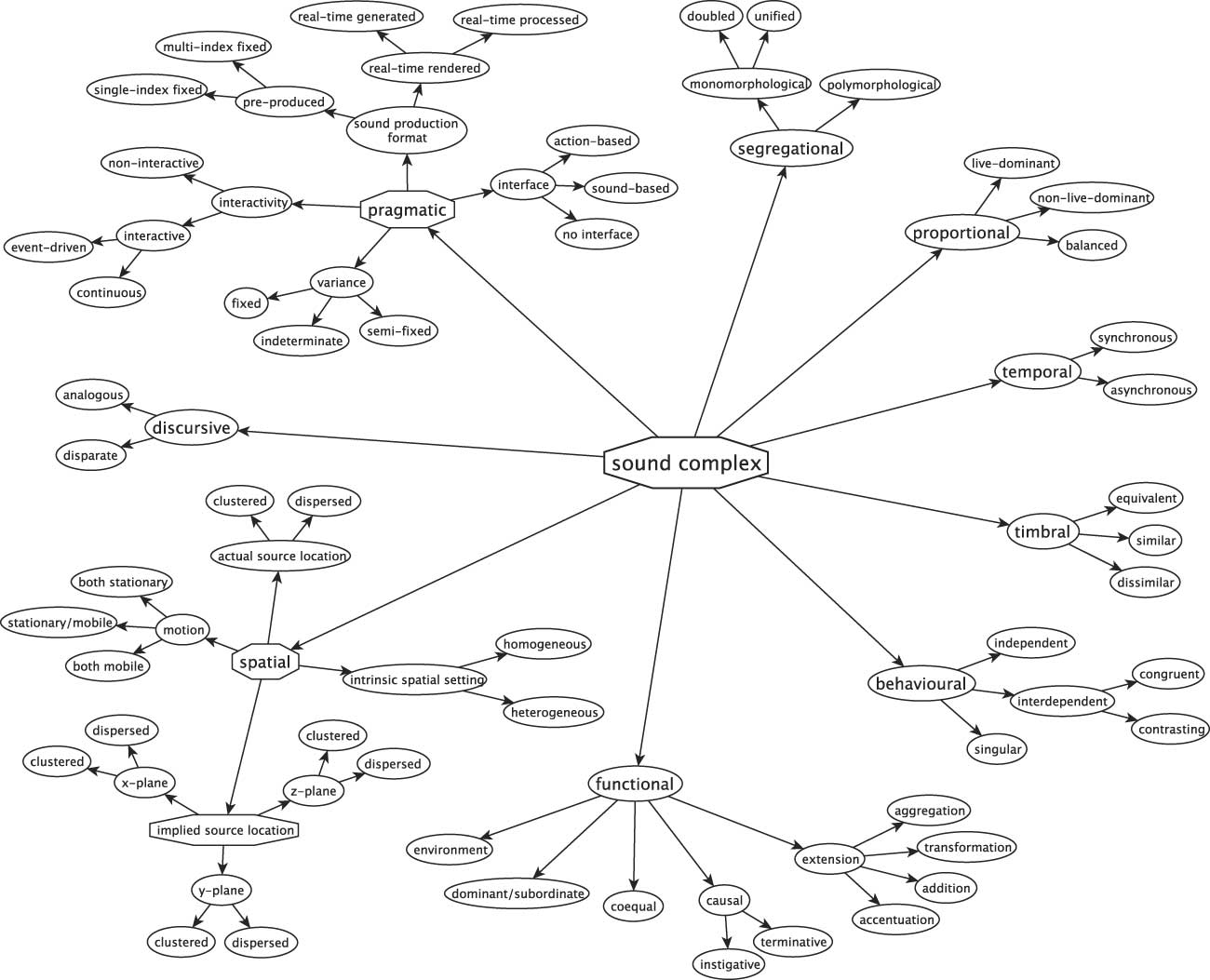
This paper proposes a multidimensional framework of relations between live and non-live component pairs in mixed works. The framework is comprised of nine primary axes that are ubiquitous: segregational, proportional, temporal, timbral, behavioural, functional, spatial, discursive and pragmatic (figure 1). While most axes emerge as single dimension taxonomies, others such as the pragmatic and spatial axes display varying degrees of nested multidimensionality. Furthermore, connections exist between axes at various levels and nodes, illuminating relational possibilities associated with any particular position within the framework.Footnote 2
The nine primary axes of the multidimensional framework.

The scope of the proposed framework is limited to axes that are applicable to all mixed works. Having examined numerous works in the course of this research, my experience has been that the primary axes are sufficient in the majority of cases. However, other less pervasive axes and nodes are conceivable, and when analysing a piece of music it may be sensible to devise a specialised framework that captures the significant compositional dimensions of that particular work. As such, the framework is intended to serve as a model and foundation for analysis of relationships in mixed works, as well as providing composers with pathways of relations available under certain musical conditions.
As much as possible, attempts have been made to limit references to two works, with the hope that such a restraint will enable the reader to easily acquire the pieces and examine the concepts in context. Mario Davidovsky’s Synchronisms No. 6 (1970), for piano and electronics, considered by many to be an exceptional example of the integration of live and non-live sounds, was chosen because of its breadth of relations and because a number of recordings exist and the score is readily available. Denis Smalley’s Clarinet Threads (1985), for clarinet and electronics, was chosen specifically because it challenges some of the ideas presented. At times, references to other works are made in order to illuminate the concepts at hand. The decision to focus on works that mix traditional instruments with fixed electronics is purely practical; their deterministic quality allows particular moments to be identified and discussed. The framework is equally applicable to pieces that incorporate non-traditional instruments, improvisation and/or live electronics.
2. Segregational Axis
Heard together, events emanating from live and non-live sources coalesce into a single waveform or sound complex. The segregational axis relates to a listener’s interpretation of this compound sound as containing one musical identity or multiple components with distinct identities.Footnote 3 The axis divides into two main branches: monomorphological and polymorphological. The ‘morphological’ quality of these terms suggests an event-level analysis that is dynamic, emphasising the fact that relations often shift over time.Footnote 4
Monomorphological components contribute towards a single musical identity. Included are situations where one component doubles another, as is common in traditional monophony with multiple, distinct instruments playing the same melody in unison or octaves. Where non-pitched material is concerned, rhythmic unisons may be sufficient. Doubling preserves the live/non-live dualism while presenting components in a maximal state of congruence. Examples are found in Synchronisms No. 6 at 1′57″–2′01″ and 4′35″–4′37.5″.
The live/non-live dualism can be diminished, or even suspended altogether, with components fusing into a single, perceptually unified stream or event. The listener may not be aware of the presence of multiple components, and such a revelation may only emerge over time, or through analysis of the score or close observation of the live performance. The opening event in Synchronisms No. 6 (0′00″–0′08.5″) provides a lucid example. The piece begins with a single piano note in the live part. As the note decays, a non-live tone fades in seamlessly at the same pitch, effectively elongating the note and ultimately creating the effect of a crescendo – a behaviour that contradicts the physical capabilities of the instrument.
It is worth pointing out that interpretations are bound to context, and segregational relations surrounding the moment in question can influence the distinction between doubled and unified components. For instance, preceding material that consists of distinct identities is more likely to promote a doubled interpretation because it predisposes the listener towards a pluralistic mode of auditioning.
Polymorphological interpretations arise under conditions of plurality, where combined components are heard as having more than one musically significant identity. The live/non-live dualism is strongest here, with components displaying some degree of independence or interdependence. A more detailed description of polymorphological possibilities, along with examples, is presented in subsequent discussion.
While there are obvious ties to the conventional notion of musical texture, with the terms monophonic, homophonic, heterophonic and polyphonic commonly applied, the intention of the segregational axis is not to provide such a high-level description of the musical surface. Both the live and non-live contributions may themselves consist of numerous distinct components that act as separate identities in the overall musical surface. The segregational axis descriptors are applied to live/non-live component pairs, indicating how a specific electronic identity relates to a specific live identity. Accordingly, it is possible to find both monomorphological and polymorphological relations occurring simultaneously. One such example is found in Synchronisms No. 6 at 4′14.5″. Here, the live piano performs a sequence of descending pitches. The electronics are divided into two distinct components, one doubling the live piano in unison while the other provides a distant and distinct textural background.
3. Proportional Axis
The perceptual weighting of live/non-live component pairs is reflected on the proportional axis. Focal attention can be live-dominant, non-live-dominant or balanced. From a purely aural perspective, components might be construed as being equal, but in a live context the dominance given to the visual percept can easily destabilise this equilibrium. Pierre Boulez’s Dialogue de l’ombre double (1985), for clarinet and electronics, exemplifies this point. In this work the performer engages in a ‘dialogue’ with the non-live part, which is essentially comprised of unaltered recordings of a clarinet performing prolonged passages similar to those presented by the live instrument. The two sources rarely sound together, but rather engage in a back-and-forth exchange of materials. Proportionally, the live and non-live components are of equal importance. However, when experiencing the piece in a concert setting one senses a feeling or rest each time the performer drops out and the electronics are sounding alone. Boulez seems to acknowledge this issue by requesting that the stage lights be dimmed whenever the performer is not playing.
4. Temporal Axis
The temporal axis is concerned with the distribution of events in time, and in particular the coordination of onsets between live and non-live components. Special attention is given to onset relations because intentions to synchronise sounds tend to have implications to connections with nodes on other axes in the framework, as well as to the practical implementation of non-live materials. The axis divides into synchronous and asynchronous possibilities.
Perceptually, interpretations are not always in accordance with the classification of events along the temporal axis, but rather may depend on whether component divisions are clearly defined or ambiguous. Ambiguity can arise under monomorphological conditions when components contribute to a unified sound complex. The opening event of Synchronisms No. 6, discussed above, provides an example of this discrepancy between perception and actuality. Because the two sources effectively fuse into a unified event their temporal relationship may falsely appear synchronous, even though the non-live sound actually starts well after the live event.
5. Timbral Axis
The timbral axis reflects the degree of timbral coherence between live and non-live sources. Categorical possibilities are equivalent, similar and dissimilar. While these descriptions are fairly clear, it is worth noting that equivalent timbres are not necessarily identical, but similar enough to be associated with the same sound source type. Strong timbral associations are likely to occur whenever the non-live sounds are based on recordings or real-time processing of the live instrument. Of course, the extent to which the sounds are modified ultimately determines the strength of the association and could easily render timbres similar or dissimilar.
6. Behavioural Axis
The first tier division of the behavioural axis addresses the degree of autonomy that components possess. To this end, three primary behavioural descriptors are offered: independent, interdependent and singular. Independent and interdependent relations are both polymorphological, referring to conditions where multiple components maintain some degree of autonomy. In the case of monomorphological relations the behaviours are described as singular. These three categories are not always clearly partitioned. Instead, one may think of gradations from independence, through interdependence, to singularity.
When components simply coexist, with neither having any influence over or apparent connection to events that transpire in the other, their behavioural relationship is considered independent. Each tends to follow its own course of development and there seems to be no intended interaction. While it may be feasible to compose components independently, one may argue that true perceived independence is unrealistic in practice.Footnote 5 Listeners will instinctively attempt to make sense of what they hear, and the mere act of placing sounds or components together in a musical context inevitably leads to a search for connections between them. Perhaps the best chance of achieving independence is to be found in the use of non-live components that serve as environment; environmental relations are explained under the functional axis.
Interdependent components appear intentionally connected in some way, and display a sense of awareness and/or responsiveness to each other. In this category, congruent and contrasting nodes are offered that further elucidate the nature of the interaction. Congruence is found in Clarinet Threads, most notably at 0′33″–0′49″, 0′59.5″–1′09″ and 3′55″–4′04″, while clearly contrasting behaviours are found at 0′33″–0′49″ and 2′42″–3′11″. Both behaviours are heard concurrently in Synchronisms No. 6 at 3′50″–4′12″. In this passage, the live piano alternates between sustained, individual pitches and erratic trills. The non-live part is comprised of two components: one sounding distinct pitches that are behaviourally congruent with the live piano, while the other is characterised by a distant, shimmering texture in the high register that contrasts it.
Singular behaviours lie at the opposite end of the continuum from independence, describing situations where components are functionally, and possibly perceptually, inseparable. Such cohesive behaviour is associated with monomorphological conditions, either doubled or unified, examples of which were provided during the discussion of the segregation axis. More examples are given in connection with extension relationships below.
7. Functional Axis
The functional axis classifies components based on the role that they serve within a musical context. A complete classification of musical functions is an unwieldy task, if not impossible, and no such attempt is made here. Instead, five relations are offered that prove useful in describing many works: environment, dominant/subordinate, coequal, causal and extension. The nodes are presented in an order that roughly corresponds to a shift from independence, through interdependence, to singular conditions.
The term ‘environment’ is used in a broad sense to reference independent components that provide a sense of spatial setting, real or imaginary, for other foreground material. While acknowledging that ambient recordings often function as primary musical material in electroacoustic music, purely environmental-based discourse is less prevalent in mixed works that utilise traditional instruments. This is due in part to the nature of instrumental sounds, which tend to be non-environmental, and in part to the presence of a live performer, which grounds focal attention to the concert space. In mixed works, environmental relations are more likely to set the stage, so to speak, allegorically removing the instrument from the concert hall and placing it in another setting. Used in this way, there is a sense that the ambience exists outside of the primary diegesis of the music, and it is precisely this diegetic/non-diegetic dichotomy that characterises the environment node.Footnote 6 The use of filtered noise to create atmospheric backgrounds for the live piano in Joji Yuasa’s Towards ‘The Midnight Sun’ (1984) provides an example.
Progressing to interdependent relationships, the dominant/subordinate node describes conditions where one component is clearly in the forefront while the other provides a secondary role. Dominant/subordinate relations are common in mixed works due to the perceptual weight afforded to the live performer. Live-dominant examples can be found in Synchronisms No. 6 at 1′26.5″–1′34″ and 1′57″–2′01″; 2′33.3″–2′50″ is mostly live-dominant, but the roles are reversed momentarily from 2′36″ to 2′42″, as the piano part changes from isolated staccato notes to more sustained chordal motion. Clarinet Threads challenges the notion of live-dominance in mixed works, providing many instances where the live part functions as just one element of a larger non-live sound mass. Striking examples occur at 6′21″–7′04″ and 8′42.5″–9′01″. At other times there seems to be a shift from non-live to live dominance, for example 0′00″–0′10″ and 0′51″–1′09″.
Coequal components function as distinct musical identities that balance or equally complement one another. Again, issues pertaining to the perceptual dominance of the performer apply, and it may be that aurally balanced components considered coequal through an analysis of the recorded work appear to be dominant/subordinate in live contexts. Nonetheless, an examination of recordings reveals coequal relations in Synchronisms No. 6 at 0′36″–0′40.5″ and 3′50″–4′10″, and in Clarinet Threads at 0′59.5″–1′09″, 1′53″–2′03″ and 7′42″–7′56″.
Causal relationships represent a unique class of dominant/subordinate relations where one component appears to directly affect the behaviour of another. It is this elevated degree of musical interaction that warrants special attention. Causal relations can be instigative or terminative, with instigator/instigated and terminator/terminated functional pair descriptors illuminating individual component roles. In Synchronisms No. 6 a live piano chord terminates the preceding electronic swell at 0′31″, while at 1′44.5″ the live part seems to instigate a dissolving electronic gesture. In Clarinet Threads, examples can be heard at 2′32″, where a sweeping breath sound in the live clarinet appears to halt all preceding material, and at 8′02.5″, where the non-live component acts as terminator.
Extension is concerned with the fusion of live and non-live sources into a unified sound complex. They are always monomorphological, with components merging into a single, musically inseparable identity. Common modes of extension include accentuation, addition, transformation and aggregation.
The first three modes tend to apply to individual sound events; proportions are usually unbalanced, with the dominant component carrying the musical identity and the other extending that sound.Footnote 7 Accentuation highlights sonic features perceptually present in the component being extended, while addition adds a unique quality not present in the dominant sound. The distinction can be subtle and subjective, depending largely on the degree of timbral and behavioural coherence between components. There are moments in Synchronisms No. 6, such as 1′34″–1′37″, where accentuation may have been the intention but the primitive synthesis technology used to generate the non-live sounds results in significant difference, leading interpretations towards addition. Clearly isolated examples of addition are found at 3′40.5″, 4′58″ and 6′57.5″. Others are integrated into phrases at 4′27.5″, 4′32.5″, 5′06″ and 5′15.5″. Clarinet Threads provides several examples of non-live-dominant extensions. Accentuation occurs at 0′11″–0′14″, with the live clarinet acting as a partial of the non-live spectrum. Addition occurs at 1′38.5″–1′46″, 5′25″–5′53″ (with the exception of the breathy, sub-tone run at 5′42″), and through use of multiphonics at 10′32″–10′55″ and 11′23″ to the end of the piece.
Transformations shift intentions away from timbre to modifications of the temporal evolution of a sound complex, often elongating it. The opening event in Synchronisms No. 6 provides a stark example. Other isolated instances are found at 0′40.5″–0′46.5″ and 3′46″–3′50″, but also appear fleetingly at 0′37.5″, 4′58″ and 5′00″.
The fourth mode, aggregation, is concerned with extensions in the context of larger musical structures, where asynchronous live and non-live events amalgamate to form a unified gesture, phrase or texture. The temporal coordination between components can be highly organised, such as syncopated or hocket rhythms, or it can be loose and indeterminate, as found in rhythmically irregular textures. In either case, unification is strongest when the rate or density of activity is near or beyond the listener’s ability to easily discriminate events. Instances of aggregation appear in Synchronisms No. 6 at 2′06″–2′08″, 3′05.5″–3′07.5″ and 3′16.5″–3′18.5″ and in Clarinet Threads at 3′54″–4′04″ and 5′20″–5′23″.
The explicit identification and use of extension techniques seems to have emerged in connection with mixed works. The acousmatic condition of the non-live source is particularly conducive to non-live extensions of the live instrument. However, extension roles need not be confined to the non-live source. One can imagine a live instrument functioning as an extension of another live instrument’s sound, or as an extension of a non-live sound, the latter occurring quite often in Clarinet Threads, as examples above testify. While these possibilities should not be dismissed, they are challenging in live contexts due to the fact that the source acting as extension will have a physical presence on stage, which promotes segregation.
Components need not be perceptually indistinguishable to qualify as extension. The listener may be conscious of a non-live presence, in which case the extension is only figurative, indicative of compositional intentions rather than perceptual facts. Moving beyond the allegorical, it might seem desirable to create extensions with a level of unification between sources so great that the listener is not aware of the presence of a non-live source at all, but rather believes that the sound complex comes entirely from the live instrument. This sort of perceptual trickery requires a high degree of ambiguity between live and non-live sources.Footnote 8 Intriguing as it is, there is a reciprocal relationship between the degree of extension and the potential for ambiguity between sources. In general, ambiguity is greater in conservative extensions that maintain much of the timbral and behavioural characteristics of the live instrument. As the sound complex becomes further removed from the natural quality of the instrument the presence of non-live components becomes more apparent. Consequently, efforts to achieve ambiguity tend to pose severe restraints on the electroacoustic sounds, inhibiting exploration of the medium. The use of instrumental preparations and extended performance techniques in the live part can raise the potential for ambiguity by minimising familiarity with the instrument and shifting its sound and behaviour closer to that of the non-live component.
8. Spatial Axis
Space has become a central concern for many electroacoustic music composers. Sounds can be diffused in actual space and composers can manipulate the sense of space within sounds through the use of recording and production techniques and software. A rich theoretical framework describing space and spatial motion has emerged in recent years, most notably through the writings of Denis Smalley (Reference Smalley1986 and Reference Smalley2007). Again, this discussion is restricted to issues pertaining to spatial relationships between live and non-live sources. Even with such a narrow agenda, the spatial axis is complex and multidimensional, consisting of at least four dimensions: actual source location, implied source location, intrinsic spatial setting and motion.Footnote 9
8.1. Actual source location
Actual source location refers to the physical placement of sound sources (instruments and loudspeakers) within the listening space. In a conventional concert arrangement non-live sounds are projected from main loudspeakers positioned at the front-left and front-right of the stage. These loudspeakers are usually spaced far enough apart so that the entire audience is seated within the stereo projection. Performers are typically placed in the centre of the stage, between and behind the two main loudspeakers. This spatial separation of live and non-live sources promotes component segregation, which is suitable for independent and interdependent relationships, but problematic if ambiguity and fusion are preferred. By contrast, sources emanating from points of close proximity facilitate unification of live and non-live sounds, assuming that other factors corroborate. For the sake of brevity, a simple distinction is made between clustered and dispersed sound sources. For greater definition, the actual source location could be expanded to include distinct X, Y and Z dimensions and account for speaker configurations that surround the audience.
Various methods can be used to bridge the spatial gap between live performer and loudspeakers. First, the live sound can be sent to the main loudspeakers by way of microphones or line level signals directly from the equipment on stage. While enhancing source integration, acoustic instruments will still emit sound from their location on stage, and the performer’s physical presence tends to anchor perception to that location, diverting attention away from the loudspeakers and back to centre-stage.
Alternatively, loudspeakers can be positioned near the performer. In the score for Synchronisms No. 6, Davidovsky states: ‘It is highly desirable to locate both loudspeakers very close to the piano in order to concentrate, as much as possible, the projection of the sound.’ (Davidovsky Reference Davidovsky1972). Clustered sources are conducive to extension relationships, but compromise the wide stereo field favourable for much of the non-live part.
A particularly attractive solution utilises a 4-channel playback format, where non-live sounds meant to fuse with the live instrument are projected from loudspeakers positioned close to the performer while all others are projected from main concert loudspeakers. Such a configuration not only accommodates the differing requirements for singular and non-singular relationships, but also allows mono- to polymorphological transitions (or vice versa) to be articulated spatially by moving sound between clustered and dispersed loudspeaker pairs.
8.2. Implied source location
The implied source location relates to the placement of sound within a stereophonic image, which can be defined along X (horizontal), Y (vertical), and Z (distal) planes. Microphone placement at the time of recording often produces the most natural results, but post-recording techniques such as panning, equalisation, volume manipulation and reverberation can be employed to further define spatial positioning. On each of these planes sounds can appear clustered or dispersed.
Implied source location is tied to the actual locations of loudspeakers, but not strictly bound to them. Sounds can appear to emanate, within limits, from locations between, above, below, in front of and well beyond the physical sources. Multi-channel systems with loudspeakers surrounding the audience offer rear possibilities with X, Y and Z spatial dimensions behind the listener as well.
8.3. Intrinsic spatial setting
Sounds convey a sense of spatial setting, which may be vast and open or closed and confined. These attributes are inherent in the sounds themselves, before being projected into a concert environment, and are commonly a result of the application of reverberation, delay or other signal processing techniques.Footnote 10 In the case of recorded sounds, factors such as microphone placement and the reverberant qualities of the space in which the sound is captured also prove highly significant. In terms of relationships between live and non-live sources, sounds can appear to be in the same space or different spaces, referred to as homogeneous and heterogeneous, respectively. It is worth noting that all sounds projected into a concert hall ultimately acquire the acoustic attributes of that setting as well. Nonetheless, sounds often retain enough of their intrinsic spatial characteristics to be accurately interpreted and differentiated.
8.4. Motion
Spatial motion – the illusion that sounds are moving through space – has become standard practice in the electroacoustic community, and it is not uncommon to find eight or more loudspeakers surrounding the audience at concerts. Three possible motion relationships exist between live and non-live sources: one source could be stationary while the other source moves (stationary/mobile), both sources could be mobile, or both sources could be stationary. In acousmatic works with no live performance element sounds are not bound to any particular physical location. When such works are diffused the sounds seem to move freely and convincingly to various locations in the concert space. In the case of mixed works, Simon Emmerson has pointed out that the presence of a performer positioned in front of the audience and immobile anchors perception to that spatial location (Emmerson Reference Emmerson1998).Footnote 11 As a consequence, spatial movement is not as free, but rather evaluated against this point of reference: sound no longer moves to the back, but rather moves out from front and centre.
9. Discursive Axis
Musical language can be discussed in terms of modes of discourse, which often suggest significantly different listening strategies. Emmerson makes a distinction between aural and mimetic discourse, the former used to denote the abstract musical substance of a work, free of extra-musical references, while the latter describes the imitation or representation of aspects of nature and culture that are not typically associated with music (Emmerson Reference Emmerson1986). Both can be further qualified to reveal the nature of the discourse with more specificity. For instance, aural discourse may be pitch-based, rhythmic, gestural, textural or spectromorphological, to name just a few possibilities.Footnote 12 Mimetic discourse can be timbral or syntactic, relating to whether it is the timbre or behaviour of the extra-musical that is being imitated. Furthermore, several modes may be operational at any given moment in a work, some of which could be aural and others mimetic.
Since what concerns us here is the relationship between components, what emerges as significant is not so much the mode(s) of discourse – although that is impossible to ignore – but whether the live and non-live parts are engaged in analogous or disparate modes of discourse. This distinction is particularly relevant to mixed works that utilise traditional instruments due to the potential for difference between instrumental and electroacoustic sounds and behaviours.
Traditional instruments, and their conventional performance practices, have evolved to facilitate music that is organised primarily around the parameters of pitch and rhythm. While it is entirely possible to suppress these parameters in favour of others in instrumental writing, the use of extended performance techniques poses significant compositional and notational challenges. Furthermore, alternative techniques neglect, to some extent, the musicianship skills acquired by performers over years of experience and practice. Even in a progressive genre such as electroacoustic music, it is not uncommon for composers to base their instrumental writing on pitch/rhythm relationships since, after all, that is what instruments and instrumentalists do best.
On the contrary, composers working in the electroacoustic realm have unprecedented control over the timbre and behaviour of sounds, and many of the transformation techniques available produce results that are far removed from a pitch/rhythm paradigm. Even more, the ability to incorporate recorded sounds from sources not typically associated with music offers mimetic potential well beyond that available with traditional instruments. With the plethora of options available to the studio composer, the confinement of non-live sounds to instrumental behaviours requires incredible restraint.
The failure of many mixed works often seems to lie in the juxtaposition of modes of discourse, which can be musically challenging because the materials demand different listening strategies. What we focus attention on in melody is not the same as that which concerns us in spectro-morphological relations, to give just one example. It is an issue of what listeners listen for in particular discursive modes and how those contrasting concerns interact. Emmerson makes a convincing argument that modes of discourse, particularly aural and mimetic, need not be considered incompatible but instead can mutually support and reinforce one another (Emmerson Reference Emmerson2007). While accepting this proposition, it would seem that the success of modal combinations rests on the composer’s attentiveness to those interactions to the extent that they become an aspect of the composition itself.
In its most basic form, the discursive axis simply distinguishes between analogous and disparate discourse. For a more accurate account of discursive relations in a particular work descriptor pairs could be added that reflect the specific modes that the work engages. As an example, gestural, textural and spectromorphological modes of discourse are prevalent in Clarinet Threads. In an analysis of that work nodes could be added that reflect all live/non-live combinations found, resulting in gesture/gesture, gesture/texture, gesture/spectromorphological, texture/texture, texture/spectromorphological and spectromorphological/spectromorphological possibilities. These individual nodes not only describe the specific discursive combinations, but also recapture the basic analogous/disparate distinction.
10. Pragmatic Axis
The pragmatic axis focuses on technical and practical issues of implementation.Footnote 13 The axis is itself multidimensional, comprising four dimensions: interactivity, interface, sound production format and variance. Technical models emerge with various degrees of fixity and interactivity in the non-live part as a result of the nodal combination along these four dimensions. From an aesthetic perspective the technical model that a work follows may not be of explicit interest, but becomes relevant to the extent that it affects compositional possibilities and influences movement along other axes.
10.1. Interactivity
The interactivity node refers specifically to non-live sources. A distinction is made between interactive systems, which utilise input from the live performer in real-time to somehow influence the course of events in the non-live part, and non-interactive systems that are self-contained and not affected by the performer’s actions. The difference is solely technological. Not only will live musicians naturally modify their performance in response to non-live parts, but also listeners may find strong musical links between live and non-live components in non-interactive systems. Both Synchronisms No. 6 and Clarinet Threads are non-interactive, with the non-live part prepared in advanced and fixed. However, examples where non-live components seem to respond to live actions can be found in both works.
Interactive systems can be event-driven, in which case the system waits for particular events from the live performer and, once these are detected, responds with non-live actions. In its simplest form the focus is primarily on temporal coordination; a live event triggers a non-live response, the content of which is determined by factors unrelated to the event detected. More complex event-driven systems also take into account the event type, allowing particular sonic parameters in the live performance to influence the non-live response. In an improvisatory context such systems are capable of responding ‘intelligently’ to an indeterminate live part.Footnote 14
Rather than following an event-driven model, interactive systems may be continuous, responding to a constant stream of input with a constant output. Much real-time processing falls into this category, where a blanket effect is applied to a live instrument such that, when enabled, it processes everything that passes through it in the same way. Common examples include reverberation, echo and random-cutting/sound-shredding.Footnote 15 Far from being static, the parameters of effects, and the processes themselves, often change dramatically over time.
10.2. Interface
The interface dimension focuses on the means of input to interactive systems. Action-based interactive systems receive input directly from physical actions taken by the performer, irrespective of any live sound being produced. These actions are usually auxiliary to the performance, such as manipulating a foot-controller, but could be directly connected with the playing of the instrument, such as pressing keys on a MIDI keyboard. Because action-based interfaces are not linked to the instrument’s sonic output the interaction may be divorced from the live part, affording greater autonomy to non-live components. Taken to an extreme, the performer can even interact with non-live sounds during periods of rest in the live part.
By contrast, sound-based systems capture, analyse and respond to the sound of the live instrument. Although technically more complex, they afford the possibility of event-type interactivity, where non-live outputs are influenced by specific sonic parameters in the live sound. This is particularly advantageous in works involving improvisation of otherwise indeterminate live parts. For instance, particular non-live responses can be associated with certain live events even when the order of those events is not known in advance. However, since sound-based systems necessarily respond to the sound of the instrument they are likely to maintain strong temporal ties to the live part.
10.3. Sound production format
Broadly speaking, non-live parts can be pre-produced and saved to a medium for playback or they can be real-time rendered during the performance. The choice between pre-produced and real-time sound production is more than mere technical preference; it has significant practical and musical implications that warrant consideration.
There are certain advantages to preparing non-live parts prior to performance. First, the fact that the live and non-live components are technically independent allows pre-produced parts to sound and behave autonomously. The composer is able to think freely about the musical needs of a given situation and construct the non-live part by any means necessary, which may include the use of recorded sounds from any objects, synthesis or complex multitrack editing and processing – all options are available to the studio composer. Such compositional freedom and flexibility is not found in real-time models that use the live instrument as the source for non-live sound material. Secondly, pre-produced non-live parts have the potential to be sonically superior to those rendered during performance. Proper sound engineering requires careful, repetitive listening in a controlled environment so that subtle modifications to the sound can be made using specialised tools and techniques. This degree of attention to sonic detail can only be attained in a studio setting and out of real-time.
The technical implementation of pre-produced non-live parts can take various forms. The earliest mixed works combined live instruments with non-live sounds that were pre-produced and fixed on tape.Footnote 16 Due to impracticalities of cueing and triggering tape machines, the entire non-live part was usually fixed on a single strip of tape and played continuously. Although digital technologies such as the compact disc and hard drive have replaced tape as the playback medium, the single-index fixed format is still commonly used for non-live parts in mixed works today. The technological requirements are minimal and the devices used for playback during performance are generally reliable. However, a number of issues arise that are noteworthy. First, the performer’s latitude for temporal interpretation and expression, both on local and large-scale levels, is constrained by the fact that the music is locked to the inflexible chronometer of the non-live part. Second, in music with no clear pulse it can be difficult for the performer to coordinate events with the non-live part. Third, players often focus their attention more on issues of timing than on listening and responding to the musical material itself.
An increasingly common alternative to the single-index fixed format is to divide the non-live part into multiple indices (multi-index fixed) that can be initiated at specific moments during performance. For my own works I have developed a Max/MSP patch that allows the performer to instigate indices using a foot pedal. Each index is a pre-produced sound file played back from a computer, and the patch has modes for overlapping or index-discrete playback, which can be specified per index. Slinky, for acoustic guitar and electronics, divides the non-live part into 97 indices. Although each is pre-produced, such a large number of indices minimises the temporal constraints associated with fixed formats, making them hardly noticeable to the performer.
In contrast to fixed formats, non-live parts can be rendered in real-time during performance, the principle motivations for which are a concern for coherence between live and non-live components and variation from one performance to another. Although they may be present concurrently, these concerns are fundamentally distinct and are often pursued separately. Two basic forms of real-time rendering are identified: real-time generation and real-time processing.
Real-time generated non-live parts rely on synthesis or sample playback as the source of their sound material while allowing significant aspects of the part to be determined during performance. Real-time generated non-live parts may be autonomous, based on algorithms in which variance is derived from factors contained within the system itself. In such non-interactive contexts it is the sole responsibility of the performer to adapt to the varying musical situation, since the performer’s actions never influence the non-live part. More interesting are mutually influential interactive systems in which variance in the non-live part is driven by information extracted from the live performer. Systems of this sort function as virtual musicians in an improvisatory situation where both human and machine listen and respond to the current musical context.
Real-time processing uses sound taken directly from the live instrument as its source material. Perhaps the most compelling quality of real-time processing is that timbral and temporal subtleties in the live performance can be captured and reflected in the non-live part, leading to a high degree of spectral and behavioural similarity. This potential for coherence between live and non-live parts can be particularly important in works that incorporate improvisation or indeterminacy, since the composer is not able to predict what the performer will be playing in advance. On the other hand, achieving timbral, behavioural or temporal autonomy is more challenging since the non-live sound is derived directly from the live source.
10.4. Variance
The variance dimension captures whether the non-live part is fixed, remaining the same from one performance to another, or indeterminate, varying from performance to performance. The single-index fixed format discussed earlier is a clear example of a fixed situation, where the non-live part is played from a single index and is identical at each performance.Footnote 17 At the other pole we find interactive environments that respond to an indeterminate live instrument, creating a fresh and varied non-live part for each performance. In practice, it turns out that degrees of fixity can be found between these poles, and the semi-fixed node is intended to capture these. One such case emerges through the use of the multi-index fixed format, which allows for a degree of temporal flexibility while utilising individual sound files that are themselves pre-produced and fixed. When few indices are used one might tend to categorise the non-live parts as fixed, viewing the few moments of temporal variance as insignificant to the overall character and performance of the non-live part. However, as the number of indices increases the temporal flexibility can begin to affect musical phrasing, or even individual events, resulting in significant variation from one performance to another.
11. Conclusion
The aim of this paper has been to present a multidimensional framework for the analysis and discussion of component pair relationships in mixed works. The need for such a framework arises due to the peculiarity of the mixed format, where only some sound sources are seen, while many others may be heard. Far from being problematic, the perceptual dissonance that arises between aural and visual stimuli may be viewed as an opportunity. Most notably, the acousmatic condition of non-live sources promotes ambiguity and creates a context in which extension relationships can be most effective. More generally, a heightened awareness of the relationship between live and non-live components becomes a compositional parameter that can be controlled and thus serve as a structuring factor in works. A conscious understanding of the particularities of the mixed-work format allows, and hopefully encourages, composers to take advantage of the unique potentials offered by the medium.