Introduction
Pistacia vera L. is the only species in the genus of Pistacia that its fruits are used traditionally (Xiehai et al., Reference Xiehai, Fangfang, Xiaochao, Jin, Minghui and Yong2019). Other species are used as rootstock and in forestry (Karimi et al., Reference Karimi, Zamani, Ebadi and Fatahi2009, Reference Karimi, Ebadi, Zamani and Fatahi2011, Reference Karimi, Zamani, Ebadi and Fatahi2012). Low temperature causes injury to plants by way of chilling and freezing. Chilling damages refer to disorders caused by temperatures lower than 15°C temperatures and above the freezing point of the tissue, whereas the freezing damage occurs when temperatures fall below 0°C (Anonymous 2004). Several rapid and effective methods have been proposed to evaluate plants response to freezing stress (Anderson and Gesick, Reference Anderson and Gesick2004). Triphenyl tetrazolium chloride (TTC) assay and measurement of electrolyte leakage (EL) are two common methods to measure cold hardiness (Linden, Reference Linden2002). Aslani Aslamarz et al. (Reference Aslani Aslamarz, Vahdati, Hassani, Rahemi, Mohammadi and Leslie2011) compared three methods TTC assay, EL and proline analysis for determining cold hardiness in walnuts and reported that TTC and EL methods were able to separate tolerance and sensitive cultivars of walnuts. It has been reported that there was a correlation between soluble carbohydrate content and proline of shoot with cold hardiness in woody plants (Aslani Aslamarz et al., Reference Aslani Aslamarz, Vahdati, Hassani and Rahemi2010, Reference Aslani Aslamarz, Vahdati, Hassani, Rahemi, Mohammadi and Leslie2011). The proline content of plant tissues increases with cold treatments (Keller, Reference Keller2010). Barka and Audran (Reference Barka and Audran1997) measured the available proline in shoots and buds of grapes and reported that there was a correlation between proline of shoot and tolerance to freezing stress.
Pistachio trees are usually cultivated in subtropical zones of the world. In recent years, pistachio cultivation has expanded to higher latitudes due to its drought resistance. One of the problems that limit pistachio production in these areas is spring frost and winter frost. It has been reported that in pistachio trees, cold hardiness tolerance depends on the scion cultivar and rootstock. Therefore, the use of frost-resistant genotypes as a rootstock for this area is required. In several studies, pistachio rootstocks have been evaluated for salinity and drought stress, but there is no comprehensive report related to their evaluation for freezing stress (Karimi and Nasrolahpour-Moghadam, Reference Karimi and Nasrolahpour-Moghadam2016a, Reference Karimi and Nasrolahpour-Moghadam2016b).
Deborah et al. (Reference Deborah, Beede and Talbott1990), reported that a hybrid of P. integrrima and P. terebinthus was more resistant to freezing damage than P. atlantica. They also reported that P. integrrima was more sensitive to freezing damage and UCB1 (P. atlantica × P. integrrima) was between P. integrrima and P. atlantica. Therefore, the subjects of this study were (1) evaluation of Pistacia species to forest stress using EL and eco-physiological parameters, (2) Screening of cold resistance genotypes in order to use the rootstock or parent in breeding programs (3) Correlation between eco-physiological parameters and ion leakage in studied genotypes.
Materials and methods
This study was conducted to evaluate nine genotypes from Pistacia species including P. terebinthus L., P. atlantica Desf., P. atlantica subsp. kurdica, P. atlantica subsp. mutica, P. khinjuk Stocks., P. vera var. Sarakhs, P. vera cv. Badami-Riz-Zarand I, P. vera cv. Badami-Riz-Zarand II and UCB1 to freezing stress. The trees used in this study were 10 years old and were planted at a distance of 7*3 metres and were irrigated with an irrigation cycle of 20 days. UCB1 trees were propagated through tissue culture. The experiment was conducted in two parts, in the first part; the genotypes were compared in terms of eco-physiological parameters. The investigated eco-physiological parameters were proline content, soluble carbohydrates, starch, phenolic compounds, water content of shoot, calcium and potassium concentration of shoot that were measured in December, January and February months. In the second part of the experiment, the shoots collected from genotypes in the months of December, January and February were evaluated to freezing stress. For eco-physiological parameters, three replicate samples were used and for freezing stress, six replicate samples were used.
Eco physiological parameters
Proline
Proline concentration was determined using the method of Paquin and Lechasseur (Reference Paquin and Lechasseur1979). Half a gram of shoot bark was homogenized in 5 ml of 95% ethanol and then was centrifuged for 10 min. The supernatants were treated with Ninhydrin and glacial acetic acid and were placed in a hot bath at 90°C for 45 min. After cooling samples benzene was added to them and the supernatants were isolated and the absorbance was measured at 515 nm using a spectrophotometer (PG Instruments1 Ltd T80 UV/VIS).
Soluble carbohydrates
In order to determine the soluble carbohydrate, 0.1 ml of the ethanol extract which has resulted from proline measurement stage was mixed with 3 ml Antron. The resulting product was placed in a hot water bath for 10 min. Absorbance of the coloured phases was read at 625 nm using a spectrophotometer (PG Instruments1 Ltd T80 UV/VIS) (Irigoyen et al., Reference Irigoyen, Emerich and Sanchez-Diaz1992).
Phenolic compounds
In order to determine phenolic compounds, 0.1 g of shoot bark was homogenized in 5 ml of 95% ethanol and was kept for 24–72 (48 h) in dark conditions. Then supernatants were treated with Folin -Ciocalteu solution and calcium carbonates. The samples were located in the dark for 1 h and then absorbance was read at 725 nm using spectrophotometer (Isfendiyaroglu and Zeker, Reference Isfendiyaroglu, Zeker and AKB2002).
Water content of shoot
Water content of the shoot was determined using the method of Kirnak et al. (Reference Kirnak, Kaya, Tas and Higgs2001), One centimetre pieces were removed from the shoots and dried at 75°C and their water content was calculated from the following formula.

Starch content of shoot
Starch of the shoot was determined using the method of Bellasio et al. (Reference Bellasio, Fini and Ferrini2014). The precipitated materials obtained from the carbohydrate extraction were treated with 52% Perchloric acid and were centrifuged (5800 rpm) for 10 min. The supernatants were treated with Antron and were incubated in a hot water bath for 20 min. Absorbance of the solutions was read at 620 nm using a spectrophotometer (PG Instruments1 Ltd T80 UV / VIS).
Concentration of elements
The bark of the shoots was used to measure calcium and potassium concentrations. Half a gram of the dried bark shoot was ground in pestle and mortar and ashed at 550°C. Then 5 ml of 2N Chloric acid was added to each ash sample and their final volume was adjusted to 50 ml by adding distilled water. This extract was used directly to measure calcium and potassium. The potassium concentration was measured using a Film photometer (Model PFP7, JENVY, England) (Kalra and Maynard, Reference Kalra and Maynard1991) and calcium by the titration method (Estefan et al., Reference Estefan, Sommar and Ryain2013).
Electrolyte leakage
One-year-old shoots were collected from field in December, January and February. The shoots were placed in plastic bags immediately after collection and were transferred to the laboratory for further testing. After washing the shoots, 1 cm long piece was prepared from the middle of them and was placed to 30 ml falcon tubes. To prevent water loss at low temperatures, 1 ml of deionized water was added to each falcon tube. The falcon tubes were programmed to decrease in temperature by 2°C h–1 to freezing temperatures of −4°C, −8°C, −12°C and −16°C. The samples were incubated at above temperatures for one hour. The Falcon tubes with thawed samples were filled with 20 ml distilled water and shaken in a horizontal shaker (150 cycles per min) for 24 h and then were used to measure the EL parameter (Lutts et al., Reference Lutts, Kinet and Bouharmont1996; Ershadi et al., Reference Ershadi, Karimi and Naderi2015).
Statistical analysis
The first experiment was conducted as factorial in the framework completely randomized design with three replications. Factors included genotype at nine levels, including P. terebinthus L., P. atlantica Desf., P. atlantica subsp. kurdica, P. atlantica subsp. mutica, P. khinjuk Stocks., P. vera var. Sarakhs, P. vera cv. Badami-Riz-Zarand I, P.vera cv. Badami-Riz-Zarand II, and UCB1 (P. atlantica × P. integrrima) and sampling time factor at three levels including December, January and February. The second was conducted as a factorial in the framework completely randomized design with six replications. Factors included genotype at nine levels (genotypes used in the first experiment) and temperature at four levels (−4, −8, −12 and −16) and sampling time was at three levels (December, January and February). Data were analysed using SAS Software (ver. 9.) and means with significant differences were compared to Duncan's multiple range test at 0.05% level.
Results
Eco physiological parameters
Proline
Based on the results of the variance analysis, the shoot proline was affected by sampling time at 1% Duncan test and also the interaction of genotype and sampling time at 5% Duncan test (Table S1). Based on the results of the comparison means, with increasing time from December to February, proline content of the shoot increased in all genotypes, so that in February, the highest proline content was observed in the P. atlantica (3.0 mg g−1 fresh weight) and P. atlantica subsp. kurdica (3.06 mg g−1 fresh weight) genotypes and the lowest in the P. atlantica subsp. mutica (1.75 mg g−1 fresh weight) genotype (Table S2).
Soluble carbohydrates
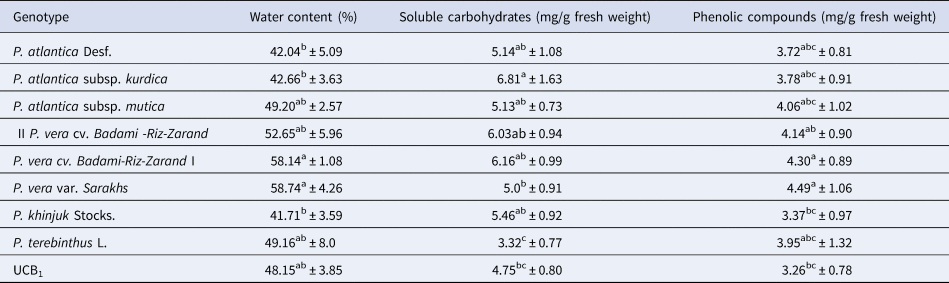
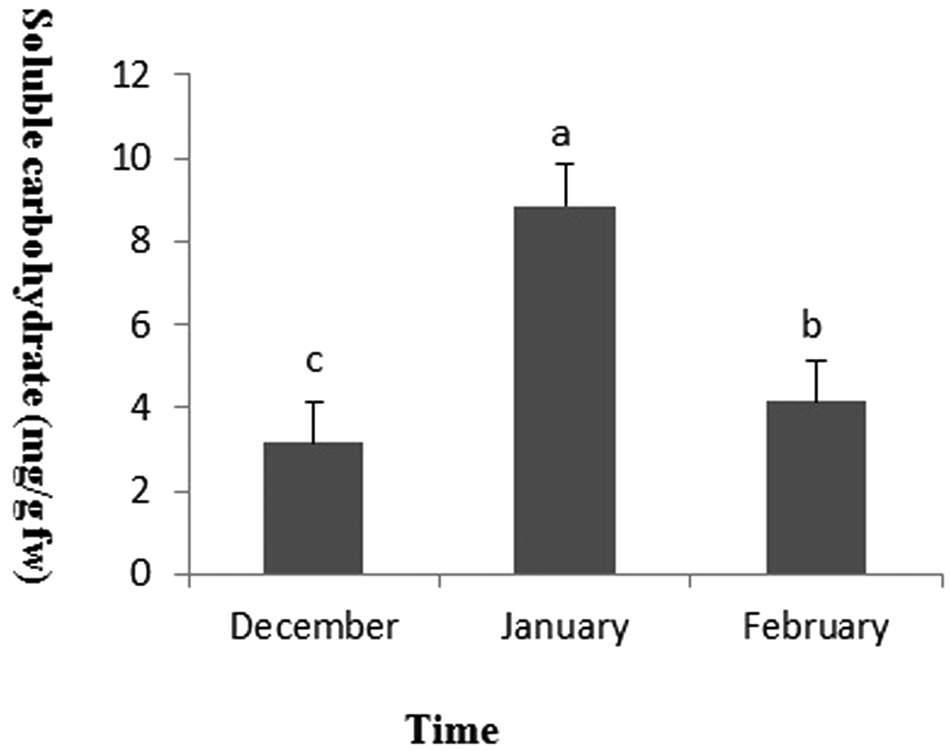
The results of the variance analysis showed that soluble carbohydrates of shoot were affected, by genotype and sampling time (Table S1). The results of the comparison means showed that the highest soluble carbohydrate of shoot was observed in P. atlantica subsp. kurdica (6.81 mg g−1 fresh weight) genotype and the lowest in the P. terebinthus (3.32 mg g−1 fresh weight) genotype, although there was no significant difference between P. terebinthus and UCB1 genotypes (Table 1). There also was a significant difference between sampling times in terms of shoot-soluble carbohydrates, so that, the highest shoot-soluble carbohydrate was observed in January (8.86 mg g−1 fresh weight) and the lowest in December (3.15 mg g−1 fresh weight) (Fig. 1).
Comparison of genotypes in terms of soluble carbohydrates, phenolic compounds and water content of shoot

Means with a common letter in each column are not significantly different (Duncan test, P = 0.05).
Soluble carbohydrate contents of bark shoot at different times.

Phenolic compounds
The results of the variance analysis showed that phenolic compounds of the shoot were affected by genotype and sampling time (Table S1). The results of comparison means showed that the highest shoot phenolic compounds were observed in P. vera var. Sarakhs (4.49 mg g−1 fresh weight) genotype and the lowest in P. khinjuk (3.37 mg g−1 fresh weight) and UCB1 (3.26 mg g−1 fresh weight) genotypes, although it was not observed a significant difference between P. khinjuk and UCB1 genotypes with other genotypes (Table 1). Also, the highest shoot phenolic compounds were observed in February (7.20 mg g−1 fresh weight) and the lowest in December (1.02 mg g−1 fresh weight) (Fig S1).
Water content of shoot
The results of the variance analysis showed that the water content of the shoot was affected by sampling time and genotype (Table 1). The results of the comparison means showed that the genotypes had a significant difference in terms of water content of shoot so that, the highest water content of shoot was observed with P. vera var. Sarakhs (58.74%) and Badami-Riz-Zarand I (58.14%) genotypes, and the lowest was in P. khinjuk (41.71%) genotype, although it was not observed significant difference between the P. khinjuk and P. atlantica and UCB1 (Table 2). The results of comparison means of sampling time showed that the lowest of shoot water content was observed in December (37.88%) and the highest in January (57.20%), although it, was not observed significant difference between January and February (Fig S2).
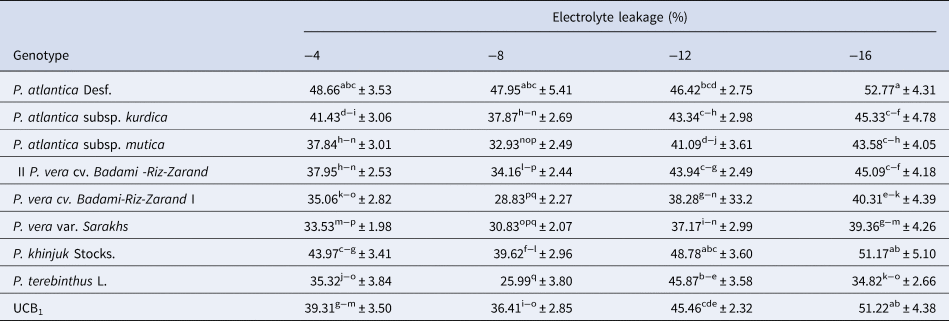
Interaction of genotype and temperature on electrolyte leakage percentage

Means with a common letter in each column are not significantly different (Duncan test, P = 0.05).
Starch
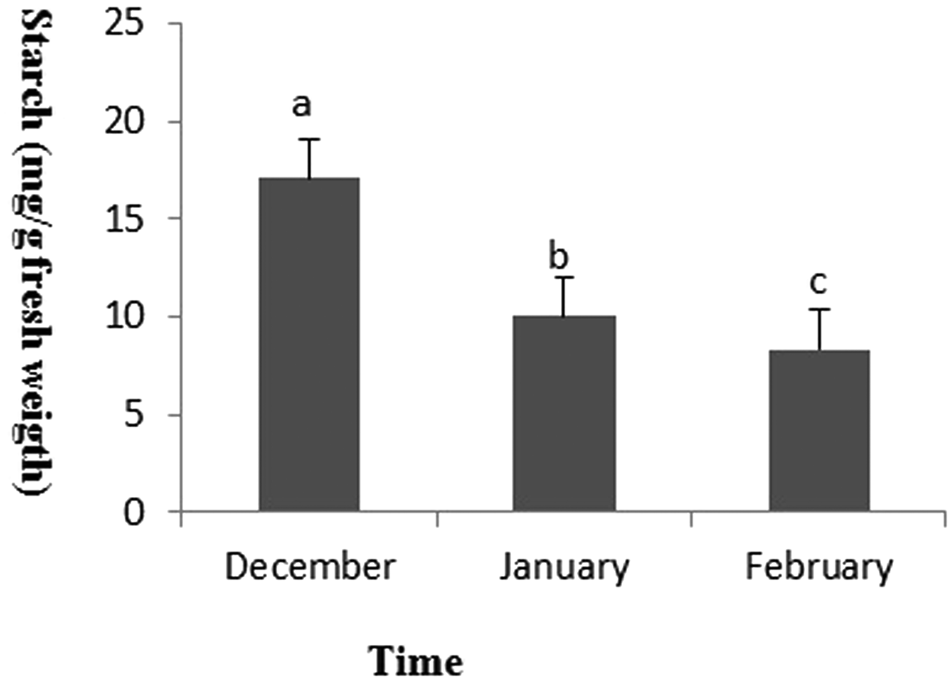
The starch of shoot was affected by sampling time at 1% Duncan test (Table S1). The results of the comparison means showed that starch of shoot decreased from December (17.06 mg g−1 fresh weight) to February (8.35 mg g−1 fresh weight) so that, the highest shoot starch was observed in December (17.06 mg/g fresh weight) and the lowest in February (8.35 mg g−1 fresh weight) (Fig. 2).
Effects of time sampling on the starch rate of bark shoot.

Concentration of elements
Calcium
The calcium concentration of the shoot was affected by the genotype and sampling time, as well as the interaction of genotype and sampling time at 1% Duncan test (Table S1). Genotype and sampling time interaction showed that calcium concentration of shoot increased significantly in all genotypes in February compared to December so that in February the highest calcium concentration of shoot was observed in P. terebinthus (0.29%) and the lowest in P. khinjuk (0.16%) although there was no significant difference between P. khinjuk (0.16%) and UCB1 (0.18%) (Table S3).
Potassium
The potassium concentration of shoot was affected by the interaction of genotype and sampling time at 5% Duncan test, as well as genotype and sampling time (Table S1). The results of comparison means genotype and sampling time interaction showed that the potassium concentration of the shoot was increased in February compared to December. In February, the highest potassium concentration of shoot was observed, in genotypes of P. atlantica subsp. mutica (2.40%) and P. atlantica (2.31%) and the lowest with P. khinjuk (1.78%), although it was not observed a significant difference between P. khinjuk (1.78%) and the P. terebinthus (1.46%) and UCB1 (1.57%) genotypes (Table S4).
Electrolyte leakage
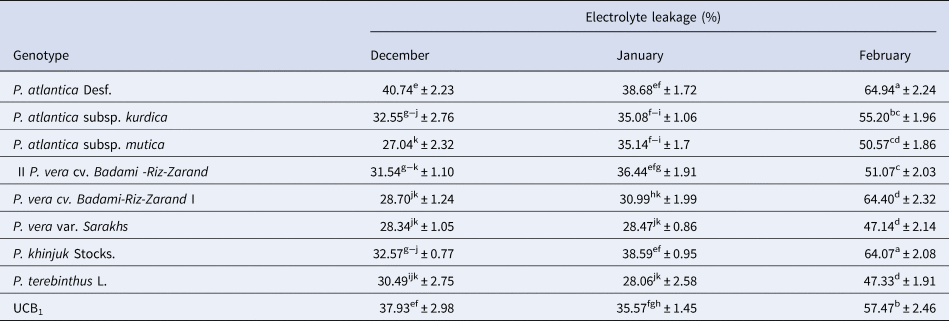
The results of the variance analysis showed that EL of shoot was affected by genotype, temperature and sampling time, as well as the interaction of genotype and temperature, genotype and sampling time (data not show). The results of comparison means of genotype and sampling time interaction showed that, in all genotypes EL percentage in February was higher compared to the December. In December, the highest EL percentage was observed in genotypes of P. atlantica (40.74%), P. khinjuk (32.57%), and the lowest were with genotypes of P. atlantica subsp. mutica (27.04%), P. vera var Sarakhs (28.34%) and Badami-Riz-Zarand I (28.70%). In January, the highest EL percentage was observed in genotypes of P. khinjuk (38.59%) and P. atlantica (38.68%) and the lowest was with P. terebinthus (28.06%) and P. vera var. Sarakhs (28.47%). In February, as January, the lowest EL percentage was observed in P. terebinthus and P. vera var. Sarakhs genotypes and the highest in the P. atlantica (64.94%) and P. khinjuk (67.07%) (Table 3). The results of genotype and temperature interaction showed that, in all genotypes, EL increased with decreasing temperature from −4°C to −16°C, however, this increase was only significant in genotypes of P. atlantica (52.77%), P. khinjuk (51.17%) and UCB1 (51.22%). At −16oC, the highest EL percentage was observed in genotypes of P. atlantica (52.77%) and P. khinjuk (51.17%) and the lowest with P. terebinthus (34.82%) and P. vera var. Sarakhs genotypes (39.366 percentage) (Table 2).
Interaction of genotype and sampling time on electrolyte leakage percentage

Means with a common letter in each column are not significantly different (Duncan test, P = 0.05).
Correlation between EL percentage and eco-physiological parameters
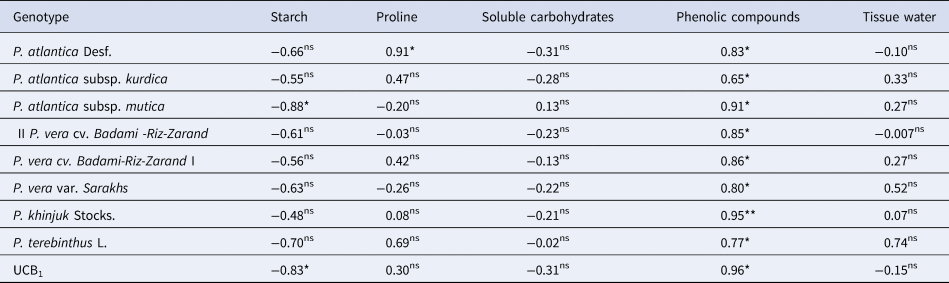
The results showed that there was a correlation between proline content of shoot and EL percentage in P. atlantica at the −16°C (r = 0.91) while no correlation was observed in other genotypes. Based on the results, a significant and negative correlation was observed between shoot starch and EL at −16o C in P. atlantica subsp. mutica (r = −0.88) and UCB1 (r = −0.83) (Table 4). The results also showed that in all genotypes there was no significant correlation between EL percentage and shoot soluble carbohydrates and water content of shoot.
Correlation between echo physiological parameters and electrolyte leakage percentage

* and ** Significant at the probability level of 1 per cent and 5 per cent, respectively; ns: no significant.
Discussion
Few studies have been undertaken to evaluate the effect of freezing stress on Pistacia species. In this study, the highest EL percentage at −16°C, was observed with P. atlantica (52.77%) and P. khinjuk (51.17%) genotypes, and the lowest was in P. terebinthus (34.82%) and P. vera var. Sarakhs (39.36%). The results indicate that the genotypes of P. terebinthus and P. vera var. Sarakhs were more resistant to the freezing stress than P. khinjuk and UCB1 genotypes. This result was in line with the reports of Deborah et al. (Reference Deborah, Beede and Talbott1990) and Afrousheh et al. (Reference Afrousheh, Hokmabadi, Arab and Tajabadipour2018) on pistachio rootstocks. Deborah et al. (Reference Deborah, Beede and Talbott1990), in a field study, reported that a hybrid of P. integerrima and P. terebinthus was more resistant to frost damage than P. atlantica. They also postulated that P. integerrima was sensitive to frost damage and UCB1 was intermediate P. integerrima and P. atlantica. In another study, Afrousheh et al. (Reference Afrousheh, Hokmabadi, Arab and Tajabadipour2018) evaluated seedlings of four pistachio rootstocks; P. atlantica, P. vera cv. Badami-Riz-Zarand, P. vera var. Sarakhs and, P. mutica to cold stress and reported that the P. atlantica with more EL percentage was the most sensitive rootstocks to frost damage and the P. mutica rootstock with the lowest EL percentage was the most resistant to frost damage.
Few studies, have investigated the physiological changes of shoot in the pistachio trees in winter months and their relationship with resistance to freezing stress. In the present study, a negative correlation was observed between starch content of shoot and EL percentage at −16°C in the genotypes of P. atlantica subsp. mutica (r = −0.88) and UCB1 (r = −0.83). The result indicates that the genotypes with low starch in the shoot had a higher EL percentage. Soluble carbohydrates as osmotic compounds are produced from the breakdown of starch at low temperatures and increase the osmotic potential of cells and protect tissues against plant damage (Hallowell, Reference Hallowell1980; Huany and Johnson, Reference Huany and Johnson1995). The stability of the cell membrane during freezing stress is influenced by factors such as the amount of calcium and also free radical receptors. In the present study, the highest calcium concentration and phenolic compounds of shoot were observed in February in genotypes of P. terebinthus and P. vera var. Sarakhs and the lowest in P. khinjuk. Our results are consistent with previous studies where the calcium concentration and phenolic compounds of buds increase during the dormancy phase (Demarty et al., Reference Demarty, Morvan and Thellier1984; Hepler and Wayne, Reference Hepler and Wayne1995; Jian et al., Reference Jian, Li, Sun and Chen1997; Balasundram et al., Reference Balasundram, Sundram and Samman2007) that was in line of our study. Calcium is a signal in many physiological and biochemical processes in response to cold stress (Bush, Reference Bush1995). In addition, Calcium plays an important role in the resistance and strength of cells against cold damage. Also, Phenolic compounds with carboxyl groups are scavengers and destroy free radicals produced by environmental stresses (Wrolstad, Reference Wrolstad1976; Sayyari et al., Reference Sayyari, Bablar and Kalantari2011). In total, based on the results of the present study, it can be postulated that the mechanisms of resistance to freezing stress in the P. terebinthus and P. vera var. Sarakhs were elevated stability of the cell membrane associated with higher calcium accumulation and phenolic compounds, which requires more studies in this field.
Conclusion
The results of the present study showed that during winter, the soluble carbohydrates, proline and potassium and calcium concentration of shoot were increased in genotypes of Pistacia species. The genotypes were different in terms of these parameters due to chilling requirements which warrants further investigations. P. terebinthus and P. vera var. Sarakhs had lower EL percentage at −16 0 C than P. khinjuk and P. atlantica which is relevant to forestry and the programs of the pistachio rootstocks breeding. The correlation between eco-physiological parameters and EL percentage showed that higher calcium concentration of shoot and lower starch content can be informative for the select genotypes of Pistacia species resistant to freezing damage.
Supplementary material
The supplementary material for this article can be found at https://doi.org/10.1017/S1479262123000473.
Authors’ contributions
HRK designed the experiments; AR performed the experiments and AMM analysed data: all authors read and approved the final manuscript.
Competing interest
None.
Data archiving statement
All relevant data are within the paper and tables and figures.