Introduction
Each year, over 40 000 Americans die from suicide (Heron, Reference Heron2013), and suicide rates have increased substantially over the past 15 years (Curtin et al. Reference Curtin, Warner and Hedegaard2016). Both major depressive disorder (MDD) and recent psychiatric hospitalization significantly increase risk for suicide attempts and completed suicide (Goldacre et al. Reference Goldacre, Seagroatt and Hawton1993; Henriksson et al. Reference Henriksson, Aro, Marttunen, Heikkinen, Isometsa, Kuoppasalmi and Lonnqvist1993; Appleby et al. Reference Appleby, Shaw, Amos, McDonnell, Harris, McCann, Kiernan, Davies, Bickley and Parsons1999; Brown et al. Reference Brown, Beck, Steer and Grisham2000; Qin & Nordentoft, Reference Qin and Nordentoft2005; Hayashi et al. Reference Hayashi, Igarashi, Imai, Yoshizawa, Utsumi, Ishikawa, Tokunaga, Ishimoto, Harima, Tatebayashi, Kumagai, Nozu, Ishii and Okazaki2012; Bolton et al. Reference Bolton, Gunnell and Turecki2015), and one study estimated a 100-fold increased risk for suicide shortly post-discharge relative to never-hospitalized individuals (Qin & Nordentoft, Reference Qin and Nordentoft2005). Thus, there is a critical need to develop and test post-discharge interventions that reduce suicidal behaviors among at-risk individuals.
Most interventions to reduce suicide risk target negative psychological constructs, such as depressed mood, suicidal ideation and hopelessness, which are linked to suicidal behaviors and completed suicide (Brown et al. Reference Brown, Ten Have, Henriques, Xie, Hollander and Beck2005; Linehan et al. Reference Linehan, Comtois, Murray, Brown, Gallop, Heard, Korslund, Tutek, Reynolds and Lindenboim2006; Bolton et al. Reference Bolton, Gunnell and Turecki2015). For example, cognitive therapy for the prevention of suicide typically focuses on the core beliefs and thoughts that lead to suicide attempts (Brown et al. Reference Brown, Ten Have, Henriques, Xie, Hollander and Beck2005), while dialectical behavior therapy focuses both on the identification of thoughts and emotions that lead to suicidal or self-injurious behavior and the development of skills to avoid engaging in those behaviors (Linehan et al. Reference Linehan, Comtois, Murray, Brown, Gallop, Heard, Korslund, Tutek, Reynolds and Lindenboim2006). Unfortunately, such interventions have had limited impact on the prevention of suicidal behaviors (Calati & Courtet, Reference Calati and Courtet2016), especially in acute care settings (Inagaki et al. Reference Inagaki, Kawashima, Kawanishi, Yonemoto, Sugimoto, Furuno, Ikeshita, Eto, Tachikawa, Shiraishi and Yamada2015), and current treatments may not be appropriate, feasible or available for patients in the post-discharge period.
Positive psychological constructs also may play a distinct role in reducing suicide risk. Cross-sectional studies have found that positive affect, optimism and gratitude are associated with reduced suicidal ideation or suicide attempts in depressed and non-depressed populations (Hirsch et al. Reference Hirsch, Conner and Duberstein2007a , Reference Hirsch, Duberstein, Chapman and Lyness b ; Yamokoski et al. Reference Yamokoski, Scheel and Rogers2011; Li et al. Reference Li, Zhang, Li, Li and Ye2012), often independent of negative affect. Furthermore, positive psychology (PP) interventions, which promote psychological well-being by targeting optimism, gratitude, use of personal strengths and altruism, have been shown to reduce depressive symptoms and enhance well-being in psychiatrically healthy persons (Seligman et al. Reference Seligman, Steen, Park and Peterson2005, Reference Seligman, Rashid and Parks2006; Sin & Lyubomirsky, Reference Sin and Lyubomirsky2009; Bolier et al. Reference Bolier, Haverman, Westerhof, Riper, Smit and Bohlmeijer2013), and there is preliminary evidence for the efficacy of these interventions at reducing depressive symptoms in patients with MDD (Seligman et al. Reference Seligman, Rashid and Parks2006). Given their potential to reduce both depressive symptoms and suicide risk, there has been increasing interest in using PP treatments in psychiatrically ill populations (Jeste et al. Reference Jeste, Palmer, Rettew and Boardman2015). However, there have been no randomized trials of PP interventions for patients with depression and high suicide risk.
Accordingly, we developed a 6-week, telephone-based PP intervention for depressed patients hospitalized for a suicide attempt or suicidal ideation, initiated in-hospital and continued post-discharge. In a randomized trial, we examined the efficacy of the PP intervention in reducing hopelessness (primary study outcome) and other suicide risk factors, as well as promoting positive psychological constructs, compared with an attention-matched, cognition-focused (CF) control intervention that trained participants to systematically recall life events. This CF intervention focused on recalling events from the prior week in a neutral manner. It had some similarities to interventions focused on improving specificity of memory in depression (Watkins et al. Reference Watkins, Baeyens and Read2009), though was largely chosen given its use as a control condition in prior studies (Huffman et al. Reference Huffman, Mastromauro, Boehm, Seabrook, Fricchione, Denninger and Lyubomirsky2011).
We hypothesized that the PP intervention would result in greater improvement in hopelessness at 6 weeks (primary time point) and 12 weeks, given that this intervention targeted optimism/hope and other positive psychological constructs, and that these constructs have been prospectively associated with lower hopelessness, fewer suicidal thoughts and reduced suicidal behaviors (Hirsch & Conner, Reference Hirsch and Conner2006; Hirsch et al. Reference Hirsch, Conner and Duberstein2007a , Reference Hirsch, Duberstein, Chapman and Lyness b ; O'Connor et al. Reference O'Connor, Fraser, Whyte, MacHale and Masterton2008; Price et al. Reference Price, Butow, Bell, deFazio, Friedlander, Fardell, Protani and Webb2016). Additionally, we expected that PP would be associated with greater improvements in suicidal ideation, depression, and positive psychological constructs at 6 and 12 weeks compared with the CF intervention.
Method
The Happiness, Optimism, and Positive Emotions (HOPE) study was a single-blind, two-site randomized trial of 6-week PP and CF interventions for patients with a primary diagnosis of MDD. All participants were admitted between October 2013 and June 2015 to in-patient psychiatric units at an urban general hospital or psychiatric hospital for suicidal ideation or following a suicide attempt. Institutional Review Board approval at both sites was obtained, and the trial was registered on ClinicalTrials.gov (NCT02004145) prior to study initiation.
Participants
Eligible participants were English-speaking adults who were: (a) admitted to one of the study site in-patient psychiatric units; (b) had a primary admission diagnosis of MDD with a current major depressive episode [confirmed using the Mini International Neuropsychiatric Interview (MINI); Sheehan et al. Reference Sheehan, Lecrubier, Sheehan, Amorim, Janavs, Weiller, Hergueta, Baker and Dunbar1998]; and (c) expressed suicidal ideation on admission or were admitted following a suicide attempt, based on review of the clinical admission interview in the medical record and confirmed by the patient's attending physician. Patients were excluded if they had: (a) current psychosis, assessed using the MINI; (b) a cognitive disorder, assessed using a six-item screen developed for research (Callahan et al. Reference Callahan, Unverzagt, Hui, Perkins and Hendrie2002); or (c) a primary admission diagnosis of a substance use disorder.
Study procedures
Eligible participants were identified through review of unit census lists. Study staff approached potential participants with the permission of the patient and attending psychiatrist. Staff discussed the study with the patient and administered screening instruments (MINI, cognitive screen) to assess inclusion/exclusion criteria. Eligible patients provided written informed consent, and baseline study outcome measures were completed prior to discharge. Participants were then randomized (via a random number generator) to receive the PP or CF intervention, with group assignments placed in sealed envelopes opened by staff following completion of baseline assessments. During hospitalization, both before and after enrollment, participants in both conditions were free to receive any and all treatments offered by their clinical teams. These potentially included pharmacotherapy, electroconvulsive therapy (ECT), and group and individual psychotherapy.
Study interventionists delivered both PP and CF interventions; participants were paired with the same interventionist for the entire 6-week protocol. Interventionists were psychiatrists, psychologists, or licensed social workers, trained by the study principal investigator on both study conditions. Training included didactic information, observation of experienced team members, role-play, and ongoing feedback from supervising study staff throughout the study.
We chose to develop a telephone-based intervention to improve the reach of this adjunctive intervention, given that in-person visits (especially on top of existing visits with providers) may not be feasible, especially for those with intensive out-patient care, transportation limitations, functional limitations, or those from rural/outlying areas.
Following group assignment, interventionists reviewed with participants the introductory section of the PP or CF manual. Then, participants were assigned an in-hospital exercise to be completed that day. The following day, the interventionist reviewed the exercise with the participant and assigned the second exercise, to be completed over the following week at home. Post-discharge, participants independently completed one exercise each week and had 30-min weekly telephone calls with the interventionist. Calls included a review of the prior week's exercise and assignment of the next week's exercise via guided review of the intervention manual. During each telephone session, suicidal ideation was monitored by asking participants to rate their degree of agreement with the following statement: ‘I have been having thoughts of killing myself’. If participants endorsed any suicidal ideation, a detailed suicide evaluation was performed (Suarez et al. Reference Suarez, Beach, Moore, Mastromauro, Januzzi, Celano, Chang and Huffman2015) and assistance was provided as needed.
Baseline sociodemographic and medical data were abstracted from the electronic medical record by study staff. Blinded assessors administered psychological outcome measures at baseline and again 6 and 12 weeks post-hospitalization by telephone. At 6- and 12-week assessments, participants were also queried about suicide attempts, self-injurious behavior and rehospitalizations. To assess intervention feasibility, interventionists recorded the number of completed sessions; we defined feasibility a priori as completion of at least four of six exercises by a majority of participants assigned to that condition. Participants were compensated financially for completing follow-up telephone calls at 6 ($25) and 12 ($50) weeks.
Study interventions
PP intervention
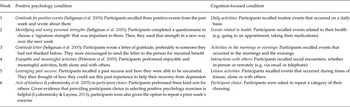
The PP intervention utilized six PP-based exercises (see Table 1 and online Supplementary material) chosen due to their demonstrated feasibility and utility in a prior study of suicidal in-patients (Huffman et al. Reference Huffman, DuBois, Healy, Boehm, Kashdan, Celano, Denninger and Lyubomirsky2014). During each telephone session, interventionists and participants reviewed the week's section of the treatment manual, which highlighted a specific positive construct (e.g. gratitude) and its role in their recovery. Then, participants were introduced to an associated exercise (e.g. writing a letter of gratitude) and worked with interventionists to develop a practical plan for its completion over the next week. After each telephone session, participants were instructed to complete the exercise and record in their manual the details of the exercise, along with any thoughts and feelings they experienced while performing and documenting the exercise. During each subsequent session, participants and interventionists reviewed the completed exercise, identified positive emotions associated with the exercise, and explored ways to integrate the exercise and associated skill into daily life.
Weekly positive psychology and cognition-focused exercises

CF intervention
The CF control intervention (see Table 1 and online Supplementary material), time- and attention-matched to the PP intervention, focused on emotionally neutral memory recall and was found to be feasible and well accepted in a prior PP-based trial (Huffman et al. Reference Huffman, Mastromauro, Boehm, Seabrook, Fricchione, Denninger and Lyubomirsky2011). At the first (in-hospital) session, participants received a manual and were introduced to the CF intervention, described as an intervention to assist with memory, organization and concentration. Participants were assigned their first in-hospital exercise: to write down three events that occurred each day over the past week. Participants were encouraged to think of neutral events, to avoid assigning emotions to the events, and to be specific when describing the events (e.g. ‘I had eggs for breakfast’ rather than ‘I had breakfast’). Exercise completion and details were reviewed with interventionists the next day, and subsequent weekly exercises were assigned and reviewed by telephone. To promote participant engagement, the nature, setting or type of events to be recorded differed each week (e.g. medical events).
Intervention fidelity
Study interventionists delivered both interventions, and all sessions were audio-recorded. At weekly interventionist meetings, sessions were reviewed with the project director and interventionists to discuss clinical issues and ensure consistency of intervention delivery. The project director also reviewed randomly selected sessions and rated them on fidelity scales created for the project. The fidelity scales contained ratings related to the logistics of each session, proper delivery of interventions, and assurance that other skills/interventions (e.g. problem-solving, reducing cognitive distortions) were not being used. Sessions were assigned total numerical scores (on a scale of 0–10, with 10 being fully adherent) and interventionists received feedback as needed.
Instruments
Suicide risk factor outcomes: hopelessness (primary outcome), suicidal ideation and depressive symptoms
Beck Hopelessness Scale (BHS; range 0–20)
Hopelessness was measured with the 20-item self-report BHS (Cronbach's α = 0.92 in this sample) (Beck et al. Reference Beck, Weissman, Lester and Trexler1974). The well-established BHS has been used in prior studies examining risk of completed suicide (Beck et al. Reference Beck, Brown and Steer1989, Reference Beck, Brown, Berchick, Stewart and Steer1990).
Concise Health Risk Tracking scale (CHRT; range 12–60)
Suicidal ideation was assessed with the CHRT (α = 0.90) (Trivedi et al. Reference Trivedi, Wisniewski, Morris, Fava, Gollan, Warden, Nierenberg, Gaynes, Husain, Luther, Zisook and Rush2011), a 12-item questionnaire previously validated in depressed patients that has participants rate their agreement with such statements as ‘I have been having thoughts of killing myself’ on a scale of 0 (strongly disagree) to 4 (strongly agree).
16-Item Quick Inventory of Depressive Symptomatology, Self-Report (QIDS-SR16; range 0–27)
Depressive symptoms were measured using the well-validated QIDS-SR16 (α = 0.73) (Rush et al. Reference Rush, Trivedi, Ibrahim, Carmody, Arnow, Klein, Markowitz, Ninan, Kornstein, Manber, Thase, Kocsis and Keller2003). This scale has been widely used to measure depression in numerous research studies and in clinical care (Trivedi, Reference Trivedi2009). We also used item no. 10 (concentration/decision making) to examine the impact of our interventions on cognition.
Though the CHRT is designed to directly assess suicidality, we chose hopelessness, as measured by the BHS, as our primary outcome measure. This is because the BHS has been clearly associated with suicide risk, with elevated BHS scores associated with an elevated risk of completed suicide in both in-patient and out-patient settings (Beck et al. Reference Beck, Brown and Steer1989, Reference Beck, Brown, Berchick, Stewart and Steer1990), while the CHRT's association with completed suicide has not yet been established.
Positive psychological outcomes: optimism, gratitude and positive affect
Life Orientation Test-Revised (LOT-R; range 0–24)
Optimism was measured using the well-validated six-item LOT-R (α = 0.91) (Herzberg et al. Reference Herzberg, Glaesmer and Hoyer2006), which has been used in prior studies examining connections between optimism and suicidal ideation (Hirsch & Conner, Reference Hirsch and Conner2006; Hirsch et al. Reference Hirsch, Conner and Duberstein2007a ; Huffman et al. Reference Huffman, Boehm, Beach, Beale, DuBois and Healy2016b ).
Gratitude Questionnaire-6 (GQ-6; range 6–42)
Gratitude was measured using the GQ-6 (α = 0.85) (McCullough et al. Reference McCullough, Emmons and Tsang2002), a brief, validated six-item measure of dispositional gratitude. The GQ-6 has been studied in a range of populations and used in clinical research projects (McCullough et al. Reference McCullough, Emmons and Tsang2002; Ivtzan & Papantoniou, Reference Ivtzan and Papantoniou2014; Huffman et al. Reference Huffman, Beale, Celano, Beach, Belcher, Moore, Suarez, Motiwala, Gandhi, Gaggin and Januzzi2016a ).
Positive and Negative Affect Schedule (PANAS; range 10–50)
Positive affect was measured using the 10-item positive affect subscale of the PANAS (α = 0.93) (Watson et al. Reference Watson, Clark and Tellegen1988). The PANAS has been broadly used to assess affect; this includes use in currently (Berman et al. Reference Berman, Kross, Krpan, Askren, Burson, Deldin, Kaplan, Sherdell, Gotlib and Jonides2012) and recently (Bagley et al. Reference Bagley, Weaver and Buchanan2011) depressed samples.
Exploratory outcomes: readmissions, self-injury and suicide attempts
Self-report information about psychiatric readmissions, non-suicidal self-injurious behavior, and suicide attempts was collected at 6- and 12-week follow-up assessments.
Exploratory outcome: impact of the CF condition on cognition
To determine whether the CF condition improved cognition in those participants randomized to this condition, we examined the impact of CF on item no. 10 of the QIDS, which relates to concentration and decision-making.
Data analysis
All analyses were performed using Stata 14 (StataCorp LP, USA). Two-tailed α was set at 0.05 for all analyses. Between-group differences in baseline sociodemographic, psychiatric and self-report outcome variables were calculated using t tests for continuous variables and χ2 analyses for dichotomous variables. In the primary multivariate analyses, rather than selecting covariates based on between-group baseline differences, which can increase the risk of overfitting the model (Babyak, Reference Babyak2004), we selected two markers of post-discharge treatment intensity – partial hospital (PHP) day treatment program and ECT – a priori to control for these factors when assessing intervention efficacy.
To compare between-group differences on change from baseline in BHS (hopelessness), CHRT (suicidal ideation) and QIDS-SR16 (depression) scores at 6 weeks (primary time point) and 12 weeks post-hospitalization, we utilized mixed-effects regression models, with a random intercept for each patient, for multivariable between-group analyses including post-discharge PHP participation and ECT administration as covariates. These models allow inclusion of participants with missing data in an intent-to-treat analysis (Blackwell et al. Reference Blackwell, de Leon and Miller2006). Likewise, between-group differences in change from baseline LOT-R (optimism), GQ-6 (gratitude) and PANAS (positive affect) scores at 6 and 12 weeks were compared using multivariable mixed-effects models as above. The effect size of between-group differences in outcomes was also calculated, by dividing the change from baseline of each variable at each time point by the standard deviation of the residual in the regression model.
With a sample size of n = 65, 1:1 group allocation (groups of n = 32 and n = 33), using a two-tailed α of p = 0.05 via univariate analyses between groups, and assuming a between-group difference of medium effect size (Cohen's d = 0.5), the study was powered at 81% to detect a between-group difference in the primary study outcome of change from baseline hopelessness (BHS) at 6 weeks.
To compare between-group differences on cognition, we utilized the same mixed-effects regression models noted above, controlling for PHP participation and referral to ECT post-discharge. We examined cognition using item no. 10 from the QIDS-SR16, which examines impairments in concentration and decision-making.
Finally, to explore between-group differences on rehospitalizations, non-suicidal self-injurious behavior and suicide attempts over the 12-week assessment period, Fisher's exact tests were performed, as multivariate regression models would be overfit due to the small expected number of these events.
Results
In all, 94 patients were approached for the study, and 65 (69%) enrolled. Participants were randomized to either the PP (n = 32) or CF (n = 33) intervention [see Consolidated Standards Of Reporting Trials (CONSORT) diagram, Fig. 1]. A total of 58 individuals (89%) provided follow-up data, and all participants were included in the intent-to-treat analyses.
Consolidated Standards Of Reporting Trials (CONSORT) diagram of recruitment. MDD, Major depressive disorder.

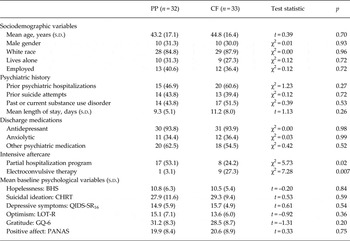
Baseline sociodemographic and psychiatric data are summarized in Table 2. Participants’ ages ranged from 19 to 84 years (mean = 44.0, s.d. = 16.6 years), most (69%) were women, and 57 (87%) were white. Of the participants, 27 (42%) had a previous suicide attempt. Mean CHRT scores (mean = 28.6, s.d. = 10.5) were higher than in prior CHRT studies in out-patients (mean = 23.7–25.3) (Ostacher et al. Reference Ostacher, Nierenberg, Rabideau, Reilly-Harrington, Sylvia, Gold, Shesler, Ketter, Bowden, Calabrese, Friedman, Iosifescu, Thase, Leon and Trivedi2015; Reilly-Harrington et al. Reference Reilly-Harrington, Shelton, Kamali, Rabideau, Shesler, Trivedi, McElroy, Sylvia, Bowden, Ketter, Calabrese, Thase, Bobo, Deckersbach, Tohen, McInnis, Kocsis, Gold, Singh, Finkelstein, Kinrys and Nierenberg2016). There were no significant differences between groups on baseline sociodemographic, psychiatric or outcome measure variables. While in the hospital, similar numbers of patients in each group received ECT (31% in the PP group and 45% in the CF condition; χ2 = 1.38, p = 0.24). However, participants randomized to PP were more likely to have been referred for PHP (53.1% v. 24.2%, χ2 = 5.72, p = 0.02) and less likely to have been referred for post-discharge ECT (3.1% v. 27.3%, χ2 = 7.28, p = 0.007) than CF participants. Despite the differences in ECT between groups, ECT was not significantly associated with change in hopelessness over time (ECT × time point interaction: β = 2.03, p = 0.30 at 6 weeks, β = 2.19, p = 0.28 at 12 weeks).
Baseline characteristics

Data are given as number of participants (percentage) unless otherwise indicated.
PP, Positive psychology; CF, cognition-focused condition; s.d., standard deviation; BHS, Beck Hopelessness Scale; CHRT, Concise Health Risk Tracking; QIDS-SR16, 16-item Quick Inventory of Depressive Symptomatology – Self-Report; LOT-R, Life Orientation Test – Revised; GQ-6, Gratitude Questionnaire-6; PANAS, Positive and Negative Affect Schedule.
Suicide risk factor outcomes
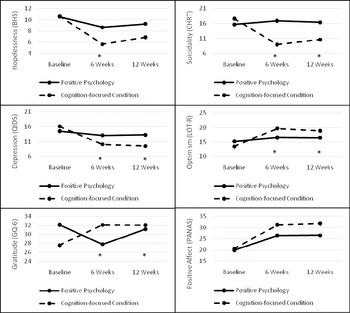
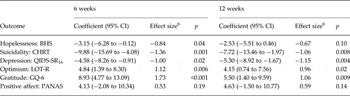
In multivariable analyses controlling for PHP and ECT (see Table 3, Fig. 2), compared with PP, CF was associated with greater reductions in hopelessness at 6 weeks; this difference was non-significant at 12 weeks. CF also was associated with significantly greater reductions in suicidal ideation and depressive symptoms at both 6 and 12 weeks.
Estimated changes in suicide risk factors and positive psychological constructs (from baseline to 12 weeks). * p < 0.05. BHS, Beck Hopelessness Scale; CHRT, Concise Health Risk Tracking; QIDS, 16-item Quick Inventory of Depressive Symptomatology – Self-Report; LOT-R, Life Orientation Test – Revised; GQ-6, Gratitude Questionnaire-6; PANAS, Positive and Negative Affect Schedule.

Mixed-effects regression results indicating the impact of the CF intervention (compared with PP) on psychological outcomes at 6 and 12 weeks a

CF, Cognition-focused; PP, positive psychology; CI, confidence interval; BHS, Beck Hopelessness Scale; CHRT, Concise Health Risk Tracking; QIDS-SR16, 16-item Quick Inventory of Depressive Symptomatology – Self-Report; LOT-R, Life Orientation Test – Revised; GQ-6, Gratitude Questionnaire-6; PANAS, Positive and Negative Affect Schedule; ECT, electroconvulsive therapy; PHP, partial hospitalization program.
a Results of mixed-effects regression models, controlling for referral to ECT and participation in PHP. Coefficients are group × time interaction values.
b Effect size was calculated by dividing the change from baseline of each variable at each time point by the standard deviation of the residual in the regression model.
Positive psychological outcomes
Relative to PP, the CF condition was associated with significantly greater improvements in optimism and gratitude at 6 and 12 weeks (see Table 3, Fig. 2). There were no significant between-group differences in improvement in positive affect at either time point.
Cognition
Compared with PP, the CF condition led to significantly greater improvements in cognition (QIDS-SR16 item no. 10) at 12 weeks (group × time point interaction: β = −0.90, 95% confidence interval −1.42 to −0.38, p = 0.001), but not at 6 weeks (p = 0.27).
Exploratory outcomes: rehospitalizations, self-injury and suicide attempts
Of the 52 participants who provided 12-week follow-up data regarding rehospitalizations and suicide attempts, six participants were rehospitalized (three per group), six engaged in non-suicidal self-injurious behavior (four in the PP group, two in CF) and one (in the PP group) reported a suicide attempt. The groups did not significantly differ on any of these outcomes.
Feasibility and intervention fidelity
Among PP participants, 20/32 (63%) completed at least four of the six exercises, while 27/33 (82%) in the CF group did so, with a trend towards greater feasibility of CF (χ2 = 3.03, p = 0.08). Mean fidelity ratings were 9.3/10 (s.d. = 0.9) for the PP intervention and 9.6 (s.d. = 0.8) for the CF intervention.
Discussion
Among high-risk patients with MDD and suicidality who were recently discharged following psychiatric hospitalization, the CF intervention was associated with greater reductions in hopelessness at 6 weeks and greater improvement of suicidal ideation, depression and positive psychological outcomes at 6 and 12 weeks, controlling for two markers of concurrent treatment intensity (ECT and PHP).
These findings were in contrast to our hypothesis that the PP condition would be associated with superior benefits. Our results conflict with past results demonstrating that PP interventions lead to reductions in depression and increased well-being (Sin & Lyubomirsky, Reference Sin and Lyubomirsky2009; Bolier et al. Reference Bolier, Haverman, Westerhof, Riper, Smit and Bohlmeijer2013), as well as a prior meta-analysis suggesting that the impact of PP interventions is greater in depressed individuals, compared with those without depression (Sin & Lyubomirsky, Reference Sin and Lyubomirsky2009). Though few PP studies had been performed in MDD patients, those using similar interventions suggested efficacy in this population (Fava et al. Reference Fava, Rafanelli, Cazzaro, Conti and Grandi1998; Seligman et al. Reference Seligman, Rashid and Parks2006).
Both sample- and intervention-related factors may help to explain these findings. First, PP-based interventions may not be additionally beneficial to patients with ongoing moderate depression, hopelessness and suicidal ideation. In contrast to prior studies that delivered PP interventions to out-patients with MDD (Fava et al. Reference Fava, Rafanelli, Cazzaro, Conti and Grandi1998; Seligman et al. Reference Seligman, Rashid and Parks2006), we enrolled a high-risk, in-patient sample with substantial ongoing symptoms. That more depressed or hopeless individuals may have had difficulty engaging in PP exercises is plausible. Many of the exercises used in this trial, such as writing a gratitude letter, require initiative and organization that patients in crisis may lack. Furthermore, several exercises require significant interpersonal contact, which may have been a barrier for some depressed patients struggling with low energy or interest.
Psychological factors also may have played a role, as participants may have had difficulty identifying positive aspects of themselves or their lives during a period of recent destabilization. Furthermore, when asked to focus on positive feelings (e.g. gratitude), depressed individuals may have focused instead on the discrepancy between those positive feelings and their current negative ones (Joormann et al. Reference Joormann, Siemer and Gotlib2007). In addition, following hospital discharge, patients often have numerous work-, life- and treatment-related commitments, as they may be referred to new or additional mental health treatment or need to catch up on tasks missed during hospitalization. Consequently, some participants may have found it difficult to engage fully in the adjunctive PP intervention, which often required more planning and action than the CF intervention, during the immediate post-discharge period. Finally, it may be that the natural course of hopelessness and positive constructs are to worsen substantially post-discharge, given the substantial support offered in the hospital, and both interventions were superior to no treatment, with the CF condition simply being superior in all domains; this hypothesis cannot be tested without a no-treatment condition.
The CF intervention, by contrast, was more effective than anticipated. The CF intervention trained participants to recall specific personal events. Depressed patients have impaired memory for specific life events, and this reduction in autobiographical memory specificity is associated with poor depression recovery (Raes et al. Reference Raes, Williams and Hermans2009; Sumner et al. Reference Sumner, Griffith and Mineka2010). Interventions that target memory specificity may improve cognition and depressive symptoms. In a randomized, controlled trial, a 4-week life review intervention, in which participants recorded autobiographical events in detail, was associated with improvements in memory specificity, depression, hopelessness and life satisfaction (Serrano et al. Reference Serrano, Latorre, Gatz and Montanes2004). Furthermore, a single-arm trial of a similar 4-week life review intervention increased memory specificity, reduced rumination and improved social problem-solving among depressed psychiatric in-patients (Raes et al. Reference Raes, Williams and Hermans2009). Finally, an intensive intervention to improve specific, concrete memory led to greater reductions in depression and self-criticism (Watkins et al. Reference Watkins, Baeyens and Read2009).
Memory specificity interventions could lead to decreased depression, hopelessness and other suicide risk factors through several mechanisms. Attenuating negative rumination could reduce depression (van der Velden et al. Reference van der Velden, Kuyken, Wattar, Crane, Pallesen, Dahlgaard, Fjorback and Piet2015), and individuals with more life satisfaction may be more hopeful about the future (Koivumaa-Honkanen et al. Reference Koivumaa-Honkanen, Rissanen, Hintikka, Honkalampi, Haatainen, Tarja and Viinamaki2011). Furthermore, improving social problem-solving could improve empowerment and social support, reducing hopelessness (Abramson et al. Reference Abramson, Metalsky and Alloy1989).
Though our CF intervention was less intensive than the memory specificity interventions described above, it may have improved memory specificity and ultimately produced downstream improvements in hopelessness, suicidal ideation and depression, as well as increases in optimism. This is supported by the finding that the CF intervention did lead to improved concentration/decision making at 12 weeks, compared with PP. One additional mechanism by which this intervention may have provided benefit is through a greater sense of accomplishment and self-efficacy. Participants in the CF group often listed events that involved successful completion of required daily tasks and/or successful social interactions, both of which may have improved self-esteem and self-efficacy. Overall, this straightforward, structured intervention also appeared to be very feasible in this cohort, as evidenced by a trend towards greater completion rates in CF than PP. Further study is needed to determine its benefit as a simple adjunctive treatment for patients with MDD and high suicide risk.
Despite having a number of strengths, it is important to note several limitations of this study. First, the study included a largely white sample recruited from academic medical centers, which may limit generalizability. Second, participants engaged in heterogeneous post-discharge treatment outside of the study interventions, and it was not possible to control for this heterogeneity in our analyses. Finally, our study's moderate sample size and relatively short follow-up period made it difficult for us to examine the impact of the interventions on our exploratory outcomes of rehospitalizations and suicide attempts, and larger and longer studies are needed to replicate these findings and assess intervention effects on key clinical outcomes.
In sum, relative to a PP intervention, a 6-week CF intervention led to greater reductions in hopelessness and other suicide risk factors in a cohort of recently-hospitalized patients with MDD and suicidal ideation. These findings provide support for further investigation into the use of interventions focusing on memory specificity in this high-risk population.
Supplementary material
The supplementary material for this article can be found at https://doi.org/10.1017/S0033291716002798
Acknowledgements
This research project was supported by the American Foundation for Suicide Prevention (grant no. SRG-1-035-11 to J.C.H.). Time for analysis and article preparation was also funded by the National Heart, Lung and Blood Institute through grants K23HL123607 (to C.M.C.) and R01HL113272 (to J.C.H.). The National Institute of Mental Health funded time and effort through grant K23MH097786 (to R.P.A.). The content is solely the responsibility of the authors and does not represent the official views of the National Institutes of Health or other funders.
Declaration of Interest
None.