


I. INTRODUCTION
The Radio Frequency IDentification (RFID) technology has become one of the emblematic wireless technologies and has quickly been developed for real-time identification in several fields such as logistics, access control, automation systems, etc. Owing to their relatively low cost and large communication distance, the passive ultra high frequency (UHF) RFID systems are very promising [Reference Weinstein1–Reference Duroc and Kaddour2]. In particular, the confluence of UHF RFID with other wireless technologies will lead to many emerging applications, such as remote medicine, wireless sensing, or automated inventory management [Reference Want3]. Such applications require location capabilities whereas RFID systems do not intrinsically provide aptitudes for accurate object location. Although they can typically be used as proximity location sensors providing rough location information, their accuracy depends on the coverage area of the reader device. Other solutions are based on the classic location techniques which use the properties of triangles to estimate the target's location by trilateration or triangulation [Reference Bouet4–Reference Zhang, Li, Amin, Bolić, Simplot-Ryl and Stojmenović6]. However, none of these techniques provide satisfactory solutions in terms of location accuracy and minimum complexity. The distance estimation is based on the measurement of one variable related to the radio frequency (RF) signal received at the antenna. At this point, there are three available approaches: time measurement methods, angle measurement methods, and power measurement methods. Firstly, included in the time measurement perspective, time of arrival (TOA) and time difference of arrival (TDOA) techniques involve synchronization setting, leading to high costs and complexity. In addition, these techniques are not in compliance with the UHF RFID standards, since the maximum available bandwidth of 26 MHz (Industrial Scientific Medical band, ISM) is not large enough to guarantee a good accuracy. Recent studies show the usefulness of the phase-based distance measurement combined with the RFID technology looking for both, the identification and the distance estimation. Therefore, the phase difference of arrival (PDOA) technique could allow a calibration step, eliminating the effects of the unknown tag properties implied by dispersive properties of the modulated reflection coefficient and power dependency [Reference Li, Zhang and Amin7–Reference Viikari, Pursula and Jaakkola9]. Regarding the angle measurement option, angle of arrival (AOA) technique requires an antenna array for achieving extremely directive patterns. This approach entails a high cost and is rather inaccurate. Lastly, as a power measurement choice, the received signal strength indicator (RSSI) method exploits the signal attenuation in order to estimate the tag distance. Although this approach is simple, it suffers from fluctuations of the received signal strength. Those fluctuations derive from the RF environment, and also from intrinsic parameters of the RFID system that affect the strength of the signals due to the non-linearity of the components and matching conditions. Any of these techniques let the distance to be estimated. Although the trilateration method has been chosen to perform this estimation, there are other possibilities. In fact, some improvement solutions have been proposed using scene analysis with fingerprinting techniques [Reference Ni, Liu, Lau and Patil10–Reference Chawla, Robins and Zhang12] and probabilistic methods such as the Bayesian learning method or the machine learning location algorithm (Support Vector Machine, SVM) [Reference Guo, Zhang, Wang and Xu13], the Kalman filtering [Reference Bekkali, Sanson and Matsumoto14], or supervised fuzzy inference system to learn the RFID sensor model [Reference Cicirelli, Milella and Di Paola15]. However, these methods are quite complex requiring high processing resources and dense reference tag networks as Landmark mapping.
In this paper, a modified version of the RSSI method for the localization of passive UHF RFID tags is presented. The objective is to improve the accuracy of the estimated location without complexity in terms of materials or processing. The proposed method takes into account the presence of unknown parameters (due to the propagation channel and the intrinsic behavior of the RFID system) relying on a dichotomous algorithm which includes probabilistic parameters. Section 2 exposes the theoretical concept of the proposed method emphasizing not only the contributions but also assumptions and limitations. Section 3 demonstrates the interest of the introduced approach from simulation and measurement results. Finally, Section 4 draws conclusions and outlines future works.
II. THE PROPOSED METHOD
A) Brief overview of the principle of passive RFID systems
RFID technology allows data storage in small electronic transponder circuits (tags) that are particularly portable. The communication between a passive RFID tag and an interrogator (reader) is realized by RF waves. Figure 1 presents the block diagram of an RFID system.
Block diagram of an RFID reader and a RF tag.

The tag, which is generally attached to a person or an object, consists of an antenna and an associated integrated circuit (chip). In passive tags there is no internal power supply, and then the chip obtains power for its operations as transponder from the RF signal transmitted by the reader. The communication consists of a query sent from the reader, to which the tag respond by sending back its data by switching its input impedance between two states, and thus modulating the backscattered signal with information.
B) Backscatter Link Budget and the RSSI method
Figure 2 shows the functional principle of the RFID communication detailing on the backscattering link budget. For clarity and without loss of generality, the transmitting and receiving antennas of the reader are presented separately, even if the monostatic configuration is currently used in commercial readers.
Illustration of the RFID backscatter link.

In free space, the ratio p of the received power P r to the transmitted power P t depends on the distance d [m] between the tag and the reader. From the radar range equation defined in [Reference Balanis16], p is given by:
 $$p\left(d \right)= e_t e_r \left(1 - \left\vert \Gamma_{t} \right\vert ^2 \right)\left(1 - \left\vert \Gamma_{r} \right\vert ^2 \right)\sigma \displaystyle{{D_t \left(\theta _t \comma \; \phi _t \right)D_r \left(\theta _r \comma \; \phi _r \right)} \over {4\pi }} \left(\displaystyle{\lambda \over {4\pi d^2 }} \right)^2 \left\vert \hat \rho _w \cdot \hat \rho _r \right\vert ^2\comma \;$$
where e is the dielectric conduction loss, Γ is the reflection coefficient, σ [m2] is the radar cross section (RCS) or echo area, D(θ, ϕ) is the directivity in the direction (θ, ϕ), λ [m] is the wavelength (λ = c/f, c speed of light, f frequency),  ${\hat \rho }_{r}$ is the polarization unit vector of the receiving antenna, and
 ${\hat \rho}_{w}$ is the polarization unit vector of the scattered waves. The indices «t» and «r» refer to the transmission and the reception conditions, respectively.
Assuming ideal conditions (i.e., impedance matching conditions in transmission and reception and polarization matching of the transmitting and receiving antennas) and the antenna gains G t and G r, Equation (1) can be rewritten as:
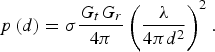 $$p\left(d \right)= \sigma \displaystyle{{G_t G_r } \over {4\pi }} \left(\displaystyle{\lambda \over {4\pi d^2 }} \right)^2.$$
Therefore, the distance d can be easily deduced from Equations (1) or (2) if all other parameters are known. This approach is the principle of the RSSI method. Unfortunately in real conditions, the direct application of this method is limited and can lead to very inexact distances. Indeed, the ideal conditions are generally not verified and several parameters are unknown a priori. Firstly, the RCS σ value is very difficult to estimate: it depends on many parameters such as the chip sensitivity, the impedance matching between the tag antenna and the chip, the incident power on the tag which causes change in the input impedance of the chip, the polarization matching (which depends on the orientation between reader and tag), the modulation depth and the tagged object properties [Reference Nikitin and Rao17–Reference Colin, Moretto, Abou Chakra and Ripoll19]. Furthermore, the propagation conditions can vary with changes in the environment.
In fact, the distance d to be estimated is written as the product between the constant α which is assumed known or measured and an unknown variable γ such as:
 $$d = \underbrace{\underbrace{\left(\displaystyle{\lambda \over {4\pi }} \right)^{1/2} \left(\displaystyle{{G_t G_r } \over {4\pi }} \right)^{1/4}} _{\matrix{term\; constant\cr assumed\; known}} \underbrace{\left(\displaystyle{1 \over {p\left(d \right)}} \right)^{1/4} }_{\matrix{ measured \cr variable}}}_\alpha \times \underbrace{\underbrace{\chi \left(\sigma \right)^{1/4}}_{\matrix{unknown \cr variable}}}_\gamma = \alpha \times \gamma\comma \;$$
where the coefficient χ takes into account the non-ideal conditions.
Consequently, although the gain of the reader antenna and the measured powers can be considered known with a good exactness, it is not enough to achieve an accurate estimation of the distance d between the tag and the reader.
C) Proposed approach for improving the localization of the tag
The indetermination in the estimation of the distance d between tag and reader can be solved by directly considering the overall problematic: the trilateration, i.e., achieve the localization of the tag by measuring three different distances d i, i = 1, …, 3 between the tag and three differently positioned readers. For the two-dimensional case, the trilateration consists of finding the intersection of the three circles defined by the position of the readers (center of circles) and the associated distances d i (radius of circles). Therefore, considering that this intersection exists and is unique, the problem can be resolved, even if, the estimated distances d i are wrong. It should be understood that the estimated distances only inform about the weight of the distance (i.e., a relative distance) and not about the absolute distance (i.e., the real distance). The distance deduced from Equation (3) is only an indicator composed of two parameters α and γ. The resolution of the problem relies on the following idea: find the three most probable radii leading to a unique intersection using scale factors (SFs) which represent the unknown variables related to the environment and the RFID system. Figure 3 illustrates the principle of the proposed approach. The readers are located on square points and the true position of the tag is a grey circle. From the estimated distances (which can be calculated from (3)), a direct trilateration detects the tag on the black circle. By applying the technique just described, now the position of the tag now corresponds to the position defined by the black star. The estimation of the tag position is consequently improved.
Illustration of the modified trilateration.

The algorithm of the proposed method is illustrated in Fig. 4. The corresponding radius for each one of the three readers is estimated from the measured power received at each reader using the Friis equation. The area of the intersection of the three associated circles is calculated. If the area is not small enough, by considering that the intersection should be a point, then the radii are modified by the SF, and so on until the found area is small enough. When the algorithm stops, the distance between readers and tag and the position of the tag are known.
Schematic representation of the algorithm.

Now, it should be noted that if the SFs are assumed constant (e.g., if we consider d as the unique unknown parameter) and by varying, linearly and simultaneously, each SF until we find an intersection point, the true distances d i can be found; and then, the estimated position is correct. In this case, the correction of the estimated distances due to the SF is given by:
 $${d}_{i} = {d}_{i} \times SF\comma \; \quad i = 1\comma \; \, 2\comma \; \, 3\comma \;$$
where SF is a value slightly less than 1 because with the assumption that the initial radii are over-estimated, the SFs gradually decrease their values. Otherwise, other SFs could also be envisaged. The SFs can be differentiated with a weighting coefficient depending on the estimated distances. For example, a possible solution could be:
 $$d_{i} = d_{i} \times SF_{i}\comma \; \quad i = 1\comma \; \, 2\comma \; \, 3\comma \;$$
with
 $$SF_{i} = {SF} \times \left(\displaystyle{{d_{i}} \over {\sum_{{j} = 1}^{3} d_{j}/3}} \right)\comma \; \quad i = 1\comma \; \, 2\comma \; \, 3.$$
In this case, therefore the SFs take into account the relative estimated distances. The next section details the method and demonstrates the proposed concept from simulation and experimental results.
III. SIMULATION AND EXPERIMENTAL RESULTS
A) Validation by simulations
The objective of this section is to verify the feasibility of the proposed concept and to evaluate its performance. The parameters of the simulation are the following: three RFID readers are placed in the three corners of a square room as illustrated in Fig. 5 (filled circles); the operating frequency is 915 MHz; the power of interrogation signal (output of the readers) is 800 mW; Transmitting (TX) and Receiving (RX) antennas gain are assumed equal to 0 dBi for the simulations. Firstly, Fig. 5(a) illustrates the case where the unknown parameters, defined through the variable γ as in (3), are assumed constant. The dashed lines correspond to the estimated distances for each link reader-tag. The deduced tag position from trilateration is represented by the small circle. The solid lines represent the reference (with real distances and real tag position). After processing and using a SF varying in the same way for each link, i.e. defined by (4), the distances and the tag position are achieved. The estimation is as accurate as expected. In the following, the estimated position evaluated only using a classic trilateration is so-called direct estimated position, and the estimated position achieved after the application of the proposed method is so-called estimated position after processing. Figure 5(b) gives an example of the general case with the unknown parameter γ randomly modeled by a white Gaussian noise and centered on their previous constant value. The chosen SF is variable: it depends on the estimated distances and is adaptive as defined in (5). The estimated position after processing (dash-dot lines) is much better than the direct estimated position (dashed lines). The simulation confirms the improvement of the accuracy in the tag localization by using the proposed concept. To quantify the achieved qualitative results, Fig. 6 shows the error encountered when calculating the position of the tag compared with its real position by calculating the mean Euclidean distance in terms of the deduced root mean square (RMS) error. This error represents the accuracy on the tag location estimation in function of the variance, i.e. the power, of the white Gaussian noise added to the unknown parameters. For each variance of noise, 100 simulations are realized and the corresponding error is calculated. Figure 6 shows the mean error for each variance and illustrates the performance of the location algorithm. These simulations clearly highlight the performance of the proposed approach, both in terms of accuracy and robustness.
Illustration of the principle of the location method: (a) validation of the proposed method with estimated position when the errors are assumed constant; (b) example of position estimation when the errors are different.

RMS error in function of noise variance between 0 and 5.

B) Experimental validation
Finally, the proposed method is applied in a real context where the channels always present a direct path (i.e., propagation line-of-sight (LOS)) but they are more complex with the presence of multipath due to the environment. The measurement was realized in a room of 30 square meters with some furniture (Fig. 7(a)). For ease of implementation but without loss of physical meaning, the measurement setup is the following: one of the three commercial tags presented in Table 1 is positioned in a fixed manner as illustrated in Fig. 7(b); the reader (Alien ALR-9780) successively takes the 12 indicated positions; for each case the transmitted power is constant, the measured received power is presented in Table 2.
Experimental configuration: (a) photo of the setup configuration; (b) functional scheme of the setup configuration.

Tested UHF RFID tags.

Measured received powers for different positions of the reader and for the considered tags.

At once, several remarks have to be emphasized. One reader was displaced by 12 different positions in order to offer multiple combinations and to accomplish the scheme with three readers. In order to evaluate the proposed concept, this approach is correct: being fixed to the tag and considering several configurations of the three readers, the positioning distribution is satisfied for the proposed method. Among the 220 possible combinations of three readers, only the combinations where two or three readers are not aligned are taken into account, i.e. 108 combinations. Indeed, the associations of aligned readers ({1, 2, 3}; {4, 5, 6}; {7, 8, 9}; {10, 11, 12}) were not considered because these configurations are not adequate in order to realize a trilateration; and assuming that the readers are positioned at the corners of a room, the tag cannot be aligned with two readers. It should also be noted that in practice, three readers are sufficient, even if, more readers could provide diversity and improve the accuracy of localization. Moreover, the different values of the received power for the three considered tags, even when they occupy the same position, highlight the strong influence of the specific characteristics of each tag. Furthermore, these received powers present different values which are unexpected for symmetrical positions, mainly due to the non-ideal propagation in the channel. These last two remarks reveal the type of difficulties met when the RSSI method is directly applied. It should be noted that for all the experimental experiences, in order to prove the proposed concept, the SF is simply assumed identical and linear for the three radii. Figure 8 illustrates the positioning distribution when the three readers are located in the positions {1, 5, 12} and using the tag T1.
Example of the localization method by considering the three readers in the positions {1, 5, 12}.

The estimated tag position after processing is clearly better than before processing. In this specific practical case, the proposed concept seems validated. The use of a SF in order to determine the position of the tag leads to a better location estimation. In order to quantify the method more precisely, Table 3 shows several results for the 108 considered combinations of the readers and the three tags. The parameter “best estimation” compares the errors in terms of RMS error found by the direct estimation and the estimation after processing, respectively. The estimation with the smallest error wins. When the “best estimation” is realized, the second parameter “correct estimation” evaluates if this estimation is correct or not; a correct estimation is arbitrarily defined as estimation with an error less than 0.25 m. For example, consider the tag T1: 88% of the reader combinations achieve a better estimation by using the processing (and 12% are better with a direct estimation); and among these best estimations, 69% verify the criterion “correct estimation”. These results show the strong improvement provided by the proposed concept.
Comparison and performance of the location operation achieved from direct estimation and after processing.

Figure 9 shows the histogram of the error considering the direct estimation and the post-processed estimation for the tag T1. For example, the error is zero for two configurations with direct estimation versus three with post-processed estimation; the error is equal to 0.1 m for 13 configurations with direct estimation versus 39 with post-processed estimation; etc. This graph also demonstrates the interest of the proposed processing. The estimations are better, and at the same time, the variance of error is smaller. Otherwise, numerous cases also show that certain configurations are more relevant. In particular, the pseudo-alignments, such as for example {2, 4, 7} or {3, 5, 8} can provide worst results, and therefore, these should be avoided. Consequently, a configuration with the three readers located in three corners of a room will be more appropriate than, for example, a configuration with the three readers aligned on a wall.
Histogram of the error considering the direct estimation and the post-processed estimation for the tag T1.

IV. CONCLUSION
A modified RSSI technique for the localization of passive UHF RFID tags is presented. The conceptual idea is to resolve the trilateration issue through a global approach using an adaptive SF. This approach overcomes the inaccuracies in the location due to uncertainties in the characteristics of the RFID system (especially the tags) and a non-ideal propagation in real channels. Simulations and experimental results showed the relevance and the performance of the proposed method. In a real propagation channel with a direct path and moderate fading, the improvement of the localization accuracy is unequivocal. Furthermore, the use of an SF requires very little knowledge about the system itself. The method compensates perfectly all the uncertainties of constant values such as for example the gains. This approach leads to correct results and is very simple to implement. Finally in perspective, the proposed concept combined with approaches using the frequency diversity or more readers could suggest new solutions for more complex channels. Otherwise, the proposed concept could be applied in other localization contexts using RSSI coupled to another technology such as WiFi.
 Yvan Duroc was born in Angoulême, France in 1971. He received a teaching degree “Agregation” (French national degree) in Applied Physics (1995), the Ph.D. degree in Electrical Engineering (April 2007) and tenure Degree (November 2012) from Grenoble INP, France. From 1997 to 2009, he has been a Teaching Associate at Grenoble INP. Since 2009, he has been an Associate Professor at Grenoble INP. He is in charge of lectures in applied signal processing, physics, electronic and digital communications for undergraduate and graduate students. His actual research interest resides in the design and modeling of antennas, and development of the concept of signal processing antenna with special attention to RFID, UWB, and Radio Cognitive technologies.
 Gianfranco Andía Vera was born in Puno, Peru, in 1986. He received a dual M.Sc. degree in telecommunications engineering from the Universitat Politècnica de Catalunya (UPC), Barcelona, Spain, and the Pontificia Universidad Católica del Perú (PUCP), Lima, Peru, in 2009, the Postgraduate degree in development and management of networks on information technology from UPC, in 2010, and is currently working toward a Ph.D. degree at the Grenoble Institute of Technology (Grenoble-INP), Grenoble, France. His M.Sc. thesis concerned the design of a rectenna for energy harvesting at the Centre Tecnologic de telecomunications de Catalunya (CTTC), Barcelona, Spain. From 2009 to 2011, he was a Communication Engineer involved in RF planning and network deployment for a telecom carrier. Since October 2011, he has been with the Laboratoire de Conception et d'intégration des Systèmes (LCIS), Grenoble-INP. His research interests include RFIDs, antennas, energy harvesting, wireless networks, and microwave devices.
 Juan Pablo Garcia Martin received a degree in telecommunication engineering from the University of Seville in 2010. He now works for the Electronic Department of the University of Seville. He is doing his Ph.D. oriented to hardware and software development in modern communications: 802.15.4, Zigbee, and RFID. His main research interests are design of wireless sensor networks and signal processing.



