Death Anxiety and Psychopathology
The awareness of death is a central part of the human condition (Yalom, Reference Yalom2008). While death anxiety (i.e., the fear of death or the process of dying, for oneself or others) may produce effective coping mechanisms (e.g., striving for achievements, focusing on creating a meaningful life), it may also lead to distress and maladaptive coping strategies (Yalom, Reference Yalom2008). As a result, death anxiety has been proposed to be a transdiagnostic construct, underpinning numerous mental health conditions (for a review, see Iverach, Menzies, & Menzies, Reference Iverach, Menzies and Menzies2014). Among clinical samples, death anxiety has been found to predict the total number of lifetime psychiatric diagnoses, number of medications and hospitalisations, and overall distress and impairment (Menzies & Dar-Nimrod, Reference Menzies and Dar-Nimrod2017; Menzies, Sharpe, & Dar-Nimrod, Reference Menzies, Sharpe and Dar-Nimrod2019). Furthermore, the fear of death is significantly associated with the severity of at least 13 different mental disorders, including anxiety disorders, obsessive–compulsive-related disorders, depressive disorders, addictive disorders, trauma-related disorders and somatic symptom-related disorders (Caras, Reference Caras1995; Martz, Reference Martz2004; Menzies et al., Reference Menzies, Sharpe and Dar-Nimrod2019; Menzies, Zuccala, Sharpe, & Dar-Nimrod, Reference Menzies, Zuccala, Sharpe and Dar-Nimrod2020a; Noyes, Stuart, Longley, Langbehn, & Happel, Reference Noyes, Stuart, Longley, Langbehn and Happel2002).
The majority of studies on death anxiety and mental health conditions have been correlational, limiting conclusions regarding causality. However, a growing number of experimental studies support the proposed causal role of death anxiety in mental health. Reminders of death have been shown to worsen the avoidance of social situations among students high in social anxiety (Strachan et al., Reference Strachan, Schimel, Arndt, Williams, Solomon, Pyszczynski and Greenberg2007) and the restriction of high calorie food among women (Goldenberg, Arndt, Hart, & Brown, Reference Goldenberg, Arndt, Hart and Brown2005). Among clinical samples, death reminders have been shown to increase threat perception and avoidance among people with spider phobias (Strachan et al., Reference Strachan, Schimel, Arndt, Williams, Solomon, Pyszczynski and Greenberg2007), compulsive handwashing among people with obsessive-compulsive disorder (OCD) (Menzies & Dar-Nimrod, Reference Menzies and Dar-Nimrod2017) and body checking and intention to visit a medical specialist among people with panic disorder, illness anxiety disorder and somatic symptom disorder (Menzies, Sharpe, & Dar-Nimrod, Reference Menzies, Sharpe and Dar-Nimrod2021).
If death anxiety is indeed a transdiagnostic construct, addressing it in interventions offers a valuable new avenue for treatments. Current standard treatments do not typically address death anxiety. For example, current standard treatments for anxiety disorders typically focus on disputing the client's threat estimates (e.g., reducing the perceived probability of a plane crash, of catching HIV or having a heart attack). As a result, the underlying fear of death itself remains unaddressed by current gold standard treatments for mental health conditions. This has been argued to at least partially explain the ‘revolving door’ often seen in clinical practice, in which it is not uncommon for clients to receive treatment for one disorder, only to return to treatment at a later timepoint for a seemingly different disorder (Iverach et al., Reference Iverach, Menzies and Menzies2014, p. 590). This clinical observation is supported by data showing that presenting to treatment with a different disorder is more common than presenting again with the same disorder (Scholten et al., Reference Scholten, Batelaan, Penninx, van Balkom, Smit, Schoevers and van Oppen2016). Moreover, recent research found that death anxiety is associated with how many disorders are experienced prior to current disorder onset, at least for obsessive–compulsive disorder (Menzies, Zuccala, Sharpe, & Dar-Nimrod, Reference Menzies, Zuccala, Sharpe and Dar-Nimrod2020b)
Despite the importance of targeting death anxiety in treatment, at present, no self-help treatments for this construct exist. In fact, to the best of the authors’ knowledge, only two published therapist manuals exist, each of which only specifically address treating death anxiety in a single brief chapter (Furer, Walker, & Stein, Reference Furer, Walker and Stein2007; Willson & Veale, Reference Willson and Veale2009). Given this, it is unsurprising that death anxiety goes unaddressed in standard treatments, even when fears of death appear highly relevant to the disorder or presentation in question (Menzies & Veale, Reference Menzies, Veale, Menzies, Menzies and Dingle2022).
The Advantages of Online Treatments
Alongside the need for death anxiety interventions, there is a growing need for accessible, scalable and cost-effective treatments. Fairburn and Patel (Reference Fairburn and Patel2014) argue that interventions need to be scaled up in order to impact psychological outcomes in the broader community. Given the burgeoning population and increasing demand, traditional one-on-one therapy is unlikely to meet these mounting mental health needs (Helgadóttir, Menzies, Onslow, Packman, & O'Brian, Reference Helgadóttir, Menzies, Onslow, Packman and O'Brian2014). This issue is magnified for those in rural areas whose access to psychological services is generally more limited. Even in metropolitan areas with seemingly adequate availability, waitlists to access psychological treatment remain lengthy. Loumidis and Shropshire (Reference Loumidis and Shropshire1997) found an average wait time of 19 weeks between the initial referral and the first therapy session. Furthermore, never has the need for online interventions been more urgent than during the recent COVID-19 pandemic. The virus has led to a surge in mental health problems across the globe (Torales, O'Higgins, Castaldelli-Maia, & Ventriglio, Reference Torales, O'Higgins, Castaldelli-Maia and Ventriglio2020), in addition to enforced or voluntary home confinement, emphasising the need for online therapy. Notably, death anxiety has been found to significantly predict distress related to the virus (Newton-John, Chambers, Menzies, & Menzies, Reference Newton-John, Chambers, Menzies and Menzies2021), further highlighting the importance of online treatments targeting this construct during the pandemic (Menzies & Menzies, Reference Menzies and Menzies2020; Menzies, Neimeyer, & Menzies, Reference Menzies, Neimeyer and Menzies2020).
Online treatments have been proposed as an ideal solution to the growing mental health demands of the public, given their low cost, flexibility, anonymity and accessibility to individuals in rural or remote areas (McCall, Richardson, Helgadóttir, & Chen, Reference McCall, Richardson, Helgadóttir and Chen2018). Computerised interventions are hardly novel. In fact, as early as the 1960s, computer simulations of psychologists were developed, mimicking face-to-face therapeutic interactions (Weizenbaum, Reference Weizenbaum1966). However, only recently has the evidence for available online treatments been examined through rigorous trials.
The Efficacy of Online Treatments
Fortunately, a growing body of research suggests that online treatments can produce significant improvements in symptoms. One meta-analysis of 92 studies found that, on average, online interventions produced a moderate effect size across a range of outcome variables related to both physical and mental health (Barak, Hen, Boniel-Nissim, & Shapira, Reference Barak, Hen, Boniel-Nissim and Shapira2008). Furthermore, online treatments appeared particularly beneficial for anxiety-related conditions, such as post-traumatic stress disorder (PTSD) and panic disorder. Indeed, a number of studies show that online treatments produce significant improvements in various other mental health conditions, including specific phobias, OCD, social anxiety disorder, generalised anxiety disorder and depression (Andersson & Cuijpers, Reference Andersson and Cuijpers2009; Cuijpers et al., Reference Cuijpers, Marks, van Straten, Cavanagh, Gega and Andersson2009; Reger & Gahm, Reference Reger and Gahm2009). These findings, showing the efficacy of online interventions among related mental health conditions, highlight the potential relevance of online treatments for death anxiety.
Interestingly, several meta-analyses have found that efficacy does not significantly differ between online and face-to-face interventions (Barak et al., Reference Barak, Hen, Boniel-Nissim and Shapira2008). For instance, a meta-analysis of 19 randomised controlled trials of online cognitive behaviour therapy (CBT) treatments for anxiety found no significant difference in outcome between online and therapist-delivered treatments (Reger & Gahm, Reference Reger and Gahm2009). This meta-analysis also found no significant difference in the effect sizes between samples with an anxiety disorder diagnosis, or samples with subclinical anxiety. These findings suggest that online therapies may be just as beneficial as traditional therapy, and that the benefits extend to those without a formal anxiety disorder diagnosis. This is particularly noteworthy given the advantages of online therapy regarding cost-effectiveness and accessibility.
Overcome Death Anxiety
The current programme, Overcome Death Anxiety (ODA), represents the first online treatment developed specifically to target fears of death. This article describes the novel online treatment programme below. It also presents data and qualitative responses from participants who have completed the programme, to illustrate the feasibility of the programme, and individuals’ experience with the tasks. That is, this article utilises information from these participants to indicate how readily users engaged with the treatment, and how they responded to exercises such as cognitive challenging tasks and novel reflection tasks.
The Structure of ODA
The ODA structure is principally based on two largely overlapping online programmes. CBTPsych was originally developed to address social anxiety in stuttering populations (Helgadóttir, Menzies, Onslow, Packman, & O'Brian, Reference Helgadóttir, Menzies, Onslow, Packman and O'Brian2009b) and was later developed into Overcome Social Anxiety to address social phobias outside of a stuttering context (McCall et al., Reference McCall, Richardson, Helgadóttir and Chen2018). Notably, in a review of real-world uptake of online therapies, CBTPsych demonstrated the highest community usage and completion of any standalone online programme (Fleming et al., Reference Fleming, Bavin, Lucassen, Stasiak, Hopkins and Merry2018). Furthermore, Overcome Social Anxiety later demonstrated the highest real-world completion rates of any standalone online programme, with 27.7% of users fully completing the intervention (McCall, Helgadóttir, Menzies, Hadjistavropoulos, & Chen, Reference McCall, Helgadóttir, Menzies, Hadjistavropoulos and Chen2019). The co-creator of these two programmes (Fjóla D. Helgadóttir) was involved in the technical development of ODA. As a result, ODA shares a similar structure to these two existing programmes. Specifically, all three programmes open with a focus on cognitive challenging before proceeding to behavioural strategies (e.g., exposure therapy). This order of treatment components is based on numerous other self-help treatments for anxiety, which similarly present cognitive strategies prior to introducing behavioural strategies (e.g., Anderson, Saulsman, & Nathan, Reference Anderson, Saulsman and Nathan2011; Bank et al., Reference Bank, Burgess, Sng, Summers, Campbell and McEvoy2020). In the context of death anxiety specifically, the modules aim to address the unhelpful beliefs and behaviours (e.g., avoidance, reassurance seeking) which have been argued to maintain elevated fears of death (Furer et al., Reference Furer, Walker and Stein2007). Thus, by adapting the structure and methodology of the CBTPsych and Overcome Social Anxiety programmes, in collaboration with their developers, we aim to increase the likelihood of adequate completion rates and efficacy, while simultaneously addressing the key mechanisms contributing to death anxiety.
General Considerations for Increasing Adherence in Standalone Programmes
The majority of internet-based treatments rely on additional support from therapists, such as by telephone or face-to-face sessions. For example, one meta-analysis of self-help treatments for anxiety disorders found that out of 27 online treatments, only two studies were ‘standalone’, and did not utilise therapist support (Haug, Nordgreen, Öst, & Havik, Reference Haug, Nordgreen, Öst and Havik2012). On the one hand, one-on-one therapist support has been shown to improve outcomes of online treatments (Andersson & Cuijpers, Reference Andersson and Cuijpers2009). However, this reliance on additional therapist assistance is a major limitation for many online programmes if the overarching goals of internet treatments are increased accessibility and cost-effectiveness (Fleming et al., Reference Fleming, Bavin, Lucassen, Stasiak, Hopkins and Merry2018). Whereas therapist telephone or face-to-face support may be easily achieved under research conditions, this is rarely feasible in real-world settings. Given this, ODA was developed to be a standalone intervention to ensure maximum scalability (Helgadóttir, Menzies, Onslow, Packman, & O'Brian, Reference Helgadóttir, Menzies, Onslow, Packman and O'Brian2009a).
However, standalone programmes are typically associated with poorer adherence. Richards and Richardson (Reference Richards and Richardson2012) found average dropout rates of 74% for standalone programmes, compared with 28% among those who received therapist support. Although dropout rates are relatively high in research settings, they are even higher in the real world. Fleming et al. (Reference Fleming, Bavin, Lucassen, Stasiak, Hopkins and Merry2018) conducted a systematic review of real-world engagement with standalone digital interventions for mental health problems, revealing relatively low rates of engagement and completion. For example, among users of MoodGYM, a standalone online programme which has attracted more than 1 million users worldwide (https://moodgym.com.au), completion rates varied between 0.5 and 2.8% (Christensen, Griffiths, Korten, Brittliffe, & Groves, Reference Christensen, Griffiths, Korten, Brittliffe and Groves2004; Neil, Batterham, Christensen, Bennett, & Griffiths, Reference Neil, Batterham, Christensen, Bennett and Griffiths2009).
Given the standalone nature of ODA, it was essential to maximise treatment adherence and efficacy. A number of factors have been shown to improve both adherence to, and outcomes of, online interventions. First, interactive sites (i.e., those that include cooperative elements, such as exercises and quizzes) have been found to be significantly more effective than static sites (i.e., didactic sites that simply present information; Barak et al., Reference Barak, Hen, Boniel-Nissim and Shapira2008). Second, the use of varying media types has also been shown to be important. One recent meta-analysis found that the diversity of multimedia (e.g., images, voice-overs, videos) was one of the only predictors of improvement in eating disorder symptoms as a result of online interventions (Barakat et al., Reference Barakat, Maguire, Smith, Mason, Crosby and Touyz2019). Given these findings, ODA includes eight different videos to explain key concepts in a more engaging way. Furthermore, images are included throughout the programme, such as photos of real people alongside examples depicting fictional characters. This decision was made due to previous criticisms of online programmes for relying on cartoon depictions, which lack the feel of human contact (Helgadóttir et al., Reference Helgadóttir, Menzies, Onslow, Packman and O'Brian2009a). ODA also features videos filmed specifically for the programme, designed to help simulate a therapeutic relationship between the user and the virtual therapist. For example, the programme opens with a video introducing the virtual therapist (i.e., the first author and the creator of the programme) and later features a video of the therapist encouraging the user to continue through the module focusing on exposure therapy. Moreover, every page of ODA features a voiceover of the therapist explaining the written content on that page in a more conversational way and congratulating the user for their progress.
Third, individualisation and formulation-based interventions have been proposed to be central to the success of online treatments (Helgadóttir et al., Reference Helgadóttir, Menzies, Onslow, Packman and O'Brian2009a) and transdiagnostic treatments in particular (Persons & Hong, Reference Persons, Hong and Johnson2015). Johansson et al. (Reference Johansson, Sjöberg, Sjögren, Johnsson, Carlbring, Andersson and Andersson2012) found that an individualised online treatment produced significantly greater improvements in depressive symptoms, compared with a standardised treatment, and a control condition. Given this, ODA was designed to be highly individualised, creating a unique formulation for the user based on their responses, and presenting them with relevant cognitive challenging and exposure exercises.
Fourth, many standalone programmes lack corrective feedback (Helgadóttir et al., Reference Helgadóttir, Menzies, Onslow, Packman and O'Brian2009a). This is particularly problematic when it comes to cognitive challenging, a skill which is difficult, yet central, to CBT (Menzies & Veale, Reference Menzies, Veale, Menzies, Menzies and Dingle2022). It is rare for online programmes to provide sample answers to cognitive challenging questions, meaning that users may consistently answer thought challenging prompts in a suboptimal way (Helgadóttir et al., Reference Helgadóttir, Menzies, Onslow, Packman and O'Brian2009a). This may also explain the poor completion rates for standalone interventions, as cognitive challenging components may be failing to effectively teach this crucial skill, leading to user frustration, limited improvement and, subsequently, drop out. To address this, ODA was designed to include pre-written sample answers for each cognitive challenging task.
Fifth, meta-analytic findings have shown that higher numbers of treatment sessions produce significantly greater reductions in death anxiety (Menzies, Zuccala, Sharpe, & Dar-Nimrod, Reference Menzies, Zuccala, Sharpe and Dar-Nimrod2018). For example, this meta-analysis found that psychological interventions which significantly reduced death anxiety had an average of 7.9 treatment sessions. Given this, and in light of concerns that lengthy online treatments increase the risk of user fatigue and attrition (see further, Sethi, Campbell, & Ellis, Reference Sethi, Campbell and Ellis2010), the final structure of ODA included seven modules. The finding that higher numbers of treatment sessions are associated with reduced death anxiety suggests that repetition of CBT skills is crucial to improving fears of death. Thus, ODA was designed to ensure sufficient repetition of CBT skills. This includes participants completing three distinct exposure tasks and cognitive challenging of five different cognitions.
Lastly, in another effort to boost adherence, users receive automated email reminders if they have not logged on to the programme after 3, 7, 10, 14, 21 or 28 days. In addition, they receive an automated email congratulating them for completing each module, containing a brief summary of that module's content. Both these strategies were drawn from CBTPsych and Overcome Social Anxiety.
Method
Design
The primary aim of ODA is to produce reliable and clinically significant changes in death anxiety among users, as measured by the Collett-Lester Fear of Death Scale-Revised (Lester, Reference Lester1990). Particularly important is to ensure that the programme is without adverse effects (e.g., a reliable deterioration in death anxiety or overall mental health). We also report the participant evaluations of treatment satisfaction. This is assessed via both quantitative measures and qualitative items designed to elicit suggestions for improvement to the ODA programme. Due to the standalone nature of the programme, the users are not contacted by any research or clinical staff until they had completed the online treatment. Upon completion, a telephone interview is conducted with each participant in order to obtain qualitative feedback.
Ethics approval was obtained by the Human Research Ethics Committee at the University of Sydney. The authors assert that all procedures contributing to this work comply with the ethical standards of the relevant national and institutional committees on human experimentation and with the Helsinki Declaration of 1975, as revised in 2008. The clinical trial was registered on the Australian and New Zealand Clinical Trials Registry.Footnote 1
Participants
Participants were recruited from a waitlist of a large psychological clinic in Sydney, Australia. The trial targeted individuals who had not had CBT in the past 6 months, who had no symptoms of psychosis or severe symptoms of depression and who had significantly higher death anxiety than community norms, as indicated by a score of more than one standard deviation below the mean on the Multidimensional Fear of Death Scale (Hoelter, Reference Hoelter1979).
At the time of writing, a total of 12 participants had commenced the programme. Of these, six users discontinued before the end of the programme, although four of them completed at least half of the modules. Two participants are currently engaging with the programme. The remaining four users have reached the end of the programme.
Measures
To determine eligibility, participants complete the following measures: The Anxiety and Related Disorders Interview Schedule — Lifetime Edition (ADIS-5L; Brown & Barlow, Reference Brown and Barlow2014); the Patient Health Questionnaire (PHQ-9; Kroenke, Spitzer, & Williams, Reference Kroenke, Spitzer and Williams2001) and the Multidimensional Fear of Death Scale (MFODS; Hoelter, Reference Hoelter1979). The ADIS-5L was administered by a senior clinical psychologist with extensive experience conducting structured diagnostic interviews. For inclusion, participants needed a current mental health diagnosis, as determined by the ADIS-5L interview. In addition, they also needed to score one standard deviation below the community mean on the MFODS (i.e., <118), indicating higher than average death anxiety. Lastly, to ensure they did not have severe depressive symptoms, participants needed to score less than 19 on the PHQ-9, and less than two on item nine of this measure, which assesses suicidality.
At both pre- and post-intervention, participants complete the Collett-Lester Fear of Death Scale-Revised (CLFD-R; Lester, Reference Lester1990) and the Depression Anxiety Stress Scales-21 (DASS-21; Lovibond & Lovibond, Reference Lovibond and Lovibond1995). The CLFD-R was selected for this purpose as it is the only death anxiety measure which has demonstrated appropriate responsiveness to change (Zuccala, Menzies, Hunt, & Abbott, Reference Zuccala, Menzies, Hunt and Abbott2019). Furthermore, the following two questionnaires, uniquely designed for the programme, are administered at both pre- and post-treatment.
Death Thoughts Questionnaire
A 46-item questionnaire assessing the frequency of various death-related thoughts (e.g., ‘I would not recover after the death of someone close to me’, ‘If I'm going to die, then the future holds nothing for me’). Each item is rated on a 5-point scale, ranging from 1 (‘never have the thought’) to 5 (‘always have the thought’). The Death Thoughts Questionnaire (DTQ) was developed for the purpose of the present study, primarily in order to establish relevant thoughts for each participant to later address in the cognitive challenging component of the programme. The list of thoughts that comprise the DTQ were drawn from items from pre-existing commonly used measures of death anxiety and rewritten into independent cognitions. For example, the item ‘I often think about how short life really is’ was adapted from the Death Anxiety Scale (Templer, Reference Templer1970) and reworded into the thought ‘Life is far too short’ for the DTQ.
Death Behaviour Questionnaire
A 23-item questionnaire assessing how often a number of death-related situations are avoided (e.g., ‘visit a cemetery’, ‘think about yourself dying’, ‘read a novel with a character who is dying’). Each item is rated on a 5-point scale, ranging from 1 (‘never avoid’) to 5 (‘always avoid’), with high scores on the measure indicating greater avoidance. Like the DTQ, the Death Behaviour Questionnaire (DBQ) was developed for the present study, in order to establish which situations participants typically avoid and therefore identify relevant exposure tasks in later parts of the programme. The items on the DBQ were drawn from pre-existing measures of death anxiety, in addition to theoretical literature (e.g., Furer et al., Reference Furer, Walker and Stein2007) outlining death-related situations that are typically avoided due to anxiety.
Procedure
The content of ODA
Part 1: Introduction
After the questionnaires have been completed, Part 1 introduces the programme. The therapist who will guide participants through the programme (i.e., the first author and the developer of the programme) is introduced visually using a pre-recorded video clip. The therapist highlights how the user will be guided through the programme and emphasises the importance of addressing fears of death. This introduction also emphasises the importance of addressing fears of death and the relevance of this construct to mental health.
Part 2: Thinking exercises
Part 2 was adapted from Section 1 of Overcome Social Anxiety (McCall et al., Reference McCall, Richardson, Helgadóttir and Chen2018). This module introduces participants to the cognitive model of emotion. The user must complete various exercises, such as identifying which thoughts may cause a given emotion, in order to strengthen their understanding of this central CBT concept. In addition, 10 types of cognitive errors (or ‘unhelpful thinking styles’) are introduced. In order to proceed to the next section, the user must pass a quiz, which was developed specifically for the ODA programme. The quiz provides a list of death-related thoughts requiring the user to match each thought to the category of cognitive error it belongs to. For example, the thought ‘My death will ruin my children's lives forever’ must correctly be identified as an example of fortune-telling before the user can proceed to Part 3.
Part 3: Challenging your thinking
In Part 3, participants are shown how to challenge unhelpful or unrealistic thoughts. In this section, they are presented with the five thoughts they identified with most strongly from the DTQ in the pre-assessment. Using seven standard cognitive challenging questions, centring on how helpful and realistic the thought is, participants are guided through challenging their five negative thoughts about death. In addition, after each attempt, they are provided with sample answers to each of the seven questions in response to that specific thought, in order to offer corrective feedback. A total of 322 sample answers to the cognitive restructuring exercises were developed by the research team for this purpose. To proceed to Part 4, participants have to write 35 different cognitive challenging responses (i.e., answers to seven prompt questions for each of their five unhelpful beliefs), in order to ensure that this skill is refined before moving on to the next stage of the programme. This emphasis on repeated practice of cognitive challenging skills is similarly found in the CBTPsych and Overcome Social Anxiety programmes. The provision of corrective feedback after each response ensures a progressive improvement in the quality of responses and the refinement of the skill of cognitive challenging. The most common thoughts challenged by the four users were ‘It will be terrible to never think or experience anything again’, ‘If a loved one were to die suddenly, it would destroy me’, ‘I need to accomplish my goals in life before I die’ and ‘It would be terrible to not have time to experience everything I want to’. Each of these thoughts was endorsed and challenged in the programme by two of the four users. Table 1 contains an example of User 4's own cognitive restructuring responses, alongside the answers suggested by ODA.
User 4's Answers and Sample Answers for the Unhelpful Thought: ‘It would be terrible to not have time to experience everything I want to’

Part 4: Creating your model
Part 4 involves extensive psychoeducation on the role of behaviours (i.e., avoidance, safety behaviours, reassurance seeking and checking) in maintaining anxiety. Participants are guided through creating their own individualised formulation of their anxiety. To do so, the user is prompted to select one feared situation that they reported avoiding from the previous DBQ. Next, they are prompted to select which causal thought they believe they experience in relation to this avoided situation from a dropdown list of endorsed thoughts on the DTQ. Next, users are presented with a dropdown list of 30 behaviours. They are asked to select any behaviours from the list which they engage in when faced with anxiety. Due to the transdiagnostic aim of the programme, this list of behaviours was based on those related to a number of different disorders, including OCD (e.g., repeatedly checking stovetops or gas switches, hand washing), panic disorder (e.g., monitoring heart rate or chest pain, carrying a water bottle), agoraphobia (e.g., locating exits in public, having a companion accompany you places) and somatic symptom-related disorders, such as illness anxiety disorder (e.g., googling illness symptoms online, going to a doctor to enquire about symptoms of feared illness, checking stools, urine or saliva). Lastly, they are asked to select which physical sensations of anxiety they experience from a dropdown list of 10 symptoms (e.g., trembling, shortness of breath).
Thus, based on their dropdown selections of physical symptoms and unhelpful behaviours (and drawing on their earlier responses on the DTQ and DBQ), an individualised formulation of their own unique anxiety is tailored for the clients. The individualised model is largely based on the model of death anxiety outlined by Furer et al. (Reference Furer, Walker and Stein2007). In this way, the programme builds each user a unique diagram, tailored to the individual, which explicitly outlines how their anxiety is being maintained (see Figure 1 for an example of User 1's model). The user's model is then utilised in the following section of the programme, in order to choose exposure tasks for participants to complete.
The individualised formulation created for User 1.

Part 5: Exposure
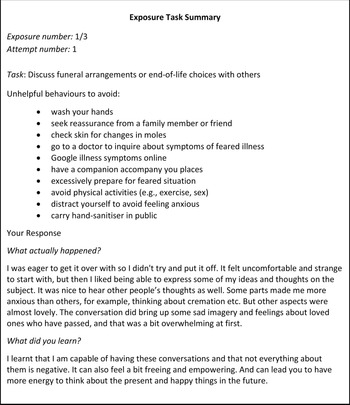
Part 5 starts with a rationale for exposure therapy, in addition to psychoeducation regarding how to conduct an exposure task. Participants then select an avoided situation from their unique list of avoided situations created by their earlier completion of the DBQ. In response, the programme creates an exposure task for the participant to complete. After each exposure task, participants complete a written exercise about how the task went and what they learned. The programme also determines whether any exposure tasks should be repeated, prior to recommending a new exposure task, based on whether the participant responds ‘yes’ or ‘no’ when asked ‘Do you think you would still avoid this situation?’. After successfully completing three distinct exposure exercises, the participant can proceed to the next module. The most commonly selected exposure exercises were ‘think about a loved one dying’, chosen by three users and ‘Watch a film or TV show with a character who is dying’, chosen by two users. Figure 2 demonstrates an example of an exposure task completed by User 3, and her written responses following the task.
An example of an exposure task the programme created for User 3, and the user's responses following the completed task.

Part 6: Living life to the fullest
Part 6 assists participants in increasing their sense of meaning in life, by having participants identify their own personal values from a list and attempt to practice living in accordance with these values. Participants are asked to rank the importance of a list of values and their perceived success in living with this value in the last month. Next, they are tasked with choosing three specific values to work on for the next week and are asked to write a goal for each. This focus on values is based on the idea that behavioural strategies for improving general quality of life should be included alongside death anxiety treatments (Furer et al., Reference Furer, Walker and Stein2007). It is also consistent with arguments that these treatments may benefit from including value-based components (Iverach et al., Reference Iverach, Menzies and Menzies2014). This may help create a sense of meaning in life, which has been shown to protect individuals from death anxiety (Routledge & Juhl, Reference Routledge and Juhl2010; Simon, Arndt, Greenberg, Solomon, & Pyszczynski, Reference Simon, Arndt, Greenberg, Solomon and Pyszczynski1998).
User 1 selected ‘bravery’, ‘love’ and ‘community’ as the three values he intended to work on in the next week, and wrote goals, such as ‘Become a member of the local surf lifesaving club’. User 3 selected ‘generosity’, ‘fun’ and ‘bravery’, and her goals included ‘Encouraging myself to choose a few key household activities that I have been avoiding for a long time due to fear’. When they returned to the programme after a week, three users’ scores reflected mixed improvement compared with their previous ‘success’ ratings for each value. As a result, ODA prompted these users to work on their values again the following week.
Part 7: Relapse prevention
The final component briefly reviews the previous components of the programme and provides the participant with strategies for relapse prevention. This section opens by outlining the differences between a lapse and relapse and encourages realistic thinking if one encounters a lapse, rather than catastrophising. Participants are reminded to be aware of periods of stress, which may cause their anxiety to increase, and to anticipate and plan for such times. This component also encourages users to identify and address other factors contributing to stress (e.g., lack of sleep or free time) and re-iterates the importance of not avoiding situations due to anxiety. Relapse prevention has been argued to be a central part of interventions targeting anxiety-related conditions (Scholten et al., Reference Scholten, Batelaan, van Balkom, Penninx, Smit and van Oppen2013) and is a common component of many online programmes (McCall et al., Reference McCall, Richardson, Helgadóttir and Chen2018; Titov et al., Reference Titov, Dear, Schwencke, Andrews, Johnston, Craske and McEvoy2011).
Other features of ODA
In addition to the seven structured modules targeting death anxiety, ODA also includes two novel, unique types of tasks. These are described below.
Reflection tasks
Reflection tasks are written exercises which appear at various points throughout OAD. The programme includes a total of six reflection tasks, which are presented between Part 2 and Part 5. They present the user with relevant quotes (e.g., ‘You may leave this life at any moment: Have this possibility in your mind in all that you do or say or think’ by Marcus Aurelius), short videos (e.g., Richard Dawkins reading aloud from Unweaving the Rainbow)Footnote 2 and music (e.g., the song ‘(Don't Fear) The Reaper’, by Blue Öyster Cult), all of which specifically focus on death. They then encourage a written reflection in response to a prompt question. The reflection tasks are designed to introduce the user to different perspectives on death, such as those drawn from philosophical approaches (e.g., stoicism), and to prompt reflective in programme responses. They are scattered throughout the programme in order to offer alternative perspectives on death, which do not fit into the standard CBT psychoeducation components, as well as to offer some respite amidst the longer sections of the programme (i.e., those involving repeated cognitive challenging exercises and multiple exposure tasks).
For example, in response to the above quote from Marcus Aurelius, a reflection task asked ‘How would your life be different if you truly kept in mind the fact that you could die at any point, as could those around you?’, User 2 responded: ‘So much … I'd worry less about the kids doing their own thing, being on their own, holidaying on their own. I'd probably travel more, ski more if I didn't fear some of the potential outcomes. I'd argue less, not worry about the small things … all the obvious stuff … I'd be less uptight, cook less family meals, clean less’. User 3 wrote that they would ‘have more patience and want to spend more quality time with loved ones and less time worrying about unimportant things. Spend more time playing and laughing. Value intimate moments more’.
Expansion tasks
Unlike reflection tasks, expansion tasks are introduced as optional exercises that participants can choose to complete outside of the programme itself. These are optional primarily due to the length of the materials (e.g., films and books). It is therefore up to the user's discretion as to whether they would like to seek out these materials. Thus, proceeding to the next part of the programme is not contingent in any way on completing an expansion task.
The first six parts of the programme introduce one expansion task each. Thus, ODA recommends a total of six expansion tasks, including three books, two films, and one audio recording of an interview with existential psychotherapist Irvin Yalom. Each expansion task was included to offer an alternative perspective on death, such as using humour (e.g., the book Everybody Dies: A Children's Book for Grown Ups, by Ken Tanaka), attempting to induce gratitude for existence in the face of death (e.g., the films Blade Runner and Up, and the book Gratitude, by Oliver Sacks), or being specifically designed by the creator to help alleviate fears of death (e.g., the book Staring at the Sun, by Irvin Yalom). Each expansion task features relevant reflection questions on the page for the user to return to at a later date if they do choose to complete an expansion task.
For example, in response to the aforementioned audio-recorded interview, users were asked to reflect on the concept of ‘rippling’ that Yalom discussed. User 1 responded: ‘The concept of rippling does bring some comfort. Rippling in my life would occur through my children. I like the idea of expanding my rippling effect to a broader group of people. I may do this through increased community involvement from the values identified earlier in this part’. User 3 responded: ‘My care for animals I think can be attributed to conversations with my parents when I was little and this has continued to ripple into my husband's life too. I find the notion of rippling very comforting and empowering on the whole’. User 4 wrote a lengthy reflection on rippling, in which she stated: ‘I am very grateful to have people approach me and tell me that they are so inspired by the work that I do that they have been inspired to do something or to care, or to carry on these values’, concluding with ‘we are all in the end a part of each other’.
Discussion
The present report aims to outline the development of the ODA programme, which is the first online treatment to specifically target fears of death. Furthermore, examples from four users were reported to give an indication of the content of the programme and how it individually tailored the experience to the participant's issues.
The limitations of the current study should be acknowledged. While the clinical trial is still underway, of those who have currently commenced the programme, 33% have reached the end, whereas 50% have discontinued, and 17% are still engaging with it. While this completion rate may seem low, it appears substantially more promising than the average dropout rate of 74% previously found in reviews of trials for standalone online programmes (Richards & Richardson, Reference Richards and Richardson2012). Furthermore, the current completion rate is comparable to the 27.7% found for Overcome Social Anxiety, which has demonstrated the highest real-world completion rate of any standalone online programme (McCall et al., Reference McCall, Helgadóttir, Menzies, Hadjistavropoulos and Chen2019). Thus, while the current attrition rate is not inherently a limitation, it is important to understand potential reasons for participant dropout. In the present clinical trial, it was not possible to collect evaluative feedback from those who did not complete, which is indeed a limitation. It is therefore difficult to identify what features may be most relevant to include in any future iterations of the programme. Future research should aim to interview participants who discontinue, in order to establish potential areas for improvement in the programme. In a similar vein, no follow-up data are available for the present trial. Future research (and subsequent phases of the clinical trial) should aim to collect follow-up data, so as to examine whether any treatment gains are maintained over time.
Having acknowledged these limitations, the potential strengths of the programme should be noted. ODA is based on CBT, which has been shown to be the most evidence-based treatment for death anxiety (Menzies et al., Reference Menzies, Zuccala, Sharpe and Dar-Nimrod2018). Furthermore, the exposure therapy tasks are individually tailored to the participant, as are the cognitive challenging exercises. This marks a significant departure from many common online treatments for anxiety (Fleming et al., Reference Fleming, Bavin, Lucassen, Stasiak, Hopkins and Merry2018). So too does the programme's creation of an individualised formulation of the user's anxiety (McCall et al., Reference McCall, Richardson, Helgadóttir and Chen2018). In addition, ODA provides corrective feedback on thought challenging exercises, with users being presented with sample answers to help them challenge each of their maladaptive beliefs concerning death. Lastly, the programme is standalone and completely automated, needing no additional input or support from a therapist. This ensures that ODA has maximum scalability in real-world settings.
Recent research has emphasised the importance of addressing death anxiety in treatment, given its argued status as a transdiagnostic construct (Iverach et al., Reference Iverach, Menzies and Menzies2014). This is particularly the case given the possibility that untreated fears of death may be contributing to the high recurrence of mental illnesses and the ‘revolving door’ phenomenon observed in clinical services (Iverach et al., Reference Iverach, Menzies and Menzies2014, p. 590). However, until now, no self-guided therapist-free treatment exists for this central transdiagnostic construct. Furthermore, there is increasing emphasis on the need to develop effective online treatments for mental health difficulties, due to the cost-effectiveness, scalability and accessibility of internet-based interventions (Fleming et al., Reference Fleming, Bavin, Lucassen, Stasiak, Hopkins and Merry2018; McCall et al., Reference McCall, Helgadóttir, Menzies, Hadjistavropoulos and Chen2019). The ODA programme aims to address these issues.
The efficacy of the treatment remains to be seen. Future research with treatment-seeking individuals is needed to evaluate the impact of ODA on death anxiety. Such research may want to probe clients’ specific expectations of their treatment, as well as their goals, to allow for improvement of the programme (Ritterband, Thorndike, Cox, Kovatchev, & Gonder-Frederick, Reference Ritterband, Thorndike, Cox, Kovatchev and Gonder-Frederick2009). Further study is also necessary to examine whether an improvement in death anxiety as a result of the treatment helps to reduce other mental health symptoms or prevent relapse, consistent with theoretical arguments (Iverach et al., Reference Iverach, Menzies and Menzies2014).
Funding
This research received no specific grant from any funding agency, commercial or not-for-profit sectors.
Conflict of Interest
The authors declare no conflict of interest.