INTRODUCTION
Breast cancer is the most common cancer among women in all five major racial and ethnic populations (Howe et al., 2001), with an estimated 213,000 new cases diagnosed each year (American Cancer Society, 2006). Although White women are more likely to develop breast cancer, incidence rates in African American women under 40 exceed those of White women (American Cancer Society, 2005a). In addition, African American women are more likely to die of breast cancer than are women of any other racial or ethnic group (American Cancer Society, 2005b). Among Hispanic women, breast cancer is diagnosed at a later stage than among non-Hispanic White women and is the leading cause of cancer death (American Cancer Society, 2003). With an estimated 5-year survival rate of 88% for all races, 2.3 million American breast cancer survivors represent the largest subgroup of cancer survivors (American Cancer Society 2005a, 2006).
How the experience of being diagnosed and treated for a potentially life-threatening illness affects the quality of life of these survivors has raised important questions. Health-related quality of life (HRQL) has been defined as the extent to which a person's usual or expected physical, emotional, and social well-being is affected by a medical condition and/or its treatment (Cella, 1998). The HRQL of breast cancer survivors has been the subject of considerable research, much of it focused on the prevalence and patterns of functional, physical, and psychosocial sequelae (Canales et al., 1995; Warnecke et al., 1996; Ferrell et al., 1997; Cella, 1998; Ganz et al., 1998, 2003; Kissane et al., 1998; Mols et al., 2005), as well as the factors that enhance or mitigate such sequelae, including primary and adjuvant treatment, age, marital status, and menopausal status (Schover, 1994; Moadel et al., 1995; Andrykowski et al., 1996; Moyer & Salovey, 1996; Carpenter, 1998; Carver et al., 1998; Meyerowitz et al., 1999; Vacek et al., 2003).
There is growing evidence that ethnic minority and underserved breast cancer survivors may be at even greater risk for HRQL impairment than Caucasian cancer survivors (Rodrigue, 1997; Ashing-Giwa, 1999; Ashing-Giwa et al., 1999; Bourjolly et al., 1999; Spencer et al., 1999; King et al., 2000; Aziz & Rowland, 2002; Moadel et al., 2002a; Culver et al., 2004; Baker et al., 2005; Eversley et al., 2005). Likewise, in a psychosocial needs assessment, we found that ethnic minority cancer survivors report greater needs for information, emotional support, practical assistance, and spiritual support in their cancer care (Moadel et al., 1999, 2007). Although previous research offers key directions about which areas of psychosocial impairment and need to address, little is known about how the cancer care system can implement such interventions to be responsive to culturally relevant needs. Understanding the context in which ethnic minority cancer patients perceive, experience, and respond to HRQL challenges may provide a much needed roadmap for developing informed practice guidelines.
Assessing the Quality of Life Experience after Breast Cancer
Qualitative methods are important to uncovering unidentified themes, influencing new hypotheses, and guiding interventions (Gilchrist, 1993; Waxler-Morrison et al., 1995). Qualitative research has been acknowledged as revealing the meaning of breast cancer in ways not assessed in quantitative studies (Mathews et al., 1994). In particular, focus group, interview, and other qualitative research approaches have helped illuminate a number of relevant issues among ethnic minority breast cancer survivors including patient assertiveness (Adler et al., 1998), decision making following breast symptoms (Mathews et al., 1994; Facione & Giancarlo, 1998), the social context around cancer and HRQL (Moore, 2001; Lopez et al., 2005), sexual functioning, intimacy and personal issues (Wyatt et al., 1998; Wilmoth & Sanders, 2001), and cultural and socio-ecological aspects of HRQL (Ashing-Giwa & Ganz, 1997; Ashing-Giwa et al., 2004). Although these studies are beginning to provide invaluable insights into the meaning of breast cancer survivorship to ethnic minority women, there is a clear call for more qualitative research with such populations to provide a more complete picture (Farmer & Smith, 2002).
One area in which little qualitative investigation exists is the impact of illness-specific effects, including physical changes (e.g., fatigue, weight gain), emotional symptoms (e.g., hopelessness, anxiety), treatment side effects (e.g., lymphadema, hair loss), and menopausal symptoms (e.g., hot flashes, vaginal dryness), on the Hispanic and African American breast cancer survivor. The present study seeks to address this area by using an inductive approach to the content analysis of qualitative data gathered through semistructured interviews.
Current Research Approach
This article presents one component of a comprehensive study of HRQL issues among breast cancer survivors in the Bronx, New York. Among a Bronx population of nearly l.4 million people, 23% are foreign born and 48% are Hispanic among whom three-quarters are Spanish speaking and nearly half identify themselves as of Puerto Rican ethnicity (U.S. Bureau of the Census, 2000). Further, 36% self-identify as Black or African American. The median household income is $23,949 with 31% of residents living below the poverty level and 41% over age 25 lacking a high school diploma (U.S. Bureau of the Census, 2000). As an extension of a quantitative investigation on HRQL among 248 breast cancer patients as measured in a symptom checklist (Moadel et al., 2002a; 2002b), a qualitative study of a subsample of this underrepresented population was undertaken. The primary aim of this qualitative study was to describe the nature and experiential impact of physical symptoms, emotional symptoms, treatment side effects, and menopausal symptoms on African American and Hispanic breast cancer survivors. As a secondary aim, it sought to examine illness-related life changes in such areas as relationships/roles, financial stability, and spirituality.
METHODS
Subjects
During March and April 2001, 20 of 34 (59%) breast cancer patients at a major cancer center in the Bronx, New York, consented to participate in the study. Inclusion criteria for this sample of convenience were (1) women over 18 years of age, (2) English or Spanish speaking, and (3) able and willing to give informed consent.
Materials
A semistructured Interview Outline was developed as a guideline and translated into Spanish by a graduate student from Columbia University's Translation Committee, after which it was reviewed by another member of the Translation Committee. The outline provided broad, open-ended, exploratory questions as well as specific probes guided by both the literature and clinical experience regarding HRQL issues about cancer, including physical functioning, menopausal symptoms, sexual functioning, body image, psychological functioning, cognitive functioning, spirituality, financial impact, and role changes. Demographic variables queried were age, self-identified ethnicity, year of diagnosis and stage at diagnosis, religion, country where raised, education, employment, and marital and parental status.
Procedure
After obtaining IRB approval, trained data collectors recruited patients in the waiting rooms of breast clinics during select clinic hours at two medical facilities. Data collectors explained the general nature of the study, administered informed consent in the patient's language of preference and scheduled a telephone interview appointment, a written confirmation of which was given to the patient. Patients were asked to participate “in an interview to help us understand the physical and emotional changes they experienced since their illness.” The choice to conduct the interview by telephone was based on previous research documenting the advantages of phone methods including reduced interviewer bias (Bauman, 1993; Scudds & Pederson, 1996), efficient use of interviewer time and resources without sacrificing quality of the data collected (Oppenheim, 1992; Chen, 1996), and response rates over 70% with ethnically diverse populations (Allison & Yoshida, 1989; Marin et al., 1990; Bauman, 1993).
The English telephone interviews were administered by the first author. A bilingual female psychology graduate student with telephone interviewing experience administered interviews in Spanish and was trained utilizing a recommended telephone interviewing orientation session conducted prior to the study (Frey, 1989). To ensure standardization, training focused on the types of respondents to be interviewed, ethical considerations, and telephone data collection (Naranjo & Dirksen, 1998; Chen, 1996), and was supplemented by role-playing in both English and Spanish (Chen, 1996).
Data Analytic Approach
Qualitative data were recorded verbatim onto the Interview Outline and then transcribed prior to coding. A line-by-line content analysis of transcribed data was performed to identify topics, themes, and patterns of HRQL issues raised during the interview process. Based on the patterns that emerged, a categorical organizing scheme was developed that included the following HRQL domains: physical, psychological, cognitive, sexual, social/functional, and spiritual/existential. Coding of the data according to categories was done by the first author and a psychology graduate student, blind to the nature of the study. For the full-sample coding, the value of kappa was .81, indicating excellent interrater agreement in the domain totals (Cohen, 1960). For the secondary coding of data that was done separately by ethnic group, the value of kappa was .84 for the Hispanic subsample and .68 for the African American subsample, indicating excellent to good agreement among the domain totals (Cohen, 1960).
The most salient quality-of-life issues were identified by percent of interviewee endorsement and are documented with direct quotes from interviewees.
RESULTS
Response Rate
Of 34 eligible women approached for study, 9 (26%) refused. Of those refusing, 7 (78%) were English speaking and 2 (22%) Spanish speaking. Reasons for refusal among English-speaking women included one not interested, one too anxious/distressed, and five no reason given (71%). For the two Spanish-speaking women, reasons for refusal included leaving the country and no reason given.
Of the 25 women who agreed to participate, two lacked operating phones and one woman, recently hospitalized, was too ill to participate in the interview, rendering them ineligible, and two people could not be contacted within three attempts. The resulting response rate was 65%.
Sample Characteristics
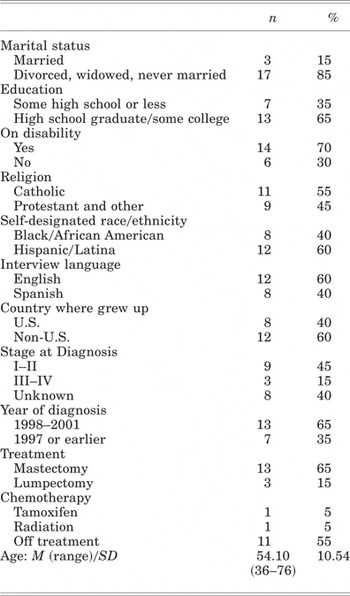
Sociodemographic characteristics of minority breast cancer survivors who completed the telephone interview (n = 20) are shown in Table 1. Respondents were primarily Hispanic (60%), not married (85%), unable to work due to disability (70%), first-generation immigrants (60%), and high school graduates (65%). Most were diagnosed between 1998 and 2001 (65%); a large number did not know their stage of disease (40%), had been treated with mastectomy (65%), and were no longer on treatment (55%). Ethnic differences included education, with 88% of African Americans having more than 12 years of education compared with 50% of Hispanics; 50% of African Americans compared to 33% of Hispanics were raised in the U.S. and 75% of African Americans were Protestant compared to 75% of Hispanics who were Catholic.
Sociodemographic and medical characteristics of interview respondents (n = 20)

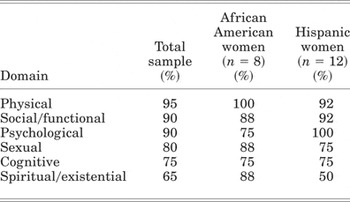
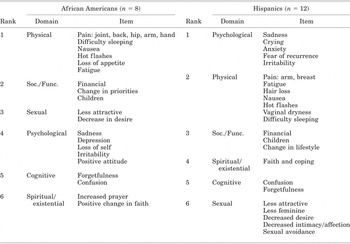
Table 2 presents the endorsement of HRQL domains by ethnic group and Table 3 salient issues by HRQL domain, as endorsed by telephone interviewees.
Endorsement of quality of life domains by ethnic group (n = 20)

Comparison of salient issues for African American and Hispanic breast cancer survivors

Quality of Life Domains
Physical Well-being
Probe: “Have you noticed any changes in your body since your breast-related illness, for example, the way it looks, feels, functions?”
As expected, physical symptoms were the most frequently reported, with nearly all of the women, 95%, reporting one or more symptoms. Pain was a major source of discomfort, with arm pain and swelling a frequent complaint. Nausea was the most common treatment side effect cited; additionally, menopausal symptoms, including hot flashes and vaginal dryness, were problematic. Below are some statements that best exemplify these physical symptoms:
“I can't use my arm the way I used to.”
“The tendons and ligaments of my hand pained a lot and I had to wear a splint.”
“I feel tired all the time.”
“I'm sweating a lot; I get dripping wet.”
Social/Functional Well-being
Probe: “How has your breast-related illness changed your life, such as relationships, social activity, job, money?”
A second domain of importance raised by 90% of these women was in the area of social and daily functioning. Specifically, themes of changes in priorities and/or lifestyle, financial issues, including the fear of losing one's independence, and family distress, particularly in terms of worries about children, were voiced in emphatic terms:
“I put my kids before me.”
“I'm worried about paying the rent; disability payments aren't enough.”
“I don't have lights in my apartment.”
“I'm afraid to lose my independence because I can't work.”
“Haven't felt like doing much, going out dancing or social activities.”
“It takes so much out of your normal living.”
Psychological Well-being
Probe: “Going through diagnosis and treatment of a breast-related illness can be hard to cope with emotionally. Have you noticed any changes in yourself and how you feel emotionally?”
The third most prevalent topic was the emotional toll exacted by the experience of breast cancer diagnosis and treatment. For the 90% of the survivors who expressed psychological distress, a theme of strong negative emotions described their feelings. Sadness was overwhelmingly singled out, either alone or in combination with crying, tension, depression, and irritability. Although some women reported reserves of strength and positive attitude, additional themes which presented included fear of recurrence and a sense of the loss of self:
“At first I felt depressed, sad and cried at moments but I tried to lift myself up immediately.”
“I feel frustrated; why me?”
“I feel like I'm in a war against cancer.”
“I feel stronger; I don't want to just lay there.”
“Every day it's in the back of my mind; it's always there.”
“I don't feel like myself at all.”
Sexual Well-being
Probe: “Many women who have a breast-related illness notice sexual changes. Have you noticed any changes in sexual function since your illness?”
Changes in sexuality were acknowledged by 80% of the women, with the primary theme centered around body image distress. Decreased sexual desire was noted by 50% of the interviewees. A decrease in sexual activity was frequently mentioned but not regarded as particularly problematic:
“(Decrease in sexual activity) doesn't bother me because I've been sick so long.”
“Not being intimate like I used to be. Not the (name) that I was.”
“My breasts were my pride and joy.”
“Don't feel like a woman anymore.”
“I feel less attractive especially because of the loss of my hair.”
Cognitive Well-being
Probe: “A serious illness and its treatment can sometimes make it difficult to think clearly and remember things. Have you noticed any changes in how well you think or with your memory?”
Cognitive issues were acknowledged by 75% of the women, with the predominant symptom being forgetfulness for 50% of those interviewed:
“Not being able to remember people's names is upsetting.”
“I used to read two to three books at a time; now I can't remember from one page to the next.”
Spiritual/Existential Well-being
Probe: “Do you have any thoughts you would like to share about your quality of life since your illness and treatment?”
For these women, the spiritual/existential was an important domain, with 65% of the women raising such issues in response to this open-ended probe. The theme of positive spiritual change was reiterated repeatedly, with gratitude toward God being voiced, as well as faith as a source of strength during this difficult time. None of the women described a loss or crisis of faith but rather a strengthening of their beliefs. An additional theme was an increased awareness of death:
“I am very thankful to God that they caught it in time and were able to help me.”
“I have had such faith in God which helps to get me through.”
“I am very thankful to God because my illness did not affect me mentally or physically.”
“I read the Bible more often. I have greater involvement (with God) than before.”
Quality of Life Domains by Ethnic Group
African American Women
For African American interviewees (n = 8), physical issues had the greatest impact on quality of life, with every woman indicating one or more symptoms as changing their lives. A major theme was that of pain: back and hip pain and pain in the arm and hand. Another disturbing physical symptom was nausea and fatigue as a side effect of treatment:
“I can't do anything too long because of back pain.”
“The continuous annoying pain to my body (is upsetting).”
“I feel very lazy; don't do anything but feel tired.”
“I have no appetite; lost my taste.”
The social/functional represents the next most commonly endorsed (88%) domain for these women, with both financial issues and changes in priorities, such as postponing returning to school, changing jobs, and saving to buy a house, impacting 50% of African American interviewees. Concern about children was another prevalent theme:
“I can't be as active as before. There's a lot I planned to do after the treatment, but it's hard to get started.”
“I just want the strength to see my daughter grow to age three.”
“When I'm uncomfortable, I don't feel like going anywhere.”
The sexual domain was also reported as an area of concern by 88% of the interviewees, with body image changes, specifically feeling less attractive, a strong theme for 63% of the women:
“I don't want to look at myself; I can see the sickness in my face.”
“Always something (physical) reminds me of what I've been through.”
“I'm just not interested (in sex).”
“I have more of an awareness of my body.”
African American breast cancer survivors indicated that psychological issues affected 75% of them, with the main theme being sadness:
“Sometimes I feel sorry for myself.”
“I'm feeling depressed.”
“I've seen so much death; have to just get on with your life. Why worry about it?”
Cognitive concerns about forgetfulness and confusion occurred in 75% of these women:
“My memory is terrible.”
Seven of the eight participants referred to spiritual changes including a positive change in their faith experience, as well as increased prayer and Bible study:
“Pray to God; trust Him. Just keep serving the Lord.”
“I pray more.”
“I'm not afraid of dying.”
Hispanic Women
The primary domain of concern was the psychological, as noted by every Hispanic breast cancer survivor (n = 12). The main theme again was sadness, coupled with crying and anxiety, as expressed in their own words:
“It's been very difficult because it's a very drastic change in my life. I tried to commit suicide but saw a psychiatrist; I didn't want to live much more.”
“I feel very sad because I never thought it would happen to me.”
“I was afraid very much that it would recur.”
Positive statements expressed less frequently included the following:
“I always had the strength and force to move on.”
“I am very determined. I live for my kids.”
The physical domain was the next most commonly endorsed, as indicated by 92% of the women. Pain was again the main theme, particularly arm and breast pain; fatigue was also a major theme, along with hair loss and nausea:
“Have lots of pain when I lift my arm.”
“I can't work because of my hand.”
Menopausal symptoms, including hot flashes and vaginal dryness, were also experienced as physical symptoms by Hispanic interviewees:
“My head felt very hot, kind of like hot flashes in my face.”
“Had lots of vaginal dryness when having sex and pain which made me scared that cancer would recur in my genitals, in the vagina.”
At a high level of concern, 92%, Hispanic women identified social/functional issues as of major importance. A central theme was financial distress for 67% of the women. Two additional themes were family, particularly children, and changes in lifestyle, such as less socializing and inability to work:
“I'm very worried about the future and money. My financial situation has become very difficult.”
“I worry about what my daughter and grandchild will do if I die.”
“The support of the family is so important.”
Another survivor, after having put her plans to buy a house and return to college on hold, experienced a resurgence:
“Had to change the goals in my life. Now feel again like I can go on with my life.”
Spiritual/existential issues represented a high priority among half of the women who indicated the importance of this area of their lives. Faith as a source of strength in coping with the diagnosis and treatment was a major theme:
“The faith in the Lord has made me strong. Having faith and being positive helps a lot. That's made me survive.”
“I'm very thankful to God that I was given a second chance.”
Cognitive issues, primarily forgetfulness, were a concern to 75% of these respondents:
“I'm very confused; I don't know if it's menopause or the chemotherapy.”
The sexual domain affected 75% of the Hispanic breast cancer survivors, with half the women experiencing body image concerns, viewing themselves as both less attractive and less feminine. Major themes of sexual change included decreased sexual activity, intimacy and affection:
“My breasts are completely gone, weak appearing.”
“I feel like less of a woman.”
I can't look in the mirror at my body; I want to have reconstructive surgery because I'm the type of woman this matters to. My sister was ok and at peace with the experience, but not me.”
“I used to have nice big breasts; used to show my cleavage. Using a prosthesis is aggravating.”
Less common were statements of acceptance, such as:
“(Less intimacy and affection,) it doesn't bother me.”
DISCUSSION
Although breast cancer has received a great deal of attention from researchers interested in how diagnosis and treatment affects the HRQL of survivors, the ethnic make-up of the studied population has, in general, lacked representation of women of color. Further, HRQL instruments rarely offer insight into the lived experience of breast cancer and its physical and psychosocial challenges, thus limiting our ability to understand the intervention needs of the ethnic minority population. As part of an effort to enhance our knowledge in this area, the present qualitative study was designed as part of a comprehensive initiative to identify HRQL issues of import and better understand the experience of breast cancer among ethnic minority women.
As guided by previous research, semistructured telephone interviews were conducted with a subsample of African American and Hispanic breast cancer survivors. Although the range of HRQL issues was similar for both ethnic groups, some differences in the saliency of these issues were evidenced between African American and Hispanic women.
Physical symptoms were a critical concern among both groups of women, with specific complaints including joint pain, difficulty sleeping, hot flashes, and decreased sexual desire, highly suggestive of menopause-related factors. This is not surprising given the typically abrupt, severe, and long-lasting menopausal syndrome that women with breast cancer are often predisposed to due to chemotherapy-induced menopause, anti-estrogen treatments, and contraindications to estrogen replacement (Crandall et al., 2004; Glaus et al., 2006; Gupta et al., 2006). These results also support focus-group findings by Wilmoth and Sanders (2001) on the strong effect of menopausal symptoms on African American breast cancer survivors and suggest similar effects on Hispanic women.
Psychological issues were of primary concern to all the Hispanic breast cancer survivors. Hispanic women were more verbal during the interviews than African American women, particularly regarding the emotional toll of this experience. If their high emotional needs are reflective of cultural acceptance of emotional disclosure, as hypothesized by Spencer et al. (1999) and Gotay et al. (2002), future intervention efforts could focus on offering an outlet for emotional expression and examine how such expression impacts distress levels.
Regarding the social/functional domain, financial distress, single-parent childcare issues, and changes in lifestyle and/or priorities were strongly endorsed by both groups. Although socioeconomic status (SES) is typically controlled for in HRQL studies, the saliency of these issues to this population, in conjunction with previous research indicating socio-ecological factors as proximal predictors of HRQL among African American cancer survivors (Hughes & Thomas, 1998; Ashing-Giwa, 1999), raises questions about the appropriateness of that policy with women of color who have had breast cancer. This is particularly crucial with SES, ethnicity, and health outcome being related, with poorer African American women having lower rates of survival than those from higher SES levels and White women overall (Freeman & Wasfie, 1989). It is imperative that cancer care services, including palliative and supportive care, be not only available, but accessible. As such, culturally tailored interventions must include strategies to address the socioeconomic barriers to accessing such care.
As in previous research with Hispanic and African American cancer patients (Wan et al., 1999), spiritual/existential issues were an integral part of the cancer experience in the present study. Eighty-eight percent of African American women, most of whom identified as “Protestant,” voiced primarily positive changes in their faith after the diagnosis and treatment of breast cancer, such as increased prayer. For half of the Hispanic women, most of whom identified as “Catholic,” faith was mentioned as an important way of coping with breast cancer diagnosis and treatment. Previous research has shown religiousness among Hispanic breast cancer patients to be related to measures of hope (Mickley & Soeken, 1993). Existential distress (Spencer et al., 1999) and high spiritual and existential needs (Moadel et al., 1999) previously noted in Hispanic breast cancer survivors may be reflected in the Hispanic women in this study for whom religion or spirituality was not indicated as a way of coping. Incorporating spiritual support and resources in the cancer care setting may provide a potent way to promote psychosocial adjustment and well-being for women of color after breast cancer. This could include expanding the role of chaplaincy, offering spiritual and existential psychotherapy (e.g., Breitbart et al., 2004; Moadel et al., 2005), or encouraging patients to utilize their own spiritual resources. As an example of this approach, a religious African American woman with advanced lung cancer fearful of receiving test results was encouraged by her psychologist (author A.B.M.) and oncologist to bring a member of her church with her to the appointment; she brought her minister and despite “bad news” she felt the support she received greatly helped her to cope with it.
This study is limited by the small size of the sample of convenience utilized, as well as variability in time since diagnosis, treatment, and stage at diagnosis of the respondents. The high percent (40%) of women who were not aware of their disease stage is striking and may speak to a need for improved communication between patient and physician as well as greater understanding about the information needs and coping styles of patients of color. Generalizability is limited to urban African American and Hispanic breast cancer patients, with Hispanics being primarily represented by Puerto Rican and South American backgrounds. A strength is that both English- and Spanish-speaking patients are represented. Sociodemographic information for those who refused participation (26%), other than language of preference, was not available; any systematic differences between the groups that might bias the conclusions are not known. The educational level of respondents was higher than anticipated based on Census data and may preclude generalization to women of color with less education.
Further exploration of the most salient HRQL issues for these understudied and medically underserved populations will enable the development of appropriate clinical interventions, including referrals to social work, community resources, and/or pastoral counseling. The design and validation of instruments to accurately measure universal and culture-specific quality of life of breast cancer survivors from multiethnic and/or immigrant backgrounds is complex. Qualitative research can contribute by giving voice to populations currently underrepresented in HRQL research by providing an opportunity for partnership and collaboration throughout the research process, thereby enhancing both validity and generalizability of the research.