


In cattle, measuring in vitro digestibility using the gas production (GP) technique is valuable because it facilitates the screening of large numbers of dietary interventions using rumen inoculum derived from a small number of animals. However, the collection of rumen contents is invasive, usually requiring fistulated animals, making the exploration of alternative inoculum sources ethically and economically valuable. The use of faeces in GP systems has been investigated in mature cattle, where faecal inocula were found to have a lower fermentative capacity and different rates of degradation compared to rumen liquor, in spite of strong correlations between inocula for GP: R 2 = 0.83 in grass incubations and R 2 = 0.94 in maize silage incubations, and organic matter digestibilities: R 2 = 0.81 in grass incubations and R 2 = 0.92 in maize silage incubations (Mauricio et al., Reference Mauricio, Owen, Mould, Givens, Theodorou, France, Davies and Dhanoa2001; Zicarelli et al., Reference Zicarelli, Calabro, Cutrignelli, Infascelli, Tudisco, Bovera and Piccolo2011). To our knowledge, the use of faecal inoculum to model digestibility in calves has not been investigated. Neonatal calves are pre-ruminants with underdeveloped reticulorumens and a digestive tract akin to monogastrics (Drackley, Reference Drackley2008). The microbial populations found throughout the calf digestive tract differ from, and are more dynamic, than those found in mature cattle (Anderson et al., Reference Anderson, Nagaraja, Morrill, Avery, Galitzer and Boyer1987). This means that results from in vitro GP experiments using rumen inoculum from mature cattle may not be translatable to calves and, as such, defining a method to accurately model digestibility in the calves is needed. Notably, the GP technique has been successfully adapted to use faecal inoculum from monogastrics, including pigs (Bindelle et al. Reference Bindelle, Buldgen, Lambotte, Wavreille and Leterme2007), and hindgut fermenters, such as horses (Lowman et al., Reference Lowman, Theodorou, Hyslop, Dhanoa and Cuddeford1999). Physiological similarities between monogastrics and pre-ruminants could mean that faeces have more utility in calf models compared with models measuring digestibility in mature cattle. The aim of this pilot study was to obtain a preliminary assessment of an in vitro system that uses faeces as a microbial inoculum to model digestibility in calves, by assessing and modelling GP profiles from faecal and rumen inocula from pre-weaned and weaned dairy calves.
Materials and methods
Twenty-five Holstein Friesian bull calves aged 19 ± 5 days, weight 52 kg (SD = 18), were obtained from a single farm. Calves were individually housed, given ad libitum access to barley straw, water and starter concentrates (I'Anson Early Weaner Pellets, 18% CP, 8.75% CF, 4.25% fat, 7.5% ash), and fed 6 l of milk replacer (Volac Heiferlac, 26% CP, fat 16% fat, 19.7 Mj ME/kg DM) split in two equal feeds in the pre-weaned period, before abrupt weaning at 48 ± 5 days-old. The ages, weights and starter intakes of calves at culls are displayed in the supplementary file associated with this paper which can be accessed through the DOI in the notes section of this communication. Upon arrival to the farm, calves were blocked by age and then randomly allocated to three balanced cull groups. Rumen and faecal digesta were collected at three time points, when five calves were culled at 27 ± 5 days-old (week 4), ten calves at 48 ± 5 days-old (week 7) and another ten at 90 ± 5 days-old (week 13). All animals remained healthy throughout the trial with no cases of morbidity or milk refusals observed. GP was performed using the ANKOMRF system (ANKOM Technology, USA), adapted from Theodorou et al. (Reference Theodorou, Williams, Dhanoa, McAllan and France1994). Under a stream of CO2, 10 ml of rumen digesta was collected from the ventral sac of each calf and 20 ml of faeces was collected rectally. Rumen digesta and faeces were each combined with 50 ml of buffered mineral solution, the composition of which is described by Theodorou et al. (Reference Theodorou, Williams, Dhanoa, McAllan and France1994), and homogenised for 30 s using a blender. Solutions were strained through four layers of cheesecloth and 50 ml of the strained fluid was poured into 137-ml glass bottles. Each bottle contained 0.5 g calf starter, milled to pass through a 2-mm sieve and sealed in F57 fibre bags. The headspace of each bottle was flushed with CO2 prior to the attachment of ANKOMRF modules and bottles were placed in a water bath set to 39°C, for 24 h. The timescale for incubations was decided due to starter (assumed to be rapidly digestible), rather than forage, being used as a substrate. This does limit the time available to observe effects of inocula on the slowly degradable fraction of the substrate, with typical in vitro incubations for mature cattle lasting 72 h. Cumulative gas pressure from each module was measured automatically at 10 min intervals and, after incubations, F57 bags were removed from bottles, rinsed in de-ionised water and dried in a 55˚C oven overnight for the calculation of dry matter disappearance (DMD). Gas pressure was converted to moles using the Ideal Gas Law:
 \begin{equation*}n = PV/RT\end{equation*}
n = gas produced (mol)
P = pressure (kPA)
V = head-space volume in each bottle (l)
R = gas constant (8.314472 L·kPa·K−1 mol−1)
T = temperature (K)
Moles were converted to ml using Avogadro’s law where 1 mol of gas occupies a volume of 22.4 l at 273.15 °K and 101.325 kPa:
 \begin{equation*}y = n \times 22.4 \times 1000\end{equation*}
y = gas produced (ml)
n = gas produced (mol)
GP kinetics in ml were modelled using the SAS NLIN procedure (SAS University Edition, SAS Institute Inc., USA), to estimate the parameters of the Cumulative Gas Production Equation of Schofield et al. (Reference Schofield, Pitt and Pell1994):
 \begin{align*}Y & =\,\,(a/\!\left( {1 + \exp \left( {2 + 4 \times b \times \left( {c - t} \right)} \right)} \right) \nonumber\\
& \quad + (d/(1 + \exp \left( {2 + 4 \times e \times \left( {c - t} \right)} \right))
\end{align*}
Y = cumulative gas produced (ml)
a = volume of gas produced from the rapidly degradable fraction (ml)
b = degradation rate of the rapidly degradable fraction (h−1)
c = lag time (h)
t = time (h)
d = volume of gas produced from the slowly degradable fraction (ml)
e = degradation rate of the slowly degradable fraction (h−1)
Data were subjected to Shapiro–Wilks normality tests and found to be normally distributed. Comparison between estimates of each of the parameters of the Cumulative Gas Production Equation for rumen and faecal inocula of GP kinetics were performed using one-way ANOVA in R (R Core Team, 2024). The relationship between rumen and faecal GP kinetic parameters, total GP and DMD was estimated using linear regression in R:
 \begin{equation*}lm\left( {faecal rumen,{\text{ }}data = CalfGP} \right)\end{equation*}
Results and discussion
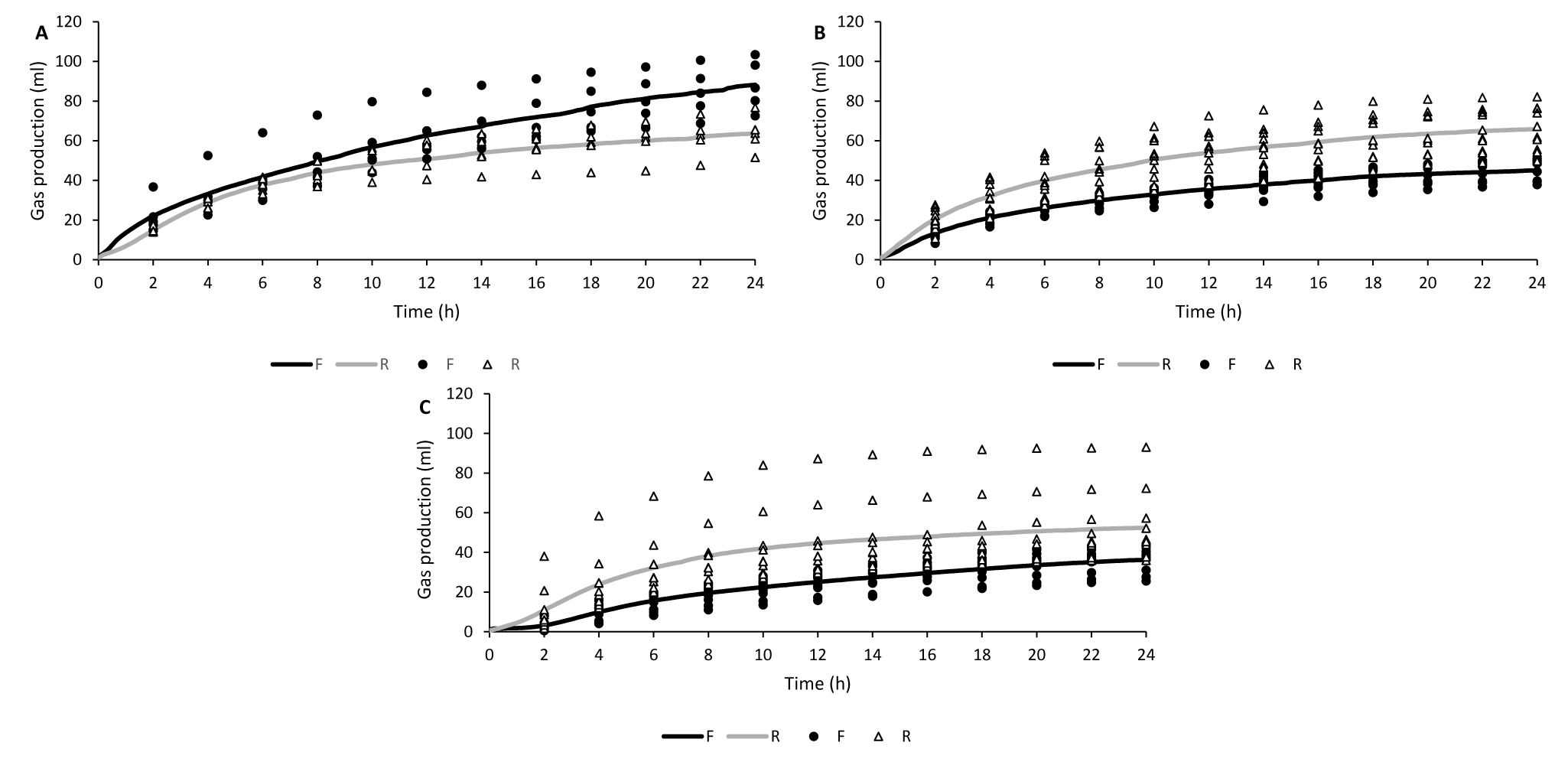
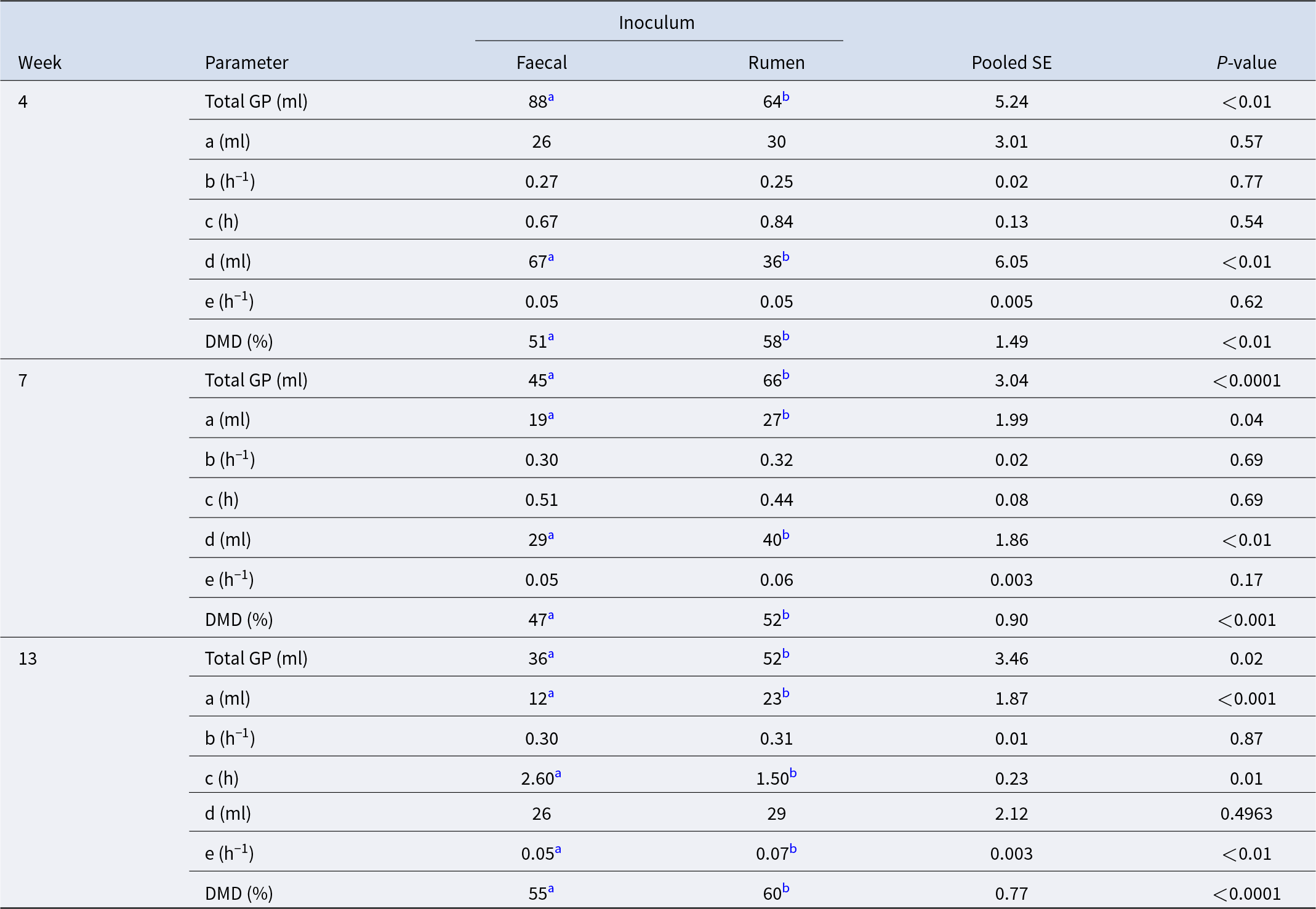
The GP profiles of rumen and faecal inocula at weeks 4, 7 and 13 are shown in Figure 1; total GP and estimates for the parameters of the Cumulative Gas Production Equation of faecal inoculum on rumen inoculum GP kinetic parameters are shown in Table 1; and coefficients of determination between kinetic parameters from faecal and rumen incubations are shown in Table 2. In the pre-weaned incubation, faecal inoculum produced more gas than rumen inoculum, and in the incubations at weaning, and 6 weeks post-weaning, rumen inoculum produced a greater volume of gas that faecal inoculum. As shown in Figure 1, there was large variation in GP between animals for both inocula, especially rumen inoculum at week 13, likely indicative of different levels of rumen development in the calves. Visually, Figure 1 appears to show similar mean GP curves between faecal and rumen incubations; however, the results of linear modelling (Table 2) show a weak, or very weak, relationship between the GP kinetics of rumen and faecal incubations.
Gas production from 0.5 g calf starter incubated for 24 h with faecal and rumen inoculum obtained from Holstein Friesian bull calves. Solid lines show mean gas production measured at 10 min intervals using the ANKOMRF GP system. Symbols show GP from individual modules at 2 h intervals. (A) Inoculum obtained from five 4-week-old calves. (B) Inoculum obtained from ten 7-week-old calves. (C) Inoculum obtained from ten 13-week-old calves.

Estimates of gas production kinetics of 0.5 g calf starter incubated for 24 h, in the ANKOMRF system with faecal and rumen inoculum obtained from Holstein Friesian calves at 27, 48 and 90 days old

DMD, dry matter disappearance; GP, gas production; a, gas derived from the rapidly degradable fraction of substrate; b, degradation rate of the rapidly degradable fraction; c, lag time of incubation; d, gas derived from the slowly degradable fraction of substrate; e, degradation rate of the slowly degradable fraction.
a,b Values in the same row not sharing a superscript are significantly different (P < 0.05).
Coefficients of determination between in vitro gas production kinetic parameters from faecal and rumen content incubations, obtained from Holstein Friesian calves at 27, 48 and 90 days old and incubated with 0.5 g calf starter for 24 h in the ANKOMRF system

DMD, dry matter disappearance; GP, gas production; RSE, relative standard error; a, gas derived from the rapidly degradable fraction of substrate; b, degradation rate of the rapidly degradable fraction; c, lag time of incubation; d, gas derived from the slowly degradable fraction of substrate; e, degradation rate of the slowly degradable fraction.
In the pre-weaned incubation, faecal inoculum produced a significantly greater volume of total gas, with the increased gas predominantly arising from the slowly degradable of fraction of calf starter. There were no differences in the estimates for GP from the rapidly degradable fraction, or the fractional rates of degradation and lag time. This contrasts with studies using faeces from mature cattle, in which faecal inoculum produced less gas and incubations had increased lag times compared with rumen inoculum (Mauricio et al., Reference Mauricio, Owen, Mould, Givens, Theodorou, France, Davies and Dhanoa2001; Zicarelli et al., Reference Zicarelli, Calabro, Cutrignelli, Infascelli, Tudisco, Bovera and Piccolo2011). In pre-weaned calves, increased GP could be indicative of greater microbial activity in faeces, although at week 4 the DMD of starter in faecal incubations was 51%, compared with 58% in rumen incubations, possibly suggesting a less efficient, acetogenic, fermentation pathway from the microbes in faeces.
At week 7, rumen inoculum produced a significantly greater volume of gas than faecal inocula, which could indicate increased microbial activity in the rumens of calves about to be weaned. This was not paired with increased DMD in faecal or rumen incubations, which decreased to 47% and 52%, respectively. In a tandem study, the in vivo total tract digestibility of calf starter was estimated using faecal acid insoluble ash (Van Keulen and Young, Reference Van Keulen and Young1977). At week 7, DMD was estimated to be 62%, standard error of the mean (SEM) = 2.31 (data unpublished), demonstrating that rumen inoculum may be more accurate at predicting in vivo digestibility. The results of Mauricio et al. (Reference Mauricio, Owen, Mould, Givens, Theodorou, France, Davies and Dhanoa2001) show that the effects of faecal and rumen inocula on in vitro feed digestibility in mature cattle are substrate specific, so further investigation into the effect of calf inocula source on the digestibility of other feedstuffs would be valuable. In rumen incubations, modelling estimated significant increases in GP from both rapidly and slowly degradable fractions of calf starter. As with week 4, the rates of degradation of the rapidly and slowly degradable fractions of calf starter, and the lag times of incubations, were similar between inocula, although regression analysis indicated a weak relationship between these parameters. The changes in GP kinetics between weeks 4 and 7 are likely due to the developing gastrointestinal tract and associated microbial dynamics in transition stage calves. If changes in faecal GP could be associated with increasing rumen function in dairy calves, a non-invasive test to inform weaning decisions could be developed. Considerably, more data are required to achieve this; however, given the importance of rumen function for a smooth transition from milk to solid feed, it would be a worthwhile area of research.
At week 13, faecal and ruminal inocula produced the least total gas, 36 and 52 ml, respectively, of the three experiments in the study. This was paired with the highest DMD for each inoculum, 55% for faecal and 60% for rumen, indicating a potential shift in fermentation to more efficient, less gaseous, pathways. In vivo digestibility was estimated to be 68%, SEM 1.25, showing a similar discrepancy between in vitro and in vivo digestibility as week seven. As with weeks four and seven, the relationship between faecal and rumen GP kinetic parameters were weak for all parameters. Modelling estimated that faecal inoculum had a significantly longer lag time than rumen inoculum, 2.6 h compared with 1.5 h, and the rate of degradation of the slowly degradable fraction of calf starter was lower in faecal incubations, 0.05 h−1 compared with 0.07 h−1 in rumen incubations. Six weeks post-weaning, these calves should have rumens functioning in a similar capacity to mature cattle. As such, these results align with studies examining faecal inocula in mature cattle where GP kinetics differ between rumen and faecal inocula (Mauricio et al., Reference Mauricio, Owen, Mould, Givens, Theodorou, France, Davies and Dhanoa2001).
Conclusion
These results indicate that there is a weak, or non-existent, relationship between the fermentative activity of microbes in calf faeces and calf rumen digesta. Differences between faecal and rumen inocula GP kinetics, in both pre-weaned and weaned calves, suggest that faeces is unlikely to be a suitable source of microbes to act as a proxy for rumen digesta in calf rumen models. The replication possible in this study was limited by the number of animals and ANKOMRF modules that could be used, and large variations in GP between animals, likely associated with different stages of gastrointestinal tract development, highlight a challenge of refining a model suitable for calves transitioning from pre-ruminant to ruminant. Further examination into the use of faecal inoculum in pre-ruminant, whole tract digestibility models could be worthwhile, but suitable foregut enzymatic digestion steps would likely need defining.
Acknowledgements
The authors sincerely thank Daisy Taylor for her contribution to the lab work involved in this study.
Funding statement
This study was supported by the University of Glasgow and Alltech as part of a PhD studentship.
Competing interests
None.
Data availability statement
Full data sets from this experiment are deposited in the University of Glasgow Enlighten repository: http://dx.doi.org/10.5525/gla.researchdata.1998.
Declaration of generative AI and AI-assisted technologies in the writing process
The authors did not use any artificial intelligence assisted technologies in the writing process.
Ethics approval
The experiment described in this study was authorised by The University of Glasgow Research Ethics Committee, ref EA07/24, granted: 26 February 2024.


 Open access

