





Introduction
Pediatric transport during high-consequence infectious disease (HCID) incidents presents clinical, developmental, and psychosocial challenges distinct from adult movement.1–Reference Arrington3 Children’s cognitive understanding, communication abilities, emotional regulation, and stress responses require tailored approaches to ensure safety and effective care under biocontainment conditions.Reference Chiu, Goodman, Palacios and Dingeldein4–Reference Gilchrist and Simpson6 They are also highly sensitive to environmental disruption, unfamiliar equipment, and caregiver separation – factors amplified during transport in high-risk infectious contexts.
Despite known differences, national HCID transport systems have historically centered on adult patients, with limited pediatric-specific guidance, equipment, or workforce preparation.Reference Cieslak, Evans and Kortepeter7,Reference Herstein, Stern and Gibbs8 Although pediatric disaster frameworks emphasize family-centered and developmentally appropriate care, these principles have not been consistently integrated into biocontainment planning, leaving gaps in the safe movement of children during HCID responses. No national-level exercise had previously evaluated the operational realities of transporting children within a federally developed biocontainment platform.
The 2025 Tranquil Passport Full-Scale Exercise was the first operational test of the US Department of Health and Human Services (HHS; Washington, DC USA)/Administration for Strategic Preparedness and Response (ASPR; Washington, DC USA) Portable Biocontainment Unit (PBCU)9 and the first to intentionally integrate pediatric actors and caregivers into biocontainment operations.10 Conducted across multiple airports and five Regional Emerging Special Pathogen Treatment Centers (RESPTCs), the exercise evaluated human factors, workflows, and environmental considerations associated with pediatric transport using this new capability.
The PBCU is a fully enclosed biocontainment system designed to support long-range transport of multiple HCID patients by ground or air.9 Its inaugural deployment during Tranquil Passport provided a unique opportunity to examine how pediatric-specific needs intersect with biocontainment transport operations, including communication, sensory exposure, caregiver integration, and medication management. This study describes pediatric-specific observations from the first operational deployment of the PBCU and identifies considerations relevant to integrating children into domestic and international HCID biocontainment transport systems.
Methods
A descriptive qualitative approach was used. Data sources included pediatric actor interviews, caregiver feedback, evaluator observations, and debrief discussions. Five child actors aged five-to-eleven and six guardians participated across exercise sites, providing developmentally diverse perspectives. Twelve evaluators from ASPR and National Emerging Special Pathogens Training and Education Centers (NETECs) documented observations across transport phases, with attention to communication, sensory stressors, workflows, and caregiver separation.
Tranquil Passport Full-Scale Exercise
Tranquil Passport, conducted June 24-27, 2025, assessed domestic capability for international, cross-border, multi-state biocontainment transport and the redistribution of HCID patients.10 Led by HHS/ASPR in coordination with the Centers for Disease Control and Prevention (CDC; Atlanta, Georgia USA); the US Departments of Justice, State, Transportation, and Defense; and NETEC, the exercise validated plans, policies, and operational procedures for moving a mixed cohort of adult and pediatric HCID patients from Toronto, Canada to RESPTCs within the National Special Pathogen System (NSPS).11
More than 60 federal, state, local, non-governmental, and international organizations participated. Exercise play occurred across four airports, five RESPTCs, and multiple emergency operations centers in Washington, DC; Baltimore, Maryland; New York City, New York; Raleigh, North Carolina; Atlanta, Georgia; and Toronto, Canada. As the first field test of the PBCU, the exercise enabled observation of clinical workflows, logistics, inter-agency coordination, and patient experience during pediatric-inclusive biocontainment transport.
Portable Biocontainment Unit Description
The HHS/ASPR PBCU is a fully enclosed biocontainment module designed to support long-range transport of multiple HCID patients9 (Figure 1, Figure 2, Figure 3, Figure 4). This allows for continuous treatment of patients isolated in the unit until they can receive more definitive care at a RESPTC hospital. The unit can accommodate up to two litter-bound patients or ten seated patients and is transportable by ground using a modified 53-foot trailer or by air via the Lockheed C-130 Hercules (Lockheed Martin Corp.; Bethesda, Maryland USA), the Lockheed L-100 Hercules, or other large cargo aircraft.9
PBCU Schematic.
Note: PBCU configurations top to bottom: one litter/critical care; two litter; six seat (max capacity: ten seats).
Abbreviation: PBCU, Portable Biocontainment Unit.

Loading PBCU onto Boeing 747.
Abbreviation: PBCU, Portable Biocontainment Unit.

PBCU Onboard Boeing 747.
Abbreviation: PBCU, Portable Biocontainment Unit.

Mock Adult and Pediatric Patients with Care Team Inside PBCU.
Abbreviation: PBCU, Portable Biocontainment Unit.

The PBCU measures approximately 30 feet in length and nine feet in width and incorporates seamless interior surfaces to support rapid disinfection. Integrated systems include pressure monitoring, intercom and closed-circuit television, and high-efficiency particulate air filtration. The unit may operate using internal rechargeable batteries or external shore power; when deployed on the trailer, a twin diesel generator supplies onboard power. An antechamber and patient pass-through support entry, exit, and in-transit care while maintaining biocontainment integrity.9
Pediatric Scenario Integration
The pediatric component of the exercise involved child actors and caregivers who simulated HCID transport scenarios within the PBCU across the full care continuum, from pre-flight preparation through transfer to the receiving facility. The children’s ages spanned the school-age developmental period. This age range was selected to capture variation in cognitive development, communication abilities, and behavioral responses to stress.Reference Chiu, Goodman, Palacios and Dingeldein4–Reference Gilchrist and Simpson6
Exercise execution incorporated a multi-disciplinary care team, including pediatric clinicians, infection prevention specialists, Emergency Medical Services personnel, behavioral health professionals, and child-life specialists, consistent with pediatric disaster preparedness frameworks.Reference Chiu, Goodman, Palacios and Dingeldein4,Reference Yaskey and Dahl-Grove5 Pediatric actors and caregivers participated in multiple transport phases, allowing for observation of responses to sensory exposure, communication practices, and transitions between operational environments.
Evaluation
A multi-pronged evaluation strategy was used to capture both operational observations and pediatric-specific experiential data.
Pediatric Actor and Guardian Feedback—Post-exercise feedback forms were completed by pediatric actors and their guardians. After completing the forms, semi-structured interviews were conducted with pediatric actors using developmentally appropriate questions to assess perceptions of comfort, fear, communication, and trust during simulated transport. Caregiver interviews were also conducted to provide complementary perspectives regarding child responses, separation experiences, and family-centered care considerations within biocontainment constraints. Forms and interview guides were developed with input from pediatric experts at ASPR and NETEC to ensure age-appropriate questions and developmentally sensitive approaches.
Exercise Evaluator Observations—Evaluator notes documented clinical workflows, communication patterns, adherence to safety protocols, and pediatric-specific adaptations observed during exercise play. These notes reflected the individual interpretations of the evaluators who were selected from ASPR and NETEC staff and who brought diverse backgrounds and professional experience.
Debrief Session Notes—Participant feedback was collected through multi-disciplinary debriefings with transport teams, hospital staff, exercise planners, and evaluators. Debriefings held after each iteration allowed real-time clarification of challenges and adaptive strategies. Documentation captured pediatric-specific issues, operational constraints, and recommendations for improvement. Discussions addressed strengths, challenges, and potential modifications to better support pediatric patients. Data from interviews, feedback forms, observations, and debriefs were synthesized using a structured, team-based review process.Reference Schexnayder, Perry and Sheahan12 Two members of the exercise evaluation team independently reviewed all data sources to identify recurring patterns, notable observations, and pediatric-specific considerations across the exercise. Each reviewer developed an initial set of observations and emerging themes based on their review. The reviewers compared findings and discussed areas of convergence and divergence and refined the grouping of observations into broader themes. This iterative process involved revisiting the original data sources to ensure that themes accurately reflected the range of participant experiences and evaluator observations.
A third reviewer independently examined the consolidated themes and supporting data to assess their consistency across sources and to provide additional perspective. Minor refinements were made through this process, resulting in a final set of themes that represent shared patterns and key insights from the exercise. Given the exploratory and applied nature of this evaluation, findings are presented as descriptive observations intended to support experiential learning, inform operational improvements, and guide future exercises, rather than as generalizable research conclusions.
Ethical Approval
This activity was reviewed by the University of Nebraska Medical Center (Omaha, Nebraska USA) Institutional Review Board and determined not to constitute human subjects research. This determination reflects the nature of the work as a program evaluation conducted during and immediately following a single large-scale multi-agency exercise rather than hypothesis-driven research involving human subjects.
Results
Pediatric Transport Challenges and Interventions
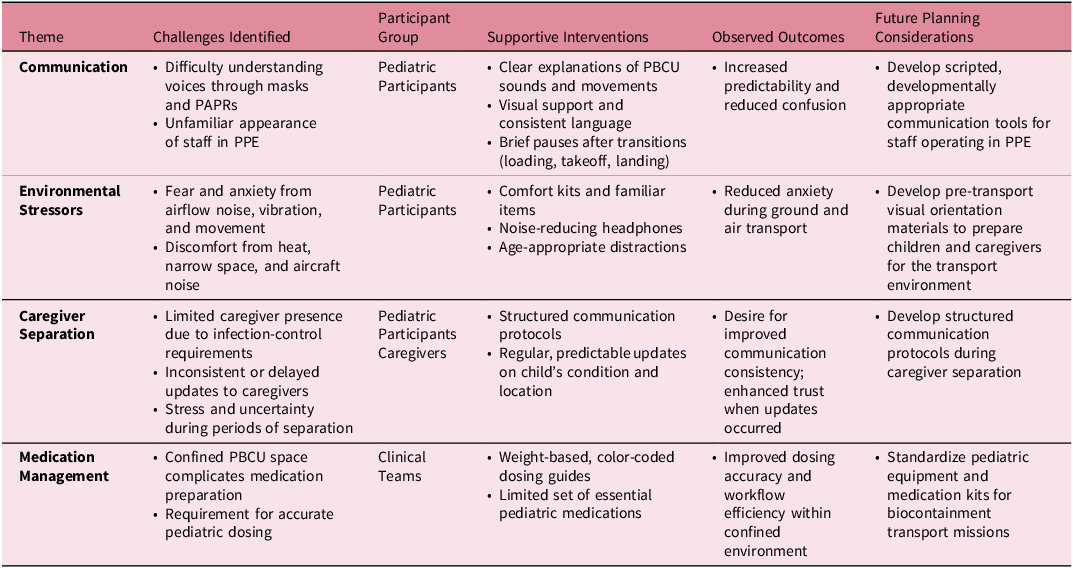
Pediatric transport challenges and supportive interventions are summarized in Table 1. Four themes emerged consistently across pediatric actor interviews, caregiver reports, evaluator observations, and multi-disciplinary debriefs: communication barriers, environmental stressors, caregiver separation, and medication management.
Pediatric Transport Challenges and Supportive Interventions in PBCU Settings

Table 1. Long description
A table summarizing pediatric transport challenges and supportive interventions in PBCU settings. The table has four columns: Theme, Challenges Identified, Participant Group, Supportive Interventions, Observed Outcomes, and Future Planning Considerations. It also has four rows for each theme: Communication, Environmental Stressors, Caregiver Separation, and Medication Management. Row 1: Theme, Communication; Challenges Identified, Difficulty understanding voices through masks and PAPRs, Unfamiliar appearance of staff in PPE; Participant Group, Pediatric Participants; Supportive Interventions, Clear explanations of PBCU sounds and movements, Visual support and consistent language, Brief pauses after transitions (loading, takeoff, landing); Observed Outcomes, Increased predictability and reduced confusion; Future Planning Considerations, Develop scripted, developmentally appropriate communication tools for staff operating in PPE. Row 2: Theme, Environmental Stressors; Challenges Identified, Fear and anxiety from airflow noise, vibration, and movement, Discomfort from heat, narrow space, and aircraft noise; Participant Group, Pediatric Participants; Supportive Interventions, Comfort kits and familiar items, Noise-reducing headphones, Age-appropriate distractions; Observed Outcomes, Reduced anxiety during ground and air transport; Future Planning Considerations, Develop pre-transport visual orientation materials to prepare children and caregivers for the transport environment. Row 3: Theme, Caregiver Separation; Challenges Identified, Limited caregiver presence due to infection-control requirements, Inconsistent or delayed updates to caregivers, Stress and uncertainty during periods of separation; Participant Group, Pediatric Participants, Caregivers; Supportive Interventions, Structured communication protocols, Regular, predictable updates on child’s condition and location; Observed Outcomes, Desire for improved communication consistency; enhanced trust when updates occurred; Future Planning Considerations, Develop structured communication protocols during caregiver separation. Row 4: Theme, Medication Management; Challenges Identified, Confined PBCU space complicates medication preparation, Requirement for accurate pediatric dosing; Participant Group, Clinical Teams; Supportive Interventions, Weight-based, color-coded dosing guides, Limited set of essential pediatric medications; Observed Outcomes, Improved dosing accuracy and workflow efficiency within confined environment; Future Planning Considerations, Standardize pediatric equipment and medication kits for biocontainment transport missions.
Abbreviations: PBCU, Portable Biocontainment Unit; PPE, Personal Protective Equipment; PAPR, Powered Air-Purifying Respirator.
Pediatric movement within the PBCU required deliberate planning for developmental, psychosocial, and physiologic needs distinct from adult transport. Across sites, children, caregivers, and clinical teams described similar concerns related to understanding the environment, coping with sensory input, and managing uncertainty during transitions. Small supports – such as comfort items, noise-reducing headphones, and familiar distractions – were consistently noted to reduce anxiety when paired with clear explanations and predictable routines.
Communication Barriers
Children frequently described initial fear or confusion related to airflow noise, vibration, and the unfamiliar appearance of staff wearing personal protective equipment (PPE). Many reported difficulty hearing or understanding speech, particularly when powered air-purifying respirators were in use, which occasionally led to brief communication lapses. Caregivers emphasized that previewing photos or videos of the PBCU and providing age-appropriate explanations in advance helped reduce distress. Participants across sites expressed a desire for clearer, developmentally tailored information about the disease, infection-control measures, and what to expect during each phase of movement. These observations reinforced known communication barriers associated with PPE in pediatric disaster and special pathogen contexts.Reference Chiu, Goodman, Palacios and Dingeldein4–Reference Gilchrist and Simpson6
Environmental Stressors
Pediatric participants described the PBCU as small and sometimes overwhelming. The combination of heat, narrow stretchers, and loud aircraft noise created discomfort, particularly during takeoffs and transferring on and off the aircraft. Comfort items, noise-reducing headphones, and age-appropriate distractions were reported to reduce anxiety during both ground and air transport. These supports were most helpful when paired with clear explanations of PBCU sounds and movements and brief pauses after transitions such as loading, takeoff, and landing. Visual support and consistent language helped create a greater sense of predictability. These findings highlighted the importance of anticipating sensory burden in pediatric transport and preparing children with simple, predictable explanations of the environment.
Caregiver Separation
Caregiver presence was limited during the majority of transport because of infection-control requirements, and both children and parents described this separation as stressful. One caregiver reported heightened stress after prolonged delay in receiving updates about the child’s condition and location. Pediatric participants emphasized the powerful role of staff interpersonal interactions. Children indicated feeling more secure when staff members took time to introduce themselves, explained what was happening in age-appropriate language, and engaged in conversation. Caregivers identified these compassionate interactions as transforming potentially frightening moments into reassuring ones. Across sites, participants expressed a need for more reliable communication during separation and clearer expectations about when reunification would occur. Similar challenges have been reported in pediatric disaster and HCID care.Reference Kociolek, Shane, Simonsen and Zerr2,Reference Chiu, Goodman, Palacios and Dingeldein4,Reference Cieslak, Evans and Kortepeter7
Medication Management
Clinical teams noted that pediatric medication preparation was constrained by limited workspace and the need for precise dosing. Weight-based, color-coded dosing guides and a small set of essential pediatric medications supported rapid and safe preparation within the confined PBCU, aligning with pediatric emergency preparedness guidance.Reference Arrington3,Reference Yaskey and Dahl-Grove5
Discussion
This multi-site exercise demonstrated the operational feasibility of transporting pediatric patients within the PBCU during a coordinated HCID response. While prior work has described the challenges associated with pediatric disaster and special pathogen care,1–Reference Yaskey and Dahl-Grove5 Tranquil Passport offered an early opportunity to observe how these considerations arise during biocontainment transport using a newly developed federal capability. To the authors’ knowledge, this study represents the first national-scale evaluation of a federally developed PBCU.
Observed pediatric responses during transport were consistent with prior pediatric disaster and HCID literature, particularly regarding sensory stressors, communication barriers related to PPE, and the effects of caregiver separation.Reference Chiu, Goodman, Palacios and Dingeldein4–Reference Gilchrist and Simpson6 These observations underscore that pediatric needs cannot be extrapolated from adult biocontainment protocols; rather, they require dedicated operational planning, staff training, and environmental adaptation.
Several observations from this exercise were consistent with findings from existing pediatric disaster and HCID literature, including communication barriers associated with PPE, environmental sensory burden, and the psychosocial impact of caregiver separation.Reference Chiu, Goodman, Palacios and Dingeldein4–Reference Gilchrist and Simpson6 However, the PBCU environment introduced operationally specific challenges not previously described, including the acoustic effects of the enclosed module during aircraft operations, the physical constraints of the confined space on pediatric comfort and medication preparation, and the complexity of maintaining caregiver communication across geographically distributed transport phases. These PBCU-specific findings underscore the need to evaluate novel biocontainment platforms independently rather than assuming their pediatric suitability from prior transport literature.
Workforce composition and pediatric equipment availability emerged as important operational considerations. Personnel with pediatric experience align with guidance and should be considered in planning pediatric-inclusive biocontainment transport.Reference Arrington3,Reference Cieslak, Evans and Kortepeter7 Variability in pediatric-sized equipment and medications points to the importance of having standardized pediatric supplies available during biocontainment transport.Reference Chiu, Goodman, Palacios and Dingeldein4,Reference Yaskey and Dahl-Grove5
Caregiver separation, while sometimes unavoidable for infection-control purposes, was consistently described as a source of stress for both pediatric participants and caregivers. Prior HCID transport and disaster response literature underscores the importance of communication in maintaining trust and supporting family-centered care during high-risk events.Reference Kociolek, Shane, Simonsen and Zerr2,Reference Herstein, Stern and Gibbs8 When physical caregiver presence is not feasible, a designated advocate or communicator – such as a child-life specialist, behavioral health provider, or trained team member – may help bridge this gap by offering consistent explanations, emotional support, and reassurance. Observations from this exercise suggest that structured communication strategies, including clearly defined advocacy roles and scheduled updates when operationally safe, may help mitigate distress and support continuity of care during biocontainment transport.
Findings from this exercise also point to several actionable strategies for enhancing pediatric readiness in biocontainment transport: (1) standardized pediatric equipment and medication kits; (2) scripted, developmentally appropriate communication tools for staff in PPE; (3) pre-transport visual orientation materials for children and caregivers; (4) structured communication protocols during caregiver separation; and (5) incorporation of pediatric behavioral health or child-life support roles, when feasible.
The scalability of pediatric-inclusive biocontainment transport in real-world HCID events warrants consideration. The resources available during Tranquil Passport – including child-life specialists, behavioral health providers, and pediatric-trained clinicians – may not be universally accessible, particularly in resource-constrained settings or during prolonged transport durations. Core elements identified in this exercise, such as pre-transport orientation materials, color-coded dosing guides, and structured communication protocols, represent relatively low-cost, scalable adaptations. More resource-intensive interventions, such as dedicated pediatric advocacy roles, may require advance planning, regional coordination, or integration into NSPS capacity-building efforts. Future exercises should also consider incorporating children with special health care needs, including technology-dependent patients, those with sensory or developmental differences, and children with communication disabilities, to further strengthen the generalizability of pediatric biocontainment transport protocols.
Limitations
Findings are based on a simulated exercise, and pediatric participants were not experiencing true clinical illness. Although they had no prior exposure to the PBCU or its clinical care team, the simulated nature of the environment may still have influenced their stress responses and communication dynamics. The number of pediatric participants was limited, and observations may not be generalizable across all pediatric age groups, clinical conditions, or operational contexts.
Conclusions
This inaugural national deployment of the PBCU with pediatric participants identified key considerations relevant to pediatric-inclusive HCID transport. The evaluation demonstrated that pediatric patients introduce distinct developmental, operational, and psychosocial needs that require intentional integration into biocontainment transport planning. Findings from the Tranquil Passport exercise provide early evidence to guide the development of pediatric-inclusive protocols, staff training, and evaluation processes within the NSPS. These insights may help inform future preparedness planning, exercise design, and operational protocols for pediatric-inclusive HCID transport across domestic and international health systems.
Author Contributions
TG: Conceptualized the manuscript and integration of study; drafted the manuscript; and oversaw all revisions.
CW: Co-developed the questionnaire and interview/focus group guides; conducted interviews and focus groups; contributed to qualitative analysis; contributed to the Results and Discussion sections; and supported interpretation of findings.
AL: Co-developed the questionnaire and interview/focus group guides; conducted interviews and focus groups; contributed to qualitative analysis; and contributed to the Results and Discussion sections.
TP: Contributed to manuscript development through writing and refinement of the Introduction and Methods sections; and supported data management activities.
JL: Served as the primary designer of the Portable Biocontainment Unit (PBCU) and Tranquil Passport exercise; provided operational expertise on biocontainment transport; and contributed to interpretation of findings and manuscript revisions.
Funding Statement
Funding for the Tranquil Passport exercise was provided by the Administration for Strategic Preparedness and Response (ASPR; Washington, DC USA). Dr. Goodwin and Dr. Lowe received support through the National Emerging Special Pathogens Training and Education Center (NETEC; Atlanta, Georgia USA), which is funded by ASPR.
Competing Interests
The authors declare that they have no conflicts of interest.
Use of AI Tools
AI-assisted tools (ChatGPT – OpenAI; San Francisco, California USA) were used solely for copyediting, including grammar and consistency of phrasing and acronyms. All conceptual content, analysis, and interpretations were developed by the authors.



 Open access

