INTRODUCTION
A wide portion of the coastal zone of the Gulf of Tehuantepec remains unexplored, and a large number of taxonomic groups have been ignored by recent studies (López-Pérez et al., Reference López-Pérez, Bastida-Zavala, García-Madrigal, Barrientos-Luján, Torres-Huerta, Montoya-Márquez, Benítez-Villalobos, Meraz-Hernando, Sánchez, Chiappa-Carrara, Brito Pérez, Guillén-Hernández, Barba, Ayala-Pérez, Villalobos-Zapata and Vega-Cendejas2012). Among these groups are the roundrays of the genus Urotrygon Gill 1863, which comprises small-sized species (less than 47 cm total length). These rays are frequently caught as by-catch in shrimp fisheries and are discarded as species without commercial value. These species are Urotrygon aspidura (Jordan & Gilbert, 1882), U. chilensis (Günther, 1872), U. munda Gill, 1863, U. nana Miyake & McEachran, 1988 and U. rogersi (Jordan & Starks, 1895) (Tapia-García & García-Abad, Reference Tapia-García, García-Abad and Tapia-García1998), all of which have very similar morphological characteristics. The main differences are the disc shape and the presence or absence of spines and denticles in the median dorsal part of the disc and tail.
The denticled roundray Urotrygon cimar (López & Bussing, Reference López and Bussing1998) is a tropical benthic species usually associated with soft bottoms (Robertson & Allen, Reference Robertson and Allen2002, Reference Robertson and Allen2008). The name is derived from them having a round disc with dorsal surface covered densely by dermal denticles of sharp-tipped, moderate sized and stelliform bases, denticles of midline of disc slightly increasingly larger and recurved with their tips facing backwards, and, but not forming distinct rows of enlarged denticles or thorns (López & Bussing, Reference López and Bussing1998; Robertson & Allen, Reference Robertson and Allen2008). Until 2008 its presence in the Central Pacific was only known for Costa Rica, Nicaragua and El Salvador (López & Bussing, Reference López and Bussing1998; Robertson & Allen, Reference Robertson and Allen2008). However, Amezcua-Linares & Amezcua (Reference Amezcua-Linares and Amezcua2009) reported the presence of a female U. cimar caught in 1985 in Bahía de Petacalco in the Mexican Pacific, thus increasing its distributional range. During four trips to the Gulf of Tehuantepec a total of 101 specimens of U. cimar were collected, including juveniles and adults of both sexes, confirming the presence of this species off the southern coast of the Mexican Pacific.
MATERIALS AND METHODS
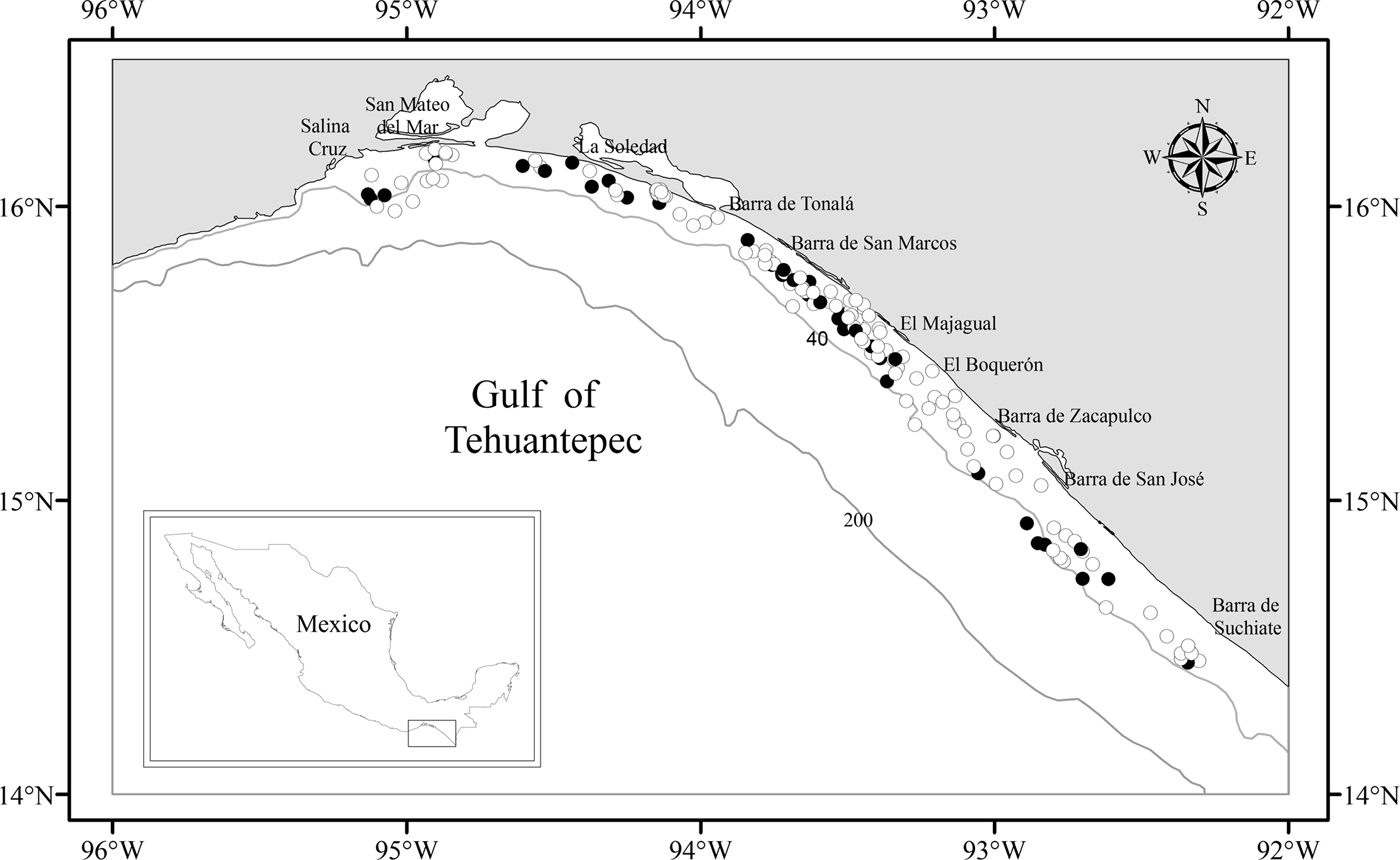
A total of 152 bottom trawls were carried out between October 2009 and October 2010, at depths between 11 and 62 m, using the RV ‘UMAR'. The study area comprised the coast between Salina Cruz, Oaxaca (95°10′50″W 16°7′89″N) and Barra de Suchiate, Chiapas (92°14′30″W 16°13′N) (Figure 1). During these sampling trips specimens from the Urotrygon genus were found that did not correlate with descriptions of species recorded in the area. The rays were identified as U. cimar based on criteria proposed by López & Bussing (Reference López and Bussing1998) and Robertson & Allen (Reference Robertson and Allen2002, Reference Robertson and Allen2008), and by comparison with the specimen from the Ichthyological Collection of the Marine Science and Limnology Institute, Universidad Nacional Autónoma de México (UNAM), catalogue number ICMYL 724.01 (Amezcua-Linares & Amezcua, Reference Amezcua-Linares and Amezcua2009).
Study area and location of bottom trawls. Black circles show the stations where Urotrygon cimar was caught.

The sex, total length, disc width, disc length, distance from the cloaca to the tip of the caudal fin, and maturity stage of all organisms were recorded. Males had a pair of copulating organs on the pelvic fins. Total length was measured from the tip of the head to the tip of the caudal fin; disc width was measured as the distance between the extreme edges of the pectoral fins; disc length was measured from the tip of the head to the tip of the pectoral fin; tail length was measured from the middle of the cloaca to the tip of the caudal fin. Males and females were classified according to their macroscopic gonadal development. The internal reproductive organs of juveniles were undifferentiated; males had small and flaccid claspers. Adult females had well-differentiated gonads, thick oviducts and wide uteri. Adult males had the epididymis rolled along the whole conduct up to the seminal vesicle, stored sperm and completely calcified claspers.
RESULTS
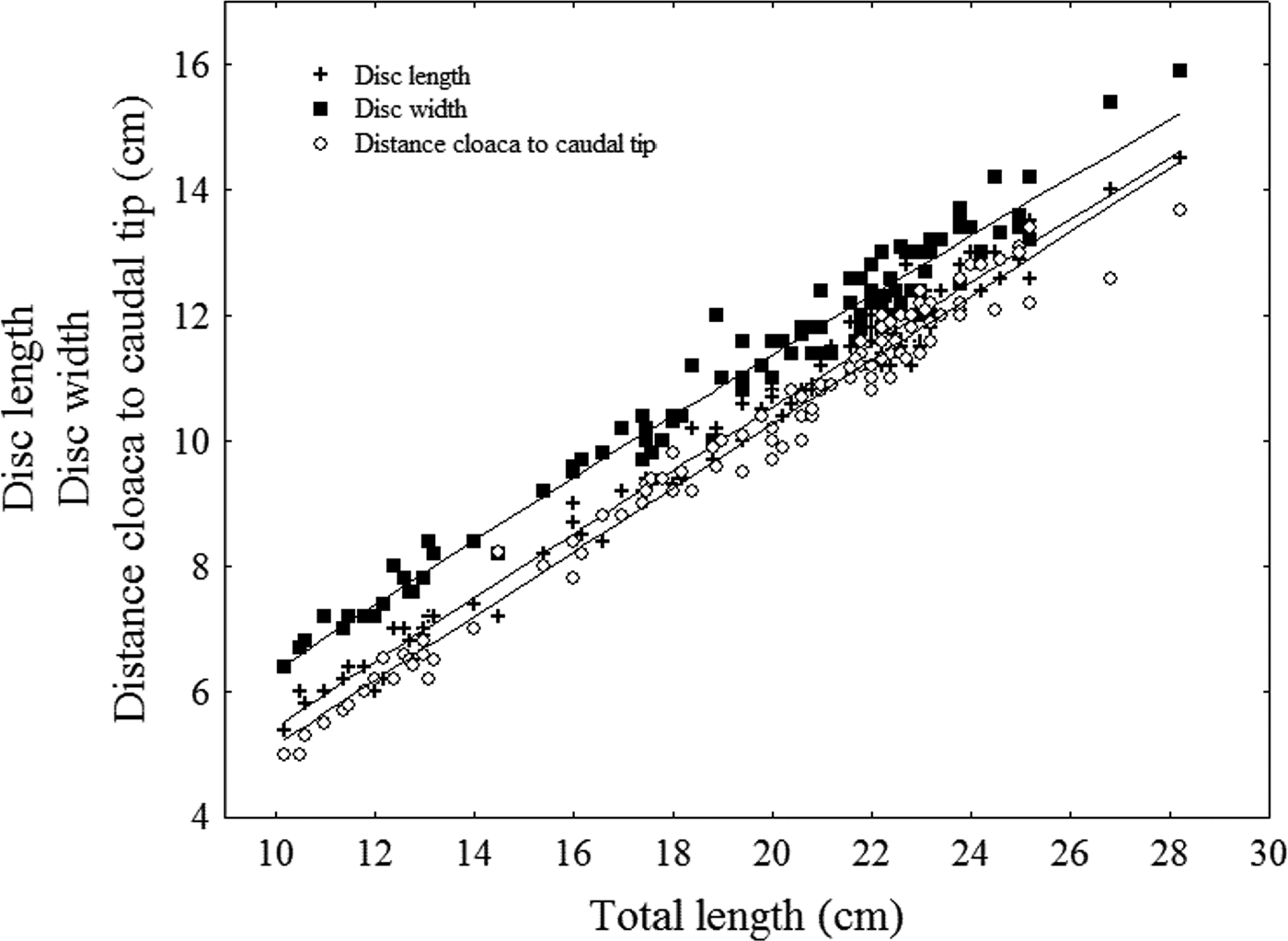
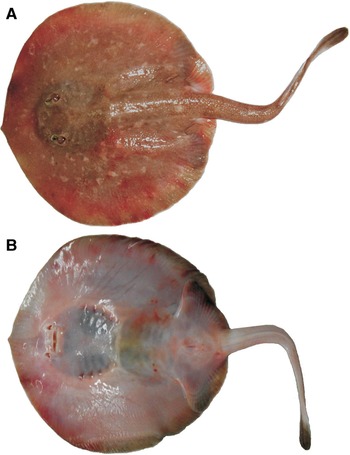
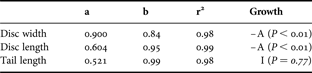
Of 152 trawls, in 36 were caught 101 denticled roundrays. Sizes ranged between 102 and 282 mm total length (TL). Disc shape was round, with a width of 54 to 61% TL, and disc length ranged from 49 to 57% TL. Morphometric relationship equations showed that disc width increased more than total length (Figure 2; Table 1). Tail length was 44 to 57% TL. The dorsal surface of the disc, tail and upper part of the caudal fin were covered by sharp denticles and star-shaped bases. Denticles were slightly larger on the median disc line, and the inferior surface was smooth (Figure 3). Adults had a dorsal surface of yellow-brown to light brown coloration, irregularly spotted with brown, black, and on rare occasions, light spots. These spots ranged in size from eye-sized to spiracle-sized, and were common towards the middle line. The ventral side was white and the edge of the disc and posterior edges of the pelvic fins were wide and dark. The caudal fin was brown with dark spots and dark edges. The pupil had a black triangle cover that descended to the centre; this characteristic was more visible in recently caught specimens that were not preserved in alcohol.
Relationship among three morphometric measurements (disc width, disc length and distance from the cloaca to the tip of the caudal fin) and Urotrygon cimar total length.

Photograph of female Urotrygon cimar caught off Gulf of Tehuantepec: (A) dorsal view; (B) ventral view.

Coefficients of three morphometric relationships versus Urotrygon cimar total length. Growth patterns are: –A, negative allometry; I, isometry.

Three females containing embryos in advanced stages of development were found. The embryos had the disc surface covered by denticles, which indicates that these organisms born with this characteristic and can be easily separated from juveniles belonging to other species of the Urotrygon genus. A specimen of U. cimar was deposited at the Marine Fish National Collection of the Biology Institute, UNAM, under the catalogue number CNPE PE16662.
The 101 specimens of U. cimar were captured between San Mateo del Mar (94°53′90″W 16°9′06″N) and Barra de Suchiate (92°40′0″W 14°49′00″N), encompassing a distance of 334 km, and depths between 23 and 44 m. An average number of 3 organisms per station were caught, with a range from 1 to 10 specimens per station.
The southern-most specimen was caught close to the frontier with Guatemala (92°41′0″W 14°43′14″N), a distance of 1100 km from the holotype, which was found in Costa Rica (López & Bussing, Reference López and Bussing1998), 446 km from the limit of the distribution proposed by Robertson & Allen (Reference Robertson and Allen2002), and 1778 km to the south from the specimen found in Michoacán by Amezcua-Linares & Amezcua (Reference Amezcua-Linares and Amezcua2009).
A percentage of 59% of rays were found between Barra de Tonalá (93°56′47″W, 15°59′13″N) and Barra de Zacapulco (92°5117″W 15°929″N); the remaining 21% were found between Barra de Zacapulco and Barra de Suchiate (92°13′32″W 14°31′47″N) (Figure 4). The following three sampling stations yielded 27% of rays: off la Soledad (94° 9′43″W 16°5′20″N), between Barra de San Marcos and El Majagual (93°29′28″W 15°43′1″N), and off Barra de San José (92°37′52″W 14°55′31″N).
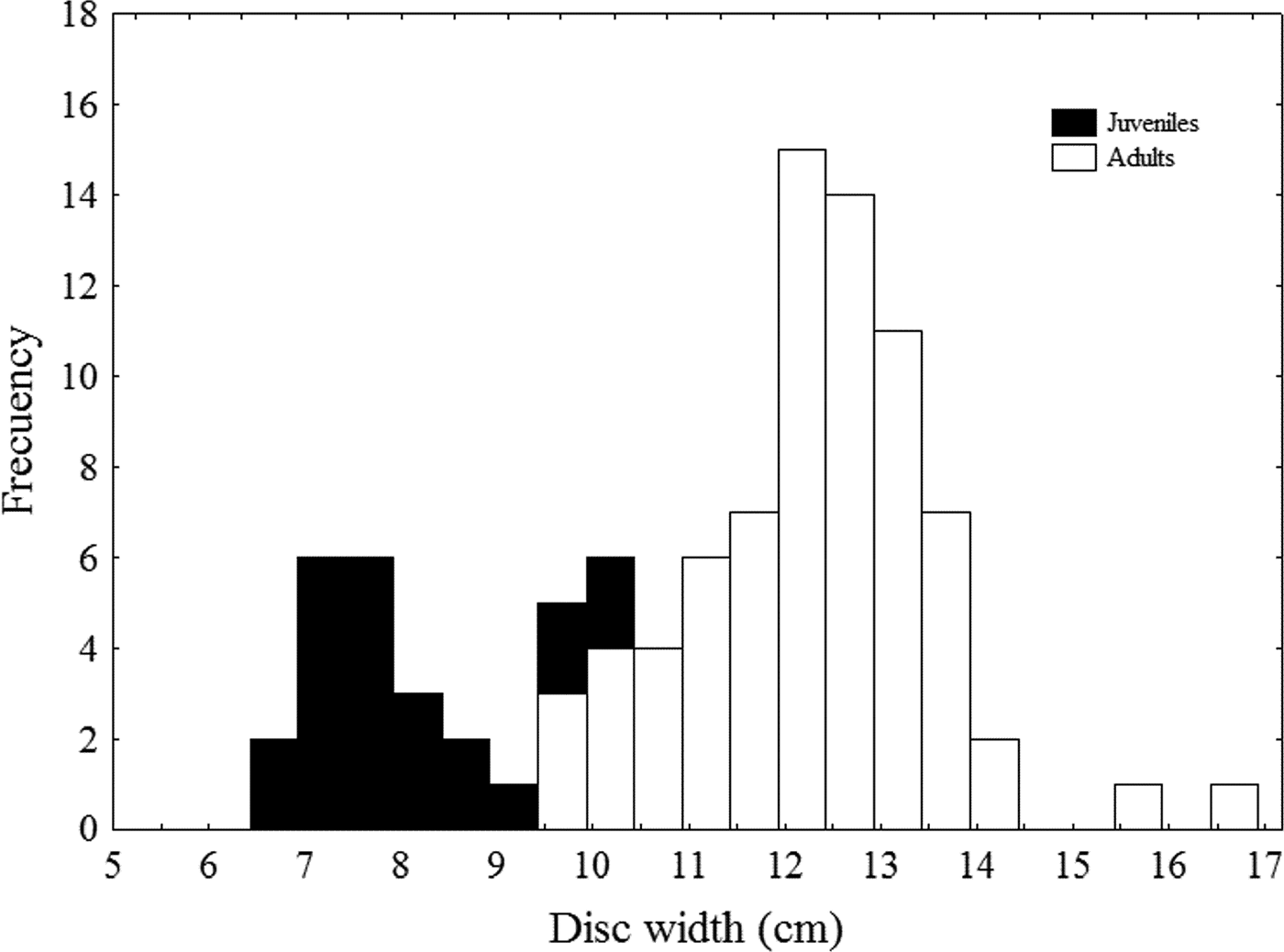
Size–frequency of Urotrygon cimar by maturity stage.

Of 101 specimens caught, 47 were females and 54 males. Females ranged from 67 to 158 mm disc width (DW), and males ranged from 64 to 137 mm DW. Immature individuals measured from 64 to 100 mm DW, and adults measured from 96 to 164 mm DW (Figure 5). Adults measuring from 118 to 128 mm DW were the most abundant (15 individuals). Of 36 adult females, 14 were pregnant; these were observed in December 2009, March 2010 and June 2010. Fecundity was from 1 to 2 embryos. Seven gravid females measuring from 104 to 142 mm DW had one embryo in the left uterus, and seven females measuring from 116 to 164 mm had two embryos in the left uterus. The presence of embryos measuring 64 mm DW and of juveniles of this same size recorded in March 2010 between Barra de San Marcos (93°41′22″W 15°51′32″N) and El Boquerón (93°6′6″W 15°23′43″N) off the Chiapas coast suggests that this area could be a birthing area for the denticled roundray. This study confirms the presence in the Gulf of Tehuantepec of U. cimar, and highlights the importance of knowing more about this species' biology, in order to avoid confusing it with other species from the Urotrygon genus.
DISCUSSION
The present study confirms the presence of the denticled roundray Urotrygon cimar off the Oaxaca and Chiapas coasts, with over one hundred specimens caught. The denticled roundray is distributed in the southern Mexican Pacific, where it has probably been confused with spiny roundray U. munda. The spiny roundray has been reported in the Gulf of Tehuantepec by Amezcua-Linares (Reference Amezcua-Linares1996), Castro-Aguirre & Espinosa-Pérez (Reference Castro-Aguirre and Espinosa-Pérez1996), Tapia-García & García-Abad (Reference Tapia-García, García-Abad and Tapia-García1998), Robertson & Allen (Reference Robertson and Allen2002), Corro-Espinosa & Ramos-Carrillo (Reference Corro-Espinosa and Ramos-Carrillo2004) and Robertson & Allen (Reference Robertson and Allen2008). However, Corro-Espinosa & Ramos-Carrillo (Reference Corro-Espinosa and Ramos-Carrillo2004) show a predominance of denticled roundray instead of U. munda. None of these studies has reported U. cimar in the area.
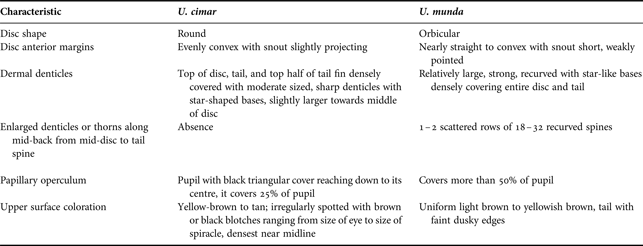
This confusion could be due to the similar external morphology between the two species. Both are characterized by the presence of dermal denticles spread all over the disc and tail; the difference lies mainly for the presence of enlarged denticles or thorns, which are on the median dorsal line in U. munda, while U. cimar has no thorns and instead has sharp dermal denticles that are slightly larger on the median line of the disc (López & Bussing, Reference López and Bussing1998; Robertson & Allen, Reference Robertson and Allen2008). A picture of the distribution of U. munda is described by Amezcua-Linares (Reference Amezcua-Linares1996) and Robertson & Allen (Reference Robertson and Allen2008). The disc anterior margins of U. cimar are convex forming a disc that is almost round and U. munda have anterior margins that are almost straight to convex (Robertson & Allen Reference Robertson and Allen2008). In addition, the lid or papillary operculum is triangular in U. cimar covering approximately 25% of the pupil, while in U. munda it covers more than 50% (López & Bussing, Reference López and Bussing1998). Table 2 shows the main characteristics which allow the description of these species differences.
Main characteristics between Urotrygon cimar and Urotrygon munda.

It is noteworthy that during this study over 100 bottom trawls were carried out, at depths between 17 and 23 m, during which no U. munda specimens were caught. According to Robertson & Allen (Reference Robertson and Allen2008), U. munda occurs between 1 and 51 m depth, which could indicate that U. munda is not very abundant at depths under 51 m. The findings of our study emphasize the need to collect specimens at depths under 17 m and over 62 m in order to establish the distributional range of both species.
ACKNOWLEDGEMENTS
This research was supported by the National Commission for the Use and Knowledge of Biodiversity in Mexico (CONABIO). Financial support was received from the project Batoids fishes of the continental shelf in the Gulf of Tehuantepec (Peces batoideos de la plataforma continental del Golfo de Tehuantepec, HJ031). The authors thank the Universidad del Mar for support in collecting organisms in the RV ‘UMAR'. A. Torres was supported by the Posgrado en Ciencias Biológicas of UNAM.