


Introduction
Presidential speeches are well known vectors of policy priorities, affording citizens an account of government directions based on their rhetoric. In extant studies of the modern presidency, the public pronouncements that leaders make in both formal and informal venues provide cues for programmatic agenda (Cohen Reference Cohen1995; Peake Reference Peake2001; Stuckey Reference Stuckey2010) and a mechanism by which the president creates a social reality and shapes the context in which issues are viewed by the public (Zarefsky Reference Zarefsky2004). In polities where constitutional structure has limited the powers of the president, public pronouncements provide a platform for rallying supporters and conveying policy positions to the public (Tulis Reference Tulis2017; Reference Tulis2007) or drawing public attention to important government initiatives (Edwards and Wood Reference Edwards and Wood1999).
When it comes to making public pronouncements, Philippine president Rodrigo Duterte is probably among the most evocative. In his public speeches, the former Davao mayor is known to cuss, threaten, throw inappropriate jokes, insult women, and instigate lynch mobs. Prior to the 2016 election, Duterte not only admitted his links to a vigilante group allegedly responsible for the summary executions of criminals in his city, but also warned that he would kill up to 100,000 criminals if elected president (ABS-CBN News 2015). Even his State of the Nation Addresses (SONAs) exude the same threatening tenor, though they are delivered in a more sanguine tone. In his second SONA, for instance, he warned sternly:
There is a jungle out there. There are beasts and vultures preying on the helpless, the innocent [and] the unsuspecting. I will not allow the ruin of the youth, the disintegration of families and the retrogression of communities, forced by criminals whose greed for money is as insatiable as it is devoid of moral purpose. Neither will I be immobilized into inaction by the fear that I will commit an act that will expose me to public condemnation or legal prosecution. You harm the children in whose hands the future of this Republic is entrusted, and I will hound you to the very gates of hell [emphasis added]. (Duterte Reference Duterte2017)
Are Duterte's threatening crime spiels all just theatrics? Or are they instead deliberately targeted to a particular type of functional audience? When Duterte talks about crime, who exactly is he talking to?
Extending theories of rhetorical leadership in precarious democracies, we argue that Philippine president Rodrigo Duterte's evocative utterances are not just deliberate illocutionary acts intended to court public support, but are also priming tactics aimed towards a politically and economically significant audience whose acquiescence gives symbolic legitimacy to a controversial anti-crime policy. Drawing on quantitative textual approaches on a corpus of 845 presidential speeches delivered between June 2016 and July 2020, we find that violent-crime rhetoric is more likely to accompany public pronouncements made before a political audience consisting of law enforcement authorities, and government officials, or an economic audience made up of business chambers, overseas Filipino workers, and labor groups. Our findings nuance an image of the Philippine president beyond that of the conventional penal populist. We unravel instead an incisive rhetor who deliberately and strategically capitalizes on symbolic leadership to coax a functional component of the citizenry to support the government's botched antidrug campaign.
Presidential rhetoric is important in political systems that regard the president as an authoritative source of direction on key public policies. While crime as a subject of presidential speech is not uncommon in the literature (Chambliss Reference Chambliss1995; Marion Reference Marion1994; Oliver, Hill, and Marion Reference Oliver, Hill and Marion2011), empirical introspection beyond the US presidential system remains rare. The emergence of illiberal and hybrid regimes in many parts of the world, however, warrants a reexamination of prevailing theories, especially as rhetoric becomes more and more ubiquitous in the authoritarian toolkit. In the Philippines, for instance, Duterte occasionally makes headlines not only for his in-your-face language but for a gonzo approach to criminality that evokes memories of the country's authoritarian past. Before becoming president, Duterte was mayor of Davao City, a bustling city located in the Southern part of the Philippines, for close to two decades. As a local official, Duterte would hog the media spotlight by boasting how he turned the city into one of the world's safest by executing criminals. True to his word, Duterte embarked on a war on illegal drugs immediately upon his election into the presidency. Notwithstanding the excessive and violent crackdown, however, the drug problem showed no signs of abating. Duterte himself admitted in 2018 that his drug war had failed and that the country's drug problem will not end under his watch (Leonen Reference Leonen2018).
Despite it all, Duterte remains astonishingly popular. In a survey conducted in the last quarter of 2019, the Philippine president garnered a net satisfaction rating of +72 or “excellent,” besting his own “very good” records of +65 and +68 two quarters earlier (Tomacruz Reference Tomacruz2020). Equally surprising was people's reception of the government's war on illegal drugs. According to a December 2019 Social Weather Stations survey, eight in 10 Filipinos were satisfied with the government's anti-drug campaign notwithstanding the long shadow cast upon authorities and their role in the death of thousands of drug suspects (ABS-CBN News 2019).
Curiously, scholarly accounts dismiss Duterte's crime rhetoric as all part of the “populist” playbook (Thompson Reference Thompson2016; Curato Reference Curato2016; Bello Reference Bello and Berberoglu2019; McCoy Reference McCoy2017; Kenny and Holmes Reference Kenny and Holmes2020; Kreuzer Reference Kreuzer2018). Literature overlooks the fact that addressing criminality has long been on the list of what Filipinos consider to be recurring policy priorities. This paper contributes by looking at the role of selective audience targeting in the conveyance of Duterte's crime rhetoric and how this manner of messaging has worked to the president's advantage. Conventional views of populism construe the elite as a homogenous wicked entity that shares a common interest in exploiting the majority. Likewise, there seems to be a general notion that populism must encompass the people and the sovereign will by default (Rovira Kaltwasser Reference Rovira Kaltwasser2014; Akkerman, Mudde, and Zaslove Reference Akkerman, Mudde and Zaslove2014). Following this logic, populist politicians are expected to target the ordinary voters or the larger class of citizens as audience to their populist appeal. On the contrary, however, Duterte's functional audience wittingly embraces components from both the elites and the masses. Overall, the findings suggest that there remains a lot to unravel about the audience in populist rhetoric.
This article proceeds by first examining scholarly treatment of presidential rhetoric as a political tool and as a framework for socially constructing government policies. We focus specifically on the impact of presidential speechmaking on controversial policies such as penal legislations and antidrug campaigns. We then look at Philippine president Rodrigo Duterte's anticrime rhetoric and discuss how it coincides and at the same time deviates from documented accounts of presidential speechmaking. We then provide a theoretical layout explaining how the strategic targeting of political messages to certain audiences with similar values or predispositions enhanced the persuasive power of the Philippine president's controversial rhetoric on illegal drugs. Afterwards, we explain how quantitative text analytical techniques were used to create measures for the statistical models with which we tested our theoretical assumptions. We then discuss the results of the estimates and how they support our view that fiery anti-crime speechmaking is specifically oriented towards certain types of functional audiences. We conclude by reiterating the importance of audience and timing in conveying controversial government policies and recommending areas for future extensions.
Presidential rhetoric as agenda setting
Rhetoric may be defined as “the strategic stance that the speaker takes vis-à-vis his audience made possible by the asymmetry between speaker and audience but fueled by an interest in power over truth” (Chambers Reference Chambers2009, 327). Modern presidencies are long considered positions of rhetorical leadership (Medhurst Reference Medhurst, Price and Wren2007). Presidents are known to engage in verbal and visual forms of discourse “to defend themselves publicly, to promote policy initiatives nationwide, and to inspirit the population” (Tulis Reference Tulis2017). The symbols that the public associate with the presidency endows the office with enormous power over national definitions (Zarefsky Reference Zarefsky2004; Murphy Reference Murphy2008) and make presidential rhetoric instrumental in policymaking (Stuckey Reference Stuckey2006). Through rhetoric, presidents can rally support over positions, claim legitimacy over decisions, and invoke such claim as a weapon in political battles (Bimes and Mulroy Reference Bimes and Mulroy2004). By advancing a cause or claim, presidents can shape the context in which events or proposals are viewed by the public.
Studies on the American presidency customarily make reference to the bully pulpit as the chief mode through which presidents engage the public on any policy (Cohen Reference Cohen1995; Goodwin Reference Goodwin2013; Strock Reference Strock2003). There is evidence that citizens become particularly attentive when presidents publicize economic issues (Wood, Owens, and Durham Reference Wood, Owens and Durham2005), foreign policy concerns (Cohen and Hamman Reference Cohen and Hamman2003), or positions on civil rights (Cohen Reference Cohen1995; Reference Cohen1999; Canes-Wrone Reference Canes-Wrone2001). Modern presidents have also shown a predilection to bypass Congress and mobilize the public as a routine mode of governance (Stuckey Reference Stuckey2010).
The extent by which rhetorical leadership influences public policy is also catching scholarly interest in other polities. In South Korea, for instance, Heo and Park (Reference Heo and Park2016) show that presidents capitalize on achievements and moral authority to persuade citizens. Cheng's (Reference Cheng2006) study of inaugural speeches delivered by Taiwan's Chen Shui-Bian shows stylistic feigning of victimhood to call for a shared sense of belonging and recognition of a Taiwan experience amidst the island's vague and complicated relationship with mainland China. In Poland and Russia, leaders resort to rhetoric to create enemies of the state and legitimize regimes (Karaliova Reference Karaliova2016). In Belarus, on the other hand, presidential rhetoric is used in the discursive construction of a national identity (Klymenko Reference Klymenko2016). Meanwhile, in Rwanda, rhetoric facilitates the promotion of national identity in the backdrop of genocide (Mayersen Reference Mayersen2015).
Although the aforementioned studies are largely in the context of presidential systems, there is evidence that even in parliamentary systems leaders sometimes resort to political rhetoric to create narratives capable of making a persuasive case for policy change without being perceived as “‘talking down’ the nation in the process of suggesting reform” (Grube Reference Grube2012, 581).
Crime as rhetoric
Controlling crime rates figures prominently in political rhetoric due to the ease by which citizens’ fear of crime can be exploited by political elites to advance or preserve a particular political or social environment. Examining incarceration rates in England, for instance, Jennings and his colleagues (Reference Jennings, Farrall, Gray and Hay2017) note that the public's appetite for punitive criminal policies is an inevitable product of the interaction of democratic politics as political elites seek to satisfy perceived demand for punitive policies. Meanwhile, US presidents over the past several decades have been known to take political advantage of the crime issue as a means to enhance their visibility (Chambliss Reference Chambliss1995; Marion Reference Marion1994). Sometimes presidents even try to inflate public anxiety over crime in order to placate or obfuscate during times when actual crime rates are falling (Oliver Reference Oliver1998).
The war on drugs, in particular, has been a fixture in presidential rhetoric in the US since the Nixon Administration, although subsequent presidents showed varying levels of commitment to the policy (Hawdon Reference Hawdon2001). Oliver, Hill, and Marion (Reference Oliver, Hill and Marion2011) found that not only did presidential statements about drugs have more influence over the public than the media, but also that the less the president talked about drugs the less it became the subject of media coverage. With penal rhetoric, presidents engage in the social construction of policies and “position themselves as protectors of vulnerable populations (like children) and repudiators of threatening and disfavored target populations (such as drug addicts and drug kingpins)” (Whitford and Yates Reference Whitford and Yates2009, 159). Rhetoric can generate policy attention on a lingering issue and its ramifications. However, presidents who resort to rhetorical devices are also likely to misdiagnose a social problem or pin blame wrongly (Mackey-Kallis and Hahn Reference Mackey-Kallis and Hahn1994). The narrative techniques that politicians and public officials employ require crafting emotionally charged tales of lawbreaking and injustice, oftentimes without empirical support, to justify publicly punitive forms of punishment and to attract the rabid attention of mass media outlets (Hilgartner and Bosk Reference Hilgartner and Bosk1988; Maratea and Monahan Reference Maratea and Monahan2013). Efforts to approach criminal justice through rhetoric, for instance, are known to produce policies that are rich in symbolic meaning but have little practical substance (Barlow, Barlow, and Johnson Reference Barlow, Barlow and Johnson1996; Stolz Reference Stolz2002).
Like his counterparts elsewhere, Philippine president Rodrigo Duterte also makes agitated remarks about crime, particularly those committed under the influence of, or in relation to, illegal drugs. Traditionally, presidential speeches are supposed to be platforms for dialogue with the public on key national issues. In Duterte's case, however, there appears to be no attempt to package government's anti-drug campaign in order to appeal to a broader audience. In his public pronouncements the president makes open threats against criminals and encourages law enforcement authorities that they are “free to kill” in the name of the government's war on drugs (Regencia Reference Regencia2019). Human rights groups as well as the media occasionally cry foul over the expletive-laden diatribes. Law enforcement officers, on the other hand, construe the pronouncements as the unwritten framework by which government's campaign against illegal drugs are to be enforced (Johnson and Giles Reference Johnson and Giles2019). The fact that Duterte is unfazed by both domestic and international criticism suggests that his message is not targeted to the undecided, but to a core audience who are more inclined to provide loyal support and generate echo chambers (Kabiling Reference Kabiling2021).
Duterte's functional audience
We argue that the persuasive value of a politician's crime rhetoric follows a strategic consideration of the audience to heighten public concern over the issue of illegal drugs and criminality. It is well known among scholars of political campaigns that candidates send tailored messages based on particular characteristics of voters as target audience (Hillygus and Shields Reference Hillygus and Shields2008; Hersh and Schaffner Reference Hersh and Schaffner2013). Not only is public opinion favorable to presidents following a public speech, for instance, it is strongest among those who follow the president closely (Cavari Reference Cavari2013).
However, political messages can only create social contexts that shape public opinion toward a desired policy agenda if they are able to capture the attention of the right audience (Weiss and Tschirhart Reference Weiss and Tschirhart1994). Smith (Reference Smith1983) believes that presidential persuasion fails due to a flawed communication strategy and, more importantly, when it is directed toward an inappropriate audience. The audience, according to Bitzer (Reference Bitzer1968), are those who are capable of resolving the exigence of a rhetoric by being constrained by the discourse to make a decision or take a course of action and become mediators of change.
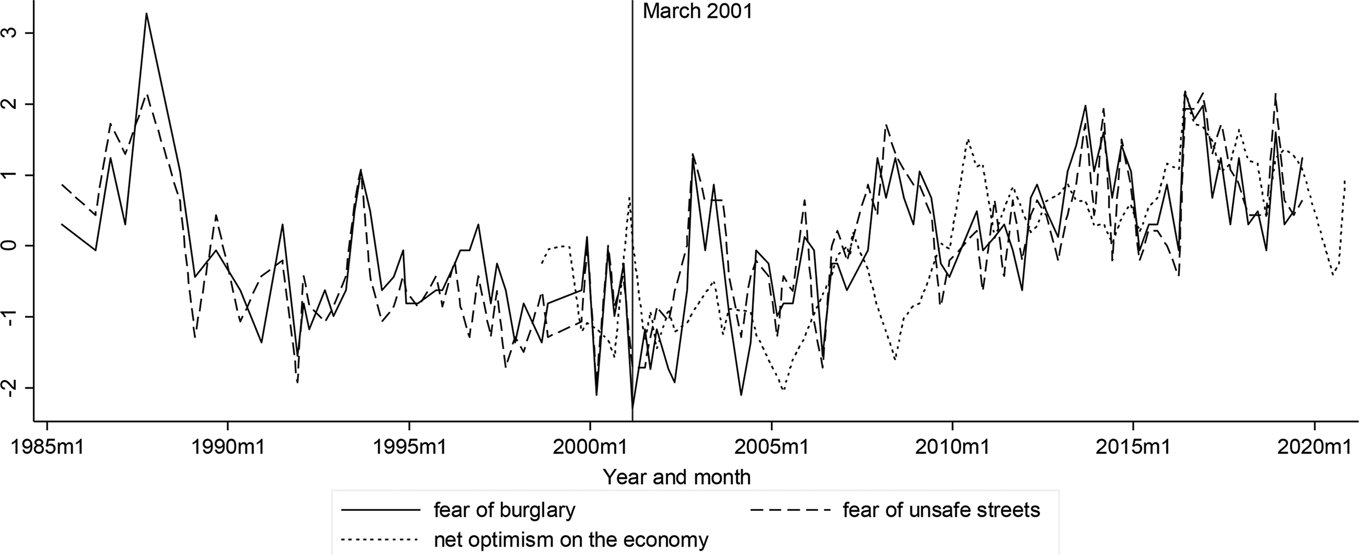
Who, then, is Duterte's audience? Who is he preaching to when he is talking about crime and illegal drugs? A 2015 Pulse Asia Research Nationwide Survey on Urgent National Concerns reveals crime victimization as the third most cited national concern and consistently at the top 10 of what Filipinos regard as pressing (Pulse Asia 2015). Social Weather Stations, for its part, shows that there has been a rise in fear of burglary and unsafe streets since 2001 (Figure 1), a concern that seems to coincide with Filipinos’ outlook on the economy (Social Weather Stations 2019). Fear of crime also figures in the latest (seventh) wave of the World Values Survey for the Philippines, which suggests that even though having a stable economy takes primacy, fighting crime is the next most urgent concern among Filipinos (31.5 percent) (Haerpfer et al. Reference Haerpfer, Inglehart, Moreno, Welzel, Kizilova, Diez-Medrano and Puranen2020).
Filipinos’ fear of burglary and unsafe streets. Net optimism on the economy is the difference between the percentage of respondents who believe the economy will be better in the next 12 months and those who believe it will be worse. Values are standardized for comparison. Source: Social Weather Stations, 2019

Nelson and Garst (Reference Nelson and Garst2005) believe value-based rhetoric enhances the persuasive power of political speech by establishing a common identity between the speaker and like-minded audience. In the context of Duterte's anti-crime rhetoric, we argue there are two important functional audiences.
Economic audience
Anxiety or fear of crime, or even the feeling of vulnerability to crime, facilitates persuasion by stimulating vigilance and increasing reliance on the evaluations of politicians (Brader Reference Brader2005). Crime policies affect everyone, but a narrative premised on creating a safer society can be more compelling for certain individuals, such as those whose lives and livelihood are perennially at risk under crime-ridden thoroughfares. Investors and merchants, for example, would have a material interest in reducing crime as it will also cut the cost of property or transactions lost to robbery, theft, vandalism, and arson (Motta Reference Motta2017). In the same vein, Filipinos who make a living overseas have a huge political and emotional stake on a tough approach to crime since it would mean safer streets for loved ones left in the Philippines. The remittances sent back by migrants back home, Tusalem argues, are positively associated with governmental effectiveness and better public goods provision, which in turn, implies greater consideration for the safe transfer of their contributions as it “can induce local governments to perform as a way to prove their legitimacy” (Tusalem Reference Tusalem2018, 22).
Hence, we hypothesize:
H1: Crime rhetoric is more likely when the president is speaking before members of the economic audience (e.g., business, professions, labor groups, overseas Filipino workers, etc.).
Political audience
Besides being a strategic tool to persuade relevant constituencies, presidential rhetoric is also a cue for administrative agents over whom the president exercises managerial control as to what policies to prioritize (Whitford and Yates Reference Whitford and Yates2003). For instance, in many reports local government officials are identified as “foot soldiers” in the government's campaign against illegal drugs (Marshall and Chalmers Reference Marshall and Chalmers2016). On the other hand, the Philippine National Police, has been a central figure in Duterte's drug campaign, with law enforcement officers reportedly acting as henchmen in both legitimate operations and vigilante-style killings (Reyes Reference Reyes2016).
A recent study suggests that in carrying out his “signature policies,” Duterte effectively obtained the collaboration of “outsider” local political elites who showed their loyalty through the drug war campaign (Ravanilla, Sexton, and Haim Reference Ravanilla, Sexton and Haim2021). Projecting himself as a political outsider, Duterte's populism relied on strong support from local elites who were peripheral to the preceding political establishment altering the configurations of political power of the country (Ravanilla, Sexton, and Haim Reference Ravanilla, Sexton and Haim2021). In the literature, this network of collaborators has been variously described as an indication of the instability of the “third wave” of democratization (Haggard and Kaufman Reference Haggard and Kaufman2016), a gauge of democratic deconsolidation and the rise “strong leaders” (Foa and Mounk Reference Foa and Mounk2017; Foa Reference Foa2021; Quinlan and Tinney Reference Quinlan and Tinney2019), or a sign of “autocratization” (Lührmann and Lindberg Reference Lührmann and Lindberg2019). All these descriptions commonly point to Duterte's political strategy of courting allies and guaranteeing political survival through rhetoric.
Consequently, we posit:
H2: Crime rhetoric is more likely when the president is speaking before a political audience (e.g., local government officials and civilian law enforcement officers).
Controls
It is also important to account for the context by which a speech is delivered to its intended audience. Presidents, in particular, are known to react to issues of widespread public concern such as crime and resort to symbolic rhetoric not only to magnify its relevance as a social problem but to justify the policy recourse (Hawdon Reference Hawdon2001; Oliver Reference Oliver1998; Hill and Marion Reference Hill and Marion2016). Thus, we expect Duterte's crime rhetoric to be more pronounced during periods of relatively high crime volume.
Meanwhile, a robust body of work argues that economic conditions can shape the way people assess their elective leaders (Lewis-Beck Reference Lewis-Beck1986; Erickson Reference Erickson1998; Becher and Donnelly Reference Becher and Donnelly2013). People are likely to become more critical of violent anti-crime policies during economic downturns when there is tendency to demand more accountability mechanisms in place (Lewis-Beck and Lobo Reference Lewis-Beck, Lobo, Arzheimer, Evans and Lewis-Beck2017). Filipinos are particularly sensitive to an economic crisis due to the lack of social safety nets (Gonzalez and Manasan Reference Gonzalez, Manasan, Adam, von Hauff and John2002) and, thus, would likely expect socioeconomic policies to be prioritized as urgent concerns.
To ensure our results are robust, we also control for potential determinants of crime rhetoric based on extant works on human rights and political communication. Risse, Ropp, and Sikkink (Reference Risse, Ropp and Sikkink2013, 6) argue, for instance, that ‘repressive’ states engage in tactical concessions in order to get the international human rights community “off their backs.” Governments are known to reciprocate pressures from domestic advocacy groups and political activists with low cost compromises such as tolerating demonstrations or releasing a few political prisoners to give a semblance of meeting domestic and international human rights expectations (Anja and Liese Reference Anja, Liese, Risse, Ropp and Sikkink2013, 26; Dai Reference Dai2014). Thus, we expect domestic criticism on the country's human rights situation to decrease Duterte's crime rhetoric.
Media coverage, on the other hand, has been documented to influence presidential rhetoric on crime although there is still debate on whether or not it eventually shapes public opinion (Oliver Reference Oliver1998; Oliver, Hill, and Marion Reference Oliver, Hill and Marion2011; Hill, Oliver, and Marion Reference Hill, Oliver and Marion2012). Gonzenbach (Reference Gonzenbach1992; Reference Gonzenbach1996, 90) even argues that it is the media that shapes presidential rhetoric so much so that “when the media speaks, the president listens—not the reverse.” Hence, we posit that negative media coverage on the war on drugs will decrease Duterte's crime rhetoric.
We also include monthly inflation as an additional economic control. In extant studies, inflation is among the most familiar and widely accessible sociotropic measure of the state of the economy (see, e.g., Whitten and Palmer Reference Whitten and Palmer1999). Controlling inflation is also regarded as a top national concern for many low-income families (Easterly and Fischer Reference Easterly and Fischer2001). Hence, we expect Duterte's crime rhetoric to decrease with rising inflation.
Finally, we include a dichotomous time variable marking the onslaught of COVID 19 in 2020. In the Philippines, COVID not only stifled growth projections for economic policies that have yet to fully materialize, but also magnified lingering socioeconomic inequalities that have long characterized communities (Atienza et al. Reference Atienza, Arugay, Encinas-Franco, Go and Panao2020). We expect the president's violent insinuations against criminals to be fewer during the pandemic.
Data and measures
The principal dataset used in this study is built from a corpus of 845 speeches delivered beginning with Duterte's inauguration, on June 30, 2016, up to July 31, 2020. The transcripts of the president's public pronouncements are publicly accessible at the website of the Presidential Communications Operations Office.Footnote 1 The speech corpus has been updated to include Duterte's fifth State of the Nation Address delivered on July 27, 2020.
Duterte is known for threatening remarks that typically embellish his drug narratives. His own presidential campaign was hinged on threats to kill thousands in the war against crime and illegal drugs. In a crowd of 500 slum dwellers right after he was sworn in, he was quoted warning drug traffickers “don't go into that, even if you're a policeman, because I will really kill you” (Guardian staff and agencies 2016). Three years later, and despite drawing condemnation from international rights bodies, Duterte's drug campaign remains overwhelmingly popular and his urge to kill never seems to mellow (Cabato Reference Cabato2019). Thus, we operationalize crime rhetoric as the frequency by which the president uttered the following phrases in his speeches: “kill you,” “kill them,” “shoot you,” “shoot them,” “shoot him,” “barilin mo,” “barilin ko,”Footnote 2 “patayin ko,”Footnote 3 “patayin mo,” “patayin kita,” “barilin kita,” “pinatay ko,” “binaril ko,” “I shot,” “I killed,” “I will kill,” “I will shoot,” “patyon,”Footnote 4 “pusilon.”Footnote 5 In counting the frequency we employed the keyword-in-context feature of the package Quanteda in RFootnote 6 to make sure the phrases are uttered in the context of the anti-crime campaign and not as artifacts of related topics.
We then categorized the speeches according to their main audience. Coding was done manually based on Koenig (Reference Koenig1975; Reference Koenig1964) and Smith (Reference Smith1983), but was modified to nuance a categorization that reflects functional constituencies in the Philippines. As in Koenig (Reference Koenig1975) the economic audience includes business, labor, and the professions. A speech delivered, say, during the annual installation of the board of trustees of a commercial chamber, is categorized as having the business sector as primary audience, and thus is considered to have an economic audience. We also include in the economic audience Filipinos overseas whose remittances helped fuel domestic consumption and have kept the Philippine economy afloat (Roughneen Reference Roughneen2016). An address before the Filipino community in Singapore is an example of a speech with overseas Filipinos as the main audience, and is likewise regarded as having an economic audience.
A political audience, as in Koenig's classification, includes political parties, subnational officials, members of Congress, the electorate, and the international community. However, we reclassify the international community as a separate category. As heads of state, presidents are expected to engage the international community. In Duterte's case, however, the international community are also among his staunchest detractors, especially on the subject of the government's controversial anti-drug campaign (Ranada Reference Ranada2016). Also, we distinguish between law enforcement officers and military personnel as audience and treat the latter as an entirely separate audience type. A speech addressing military personnel, such as one given on occasion of the Armed Forces of the Philippines’ changing of the guard ceremony, is coded as having uniformed personnel as audience. Meanwhile, a speech delivered to honor officers killed in a police operation is categorized as having law enforcement officers as audience. Since the police are under the operational supervision and control of city and municipal mayors,Footnote 7 they are considered part of the political audience.
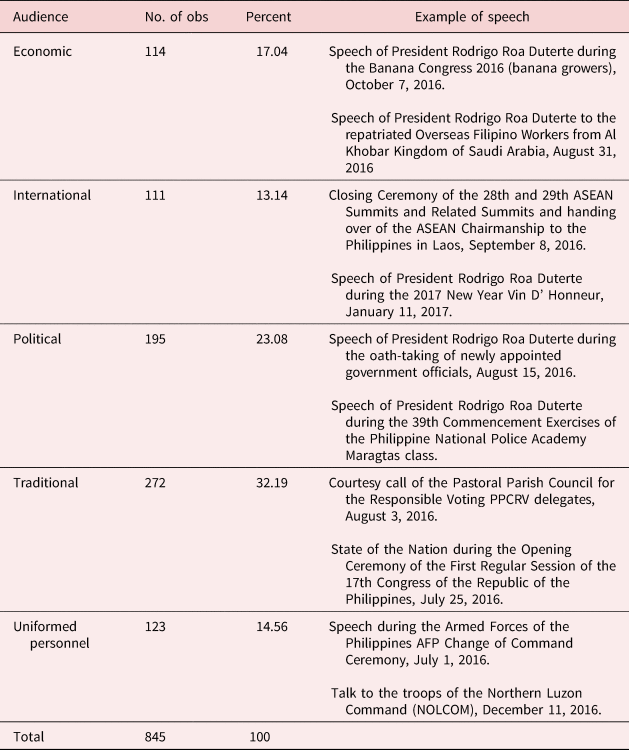
We again follow Koenig's nomenclature and construe traditional audiences as consisting of the media, religious groups, and intellectuals. As a slight modification, however, we also considered speeches directed to the general public as belonging to this category. An address before delegates of the Catholic Church-affiliated Parish Pastoral Council for Responsible Voting during a courtesy call, the annual State of the Nation Address, and the talks to the nation on COVID 19 that have become ubiquitous since March 2020, are but a few examples of speeches in this audience category. Table 1 details the categories, frequency, percentage share in the sample, and examples. There is a dearth of reliable crime statistics in the Philippines, and those that are publicly accessible are either limited or outdated. As an alternative, we constructed a crime proxy for the Philippines based on reported events of violence committed against civilians collated by The Armed Conflict Location & Event Data Project (ACLED).Footnote 8 We then aggregated the events to produce weekly observations.
The President's Main Audience

Data from: Presidential Communications Operations Office (PCOO)
Taking cue from the political economy literature, we exploit two indicators to measure economic conditions. We adopt the Social Weather Stations’ net economic optimism as a pocketbook measure, and monthly inflation as a sociotropic indicator for the economy. Net economic optimism is the difference between the percentage of respondents who said the Philippine economy will improve (“economic optimists”) and those who said it will worsen (“economic pessimists”).Footnote 9 Since the SWS conducts the survey on a quarterly basis, we constructed a categorical variable (economic pessimism) assigning a value of 1 to presidential speeches delivered during quarters when net optimism is below zero, and 0 otherwise. Data on monthly inflation, on the other hand, were computed from the Consumer Price Index for all goods, based on figures reported by the Philippine Statistical Authority. The values correspond to the month of the presidential speech.
To construct a measure of domestic human rights account, we used PythonFootnote 10 to text-mine 545 press statements issued by Karapatan—a left leaning alliance of human rights advocacy groups which conducts research and documentation of human rights abuses in the Philippines—and tallied the number of releases during the week of the presidential speech.
For media coverage, we employed a dictionary-based sentiment approach utilizing a corpus of 366 news reports which appeared in the online portal of ABS-CBN News. Corresponding to keywords that appear on the corpus, words with positive (e.g., “good,” “great,” “amazing”) or negative (“bad,” “worse,” “terrible”) polarities are accounted to compute a positive or negative score for a text (Welbers, Van Atteveldt, and Benoit Reference Welbers, Van Atteveldt and Benoit2017; Benoit et al. Reference Benoit, Watanabe, Wang, Nulty, Obeng, Müller and Matsuo2018). We used “drug war” and “war on drugs” as contextual keywords, then computed sentiment scores based on Young and Soroka's lexicon (Reference Young and Soroka2012). The positive and negative sentiment scores are aggregated by week, as is conventional in political content analysis (see, for instance, Holian Reference Holian2004).
COVID 19, on the other hand, is a dichotomous variable coded 1 for speeches delivered from 2020, and 0 otherwise. Philippine health authorities investigated the country's first suspected case on January 22, 2020 (Edrada et al. Reference Edrada2020).
Results
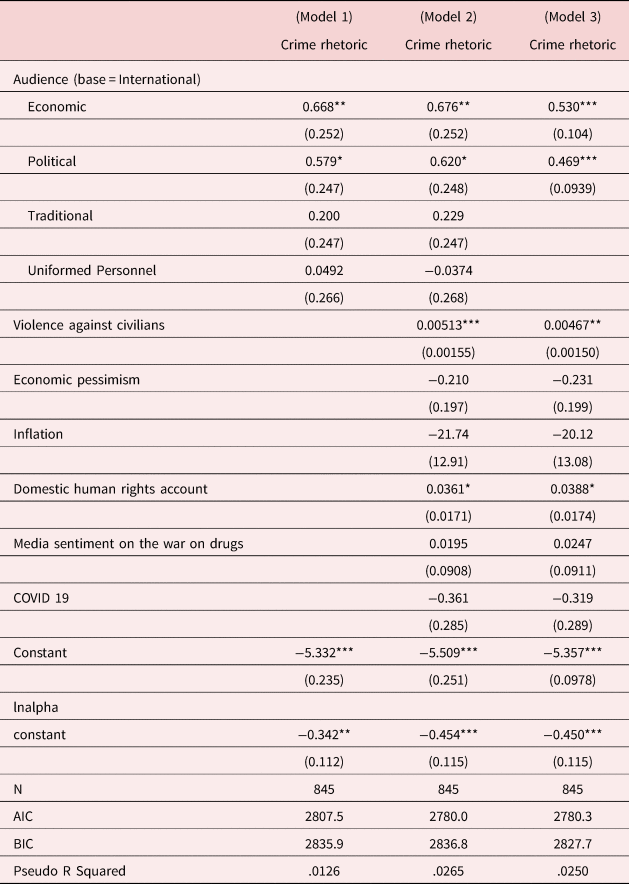
Table 2 summarizes the results of three negative binomial regression models. Model 1 is a very basic specification with only audience type as its regressor. Model 2 is a fully specified model containing audience type and the control variables. Model 3 is also a fully specified model with controls but recalibrates audience type to highlight two functional audiences (economic and political) and their effects on the president's crime rhetoric.
Audience and Crime Rhetoric

Standard errors in parentheses
*p < 0.05, ** p < 0.01, *** p < 0.001
Note: In all models, international audience is the base category. The political audience includes local government officials and the police. All three specifications utilize the number of sentences in a speech as exposure variable.
Negative binomial regression assumes that the count variable (number of words pertaining to the crime rhetoric previously specified) is generated by a Poissonlike process but adds an extra parameter to accommodate overdispersion. Crime rhetoric has a mean of 2.6 and a variance of 17.4, indicating that there is overdispersion and that Poisson may be inappropriate. There are 402 speeches that do not carry terms associated with crime rhetoric but there is no reason to believe that the absence (zero count) is due to some other systematic process other than the variables specified. All models include the number of sentences in a speech as exposure. This turns the response variable into a rate variable, that is, the number of events per time or space. In this case, the exposure modifies the number of crime-related terms from a count into a rate per speech so as to minimize the bias that may occur, say, when crime rhetoric appears more frequently in much shorter pronouncements, or less frequently in longer pronouncements.
The estimates in Model 1 lend support to the hypothesis that Duterte's crime rhetoric targets an economic audience—those whose preoccupations, trade, or livelihood thrive when there is law and order, and when right to property is safeguarded. Similarly, the model is consistent with the conjecture that the president's fiery speechmaking is meant to capture the attention of a political audience—local government officials and law enforcement officers—whose cooperation is instrumental in every aspect of the government's controversial drug-centered crime campaign.
To facilitate the interpretation of significant predictors, we transform the coefficients into incidence rate ratios. Since crime is conventionally treated as part of domestic politics (e.g., Finckenauer Reference Finckenauer1978), we apply the international audience as a base category. The estimates suggest that, compared to a speech made before an international audience, the rate by which the president is likely to engage in violent-crime rhetoric increases by a factor of 1.95 or an increase of about 95 percent if a speech is made before an economic audience.
In the same vein, the use of strong words intensifies by a factor estimate of about 78 percent for pronouncements made before an audience consisting of, say, local government officials and police officers (political audience). In both cases, the effect is statistically significant and in the expected direction. Also, only the economic and political audience appear to have a significant relationship with presidential crime rhetoric.
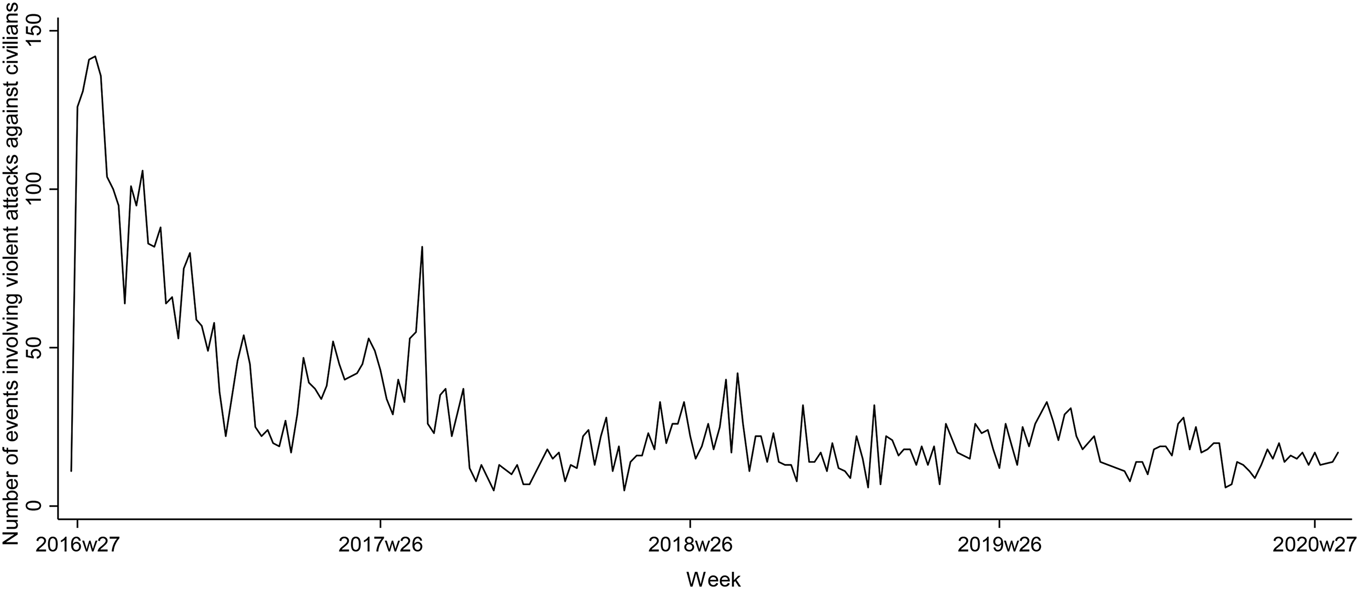
Model 2 also echoes the hypothesized relationship between crime rhetoric and audience priming with substantially similar results as in Model 1. However, the estimates also suggest a tendency for the president to appeal to people's emotion and justify the necessity of the government's crime response during periods of heightened criminality. About half (48 percent) of the events involving violent attacks against civilians took place in the first two years of the Duterte administration (Figure 2). Arguably, some of these attacks may have even been perpetrated by no less than elements of the state. Johnson and Fernquest (Reference Johnson and Fernquest2018) suggest that incidents of civilian bloodbath were committed by police or vigilantes who were encouraged to execute Duterte's war on drugs. The highest number (142 events) in this data was observed during the last week of July 2016 or just a few weeks after Duterte took his oath of office. With, say, an average of 34 violent events in a given week, the rate of evocative crime rhetoric increases by a factor estimate between 7 and 32 percent.
Number of events involving violent attacks against civilians, 2016–2020. Source: ACLED, 2020

Model 2 controls for monthly inflation, the onslaught of the COVID 19 pandemic, domestic human rights reports, and broadcast media's sentiment on the government's drug war. Of the controls, only domestic human rights reports appear to be statistically significant, but the direction of the relationship is contrary to what we hypothesized. In this case, murderous or threatening words from the president only seem to increase as domestic criticism on the country's human rights situation intensifies. Nevertheless, this is not altogether surprising and, in fact, appears consistent with a number of media and scholarly accounts pertaining to the Philippines (Pernia Reference Pernia2019; Johnson and Fernquest Reference Johnson and Fernquest2018). Duterte is known for his “indifference and violative overarching treatment of human rights” (Pernia Reference Pernia2019, 66) and, in one report, he even bragged that “he would not hesitate to order killings of human rights activists who pissed him off” (Ranada Reference Ranada2021).
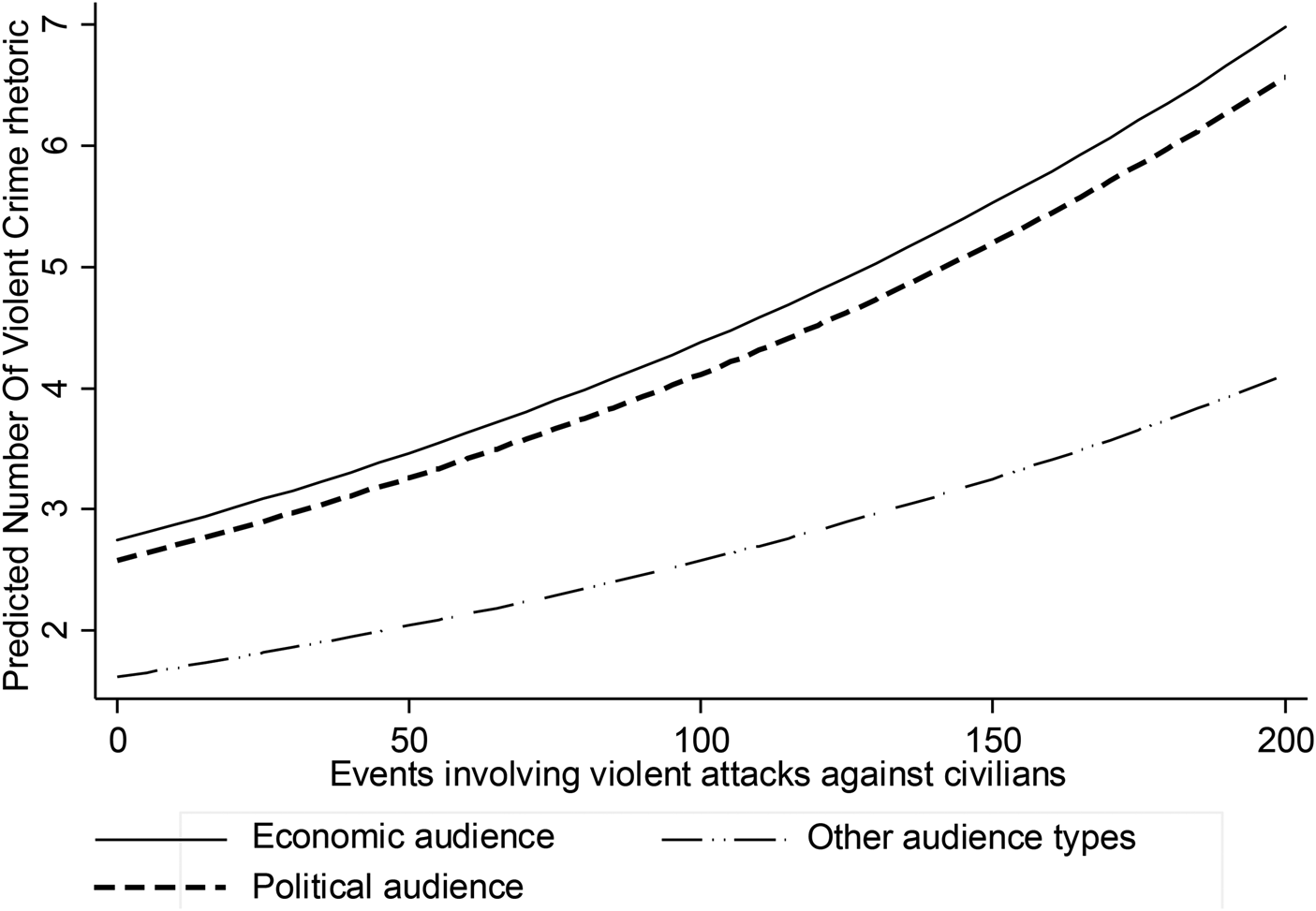
Model 3 reiterates Model 2 but puts emphasis on the effect of economic and political audience on the president's crime rhetoric. In this specification, the audience consists only of the economic and political types, while the other types are grouped together as the base category for comparison. As in previous models, both economic and political audiences appear to motivate the president to engage in firebrand criminal rhetoric in official speeches. We can also decipher the effect of audience type on crime rhetoric by comparing their marginal effects for a given value of a covariate. The graph in Figure 3 gives a visual comparison of the predicted number of violent-crime rhetoric in presidential speeches for economic and political audiences during periods of heightened violence. The graph illustrates the extent by which the president engages in fiery anti-crime speechmaking when he is speaking before an economic and a political audience respectively. The graph also indicates how speechmaking before these two types of audience varies in comparison with other audience types.
Predicted margins of economic and political audiences

Conclusion
Examining a unique dataset consisting of a corpus of Philippine president Duterte's speeches delivered between June 2016 and January 2020, we find that violent allusions to crime are strategic linguistic devices deliberately targeting particular types of functional audience: an economic audience whose business or livelihood benefits from a crime-free environment, and a political audience which consists of state and administrative elements whose collaboration is needed for government's controversial drug campaign to work. The findings convey an image of a president who has a keen understanding of his constituents’ primal preferences—economic well-being and security—and how they can be activated or highlighted by means of a rhetorical strategy that is excessively fixated on crime. By deliberately narrowcasting his message to key functional audiences, Duterte exudes the same sensibilities as any national leader who embodies “what the nation collectively feels” and persuades citizens to believe that “their interests align with the various policy directions being pursued by the government” (Grube Reference Grube2013, 65). This enabled the Philippine president to win over citizen's hearts and minds, as demonstrated in his high approval ratings and in the resounding victory of the administration slate during the 2019 midterm elections.
The Filipinos’ subsequent validation of government's controversial antidrug campaign caught many by surprise, but it probably owes much to this performative communication strategy that invokes elite-mass signaling. Although the object of Duterte's rhetoric—a national policy curbing illegal drugs and criminality—was ultimately a failure, this is probably beside the point. It is possible that presidents draw legitimacy not by charting effective policy directions but by giving the public a semblance of responsiveness. Though at odds with the mainstream literature, this perhaps explains why Duterte continues to enjoy public confidence despite unflattering scholarly appraisal of his administration and leadership style. Presidents, after all, exert a substantial influence on their very own approval by “priming the criteria on which citizens base their approval evaluations” (Druckman and Holmes Reference Druckman and Holmes2004, 755). Furthermore, the findings provide evidence of how presidents use their bully pulpit to activate latent issues of public importance, such as Filipinos’ yearning for order and security, among others, that comports chiefly to the strategic and stylistic means of how populists discursively work (Weyland Reference Weyland2001; Moffitt and Tormey Reference Moffitt and Tormey2014; Hawkins Reference Hawkins2009).
In presenting our findings, we recognize that some discretion is necessary when fleshing out the larger implications of our empirical evidence. For instance, we do not discount the possibility that not all of Duterte's speeches were transcribed and that there may have been some undercounting in the data that might pose stochastic issues.Footnote 11 We have tried our best to ascertain that the pool of speeches that make up our sample were not biased by deliberate suppression or selection. We were assured by government data custodians that the speeches were processed under standard procedures and that they had been properly and appropriately transcribed prior to their public release. This notwithstanding, we believe our findings were still able to demonstrate the significance of presidential statements as instruments of policy agenda and the value of presidential rhetoric as a strategic political device.
Future research could venture into several lines of inquiry drawn from the findings. First, since our analytical approach barely scratched the surface, it may also be worthwhile to look into how Philippine presidents engaged in symbolic and substantive rhetoric on anticrime policies (Hill and Marion Reference Hill and Marion2016; Oliver, Hill, and Marion Reference Oliver, Hill and Marion2011). Second, a richer examination of presidents and the presidency warrants a probe into the institutional constraints vis-à-vis other policy actors and shapers of public opinion. This could be done by exploring the dynamics of lawmaking in the country (Panao Reference Panao2014; Reference Panao2016; Reference Panao2019) and how its formulation signals a calibrated rhetorical alignment with the executive branch. Third, it is high time to ask whether or not Duterte is indeed a populist from both a conceptual and theoretical point of view (Hawkins Reference Hawkins2009; Block and Negrine Reference Block and Negrine2017; Sagarzazu and Thies Reference Sagarzazu and Thies2019). If populism construes elites as homogenously oppressive of the majority, then the fact that Duterte's functional audience have both elite and mass components suggests that the audience in populist rhetoric is not really well understood. It could also be that, like Trump in the US, Duterte's leadership demonstrates a rhetorical turn in modern presidencies that “reveal the habits of thought that the overwhelming majority of us take for granted” (Zug Reference Zug2018, 19). Future work may need to extend beyond the current regime and test the general hypotheses of this study through a thorough examination of previous Philippine presidents’ speeches. Fourth, investigating the instrumental role of mass media (print and broadsheet) in shaping the narrative of the Philippine drug war can also offer a panoramic perspective that parallels studies in comparative politics on media and populism (Bonner Reference Bonner2019; Krämer Reference Krämer2014; Hameleers, Bos, and De Vreese Reference Hameleers, Bos and de Vreese2017).
Finally, a much-layered and fruitful study of Philippine presidents may venture into incorporating citizen's psychological underpinnings, i.e., ‘demand-side’ of populism, not just the ‘supply side’ (Akkerman, Mudde, and Zaslove Reference Akkerman, Mudde and Zaslove2014; Rovira Kaltwasser Reference Rovira Kaltwasser2021; Mudde and Rovira Kaltwasser Reference Mudde and Kaltwasser2018; Rovira Kaltwasser and Hauwaert Reference Rovira Kaltwasser and Van Hauwaert2020; Pernia Reference Pernia2021; Kenny and Holmes Reference Kenny and Holmes2020). Perhaps it is high time to examine Filipinos’ level of ideological and cultural conservatism to explain why many are drawn to illiberal leaders and authoritarian figures (Inglehart and Norris Reference Inglehart and Norris2017; Norris and Inglehart Reference Norris and Inglehart2019). Maybe deep-seated conservative values expressed in preference for material security and maintenance of peace and order can shed light on Filipinos’ continuing support for Duterte and his ilk.
Acknowledgements
The authors are grateful to the editor of the Journal of East Asian Studies (JEAS), and the two anonymous reviewers for their detailed comments. In addition, the authors thank Dr. Jinhyeok Jang and the participants of the lecture presentation titled “Fear & Loathing or Symbolic Framing? Context and Audience Selection in Duterte's Crime Rhetoric” on November 25, 2020 held at the Institute of Political Science, National Sun Yat-sen University, in Kaohsiung, Taiwan for their helpful feedback.
Rogelio Alicor L. Panao, Ph.D., is an associate professor in the Department of Political Science, University of the Philippines Diliman. He is a member of the Philippine Bar.
Ronald A. Pernia is an assistant professor in the Political Science Program of the College of Social Sciences, University of the Philippines Cebu. He is currently a Ph.D. candidate in the Institute of Political Science, National Sun Yat-sen University (NSYSU), Kaohsiung, Taiwan.