Introduction
Head and neck cancers constitute more than 15 per cent of cancers in India,1 and since as many as 20–50 per cent of patients can present with recurrent disease after radiation treatment,Reference Forastiere, Goepfert, Maor, Pajak, Weber and Morrison2 recurrent head and neck cancers pose a significant health burden. Second primary cancers in the head and neck region further add to this burden, with as many as 20–25 per cent of patients affected in the long-term.Reference Schwartz, Ozsahin, Zhang, Touboul, De Vataire and Andolenko3
The treatment of recurrent and second primary head and neck cancers has always been challenging, and is associated with significant toxicities. A balance has to be achieved between local control and treatment-related morbidities and mortalities. Salvage surgery alone has yielded dismal results,Reference Goodwin4 as has systemic chemotherapy alone.Reference Forastiere, Metch, Schuller, Ensley, Hutchins and Triozzi5–Reference Bentzen and Hansen8 Median duration of survival with these approaches has been reported to range from five to nine months.
Local and locoregional recurrences remain a significant problem in this group of patients.Reference Honk, Bromer, Amato, Shapshay, Vincent and Vaughan9–Reference Nishijima, Takooda, Tokita, Takayama and Sakura11 The focus has subsequently shifted to treating patients with re-irradiation alone. Traditionally, full-dose re-irradiation resulted in unacceptable complication rates, with grade 3–4 acute and late toxicities ranging from 14–41 per cent.Reference De Crevoisier, Bourhis, Domenge, Wibault, Koscienly and Lusinchi12 The addition of concurrent chemotherapy has not resulted in improved outcomes, and a recent report from the MD Anderson Cancer Center showed that the addition of chemotherapy was associated with decreased overall survival.Reference Takiar, Rosenthal, Ang, Beadle, Frank and Fuller13 Radiotherapy (RT) alone has shown a more durable response,Reference Takiar, Rosenthal, Ang, Beadle, Frank and Fuller13, Reference Langendijk, Kasperts, Leemans, Doornaert and Slotman14 with a dose–response relationship.Reference Salama, Vokes, Chmura, Milano, Kao and Stenson15, Reference Watkins, Shirai, Wahlquist, Stuart, Chaudhary and Garrett-Mayer16 Hence, re-irradiation alone or in combination with surgery has become an acceptable treatment option for affected patients.
This paper reports our experience of patients treated (in a tertiary cancer centre) with re-irradiation for recurrent or second primary head and neck cancers, with respect to various prognostic factors likely to have impacted outcome.
Materials and methods
Patients
Patients with histological proof of recurrent disease, who had received re-irradiation with curative intent (definitive or post-operative treatment with doses between 45 and 60 Gy) to the areas overlapping with previous radiation portals, were included in the study. In total, 79 patients with recurrent head and neck cancers or second primary tumours, who underwent re-irradiation between January 1999 and December 2011, were included in this retrospective analysis.
The patients were evaluated by a multidisciplinary team (in the Head and Neck Cancer Clinic) comprising a head and neck surgeon, a radiation oncologist and a medical oncologist. The detailed evaluation included: physical evaluation; laboratory investigations with complete haematological profile; liver function tests and renal function tests; computed tomography (CT) and/or magnetic resonance imaging of the head and neck area; direct laryngoscopy or panendoscopy (where clinically indicated); and X-ray or CT of the thorax. Positron emission tomography was not routinely used in the cases. Patients treated with primary surgical intent were offered post-operative RT in cases of high-risk features (positive surgical margins, or nodal involvement with extracapsular extension or multiple levels of nodes).
Radiotherapy
For all radiation treatments, patients were immobilised in a thermoplastic immobilisation device in a supine position with their arms by their sides. Opposed lateral or oblique wedge-pair fields were used in those who underwent planned conventional radiation. For patients who underwent planned conformal radiation (three-dimensional conformal RT or intensity-modulated RT), a planning CT scan was acquired (with intravenous contrast), with 3 mm slice thickness, using a Philips large bore CT scanner. Conventional radiation patients were treated using a cobalt-60 teletherapy machine (Theratron® 780c) and other patients were treated with a 6 MV photon beam on a Varian Clinac® 2300 CD linear accelerator.
For patients treated with definitive RT, the gross tumour volume was defined according to the gross tumour evident on the planning CT scan, and on clinical and endoscopic findings. Advice was taken from radiologists with respect to treatment changes. An isotropic expansion of 5–10 mm was used to form the clinical target volume. The clinical target volume was restricted with respect to natural barriers such as bone. The clinical target volume was isotropically extended by 3–5 mm when generating planning target volume. For patients receiving post-operative RT or RT following neoadjuvant chemotherapy, the pre-operative or pre-chemotherapy irradiated volume included a margin. Elective nodal irradiation was not performed. During the RT planning, achievement of a conformal dose distribution covering the planning target volume was of the highest priority, followed by maximal sparing of the spinal cord.
Chemotherapy
Patients with normal haematological parameters, and normal kidney and liver function test results, with a Karnofsky performance status score of more than 70 (i.e. they were able to take care of their personal needs with no assistance), were given concurrent chemotherapy at the discretion of the treating physician. In these patients, chemotherapy using cisplatin (40 mg/m2 weekly) was administered intravenously for a median of five cycles (range of three to five cycles). Induction chemotherapy consisted of cisplatin (100 mg/m2), administered intravenously on days 1 and 5, and 5-fluorouracil (750–1000 mg/m2), administered intravenously on days 1–4.
Toxicity assessment and follow up
Acute toxicities were assessed in line with the Radiation Therapy Oncology Group's Acute Radiation Morbidity Scoring Criteria.17 All patients were assessed weekly during the course of RT. Those receiving concurrent chemotherapy also had weekly complete blood count tests performed.
After the completion of treatment, patients were evaluated (in the Head and Neck Cancer Clinic) at one month and then every three months for the first two years, and every six months in the subsequent years. Clinical examination was performed at each follow up, and imaging (CT or magnetic resonance imaging) was conducted every four to six months, or earlier in cases where there was clinical suspicion of progression.
Clinical end-points
The disease-free interval for primary treatment was defined as from the start of the first treatment to the diagnosis of the recurrent or second primary disease. Progression-free survival for recurrent disease was defined as from the start of the second treatment to locoregional recurrence, distant recurrence or death. Those patients who had not experienced any such event by the time of the last follow up were excluded.
Statistical analyses
The log-rank test was used to evaluate the impact of prognostic variables on survival. The following prognostic variables were included in the analysis: age (younger than 50 years vs 50 years or older); disease-free interval (less than 2 years vs 2 years or more); histology of recurrent disease (poorly-differentiated carcinoma vs other types); RT dose (less than 50 Gy vs 50 Gy or more); RT technique (conventional vs conformal); recurrence type (recurrence vs second primary); and treatment modality (re-irradiation alone vs re-irradiation plus surgery or chemotherapy).
Kaplan–Meier estimates were used to conduct survival analyses.Reference Kaplan and Meier18 The Cox regression model was used for multivariate analysis. A p value of less than 0.05 was considered significant for all statistical analyses. Statistical analyses were conducted using SPSS® version 17.0.
Results
Patients' characteristics
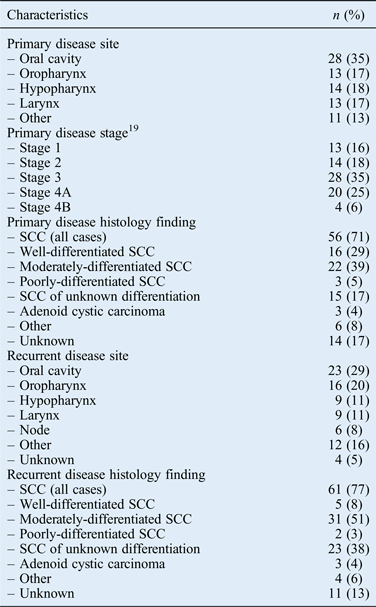
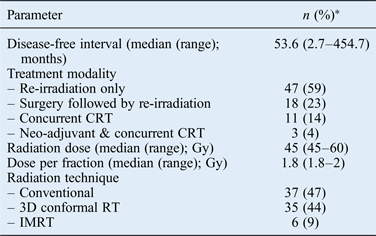
The median follow-up duration from the date of the first diagnosis was 64.7 months (range, 15–454 months). The median age of patients was 54 years (range, 21–76 years). Of the 79 patients, 71 were male and 8 were female. Thirty-two per cent of the patients had a second primary tumour, 62 per cent had recurrent head and neck cancers, and status was unknown in 6 per cent of patients. Patient and tumour characteristics are summarised in Table I (primary disease stage was defined according to the American Joint Committee on Cancer19). Table II summarises the details of treatment modalities used.
Patient and tumour characteristics at time of re-irradiation

SCC = squamous cell carcinoma
Re-irradiation treatment details
*Unless indicated otherwise. CRT = chemoradiotherapy; 3D = three-dimensional; RT = radiotherapy; IMRT = intensity-modulated radiotherapy
Radiation data
Median time from initial radiation to re-irradiation was 53.6 months (range, 2.7–454.7 months). Median prior radiation dose was 70 Gy (range, 48–70 Gy). Median dose of re-irradiation was 45 Gy (range, 45–60 Gy). Median cumulative radiation dose was 110 Gy (range, 60–140 Gy). Median clinical target volume was 92.49 cc (range, 45.49–390.81 cc) and median planning target volume was 159.97 cc (range, 94.15–643.25 cc). Median spinal cord maximum dose for re-irradiation was 14.28 Gy (range, 5.35–49.72 Gy).
Eighteen patients (23 per cent) underwent surgery followed by post-operative re-irradiation. Four patients could not complete their scheduled radiation course (three of the patients had progression of the disease during the course of the treatment and one patient suffered an acute cardiac vascular accident). Two patients received repeat re-irradiation. Of these, one patient (with aesthesioneuroblastoma) received a cumulative radiation dose of 135 Gy and the other (with nasopharyngeal carcinoma) received a total dose of 140 Gy. Both the patients were alive and their disease status remained unchanged at the time of the last follow up.
Re-irradiation portals were overlapping by more than 25 per cent of the initial field in 44 patients (56 per cent). Thirty-five patients had an overlap of less than 25 per cent. In 30 patients, the radiation field was almost the same as in the initial irradiation, with an overlap of more than 90 per cent.
Chemotherapy data
Fourteen per cent of patients underwent re-irradiation with concurrent chemotherapy. Three patients received induction chemotherapy with cisplatin and 5-fluorouracil (a total of two cycles each). No patient received adjuvant chemotherapy.
Toxicity data
Thirty per cent of patients suffered from acute grade 3 or worse toxicity. Of these, 7 patients suffered from grade 3 skin toxicity, 12 patients suffered from grade 3 mucosal toxicity, and 5 patients had grade 3 laryngitis or pharyngitis. No patient died as a result of the acute treatment toxicity.
Survival outcomes
The median disease-free interval for primary treatment, for the entire cohort, was 53.66 months (95 per cent confidence interval (CI), 42.19–64.42). Median progression-free survival for recurrent disease, for the entire cohort, was 15.0 months (95 per cent CI, 8.33–21.66) (Figure 1). One-year and two-year recurrence-free survival rates were 63 per cent and 40 per cent respectively.
Progression-free survival rates for patients with recurrent or second primary head and neck cancers.
Prognostic variables
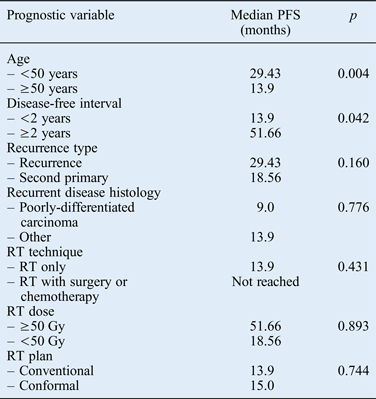
Table III summarises the impact of prognostic variables on progression-free survival, determined via univariate analysis. Recurrent tumour was associated with better survival than second primary malignancy, but this finding did not reach statistical significance. The only variables that had a statistically significant impact were patient age of less than 50 years and disease-free interval of more than 2 years. Median progression-free survival for patients aged less than 50 years was 29.43 months, versus 13.9 months for those aged 50 years or older. Median progression-free survival for patients with a disease-free interval of 2 years or more was 51.66 months, versus 13.9 months for those with a disease-free interval of less than 2 years. Figures 2 and 3 show the respective statistically significant differences in progression-free survival associated with disease-free interval and age. On multivariate analysis, no variable had a statistically significant impact on progression-free survival (p = 0.451)
Impact of disease-free interval (DFI) on progression-free survival rates for patients with recurrent or second primary head and neck cancers.
Impact of age on progression-free survival rates for patients with recurrent or second primary head and neck cancers.
Impact of prognostic variables on progression-free survival*
* Determined via univariate analysis. PFS = progression-free survival; RT = radiotherapy
Discussion
Re-irradiation with external beam RT has been reported on by various institutions, with local control rates varying from 20 to 65 per cent and median overall survival ranging from 7 to 28 months.Reference Salama, Vokes, Chmura, Milano, Kao and Stenson15, Reference Lee, Chan, Bekelman, Zhung, Mechalakos and Narayana20–Reference Wang and McIntyre22 In this paper, we present our 13 years' experience of re-irradiation for the treatment of recurrent and second primary head and neck cancers conducted at a single institution. Median progression-free survival was 15 months in our study, with a 2-year recurrence-free survival rate of 40 per cent.
The radiation treatment technique has been found to be a factor influencing outcome. In a study by Lee et al., two-year locoregional failure-free survival was found to be better with intensity-modulated RT than with non-intensity-modulated RT techniques (52 per cent vs 20 per cent, p < 0.001).Reference Lee, Chan, Bekelman, Zhung, Mechalakos and Narayana20 This difference persisted on multivariate analysis. This was not the case in our study; median progression-free survival was not better in patients treated with conformal techniques compared with conventional techniques (15.0 vs 13.9 months, p = 0.744). This may be because of the varying primary tumour site in our patient population. In the study by Lee et al., 20 per cent of the patients had recurrent disease in the nasopharynx,Reference Lee, Chan, Bekelman, Zhung, Mechalakos and Narayana20 and this subsite has been associated with better local control rates and overall survival in various other re-irradiation studies.Reference Chua, Sham, Hung, Leung, Cheng and Kwong23, Reference Oksüz, Meral, Uzel, Cağatay and Turkan24
Several new treatment strategies have been explored recently. These include re-irradiation combined with cetuximab,Reference Balermpas, Keller, Hambek, Wagenblast, Seitz and Rödel25 and re-irradiation plus concurrent paclitaxel and carboplatin.Reference Kharofa, Choong, Wang, Firat, Schultz and Sadasiwan26 However, these strategies have not improved survival, and have in fact worsened patient morbidity. A recent report by Takiar et al. from the MD Anderson Cancer Center has even shown detrimental effects associated with the addition of chemotherapy.Reference Takiar, Rosenthal, Ang, Beadle, Frank and Fuller13 The use of chemotherapy was linked to decreased overall survival (p < 0.035) and locoregional control (p < 0.057). We did not see any statistical difference between the outcome of patients treated with or without concurrent chemotherapy. However, this could be because of the small proportion of patients (14 per cent) who received concurrent chemotherapy.
Dose escalation is another strategy that has been utilised to improve survival in this setting. In several studies, dose escalation up to 60–64 Gy has been found to result in increased local control, but at the cost of unacceptably high toxicity levels.Reference Salama, Vokes, Chmura, Milano, Kao and Stenson15, Reference Goldstein, Karnell, Yao, Chamberlin, Nguyen and Funk27, Reference Sher, Haddad, Norris, Posner, Wirth and Goguen28 The rate of acute and late grade 3–4 toxicity was reported to be as high as 68 per cent in a study by Goldstein et al.Reference Goldstein, Karnell, Yao, Chamberlin, Nguyen and Funk27 and reached 91 per cent in a study by Sher et al.Reference Sher, Haddad, Norris, Posner, Wirth and Goguen28 The challenge in treating recurrent head and neck cancers with re-irradiation is achieving a delicate balance between the radiation dose and consequent toxicity. We achieved a progression-free survival of 15 months with a modest median dose of 45 Gy (range, 45–60 Gy). This was associated with a grade 3 acute toxicity rate of 30 per cent and no treatment-related death. Similar to our study, Zwicker et al. showed a one-year survival rate of 63 per cent and acceptable toxicity (acute grade 4 toxicity rate of 6 per cent and late grade 0–3 toxicity rate of 21 per cent) when patients were treated with a median re-irradiation dose of 50 Gy.Reference Zwicker, Roeder, Hauswald, Thieke, Timke and Schlegel29 Based on the above findings, we feel that a dose of 45–50.4 Gy is sufficient to achieve decent local control with an acceptable toxicity profile, in the absence of advanced treatment modalities such as intensity-modulated RT are used.
• Recurrences or second primaries affect 20–30 per cent of previously irradiated head and neck cancer patients
• Treatment options include re-irradiation alone or in combination with surgery or concurrent chemotherapy
• Our single-institute experience indicates that re-irradiation treatment with moderate radiation doses (45–50.4 Gy) yields acceptable progression-free survival and morbidity rates
• This finding is particularly relevant in a resource-constrained setting
• Aggressive treatment with higher radiation doses or concurrent chemotherapy can increase morbidity and mortality
Several prognostic factors have been correlated with improved outcome. These include surgery prior to re-irradiation,Reference Salama, Vokes, Chmura, Milano, Kao and Stenson15 anatomical site (e.g. nasopharynx),Reference Lee, Chan, Bekelman, Zhung, Mechalakos and Narayana20 radiation treatment techniqueReference Lee, Chan, Bekelman, Zhung, Mechalakos and Narayana20 and duration of radiation-free interval.Reference Duprez, Madani, Bonte, Boterberg, Vakaet and Derie30 In our study, a disease-free interval of 2 years or more was associated with a favourable outcome (median progression-free survival of 51.66 months for intervals of 2 years or longer vs 13.9 months for intervals of less than 2 years; p = 0.042), which is in line with the findings of Duprez et al.Reference Duprez, Madani, Bonte, Boterberg, Vakaet and Derie30 Additionally, younger patient age (less than 50 years) was associated with a better survival outcome in our study. The results of our study and those of previous studies indicate that certain patients are more suitable for aggressive treatment approaches such as dose-escalated RT or additional post-operative RT. A subset of patients could be pre-selected for such treatment on the basis of particular favourable prognostic factors (e.g. younger age, longer disease-free interval, surgically operable recurrences and good performance status). Other patients are best treated with a modest dose of re-irradiation (45–50.4 Gy) only.
The limitations of our study include: the lack of data on late toxicities and missing data for minor toxicities (grade 1–2), the heterogeneity of the patient population, and the limited follow-up period. The retrospective analysis of patients treated over a long period of time (as in our study, which comprised patients treated from 1999 to 2011) with varying treatment strategies is a limitation in itself.
This paper describes the largest series on re-irradiation in head and neck cancers reported from this part of the developing world. Our study highlights the practice of safely delivering a modest dose of re-irradiation with an acceptable toxicity profile and decent survival in a resource-constrained setting.
Conclusion
Based on our experience, re-irradiation for recurrent or second primary head and neck cancers is a feasible treatment, with acceptable toxicity and decent progression-free survival. Patient age of less than 50 years and a disease-free interval of 2 years or longer are independent prognostic factors that can help to determine those patients likely to have a good clinical outcome. A delicate balance has to be established between the radiation dose and consequent toxicity. A re-irradiation dose of 45–50.4 Gy was a safe and acceptable dose in our setting.