Introduction
Flies of the Tabanidae family are distributed worldwide and are important mechanical vectors of viruses, bacteria, protozoans and helminths that cause diseases in wild and domestic animals (Krinsky, Reference Krinsky1976; Foil, Reference Foil1989). They can also be implicated in Anaplasma transmission to humans (De La Fuente et al., Reference De La Fuente, Naranjo, Ruiz-Fons, Höfle, De Mera, Villanúa, Almazán, Torina, Caracappa, Kocan and Gortázan2005).
Equine and bovine trypanosomosis that occurs in South Brazil has their agent transmitted by tabanids (Silva et al., Reference Silva, Oliveira, Zanette, Soares, Coradini, Polenz, Santurio and Monteiro2007). Despite the increased cases of ‘Mal das Cadeiras’ caused by Trypanosoma evansi in southern Brazil, few studies have been conducted in this region to understand the tabanid ecology. Most of them were about taxonomy (Turcatel et al., Reference Turcatel, Carvalho and Rafael2007; Krolow et al., Reference Krolow, Krüger and Ribeiro2007). In Brazil, most studies were conducted in Pantanal (Barros, Reference Barros2001; Koller et al., Reference Koller, Barros, Gomes, Madruga, Araújo, Umaki and Ismael2002) and Amazon regions of the country (Ferreira et al., 2002).
The objective of this study was to investigate the tabanid species that attack horses as well as to determine their seasonality and landing behaviour. This is the first work on tabanids in the Santa Catarina State, Brazil.
Materials and methods
Collections were carried out from March 2007 to February 2009 at the Tessarollo ranch (27°48′S, 50°19′33W) in Planalto Serrano, located in the mid-eastern part of Santa Catarina State. The Planalto Serrano is at 916 m above sea level and approximately 230 km from the Atlantic coast. Average annual rainfall is about 1500 mm, and average annual temperature and relative humidity are, respectively, 14.3 °C and 79.3%. The Tessarollo ranch is located approximately 30 km northeast of the city of Lages. The collection site was mostly grass covered and near a wooded creek. During the rainy seasons, the site was flooded.
Once a month, the experiment was carried out for 2 hours (14.00–16.00 h) by four observers, each one responsible for collection of tabanids on different parts of the horse. Tabanids that landed on the horse body (female, 18 years old, dark coloured) were carefully captured with a glass tube (4.5 cm diameter and 9 cm deep). The same horse was used throughout the study. Observers remained continuously near (1–3 m) the animal, and all flies landing on the horse were captured. The flies were put in different plastic bottles using the SECTAB device (Christen et al., Reference Christen, Tavares, Komati, Ramos and Miletti2009). In case of rain, the collections were conducted on the subsequent day.
The horse remained stationary, except for a 5 min walk every 30 min in a pre-defined transect (about 100 m). The purpose of the walk was to increase host attraction and improve tabanid captures (Barros, Reference Barros2001). At the end of each sampling month, flies were forwarded to the laboratory for identification and counting.
The behaviour of horseflies was determined by counting the number of individuals that landed on different parts of the horse (head, body and limbs) (Bassi, 2001).
Tabanids were identified using the taxonomic keys of Fairchild (Reference Fairchild1969 and Reference Fairchild1984) and Barros and Gorayeb (Reference Barros and Gorayeb1996), and later confirmed by Dr Inocêncio S. Gorayeb (Museum Goeldi, Pará, Brazil). Data on temperature, relative humidity and rainfall were obtained from a weather station located in the municipal district.
Results
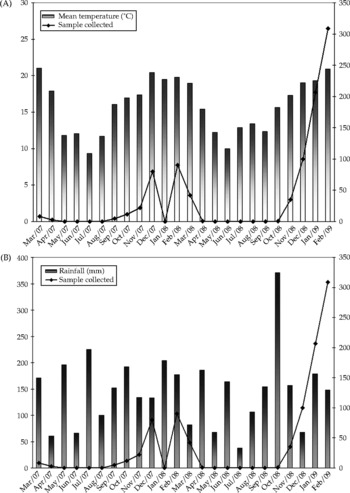
In general, temperature and relative humidity can be considered typical for the region. Temperature averaged 15.8 °C, and was higher during the summer months (December–March) and lower in the autumn/winter months (May–September) (Fig. 1A). The average relative humidity was 79.6%, and the rainfall was variable during the period without any preferential precipitation cycle (Fig. 1B).
Climate data from March 2007 to February 2009 at Tessarollo Ranch in Lages-SC, Brazil. (A) mean temperature × samples; (B) rainfall × samples.

Seasonal abundance
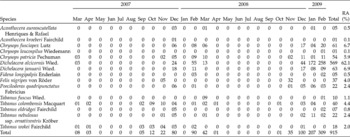
A total of 915 tabanids, classified in 15 species, were collected during the 2-year study (Table 1). We found three species Chrysops fusciapex Lutz, Acanthocera aureoscutellata Henriques & Rafael and A. kroeberi Fairchild for the first time in Santa Catarina State, and the last one, also in Brazil. With five species, Tabanus was the most represented genus during the collection period, whereas Dichelacera alcicornis Wied. was the most abundant species.
Seasonal distribution and prevalence of tabanids captured on an individual horse from March 2007 to February 2009, in Planalto Serrano, Santa Catarina State, Brazil

RA, relative abundance.
A total of five species had relative abundance < 1%, which combined represented 2% of the total captures (Table 1). The number of individuals belonging to the most abundant species represented 62.1% of the total collections.
In general, the number of species and individuals was higher during the summer months (December–March), with a peak of 11 species collected in December 2007. With 309 individuals, the highest number of specimens was recorded in February 2009; as in previous years thereafter, the number of captured tabanids gradually declined towards the autumn and winter months. The lack of data in January 2008 was due to the inability to access the collection site.
Landing behaviour
The following landing preference was recorded during the collection period. Head: Chrysops (100%), Fidena (13.5%), Dichelacera (12.7%) and Tabanus (1.5%); limbs: Acanthocera (100%), Poeciloderas (100%), Tabanus (58.8%), Fidena (48.6%) and Dichelacera (31.6%); flanks: Dichelacera (56.3%), Tabanus (39.7%) and Fidena (37.9%).
Discussion
This is the first study on the prevalence, seasonality and landing behaviour of tabanids in southern Brazil, where animals previously infected with T. evansi had been identified (Silva et al., Reference Silva, Oliveira, Zanette, Soares, Coradini, Polenz, Santurio and Monteiro2007). Recently, cases of equine infectious anaemia were recorded in the neighbouring Rio Grande do Sul State and in a municipality 60 km to the south of the collection site (Carlos Ramos, Department of Health, Santa Catarina State, Brazil, personal communication).
Due to the lack of studies on tabanids in southern Brazil, we compared our data with those from studies in other regions of the country, where a similar methodology was used. The number of specimens recorded during our collections was lower than those in Pantanal (Barros, Reference Barros2001) and São Paulo State (Bouvier, Reference Bouvier1952), possibly due to the lower average annual temperatures in Santa Catarina State, as tabanids generally prefer a warmer climate. We also recorded fewer genera (six) and species (15) compared with studies conducted in more tropical regions. For instance, Barros (Reference Barros2001) collected 12 genera and 21 species in Pantanal region.
Our results corroborate those of Bassi et al. (Reference Bassi, Cunha and Coscaron2000) in Paraná State in terms of the four most prevalent species, D. alcicornis Wied., D. januarii Wied., C. patricia and C. fusciapex, which represented 81% of the total collections and which were collected mainly from the head and flank regions.
During the 2-year study, peak numbers of tabanids were recorded in December 2007, possibly linked to a single case of equine trypanosomosis reported in Santa Catarina State in 2007 (Silva et al., Reference Silva, Oliveira, Zanette, Soares, Coradini, Polenz, Santurio and Monteiro2007).
The number of specimens collected did not increase during the rainy season contrary to observations in tropical regions of Brazil (Barros, 2001). However, more tabanids were collected when the average temperature approached 17 °C. In February 2009, 3.5 times more specimens were collected than in February 2008. The rainy season in this region is most likely to influence the maturation of the horseflies, which have a long life cycle. The heavy rainfall in October 2008 probably contributed to the subsequent peak tabanid catches in February 2009 (Table 1) (Benchimol and Sá, Reference Benchimol and Sá2005).
Disease transmission is heavily influenced by the abundance of vectors, and thus high fly numbers during the summer months pose a considerable threat to the animal populations in Santa Catarina State and especially to the significant milk production in this region.
Acknowledgements
We thank the owners of Haras Tessarollo Lages-SC, Brazil, for making their facilities available for insect collection; Dr Inocêncio S. Gorayeb (Museum Emílio Goeldi) for the taxonomic classification of the material and CIRAM/EPAGRI (Santa Catarina Information Centre for Environmental Resources and Hydrometeorology) for providing the meteorological data.