Introduction
Scientific progress in understanding the relationship between nutrition and health has an increasingly profound impact on consumers approach to nutrition which has resulted in the development of the concept of functional foods (Bhat & Bhat, Reference Bhat and Bhat2011). Milk and dairy products can be used as functional foods due to their bioactive lipids such as: butyrate, branched-chain fatty acids, conjugated linoleic acid (CLA), vaccenic acid (VA = trans-11 C18:2) and n-3 polyunsaturated fatty acids (PUFA) (Shingfield et al. Reference Shingfield, Chilliard, Toivonen, Kairenius and Givens2008).
Taking into account that diet strongly influences the overall milk fat content and chemical composition, many studies have been performed in sheep to ascertain the effects of diet on milk fatty acid (FA) profile (Tsiplakou et al. Reference Tsiplakou, Mountzouris and Zervas2006; Tsiplakou & Zervas, Reference Tsiplakou and Zervas2008). Supplementation of sheep diets with vegetable oils, rich in linoleic acid, induce an increase in milk CLA content (Hérvas et al. Reference Hervás, Luna, Mantecón, Castañares, de la Fuente, Juárez and Frutos2008; Castro et al. Reference Castro, Manso, Jimeno, Del Alamo and Mantecónd2009; Gómez–Cortés et al. Reference Gómez-Cortés, Toral, Frutos, Juárez, de la Fuente and Hervás2011a, Reference Gómez-Cortés, de la Fuente, Toral, Frutos, Juárez and Hervásb) while, the inclusion of marine lipids, such as fish oil (Capper et al. Reference Capper, Winkinson, Mackenzie and Sinclair2007), and marine algae (Reynolds et al. Reference Reynolds, Cannon and Loerch2006; Toral et al. Reference Toral, Frutos, Hervás, Gómez-Cortés, Juárez and de la Fuente2010b) enhance the n-3 PUFA content in milk fat. Despite the promising results obtained from the separate inclusion of vegetable and fish oil in sheep diets, to date there is scarce information concerning the dietary supplementation with a combination of soybean oil and fish oil. On the other hand, in dairy cows a lot of research has been conducted to investigate the combination of fish oil with sunflower oil in bovine milk FA profile giving results with a considerable variation in this response, based on a number of factors including the type of forage (AbuGhazaleh et al. Reference AbuGhazaleh, Felton and Ibrahim2007), the level of oil added (Cruz-Hernandez et al. Reference Cruz-Hernandez, Kramer, Kennelly, Glimm, Sorensen, Okine, Goonewardene and Weselake2007) and the forage/concentrate ratio (F/C) (AbuGhazaleh et al. Reference AbuGhazaleh, Schingoethe, Hippen and Kalscheur2003; Shingfield et al. Reference Shingfield, Reynolds, Hervás, Griinari, Grandison and Beever2006). To our knowledge, in sheep, only Toral et al. (Reference Toral, Hervás, Gómez-Cortés, Frutos, Juárez and de la Fuente2010a) used fish oil in combination with sunflower oil in a low forage diet (F/C = 20/80) and induced milk fat depression which affects cheese yield and quality. Gómez–Cortés et al. (Reference Gómez-Cortés, de la Fuente, Toral, Frutos, Juárez and Hervás2011b) using a moderate level of plant oil only, in low – to moderate – concentrate diets, confirmed better milk FA profile with no reduction in milk fat content. Due to those different responses of sheep to dietary oil supplementation, it was hypothesized that the inclusion of soybean oil in combination with fish oil in dairy sheep diet, with a moderate F/C ratio will potentially increase the CLA and n-3 PUFA content which results in a milk FA profile more beneficial to human health, with no reduction in either milk fat content or milk yield. Thus, this work was conducted with the aim to study the effect of diet supplementation with soybean oil in combination with fish oil (SFO) on milk chemical composition and on milk and plasma FA profile in dairy sheep.
Materials and Methods
Twelve 3-years-old Friesian crossbred dairy sheep at 90–98 d in milk were maintained at the Agricultural University of Athens. The mean initial body weight (BW) of the animals was 63±2·1 kg. Housing and care of animals conformed to Ethical Committee guidelines of the Faculty of Animal Science. The sheep were assigned to 2 homogeneous sub-groups (n = 6) that were balanced by their BW and milk yield. Throughout the experimental period each sheep of each group was fed individually according to its requirements (Zervas, 2007). The animals of both groups were fed after two weeks adaptation period with a ration consisting of alfalfa hay and concentrates with an F/C = 53/47 which was offered to the animals twice a day (two equal parts at 0800 and 1600 h). The concentrate of the control group had no added oil, while that of the treated group was supplemented with 23·6 g soybean oil and 4·7 g fish oil per kg dry matter (DM) of the total ration. The choice for the levels of oils used in this study were based on the results of Gómez–Cortés et al. (Reference Gómez-Cortés, Toral, Frutos, Juárez, de la Fuente and Hervás2011a) who found that a supplementation level in sheep diets between 17 and 34 g sunflower oil/kg DM gave better milk FA profile from the consumers point of view in comparison with a supplementation with 51 g sunflower oil/kg DM of a TMR ration.
The concentrate diets were prepared every week for both groups and were formulated to be isoenergetic and isoproteic. In order to have isoenergetic and isoproteic concentrate diets, due to oil inclusion in the concentrate diet of treated group, two different raw ingredients (sugar beet pulp and sunflower meal) were used which resulted in concentrate chemical composition differences between control and treated groups (Table 1). That was unavoidable with the feedstuffs available for the experiment.
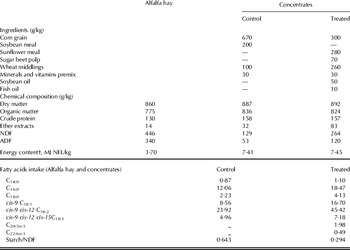
Ingredients, chemical composition and mean daily fatty acids intake (g) of the diets used throughout the experimental period

† Calculated
The quantities of food offered to the animals were adjusted at the 0, 7, 14 and 28 experimental day according to their individual requirements based on their BW and milk fat corrected yield. Ingredients and chemical composition of alfalfa hay and concentrates and the FA intake of the whole ration are presented in Table 1. The average daily DM intake throughout the experimental period for the control and the treated groups was 1·81 and 1·85 kg respectively. The whole experimental period lasted 42 d. Animals had free access to fresh water.
Samples collection
All animals were milked twice a day at 8 am and 6 pm by a milking machine. Individual milk samples were collected from sheep at day 0, 7, 14, 28 and 42 for chemical analyses, and at day 28 and 42 for FA determination after mixing the yield from the evening and the morning milking on a percent volume (5%). Blood samples were collected at day 28 and 42 for FA determination from the jugular vein into EDTA-containing tubes and subsequently centrifuged at 2700 g for 15 min to separate plasma from the cells. Both milk and blood samples used for FA analyses were stored at −80 °C, prior to analysis.
Milk, plasma and feeds analyses
The milk samples were analysed for FA according to Nourooz-Zadeh & Appelqvist (Reference Nourooz-Zadeh and Appelqvist1998) method as described by Tsiplakou et al. (Reference Tsiplakou, Chadio, Papadomichelakis and Zervas2012). A 17 ml milk sample was transferred into a separating funnel, where 30 ml isopropanol were added. After vigorous shaking, 22·5 ml hexane were added, and the mixture was shaken for another 3 min. The mixture was then centrifuged at 2520 g for 5 min at 5 °C, and the upper layer was transferred to a second separating funnel. The lower layer was extracted twice with 22·5 ml hexane, and the supernatants were pooled with the previous hexane layer. After addition of 15 ml 0·47 m aqueous Na2SO4 the hexane layer was collected into a flask and evaporated with a rotary evaporator at 30 °C. In 40 mg lipid, 2 ml hexane was added followed by 40 μl methylacetate. After vortexing, 40 μl methylation reagent (1·75 ml methanol/0·4 ml 5·4 mol/l sodium methylate) was added. The mixture was vortexed and allowed to react for 10 min, then 60 μl termination reagent (1 g oxalic acid/30 ml diethylether) was added. The sample was then centrifuged for 5 min at 2400 g at 5 °C and the liquid layer was removed and used directly for chromatographic determination.
The plasma FA analysis was carried out by the method of Bondia-Pons et al. (Reference Bondia-Pons, Castellote and Lopez-Sabater2004). One hundred microlitres plasma samples were saponified in PTFE screw-capped Pyrex tubes containing 20 μg tridecanoic acid, by adding 1 ml sodium methylate (0·5% w/v) and heating to 100 °C for 15 min. After cooling to 25 °C, samples were esterified with 1 ml boron trifluoride-methanol reagent (also at 100 °C) for 15 min. Once the tubes were cooled, FAME were isolated by adding 500 μl n-hexane. After shaking for 1 min, 1 ml of a saturated sodium chloride solution was added. Finally, the tubes were centrifuged for 8 min at 2200 g. After drying with anhydrous sodium sulphate, the clear n-hexane top layer was transferred into a vial and used directly for chromatographic determination.
Alfalfa hay and concentrate samples were analysed for FA according to Sánchez-Machado et al. (Reference Sánchez-Machado, Lo´pez-Herna´ndez and Paseiro-Losada2002) method. For the determination of FA concentration an Agilent 6890 N gas chromatograph equipped (Agilent Technologies 2850, Centerville Road, Wilmington, USA) with an HP-88 capillary column (60 m × 0·25 mm i.d. with 0·20 μm film thickness, Agilent) and a flame ionization detector, was used.
The different groups of FA and the atherogenicity index (AI) were defined according to Stockdale et al. (Reference Stockdale, Walker, Wales, Dalley, Birkett, Shen and Doyle2003) and by Ulbricht & Southgate (Reference Ulbricht and Southgate1991) respectively, while the Δ−9 desaturase activity index was calculated according to the following four ratios: C14:1/C14:0, C16:1/C16:0, C18:1/C18:0 and cis-9, trans-11 C18:2/trans-11 C18:1. The milk samples were also analysed for fat, protein, lactose, total solids (TS), and solids-not-fat (SNF), with IR spectrometry (Milkoscan 133/; Foss Electric, Hllerod, Demark), after appropriate calibration of the instrument according to Gerber (BSI, 1955) and Kjeldahl (IDF, 1993). Alfalfa hay and concentrate samples were also analysed for organic matter (OM; 7·009), dry matter (DM; 7·007), N (7·016) and ether extract (7·060) according to AOAC (1984) and for neutral detergent fibre (NDF) and acid detergent fibre (ADF) according to Van Soest et al. (Reference Van Soest, Robertson and Lewis1991).
Statistical analysis
Data are presented as least squares (LSs) means. Experimental data were analysed using the SPSS statistical package (version 16.0). The BW, the milk chemical composition and the FA profile of milk and blood plasma were analysed using a general linear model (GLM) for repeated measures analysis of variance (ANOVA) with dietary treatments (Control, Treatment) and sampling time (T) as fixed effects and their interactions (D × T) according to the model:
 $$Y _{ijk} = \mu + D_i + T_j + (D \times T)_{ij} + e_{ijk} $$
where Y ijk is the dependent variable, μ the overall mean, D i the effect of dietary treatment, T j the effect of sampling time (j = 5 for milk chemical composition, 2 for milk and plasma FA profile) (D × T)ij the interaction between dietary treatments and sampling time and e ijk the residual error.
Post hoc analyses were performed when appropriate using Duncan's multiple range test and significance was set at 0·05.
Results and Discussion
The inclusion of soybean and fish oil (SFO) in sheep diet induces important changes in milk FA profile in the absence of detrimental effects on milk fat content and on milk yield. In this respect, it should be highlighted that the SFO supplementation did not negatively affect the milk fat content (Table 2) which is an important parameter in cheese yield for the dairy sheep breeders, because ovine milk is mostly transformed into cheese. It has been shown that moderate forage diets, as in this study, when supplemented with plant oils had no effect on milk fat content (Gómez–Cortés et al. Reference Gómez-Cortés, de la Fuente, Toral, Frutos, Juárez and Hervás2011b) in sheep, while the opposite happened in dairy cows (Cruz-Hernández et al. Reference Cruz-Hernandez, Kramer, Kennelly, Glimm, Sorensen, Okine, Goonewardene and Weselake2007). Although the reasons are still uncertain, some authors have reported that lactating sheep might be less sensitive than cows to some milk fat depression inducing factors, probably because of their ability to maintain rumen function (Pulina et al. Reference Pulina, Nudda, Battacone and Cannas2006). Further to that, in relation to milk fat content there is scarce information in sheep, compared with dairy cows, concerning the inclusion of plant oils in combination with fish oil in their diets. In fact, recently, Toral et al. (Reference Toral, Hervás, Gómez-Cortés, Frutos, Juárez and de la Fuente2010a) has found a decrease in milk fat content of sheep fed a diet supplemented with sunflower and fish oil. The contradictory results of Toral et al. (Reference Toral, Hervás, Gómez-Cortés, Frutos, Juárez and de la Fuente2010a) and our study, concerning the milk fat content, could be mostly accounted for by differences in the F/C ratio, the basal diet composition and to the lipid dosage, concerning mainly the FO supplementation.
Body weight (Kg), milk yield (g/d/animal) and milk chemical composition (%) of the milk of sheep fed the two diets throughout the experimental period

† MFC = Milk fat corrected yield in 6% with the equation Y6%=(0·28+0·12F)M where F = fat% and M = milk yield in g
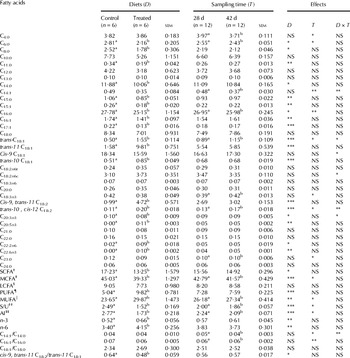
From a nutritional point of view the significant decrease in the concentrations of C6:0, C8:0, C11:0, C14:0, C15:0, C15:1, C16:0, C16:1, C17:1 FA, short chain FA (SCFA) and medium chain FA (MCFA) in sheep milk of the treated group compared with controls (Table 3) can be seen as a positive effect, because accumulated evidence shows a strong link between the intake of some saturated FA (SFA) (C12:0, C14:0 and C16:0) and the incidence of cardiovascular diseases (Hu et al. Reference Hu, Manson and Willet2001; Mensink et al. Reference Mensink, Zock, Kester and Katan2003). SCFA and MCFA are synthesized de novo from acetate and β-hydroxybutyrate in the mammary gland (Chilliard et al. Reference Chilliard, Ferlay, Mansbridge and Doreau2000). Dietary fat modifies ruminal fermentation and decreases the availability of acetate and β-hydroxybutyrate, both of which are precursors of mammary lipogenesis (Schmidely & Sauvant, Reference Schmidely and Sauvant2001). Further to that the decrease in the percentage of these FA in milk could also be due to the fact that the long chain FA (18 or more carbon atoms) alter the lipogenic gene networks in mammary epithelial cells. In fact, dietary polyunsaturated FA (PUFA) are biohydrogenated in the rumen into trans-FA, some of which, such as trans-10 C18:1, are recognized as potent inhibitors of lipogenesis in the udder (Bauman et al. Reference Bauman, Perfield, Harvatine and Baumgard2008; Kadegowda et al. Reference Kadegowda, Bionaz, Piperova, Erdman and Loor2009).
Fatty acids profile (% of total FA), atherogenicity and Δ−9 desaturase indexes of the milk from sheep fed the two diets at the two sampling times

† SCFA = C6:0+C8:0+C10:0+C11:0
‡ MCFA = C12:0+C13:0+C14:0+C15:0+C16:0
§ LCFA = C18:0+C21:0+C20:0+C22:0+C23:0+C24:0
¶ PUFA = cis-9, trans−11 C18:2CLA+trans−10, cis-12, C18:2CLA+C18:2n-6+C18:3n-3+C18:3n-6+C20:2+C20:3n-3+C20:3n-6+C20:4n-6+C20:5n-3+C22:2n-6+C22:6n-3
∥ MUFA = C14:1+C15:1+C16:1+C17:1+cis-9 C18:1+trans C18:1+trans−11 C18:1(VA)+trans−10C18:1+C20:1
†† S/U: (SCFA+MCFA+LCFA)/(PUFA+MUFA) and trans−11 C18:1 This value is not included in the C18:1content
n-3 = C18:3n-3+C20:3n-3+C20:5n-3+C22:6n-3
n-6 = C18:2n-6+C18:3n-6++C20:3n-6+C20:4n-6+C22:2n-6
‡‡ AI = (C12:0+ 4 × C14:0+C16:0)/(PUFA+MUFA)
Means with different superscript (a,b) in each row (between the two diets, and between the two sampling time) for each fatty acid differ significantly (P ⩽ 0·05)
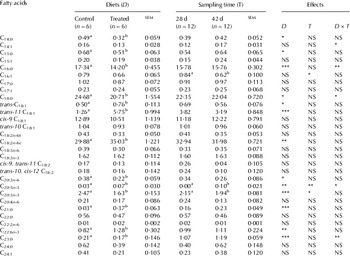
The SFO treatment resulted in a significant increase of milk trans-11 C18:1 (VA) content (Table 3) which was probably caused by the higher daily intake of linoleic acid from the sheep fed with the SFO diet (Table 1). This was also evident from the significantly higher concentration of this FA which was observed in their plasma (Table 4), since changes in plasma FA profile largely reflect the FA composition of the dietary treatments. Linoleic acid is the predominant FA in soybean oil and the main source of VA in the rumen. Indeed, measurements of FA flow in the omasum in response to incremental amounts of sunflower oil in the diet (Shingfield et al. Reference Shingfield, Chilliard, Toivonen, Kairenius and Givens2008) demonstrated that the major pathway of ruminal linoleic acid biohydrogenation involves the formation of VA as an intermediate metabolite (Griinari et al. Reference Griinari, Dwyer, McGuire, Bauman, Palmquist and Nurmela1998). On the other hand, the increase in VA content in sheep milk fed with the SFO diet may be also due to the action of long-chain n-3 PUFA present in FO which are potent inhibitors of trans-C18:1 ruminal reduction (Loor et al. Reference Loor, Ferlay, Ollier, Ueda, Doreau and Chilliard2005). Indeed, supplementation of sheep diets with fish oil has been shown to increase the plasma trans-C18:1 concentrations by incomplete ruminal biohydrogenation of PUFA (Capper et al. Reference Capper, Winkinson, Mackenzie and Sinclair2007), results that concur with the increase of trans-C18:1 and VA FA in sheep blood plasma conferred by SFO supplementation within the current study (Table 4). VA is the major trans C18:1 in dairy products and recently its protective role in cardiovascular disease has been proved (Tyburczy et al. Reference Tyburczy, Major, Lock, Destaillats, Lawrence, Brenna, Salter and Bauman2009).
The mean fatty acids concentrations (% of total FA) of total lipids of sheep plasma fed the two diets at the two sampling times

Means with different superscript (a,b) in each row (between the two diets, and between the two sampling time) for each fatty acid differ significantly (P ⩽ 0·05)
The inhibitory effect of FO long-chain n-3 PUFA on trans-C18:1 ruminal reduction had as a consequence not only to increase their concentration in milk fat, as described previously, but also to decrease the C18:0 and cis-9 C18:0 concentrations in milk and blood plasma of the treated sheep compared with controls with the results being significant only for the C18:0 content in plasma (Table 4). The inhibitory action of FO on C18:0 FA, which is produced from the biohydrogenation of dietary lipids in the rumen and is the main source on milk C18:0 content, has already been proved in cows (Lee et al. Reference Lee, Shingfield, Tweed, Toivonen, Huws and Scollan2008; Or-Rashid et al. Reference Or-Rashid, Kramer, Wood and McBride2008). Accordingly, with our results, Toral et al. (Reference Toral, Frutos, Hervás, Gómez-Cortés, Juárez and de la Fuente2010a) observed also a significant decrease in C18:0 milk fat content of sheep fed with FO alone or in combination with sunflower oil while Capper et al. (Reference Capper, Winkinson, Mackenzie and Sinclair2007) found a significant reduction on plasma C18:0 content in sheep plasma fed with fish oil.
The concentration of trans-10 C18:1 significantly increased in milk of sheep fed with SFO diet (Table 3) which is in agreement with the results of Gulda et al. (Reference Gulda, Ishlak and AbuGhazaleh2012) who observed, in continuous culture fermenters, that fish oil (1% DM) with soybean oil (2% DM) when added in a high forage diet (F/C = 70/30) caused an increase in both VA and trans-10 C18:1 concentrations. It is remarkable that high levels of trans-10 C18:1 in sheep milk appear to be accompanied by similar or even higher contents of VA (Reynolds et al. Reference Reynolds, Cannon and Loerch2006), whereas in dairy cows there is a pronounced inverse relationship between these two FA. So the trans-10 C18:1 content may amply exceed that of VA (Boeckaert et al. Reference Boeckaert, Vlaeminck, Dijkstra, Issa-Zacharia, Van Nespen, Van Straalen and Fievez2008). In addition, in contrast to cows, an increase in trans-10 C18:1 levels as a consequence of SFO supplementation was not followed by a concomitant decrease in sheep milk fat as mentioned earlier. The reasons for this discrepancy between ovine and bovine responses to oils supplementation in milk fat remain uncertain.
The principal dietary factors that affect the production of trans-10 C18:1 content in milk have been classified in two categories: 1. diets that alter rumen microbial activity associated with PUFA hydrogenation and 2. the presence of a source of linoleic acid in the rations (Chilliard & Ferlay Reference Chilliard and Ferlay2004; Palmquist et al. Reference Palmquist, Lock, Shingfield and Bauman2005). Further to these it has been observed that an increase in the dietary starch:NDF ratio caused a relative decrease of cellulotic bacteria abundance and also shifts the rumen biohydrogenation of PUFA toward the production of trans-10 C18:1, but this is related to the proportions of the readily degradable carbohydrates (Griinari et al. Reference Griinari, Dwyer, McGuire, Bauman, Palmquist and Nurmela1998). In the present study the starch: NDF ratio was higher in the control diet (0·643 vs. 0·294), compared with SFO, but the opposite was observed for the linoleic acid intake (Table 1). This indicates that in this study the alterations in milk FA profile, as far as the trans-10 C18:1 was concerned, were due to the oil inclusion in the SFO sheep diet.
The significance of the increasing VA concentration also comes from its role as substrate for cis-9, trans-11 C18:2 CLA endogenous synthesis not only in the ruminant mammary gland but also in human tissues (Palmquist et al. Reference Palmquist, Lock, Shingfield and Bauman2005). Thus, in our study the SFO inclusion in a moderate forage diet (F/C = 53/47) caused a significant increase on cis-9, trans-11 C18:2 CLA (Table 3) in sheep milk to a higher level compared with that observed by Toral et al. (Reference Toral, Hervás, Gómez-Cortés, Frutos, Juárez and de la Fuente2010a) with a high concentrate diet (F/C = 20/80). In agreement with our results, supplementation of high forage diets with 10 g FO in combination with 20 g sunflower oil per kg DM has been shown to result in higher levels of cis-9, trans-11 C18:2 CLA in cow milk (6·1 g/100 g FA) in relation to that found when the same amount of these oils was offered in a high concentrate diet (1·7 g/100 g FA). In addition, comparisons between sheep and cows fed with moderate forage diets supplemented with a combination of sunflower oil with fish oil reveal two fold higher cis-9, trans-11 C18:2 CLA and VA levels in sheep milk fat compared with cows which underlines the animal species differences (AbuGhazaleh & Holmes, Reference AbuGhazaleh and Holmes2007; AbuGhazaleh et al. Reference AbuGhazaleh, Felton and Ibrahim2007). Further to cis-9, trans-11 C18:2 CLA concentration, significant increase was also observed in the trans-10, cis-12 C18:2 CLA (Table 3) in the milk fat of sheep fed with SFO diet compared with controls, in contrast to the observations of Toral et al. (Reference Toral, Hervás, Gómez-Cortés, Frutos, Juárez and de la Fuente2010a). From the above it becomes clear that even though the combination of high linoleic vegetable oil with marine lipids is considered to be a good nutritional strategy for enhancing CLA content in milk fat, there is a considerable variation in this response. It has been reported that the composition of the basal diet and the F/C ratio in dairy cows are also important factors which determine the extent to which changes in ruminal biohydrogenation occur when combination of FO with plant oil (rich in C18:2n6c) are given (Shingfield et al. Reference Shingfield, Reynolds, Hervás, Griinari, Grandison and Beever2006).
The diet supplementation with SFO caused also some additional changes in milk, pointed toward an enhancement in PUFA concentration and a decrease in S/U, AI and cis-9, trans-11 C18:2 CLA/trans-11 C18:1 Δ−9 desaturase activity index values (Table 3). In the recent years, PUFA have received much attention from the nutritionists, consumers and researches because of their beneficial function on human health including antiatherogenic, immune system stimulation, etc (Ruxton et al. Reference Ruxton, Calder, Reed and Simpson2005). The reduction in cis-9, trans-11 C18:2 CLA/trans-11 C18:1 Δ−9 desaturase activity index in sheep milk by the SFO diet may suggest enzyme saturation due to the substrate (trans-11 C18:1) increases and/or that other FA which are produced from the rumen biohydrogenation inhibit its activity. On the other hand these results may also suggests that Δ−9 desaturase activity was inhibited by the high levels of linoleic acid contained in the SFO diet (Table 1) as suggested by Sessler & Ntambi (Reference Sessler and Ntambi1998). A decrease in cis-9, trans-11 C18:2 CLA/ trans-11 C18:1 Δ−9 desaturase activity index in milk was also found by Angulo et al. (Reference Angulo, Mahecha, Nuernberg, Nuernberg, Dannenberger, Olivera, Boutinaud, Leroux, Albrechtand and Bernard2012) in cows fed a diet containing 2·5% sunflower in combination with 0·4% DHA from algae.
Conclusions
The results of this work have shown that the supplementation of a moderate F/C sheep diet with soybean oil in combination with fish oil (SFO) could be an effective nutritional strategy which enhances milk FAs which may be beneficial to human health without any effect on milk yield and fat content. They also show that sheep respond in a different way to SFO inclusion in their diets compared with cows concerning milk chemical composition which underlines the differences between ruminant species.
The authors also express their thanks to Assist. Prof. Konstantinos Mountzouris for his help at the GC calibration and to Miss Afroditi Tsiligaki for her contribution to the experimental work.