INTRODUCTION
The number of interventional pain management modalities being used for pain deemed intractable to conventional oral opioid therapy has increased. Intrathecal analgesia and radiofrequency techniques for tumor ablation and neurotomies are widely employed for palliation of symptoms. Vertebroplasty both for pain control and stabilization is also employed in patients with compression fractures. Advances in imaging have increased the safety of various types of nerve blocks. Undoubtedly, these interventions are efficacious in controlling pain and improving the quality of life for a select number of patients. However, candidates must be carefully and appropriately selected to prevent needless, invasive, and costly interventions.
Total pain as defined by Dame Cicely Saunders (Reference Saunders1987) requires the medical team to recognize the underlying sources of suffering that contribute to pain expression. We must remember that pain is a multidimensional expression of physical, psychosocial, and spiritual components that may not be relieved by just medications or innovative interventional pain management procedures. In the present paper, we describe a patient who experienced intractable pain and unsuccessfully underwent cordotomy but responded to the interdisciplinary (IDT) palliative care approach in an acute palliative care unit (APCU).
CASE STUDY
A 48-year-old woman was previously diagnosed with ovarian cancer metastatic to the left psoas muscle and the supraclavicular and retroperitoneal lymph nodes. She complained of severe left thigh and flank pain and was admitted to the hospital. She had undergone unsuccessful treatment with morphine, methadone, hydromorphone, hypogastric nerve block, epidural steroid injections, and percutaneous cordotomy. The palliative care team was consulted while the decision was being made as to whether placement of an intrathecal pump was warranted. She was subsequently transferred to the APCU for symptom management and transition to hospice. At the time of her admission to the APCU, she was receiving an intravenous hydromorphone infusion with a morphine equivalent daily dose (MEDD) of 660 mg.
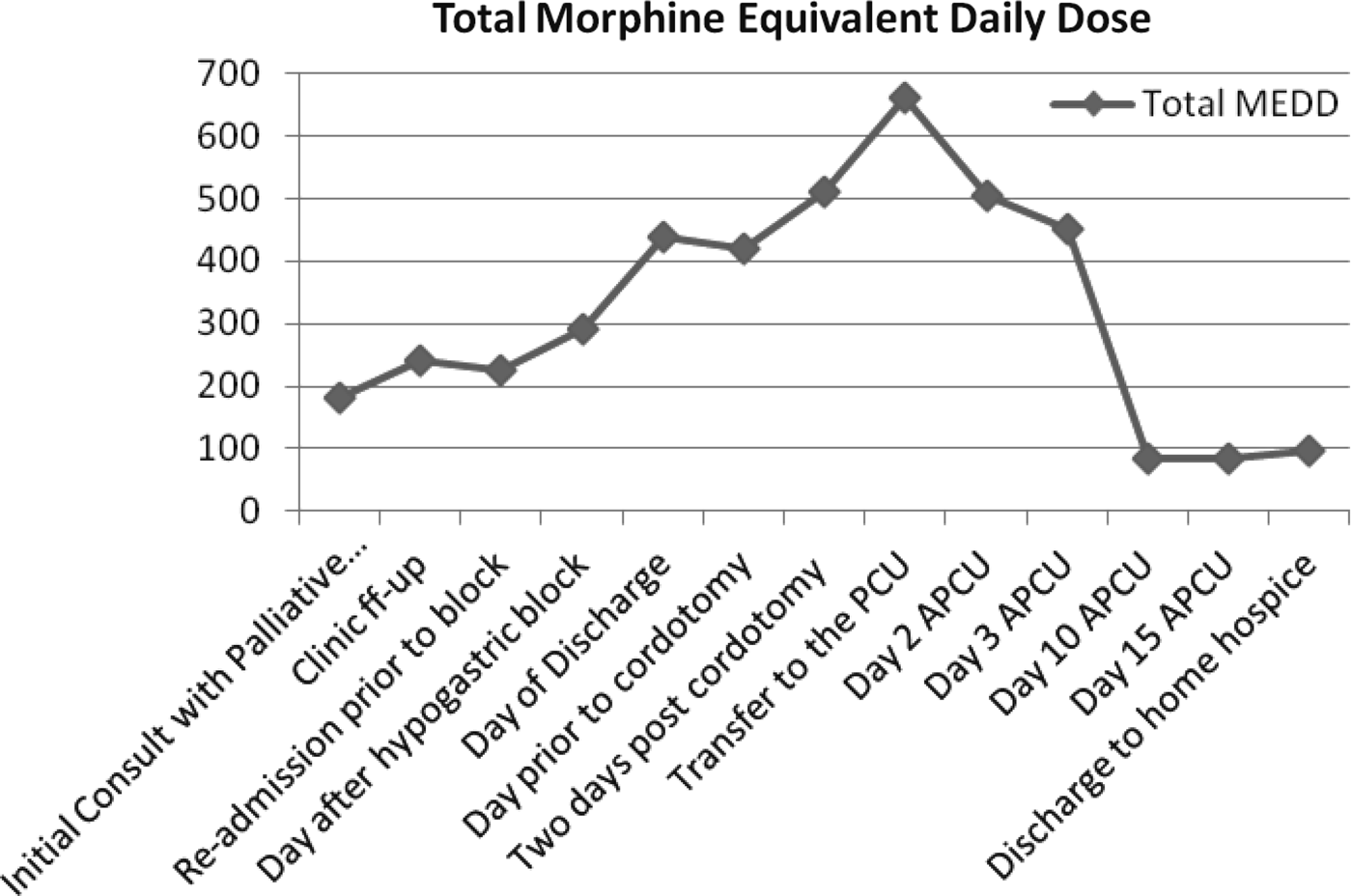
The patient was first seen by the palliative care team around two months prior to her admission to the APCU. She was reported to have disease progression and functional decline in the setting of an enlarging left thigh mass that resulted in limited physical activity. Since her initial diagnosis, the patient had undergone surgery, radiation therapy, and multiple chemotherapy regimens and had participated in clinical trials. She had been admitted to the hospital multiple times for uncontrolled pain in the two months prior to her discharge to hospice. On her fist admission, she was switched from hydrocodone/acetaminophen at 10/325 mg orally every 4 to 6 hours to extended-release morphine at 30 mg taken orally every 12 hours along with immediate-release morphine at 15 mg every 3 hours as needed for breakthrough pain. Her pain was sufficiently treated, thereby enabling her to participate in physical therapy. She had both nociceptive and neuropathic pain. She also reported increasing numbness in the anterior area of the thigh with occasional episodes of sharp, stabbing pain interspersed with a pinprick-like sensation. Gabapentin at 100 mg taken orally at bedtime was also administered as an adjuvant. Follow-up visits to the palliative care clinic and readmission resulted in escalating doses of opioids. Figure 1 illustrates the escalation in the patient's MEDD from the initial consultation to her discharge.
Changes in MEDD throughout the two months prior to discharge to hospice.

A second admission for pseudomonas bacteremia and uncontrolled pain resulted in opioid rotation from extended-release morphine at 60 mg orally every 8 hours to methadone at 5 mg taken orally every 12 hours and oral hydromorphone at 2 mg every 3 hours as needed secondary to opioid-induced neurotoxicity. The patient was eventually referred for a hypogastric nerve block. She rated her pain as 10/10. Unfortunately, her pain did not improve significantly, and her MEDD continued to increase. Also during this time, she was noted to have disease progression and received radiation therapy to her chest and left psoas muscle. She underwent right-sided computed tomography–guided cordotomy, which involves ablation of the lateral spinothalamic tract, resulting in a loss of pain and temperature sensation several segments below the contralateral side of the ablation. The procedure was not successful. She reported a slight decrease in pain at rest but an ongoing escalation of pain associated with activity. At that time, her pain medications included patient-controlled analgesia with hydromorphone at a basal infusion rate of 1.5 mg and a nurse-initiated bolus of 3 mg every 2 hours as needed (MEDD 660 mg). Recognizing the need to quickly control her pain by addressing all the components leading to her high pain expression, the palliative care consult team transferred the patient to our APCU.
Throughout the course of her admission to the APCU, the interdisciplinary team (IDT)—including a physician, fellow, nurse practitioner, counselor, chaplain, social worker, and physical and occupational therapist—identified several sources of distress that likely contributed to the patient's expression of pain. She had a history of anxiety for which she had been taking clonazepam at 0.5 mg orally twice a day as needed for about 2 years. Tapering of the medication resulted in anxiety attacks. She also screened positive for alcoholism using the Cut-down, Annoyed, Guilty, Eye-opener (CAGE) Questionnaire (Ewing, Reference Ewing1984; Parsons et al., Reference Parsons, Delgado-Guay and El Osta2008). She conveyed a lot of anxiety about dying and leaving her family behind. She worried about her husband, who had lost his first wife to cancer as well and about how emotionally difficult her passing would be for him. She also experienced a considerable amount of spiritual distress associated with not having attended religious services in recent years. Having recently converted to her husband's religion, the patient blamed this decision for her cancer diagnosis. Our chaplain made regular visits to alleviate her spiritual distress. Meanwhile, she still hoped for a miraculous cure for her cancer. She also expressed concern about her family back in her home country, whom she continued to support financially even after migrating to the United States. She came from an extremely poor family and had worked multiple jobs to support them. She was able to financially support all her siblings through college and also covered the healthcare costs of her ailing mother. She was also dealing with body image issues. She had won many beauty pageants in her home country. She confided to our team that her husband may not find her attractive anymore. She called herself his “trophy wife.” Her scores on the Edmonton Symptom Assessment System (ESAS) Scale (Bruera et al., Reference Bruera, Kuehn and Miller1991) (Figure 2) showed that increases in her MEDD were related to higher expressions of depression and anxiety.
Reported levels of pain, depression, and anxiety during the two months prior to discharge to hospice.

Our IDT focused on frequent counseling; improving the patient's function via concerted efforts from the bedside nurses and physical and occupational therapists; educating her about medications and hospice; and discussing the goals of care. She was discharged to hospice care. Her pain was well controlled with extended-release oxycodone at 15 mg taken every 12 hours and hydromorphone at 1 mg administered subcutaneously every 4 hours as needed for pain with an MEDD of 95 mg (85% reduction). Her anxiety was managed with escitalopram at 10 mg taken orally once daily and olanzapine at 2.5 mg taken every 6 hours as needed. She was successfully weaned off clonazepam. She did not require an intrathecal pump.
COMMENTS
By promptly addressing the patient's psychosocial distress, the interdisciplinary team of our acute palliative care unit alleviated her total pain expression, dramatically decreased the MEDD, and prevented yet another invasive procedure (intrathecal pump placement), which could have made home or hospice discharge very difficult. Interventional pain management techniques, such as cordotomy, have been recommended for patients for whom pharmacologic treatment is unsuccessful or who have intolerable side effects from opioids, consequently diminishing their quality of life (Kanpolat, Reference Kanpolat2004; Raslan et al., Reference Raslan, Cetas and McCartney2011; Zuurmond et al., Reference Zuurmond, Perez and Loer2010; Nersesyan & Slavin, Reference Nersesyan and Slavin2007). Cordotomy is an ablative technique aimed at the lateral spinothalamic tract to provide selective loss of pain and temperature perception several segments below and contralateral to the segment of the ablated region. The reason for this is that the fibers from the anterolateral system decussate before entering the anterolateral columns (Fitzgibbon, Reference Fitzgibbon2009). Previous studies have suggested that the best candidates for cordotomy are patients with unilateral localized intractable nociceptive pain located below dermatome C5 for whom conventional opioid therapy has been unsuccessful. Patients with neuropathic pain are not considered ideal candidates, as this procedure has been deemed ineffective in treating neuropathic pain (Kanpolat et al., Reference Kanpolat, Savas and Ucar2002). Other recommendations include a prognosis of at least two to five months but less than a year (Kanpolat, Reference Kanpolat2004; Zuurmond et al., Reference Zuurmond, Perez and Loer2010). The procedure has been shown to be successful in 80% of appropriate patients (Raslan et al., Reference Raslan, Cetas and McCartney2011). Serious side effects of cordotomy are rare and include weakness that usually improves within 48 hours (Zuurmond et al., Reference Zuurmond, Perez and Loer2010).
Importantly, the treatment of pain in patients with cancer is a dynamic process that requires an interdisciplinary approach to evaluating various aspects of the patient's condition that contribute to pain expression as well an understanding of available treatment options. Successful pain management must reflect rigorous assessment of the physical, psychological, spiritual, social, and practical aspects of pain even before consideration for more invasive treatments (Reddy et al., Reference Reddy, Hui and Bruera2012; Delgado-Guay et al., Reference Delgado-Guay, Parsons and Li2009; Mori et al., Reference Mori, Elsayem and Reddy2012; Klepstad et al., Reference Klepstad, Hilton and Moen2002; Strang et al., Reference Strang, Strang and Hultborn2004). For complex cases like the one we have described here, an APCU approach involving the IDT can alleviate the need for invasive interventions. When assessments of pain syndromes are suboptimal and various components of pain expression are not addressed, the success of invasive interventions is diminished, as in the case of the patient described here, who had multiple psychosocial issues that contributed to her total pain expression. A cordotomy, which had great promise for controlling her pain, was not successful in this patient as predicted, because a large component of her suffering was existential pain. This underscores the importance of the IDT in uncovering all the issues that may play a significant role in pain expression. Anxiety and depression have been shown to cause an increase in overall pain expression (Delgado-Guay et al., Reference Delgado-Guay, Parsons and Li2009). Counseling and impeccable medical management are effective in controlling distressing symptoms in these patients (Reddy et al., Reference Reddy, Hui and Bruera2012).
Patient selection is fundamental. Clinicians must be able to recognize good candidates for appropriate procedures and refer those patients to such interventions. Clinicians who have patients presenting with uncontrolled pain for which invasive procedures are being contemplated can follow simple guidelines to check for suitability to the patient's needs (Reddy et al., Reference Reddy, Hui and Bruera2012). In a recent report, Dev and colleagues recommended the following steps to guide clinicians in deciding whether patients are good candidates for invasive procedures (Yennurajalingam et al., Reference Yennurajalingam, Dev and Walker2010) such as cordotomy: (1) maximize medical management using opioids and other adjuvants; (2) include screening for factors that can influence pain expression, such as somatization, depression, anxiety, chemical coping, and delirium in the pain assessment; and (3) consider potential side effects that can impact the patient's quality of life.
CONCLUSION
Pain is common in advanced cancer patients. Several treatment modalities can be employed to treat pain, including pharmacological, nonpharmacological, and invasive procedures. There is a role for each modality. Undoubtedly, invasive procedures like cordotomy have a place in the treatment of cancer-related pain. The best approach to treating pain depends on proper and thorough assessment of the pain and the factors that might contribute to total pain expression.