Introduction
Chronic rhinosinusitis is defined as a persistent inflammatory response involving the mucous membranes of the nasal cavity and paranasal sinuses. It has recently been divided into two subgroups: chronic rhinosinusitis with nasal polyps, and chronic rhinosinusitis without nasal polyps.Reference Fokkens, Lund, Mullol, Bachert, Alobid and Baroody1 Allergic rhinitis is characterised by a number of symptoms, including sneezing, nasal congestion, nasal itching and rhinorrhoea.Reference Bousquet, Van Cauwenberge and Khaltaev2 Chronic rhinosinusitis and allergic rhinitis are common upper respiratory tract diseases.Reference Wallace, Dykewicz, Bernstein, Blessing-Moore, Cox and Khan3–Reference Hamilos5 The presence of allergic rhinitis is one of the risk factors for the development of asthma; the association between allergic rhinitis and asthma is explained by the ‘united airway disease’ hypothesis.Reference Bousquet, Van Cauwenberge and Khaltaev2, Reference Dixon, Kaminsky, Holbrook, Wise, Shade and Irvin6 It has been suggested that chronic obstructive pulmonary disease (COPD) is also associated with upper airway diseases including chronic rhinosinusitis.Reference Kelemence, Abadoglu, Gumus, Berk, Epozturk and Akkurt7–Reference Hurst9
Although numerous studies have described a relationship between upper and lower respiratory tract diseases, pulmonary function in patients with upper respiratory tract diseases has not been fully examined. To the best of our knowledge, no study has compared pulmonary function in patients with upper respiratory tract diseases (chronic rhinosinusitis and allergic rhinitis) with that in normal controls. This study aimed to evaluate pulmonary function in patients with chronic rhinosinusitis or allergic rhinitis who had not been diagnosed with lower respiratory tract diseases.
Materials and methods
This study was approved by the Institutional Review Board of Okayama University (approval number, RINRI-877), and was conducted in compliance with the Helsinki Declaration of 1975, as revised in 2008. Informed consent was obtained from all enrolled subjects.
Subjects
Four groups of participants were enrolled in this study: a chronic rhinosinusitis without nasal polyps group, a chronic rhinosinusitis with nasal polyps group, an allergic rhinitis group and a normal control group.
A total of 203 chronic rhinosinusitis patients who were scheduled to undergo functional endoscopic sinus surgery (FESS) at Okayama University were recruited and divided into two groups (chronic rhinosinusitis without nasal polyps and chronic rhinosinusitis with nasal polyps groups). The diagnosis of chronic rhinosinusitis with nasal polyps was based on the definition in the European Position Paper on Rhinosinusitis and Nasal Polyps 2012.Reference Fokkens, Lund, Mullol, Bachert, Alobid and Baroody1 All chronic rhinosinusitis patients were resistant to medical treatment, including macrolide therapy.Reference Kimura, Nishioka, Nishizaki, Ogawa, Naitou and Masuda10 Chronic rhinosinusitis patients with chronic lower lung diseases including bronchial asthma and COPD were excluded from this study. The diagnoses of asthma and COPD were based on the internationally accepted clinical guidelines.Reference Qaseem, Wilt, Weinberger, Hanania, Criner and van der Molen11, Reference Bateman, Hurd, Barnes, Bousquet, Drazen and FitzGerald12
Eighty-nine patients with allergic rhinitis took part in this study. Allergic rhinitis was defined according to the clinical symptoms and serological results reported in the Practical Guideline for the Management of Allergic Rhinitis in Japan (2008).13 The radioallergosorbent test was used for the diagnosis of immunoglobulin E (IgE) mediated allergic reactions. Computed tomography (CT) was performed to exclude the possibility of coexisting paranasal sinus abnormalities. Allergic rhinitis patients who were clinically diagnosed as having lower respiratory tract diseases were excluded from this study.
Age-matched, normal control subjects with no chronic respiratory diseases were also recruited (n = 100).
Because cigarette smoking could affect pulmonary function, smoking status was examined and the Brinkman Index (number of cigarettes per day × smoking years) was calculated.
Pulmonary function tests
Prior to FESS, pulmonary function testing was performed with the Chestac-9800 spirometer (Chest MI, Tokyo, Japan) according to the standardisation of lung function tests of the American Thoracic Society and European Respiratory Society.Reference Miller, Hankinson, Brusasco, Burgos, Casaburi and Coates14 The following parameters were measured or calculated: percentage of predicted vital capacity; forced expiratory volume in 1 second; percentage of predicted forced expiratory volume in 1 second; forced expiratory volume in 1 second / forced vital capacity ratio; mean forced expiratory flow between 25 and 75 per cent of the forced vital capacity; peak expiratory flow; maximal expiratory flow rate at 50 per cent of vital capacity; maximal expiratory flow rate at 25 per cent of vital capacity; and the maximal expiratory flow rate at 50 per cent of vital capacity / maximal expiratory flow rate at 25 per cent of vital capacity ratio.
Rhinomanometry
In all chronic rhinosinusitis patients, nasal obstruction was examined (prior to FESS) by active anterior rhinomanometry with a nasal nozzle at air pressure 100 Pa (MPR-3100; Nihon Kohden, Tokyo, Japan), according to the manufacturer's instructions.Reference Naito and Iwata15
Chronic rhinosinusitis assessment
The radiographic severity of chronic rhinosinusitis was assessed (prior to FESS) using the Lund–MacKay CT staging system.Reference Lund and Mackay16
Blood tests
Blood samples were taken prior to FESS. The peripheral blood eosinophil count was determined. Serum total IgE levels were measured with the ImmunoCap 250 system (Phadia AB, Uppsala, Sweden), according to the manufacturer's protocols.
Inflammatory mediators assessment
Nasal secretion was collected (prior to FESS) from 13 randomly selected chronic rhinosinusitis patients without lung disease (mean age ± standard deviation (SD), 48.2 ± 12.5 years; i.e. 3 chronic rhinosinusitis patients without nasal polyps and 10 chronic rhinosinusitis patients with nasal polyps). A bicinchoninic acid assay was performed to quantify the total protein concentration in each sample using the Pierce BCA Protein Assay Kit (Thermo Fisher Scientific, Rockford, Illinois, USA). The concentrations of inflammatory mediators (tumour necrosis factor-α (TNF-α), interleukin (IL)-1β, IL-4, IL-5, IL-6, IL-8, IL-17 and interferon-γ) were determined by BD OptEIA enzyme-linked immunosorbent assay sets (BD, Franklin Lakes, New Jersey, USA). A zero value was assigned when the concentration of inflammatory mediators was under the detection limit of the enzyme-linked immunosorbent assay set. The concentrations of TNF-α, IL-1β, IL-4, IL-5, IL-6, IL-8, IL-17 and interferon-γ (pg/ml) were divided by the concentration of total protein of each sample (mg of total protein per ml) for standardisation. The calculated concentrations of each cytokine (pg/mg total protein) were used for statistical evaluation.
Exhaled nitric oxide concentration
The Niox Mino device (Aerocrine AB, Solna, Sweden) was used to measure the level (fraction) of exhaled nitric oxide according to the manufacturer's instructions. This was carried out (prior to FESS) in 13 randomly selected chronic rhinosinusitis patients without lung disease (mean age ± SD, 48.2 ± 12.5 years; i.e. 3 chronic rhinosinusitis patients without nasal polyps and 10 chronic rhinosinusitis patients with nasal polyps).
Statistical analysis
Values are presented as means ± SD. Differences in proportions were examined using the chi-square test. For comparisons between groups, a one-way analysis of variance was conducted to establish the significance of inter-group variability. The two-tailed unpaired t-test was then used for between-group comparisons for normally distributed data. A correlation analysis was performed using Spearman's rank correlation coefficient. P values less than 0.05 were considered significant. Statistical analyses were performed with the Statistical Package for the Social Sciences software (SPSS, Chicago, Illinois, USA).
Results
Subject characteristics
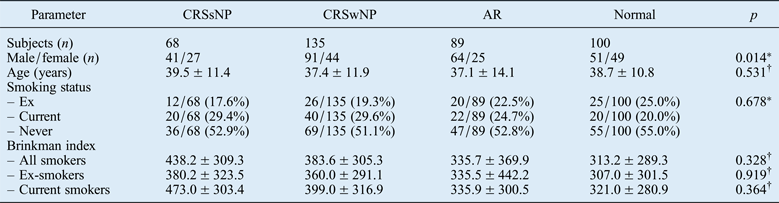
Demographic data are presented in Table I. There was a significantly higher ratio of males to females in the chronic rhinosinusitis group compared with the normal control group. There were no significant differences in age or smoking status among the groups.
Subject characteristics
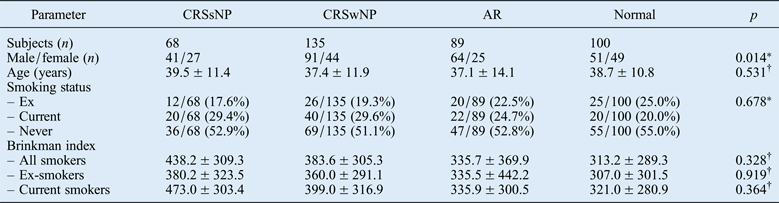
Data represent means ± standard deviation unless specified otherwise. *Chi-square test. †One-way analysis of variance. CRSsNP = chronic rhinosinusitis without nasal polyps; CRSwNP = chronic rhinosinusitis with nasal polyps; AR = allergic rhinitis
Pulmonary function
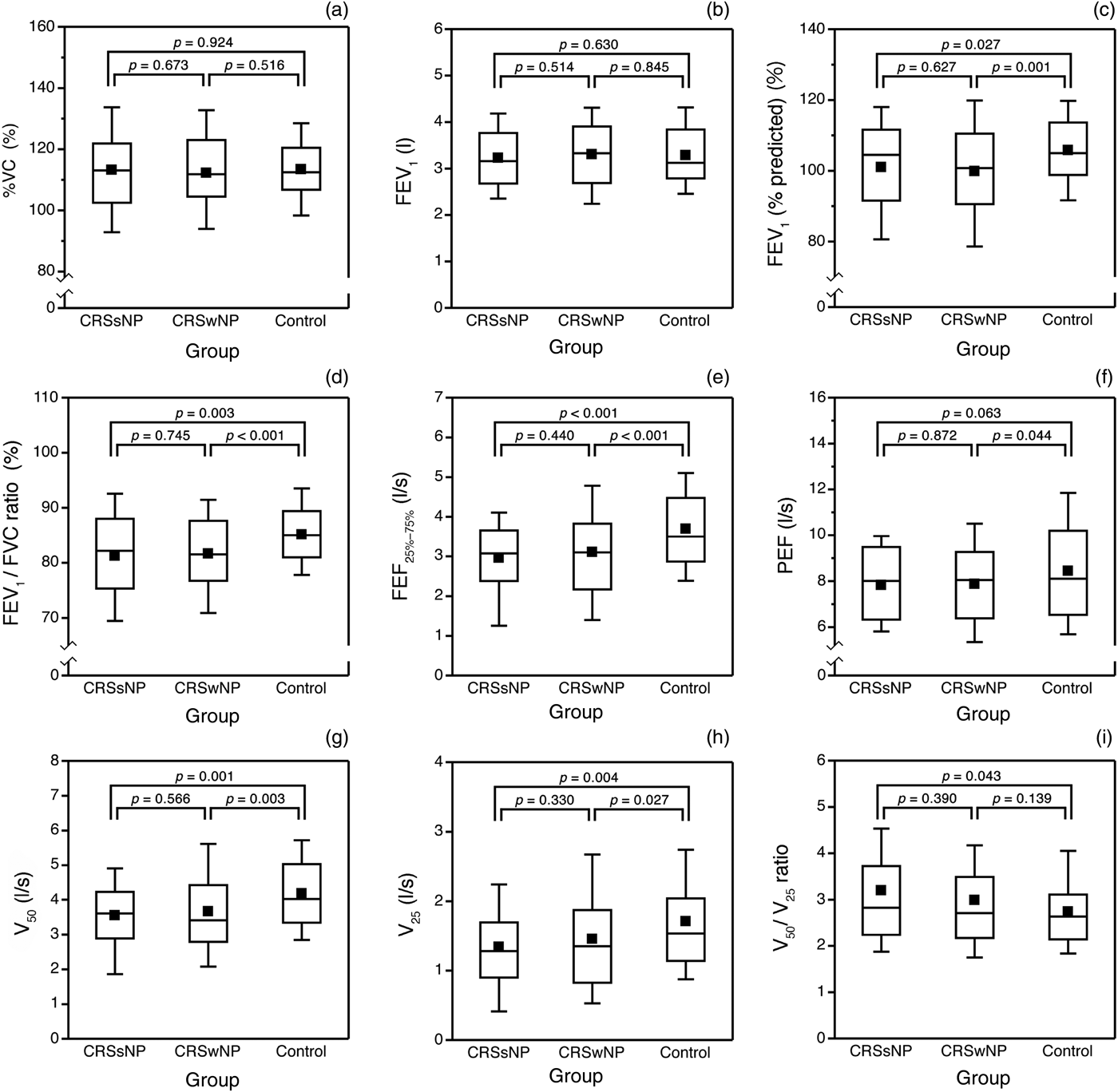
Pulmonary function data for patients with chronic rhinosinusitis (without any clinically diagnosed lung disease) and normal control subjects are shown in Figure 1. There were no significant differences between chronic rhinosinusitis patients and normal controls in terms of forced expiratory volume in 1 second and the percentage of predicted vital capacity. However, pulmonary function was significantly affected in chronic rhinosinusitis patients (compared with normal controls) in the following parameters: percentage of predicted forced expiratory volume in 1 second; forced expiratory volume in 1 second / forced vital capacity ratio; peak expiratory flow; mean forced expiratory flow between 25 and 75 per cent of the forced vital capacity; maximal expiratory flow rate at 50 per cent of vital capacity; maximal expiratory flow rate at 25 per cent of vital capacity; and maximal expiratory flow rate at 50 per cent of vital capacity / maximal expiratory flow rate at 25 per cent of vital capacity ratio. No significant differences were observed between the chronic rhinosinusitis without nasal polyps group and the chronic rhinosinusitis with nasal polyps group in any parameters.
Pulmonary function in patients with chronic rhinosinusitis, specifically: (a) percentage of predicted vital capacity (%VC); (b) forced expiratory volume in 1 second (FEV1); (c) percentage of predicted forced expiratory volume in 1 second (FEV1); (d) forced expiratory volume in 1 second / forced vital capacity (FEV1/FVC) ratio; (e) mean forced expiratory flow between 25 and 75 per cent of the forced vital capacity (FEF25%–75%); (f) peak expiratory flow (PEF); (g) maximal expiratory flow rate at 50 per cent of vital capacity (V50); (h) maximal expiratory flow rate at 25 per cent of vital capacity (V25); and (i) maximal expiratory flow rate at 50 per cent of vital capacity / maximal expiratory flow rate at 25 per cent of vital capacity (V50/V25) ratio. (Rectangles include range from 25th to 75th percentile, horizontal lines indicate median, vertical lines indicate range from 10th to 90th percentile and black squares represent mean value.) CRSsNP = chronic rhinosinusitis without nasal polyps; CRSwNP = chronic rhinosinusitis with nasal polyps

In patients with allergic rhinitis, the percentage of predicted vital capacity was 114.9 ± 15.8 per cent, the forced expiratory volume in 1 second was 3.58 ± 0.75 litres per second, the percentage of predicted forced expiratory volume in 1 second was 106.0 ± 11.8 per cent, the forced expiratory volume in 1 second / forced vital capacity ratio was 84.2 ± 7.73 per cent, the peak expiratory flow was 8.76 ± 1.98 litres per second, the mean forced expiratory flow between 25 and 75 per cent of the forced vital capacity was 3.56 ± 1.20 litres per second, the maximal expiratory flow rate at 50 per cent of vital capacity was 4.21 ± 1.24 litres per second, the maximal expiratory flow rate at 25 per cent of vital capacity was 1.63 ± 0.82 litres per second, and the maximal expiratory flow rate at 50 per cent of vital capacity / maximal expiratory flow rate at 25 per cent of vital capacity ratio was 3.10 ± 1.76. No significant differences in pulmonary function parameters were seen between allergic rhinitis patients and normal controls.
Nasal obstruction
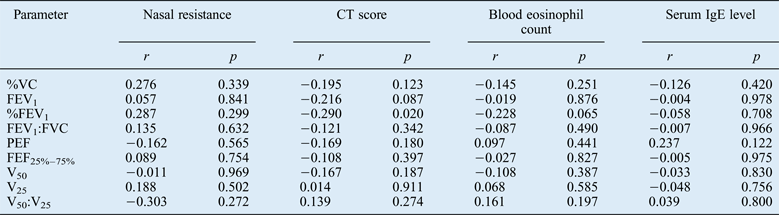
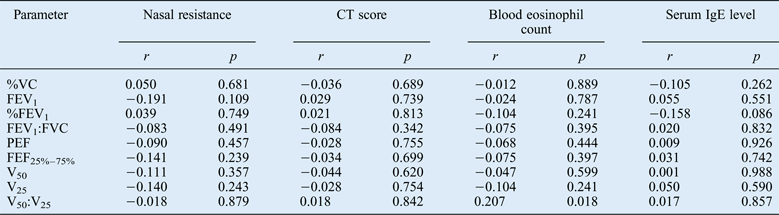
The factors that might affect pulmonary function in chronic rhinosinusitis patients were investigated. Rhinomanometry was used to evaluate nasal obstruction. The mean nasal resistances at delta P (transnasal differential pressure) 100 Pa in the chronic rhinosinusitis without nasal polyps group was 0.32 ± 0.23 Pa/cm3/s, and in the chronic rhinosinusitis with nasal polyps group it was 0.34 ± 0.24 Pa/cm3/s. There was no significant difference in nasal resistance between the chronic rhinosinusitis groups (p = 0.772). No significant correlations were observed between nasal resistance and pulmonary function in either of the chronic rhinosinusitis groups (Tables II and III).
Pulmonary function and clinical parameters correlation: patients without nasal polyps
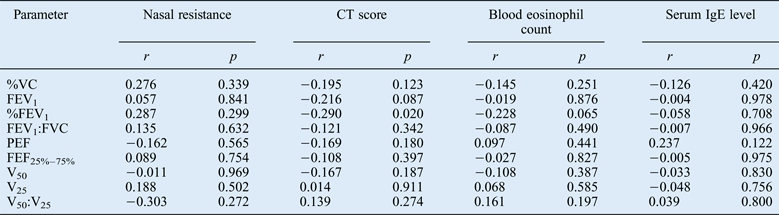
CT = computed tomography; IgE = immunoglobulin E; %VC = percentage of predicted vital capacity; FEV1 = forced expiratory volume in 1 second; %FEV1 = percentage of predicted forced expiratory volume in 1 second; FEV1:FVC = forced expiratory volume in 1 second / forced vital capacity ratio; PEF = peak expiratory flow; FEF25%–75% = mean forced expiratory flow between 25 and 75 per cent of forced vital capacity; V50 = maximal expiratory flow rate at 50 per cent of vital capacity; V25 = maximal expiratory flow rate at 25 per cent of vital capacity; V50:V25 = maximal expiratory flow rate at 50 per cent of vital capacity / maximal expiratory flow rate at 25 per cent of vital capacity ratio
Pulmonary function and clinical parameters correlation: patients with nasal polyps
CT = computed tomography; IgE = immunoglobulin E; %VC = percentage of predicted vital capacity; FEV1 = forced expiratory volume in 1 second; %FEV1 = percentage of predicted forced expiratory volume in 1 second; FEV1:FVC = forced expiratory volume in 1 second / forced vital capacity ratio; PEF = peak expiratory flow; FEF25%–75% = mean forced expiratory flow between 25 and 75 per cent of forced vital capacity; V50 = maximal expiratory flow rate at 50 per cent of vital capacity; V25 = maximal expiratory flow rate at 25 per cent of vital capacity; V50:V25 = maximal expiratory flow rate at 50 per cent of vital capacity / maximal expiratory flow rate at 25 per cent of vital capacity ratio
Computed tomography score
The Lund–Mackay CT score was used to evaluate chronic rhinosinusitis severity. The average Lund–Mackay scores on pre-operative CT scans were 6.75 ± 4.40 in the chronic rhinosinusitis without nasal polyps group and 11.71 ± 5.75 in the chronic rhinosinusitis with nasal polyps group; this difference was significant (p < 0.001). No significant correlations were observed between pre-operative CT score and pulmonary function in either of the chronic rhinosinusitis groups (Tables II and III).
Peripheral blood eosinophil count
The mean peripheral blood eosinophil count was 204.9 ± 162.8 in the chronic rhinosinusitis without nasal polyps group and 343.6 ± 311.4 in the chronic rhinosinusitis with nasal polyps group; this difference was significant (p < 0.001). There was no significant correlation between peripheral blood eosinophil count and pulmonary function for either chronic rhinosinusitis group (Tables II and III).
Immunoglobulin E level
The mean total serum IgE level was 344.0 ± 494.7 IU/ml in the chronic rhinosinusitis without nasal polyps group and 268.6 ± 455.8 IU/ml in the chronic rhinosinusitis with nasal polyps group; this difference was not significant. There was no significant correlation between serum IgE level and pulmonary function for either chronic rhinosinusitis group (Tables II and III).
Inflammatory mediators
The mean concentrations of tumour necrosis factor-α, interleukin (IL)-1β, IL-4, IL-5, IL-6, IL-8 and interferon-γ in nasal secretions were 3.4 ± 0.6, 14.1 ± 17.7, 6.4 ± 6.3, 3.5 ± 2.2, 3.9 ± 1.9, 112.4 ± 43.3 and 2.6 ± 1.0 pg/mg total protein, respectively. Interleukin-17 was undetectable in all samples. The level of IL-5 was significantly correlated with pulmonary function (forced expiratory volume in 1 second / forced vital capacity ratio, p = 0.048; mean forced expiratory flow between 25 and 75 per cent of the forced vital capacity, p = 0.027; maximal expiratory flow rate at 50 per cent of vital capacity, p = 0.043; maximal expiratory flow rate at 25 per cent of vital capacity, p = 0.043; maximal expiratory flow rate at 50 per cent of vital capacity / maximal expiratory flow rate at 25 per cent of vital capacity ratio, p = 0.032) (Table IV).
Pulmonary function and nasal secretion cytokine levels correlation
TNF = tumour necrosis factor; IL = interleukin; IFN = interferon; %VC = percentage of predicted vital capacity; FEV1 = forced expiratory volume in 1 second; %FEV1 = percentage of predicted forced expiratory volume in 1 second; FEV1:FVC = forced expiratory volume in 1 second / forced vital capacity ratio; PEF = peak expiratory flow; FEF25%–75% = mean forced expiratory flow between 25 and 75 per cent of forced vital capacity; V50 = maximal expiratory flow rate at 50 per cent of vital capacity; V25 = maximal expiratory flow rate at 25 per cent of vital capacity; V50:V25 = maximal expiratory flow rate at 50 per cent of vital capacity / maximal expiratory flow rate at 25 per cent of vital capacity ratio
Exhaled nitric oxide
The mean level of exhaled nitric oxide was 27.8 ± 17.1 parts per billion. There were no significant correlations between levels of exhaled nitric oxide and each pulmonary function test result.
Discussion
Recent studies have shown a strong link between asthma and allergic rhinitis, and COPD may also be associated with upper airway involvement.Reference Bousquet, Van Cauwenberge and Khaltaev2, Reference Hurst9, Reference Hellings and Hens17–Reference Shaaban, Zureik, Soussan, Neukirch, Heinrich and Sunyer19 Patients with asthma and COPD show increased nasal symptoms and more nasal inflammation.Reference Kelemence, Abadoglu, Gumus, Berk, Epozturk and Akkurt7
Although numerous studies have reported an association between upper and lower airway diseases based on the concept of the ‘united airway disease’ hypothesis, pulmonary function in patients with upper airway diseases has not been fully examined.Reference Ragab, Clement and Vincken20 One study reported spirometric abnormalities in patients with allergic rhinitis, but there was no normal control group in that study.Reference Ciprandi, Cirillo and Pistorio21 Furthermore, no previous study has investigated pulmonary function in chronic rhinosinusitis patients without lower respiratory tract disease. The present study showed, for the first time, that patients with chronic rhinosinusitis had latent obstruction of the small airway.
The effects of allergic rhinitis and chronic rhinosinusitis on lung function in patients with lower lung disease remain controversial. A recent report noted that asthmatics without rhinitis tend to have poorer lung function than asthmatic patients with rhinitis.Reference Dixon, Kaminsky, Holbrook, Wise, Shade and Irvin6, Reference Dixon, Raymond, Suratt, Bourassa and Irvin22 In the present study, it was clear that patients with chronic rhinosinusitis had a normal percentage of predicted vital capacity. However, compared with normal control subjects, the following parameters were affected: percentage of predicted forced expiratory volume in 1 second; forced expiratory volume in 1 second / forced vital capacity ratio; peak expiratory flow; mean forced expiratory flow between 25 and 75 per cent of the forced vital capacity; maximal expiratory flow rate at 50 per cent of vital capacity; maximal expiratory flow rate at 25 per cent of vital capacity; and maximal expiratory flow rate at 50 per cent of vital capacity / maximal expiratory flow rate at 25 per cent of vital capacity ratio. These findings suggest that chronic rhinosinusitis patients who are not clinically diagnosed as having lung disease do show evidence of obstructive lung function changes, even if these changes are asymptomatic. In contrast, there were no significant differences between allergic rhinitis patients and control subjects in spirometric parameters.
The present study investigated the factors that might influence obstructive lung function in chronic rhinosinusitis patients. Rhinomanometry is a sensitive and specific technique for the measurement of nasal obstruction.Reference Nathan, Eccles, Howarth, Steinsvåg and Togias23 The upper respiratory tract has important roles, including acting as a physical filter, resonator, heat exchanger and humidifier of inhaled air.Reference Passalacqua and Canonica24 The conditions leading to nasal obstruction may trigger lower airway dysfunction.Reference Kelemence, Abadoglu, Gumus, Berk, Epozturk and Akkurt7 The CT score based on the Lund–Mackay staging system is commonly used to assess the extent and severity of inflammatory changes in chronic rhinosinusitis.Reference Fokkens, Lund, Mullol, Bachert, Alobid and Baroody1, Reference Mehta, Campeau, Kita and Hagan25 Deal and Kountakis reported that the CT score was greater in chronic rhinosinusitis with nasal polyps patients than in chronic rhinosinusitis without nasal polyps patients.Reference Deal and Kountakis26 Although the presence of polyps in the nasal area causes blocked nose, nasal resistance to airflow (measured by rhinomanometry and CT score) was not significantly correlated with lung function in the present study.
Peripheral blood eosinophil count and serum IgE level are widely used to evaluate patients with various allergic diseases, including asthma and allergic rhinitis.Reference Ulrik27, Reference Poznanovic and Kingdom28 In the present study, no relationship was found between pulmonary function and these inflammatory mediators.
Various explanations for the upper and lower airway association have been presented. These hypotheses include: systemic reactions; nasobronchial reflex; pharyngobronchial reflex; post-nasal drainage of inflammatory mediators from the upper to lower airways; and inhalation of dry, cold air and environmental pollutants.Reference Passalacqua and Canonica24, Reference Dixon29–Reference Lai, Hopp and Lusk31 In an animal study by Kogahara et al., it was evident that a viscous post-nasal drip could flow into the lower respiratory organs when the host was asleep.Reference Kogahara, Kanai, Asano and Suzaki32 Cytokines and chemokines are important factors in the pathogenesis of upper respiratory diseases, and they play a key role in asthma and COPD.Reference Eloy, Poirrier, De Dorlodot, Van Zele, Watelet and Bertrand33, Reference Barnes34 The present study showed that patients with increased nasal interleukin-5 levels had asymptomatic lung lesions. Although the number of samples was limited, the present study findings suggest that post-nasal drip containing cytokines might be associated with obstructive lung injury in patients with chronic rhinosinusitis.
• A close relationship has been reported between upper and lower respiratory disease
• Spirometry indicated obstructive lung function in chronic rhinosinusitis patients without lower respiratory tract disease
• Cytokines in nasal secretions might be related to lung function
Exhaled nitric oxide is a marker of airway inflammation, and the concentration of exhaled nitric oxide is elevated in patients with bronchial asthma, COPD, and chronic rhinosinusitis with nasal polyps.Reference Maniscalco, Sofia and Pelaia35–Reference Guida, Rolla, Badiu, Marsico, Pizzimenti and Bommarito38 In the present study, no significant correlation was found between exhaled nitric oxide level and pulmonary function test parameters.
Conclusion
Chronic rhinosinusitis patients without clinically diagnosed lung disease had latent lung obstruction. The chronic rhinosinusitis patients with decreased lung function may be in danger of developing lower respiratory disease. Our findings suggest that the patients with upper respiratory disease should be followed carefully in order to detect lung disease. Several factors in the upper respiratory tract are considered as potential explanations for the effects on lung function. Among these factors, the present findings suggest that cytokines in nasal secretions might be related to lung obstruction.
Acknowledgement
This work was supported by JSPS KAKENHI (Grants-in-Aid for Scientific Research; grant number, 23791900).