Determiner-noun code-switching in Spanish heritage speakers
“Mi padre dijo que el car is not working” is an example of a typical code-switched utterance. Code-switching is defined as the act of switching between two or more languages within a single utterance. This is a phenomenon quite prevalent in bilingual speech as shown by, for example, Clyne (Reference Clyne2003), Grosjean (Reference Grosjean1982), Myers-Scotton (Reference Myers-Scotton2002), and Poplack (Reference Poplack1980) in a variety of different language pairs, including Spanish and English.
There are several reasons why individuals code-switch. Speakers may code-switch when a given word is not accessible in the base language and what the speaker seeks to express is more readily available in the other language (Grosjean, Reference Grosjean1982; Heredia & Altarriba, Reference Heredia and Altarriba2001), or when the interlocutor frequently engages in code-switching (e.g., Kootstra, Van Hell & Dijkstra, Reference Kootstra, Van Hell and Dijkstra2010). Additionally, code-switching in conversation may be used to convey socio-cultural or ideological meaning, the nature of the relationship between the interlocutors (e.g., power, respect, intimacy), and the perspective of the speaker (e.g., Bhatt & Bolonyai, Reference Bhatt and Bolonyai2011; Myers-Scotton, Reference Myers-Scotton1993).
Code-switching is studied from different disciplines (for overviews, see Bullock & Toribio, Reference Bullock, Toribio, Bullock and Toribio2009; Isurin, Winford & De Bot, Reference Isurin, Winford and De Bot2009; Van Hell, Litcofsky & Ting, Reference Van Hell, Litcofsky, Ting and Schwieter2015), and a common finding is that code-switching is not a random mixing of languages, but instead follows predictable patterns and is governed by linguistic structural constraints. A linguistic structure that has been studied in several corpora of natural speech is the determiner-noun code-switch. Pfaff (Reference Pfaff1979) studied Spanish–English code-switching by taking into account the specific characteristics of each language, and how they interact for each syntactic category. In her account of noun phrases, she finds that code-switched determiner-noun phrases used in conversation are more likely to be produced with a Spanish determiner and an English noun than vice versa. Pfaff also noted that in some instances, grammatical gender is lost for nouns borrowed or switched into Spanish, and masculine gender becomes the default. Jake, Myers-Scotton and Gross (Reference Jake, Myers-Scotton and Gross2002) also studied Spanish–English code-switching and found that determiner-noun switches were prevalent and, similar to Pfaff (Reference Pfaff1979), that the vast majority of the switches were comprised of a Spanish determiner and an English noun (see also Myers-Scotton & Jake, Reference Myers-Scotton and Jake2015).
Several theoretical models have been developed to explain structural constraints in code-swtiching (e.g., Belazi, Rubin & Toribio, Reference Belazi, Rubin and Toribio1994; Muysken, Reference Muysken2000; Pfaff, Reference Pfaff1979; Poplack, Reference Poplack1980; Woolford, Reference Woolford1983), and in this paper we specifically focus on two influential models: the Minimalist Program (MacSwan, Reference MacSwan1999) and the Matrix Language Frame model (Myers-Scotton & Jake, Reference Myers-Scotton and Jake2000; Myers-Scotton, Reference Myers-Scotton2002).
The Minimalist Program
The Minimalist Program is a generativist approach that sets forth rules to explain how language operates (Chomsky, Reference Chomsky1995). MacSwan extended this theory to the realm of bilingual speech by using Minimalist Program principles to predict plausible code-switches (e.g., MacSwan, Reference MacSwan2005). The theory states that in a code-switched utterance, function words are more likely to come from the language that encodes the largest number of uninterpretable features on that particular item (e.g., Liceras, Spradlin & Fuertes, Reference Liceras, Spradlin and Fuertes2005; MacSwan, Reference MacSwan2005); uninterpretable features being the aspects of the word that are purely syntactic. Content words, on the other hand, may come from either language. In code-switched noun phrases, it is predicted that the determiner that encodes more features, such as grammatical gender, will be preferred. Thus, in English–Spanish mixed language noun phrases the determiner will come from the language that has grammatical gender, Spanish. Specifically, “la cow” is predicted to occur more frequently than “the vaca” because the Spanish determiner “la” encodes grammatical gender, and the English determiner “the” does not. In the Minimalist Program, code-switching is the union of two lexicons (MacSwan, Reference MacSwan2005), where lexical items from either language are permitted but must be subjected to the Minimalist Program's feature-checking hypothesis (see MacSwan, Reference MacSwan1999, for a detailed discussion).
The Matrix Language Frame model
In contrast to the syntactically based Minimalist Program, the Matrix Language Frame model was specifically designed to explain code-switched bilingual speech and accounts for both syntax and processing (Myers-Scotton, Reference Myers-Scotton2002). This model labels the two languages being mixed as the Matrix Language and the Embedded Language. The model assumes an asymmetry between the languages such that the Matrix Language dominates the syntactic structure of the code-switched utterance, into which the Embedded Language is inserted. The Matrix Language provides the grammatical elements in the utterance, such as determiners, pronouns, and inflectional morphemes (system morphemes). The Embedded Language consists mainly of nouns, verbs, and adjectives (content morphemes). In addition to these constraints, code-switched utterances must also be confirmed to be semantically and syntactically sound. In a code-switched determiner-noun phrase, the Matrix Language Frame model predicts that the determiner will come from the Matrix Language. For example, a sentence such as “I see the vaca” is preferred over “I see la cow.” In fact, the model states that the latter is greatly dispreferred and findings from Jake et al. (Reference Jake, Myers-Scotton and Gross2002) support this, showing that such a construction is rarely observed in bilingual speech. The Matrix Language Frame model was originally devised to specifically explain code-switched bilingual speech of balanced bilinguals (“classic code-switching”; Myers-Scotton, Reference Myers-Scotton2006). Myers-Scotton argues, though, that it can be extended to less balanced bilinguals in “composite code-switching.”
Comparing and testing the Minimalist Program and the Matrix Language Frame model
It is to be noted that although the two models both make predictions about code-switching, they originated from different types of data. Support for MacSwan's Minimalist Program is derived mainly from grammaticality judgments, whereas the Matrix Language Frame model is based on naturally-occurring speech. Additionally, even though the two theories differ in their linguistic explanation of code-switches, they still may come to the same prediction in specific cases, but diverge in their predictions for other cases. In the case of determiner-noun code-switched phrases, if the determiner comes from the gendered language and the gendered language is also the Matrix Language, both theories make the same prediction about the code-switching pattern. For example, in the sentence “Yo fui a la store a comprar leche,” the mixed nominal phrase “la store” is the preferred code-switch according to both theories. The Minimalist Program predicts this switch from a Spanish determiner to an English noun because the Spanish determiner has grammatical gender, and therefore more uninterpretable features than an English determiner. The Matrix Language Frame model predicts this switch because the determiner ‘la’ comes from the Matrix Language, Spanish. However, if a language such as English is the Matrix Language, the two theories predict competing outcomes. In the sentence “I went to the store,” the Matrix Language Frame model predicts the switch “the tienda” as in “I went to the tienda” whereas the Minimalist Program predicts the switch “la store.” The question then arises, which of the theories most accurately reflects what is actually produced in bilingual speech?
Herring, Deuchar, Parafita Couto and Moro Quintanilla (Reference Herring, Deuchar, Parafita Couto and Moro Quintanilla2010) compared the Minimalist Program and the Matrix Language Frame model, targeting their accuracy in predicting the language of the determiner in code-switched nominal phrases produced by Welsh–English and Spanish–English bilinguals. Corpora consisting of conversations from Welsh–English bilinguals living in Wales, UK, and two groups of Spanish–English bilinguals living in Miami, Florida, were analyzed for this purpose. Determiner-noun code-switches were found to be prevalent in every group, with 225 instances in the Welsh–English corpus and 148 instances in the two Spanish–English corpora. In all cases, the language of the determiner was compared to the language of the sentence (the finite verb was used as the indicator of the Matrix Language). The Minimalist Program predicts that the determiner must always come from the gendered language, Welsh or Spanish in this case. The Matrix Language Frame model predicts that the determiner should come from the Matrix Language, which could be Welsh, Spanish, or English. The Minimalist Program was able to make a correct prediction 100% of the time in the Welsh–English corpus and 92% and 93.75% of the time in the two Spanish–English corpora. In utterances containing a Matrix Language, the Matrix Language Frame model was able to make correct predictions 98.73% of the time in the Welsh–English corpus, and 97.78% and 94.74% of the time in the two Spanish–English corpora.
Since both theories were fairly accurate in their predictions, it is not surprising that there was no statistically significant difference between the two in terms of success of predictions. Furthermore, the authors note that the Matrix Language was usually either Welsh or Spanish, so we have little information about how the two theories compare when English is the Matrix Language.
The Present Study
The present study sought to test the Minimalist Program and the Matrix Language Frame model using well-attested experimental research techniques, again targeting determiner-noun code-switches in Spanish–English bilinguals. Admittedly, studying code-switching in a laboratory setting is not as ecologically valid as analyzing naturalistic code-switched speech. However, our techniques attempt to approach natural code-switching as closely as possible under highly controlled experimental conditions that allow for a systematic manipulation of the types of code-switches under study. Our approach takes advantage of laboratory-based techniques to measure on-line processes of code-switching that provide novel insights into the production of code-switched speech. The code-switches that are produced are indeed more naturalistic than the isolated, single word language switching paradigm that is commonly used in the psycholinguistic literature (for a review, see Bobb & Wodniecka, Reference Bobb and Wodniecka2013). We manipulated the language of the determiner and the Matrix Language in order to uncover the psychological realization of code-switching within a noun phrase, and to examine the validity of the prediction of these formal theories for the production of code-switched noun phrases. Additionally, these manipulations allowed us to control the direction of the switch, thereby expanding upon previous corpora analyses. We administered a series of picture naming tasks that elicited mixed nominal phrases both in isolation and within the context of a Matrix Language. Though neither of the models make explicit predictions about reaction times or accuracy in such a task, by using the Herring et al. (Reference Herring, Deuchar, Parafita Couto and Moro Quintanilla2010) study as a guide, we were able to extrapolate the general principles of the Minimalist Program and the Matrix Language Frame model in order to test them in a psycholinguistic experiment.
The Minimalist Program predicts that the conditions in which the determiner comes from the gendered language, Spanish, will be easiest and speakers will be faster in producing Spanish determiner – English noun nominal constructions compared to English determiner – Spanish noun nominal constructions. We tested this using a determiner-noun picture naming task and a sentence context picture naming task. The Matrix Language Frame model predicts that the conditions in which the determiner comes from the Matrix Language will be preferred and have the fastest processing times, and this prediction was tested in the sentence context picture naming task.Footnote 1
Our participants were heritage language speakers of Spanish who were also proficient in English. A heritage speaker is an individual raised speaking a language other than English at home, and who holds some degree of competence in both languages (Valdes, Reference Valdes, Kagan and Rifkin2000). Heritage speakers are unique in that they are often (though not always) less proficient in their L1, and have different strengths and weaknesses than classroom learners of that language or balanced bilinguals (Polinsky & Kagan, Reference Polinsky and Kagan2007). Moreover, heritage speakers are a crucial group for studying the psychological validity of code-switching theories, as heritage speakers engage in code-switching quite often (Bullock & Toribio, Reference Bullock, Toribio, Bullock and Toribio2009; Kagan & Friedman, Reference Kagan and Friedman2003), driven by factors such as language proficiency and cultural identity.
Method
Participants
The participants were 21 Spanish–English bilinguals (15 females) with a mean age of 20.76 (SD = 3.67). They were all English dominant native speakers of Spanish, and all but one were currently undergraduate students at Penn State University. Language dominance and proficiency in both languages were assessed using two measures: self-ratings and a bare picture naming task. On a scale from 1 (not proficient at all) to 10 (highly proficient), the average self-rating of Spanish speaking proficiency was 8.6 (SD = .91) and the average self-rating of English speaking proficiency was 9.1 (SD = .86). On a bare picture naming task (Task 1; see below for a description), the mean reaction time in English was 1025 ms (SD = 190) and the mean reaction time in Spanish was 1198 ms (SD = 175); the 173 ms difference was statistically significant, F1(1,19) = 9.06, p = .005 and F2 (1,63) = 18.27, p < .001.Footnote 2 Fifteen participants were born in the United States, and for the remaining six the mean length of stay in the United States was 12 years (SD = 5.7). All but one reported to speak Spanish at home with family members on a regular basis. Due to these specific characteristics of their language background and use, the participants can be considered English dominant Spanish heritage speakers (e.g., Polinsky & Kagan, Reference Polinsky and Kagan2007). In the language history and use questionnaire, they also reported engaging in code-switching on a daily basis. The participants were compensated at a rate of $10 per hour for their involvement in the study, and were paid at the conclusion of each of the two sessions.
Materials
For all tasks we selected pictures (line drawings) from the Szekely et al. (Reference Szekely, Jacobsen, D’Amico, Devescovi, Andonova, Herron, Lu, Pechmann, Pleh, Wicha, Federmeier, Gerdjikova, Gutierrez, Hung, Hsu, Iyer, Kohnert, Mehotcheva, Orozco-Figueroa, Tzeng, Tzeng, Arevalo, Vargha, Butler, Buffington and Bates2004) database as the basis for the stimulus materials. Each of the three picture naming tasks included the same set of 64 stimuli, which were translated into both English and Spanish (see Appendix A for a list of stimuli, supplementary material). The Spanish stimuli contained 32 masculine Spanish words and 32 feminine Spanish words. The mean English word length was 4.7 letters (range = 3–7 letters, SD = 1.2) and the mean Spanish word length was 5.8 letters (range = 4–10 letters, SD = 1.4). The mean frequency of the Spanish words was 1.49 (SD = 0.59) (Alameda & Cuetos, Reference Alameda and Cuetos1995), and the mean frequency of the English words was 1.28 (SD = 0.61) (http://celex.mpi.nl; Baayen, Piepenbrock & Van Rijn, Reference Baayen, Piepenbrock and Van Rijn1993). The items were matched on English naming agreement (mean = 0.47, SD = 0.54) and Spanish naming agreement (mean = 0.63, SD = 0.65; both p's > .10). Furthermore, masculine and feminine Spanish nouns were matched on word length and naming agreement (both p's > .10). Perfect naming agreement occurs when there is only one word that can be reasonably used to describe the drawing. An example of a picture with perfect naming agreement in both English and Spanish is ‘heart’ (corazón). We also balanced phoneme onset for the stimuli, and about 2/3 of the English words and the Spanish words began with a stop (p, t, k, d, g, b; p >.10). For the sentence context picture naming task, 10 lead-in sentences were created in both English and Spanish and checked by two native speakers (who are both highly fluent Spanish–English bilinguals). In each language, two of the lead-in sentences were used for the practice session. The remaining eight were divided evenly over the 64 stimuli, such that each lead-in sentence was presented eight times per block (see Appendix B, supplementary material, for a complete list of the lead-in sentences).
Procedure
All tasks were completed on a computer in a quiet, dimly lit room with the investigator present. The study consisted of two sessions one week apart; picture naming tasks 1 and 2 were completed in the first session and task 3 was completed in the second session. For all tasks, written instructions indicating the language(s) to be used appeared on the screen either in English or in Spanish (counterbalanced across participants), and the experimenter reiterated the directions for each block in English to ensure complete understanding. In addition to the three critical picture naming tasks, a language history questionnaire was administered at the end of the second session.
Task 1. Bare picture naming task
A bare picture naming task was administered first in order to assess bare picture naming times and to acquire an objective measure of participants’ proficiency in their two languages. The participants named the 64 pictures aloud by saying the noun. The presentation was blocked by language and the presentation was counterbalanced, such that half the participants named the English pictures followed by the Spanish pictures, and the other half named first in Spanish then in English. Each drawing was selected randomly from the list and was preceded by a fixation cross for 700 milliseconds. The drawing disappeared when a response was detected or when 5000 milliseconds had elapsed, whichever came first. After 600 milliseconds, the fixation cross was presented followed by the next picture stimulus. A practice session with 4 drawings was included at the beginning of each block.
Task 2. Determiner-noun picture naming task
Following the bare picture naming task, a determiner-noun picture naming task was administered in order to test the predictions of the Minimalist Program. Participants were presented with four blocks of the original 64 drawings and were asked to name them using both a determiner and a noun. Written and verbal instructions explicitly directed participants to use a specific language combination, for example, English determiner and Spanish noun. The instructions always provided an example phrase to the participants to further illustrate the desired response. For Spanish determiner – English noun phrases, the example kept the grammatical gender of the Spanish translation equivalent (e.g., “la table”). To test code-switching in both directions as well as non-switched noun phrase production, the determiner and the noun could be in either English or Spanish, for a total of four conditions: English determiner – English noun (e.g., “the clock”), English determiner – Spanish noun (e.g., “the reloj”), Spanish determiner – English noun (e.g., “el clock”), and Spanish determiner – Spanish noun (e.g., “el reloj”). The stimulus presentation was blocked by condition; participants named a picture in one of the four conditions, according to on-screen and verbal instructions at the beginning of each block. The blocks were counterbalanced across participants. As in the bare picture naming task, each drawing was preceded by a fixation cross for 700 milliseconds, followed by a 600 millisecond blank screen, and the drawing disappeared when a response was detected or when 5000 milliseconds had elapsed. A practice session with 4 pictures was included at the beginning of each block.
Task 3. Sentence context picture naming task
In the final picture naming task, participants were presented with a lead-in sentence such as “On the next screen there is…” that acted as a matrix language, and then with one of the 64 pictures, selected at random. This task tests predictions made on the basis of the Minimalist Program, but the addition of the matrix language in this task allowed us to also specifically test the predictions that follow from the Matrix Language Frame model. The participant was asked to complete the sentence by naming the picture aloud using both a determiner and a noun, as in the determiner-noun picture naming task (task 2). Each of the four conditions of the determiner-noun picture naming task (task 2) was combined with both a lead-in sentence in English (e.g., “This is a picture of…”) and a lead-in sentence in Spanish (e.g., “Este es un dibujo de…”), for a total of eight conditions. Thus, the eight conditions comprised all permutations of the two languages. These conditions were presented in blocks, counterbalanced across participants, and participants were instructed at the beginning of each block by an on-screen cue (which was reiterated verbally) which languages to use. For example, in English–Spanish conditions, participants were told to name the picture using an English determiner and a Spanish noun. As in the previous tasks, each drawing appeared on the screen until a response was detected (up to 5000 milliseconds), was preceded by a fixation cross for 700 milliseconds, and was followed by a blank screen for 600 milliseconds. As in tasks 1 and 2, a practice session with four trials was included at the beginning of each block.
Data cleaning, scoring, and analysis
The data from one participant were excluded entirely, because of extremely low proficiency in Spanish (less than .17 accuracy on the bare picture naming task), bringing the total to 20 participants. For each response, we determined the accuracy and reviewed the reaction times. English responses were considered accurate when they matched the label given to the picture in the Szekely et al. (Reference Szekely, Jacobsen, D’Amico, Devescovi, Andonova, Herron, Lu, Pechmann, Pleh, Wicha, Federmeier, Gerdjikova, Gutierrez, Hung, Hsu, Iyer, Kohnert, Mehotcheva, Orozco-Figueroa, Tzeng, Tzeng, Arevalo, Vargha, Butler, Buffington and Bates2004) database and Spanish responses were considered accurate when they matched the translation equivalent, which was determined by two native Spanish speakers. This strategy was chosen to cover potential variations in the vocabulary of our bilinguals. It was not necessary to make changes to the English stimuli, since the labels in the Szekely et al. database are standard American English. Reaction times associated with inaccurate responses (23%, 20%, and 20% for tasks 1, 2 and 3 respectively), voice key registration errors (3%, 2%, and 1% for tasks 1, 2 and 3 respectively), responses below 300 milliseconds or above 3000 milliseconds (2%, 1%, and 2% for tasks 1, 2, and 3 respectively), or above 2.5 standard deviations of a participant's mean (2%, 2%, and 2% for tasks 1, 2, and 3 respectively) were removed from the reaction times analyses. The accuracy data included incorrect responses and omissions (i.e., no response was given within the 5000 ms response window). For the bare picture naming task (task 1), we analyzed the difference between the English and Spanish reaction times and accuracy using one-way ANOVAs, by participants (F1) and by items (F2). For the determiner-noun picture naming task (task 2), 2 (determiner language: English, Spanish) by 2 (noun language: English, Spanish) ANOVAs were performed by participants (F1) and by items (F2), separately so for the RT and the accuracy data. For the sentence context and determiner-noun picture naming task (task 3), 2 (sentence context language: English, Spanish), by 2 (determiner language: English, Spanish) by 2 (noun language: English, Spanish) ANOVAs were performed by participants (F1) and by items (F2), separately so for the reaction time and the accuracy data. In these ANOVAs, the factors determiner language, noun language, and sentence context language were treated as within-participants factors in the by-participants analysis, and as between-item factors in the by-items analysis.
Results
Bare picture naming task
In the bare picture naming task, the mean naming time for English nouns was 173 ms faster than for Spanish nouns, F1(1,19) = 9.06, p = .005 and F2 (1,126) = 18.27, p < .001 (M = 1025 ms, SD = 190 ms for English nouns; M = 1198 ms, SD = 175 ms for Spanish nouns). Likewise, picture naming accuracy was higher for the English than for the Spanish nouns, F1(1,19) = 116.23, p < .001 and F2 (1,126) = 47.60, p < .001 (M = .84, SD = .06 for English nouns; M = .59, SD = .09 for Spanish nouns). Participants were both faster and more accurate in bare picture naming in English than in Spanish.
Determiner-noun picture naming task
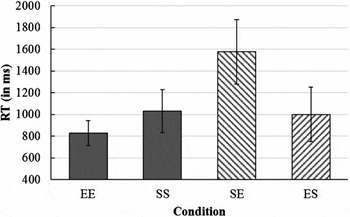
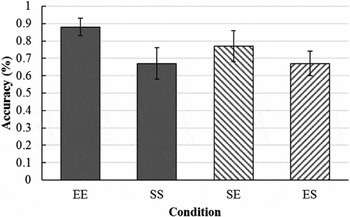
In the determiner-noun picture naming task, participants were asked to name pictures using both a determiner and a noun, in either code-switched or not code-switched conditions. Mean reaction times and accuracy are depicted in Figures 1 and 2, respectively. In the reaction times analysis, the main effect of determiner language was significant, F1(1, 19) = 63.65, p < .001 and F2(1, 252) = 821.56, p < .001, as was the main effect of noun language, F1(1, 19) = 19.37, p < .001 and F2(1, 252) = 36.14, p < .001. Importantly, the interaction between determiner language and noun language was also significant, F1(1, 19) = 95.57, p < .001 and F2(1, 252) = 573.58, p < .001. Simple effects analyses showed that in comparing the two code-switched conditions, the Spanish determiner - English noun condition was substantially (i.e., 577 ms) slower than the English determiner - Spanish noun condition, t1(19) = 6.26, p < .001 and t2(126) = 20.08, p < .001. Additionally, production of noun phrases entirely in Spanish was 202 ms slower than production of noun phrases in English, t1(19) = 4.33, p < .001 and t2(126) = 9.43, p < .001.
Mean Determiner-Noun Picture Naming Times (Task 2). EE = English determiner, English noun; SS = Spanish determiner, Spanish noun, SE = Spanish determiner, English noun; ES = English determiner, Spanish noun. Error bars depict Standard Deviations.

Mean Determiner-Noun Picture Naming Accuracy (Task 2). EE = English determiner, English noun; SS = Spanish determiner, Spanish noun, SE = Spanish determiner, English noun; ES = English determiner, Spanish noun. Error bars depict Standard Deviations.

ANOVAs on the accuracy data yielded a significant main effect of determiner language, F1(1, 19) = 20.75, p < .001 and F2(1, 252) = 26.44, p < .001, and of noun language, F1(1,19) = 53.41, p < .001 and F2(1, 252) = 22.58, p < .001.Footnote 3 The interaction between determiner language and noun language was also significant, F1(1, 19) = 40.48, p < .001 and F2(1, 252) = 36.09, p < .001. Simple effects analyses on the accuracy data yielded a significant difference between the two code-switched conditions, such that the Spanish determiner – English noun condition was more accurate than the English determiner – Spanish noun condition, t1(19) = 3.54, p < .001 and t2(126) = 3.43, p < .001. A comparison of the single language non-switched conditions showed that producing English noun phrases was more accurate than producing Spanish noun phrases, t1(19) = 9.32, p < .001 and t2(126) = 5.69, p < .001.
Sentence context picture naming task
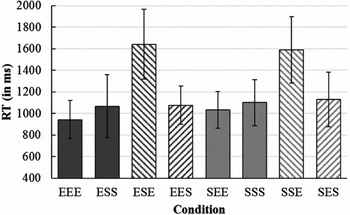
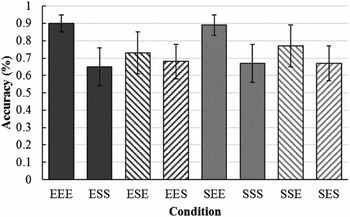
In the sentence picture naming task, participants read lead-in sentences prior to naming the pictures using a determiner and a noun. Mean reaction times and accuracy are depicted in Figures 3 and 4, respectively. The reaction time analysis yielded significant main effects of determiner language, F1(1, 19) = 88.43, p < .001 and F2(1, 504) = 718.25, p < .001, and noun language, F1(1, 19) = 32.72, p < .001 and F2(1, 504) = 81.69, p < .001. As in Task 2, the interaction between determiner language and noun language was also significant, F1(1,19) = 55.24, p < .001 and F2(1, 504) = 656.712, p < .001. Simple effects analyses comparing critical contrasts showed that in the code-switched conditions, the Spanish determiner – English noun condition was slower than the English determiner – Spanish noun condition, both when paired with an English sentence, t1(19) = 6.36, p < .001 and t2(126) = 19.08, p < .001, and with a Spanish sentence, t1(19) = 4.71, p < .001 and t2(126) = 14.89, p < .001. No significant main effect of sentence language was found, and the 3-way interaction between the three factors was not significant either.
Mean Sentence Context Determiner-Noun Picture Naming Times (Task 3). Dark bars indicate English sentence, light bars indicate Spanish sentence. EEE = English sentence, English determiner, English noun; ESS = English sentence, Spanish determiner, Spanish noun; ESE = English sentence, Spanish determiner, English noun; EES = English sentence, English determiner, Spanish noun; SEE = Spanish sentence, English determiner, English noun; SSS = Spanish sentence, Spanish determiner, Spanish noun. Error bars depict Standard Deviations.

Mean Sentence Context Determiner-Noun Picture Naming Accuracy (Task 3). Dark bars indicate English sentence, light bars indicate Spanish sentence. EEE = English sentence, English determiner, English noun; ESS = English sentence, Spanish determiner, Spanish noun; ESE = English sentence, Spanish determiner, English noun; EES = English sentence, English determiner, Spanish noun; SEE = Spanish sentence, English determiner, English noun; SSS = Spanish sentence, Spanish determiner, Spanish noun. Error bars depict Standard Deviations.

The ANOVAs on the accuracy data showed main effects of determiner language, F1(1, 19) = 37.45, p < .001 and F2(1, 504) = 49.59, p < .001, and of noun language, F1(1, 19) = 32.47, p < .001 and F2(1, 504) = 18.25, p < .001. The interaction between determiner language and noun language was also significant, F1(1, 19) = 18.38, p < .001 and F2(1, 504) = 40.65, p < .001, and the interaction between sentence language and determiner language reached significance in the by-subjects analysis, F1(1, 19) = 7.90, p = .013, but not in the by-items analysis. Again, no significant main effect of sentence language was found, or a 3-way interaction between the three variables. Simple effects analyses of the accuracy data showed that the Spanish determiner – English noun code-switched condition was more accurate than the reverse, which was marginally significant in the by-participants analysis when preceded by an English sentence context, t1(19) = 1.73, p = .093, significant in the by-items analysis when preceded by an English sentence context, t2(126) = 2.73, p = .007, and significant when preceded by a Spanish sentence context, t1(19) = 2.53, p = .005 and t2(126) = 2.94, p = .004.
Discussion
Using Spanish–English bilinguals who were all heritage speakers, we experimentally tested the predictions that follow from the Minimalist Program and the Matrix Language Frame model with regard to language mixed nominal constructions. Whereas previous work on this topic has focused predominantly on corpus data, we approached the question from a new angle by systematically manipulating the language of the determiner, of the noun, and of the sentence context, and analyzed reaction times and accuracy data, in order to gain insight into cognitive mechanisms of the production of language-mixed nominal constructions. These types of code-switched phrases were elicited in the determiner-noun picture naming task and the sentence context picture naming task. We found that the English-dominant heritage speakers were slower in producing a code-switched determiner noun phrase that contained a Spanish determiner and an English noun than vice versa. Furthermore, we found that the Matrix Language context did not modulate speed or accuracy of the production of code-switched noun phrases: the results from the sentence context picture naming task mirrored those of the determiner-noun picture naming task.
To examine to what extent our findings were consistent across the different variants of the picture naming task, and were not driven by specific task-demands, we performed a 2 (Determiner Language: English, Spanish) by 2 (Noun Language: English, Spanish) by 2 (Task: Task 2, Task 3) ANOVA, separately so for the reaction times and accuracy data, and found no main effect of Task, or any interactions with the factor Task in either analysis. The observed pattern is, therefore, not different across the different task types. In both picture naming tasks (with both sentence context languages), the Spanish determiner – English noun code-switched noun phrases yielded the slowest reaction times and lower accuracy as compared to the English determiner – English noun condition.
As mentioned earlier in the paper, corpus studies have observed that Spanish–English bilinguals have a tendency to default to the masculine determiner “el” when code-switching from Spanish to English within a noun phrase, regardless of the grammatical gender of the translation equivalent of the English noun (Jake et al., Reference Jake, Myers-Scotton and Gross2002; Pfaff, Reference Pfaff1979; see also Valdes Kroff, Reference Valdes Kroff2012). According to this observation, it would be natural for a speaker to, for example, say “el store,” despite the fact that store (tienda) in Spanish is feminine and takes the feminine determiner “la.” To examine whether this tendency was also present in our group of bilinguals and was responsible for the results we observed, we examined the specific types of errors being produced, focusing on instances in which the incorrect gender was produced. Our analysis of the errors made in the Spanish determiner – English noun nominal constructions showed that our participants did not rely on this strategy. For feminine nouns in the determiner-noun picture naming task, participants defaulted to the masculine determiner in the Spanish determiner – English noun condition only 7.2% of the time. In the sentence context picture naming task the results were the same: participants used the masculine determiner “el” with 7.2% of feminine nouns. None of our participants exclusively produced masculine determiners. This is in line with Liceras, Fuertes, Perales, Perez-Tattam and Spradlin (Reference Liceras, Fuertes, Perales, Perez-Tattam and Spradlin2008), who argue that the tendency for bilingual speakers of Spanish and English to default to the masculine gender is only present in English–Spanish bilinguals, not in early Spanish–English bilinguals (i.e., the type of bilinguals who participated in our study). Additionally, evidence from Italian–German early bilinguals shows that when switching languages between a determiner and a noun, the gender of the noun is preserved in the utterance (Cantone & Müller, Reference Cantone and Müller2008).
Our finding that Spanish determiner – English noun phrases are difficult to produce was not predicted by either of the tested theories. Because the Minimalist Program argues that in a code-switched noun phrase, the determiner will come from the gendered language, the corollary prediction regarding reaction times is that Spanish determiner – English noun code-switched phrases should be produced faster than English determiner – Spanish noun code-switched phrases, which is the opposite of what we found in both task 2 and task 3. The Matrix Language Frame model, which argues that in a code-switched noun phrase the determiner will come from the Matrix Language, was not supported due to the lack of effect of sentence context language on reaction times or accuracy in task 3.
One possible explanation for the slower naming times in the Spanish determiner – English noun condition is that the English noun is harder to retrieve than the Spanish noun. However, both latency and accuracy data of the bare noun picture naming tasks show participants were significantly faster and more accurate in naming English nouns than Spanish nouns. This indicates that the increased reaction times in the Spanish determiner – English noun condition comes from difficulty selecting the Spanish determiner, rather than from difficulty retrieving the English noun.
An alternative explanation is that determiner-noun code-switches are rare, and come unnatural to the Spanish–English bilinguals we tested. However, it is not the case that these determiner-noun code-switches are rare; in fact, it is quite the opposite. Determiner-noun switches are frequently observed in a wide range of bilingual corpora (Herring et al., Reference Herring, Deuchar, Parafita Couto and Moro Quintanilla2010; Liceras et al., Reference Liceras, Spradlin and Fuertes2005; Pfaff, Reference Pfaff1979; Timm Reference Timm1975; Woolford, Reference Woolford1983), attesting that bilingual code-switchers are likely to use this construction in everyday speech. Moreover, switching from a Spanish determiner to an English noun is also not more unnatural than switching from an English determiner to a Spanish noun. On the contrary: Milian (Reference Milian1996; as cited in Jake & Myers-Scotton, Reference Jake and Myers-Scotton1997) and Liceras et al. (Reference Liceras, Spradlin and Fuertes2005) have shown that the Spanish determiner – English noun switch is more common than a switch in the opposite direction.
Although our findings do not support either the Minimalist Program or the Matrix Language Frame model, this does not imply that the models are incorrect.Footnote 4 What our results do suggest, however, is that these models need further adaptation in order to account for the online processes of code-switching. One or both of the models may be effective in explaining the frequency of particular code-switches in naturalistic speech (Herring et al., Reference Herring, Deuchar, Parafita Couto and Moro Quintanilla2010), but not the ease of the actual production of code-switched determiner-noun phrases. An interesting avenue for further research would be to investigate this disparity between what is easiest to produce and what is most frequently produced, and to also relate this to the comprehension of code-switched determiner-noun phrases. For example, studying the comprehension of visually presented code-switched nominal phrases, Dussias (Reference Dussias2001) found reading times to align with data obtained from bilingual corpora: Reading Spanish determiner – English noun phrases (either singular or plural) was 14 ms faster than reading a switch in the opposite direction. One way to further understand the nature of the relation between ease of production and comprehension on the one hand and frequency of production on the other, is to collect multiple types of data (lab-based and natural speech studies of code-switching) from a variety of bilinguals, including habitual and non-habitual code-switchers, bilinguals who are functioning in a single or dual language context, or bilinguals with varied L1 and L2 proficiency levels (cf. Green, Reference Green2011; Green & Wei, Reference Green and Wei2014; Grosjean, Reference Grosjean, De Groot and Kroll1997). It is also important to take into account the cognitive implications of processing externally induced code-switches, i.e., non-spontaneous language switches where bilinguals switch languages prompted by an external cue or respond to an externally generated switch, and internally induced code-switches, i.e., spontaneously generated language switches (Gullberg, Indefrey & Muysken, Reference Gullberg, Indefrey, Muysken, Bullock and Toribio2009). Lab-based studies on the production of code-switches often focus on externally-induced code-switches (for exceptions, see Gollan & Ferreira, Reference Gollan and Ferreira2009; Kootstra et al., Reference Kootstra, Van Hell and Dijkstra2010) as do studies on the comprehension of code-switches, whereas corpus studies typically examine internally induced code-switches. Studying code-switching from formal linguistic, sociolinguistic, and psycholinguistic perspectives, using different research techniques, will tap into different aspects of code-switching, and will advance the formation of comprehensive models of code-switching predictive of multiple aspects of bilingual speech.
The Minimalist Program or the Matrix Language Frame model cannot fully explain the observed results, nor can the alternative explanations outlined above. In the remainder of the discussion, we therefore relate the present findings to current speech production models (typically based on unilingual speech), and explore whether our findings can be explained by how these models describe how noun phrases and determiners are retrieved and produced in speech.
In Roelofs’ (1992) Weaver ++ model, producing an open class word, such as a noun, is argued to be a feedforward process flowing from conceptual preparation, to lexical selection, to morphophonological encoding, to phonetic encoding, all the way to articulation. In the conceptual stage, the meaning of the intended word is activated. Once this lexical concept is made available, the lemma for that concept is retrieved from the mental lexicon. A lemma is an abstract form of a word that includes basic semantic and syntactic information. For example, a lemma will indicate whether the to-be-produced word is a verb or a noun. Once the speaker has retrieved this basic information, he or she can begin building the word form. The first stage is morphological encoding, which involves retrieving the appropriate morphemes for the word. In addition to the root of the word, retrieving morphemes indicating gender, number or tense, may be necessary. Next, the phonemes associated with each morpheme are activated. Before the speaker can articulate the word, however, he or she must segment the phonological form into the correct syllables and then finally apply the appropriate phonetic gestures. These gestural scores will inform the articulatory system how to produce the sounds. At all stages after the phonological word form is retrieved (including after articulation), self-monitoring occurs. If an incorrect word form has been selected or produced, the process may begin again at the conceptual stage. The process for selecting and producing a determiner is different (e.g., Alario, Ayora, Costa & Melinger, Reference Alario, Ayora, Costa and Melinger2008; Levelt, Reference Levelt1993; Miozzo & Caramazza, Reference Miozzo and Caramazza1999), and complicated by the fact that many languages, such as our target language Spanish, encode grammatical gender information on the determiner. There are different views on how the selection and production of determiners is achieved. The Weaver ++ model proposes that retrieval of grammatical gender information only occurs when gender agreement is required by the syntactic properties of the language, such as in the production of a noun phrase in Spanish. The grammatical gender of the Spanish noun must be retrieved in order to produce the correct determiner, either “el” or “la.” This gender information is accessed directly after lemma retrieval (Roelofs, Reference Roelofs2006), and in a language with a two-gender system, the two genders compete for selection in production. Empirical evidence for this competition comes from studies showing this gender (in)congruency effects in picture-word and picture-picture distractor paradigms (e.g., La Heij, Mak, Sander & Willeboordse, Reference La Heij, Mak, Sander and Willeboordse1998; Schriefers, Reference Schriefers1993). For example, Schriefers (Reference Schriefers1993) found that naming latencies for producing a noun phrase in response to a picture were shorter when the distractor has the same gender as the target. When the target and the distractor differed in grammatical gender, an inhibitory effect was obtained. This gender congruency effect was not observed in bare noun production, because, as argued by the authors, gender information is not required for production of a noun in isolation.
A similar viewpoint is taken by Caramazza's Independent Network model of speech production (Caramazza, Reference Caramazza1997). The Independent Network model also postulates that grammatical gender is only retrieved when it is required for agreement. However, in contrast to Weaver ++, the Independent Network model argues that gender selection is a non-competitive process that follows from selecting a lexical item, but that selection of the appropriate determiner to complete the noun phrase is a competitive process similar to selecting a lexical node. This implies that selecting a gendered determiner from two or more alternatives should not cause a processing cost. Caramazza's (Reference Caramazza1997) explanation of the gender congruency effect reported in previous studies is that there is competition at the level of determiner selection, not gender selection. Evidence for this position comes again from the picture-word distractor paradigm, and makes use of the Dutch determiner system, in which there are two singular determiners (“de” for common gender nouns and “het” for neuter gender nouns) and one shared determiner “de” for plural nouns. Schiller and Caramazza (Reference Schiller and Caramazza2003) observed the interference expected in singular target-distractor pairs with incongruent grammatical gender and two different determiners, but no interference when the gender incongruent target-distractor pairs shared a determiner.
An opposing view is postulated by Cubelli, Lotto, Paolieri, Girelli and Job (Reference Cubelli, Lotto, Paolieri, Girelli and Job2005), who found evidence for gender selection even in bare noun production in Italian, which has two genders. In a picture-word interference paradigm, naming latencies for bare nouns were significantly longer when the distractor word was of the same grammatical gender as the to-be-named picture. Additionally, an effect of semantic relatedness was found in which a picture was named slower when the distractor word was related in meaning. Their explanation is that both semantic and gender information must be accessed before the phonological form, and that these are competitive processes, since an inhibitory effect was found on congruent trials. The competition at these two levels must be resolved before the lexical form of a noun is retrieved.
Our results are more in line with the assumptions of the Weaver ++ model of speech production, as we do not find evidence for the retrieval of grammatical gender when it is not required for agreement. We propose that the condition in which bilinguals produce the determiner in English and the noun in Spanish is comparable to a bare picture naming situation, because gender information for the noun does not need to be retrieved in order to produce the English determiner. The WEAVER++ model states that no gender information should be activated in this specific condition, as the model argues that gender is only retrieved in situations that require gender retrieval for agreement (e.g., noun phrases). In contrast, the Spanish determiner – English noun condition requires grammatical gender agreement in order to produce the correct Spanish determiner, because selection of a Spanish determiner depends on the gender of the noun. This implies that there is gender information activated in the Spanish determiner – English noun condition, and the two gender alternatives, masculine and feminine, compete for selection. This competition effect is reflected in longer reaction times and decreased accuracy in this specific condition.
A similar model of speech production has been applied to code-switching recently by Myers-Scotton and Jake (Reference Myers-Scotton and Jake2013), but in relation to the patterns observed in corpus data. The authors argue that after the speaker's semantic and pragmatic intentions are established, content morphemes (e.g., nouns, verbs, adjectives) and early system morphemes (e.g., determiners, plural markers) are selected and sent to a formulator, which then selects late system morphemes (e.g., possessive markers). This means that for mixed nominal phrases in Spanish and English, the determiner is selected early on in the process, directly after the noun. Myers-Scotton and Jake further state that since Spanish determiners have the additional inherent feature of grammatical gender, they are more salient to the speaker than the English determiner ‘the’ and will always be preferred, unless English is the Matrix Language. They argue that switching between a Spanish determiner and an English noun is so prevalent and seemingly effortless because of the two aforementioned factors: the salience and early selection of Spanish determiners. Conversely, our data show that the salience of grammatical gender does not make Spanish determiners faster to produce, and in fact the opposite pattern occurs. This salience may be the cause of the prevalence of Spanish determiner – English noun phrases in naturalistic speech, but our results indicate that there is still a cost associated with producing these types of switches, most likely due to competition at the level of determiner selection. Additionally, the Matrix Language manipulation in the present study did not affect production whatsoever.
To conclude, the present experimental tests of bilinguals’ production of code-switched determiner-noun nominal constructions, measuring the online processing of code-switched noun phrases, did not confirm the corollary predictions of two influential linguistic models describing structural constraints that govern the grammaticality of code-switched utterances: the Minimalist Program and the Matrix Language Frame model. The present study is among the first to test the predictions that follow from the Minimalist Program and the Matrix Language Frame model in a laboratory setting, measuring online production of code-switched utterances (cf. Bultena et al. Reference Bultena, Dijkstra and Van Hell2015a; Reference Bultena, Dijkstra and Van Hell2015b; Kootstra, Van Hell & Dijkstra, Reference Kootstra, Van Hell and Dijkstra2010; Kootstra, Van Hell & Dijkstra, Reference Kootstra, Van Hell and Dijkstra2012; Myers-Scotton, Reference Myers-Scotton2006), to examine the psychological validity of these linguistic theories. Among interesting future directions would be a follow-up study testing speakers of two languages that overtly mark gender (e.g., Spanish–Italian or German–French bilinguals), to examine how grammatical gender (and congruent or incongruent gender mapping across languages) affects production times of code-switched determiner-noun phrases in bilingual speakers. It would also be of interest to test other populations of Spanish–English bilinguals, such as more balanced bilinguals and Spanish dominant bilinguals, to see how language dominance influences the ease with which code-switched noun phrases are produced, and to examine the extent to which the present results also hold for these bilingual groups. Indeed, it may be the case that balanced or Spanish-dominant bilinguals will experience less difficulty producing Spanish determiner – English noun phrases than our current heritage speaker sample. Additional research, using a wider range of experimental tasks, is needed to gain more insight into the psychological realm of linguistics theories and connect these to psycholinguistic models of language production, but the present study indicates that descriptive corpus analyses of code-switched nominal constructions do not necessarily align with online measures of the actual production of such constructions (cf. Van Hell, Litcofsky & Ting, Reference Van Hell, Litcofsky, Ting and Schwieter2015).
Supplementary material
For supplementary material accompanying this paper (Appendices A and B), visit http://dx.doi.org/10.1017/S1366728915000619