Implications
Mannan oligosaccharides (MOS) are a yeast-based by-product which may enhance gastrointestinal conditions and overall animal health, resulting in improved animal performance. In dairy cows, MOS prepartum supplementation increases colostrum quantity which could improve future calf performance.
Introduction
Colostrum is the primary source of immunoglobulins and nutrients essential for neonatal calf survival as the bovine placenta inhibits the transfer of immunoglobulins and essential vitamins (Quigley and Drewry, Reference Quigley and Drewry1998). Immunoglobulins G (IgG) account for up to 85% of the immune proteins and is the most predominant immunoglobulin found in the intestine of the calf (Butler, Reference Butler1983). Colostral IgG concentration and yield can vary greatly between individual cows and is influenced by a number of factors including parity number, time interval from calving to first milking and colostral weight (Conneely et al., Reference Conneely, Berry, Murphy, Lorenz, Doherty and Kennedy2013). In a study of 704 Irish dairy cows, colostral IgG concentrations ranged from 13 up to 256 g/l, with increasing colostral weight having a negative effect on IgG concentrations (Conneely et al., Reference Conneely, Berry, Murphy, Lorenz, Doherty and Kennedy2013).
The European Union ban on antibiotics as growth promoters in animal feed supplements in 2006 and in calf milk replacers in 2013 has intensified the need to improve the quality and quantity of colostrum produced to promote calf performance (Conneely et al., Reference Conneely, Berry, Sayers, Murphy, Lorenz, Doherty and Kennedy2014). Alternatives such as probiotics are being examined to determine their suitability to inhibit the activity of pathogens, stimulate the immune system, enhance digestion, increase yield and quality of animal proteins (Vohara et al., Reference Vohara, Poonam and Anshu2016).
A key probiotic group are yeasts such as Saccharomyces cerevisiae which is approved for human use by The European Food Safety Authority (Vohara et al., Reference Vohara, Poonam and Anshu2016). Mannan oligosaccharide is derived from the cell wall of S. cerevisiae yeast which contains both mannan proteins and complex carbohydrates including β-glucans. It has been termed a nutricine, meaning it has no direct nutritive value but maintains intestinal digestive and absorptive functions, thus improving the health and performance of farmed animals (Halas and Nochta, Reference Halas and Nochta2012). The objective of this study is to evaluate if supplementing MOS to housed dairy cows prepartum affects colostrum IgG concentration, quantity and subsequent calf performance.
Material and methods
Experimental design
In total, 80 Holstein cross Friesian cows (no heifers) were randomly assigned at point of drying off, over a 6-month period, by previous lactation number and yield into a treatment (MOS) and control (C) group in a double blind feeding trial. Cows were housed throughout the trial period in the same building split into two sections.
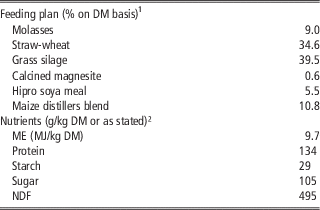
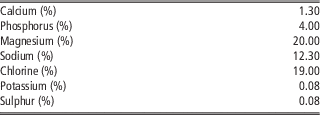
A standard dry cow total mixed ration (Table 1) was fed ad libitum from drying off until point of calving. The control group received a standard commercial dry cow supplement (www.Scotmin.com) without MOS and the treatment group received the same supplement with MOS (Table 2). The mineral supplements were top-dressed at a rate of 150 g/head daily as fresh feed was delivered. The treatment provided 2 g/cow per day of MOS for a minimum of 4 weeks pre-calving as recommended by the manufacturer. Cows were moved from the cubicles to ensure they consumed mineral supplement at the same time every day.
Calculated composition of prepartum TMR diet

TMR=total mixed ration; ME=metabolisable energy; DM=dry matter.
1 TMR formulation on per cow basis then multiplied up by number of cows and fed ad libitum to all cows on trial.
2 Calculated values.
Specification of dry cow mineralFootnote 1 , Footnote 2 , Footnote 3 (as received)

MOS=mannan oligosaccharide.
1 MOS added at 1.33% in the above to the treatment group.
2 Additional trace minerals included; cobalt, copper, iodine, manganese, selenium, zinc and vitamins A, D3, E and B12.
3 Chemical composition as legally declared and supplied by Scotmin Nutrition (www.Scotmin.com).
Sample collection
Colostrum samples were obtained from 59 of the 80 Holstein-Friesian dairy cows, as any cows that calved unattended or where the calf was known to have suckled, were not sampled. Cows were milked out of colostrum using a Fullwood® (Fullwood Ltd, Ellesmere, Shropshire, UK) mobile milking machine and calibrated milking vessel in a crush close to calving pen within 40 min of calving. This allowed time for milk let-down to be stimulated and cow to calf bonding to occur but colostrum removal took place prior to calf suckling.
Total colostrum weight was measured, six samples (30 ml) were taken and once temperature of the colostrum reached 22°C the density was measured using a Volac® (Volac International Ltd Royston, Hertfordshire, UK) colostrometer. Samples were frozen (−20°C) following cooling and stored for IgG concentration. The remaining colostrum was bottled and immediately fed to the corresponding calf.
At birth, the sex of each calf and weight were recorded. Calves were weighed in a Ritchie® (Ritchie Agriculture, Forfar, Angus, UK) mobile weigh crate. The weight of calves was taken on transfer to an individual pen and fortnightly until 2 weeks post weaning.
Laboratory analysis
Whole colostrum was analysed for IgG by single radial immunodiffusion (SRID) using BOV IgGIDRing® Test kit (IDBiotech; ImmunoDiffusion Biotechnologies, Issoire, France). Total mass of immunoglobulin produced was calculated by multiplying IgG concentration (g/l) by milk volume (l) (Osaka et al. Reference Osaka, Matsui and Terada2014).
Statistical analysis
Data analysis was carried out using Minitab® 17 statistical software package (www.minitab.com, 2012). Residual values were checked for normality. Parametric data were examined using ANOVA tests; whereas non-parametric data were examined using Kruskal–Wallis tests.
Results
Colostrum immunoglobulin G and quantity
There was a wide variation in colostrum IgG concentration in both trial groups ranging from 19.5 to 85.1 g/l with an overall average of 47.8 g/l (SEM±3.8). Treatment did not affect colostrum IgG concentration (P=0.08) with mean IgG of 42.7 g/l (SEM±4.9) for MOS and control IgG 53.7 g/l (SEM±5.8).
Mean colostrum produced immediately post-calving in the MOS group was 7.5 kg (SEM±0.69) v. control 5.6 kg (SEM±0.43). Mannan oligosaccharide significantly increased the weight of colostrum produced by an average of 1.96 kg per cow (P=0.02).
Despite increased volume of colostrum produced by MOS fed cows, there was no effect (P=0.76) on the total mass of immunoglobulin produced when compared with control cows (MOS 288 total IgG, SEM±53.4 v. 276 total IgG, SEM±55.3).
Calf performance
There were 16 male and 13 female calves in MOS group and 10 males and 9 female calves in control group. Average birth weight of MOS fed calves was 44.9 kg (SEM±1.1) v. control 43.5 kg (SEM±1.0). Birth weights (P=0.43), 8 week weaning weights (P=0.42) and gain from birth to weaning (P=0.75) did not differ between treatments.
Discussion
The current study found that supplementation prepartum of MOS derived from S. cerevisiae, had no effect on colostrum IgG concentration. This work supports the findings of Franklin et al. (Reference Franklin, Newman, Newman and Meek2005) who reported similar concentrations and levels of variation in colostral IgG but no difference in cows fed MOS (35.5 to 52.2 g/l, SEM±7.1 to 10.8) and control diet (33.8 to 60.6 g/l, SEM±6.6 to 13.8). The wide variation found in IgG concentration may explain the absence of treatment effect in both these studies.
Lactation number has been identified as a potential source of variation particularly in cows entering third lactation and above (Conneely et al., Reference Conneely, Berry, Murphy, Lorenz, Doherty and Kennedy2013). This was confirmed by Franklin et al. (Reference Franklin, Newman, Newman and Meek2005) reporting significantly higher colostral IgG concentration, regardless of treatment, for cows in third lactation or greater compared with second lactation. History of previous mammary quarter diseases may be a key influencing factor in IgG concentrations. Baumrucker et al. (Reference Baumrucker, Stark, Wellnitz, Dechow and Bruckmaier2014) identified that any quarter within the udder can produce different concentrations and mass of IgG in first-milked colostrum. Cows in third lactation or above may exhibit larger fluctuations in IgG due to previous mammary infections damaging the mammary epithelium (Baumrucker et al., Reference Baumrucker, Stark, Wellnitz, Dechow and Bruckmaier2014). In this study more than two-third of cows sampled were in their third lactation or above for both MOS and control groups and likely to be responsible for the high level of variation in colostral IgG concentration.
Time interval from calving to first milking of colostrum is another source of variation in IgG concentrations. Conneely et al. (Reference Conneely, Berry, Murphy, Lorenz, Doherty and Kennedy2013) found significantly lower IgG in cows milked post 9 h from calving. All results in this present study were from cows milked within first hour after calving therefore the variation found is unlikely to be due to time interval from calving to first milking.
In this study feeding MOS prepartum increased the quantity of colostrum produced. Franklin et al. (Reference Franklin, Newman, Newman and Meek2005) conversely found no significant change in the quantity of colostrum due to treatment (MOS 6.5±1.6 to 7.1±1.1 kg v. control 6.4±1.2 to 8.1±1.3 kg). The potential mode of action may involve the stimulating effect of MOS on the innate immune system, increasing the production of mannose-binding proteins which enhances phagocytosis (Franklin et al., Reference Franklin, Newman, Newman and Meek2005). During the vulnerable last 4 weeks prepartum Franklin et al. (Reference Franklin, Newman, Newman and Meek2005) found that feeding MOS influenced the immune system of the cow as demonstrated by increased rotavirus titres in serum and colostrum in previously unvaccinated cows. It could be hypothesised that this enhancement of the immune system, both specific and innate, may lead to enhanced colostrum production levels due to more efficient metabolism.
Several studies have emphasised that it is not just the quality or quantity of colostrum consumed that is essential but the mass of immunoglobulin intake that is important. Osaka et al. (Reference Osaka, Matsui and Terada2014) found that the total mass of IgG consumed affected the serum level of IgG in calves. The total mass of immunoglobulin produced in the present experiment was not significantly different between MOS and control, indicating that mass immunoglobulin intake would be similar for both groups of calves when left on their dams for first 24 h and therefore unlikely to affect future calf health and performance.
Previous studies have examined the effect on calf performance of including MOS in milk replacers. In this trial no differences in calf performance were found in MOS fed calves. Similarly, Terre’ et al. (Reference Terre, Calvo, Adelantado, Kocher and Bach2007) found no difference in overall average daily gain or weaning weight of calves fed MOS via the milk replacer but did see an initial effect on starter feed intake. Feed intake was not recorded in this trial and calves had access to the same feeds and forages.
Conclusions
Mannan oligosaccharide derived from S. cerevisiae does not affect IgG concentration or the total IgG mass but does increase the weight of colostrum produced. Further studies on the effect of MOS on prepartum cow health particularly metabolic and immune status and eliminating or reducing the influence of variables such as previous lactation number and history of mammary disease are warranted.
Acknowledgements
The authors would like to thank the assistance of Myerscough College laboratory staff Emma Clayton-Smith and Mary Bloye with SRID analysis and farm staff at Myerscough College, Lodge farm, in particular, Roger Leach and Peter Mitchell for assistance during the trial. This work was financially supported by Scotmin Nutrition, 13 Whitfield Drive, Ayr, KA8 9RX, a division of Carrs Agriculture Ltd, Old Croft, Stanwix, Carlisle, CA3 9BA.