


Why and under what conditions is the middle class likely to support democratization? Since Lipset (Reference Lipset1959), scholars have argued that economic development changes the class structure of society, improving the chances for democratization and democratic stability (Dahl Reference Dahl1971; Huntington Reference Huntington1991; Welzel and Inglehart Reference Welzel and Inglehart2008). As in Moore’s (Reference Teorell1966) famous formulation, “No bourgeoisie, no democracy,” a vast literature in political science casts rising middle classes as a force for democratization.Footnote 1 Thus Acemoglu and Robinson (Reference Acemoglu and Robinson2006, 39) assert that “almost all revolutionary movements were led by middle class actors,” while Huntington (Reference Huntington1991, 67) argues that, “In virtually every country [of the third wave] the most active supporters of democratization came form the urban middle class.” Urban civic protests and revolutions, in particular, have been seen as a middle-class phenomenon, belonging “to the repertoire of the educated, the informed, the connected, and the relatively well-off” (Welzel Reference Welzel2013, 217).
Yet the classical view that a growing middle class will confront old networks of patronage and privilege assumes that the middle class is not itself bound by those relations. This view ignores the reality in many contemporary autocracies, where the middle class is principally the product of opportunities within the state bureaucracy and state-owned enterprises. In contrast to the middle class of classical theory, I contend that this state-dependent middle class may actually stymie support for political change.Footnote 2 This argument implies that a middle class incubated in the public sector of an authoritarian state will be less favorable toward democracy than expected by either values-based or redistributive theories.
The Russian case typifies the type of middle class that develops under autocratic state institutions and extensive state economic engagement. The majority of new entrants to Russia’s middle class over recent years are professionals paid out of the state budget and civil servants (Russian Academy of Sciences 2014; Maleva and Ovcharova Reference Maleva and Ovcharova2009; Avraamova Reference Avraamova2008). The proportion of state workers in Russia’s middle class is approximately one half to two-thirds, while the overall share employed in the public sector is about four-in-ten (Russian Academy of Sciences 2014, 30). In this regard, Russia is not unique. Pervasive state patronage and bloated public sectors are a feature of politics in the Middle East, Africa, Latin America, and other former Soviet states (e.g., Hertog Reference Hertog2013; Diamond Reference Diamond1987; Weyland Reference Weyland1996; Gervasoni Reference Gervasoni2010; Oliveros Reference Oliveros2016; Darden Reference Darden2008). These conditions are widespread in resource states, but they are also present in post–socialist countries both with (e.g., Azerbaijan) and without oil (e.g., Belarus). More work is needed to understand the effect of middle-class state dependence on mobilizational potential.
In this article, I investigate the most consequential action that individuals can undertake to influence democratization: protest. The wave of demonstrations beginning in late 2011 after Russia’s parliamentary election offers an ideal opportunity in which to consider the constituencies and coalitions that are likely to challenge illiberal regimes. Further, since preferences cannot be inferred directly from protest behavior, I also analyze the democratic commitments of middle-class protest participants. As recent protests around the world demonstrate, better understanding citizen preferences under autocracy is critically important for grasping the sources of popular pressure for political change (Teorell Reference Teorell2010; Ulfelder Reference Ulfelder2005). Yet existing scholarship, including canonical works, offers virtually no concrete micro-level evidence on the preferences and actions of the middle class vis-a-vis democratization.Footnote 3 Protests afford a uniquely tractable and politically salient opportunity for filling this gap.
With that aim, I leverage detailed data on protest participants and a novel empirical strategy. This approach is widely applicable to the study of contentious collective action across a variety of settings. More specifically, I employ choice-based sampling methods, which allow me to combine protest survey data with representative data on the population from which protesters were recruited. The case-control method I present—a variation on designs commonly used in epidemiological studies of rare disease but ignored to date in political science research—allows me to estimate the population prevalence of protest for groups with given characteristics. This approach improves on a range of studies that lack individual data on protesters, rely on reported rather than actual participation, are unable to compare protesters to nonparticipants, or are prevented by their small sample size from reaching reliable conclusions about protest subgroups. An additional advantage is that I need not, and do not, assume that all protesters were democrats or that participation in opposition demonstrations had uniform ideological content for all who turned out.
To preview the results, I find that the prospects for mobilized democratic transition hinge considerably on the middle classes’ degree of state dependence. First, I show that the fastest growing segments of Russia’s middle class, professionals employed in the public sector, were significantly less likely than the private-sector middle class to mobilize. Controlling for a variety of other factors including ideology, I estimate that state dependence reduced the likelihood of protest by more than 25% among the middle class and 50% among the non–middle class. Further, I find that state employees who did protest were less likely to do so as part of the pro-democracy coalition. State-sector protesters were less likely to use the politicized language of rights and freedoms than their private-sector counterparts. They were also more likely to value stable development and standard of living over political liberty and regime change. For state-dependent middle-class groups, protest was not about democratic transformation, but securing a better deal from the regime. I trace these patterns of participation to the interaction of individual resources and state selective incentives.
These findings highlight the importance for regime survival of co-optation that takes place in public sector workplaces, beyond formal political institutions like parties, parliaments, and elections. Whereas most studies focus on co-optation of either elites or the poor (e.g., Gandhi and Przeworski Reference Gandhi and Przeworski2007; Magaloni Reference Magaloni2006; Medina and Stokes Reference Medina, Stokes, Kitschelt and Wilkinson2007; Calvo and Murillo Reference Calvo and Murillo2004), capitalists or labor (Bellin Reference Bellin2000), this study shows the significance of co-opting the middle class in terms of protest capacity when autocratic regimes are challenged. Its findings also hold broader lessons for our understanding of the middle class and democratization. The fact that middle-class state employees protested in smaller numbers, and that those who did were less likely to do so under the banner of democracy, implies that how middle-class growth is achieved affects bottom-up processes of democratization, through both attitudes and actions. Finally, these findings reveal that ignoring key sources of preference heterogeneity within the middle classes obscures an important micro-level mechanism behind development without democratization.
THE MIDDLE CLASS AND MOBILIZED CONTENTION
The existing literature suggests a pivotal role for the middle class in mass protests against illiberal regimes. Indeed, middle-class groups have been credited with supplying crucial support for the popular mobilizations that precipitated the overthrow of Suchinda in Thailand, the fall of Chun Doo-hwan in South Korea, and the removal of Marcos in the Philippines. Yet the middle classes’ role in pro-democracy movements has varied across time and space (e.g., Rueschemeyer, Stephens, and Stephens Reference Rueschemeyer, Stephens and Stephens1992; Koo Reference Koo1991; Jones Reference Jones1998; Shin Reference Shin1999), and no clear consensus has emerged to explain this variation.Footnote 4 Conceptual, theoretical, and empirical issues have all impeded progress on this agenda.
First, the term “middle class” carries many meanings. For some, middle class is a normative category embodying the democratic values and participatory ethic that this study aims to explain. For others, the middle class is defined by its place in the income distribution (e.g., Boix Reference Boix2003; Acemoglu and Robinson Reference Acemoglu and Robinson2006). For the purposes of this study, I define the middle class as university-educated white-collar strata.Footnote 5 In keeping with neo-Weberian approaches, I focus on educational and occupational resources and qualifications, those which the literature has long identified with more democratic values and greater mobilizational potential (Lipset Reference Lipset1959; Dahl Reference Dahl1971). Following these arguments and recent theories of democratization (e.g., Ansell and Samuels Reference Ansell and Samuels2014), I employ a sociological, rather than exclusively income-based, definition of the middle class. Although society also includes elites, we may assume, especially in a country as highly stratified as Russia, that they are not captured in surveys.
Second, few studies have had at their disposal extensive empirical evidence on the demographic characteristics and political preferences of participants in popular uprisings against authoritarian regimes. Without such evidence, the existing literature tends to homogenize the middle class—finding either that it stood with the state or against it (Huntington Reference Huntington1991; Acemoglu and Robinson Reference Acemoglu and Robinson2006). It also tends to oversimplify middle-class actors’ pro-democratic orientation. In short, the literature on democratization has not paid sufficient attention to the fact that autocracies can co-opt citizens by providing them economic opportunities and avenues of upward mobility in the public sector, potentially undermining the link between the middle class and democratization.
We, thus, urgently need to distinguish between middle classes that are and are not state-dependent. I address this gap using unusually detailed individual-level data to examine how state-led development undermines potential middle-class coalitions in support of democratization. I also consider why these splits in the middle class arise. The explanation I develop, drawing on the patronage literature, focuses on regimes’ use of selective incentives to extract support from employees in state-dependent sectors.Footnote 6
Theory & Hypotheses
Authoritarian regimes face two fundamental challenges: maintaining elite unity and deterring mobilization from below (Svolik Reference Svolik2012). This study focuses on the latter task and on how authoritarian regimes maintain social order through the management of economic self-interest. The argument, succinctly stated, is that regimes use public-sector employment to neutralize potential middle-class opposition by offering perks to encourage loyalty or denying benefits to those who participate in pro-democracy demonstrations.
Scholars have long argued that autocrats provide targeted rents to cultivate political loyalty and employ negative sanctioning to stem dissent. Public-sector jobs are themselves a benefit; but they also provide access to networks, information, and resources that can be leveraged for private gain. I argue that public-sector jobs, in addition to the privileges and side-payments that go with them, may be linked to the continuation in office not only of a particular party or patron, as emphasized by existing studies of patronage, but also a political regime.Footnote 7
From the regime’s perspective, public-sector jobs offer an ideal setting for securing the loyalty of politically pivotal constituencies. As Kitschelt and Wilkinson (Reference Kitschelt and Wilkinson2007, 8) observe, selective incentives are most effective when “organizational devices and social networks of supervision” provide the basis for repeated interactions and make it easier to monitor defection. In state agencies, enterprises, schools, and hospitals, these conditions are already present, allowing the regime to efficiently confer privileges or withdraw benefits from those who organize or participate in popular insurrections.
In general, this argument suggests more middle than non-middle class participation in anti-regime mobilization, since, all else equal, buying off the middle class is more expensive. However, it also implies that the state will be most effective at demobilizing opposition and countermobilizing support among social groups that depend on it for employment, status, and life chances. If the argument is correct, we would expect to find evidence consistent with the following propositions.
Middle-class mobilization will exhibit significant sectoral differentiation, with state-sector workers less likely to participate in anti-regime demonstrations.
The first hypothesis implies that a state’s ability to co-opt the middle class will constrain the size of anti-regime protest by limiting participation by the state-dependent middle class.
Three factors potentially account for this hypothesized pattern of protest participation: positive and negative inducements, grievances, and differences in social capital. I briefly discuss each in turn together with several additional observable implications. First, fear of being fired is perhaps the most straightforward explanation for state employees’ lower protest participation. The desire to avoid retaliation should be especially acute where exit options are limited. At the same time, if public-sector careers provide excludable economic and social protections along with access to networks, information, and resources that can be used to generate additional rents, we would expect these perks and privileges to encourage loyalty whether or not their beneficiaries are directly threatened with negative sanctions. If such carrots matter, and not only sticks, then public-sector employees should perceive themselves as more secure and less vulnerable than their private-sector counterparts. Second and relatedly, these public-sector privileges may simultaneously foster resentment among those who are excluded from special treatment. Insofar as grievances motivate protest (Gurr Reference Gurr1970), private-sector workers may be more likely to demonstrate. A third possibility is that private-sector professionals compensate for their exclusion from state-sponsored privileges through dense networks of friends and acquaintances. These networks could reflect differences in social capital that would increase private-sector workers’ propensity to be recruited as protest participants.
I next turn from participation to protesters’ goals and motivations. If public-sector workers see future benefits as tied to regime continuity, I expect that they will be not only less likely to participate but also more likely to favor the status-quo and reject the risky prospect of democratization. Accordingly, I anticipate that this group will be less likely to join pro-democracy coalitions of non-system regime opponents than others who are more insulated from government incentives. This yields the following proposition:
Protest coalitions will exhibit significant sectoral differentiation, with state sector workers less likely to join democratic forces.
In sum, the second hypothesis implies that a state’s ability to co-opt the middle class will also constrain the size of any pro-democracy coalition. Testing this proposition requires additional information about protesters’ political orientations.
Besides being less likely to self-identify as democrats, if the argument I have laid out is correct and protesters in state-dependent sectors do indeed have weaker democratic commitments, two additional patterns should be evident. First, they should be less likely to advocate regime transition and more likely to support the regime’s so-called “pocket” or “loyal” opposition (i.e., parties that collude openly with the regime). Second, they should be less likely than their private-sector counterparts to use the politicized language of rights and freedoms, which might endanger their benefit streams, and more likely to value stable development and economic well-being.
This argument builds on and contributes to the literature on co-optation in autocracies by looking beyond the role of formal political institutions—regime parties, legislatures, and elections—in co-opting elite actors (Gerschewski Reference Gerschewski2013; Svolik Reference Svolik2012; Brownlee Reference Brownlee2007; Gandhi and Przeworski Reference Gandhi and Przeworski2007; Magaloni Reference Magaloni2006). While co-optation of the mass public has been examined primarily through the lens of electoral patronage—targeted benefits to individual, usually poor voters, by the ruling party and their brokers in the context of elections—the present article differs from these other studies in terms of both actors and settings. First, I focus on potential opposition from a different set of societal actors: the middle class, a group that has often been neglected in accounts of authoritarian resilience. Second, my account points to the importance of public-sector enterprises and organizations for co-opting potential opposition. State employment remains a central institution promoting authoritarian stability and a way of life for a substantial share of the middle class across many nondemocracies.
This argument also advances the existing literature on clientelism in at least two ways. First, while most studies of clientelism emphasize how state patronage produces incentives to support candidates and parties at election time, I show how these same strategies help to induce political loyalty at other times, specifically periods of protest when regimes are most vulnerable. Second, faced with an overall budget constraint, studies of patronage typically expect patrons to specialize in low-wage employment (e.g., Medina and Stokes Reference Medina, Stokes, Kitschelt and Wilkinson2007; Calvo and Murillo Reference Calvo and Murillo2004). In part, this notion of efficiency in the allocation of patronage is a consequence of the literature’s focus on elections, and patronage as a tool to win them. While each voter (each potential client) casts a vote, which is equal to and substitutable for any other, studies of patronage have largely overlooked the fact that regimes press middle-class clients to engage in more sophisticated activities—like campaigning, organizing rallies, and serving on electoral commissions—that are worth many votes (Rundlett and Svolik Reference Rundlett and Svolik2016; Sharafutdinova Reference Sharafutdinova2011; Greene Reference Greene2010).
Moreover, the incentives facing a regime differ if the goal is not only to win elections, but to deter potential opponents from taking to the streets. Public displays of defiance entail great risk for authoritarian incumbents (Lee and Zhang Reference Lee and Zhang2013; Bunce and Wolchik Reference Bunce and Wolchik2011; Robertson Reference Robertson2011). Demobilizing a large segment of the urban middle class during anti-regime protests contributes to authoritarian resilience. This makes it worth the autocrat’s while to strategically target patronage to individuals with greater endowments, rather than specialize in relatively cheaper, low-skill clients.
Finally, examining both attitudes and actions is important for one very simple reason. Popular uprisings have often resulted not in democracy but elite rotation. While groups with distinct political preferences may partner to pressure the current government, such divisions spell trouble for the formation of a lasting and coherent pro-democracy coalition. Distinguishing democratic attitudes from oppositional action thus deepens our understanding of the prospects for stable democratic transition.
Protest and the Russian Middle Class
Buoyed by global commodity prices, between 2000 and 2007, the Russian economy grew at a rate unprecedented in the post-Soviet period. Real wages increased 2.5 times, while the Russian economy added 3.3 million jobs. Over the same period, state careers became one of the clearest pathways to the middle class. Starting in 2001, the already small share of income from entrepreneurial activities in the Russian economy began to shrink (Ovcharova Reference Ovcharova and Fisher2012, 30). Meanwhile, the fastest-growing segments of Russia’s middle class became state officials, regional civil servants, so-called “siloviki” (law enforcement, military, and intelligence), as well as public-sector managers and professionals (see Russian Academy of Sciences 2014; Remington Reference Remington2011; Avraamova Reference Avraamova2008; Tikhonova Reference Tikhonova2008; and the review in Gontmakher and Ross Reference Gontmakher and Ross2015).Footnote 8
There are several reasons to believe that coalition formation among a middle-class group with such heterogenous interests is unlikely. In addition to their formal wages, employees in Russia’s public-sector are more likely than their private-sector counterparts to enjoy certain benefits: a formal labor contract, paid vacation and medical leave, medical insurance, transportation benefits, housing benefits, and other subsidies (Remington et al. Reference Remington, Soboleva, Sobolev and Urnov2012; Russian Academy of Sciences 2014). While those outside the public-sector are vulnerable to economic volatility and corruption, bureaucrats and professionals paid out of the state budget are insulated from economic risk and benefit from informal rents. Tikhonova (Reference Tikhonova2008, 25) puts it starkly in terms of the inherent conflict of interest between bribe-takers and their victims. Besides having distinct economic and political interests, Russia’s public and private-sector middle classes are subject to different mobilizational pressures. Frye, Reuter, and Szakonyi (Reference Frye, Reuter and Szakonyi2014, 196), for example, find that Russia’s state-owned enterprises, government ministries, and public-sector unions are easy targets for the ruling party to mobilize citizens in support of the regime (see also, Hale Reference Hale, Kitschelt and Wilkinson2007).
The present article adds to recent work on mobilization in Russia, clarifying how patterns of collective action are shaped by extensive state economic engagement. Shevtsova (Reference Shevtsova2012, 23) questions “how far the Russian middle class wants to go in changing the system. . .[given that] a sizable swath of [it] lives off its role as a service provider to the state bureaucracy or big state run corporations.” I tie these incentives to protest behavior, formulating them as testable hypotheses, and situating them in comparative theoretical perspective. Lankina and Voznaya (Reference Lankina and Voznaya2015) find that regions with a high share of state employees experienced fewer protests with fewer overall participants. The present article offers a micro-level mechanism to explain this aggregate association and individual evidence that the political behavior of state employees indeed drives this correlation. This study’s emphasis on the demobilization of potential regime opponents also complements Koesel and Bunce’s (Reference Koesel and Bunce2012) observation that widening anti-regime protests resulted in Kremlin attempts to co-opt and fragment the opposition, including sponsoring pro-regime counter-demonstrations, and Smyth, Sobolev, and Soboleva’s (Reference Smyth, Sobolev and Soboleva2013a, Reference Smyth, Sobolev and Soboleva2013b) finding that the public-sector middle class played an important organizing role in these rallies. While the latter two studies use protest surveys to examine participants, the present article takes an innovative approach to comparing protesters and the population.
Finally, Chaisty and Whitefield (Reference Chaisty and Whitefield2013) show that few Russians who supported the protests embraced democracy—underscoring that the movement’s ideological platform was vague and its character not exclusively democratic. There was plenty of room to protest without wanting full-fledged democracy. Nondemocratic alternatives like the communists and nationalists were an established part of Russia’s political landscape. Given protesters’ heterogenous motivations, we need to disaggregate the “mass” in mass mobilization, moving beyond the study of protest events to examine individual-level participation in democratic coalitions.
DATA & EMPIRICAL STRATEGY
A major challenge of studying protest at the individual level is access to suitable data. A review by Walgrave and Verhulst (Reference Walgrave and Verhulst2011) finds that only a handful of studies involved surveys of protesters before the mid-1990s. Though common now in Western Europe,Footnote 9 protest surveys remain relatively rare elsewhere (for exceptions, see Volkov Reference Volkov2012; Smyth, Sobolev, and Soboleva Reference Smyth, Sobolev and Soboleva2013b ; Onuch Reference Onuch2014). Yet alone, even high-quality protest surveys can tell us little about the causes or correlates of protest participation because they lack information about nonparticipants. Without a baseline of nonparticipants, it is impossible to reliably assess how protesters differ from the population. To address this problem, most studies use existing, usually nationally representative, surveys of public opinion that ask about past protest participation (Welzel Reference Welzel2013, 223). Because these studies capture both protesters and nonparticipants, they allow researchers to better identify the causal mechanisms underlying activism.
However, for the study of protest, these surveys also have drawbacks. First, the number of sampled demonstrators is typically small. This results in low statistical power and difficulty detecting effects, especially among protest subgroups. Second, representative surveys rarely ask about participation in specific protest events. Instead, most survey-based research on social movements to date relies on broad measures of participation (e.g., at “peaceful demonstrations”), ignoring the particulars of movements’ activities. These studies thus lack direct evidence on protesters’ motivations and recruitment. Third, even when nationally representative surveys do ask about participation in a particular event, they do so after the fact. This means that most individual-level studies of protest rely on measures of reported behavior, which are subject to cognitive biases and respondent recall. Especially for revolutionary uprisings and other historic events, reported participation may be biased by social pressure to have taken part, or to hide one’s participation in a movement that failed. Fourth, relative to protest participation, nationally representative surveys provide only post-hoc measures of other covariates, potentially introducing post-treatment bias.
The research design in this article offers a new approach to these challenges. To address the inferential problems just discussed, I employ both a random sample of protesters and a random sample of the population from which protesters were recruited. I begin by comparing these two samples descriptively. Then, for the main results, I use a multivariate modeling strategy first proposed by Lancaster and Imbens (Reference Lancaster and Imbens1996) to estimate the probability of protest as a function of individual-level characteristics. This design is a variant of the standard case-control research design used in individual-level rare events studies in epidemiology. It has the advantages of scale, specificity, and verifiability that are lacking in existing methods for studying protest. By selecting on the dependent variable, the protest sample ensures an adequate supply of protest cases. Protest participation is observed at a specific protest event, with the interviewer, in effect, verifying the respondent’s participation. At the same time, the population sample supplies the necessary baseline.
The survey data I use in my analysis were collected at protest events in Moscow between December 2011 and January 2013, following parliamentary and presidential elections. These data arguably provide the most complete individual-level record of a mobilizational cycle outside the established democracies. A respected independent polling organization, the Levada Center used international best-practices in protest survey methodology to ensure a representative sample. Stationary protests in Russia are generally cordoned off by special forces and riot police, creating a defined perimeter for the protest event. During the post-election demonstrations, police established entry points and required protesters to pass through metal detectors. Interviewers took advantage of these procedures to randomly sample protesters at a fixed skip interval. When this was not possible, for example, at moving demonstrations and marches, interviewers moved systematically though the columns of participants, selecting every n-th respondent at an interval set by fieldwork supervisors.Footnote 10 In this way, interviewers worked their way from one end of the crowd to the other. Because protesters generally assembled by ideology, political party, or identity, this procedure ensured that all groups were represented.
To complement the protest data, I identified an unusual source of population data that facilitates detailed comparison. With a total sample size of 33,997 respondents, the Foundation for Public Opinion’s (FOM) GeoRating surveys are both nationally and regionally representative of Russia’s population. A minimum of 500 interviews are conducted in each region, including both the city of Moscow and Moscow oblast. The surveys were conducted face to face in respondents’ homes.
The main explanatory variables in the analysis are middle class and state employment. I measure the former in terms of human and social capital, coding those with both higher education and a nonmanual, white-collar occupation as middle class.Footnote 11 “State” is an indicator for employment in any part of the public-sector.Footnote 12 In Russia, this includes civil servants, bureaucrats, educators, medical professionals, and other so-called budget employees (budzhetniki). The same definition of each of these two variables is applied to both the protest and population data. Having outlined the empirical strategy, the next section analyzes the data descriptively. A more detailed explanation of the case-control research design and estimation strategy precedes the main results.
DESCRIPTIVE ANALYSIS
The Protesters
Table 1 summarizes the protest surveys. A quick examination of the data suggests that participants were overwhelmingly college-educated managers and professionals. This is particularly true among the first movers, participants in the earlier protests. Besides professionals and small business owners, students, retirees, and housewives made up the next largest contingent.
Descriptive Statistics for Protest Surveys

Note: This table describes key variables from four protest surveys conducted in Moscow between December 2011 and January 2013 by the Levada Center, an independent sociological research organization. Proportions may not sum to 1 due to rounding.
In terms of political views, a plurality (29–38%) in each survey identified as democrats, while an absolute majority called themselves “democrats” or “liberals.” While the terms “democrat” and “liberal” are at times used interchangeably, the “liberal” camp in Russia encompasses a range of ideologies from conservative promarket, even libertarian, to “left of center,” along with a range of political views. Although some Russian liberals advocate democracy, not all do. Indeed, the Putin administration’s pursuit of liberal economic policies has ensured that there is also a sizable group of progovernment or “system” liberals (Shevtsova Reference Shevtsova2012, 29). In the main analysis, I examine these groups separately, though I show in the Appendix that my findings are unaffected by this choice. Another important pattern to emerge in Table 1 is that communists, socialists, and nationalists comprised a substantial minority at each protest (from approximately 25–40%). Though often framed as a “pro-democracy” movement, this label obscures participants’ significant ideological diversity (Volkov Reference Volkov2012).
Lastly, for two protests in September 2012 and January 2013, survey questions distinguish between managers and professionals of the public and private-sectors.Footnote 13 These results show a striking participatory gap. In January 2013, protesters were more than two and a half times as likely to be employed in the private-sector as by the state. I next turn to a more informative comparison of protesters and the population.
Protesters and the Population
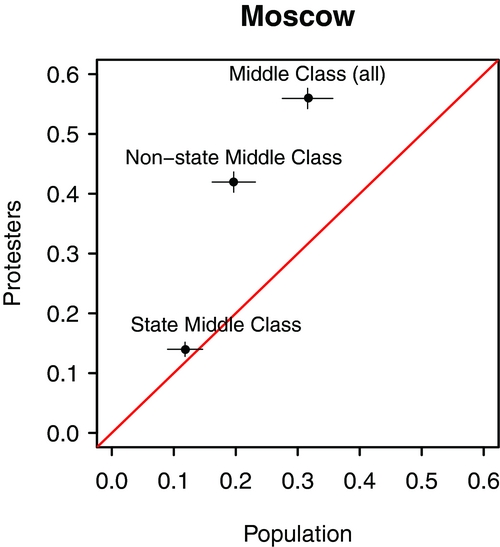
Figure 1 compares the demographic composition of the protesters with that of Moscow’s population.Footnote 14 Estimates of the share of protesters who were middle class (overall and, separately, for the state and private-sector) are plotted on the y-axis as a function of the share of middle class in the population from which protesters were recruited (x-axis). The 45º line through the plot denotes proportional representation. Points above the line thus indicate groups that were overrepresented among the protesters. Because both data sources are surveys, there is uncertainty in both x and y values. This uncertainty is captured by the horizontal and vertical 95% confidence bars.
Demographic Comparison of Protesters and the Population

Several patterns emerge clearly from this plot. First, the middle class was vastly overrepresented among the protesters relative to its share of the population. The magnitude of this overrepresentation (or percentage point differential) is indicated by each point’s vertical distance from the 45º line through the plot. Whereas close to 60% of all protest participants were middle class, the size of Moscow’s middle class (based on identical criteria) is just 30%. These were clearly protests of the “want-mores” rather than protests of the “have-nots.”Footnote 15 At the same time, however, Figure 1 highlights just how sharply Russia’s middle class is divided by sector of employment and how consequential this cleavage is for political behavior. Whereas the private-sector middle class was vastly overrepresented among the protesters, an individual from the public-sector middle class was about as likely to participate as had she been drawn randomly from Moscow’s population.Footnote 16 Though purely descriptive, these figures raise questions about the conventional view that middle-class growth necessarily contributes to greater societal mobilization.
CASE-CONTROL SAMPLING WITH CONTAMINATED CONTROLS
The principal limitation of the preceding analysis is that it ignores potential confounders. Russia’s state employees are, on average, older and predominately female. Only a multivariate strategy can address the extent to which state workers’ low rates of protest participation are explained by such factors as gender and age. Another limitation is that the preceding analysis tells us nothing about the prevalence of protest. Ideally, we want to know the probability of protest among particular groups and the population as a whole in addition to the increase (decrease) in the relative risk of protest for individuals with different covariate profiles. The case-control approach I detail next allows us to estimate these quantities.
The method I use is a variant of case-control (Keogh and Cox Reference Keogh and Cox2014) or choice-based sampling, as it is known in the econometrics literature. For rare outcomes, like protest, choice-based sampling saves significant data collection resources (King and Zeng Reference King and Zeng2001). The standard case-control design involves sampling observations (randomly or collecting all those available) for which the choice/behavior is observed (i.e., where the outcome, Y, is equal to 1, known as “the cases”) as well as a random sample of the population for which the choice/behavior is not observed (i.e., Y = 0, “the controls”). Under this basic design, the outcome is measured for all observations and selection depends on Y. The probability of the outcome can then be estimated easily as a function of covariates using, for example, the procedure described in King and Zeng (Reference King and Zeng2001).Footnote 17
In practice, however, representative random samples seldom include measures of rare events. When such a population sample—that is, one consisting of an unknown mixture of cases and controls—is paired with a random sample of “cases” (with Y = 1), the design becomes one of “contaminated controls” (Lancaster and Imbens Reference Lancaster and Imbens1996, 146). The modified case-control design with contaminated controls consists of two independent random samples, one sample selected entirely on the dependent variable, the other drawn from the whole population, with only the covariates observed.
If the prevalence of the outcome of interest is known (i.e., the marginal probability of Y = 1 in the population), then the problem is simplified. However, because the population prevalence of many outcomes of interest remain unknown, this approach is often impractical. One solution is to estimate prevalence endogenously as first proposed by Lancaster and Imbens (Reference Lancaster and Imbens1996). The model and estimation strategy are described in detail in Appendix section A.3.
The stacked dataset used in the analysis comprises the random sample of protesters plus a random sample of the population in Moscow and the Moscow region. Since protest is only observed in Moscow and protest participants came primarily from Moscow and the surrounding area, these data provide a very clean test of the hypotheses. The model regresses protest on categorical covariates for middle class, state employment, their interaction, political ideology (democrat, communist, or nationalist), and male gender, as well as continuous covariates for age and age squared.
EMPIRICAL RESULTS
Table 2 reports coefficient estimates and 95% Bayesian credibility intervals from the case-control model predicting protest participation.Footnote 18 Because the model is nonlinear and includes a multiplicative interaction of the key independent variables, I forgo a discussion of the coefficients on the explanatory variables in Table 2 and, instead, present the key quantities of interest graphically. The estimate of π in the last line of Table 2 (10% with a 95% CI of [6.4, 14.7]) is a sensible estimate of the fraction of Moscow’s population engaged in protest, given the city’s size and estimates from other sources, though its 95% confidence interval (CI) lies on the upper end of conceivable participation.Footnote 19
Multivariate Model Predicting Protest Participation Using a Case-Control with Contaminated Controls Research Design

Note: The table reports point estimates for the model parameters and 95% Bayesian credibility intervals. Data source: The Levada Center and the FOM
Figure 2 compares the probability of protest participation for several groups in terms of relative risk: the fractional increase in the probability of protest given chosen values of the explanatory variables relative to the probability of protest given some baseline values of those same variables (King and Zeng Reference King and Zeng2001, 141). Intuitively, relative risk is greater (less) than one when the probability of protest is higher (lower) for the first group than it is for the second. The median estimate of predicted relative risk is reported together with its 95% confidence interval.Footnote 20
Relative Risk of Protest Participation

First, I find that state workers were only about half as likely as private-sector workers to join the protests, even after accounting for the confounding effects of age, gender, and ideology. Second, I find that the strong positive relationship between being middle class and protest participation is attenuated substantially by employment in a state-dependent sector. Specially, I find that the state middle class was only about 75% as likely as the non-state middle class to take to the streets, holding constant class status along with the other controls.Footnote 21 These results thus indicate that very little of the apparent impact of state employment on the likelihood of protest participation can be attributed to generation, gender, or differences in political ideology.Footnote 22
What do these results tell us about how middle-class growth is likely to affect protest potential? The last two bars in Figure 2 show that while state employment does not entirely vitiate the boost in protest participation associated with a growing middle class, it does dramatically diminish it.Footnote 23 This implies that mobilization rates will be lower, and anti-regime protests less likely to obtain a critical mass, when a sizable segment of the middle class is state dependent. Accounting for cleavages within the middle class thus helps crucially to explain why threats to regime stability in Russia have not been more significant and protests more successful.
According to the preceding analysis, had the state middle class participated at the same rate as the private-sector middle class, up to 90,000 additional protesters would have taken to the streets. Moreover, had state workers protested at the same rate as others, the number of protesters would have grown by up to 200,000.Footnote 24 These findings point to an underappreciated aspect of mobilizational potential in developing nondemocracies: not only is it important whether the middle classes are growing, it matters, too, whether that mobility is supplied by the state.
Finally, although the attitudinal controls in Table 2 confirm a key role for democrats, they also reveal that possessing clear political views—whether democratic or not—increased the probability of protest.Footnote 25 Contrary to the pro-democracy frame ascribed by Western journalists, these protests attracted participants from across the ideological spectrum. Middle-class communists and nationalists, like democrats, were systematically more likely to take part than both their working class counterparts and those who did not subscribe to any particular ideology. This underscores the fact that a growing middle class may increase social mobilization behind political demands that both are, and are not, compatible with democracy. Understanding the sources of democratic protest potential requires closer examination of protest participants’ ideology. First, however, I briefly explore the mechanisms by which state-dependent development shapes mobilizational potential.
Selective Incentives, Grievances, and Social Capital
Incentives, grievances, and differences in social capital all potentially help to explain the variation in middle-class protest participation found in the preceding analysis. Though descriptive in nature, the evidence in this section suggests two tentative conclusions: first, that both fear of being fired and positive inducements demobilize the state middle class, and, second, that the grievances engendered among those excluded from special treatment contribute to mobilizing the private-sector.Footnote 26
First, the most straightforward explanation for state workers’ low protest participation is that they fear being fired from their jobs. Reports that state employers threatened dismissal to mobilize workers in support of the regime circulated widely at the time of these demonstrations. How likely is it that fear of being fired could account for overall sectoral differences in patterns of contention? If state workers are comparatively less confident in their ability to find alternative employment, we would expect them to be less likely than private-sector workers to join anti-regime demonstrations. While the protest surveys did not measure perceived alternatives, we can get some sense of them from other data sources. According to a series of surveys conducted in 2009 at the height of the financial crisis and shown in Table 3, roughly half of all state employees expressed concern about finding alternative employment if dismissed. Given limited alternatives, these data suggest that state workers would indeed be more concerned about retaliation.
Public-Sector Employees Cite Fewer Alternatives

Note: This table displays the share of respondents who think it is unlikely they would find employment, in response to the question, “In the event you are dismissed, do you think it will or will not be possible, given your qualifications and experience, to find employment in your field in the coming 2–3 months?”
Source: FOM nationally representative surveys, N = 2,000 in each wave
Besides negative sanctions like threats of dismissal, could patterns of participation have been influenced by systematic sectoral differences in formal and informal benefits? A variety of evidence suggests that positive inducements were also salient. Given Russia’s large gray economy, a formal labor contract, being paid on the books, vacation, and medical leave are far from universal practices. While these benefits are widespread in public employment, just 30% of workers at newly established private entities receive these same protections. Even among Russian professionals, fully a quarter lack these basic social benefits and sources of job stability (Russian Academy of Sciences 2014, 49–50).
The same series of surveys captures public-sector employees’ greater sense of job security.Footnote 27 Surveyed three times during 2009 as the crisis progressed, Table 4 shows that public-sector workers were as much as 17 percentage points more likely than private-sector workers to think it unlikely that they would be laid off, even under conditions of profound economic uncertainty. Whereas nearly three-quarters of public-sector workers felt their jobs were safe, only about half of private-sector workers felt the same about theirs.Footnote 28 Public-sector job security thus plausibly also encouraged regime loyalty and lower protest participation among the state middle class.
Stability of Public-Sector Employment

Note: This table displays responses to the question “What do you think, how likely is it that you will be dismissed in the coming 2–3 months due to layoffs?”
Source: FOM nationally representative surveys, N = 2,000 in each wave.
Beyond these formal benefits, public-sector careers frequently provide access to networks, information, and resources that can be used for private enrichment. While such opportunities to earn informal rents also bind public-sector workers to the regime, these privileges and side-payments simultaneously produce private-sector grievances. Specifically, the private-sector middle class was more concerned about official corruption (42% vs. 35%) and less likely to believe the courts would protect its interests (49% vs. 57%).Footnote 29 These grievances thus reinforce the rift between the two middle classes. Insofar as grievances motivate protest (Gurr Reference Gurr1970) and the desire for protection from a predatory state drives demands for democratic transition, these differences plausibly help to explain why the private-sector middle class was more likely to demonstrate, while the state middle class was reticent.
A final possibility is that private-sector professionals compensate for their exclusion from state-sponsored privileges through dense networks of friends and acquaintances. These networks could in turn reflect differences in social capital that increase the likelihood of private-sector protest participation. Turning to evidence from the protest survey, I find little support for this mechanism. While 10.1% of the state middle class reported that friends or acquaintances brought them to the protest, 5.9% of the private-sector middle class said the same (a difference that is statistically insignificant, but leans against the hypothesis). Clearly these data do not support causal claims. However, they do suggest that both negative and positive selective incentives could explain variation in middle-class mobilization—by demobilizing the state middle class and contributing to grievances among private-sector professionals excluded from special privileges.
The Democratic Protest Coalition
I next disaggregate participant ideology in order to test the second hypothesis regarding sectoral differentiation in the democratic protest coalition. As Robertson (Reference Robertson2011, 13) observes, “Not all protesters demonstrating under (or even against) authoritarian rule are democrats pushing for liberal revolutions.” Like other post-election protest movements, the demonstrations in Moscow attracted groups from across the political spectrum under a vague ideological platform and agenda. This diversity was clearly visible in images of the crowds, with activists of different political parties, movements, and identity groups congregating and marching together. While organizers united in opposition to electoral fraud, far from all participants were democrats.
Again, our expectation is that protest coalitions will exhibit significant sectoral differentiation, with the state middle class less likely to identify as democrats. I test this proposition using responses to the survey item: “Which of these groups represent ideas that are closest to your own?” The dependent variable is “democrats” and takes a value of either 0 or 1.Footnote 30 The main explanatory variables are, again, middle class and state employment, as well as their interaction.Footnote 31 The same basic controls are included and, as a robustness check, I also add a common proxy for income based on household consumption to the analysis.Footnote 32 Consumption is coded as a categorical variable with six levels from low (1) to high (6). Including this measure ensures that observed differences between the state and private-sector middle classes are not confounded by a sectoral wage gap. I use logistic regression with heteroskedastic-robust standard errors, clustered by survey wave.Footnote 33
Figure 3 shows that the effects of both state employment and middle-class status are substantively large and in the hypothesized direction.Footnote 34 Whereas a middle-class protester working in the private-sector had about a 39% chance of identifying with the democrats, a middle-class protester from the public-sector had only about a 30% chance. This difference is significant at the α = 0.05 level. Moreover, a middle-class protester from the public-sector was no more likely than a working class protester to identify as a democrat (p > 0.20). Thus, the classic result on the left side of the plot obscures significant causal heterogeneity. While these findings suggest that changes in the class structure of society and growth of the middle-class shape political preferences and democratic coalitions, they imply that the state’s role in these processes is also critical. Even those state employees who did protest were significantly less likely to join the pro-democracy coalition than would be expected given their other characteristics and class position.
The Democratic Protest Coalition by Class and Sector

Values, Incentives, and the Formation of Pro-democracy Coalitions
Though united by common opposition to electoral fraud, the groups protesting were not equally threatening to regime stability. While the democratic forces consisted overwhelmingly of regime opponents (or what in Russia is called the “nonsystemic opposition”), the communists are an official opposition party with parliamentary representation. Although they do occasionally challenge the party of power, they more often act in concert with the regime. Thus, identifying with the Communist Party represents an acceptable level of dissent within the system, one that does not threaten regime stability. Indeed, I find that middle-class state employees were more likely to identify with the communists than predicted by their other characteristics and class position.
These differences in political orientation were also evident in respondents’ motivations for protest attendance. While private-sector employees were more likely to have the goal of forcing Putin’s resignation and regime change (33% vs. 26%,
 $\mathcal {X}^{2}(1)=3.44, n=1,130, p=0.06$
), public-sector workers were more likely to have economic motivations (30% vs. 22%,
 $\mathcal {X}^{2}(1)=6.34, n=1,130, p=0.01$
). Both of these relationships hold after controlling for level of consumption and class. Compared to others, state-sector protesters were more motivated by economic and less by ideological grievances.Footnote
35
This implies that the public-sector middle class primarily sought a better bargain with the regime. It also suggests that Russia’s leaders could ensure their loyalty more easily through economic inducements, which is exactly what they did. Following the protests, the Kremlin raised wages across many categories of public-sector employment (especially for professionals of the budget sector) and instituted more robust measures to monitor regions’ compliance with the directives on public-sector wages issued by the federal center.
Finally, these differences were also apparent in the degree of radicalism protesters from the state and private-sectors believed necessary to resolve Russia’s most pressing problems. While radical protesters were a minority in both sectors, private-sector workers were significantly more likely than public-sector workers to support solving Russia’s problems through radical acts of protest with the goal of regime change (14% vs. 8%,
 $\mathcal {X}^{2}(1)=4.64, n=1,130, p=0.03$
). In sum, these findings suggest that many public-sector employees joined the protests because they believed the state had failed to uphold its commitments. At the same time, they were less likely than private-sector protesters to frame their grievances in the politicized language of rights and repression and less likely to support radical opposition and regime change. By redoubling its efforts to support the state middle class, following the protests, the Kremlin clearly sought to renew its contract with those most invested in regime stability.
CONCLUSION
Popular challenges and urban insurrections against authoritarian regimes are increasingly important for contemporary democratization (e.g., Ulfelder Reference Ulfelder2005; Bunce and Wolchik Reference Bunce and Wolchik2011; Beissinger, Jamal, and Mazur Reference Beissinger, Jamal and Mazur2015). Yet a lack of detailed data has impeded our understanding of the constituencies involved in anti-regime protest. This leaves important questions unanswered, especially concerning the post-election demonstrations that have proved so effective at dislodging authoritarian incumbents (Tucker Reference Tucker2007; Magaloni Reference Magaloni2010).
Drawing on choice-based sampling methods, I take a novel empirical approach to the individual-level study of protest and apply it to the case of Russia’s recent mobilizational cycle. This approach broadens the tools available to scholars for studying the microfoundations and mechanisms of protest. It can be used across a variety of research contexts, wherever surveys of both protesters and the population from which they are recruited can be conducted.
With the benefit of these new tools, this article nuances the notion that Russia’s middle class mobilized for democracy. Within the middle class, I found striking participatory gaps. In fact, mobilization occurred at very different rates among public and private-sector employees with similar occupational and educational profiles. While the opposition movement drew support from the private-sector middle class, the public-sector middle class—the fastest growing segment of Russia’s middle class—was more likely to stay home and less likely to identify as democrats.
One implication is that cognitive mobilization (e.g., Welzel and Inglehart Reference Welzel and Inglehart2008; Inglehart Reference Inglehart1990) is not uniformly the consequence of rising affluence, education, and occupational specialization, but depends, in part, on selective incentives like other forms of mobilization. In particular, these findings suggest that, under autocracy, both the value placed on democracy and the will and resources to intervene effectively in politics vary with an individual’s relationship to the state. This is especially true of the middle class, the group both modernization and values-based theories expect to be most active in gaining and maintaining democracy.
Other implications follow for the literature on patronage. As these results demonstrate, state patronage can provide powerful incentives for political loyalty, even among the middle class for whom these incentives are usually assumed to matter less (Medina and Stokes Reference Medina, Stokes, Kitschelt and Wilkinson2007; Calvo and Murillo Reference Calvo and Murillo2004). The analysis further shows that by demobilizing a large segment of the urban middle class during anti-regime protests, patronizing the middle class contributes to authoritarian regime resilience. Based on my analysis, I estimate that if the state middle class had participated at the same rate as the private-sector middle class, up to 90,000 additional protesters would have taken to the streets. What is more, had state workers protested at the same rate as everyone else, the ranks of protesters would have risen by up to 200,000.
As theories of critical mass and informational cascades remind us, decisions to participate in risky collective action are interdependent and hinge on beliefs about how many others are likely to join. This implies that public-sector workers’ low rates of participation likely also discouraged others and helped to prevent the protests from achieving a critical mass (Marwell and Oliver Reference Marwell and Oliver1993; Lohmann Reference Lohmann1994; Kuran Reference Kuran1995). Thus, both directly and in terms of their spillover effect, state employees’ poor turnout and comparatively weaker support for the pro-democracy coalition helped reinforce regime stability. While sheer numbers are effective at destabilizing autocrats, weak democratic coalitions make democratic transition, not to mention consolidation, a more uncertain proposition.
As described at the outset, the mobilizational cycle around Russia’s 2011–2012 parliamentary and presidential elections featured a series of protests by the opposition as well as counter-mobilization by the state. This article’s framework suggests several reasons why the regime could efficiently mobilize its public-sector middle class. First, public-sector workers were more vulnerable to selective incentives. Second, they were more invested in the continuation of the regime and required less ideological mobilization. While the Kremlin could cheaply purchase the rally attendance of low-skill, low-wage workers, to organize a credible alternative to the opposition, it required the support of the public-sector middle class. Smyth, Sobolev, and Soboleva’s (Reference Smyth, Sobolev and Soboleva2013a, 31) study of these pro-regime rallies finds that participants were better educated, more affluent, and more likely to work in the public-sector than nonparticipants—while rally stalwarts were more likely than casual participants to hold supervisory roles at state jobs. Rally stalwarts were also more likely to report that their material wellbeing increased since 2000, in keeping with the strategy I have described of enlarging the state-sector middle class and cultivating its loyalty through targeted benefits. Alongside this, selective incentives like transport and housing, promises of days off, and threats of dismissal helped to persuade state workers to attend.
So why are these incentives apparently so effective in the Russian case and how far is the argument likely to travel? Beyond Russia, the argument’s scope rests on two basic conditions: illiberal state institutions and extensive state economic engagement. In particular, three institutional factors are conducive to a high degree of dependence among public-sector professionals: (1) the absence of merit-based recruitment; (2) lack of employment protections; and (3) tolerance of official corruption (i.e., the ability to earn informal rents by exploiting one’s professional position).Footnote 36 While these conditions are widespread in other autocratic settings, in cases where alternative institutional configurations characterize the state sector, the middle class may be more politically independent.
Additionally, the power of selective incentives varies with the opportunity costs of forgoing state benefits.Footnote 37 These costs are determined not only by individual endowments, but also by available alternatives. When workers have few exit options and many excludable benefits, they will be least likely to join opposition protests. The fact that Russia’s public-sector is extensive in certain industries (like health and education) means that outside options for professionals in those fields are limited. Similarly, the overall size of the public-sector matters as does the generosity of available benefits.Footnote 38 For instance, public-sector employment is more extensive in Belarus and Azerbaijan than in either Ukraine or Georgia.Footnote 39 Consistent with this article’s argument, challenges to the regime have been less successful in the former cases than in the latter. In terms of policy, this suggests that both state retrenchment and shifts in development strategy, which favor the creation of a more economically autonomous middle class, are likely to undermine regime stability. Where the middle class remains divided, as it does in Russia, we are likely to see periodic but underpowered opposition protests continue.
In closing, this article’s findings imply that the state middle class may constitute an important swing group in the social coalition supporting nondemocratic regimes. Where government jobs fail to provide employment security, decent salaries, and superior benefits, especially in comparison with private-sector alternatives, the result is a gradual hollowing out of regime influence. This was the case in Tunisia and Egypt where government employees joined anti-regime protests, resulting in demonstrations that were truly mass (Beissinger, Jamal, and Mazur Reference Beissinger, Jamal and Mazur2015). Particularly among the Egyptian middle class, the loss of subsidies as the state retreated and increasing reliance of state workers on second salaries in the private-sector led to the breakdown of selective incentives. While survey answers are relatively costless to give, protest participation is not. This article’s findings show how state-led development weakens the middle-classes’ commitment to democracy, with behavioral consequences for how democracy is contested in the street.
SUPPLEMENTARY MATERIAL
To view supplementary material for this article, please visit https://doi.org/10.1017/S000305541700034X.
Replication materials can be found on Dataverse at https://doi.org/10.7910/DVN/5UMCKK.





Comments
No Comments have been published for this article.